
Remote vs Hybrid Work For freshers: What Every 2026 Fresher Must Know Before Saying Yes to That Offer Letter
Remote vs hybrid work for freshers is not just a lifestyle question anymore.
It is a career decision.
I have been counselling BTech students and fresh graduates across Bhubaneswar, Cuttack, Rourkela, Berhampur, and Sambalpur for 27 years. And in 2026, one question has started coming up almost every week.
“Bhaiya, the company is offering me remote. Should I take it?”
Or sometimes it flips: “They are calling me to office three days a week. But the remote company is paying more. What do I do?”
This blog is my honest answer to both questions. I am not going to give you a corporate HR presentation. I am going to tell you what actually matters when you are a fresher trying to build a real career — not just pick a comfortable work setup.
Let me start with something very few people tell you clearly.
Remote vs Hybrid Work for Freshers — What These Words Actually Mean
The IT industry throws these words around like everyone already knows what they mean. Most freshers do not. Let me fix that.
Remote work means you work from wherever you are. Your home in Rourkela. A café in Bhubaneswar. Your native village during college festivals. Your team is online. Your manager is online. You do not go to any office unless there is a specific event or meeting.
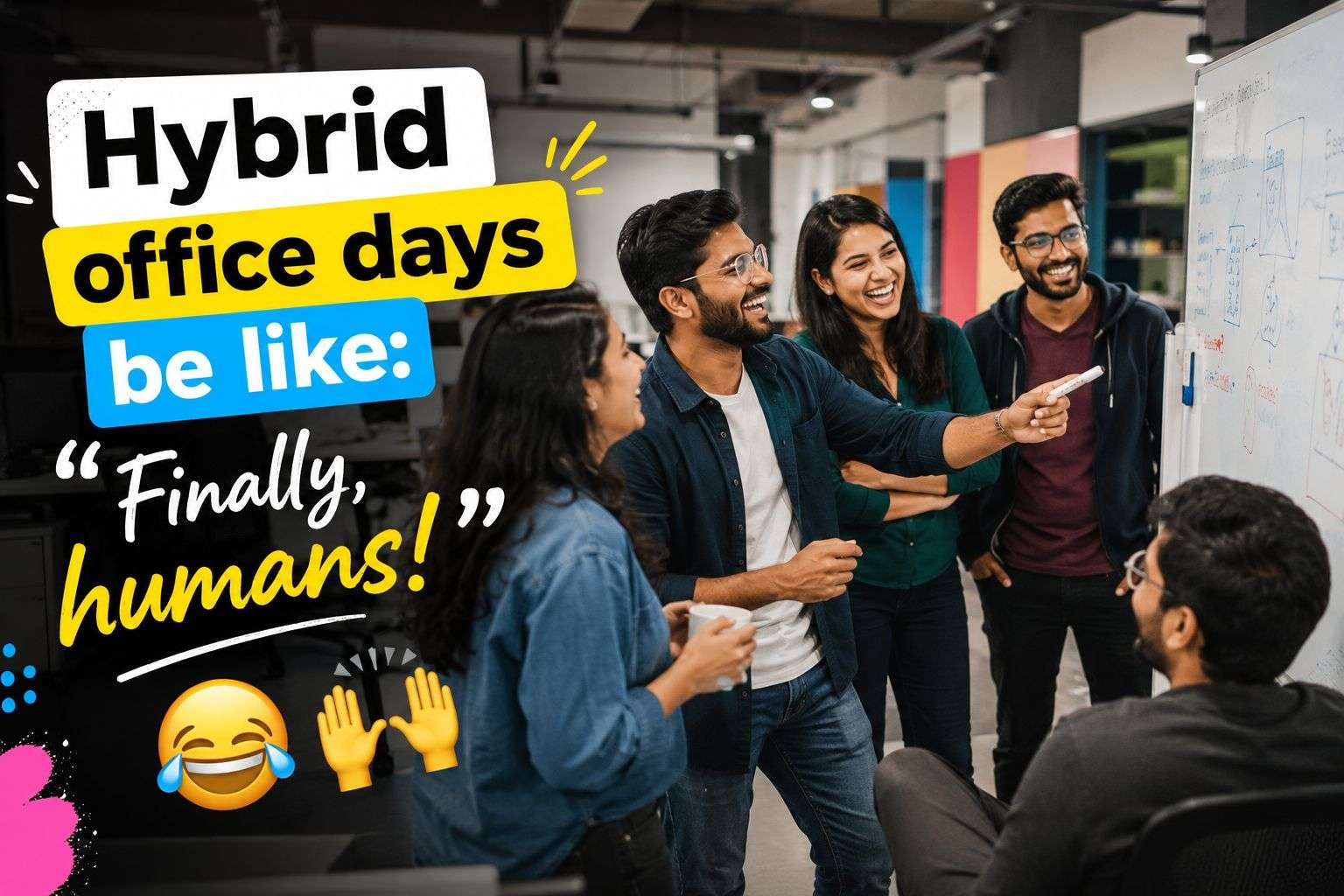
Hybrid work means you split your time between home and office. Some days remote. Some days on-site. The split varies by company. Some ask for two days in office. Some ask for three. A few ask for four and call it “hybrid” even though it is mostly office.
Full on-site means you come to office every day. Most IT companies in India had this as the default before 2020. Many still prefer it for freshers.
When a company says “hybrid,” always ask: how many days in office per week? What happens if I cannot commute? Is the office near where I will be staying? These questions matter more than the label.
Why This Decision Hits Freshers Harder Than Experienced People
Here is what experienced professionals do not tell you.
When you are a senior developer or a team lead with eight years of experience, you already know your job. You know the tools. You know how to communicate. You know how to solve problems independently. Remote work suits you because you carry your skills wherever you go.
When you are a fresher — this is a different game entirely.
You do not know what you do not know. You have gaps that only a good mentor, senior colleague, or spontaneous office conversation can fill. The real learning in your first year does not happen in training sessions. It happens when you overhear a senior fixing a bug. It happens when your team lead pulls you into a quick call and shows you how to think about a problem differently. It happens in the chai break, the lunch table, the corridor.
Remote work cuts all of that. You can still grow remotely. But you have to work twice as hard to create those learning moments yourself.
I am not saying remote is bad. I am saying remote and hybrid are not equal for freshers. And you need to know this before you choose.

Remote vs Hybrid Work for Freshers — The Real Pros and Cons
Let me be very direct here. No sugarcoating.
Remote Work — What You Actually Gain
You save money. No commute. No food expense at corporate canteens. No office-appropriate clothing budget. For a fresher earning ₹3–4 LPA in tier-2 Odisha, these savings are real and significant.
You get flexibility. You can work from your home town. You do not need to immediately relocate to Bengaluru or Hyderabad and pay ₹12,000 rent for a shared flat.
You build independence early. You learn to manage your own time. You learn to communicate well over text and video. These are skills the next generation of professionals will need.
You can apply to companies anywhere in India — or globally. A student from Berhampur can now work for a Bengaluru startup or a US company without relocating. This was not possible before 2020.
Remote Work — What You Actually Lose
Learning speed drops. Full stop. You have to seek out help. Nobody drops by your desk. Nobody spots you struggling with a problem.
Visibility suffers. Your manager cannot see you working hard. You must learn to communicate your work actively — updates, check-ins, visible outputs. Freshers who do not learn this early get overlooked during appraisals.
Loneliness is real. Sitting alone at home all day, every day, for months, it affects motivation and mental health. I have seen freshers quit good remote jobs within six months because of isolation.
Network building is near-zero. You do not make professional connections the same way. No office friends. No introductions. The informal network that gets you your next job barely exists.
Hybrid Work — What You Actually Gain
You get the best of both structures. Office days give you mentorship, collaboration, and visibility. Home days give you focus time and flexibility.
Learning is significantly faster in the first year. You absorb team culture. You pick up unwritten rules of the company. You learn by osmosis.
You build a professional network. You know people. People know you. Promotions and referrals flow through these connections more than through any resume.
You feel like part of a team. This matters more than people admit. Belonging to something gives energy and direction to your work.
Hybrid Work — What You Actually Lose
Commute cost and time. Office days mean travel expense and time. In cities like Bhubaneswar or Hyderabad, a one-way commute of 45 minutes to an hour is common.
Less flexibility. You cannot attend a family function or a college reunion without planning office days around it.
Hybrid can become “mostly office” without warning. Companies sometimes increase in-office days during projects or appraisal cycles. What started as two days a week becomes four.

What Indian IT Companies Are Actually Doing in 2026
Let me give you ground-level intelligence — not what HR says in the offer letter, but what is actually happening.
TCS, Infosys, Wipro, HCL, and Cognizant have all moved to primarily hybrid models. Most require three to four days in the office. Freshers joining these companies through campus placements are almost always on-site or hybrid. Pure remote is extremely rare in these companies for entry-level roles.
Mid-size IT service companies and Indian product startups are more split. Many genuinely offer hybrid with two days in office. Some product startups are fully remote, especially for roles like software development, QA, and data work.
Global MNCs and US-based companies hiring in India — companies like Atlassian, GitLab, Automattic — still operate fully remote. But getting into these as a fresher without experience is genuinely hard.
Edtech, fintech, and SaaS startups in Bengaluru and Hyderabad are the most hybrid-friendly for freshers. They often have smaller offices, smaller teams, and actually want you to come in regularly for the collaboration.
If you are from Odisha and applying to companies in Bhubaneswar or BBSR tech parks, most are hybrid. Fully remote entry-level roles are rare here but growing.
I am also seeing a trend among my students: they join a remote company, feel disconnected after four to six months, and come back asking how to switch to a hybrid setup. Remote sounds amazing until you live in it at 22, with no colleagues, no office rhythm, and no clear feedback on your growth.
The Career Growth Question Nobody Asks
Remote vs hybrid is not just about today’s comfort. It is about your career in 2028 and 2030.
Ask yourself this: in which setup will you learn faster? In which setup will you get noticed? In which setup will you build the relationships that get you promoted, referred, and given bigger opportunities?
For most freshers — the honest answer is hybrid.
The data backs this up too. Surveys across Indian IT companies consistently show that freshers in hybrid setups get promoted six to eight months earlier than fully remote peers in the same roles. Managers perceive remote freshers as competent but harder to assess. Hybrid freshers get more visibility, more mentoring, and more stretch assignments.
This does not mean you should take a poorly paying hybrid job over a well-paying remote one. Salary matters. Location matters. Company reputation matters.
But if two offers are comparable, choose the hybrid in your first two years.
After you know your domain. After you have built relationships. After you have proven yourself. Then, remote becomes something you can negotiate confidently.
How to Evaluate a Remote or Hybrid Offer — 7 Smart Questions to Ask
Before you say yes to any offer, ask the company these questions directly.
1. How many days a week are mandatory in the office? Get this in writing. “Flexible hybrid” can mean anything.
2. Is the in-office requirement fixed or project-dependent? Some companies call you in daily during project delivery sprints.
3. How does my manager provide feedback — weekly 1:1s, Slack messages, or quarterly reviews? For remote roles, clear feedback loops are non-negotiable. Without them, you are invisible.
4. Is there a structured onboarding for remote joiners? Many companies have terrible remote onboarding. You join, get a laptop, get a Teams account, and are left to figure it all out. That is a red flag.
5. Does the team have senior developers I can learn from? In a remote team of four where you are the only fresher, your learning will be slow and painful.
6. Can I visit the office when I want, even on non-mandatory days? The best hybrid companies let you come in more often if you want. That flexibility is valuable.
7. What is the policy on performance reviews — is remote treated equally? Some companies unconsciously favour on-site employees during appraisals. Know this before you join.

Remote vs Hybrid Work for Freshers — Action Steps by Your Stage
If you are in 3rd or 4th year BTech (Graduating 2026 or 2027)
Start learning tools that matter in both remote and hybrid environments. Learn Slack, Notion, Jira, Google Meet, and basic documentation habits. Companies watch how you collaborate online — even in internships and interviews.
Visit your campus placement cell and ask specifically which companies on the list are hybrid and which are remote. This data helps you prepare.
If you can get an internship at a hybrid company before graduation — take it. The network and visibility you build there will help you after joining.
If you are a fresh graduate actively applying right now
When you receive an offer, do not focus only on salary and role. Ask the seven questions listed above. Evaluate the company culture, team size, and whether there is a senior professional in your team who will mentor you.
If you are from Odisha and cannot relocate immediately, a remote or hybrid role with a Bhubaneswar or Cuttack office is ideal for your first year. You stay near home, you can go to the office occasionally, and you still build a local professional network.
Check out our guide on the Job Hunting Guide 2026 for Indian Graduates for specific application strategies that work in this market.
If you have been in a remote job for 6+ months and feeling stuck
This is a common situation. You joined a remote company. You are doing the work. But you feel invisible, disconnected, and unsure if you are growing.
First — set up a regular 1:1 with your manager. Ask for feedback explicitly. Create a weekly summary email or message showing what you completed that week. Visibility is your job now.
Second — join professional communities. LinkedIn groups, Discord servers for your tech stack, local Bhubaneswar or Odisha developer meetups. These replace the office water-cooler.
Third — if after 12 months you still feel stuck, consider switching to a hybrid company where your growth will accelerate.
Also read our post on Prompt Engineering for Freshers in India 2026 — it covers skills that make you more visible and valuable in any work setup.

What Rooman Technologies Courses Teach You That Matters Here
Whether you go remote or hybrid, your technical skills decide how fast you grow.
I run Rooman Technologies training programs in Odisha as their State Business Partner. Rooman is an NSDC-certified training partner and one of the best in India for industry-ready IT courses.
What I see consistently: students with structured, certified training adapt much faster to remote setups. They already know the tools, the workflows, and the discipline required. Students who only have college coursework often struggle in both models — not because of the work setup, but because of skill gaps.
If you are still in college or just graduated, this is the right time to close those gaps. Check our IT Training page to see what courses are available for you.
Also read our detailed post on Non-Coding Tech Jobs for BTech Freshers — some of the most remote-friendly roles are in non-coding areas like business analysis, technical writing, and QA.
Useful YouTube Resources on Remote vs Hybrid Work
These two videos will give you additional perspective from people who have studied this topic deeply:
📺 Companies Hiring Remotely in 2026 — What Freshers Need to Know https://www.youtube.com/watch?v=eQGY8QLizik
📺 The Rise of Remote and Hybrid Work — Trends, Benefits, and Future Insights https://www.youtube.com/watch?v=Dk4hXl_TeFM
External Resources Worth Reading
- LinkedIn’s 2026 Work Trends Report — good data on hybrid adoption across global companies
- TeamLease India Workforce Report — India-specific data on remote and hybrid trends in IT
- Naukri’s Hiring Insights Blog — tracks how Indian employers are advertising remote vs on-site roles

FAQs — Remote vs Hybrid Work for Freshers in India 2026
FAQ 1 — I got a fully remote offer with 30% higher salary than a hybrid offer. Which should I take as a fresher?
This is the most common dilemma I hear from students in Bhubaneswar right now. My answer is: it depends on what stage of learning you are in.
If the remote company is well-established, has good onboarding, gives you a clear manager, and has a team with at least two or three senior people — the salary premium is worth considering. A 30% salary difference over two years is significant money. It can fund certifications, courses, and even an MBA application later.
But if the remote company is a small 10-person startup where you will be one of two developers, with little structured mentorship — the higher salary will not compensate for the learning gap you accumulate. I have seen this pattern consistently: freshers who compromise learning for salary in their first job often plateau by year three. Freshers who invest in learning early reach ₹8–12 LPA by year three even starting at lower salaries.
Ask yourself: what will this job teach me in 12 months? That answer matters more than the CTC difference at this stage.
Consultant’s Note: First-year learning compounds. Salary differences in year one are temporary. Skill gaps from year one follow you for years.
FAQ 2 — My parents are not comfortable with me taking a remote job. They want me to go to a proper office. Is that a valid concern?
Yes, it is a completely valid concern — and honestly, it comes from a good place. Your parents’ instinct that “office” means “serious job” is not wrong for freshers.
Here is what I tell parents who ask me directly: a remote job is a real job. But for a 21-22 year old with no work experience, the office environment teaches discipline, professionalism, and team dynamics that are genuinely hard to replicate at home. The commute, the dress code, the meeting etiquette — these are not unnecessary formalities. They shape how you carry yourself as a professional.
A hybrid job is actually the best middle ground to propose to your parents. You go to office regularly. You come home some days. Your parents see you getting ready and heading out. And you get the flexibility benefits too. Present it as: “I work from office three days a week and from home twice.” That usually satisfies both sides.
Consultant’s Note: Family buy-in matters for your performance. If you are working remotely from a house where nobody understands why you are home all day, the friction affects your work quality.
FAQ 3 — What is the best city in Odisha for finding hybrid IT jobs right now?
Bhubaneswar is clearly number one. The Infocity area, Patia, and BBSR tech parks have a growing number of mid-size IT companies that operate on genuine hybrid models. Companies like Mindtree, Persistent Systems, and multiple NASSCOM-affiliated firms have delivery centres here.
Rourkela is emerging — especially for companies that need talent near the steel and manufacturing sectors. But the hybrid IT market there is smaller.
Cuttack has very limited IT hiring. Most students from Cuttack commute to Bhubaneswar.
For students graduating from colleges in Berhampur or Sambalpur, the practical reality is that you will likely need to relocate to Bhubaneswar or another metro for the first two to three years. Remote work can help you delay this relocation — but if career growth is the priority, the move to Bhubaneswar or beyond is eventually worth making.
Also check our post on Top Engineering Colleges of Odisha — it tracks placement data from colleges in each of these cities.
Consultant’s Note: City matters less than company quality. A good hybrid company in Bhubaneswar beats a mediocre on-site job in Bengaluru.
FAQ 4 — Is remote work genuinely equal to on-site in terms of salary and career growth in Indian IT?
Not yet — but it is moving in that direction. In 2026, most Indian IT companies pay the same CTC regardless of work location for the same role. Remote does not mean a discount on salary.
However, the appraisal outcomes are still not equal.
Multiple internal surveys from large IT companies in India show that remote employees at the fresher and junior level receive lower average ratings compared to hybrid employees doing the same work. The reason is not performance — it is visibility. Managers rate what they can observe.
A fresher who raises a good point in a physical meeting is remembered. A fresher who sends the same point over chat is often forgotten.
Until companies fully restructure their performance assessment systems — which a few global companies have done, but most Indian companies have not — this visibility gap exists. Plan for it. Be extra proactive in communication if you are remote.
Consultant’s Note: Equal salary does not mean equal trajectory. Manage your visibility actively if you choose remote.
FAQ 5 — How do I set up a good home office for remote work as a fresher in Odisha?
You do not need to spend a lot. Here is what actually matters.
A stable internet connection is non-negotiable. Get a 100 Mbps wired broadband connection if you can. Mobile data is unreliable for daily video calls. In Bhubaneswar and Cuttack, Airtel Xstream and JioFiber are both decent options. Budget roughly ₹600–₹900 per month.
A dedicated workspace matters more than people realise. Even if you live in a shared flat or your parents’ home — find one corner that is your “work zone.” Put a proper chair there. Keep your study table clear during work hours. The physical boundary helps your brain switch into work mode.
A decent webcam and headset make you look professional on calls. Your phone camera propped up works in a pinch. But if you are on video calls daily — a ₹1,500 clip-on webcam and a ₹800 wired headset are worth every rupee.
Good lighting. Just face a window. Natural light makes video calls look significantly more professional at zero cost.
Consultant’s Note: How you appear on a video call is how your remote manager knows you. It is your office appearance
FAQ 6 — Which tech roles are most suited for remote work as a fresher?
Some roles are genuinely better suited for remote than others. Software development — especially backend and frontend coding — translates well to remote because the output is measurable. You either wrote the code or you did not. QA testing and automation testing are also remote-friendly because the work is largely independent.
Content writing, technical writing, digital marketing, and SEO roles are among the most remote-friendly for freshers because output is highly visible and measurable.
On the other hand, roles like Business Analyst, Project Manager, Scrum Master, or Client-Facing Support are much harder to do well as a fresher in a remote setting. These roles depend heavily on reading room dynamics, building trust in real time, and informal communication — all of which are much easier in person or hybrid.
Data science and machine learning roles sit in the middle. The technical work is remote-friendly. But understanding business context — which data problems actually matter — is much easier when you are embedded in a team.
Consultant’s Note: Choose your first role carefully. Your role affects how remote-friendly your career is — not just your preference.
FAQ 7 — How do I negotiate for hybrid if the company is offering fully on-site?
Start by understanding their policy. Some companies have fixed rules. Others are flexible for the right candidate. If you have a strong profile — a good CGPA, a relevant internship, or a certification — you have more negotiation room than you think.
Do not negotiate this in the first round of salary discussion. Accept the offer. Join. Prove yourself in the first 60 to 90 days. Then make a specific, professional request: “I would like to discuss the possibility of working from home on Mondays and Fridays once I am fully onboarded. I believe I can be most productive with this structure.”
Have a plan ready for how you will maintain output and communication on remote days. Managers are much more willing to say yes when you answer their concerns before they ask them.
Consultant’s Note: Earn the flexibility. Do not demand it on day one.
FAQ 8 — What happens to remote and hybrid work in a recession or job market slowdown?
This is a sharp question and one I appreciate. History from 2023 and 2024 showed us clearly: when companies cut costs or tighten controls, remote work is the first policy to change. Amazon, Google, TCS, and others all pulled people back to office during uncertain periods.
Remote work as a policy is more fragile than it appears in the job description. Companies offer it when talent is scarce. They pull it back when they have leverage.
This does not mean you should not take remote roles. But it does mean: do not make major life decisions — like choosing a city to live in, committing to a long rent lease, or refusing to develop commute-ready habits — entirely based on a remote work policy. Build your career on skills, not on location policies.
Consultant’s Note: Build your skills so strong that companies want to accommodate you — remote, hybrid, or otherwise.
FAQ 9 — Should I mention my preference for remote or hybrid work in my resume or cover letter?
No. Not in your resume. A resume is not the place for work preference — it is a document about your skills and experience.
In your cover letter — maybe, if the company explicitly advertises remote or hybrid and you want to confirm alignment. Even then, keep it to one line: “I am comfortable with the hybrid structure mentioned in the job description.”
In interviews — do not raise this topic until the company brings it up, or until you are in the final negotiation round. Raising it too early signals that your priority is convenience, not contribution. Companies want freshers who are excited about the work first. Work setup is secondary.
Consultant’s Note: Ask about work culture, not work location. Culture includes the hybrid policy — but framing it that way sounds more professional.
FAQ 10 — My college in Odisha does not have strong placements. How does remote vs hybrid work affect my job search?
If your college placement cell is weak, you are already relying more on off-campus applications. Here remote work is actually a significant advantage for you.
Before 2020, a student from a tier-3 college in Berhampur had very limited options. They had to move to a metro, compete with well-connected students from tier-1 colleges, and often take whatever job they could find. Remote work has changed this. Today, a student from a lesser-known college with strong skills and a good portfolio can apply to companies across India — and get hired without relocating immediately.
This is a genuine equaliser. Use it. Build your GitHub profile. Get certified. Build a LinkedIn profile that shows what you can do. Apply to mid-size companies that hire remotely for development or testing roles. Companies like these care about your skills, not your college’s ranking.
Read our full guide on Job Hunting 2026 for Indian Graduates for a step-by-step plan tailored to this exact situation.
Consultant’s Note: Remote work has democratised access to good companies. A student from Koraput with the right skills can now work for a Bengaluru company without leaving home. Use this window while it is open.
My Final Word on Remote vs Hybrid Work for Freshers
Here is the truth, simply said.
Remote work is real. Hybrid work is real. Neither is “better” in absolute terms.
What matters is what stage you are at. What you need to learn. What kind of person are you? Whether you have the discipline to manage yourself without external structure.
For most freshers from Odisha that I counsel, I recommend a hybrid for the first two years. Learn the ropes. Build relationships. Get visible. Get promoted. Then negotiate remote work as a perk of your proven track record.
If you have already taken a remote job and are reading this, do not panic. Make the most of it. Be proactive. Create visibility. Seek feedback actively. Join communities outside work. You can build a strong career remotely — it just requires more deliberate effort than a hybrid.
And if you are still deciding, apply everywhere. Get multiple offers. Then use the questions in this blog to evaluate smartly.
If you need help with this decision, I am available for career counselling sessions. WhatsApp me at 9777278853 or visit Career Guru.