
Prompt Engineering for Freshers in India 2026 — A 27-Year IT Career Consultant Explains Why This Is the New Gateway Job (And What to Aim For After It)
Focus Keyword: prompt engineering for freshers
Prompt engineering for freshers is the most argued-about job title in Indian tech right now. Half the internet says it pays six figures in dollars. The other half says the job is already dead. Both sides are talking about the same three words and reaching completely different conclusions.
I get asked about this almost every week now. In my career counselling sessions in Bhubaneswar, in WhatsApp messages from students in Rourkela and Sambalpur, in calls from worried parents in Cuttack and Berhampur. Everyone has seen a reel. Nobody has seen a clear answer.
So let me give you one. After 27 years of watching IT job titles come and go — some real, some hype, some both at once — here is my honest take on prompt engineering for freshers in India in 2026. What it actually is. Whether it is dying. What it pays. And why do I keep calling it a gateway job and not a destination?
What Prompt Engineering Actually Means — In Plain Language
Prompt engineering means writing clear instructions for an AI model so it gives you the output you actually want. That is the whole idea. Nothing more mysterious than that.
When you type something into ChatGPT, Claude, or Gemini and get a vague, generic answer — that is usually a bad prompt. When you type something structured, with context, examples, and a clear goal, and the AI gives you exactly what you needed — that is prompt engineering working.
At a job level, prompt engineering for freshers usually means something more specific. It means designing prompts for a company’s AI product. Testing those prompts against real user inputs. Fixing prompts when the AI gives wrong or inconsistent answers. Working with developers to connect those prompts into apps, chatbots, and internal tools.
None of this requires you to build the AI model itself. You are not training neural networks from scratch. You are learning to communicate with one precisely, reliably, and at scale.
Is the “Prompt Engineer” Job Already Dying? Here Is My Honest Answer
I am not going to dodge this question, because every student asking me about prompt engineering for freshers has already read at least one article calling the role obsolete.
Here is what is actually happening. The standalone job title “Prompt Engineer” is genuinely shrinking on job boards. Companies are not posting as many roles with that exact title as they did in 2023. That part of the criticism is true.
But the skill behind that title has not disappeared. It has spread. Roles like AI Engineer, LLM Engineer, AI Workflow Designer, and Applied AI Engineer have grown fast in the same period — and every single one of them lists prompt design as a core requirement. The title changed. The actual work did not go away. It moved inside bigger job descriptions.
This is exactly why I call prompt engineering for freshers a gateway skill rather than a final career. It is not where you stay for ten years. It is how you get your foot into the AI side of the IT industry without first needing a machine learning degree.
Think of it like Excel twenty years ago. Nobody had a job called “Excel Engineer.” But knowing Excel well opened doors into finance, operations, and analytics roles that did not exist for people who could not use it. Prompt engineering for freshers in 2026 is playing a similar role for AI jobs.
Why I Call This the New Gateway Job for Freshers
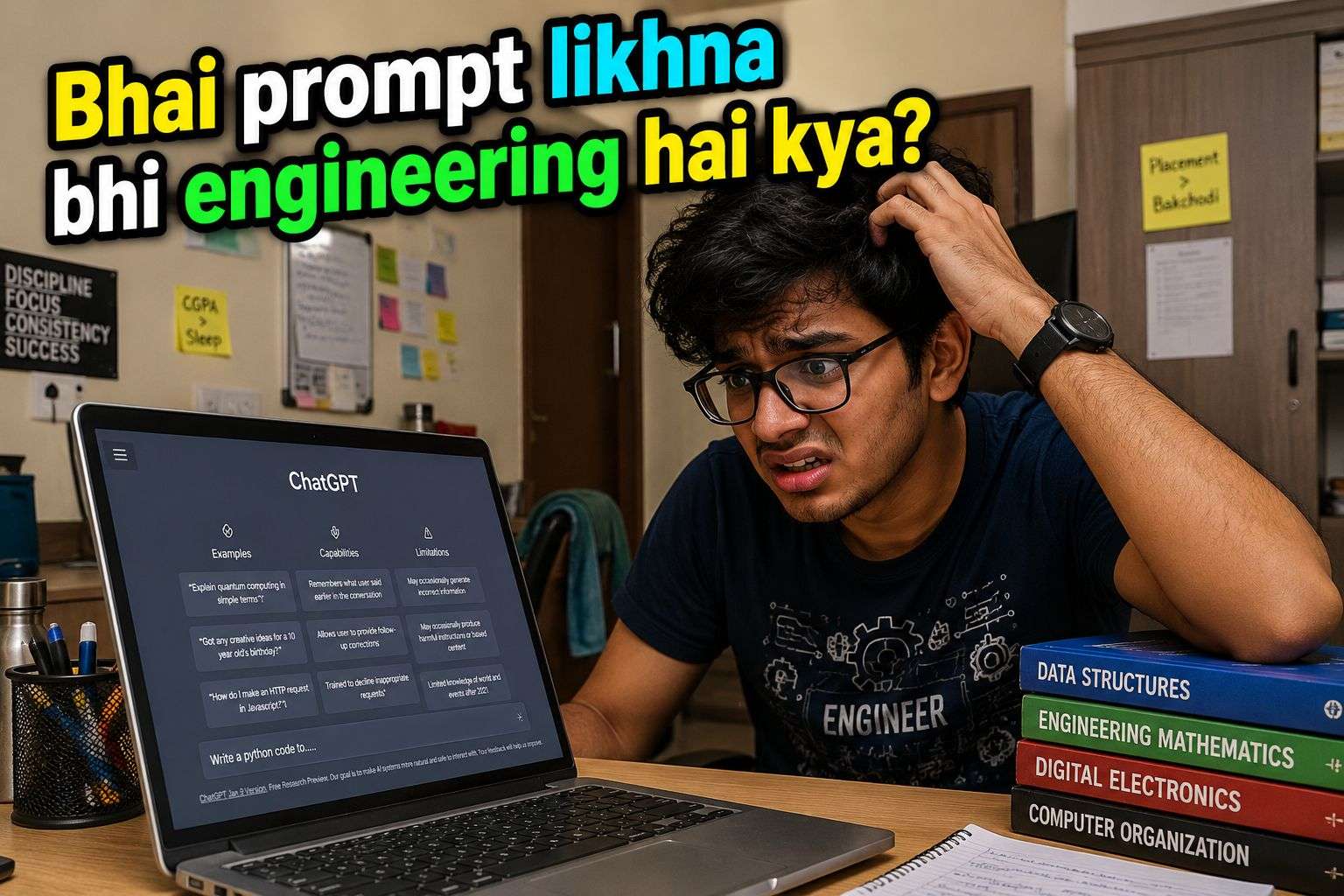
Most freshers I meet are choosing between two extremes. Either they go deep into traditional coding — Java, Python, DSA — for months before they touch anything AI-related. Or they jump straight into trying to become a “full AI engineer” with zero foundation and burn out in six weeks.
Prompt engineering for freshers sits in between, and that is exactly its value.
You do not need three years of machine learning theory to start. You need to understand how large language models behave, what kind of instructions confuse them, and how to test and refine your prompts methodically. That is learnable in weeks, not years.
Once you have that foundation, every door inside the AI world opens faster. Want to move into building RAG-based chatbots? You already understand how the model responds to context. Want to move into AI product roles? You already know how to evaluate AI output quality. Want to add coding later? Your prompting instinct makes your code-plus-AI workflows far stronger from day one.
That is the gateway. Prompt engineering for freshers is rarely the final job. It is the fastest, lowest-barrier entry point into the roles that actually pay well three to five years from now.
What Prompt Engineering Skills Actually Look Like — Stage by Stage

Stage 1 — Understand how LLMs actually think. Before writing a single clever prompt, understand the basics. What a token is. Why models sometimes “hallucinate” — confidently giving wrong answers. Why the same prompt can give different results on different days. This stage takes one to two weeks and saves you from months of confused guesswork later.
Stage 2 — Learn structured prompting techniques. Zero-shot prompting. Few-shot prompting, where you give the AI examples before asking your real question. Chain-of-thought prompting, where you ask the model to reason step by step. Role and persona prompting, where you tell the AI exactly who to act as. These four techniques alone solve most real-world prompting problems.
Stage 3 — Practise on real use cases, not toy examples. Write prompts for resume screening, customer support replies, content summarising, and code review feedback. Real business use cases force you to think about edge cases — vague user inputs, sensitive topics, and conflicting instructions — which is exactly what companies test for in interviews.
Stage 4 — Learn basic evaluation. This is the part most beginner courses skip, and it is the part that genuinely impresses Indian hiring managers in 2026. Learn to measure whether a prompt is actually working — accuracy, consistency, tone — rather than just feeling like it works. Even a simple spreadsheet comparing five prompt versions against ten test inputs shows real maturity.
Stage 5 — Add one technical layer. Learn basic Python, enough to call an AI model’s API and pass it your prompts programmatically. Learn the basics of RAG — Retrieval-Augmented Generation — where the AI pulls in your own documents before answering. This single addition is what separates a ₹4 LPA prompt-only profile from a ₹12 LPA hybrid profile.
Stage 6 — Build one complete portfolio project. A custom chatbot for a real use case — a college helpdesk bot, a placement FAQ bot, a resume feedback bot. Document your prompt iterations. Show what failed and what you changed. This single project, properly documented on GitHub, does more for your interview than any certificate alone.
What Prompt Engineering Roles Pay Freshers in India in 2026

Let me give you honest numbers, not the inflated figures that go viral on social media.
Standalone prompt-focused fresher roles — content-heavy, prompt-writing only, limited technical scope — typically pay ₹3.5 to ₹6 LPA in India. These exist mostly at AI-content startups, BPO-style AI support teams, and smaller product companies.
Hybrid fresher roles — prompt engineering combined with basic Python, API integration, and evaluation work — typically pay ₹6 to ₹10 LPA, sometimes touching ₹12 LPA at Bengaluru and Hyderabad-based product companies.
Roles that grow into Applied AI or AI Engineer titles within two to three years routinely reach ₹15 to ₹25 LPA and beyond, especially for freshers who added RAG, basic fine-tuning awareness, and evaluation frameworks early.
The pattern is consistent across every salary report I checked. Pure prompting alone plateaus early, somewhere around ₹10 to ₹15 LPA. Prompting combined with even basic coding and evaluation skills opens a completely different salary ceiling. This is the single most important fact in this entire blog. Read it twice if you need to.
🔗 Related Read: AI Recruiter Resume for Indian Freshers in 2026
Three Mistakes Freshers Make With Prompt Engineering

Mistake 1 — Putting “Prompt Engineer” as a standalone title with nothing else. Given everything I have explained above, this is a weak positioning choice in 2026. Frame your profile as “AI-enabled developer” or “AI Workflow Associate with prompt engineering skills” instead. Recruiters respond better to titles that signal range.
Mistake 2 — Collecting certificates without ever testing prompts on a real, messy problem. A certificate proves you watched videos. A documented project — with failed prompt attempts and what you changed — proves you can actually think. Indian interviewers in 2026 ask for the second thing, not the first.
Mistake 3 — Ignoring coding completely. I understand the appeal. Prompt engineering for freshers feels like an escape from DSA and coding rounds. But the data is unambiguous — coding plus prompting pays significantly more than prompting alone, at every experience level. Do not skip basic Python to avoid discomfort. It is the single highest-leverage skill you can add.
🔗 Related Read: Software Engineering in the AI Era — A 27-Year IT Career Consultant’s Honest Guide
Internal Links — Read These Next
- 📌 AI Recruiter Resume for Indian Freshers in 2026
- 📌 Software Engineering in the AI Era — A 27-Year IT Career Consultant’s Honest Guide
- 📌 Non-Coding Tech Jobs for Indian Freshers in 2026
- 📌 Top 5 In-Demand Skills for Freshers in 2026
- 📌 GitHub Profile Tips That Actually Get Indian Students Noticed by Recruiters
Free Resources to Actually Learn Prompt Engineering
I am not going to send you to a paid bootcamp first. Start with these.
🔗 Visit: ChatGPT Prompt Engineering for Developers — DeepLearning.AI — free, beginner-friendly, taught by Andrew Ng and OpenAI’s Isa Fulford.
🔗 Visit: Anthropic’s Prompt Engineering Documentation — written by the team building Claude. Technical, precise, and genuinely useful once you have the basics down.
🔗 Visit: Google Prompting Essentials — five-step framework, under ten hours, no prior experience required.
For hands-on, structured AI project work that goes beyond prompting alone — including RAG, chatbots, and real deployment — I also point my students toward Rooman Technologies’ Generative AI App Developer Internship, which builds exactly the hybrid profile this blog recommends.
Watch These — Verified, Beginner-Friendly Video Courses
🎥 Learn Prompt Engineering — Full Course (freeCodeCamp) — a clear one-hour walkthrough of prompting fundamentals, zero-shot and few-shot prompts, and AI hallucinations.
🎥 Learn Prompt Engineering: Full Beginner Crash Course (Zero To Mastery) — a deeper five-hour course covering how LLMs work internally, system messages, and applied prompting exercises.
FAQs — Prompt Engineering for Freshers in India 2026
FAQ 1 — Can a fresher with no coding background realistically start with prompt engineering?
Yes, and this is one of the genuine advantages of prompt engineering for freshers compared to most other tech entry points. The core skill is structured thinking and clear written communication, not programming. Students from ECE, Mechanical, Commerce, and even Arts backgrounds have built credible prompting portfolios with me over the past year.
That said, I will not pretend coding is irrelevant forever. The salary data is clear — prompting alone plateaus early. My honest advice is to start with zero coding, build confidence with prompting fundamentals for four to six weeks, and then add basic Python alongside it. You do not need coding to begin. You will eventually need some of it to grow.
Consultant’s note — I have watched non-CS students get their first AI-adjacent internship purely on strong prompting and a documented project, with zero lines of code. Every one of them added Python within their first year on the job, because the ceiling without it became obvious quickly. Start now. Add coding on the way, not as a precondition.
FAQ 2 — Is prompt engineering a good career choice, given all the talk about it being obsolete?
It depends entirely on how you define the career. If you mean a standalone job titled exactly “Prompt Engineer” for the next ten years, my honest answer is no — that specific title is shrinking and will likely keep shrinking. If you mean the underlying skill of writing precise instructions for AI systems, my answer is a confident yes — that skill is being absorbed into nearly every growing AI role in 2026.
Treat prompt engineering for freshers as your entry skill, not your destination title. Use it to get into companies and teams working on AI products. Once you are inside, let your title evolve naturally into AI Engineer, AI Product Associate, or Applied AI roles as you add more skills.
Consultant’s note — Students who panic about “is this job dying” usually miss the real point. Job titles in tech die constantly. Skills rarely do. The students who worried less about the title and focused on getting genuinely good at prompting are the ones now sitting in better-paying, more secure AI-adjacent roles.
FAQ 3 — What is the actual difference between prompt engineering and AI engineering?
Prompt engineering focuses narrowly on designing and refining the instructions given to an AI model to get reliable output.
AI engineering is broader — it includes prompt design, but also building the systems around the model, connecting APIs, managing data pipelines, handling RAG setups, and deploying the whole thing into a working product.
Think of prompt engineering as one specific skill inside a much bigger toolbox called AI engineering. Most fresher job descriptions in 2026 that mention “prompt engineering” are really describing a junior AI engineering role that happens to lean heavily on prompting in its early stages.
Consultant’s note — I tell students to stop asking “which one should I become.” Ask instead, “how do I move from prompt engineering toward AI engineering within eighteen months.” That question gets you a much better career trajectory than picking one label and freezing there.
FAQ 4 — Do I really need to learn Python for prompt engineering roles?
You do not need it to start. You will need it to grow. Many entry-level, content-focused prompting roles genuinely do not require Python on day one. But every salary report and every hybrid job description I have checked confirms the same pattern — adding basic Python and API skills roughly doubles your realistic salary ceiling within two to three years.
My specific advice — learn enough Python to read and slightly modify existing scripts, call an AI model’s API, and pass your prompts into that API programmatically. You do not need to become a software engineer. You need enough comfort to not be dependent on someone else for the technical layer.
Consultant’s note — I have seen students resist Python because they associate it with painful DSA rounds from their college days. Python for AI workflows is a completely different experience — practical, visual, and immediately rewarding. Give it three weeks before deciding you dislike it.
FAQ 5 — Which companies in India are actually hiring freshers for prompt engineering or AI-adjacent roles right now?
The honest pattern in 2026 is this — fewer companies are hiring with the exact title “Prompt Engineer,” and more are hiring for “AI Associate,” “GenAI Developer,” “AI Content Specialist,” or “Junior AI Engineer” roles that include prompting as a core skill. Indian product startups in Bengaluru, Hyderabad, and Pune lead this hiring. Large IT services companies are also building internal GenAI teams and recruiting freshers into them.
Search using broader terms than just “prompt engineer” when job hunting. Search “GenAI fresher,” “AI associate fresher,” and “LLM intern” as well. You will find significantly more genuine openings this way.
Consultant’s note — Students who search only for the exact phrase “prompt engineer” on job portals consistently tell me there are “no jobs.” Students who broaden their search terms find five times as many relevant openings within the same week. The jobs exist. The search habit needs updating.
FAQ 6 — How long does it realistically take a fresher to become job-ready in prompt engineering?
With consistent daily practice, six to eight weeks gets you genuinely employable for entry-level, prompting-focused roles. That includes understanding LLM fundamentals, mastering the core prompting techniques, and completing one documented project. Add another six to eight weeks if you are also picking up basic Python and API integration alongside it.
Students who rush this in under two weeks usually end up with surface-level knowledge that falls apart in technical interviews. Students who take six months without ever building anything also struggle, because they have theory without proof. Aim for steady progress with a real project by week eight.
Consultant’s note — The students who succeeded fastest in my counselling sessions were not the ones who studied the most hours. They were the ones who started building something real by week two, even badly, and kept improving it weekly instead of waiting to “finish learning” first
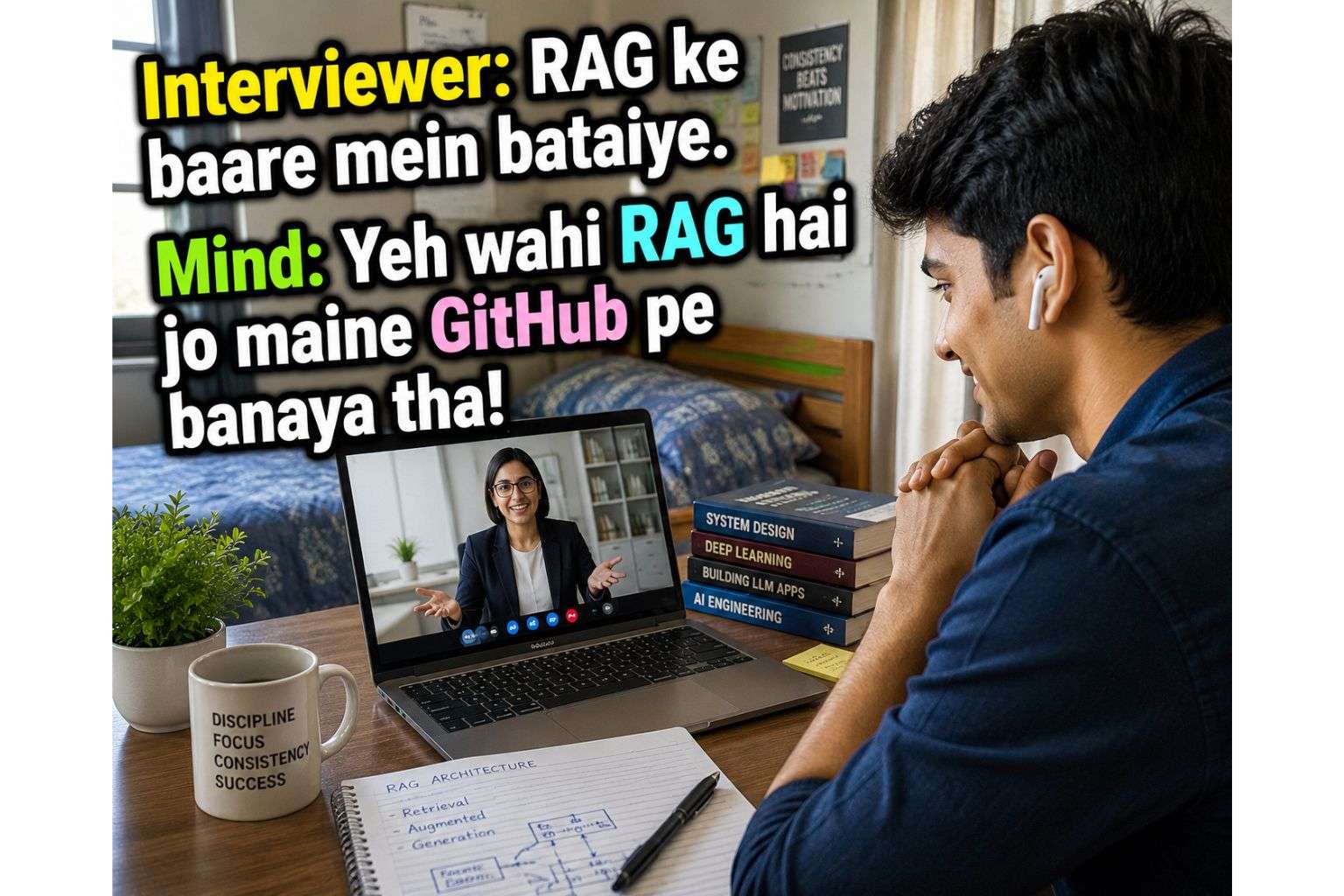
FAQ 7 — What is RAG and why does it matter for a prompt engineering fresher profile?
RAG stands for Retrieval-Augmented Generation. In plain language, it means the AI model first looks up relevant information from your own documents or database, and then uses that information to answer your question more accurately. Without RAG, an AI model can only answer from what it was trained on, which may be outdated or incomplete for your specific use case.
For freshers, even a basic understanding of RAG is a genuine differentiator. It shows you understand how real companies actually use AI in production — connected to their own data — rather than only knowing how to chat with a general-purpose AI tool. Building one small RAG-based project, even something simple like a chatbot that answers questions from your own college’s placement brochure, demonstrates this clearly.
Consultant’s note — I have seen a single small RAG project change how seriously an interviewer takes a fresher’s profile. It signals you have gone slightly beyond what every other ChatGPT user already knows. That small gap matters enormously at the fresher level.
FAQ 8 — Should I literally put “Prompt Engineer” as my job title on LinkedIn and my resume?
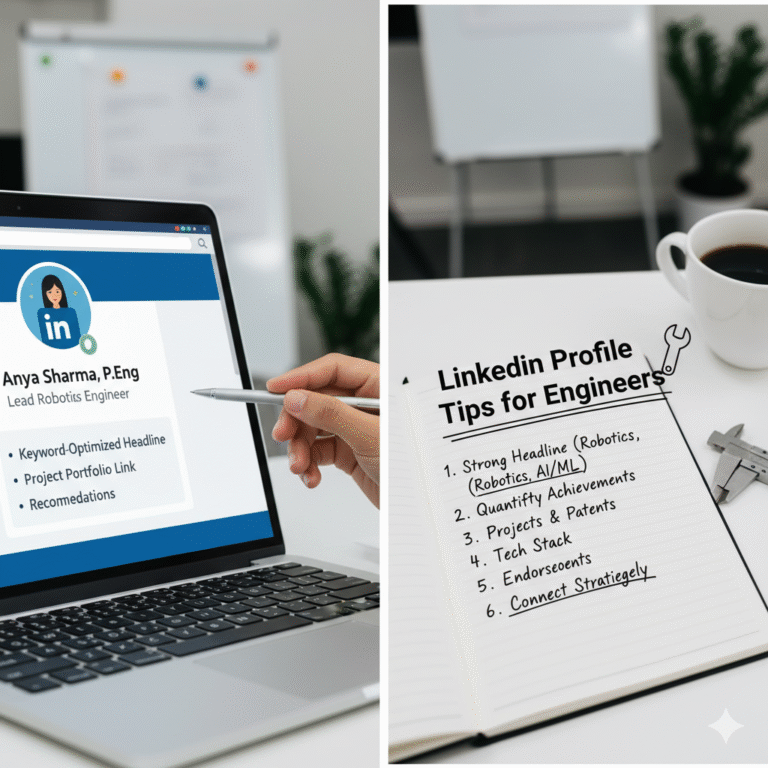
I would avoid making it your primary headline title in 2026, for the exact reasons discussed earlier in this blog. Instead, use it as a skill, not a title. A stronger headline reads something like “Aspiring AI Engineer | Prompt Engineering, Python, RAG” rather than just “Prompt Engineer.”
This framing signals range to recruiters without abandoning the genuine skill you have built. It also future-proofs your profile as the standalone title continues shrinking on job boards while the underlying skill keeps growing in demand inside other titles.
Consultant’s note — Resumes that lead with a single narrow title age badly in fast-moving fields like this one. Resumes that lead with a direction and a skill set age much better, because they do not need rewriting every time the market’s favourite job title changes.
FAQ 9 — Can students from Odisha and other tier-2 Indian cities realistically access these AI roles, or is this only happening in Bengaluru?
Most current hiring activity is concentrated in Bengaluru, Hyderabad, and Pune, and I will not pretend otherwise. But the genuine advantage of prompt engineering for freshers is that almost all of the learning, practice, and even many of the roles themselves are remote-friendly. You do not need to physically be in a metro to learn this skill or to apply for many of these positions.
What you do need from a tier-2 city like Bhubaneswar, Rourkela, or Sambalpur is a stronger, more visible portfolio, since you will not have the in-person networking advantage that metro students sometimes get. A well-documented GitHub project and a clear LinkedIn presence matter more for you, not less.
Consultant’s note — I have placed students from Odisha into remote AI-adjacent roles purely on the strength of their documented projects, without ever stepping into a Bengaluru office. Location matters less here than in almost any other IT career path I have guided students through in 27 years.
FAQ 10 — What does the realistic salary growth path look like after starting as a fresher in prompt engineering?
The honest path splits into two directions after your first one to two years. If you stay purely prompt-focused without adding coding or evaluation skills, your salary tends to plateau around ₹10 to ₹15 LPA, even with several years of experience. If you add Python, API integration, RAG, and basic evaluation frameworks, your role naturally evolves into Applied AI Engineer or AI Engineer territory, with realistic salaries of ₹20 to ₹40 LPA or more within three to five years.
The decision point usually comes around month twelve to eighteen. That is when I tell every student to consciously choose to add the technical layer rather than coasting on prompting skills alone.
Consultant’s note — I tell this to every student the same way. Prompt engineering for freshers gets you in the door fast. What you do in your first eighteen months inside that door decides whether you are still there, doing the same work, five years from now — or whether you have grown into something that pays significantly more.
What to Do This Week — Your Prompt Engineering Action Plan
Whatever year of college you are in right now, here is exactly what moves you forward this week.
If you are in first or second year — Open ChatGPT or Claude today. Pick one real task – summarising a textbook chapter, drafting an email – and try writing three different versions of your prompt for it. Notice how the output changes. That single exercise teaches you more than an hour of reading about prompt engineering theory. Then start the free DeepLearning.AI course and complete the first lesson before you close your laptop.
If you are in third year — Commit to the six-to-eight-week plan from this blog. Start with prompting fundamentals this week. Pick one small project idea — a chatbot, a content generator, a resume reviewer — and begin building it, even badly, by next week. Document every version of your prompts as you go, including the ones that failed.
If you are in final year — Your priority is a portfolio project you can show in an interview, this month, not eventually. If you already know prompting basics, add one RAG component to your project this week. If you are starting from zero, complete the freeCodeCamp video course this weekend and have your first working prompt-based project by the end of next week.
Prompt engineering for freshers is not a finish line. It is a door. Walk through it with a clear head about where you are actually heading, and you will be far ahead of students who are still arguing online about whether this job is real.
Want a clear roadmap on AI careers beyond prompting? Read our guides on Software Engineering in the AI Era and Non-Coding Tech Jobs for Indian Freshers in 2026 to see how prompt engineering connects to the wider AI job landscape in India.





2 Comments