
Job Hunting Guide 2026 for Indian Graduates — What a 27-Year Career Consultant Wants You to Know.
This job hunting guide 2026 exists because too many BTech and college graduates are doing everything they were told to do and still hearing nothing back.
They update their resume. They apply on Naukri. They wait. Nothing happens. Then they apply again. Still nothing.
I have sat across the table from thousands of students in Bhubaneswar, Rourkela, Cuttack, and Sambalpur over 27 years. The pattern repeats every single placement season. Bright students. Decent marks. Zero job offers. Not because they lack talent. Because nobody ever showed them how job hunting actually works in 2026.
This year is different from any year before it. AI is screening resumes before a human even opens them. Companies are hiring fewer freshers in bulk and more freshers who can prove they are ready. Layoffs in big tech names have made headlines, even as top IT firms like TCS, Infosys, HCLTech, and Wipro plan to onboard 82,000 graduates in FY2026, which tells you fresher hiring has not stopped. It has simply become more selective.
So this job hunting guide 2026 is not a list of tips you have already read somewhere else. It is the honest, step-by-step process I walk my own students through — the one that gets them shortlisted, interviewed, and hired.
Why Job Hunting in 2026 Feels Harder Than It Did Two Years Ago
Let me be honest with you about what is actually happening in the market right now, because most students are job hunting with outdated assumptions.
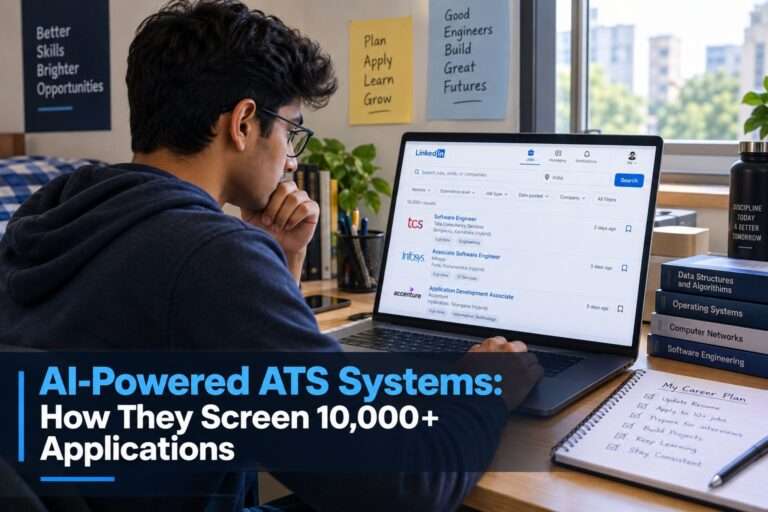
First, AI is the new gatekeeper. Most mid-size and large companies now use software that scans your resume before any human sees it. If your resume is not built for that scan, you are invisible. I have written in detail about this in my guide on the AI recruiter resume for Indian freshers, and the short version is this: keywords and structure matter more than design.
Second, the hiring funnel has narrowed. Industry trackers are reporting that nearly 40% of IT hiring in late FY26 is replacement hiring rather than fresh expansion, which means companies are filling seats left by people who quit, not necessarily creating brand-new roles. This matters because it changes how you should target your applications — broad and generic no longer works.
Third, skills are beating degrees. NASSCOM’s data shows Indian IT companies are increasingly accepting certifications and verified skills in place of specific degree requirements. This is good news for you if you build the right proof of skill. It is bad news if you are relying only on your college name.
None of this means the door is closed. It means the door has a different shape now. This job hunting guide 2026 is built around that shape.
Step 1 — Fix Your Resume Before You Apply to Anything Else
I see students apply to 50 companies with a resume that was never going to get past the first filter. That is 50 wasted applications.
Your resume in 2026 needs to do two jobs at once. It needs to pass the AI screening software. And it needs to convince a human recruiter in under ten seconds that you are worth a call.
For the AI part — use the exact keywords from the job description. If the posting says “Java, Spring Boot, REST API,” those exact words need to appear in your resume, not just synonyms. Keep your formatting simple. No fancy tables, no graphics, no text boxes. These often break when scanned by parsing software and your resume gets rejected before a human ever reads it.
For the human part — lead with outcomes, not duties. “Built a hostel management system using Java and MySQL, used by 200 students” tells a recruiter far more than “Worked on a project using Java.” Numbers, even small ones, make your resume believable.
I have broken this down in much more depth in my dedicated guide on the AI recruiter resume for Indian freshers in 2026—read that before you send out your next application. This short video on resume formatting for freshers is also a useful watch if you want to see the layout in action.
Step 2 — Build a LinkedIn Profile That Works While You Sleep
Most students treat LinkedIn like a digital certificate wall. A profile photo, college name, and nothing else.
That is a missed opportunity. Recruiters in India search LinkedIn actively for candidates, especially for roles that are never even posted publicly. A complete, keyword-rich profile gets found. A half-filled one does not exist as far as recruiters are concerned.
Your headline should say what you do, not just your college status. Instead of “Student at XYZ College,” try something like “Aspiring Java Developer | DSA, Spring Boot, MySQL | Open to Fresher Roles.” This single change makes you searchable.
Your About section should read like a short, honest pitch. What are you learning. What have you built. What kind of role are you looking for. Keep your sentences short. Recruiters skim, they do not read essays.
I go through this entire process — photo, headline, About section, skills section — in my dedicated post on LinkedIn profile building for freshers in India. If you prefer watching over reading, this video on building a LinkedIn profile as a beginner in 2026 walks through the exact same steps visually.
Step 3 — Build Proof, Not Just Claims
Anyone can write “good at coding” on a resume. Almost nobody can prove it. That gap is exactly where you can stand out.
If you are from a technical background, your GitHub profile is your proof. Three real, working projects with clear descriptions are worth more than ten half-finished ones with no explanation. I have written a full breakdown in my GitHub profile tips for Indian students guide — it covers exactly what recruiters look for in those sixty seconds before they decide to call you.
If you are from a non-technical background — commerce, arts, or a non-CS engineering branch — your proof looks different. A small Excel dashboard, a sample marketing campaign you built for a fictional brand, a mock financial model. Anything that shows you can apply what you claim to know.
This single step — building real, visible proof — is the difference between a resume that says you can do something and a portfolio that shows it.
Step 4 — Apply Smart, Not Just Often
Sending the same resume to 200 jobs a day is not a strategy. It is panic disguised as effort.
Instead, build a shortlist. Identify fifteen to twenty companies that genuinely hire freshers in your target role and location. My breakdown of the top IT companies in India hiring freshers in 2026 is a good starting point if you have not picked your target list yet.
Use multiple channels for each company. Apply on their careers page. Apply on Naukri. Search for the hiring manager or recruiter on LinkedIn and send a short, polite message. Most students only use one channel and wonder why nothing moves.
Government platforms are also worth bookmarking. The National Career Service portal run by the Ministry of Labour and Employment lists verified openings, especially useful if you are also considering public sector or PSU roles alongside private companies. And for sheer volume of private sector listings, Naukri.com remains the largest fresher-focused job board in India — use its filters properly instead of scrolling endlessly.
Track every application in a simple spreadsheet. Company name, role, date applied, channel used, status. This sounds basic. Almost nobody does it. The students who do this consistently get better at noticing what is actually working.
Step 5 — Network Like It Is Your Job, Because It Is
Cold applications get you into a pile of hundreds. A referral gets you into a conversation.
Reach out to seniors from your college who are already working. A short, specific message works better than a vague one. Do not write “please help me get a job.” Write something like “I saw you work at Infosys — could I ask you two quick questions about how the BPO to tech transition went for you?”
Attend any placement drive, job fair, or industry session your college or local training partner organises, even if the company is not your first choice. Every conversation is practice, and sometimes the company you were not excited about turns out to be the one that hires you fastest.
If your district or city has a Rooman Technologies centre or similar NSDC-backed skilling partner, their placement cells often have direct company tie-ups that individual students cannot access on their own. I work closely with Rooman Technologies as their state business partner here in Odisha, and I have watched their placement network open doors for students who could not get a single interview call on their own.
Step 6 — Walk Into the Interview Prepared, Not Just Hopeful
Getting the interview call is half the battle. What happens in that room — or that video call — decides the rest.
Research the company before you walk in. Know what they do, who their clients are, and why you specifically want to work there. “I want a job” is not an answer that gets you hired. “I want to work on your fintech product because I built a small expense tracker app myself” is.
Practice answering “Tell me about yourself” in under ninety seconds. This single question trips up more freshers than any technical round. Keep it structured — your background, your key skill, one project, and why you are excited about this role.
Prepare two or three questions to ask the interviewer at the end. It shows genuine interest, not just desperation for any job.
And whatever the outcome, send a short thank-you message afterwards. It is a small gesture that almost nobody does, and it keeps you memorable.
Know Your Worth Before You Negotiate
Many freshers accept the first number offered because they are afraid of losing the offer entirely. Some negotiation room almost always exists, but only if you know the realistic range for your role and city.
I have laid out detailed, current salary bands for different fresher roles in my fresher salary in India 2026 guide. Read it before your offer letter arrives, not after, so you walk into that conversation with real numbers instead of guesses.
Three Mistakes That Quietly Sabotage a Job Hunt
Mistake 1 — Applying everywhere with the same resume. A generic resume gets a generic outcome — no response. Tailor your top three to five skills to each specific job description.
Mistake 2 — Going silent after rejection. One rejection is not a verdict on your future. The students who keep applying, keep improving their resume slightly each week, and keep practising interviews are the ones who get hired by month three or four, not month one.
Mistake 3 — Ignoring tier-2 and tier-3 city openings. Smaller tech hubs outside the traditional metro corridors are now seeing real hiring growth as companies expand beyond saturated cities. If you are based in Odisha or similar regions, do not assume every good job is only in Bengaluru or Pune.

Your Job Hunting Action Plan — By Year
If you are in first or second year, Do not wait until placements to start. Open a LinkedIn account today if you do not already have one. Start one small project, even a basic one, and put it on GitHub. This early head start makes your third and final year significantly less stressful.
If you are in third year — This is your skill-building window. Pick one or two roles you are genuinely interested in and start preparing specifically for them. Fix your resume now, not in November of final year. Apply for internships actively — they are often the fastest route into a full-time offer at the same company.
If you are in final year, treat job hunting like a daily task, not an occasional one. Apply to five to ten well-matched roles every single day across multiple channels. Practice interview answers out loud, not just in your head. Keep your spreadsheet updated and review it weekly to see what channel is actually getting you responses.
If you have already graduated and are still searching, You are not behind. Many strong professionals took six months to a year to land their first role. Use this time to add one visible skill or certification; keep your LinkedIn active with small posts about what you are learning, and keep applying with the steps in this job hunting guide 2026.
Internal Links — Read These Next
- 📌 AI Recruiter Resume for Indian Freshers in 2026
- 📌 GitHub Profile Tips That Actually Get Indian Students Noticed
- 📌 LinkedIn Profile for Freshers in India 2026
- 📌 Top 10 IT Companies in India Hiring Freshers in 2026
- 📌 Fresher Salary in India 2026
FAQs — Job Hunting Guide 2026 for Indian Graduates
FAQ 1 — How long does job hunting usually take for a fresher in India in 2026?
This is the question that causes the most anxiety, so let me answer it honestly. Most freshers I counsel take between two and six months to land their first offer, assuming they are applying consistently and improving their approach along the way.
Students who apply randomly with no strategy often take much longer, sometimes a year or more, not because they lack ability but because they keep repeating the same mistakes without realising it.
The job hunting guide 2026 approach – fixing your resume, building proof, networking, and applying smart – typically shortens this window because it removes the silent rejections that happen before a human ever reviews your application. If you are in your third month of searching with zero interview calls, that is the signal to revisit your resume and LinkedIn profile rather than simply applying to more companies. Speed comes from the quality of approach, not the volume of applications. I have watched students go from zero responses to three interview calls in two weeks simply by rewriting their résumés properly. Patience matters, but so does honest self-assessment of what might be going wrong.
Consultant’s note — If you have sent out fifty applications with no response, the problem is rarely bad luck. It is almost always the resume or the targeting. Fix the input before you increase the volume.
FAQ 2 — Should I apply only for jobs that exactly match my degree, or can I apply more broadly?
Many students box themselves into roles that match their degree title exactly, and this unnecessarily limits their options. A mechanical engineering graduate can absolutely move into IT support, data analytics, or even software roles with the right additional skill building, and I have guided several through exactly this transition.
What matters far more to most recruiters in 2026 than your degree title is whether you can demonstrate the specific skill the role requires. That said, broadly applying without any skill preparation is not the same as smart applying — you still need to build the relevant proof before you target a role outside your core degree.
The honest middle path is this: apply for roles closely matched to your degree as your primary channel, and simultaneously build one adjacent skill that opens a second door. This dual approach gives you more shots without spreading your preparation too thin. Students who try to prepare for five completely different fields at once usually end up mediocre in all of them rather than strong in one.
Consultant’s note — Pick one primary direction and one realistic backup. Trying to keep every door open often means walking through none of them.
FAQ 3 — Is it worth paying for a placement guarantee course, or can I do this entirely on my own?
This depends heavily on your starting point and your access to structured guidance. If you already have strong fundamentals, disciplined self-study habits, and a network that can guide you, you can absolutely build your job hunting process on your own using free resources and guides like this one. However, many students in tier-2 cities do not have access to mentors who have actually worked in IT hiring, and that gap is exactly where a structured programme earns its value. A genuine placement-linked programme should offer real employer tie-ups, not just training content you could find online for free.
I always tell students to ask specific questions before paying for any course — how many of last year’s batch were actually placed, in what roles, and at what salary. Programmes through NSDC-backed partners like Rooman Technologies, where outcomes are tracked and tied to government skilling missions, tend to be more accountable than informal online bootcamps with vague promises. The right programme accelerates a process you could technically do alone, but it does not replace your own effort.
Consultant’s note — Pay for access and accountability, not for content you could find for free. Ask for placement numbers before you ask for the fee structure.
FAQ 4 — How many companies should I apply to per week to job hunt effectively?
There is no single magic number, but I generally guide students toward thirty to fifty well-targeted applications per month rather than hundreds of generic ones. Quality of targeting matters more than raw volume, because a poorly matched application wastes both your time and the recruiter’s attention.
A more useful way to think about this is in terms of effort distribution — spend real time tailoring your top ten to fifteen target companies each month, and use a faster, slightly more general approach for the rest. Final year students closer to placement deadlines can reasonably push toward five to ten applications a day during peak season, since time pressure is real. What matters most is consistency over weeks, not a single burst of fifty applications followed by silence for a month. Track your numbers weekly so you can see honestly whether you are actually maintaining the pace you think you are.
Consultant’s note — Consistency beats intensity. Ten well-matched applications every week for two months will usually outperform a hundred applications sent in one panicked weekend.
FAQ 5 — What if I have gaps in my resume, like a backlog or a study break?
Gaps and backlogs feel much larger to students than they actually do to most recruiters, especially in 2026 when skill-based hiring has become the norm. The honest approach works best – do not try to hide a gap or backlog, because it usually comes up in conversation anyway, and dishonesty damages trust permanently.
Instead, be ready to explain it briefly and pivot quickly to what you did during or after that period to improve yourself. A recruiter is far less interested in why you had a gap than in what you have done since to demonstrate readiness.
If your gap is recent, use the time before your next interview to add one visible piece of proof — a course completion, a small project, or anything that shows forward movement. Confidence in how you discuss it matters more than the gap itself. I have placed many students with backlogs and study breaks once their resumes showed clear progress afterwards.
Consultant’s note — Own the gap in one sentence, then spend the rest of the conversation on what you built afterwards. Dwelling on the explanation only makes it feel bigger than it is.
FAQ 6 — Are walk-in interviews still worth attending in 2026, or should I focus only on online applications?
Walk-in interviews remain genuinely useful, particularly for IT services companies and BPO-to-IT transition roles that still recruit in volume through this format. The advantage of a walk-in is speed — you often get feedback and sometimes even an offer within the same day, compared to weeks of waiting after an online application.
The disadvantage is that walk-ins can attract very large crowds, so preparation matters even more to stand out quickly in a short interaction. My honest advice is to treat walk-ins as one channel among several, not your only strategy. Combine them with online applications, LinkedIn outreach, and referrals so you are not dependent on any single method.
Dress professionally; carry multiple printed copies of your resume, and arrive early, because the energy and organisation of the queue itself often become part of how recruiters judge candidates informally.
Consultant’s note — Walk-ins reward people who show up prepared and calm. Most candidates show up tired and irritable after standing in line for hours, and that visibly affects their interview performance.
FAQ 7 — How important is my college’s brand name in this job hunting guide 2026 approach?
College brand still matters at the very top end of hiring — certain product companies and elite recruiters do filter heavily by institute tier. But for the vast majority of IT services companies, GCCs, and mid-size product companies that hire the bulk of India’s freshers, demonstrated skill is closing this gap faster than most students realise.
NASSCOM’s own data shows the majority of Indian tech firms now prioritise demonstrated skills over formal qualifications for entry-level hiring, which is genuinely good news if your college is not a well-known name. What this means practically is that your resume, your GitHub or project portfolio, and your interview performance now carry more weight than they did even five years ago.
Students from tier-2 city colleges in Odisha that I have mentored have been placed at strong companies purely on the strength of their skill proof and interview preparation. The brand name opens slightly more doors at the very top tier, but it does not close the door everywhere else, and that gap is shrinking every year.
Consultant’s note — I have placed students from small Odisha colleges into roles that classmates from bigger-name institutes did not get, simply because the smaller-college student had a stronger project portfolio and clearer interview answers.
FAQ 8 — Should I accept the first job offer I get, even if it is not my dream role?
In most cases, yes, especially if this is your very first offer and you have been searching for more than two or three months. A first job gives you income, experience, and most importantly, a current employment status that itself makes you more attractive to other recruiters later. It is far easier to move from one job to a better one than to move from zero jobs to your dream role directly. That said, do a basic sanity check before accepting anything — confirm the company is genuine, the offer letter has clear terms, and the role does not involve unreasonable bonds or unclear payment structures. If you already have multiple offers, then it becomes reasonable to compare and choose more selectively. But waiting indefinitely for a perfect first role while turning down genuine offers is a pattern I have seen backfire on students more often than it has paid off.
Consultant’s note — Your first job is a stepping stone, not a life sentence. Get into the system, build real experience for twelve to eighteen months, then make your next move from a position of strength.
FAQ 9 — How do I handle multiple interview rejections without losing motivation?
Rejection fatigue is real, and I have seen it derail otherwise capable students more than any actual skill gap. The first thing I tell students is to separate the outcome from their self-worth — a rejection reflects a mismatch for that specific role at that specific time, not a verdict on your overall ability. Build a simple habit of asking for feedback after a rejection where possible; even a short response from a recruiter can reveal a pattern you were not aware of, like communication clarity or a specific technical gap.
Take short, deliberate breaks between intense application pushes rather than grinding nonstop, because burnout quietly reduces your interview performance even when you do not notice it happening. Talk to someone — a mentor, a senior, a career counsellor, or even peers going through the same search — because isolation tends to make rejection feel far heavier than it actually is. Most successful job seekers I have worked with faced ten or more rejections before their first real offer, and almost none of them remember those rejections clearly a year later.
Consultant’s note — I tell every student the same thing after a tough rejection. This one no does not erase your effort. It just means this particular door was not the right one. Keep walking toward the next.
FAQ 10 — Is it too late to start this job hunting guide 2026 process if I am already a few months into searching with no results?
it is genuinely not too late, and this is one of the most common situations I see corrected successfully. Months of unsuccessful searching usually mean something specific is broken in the process — most often the resume, the targeting, or the interview preparation — not that the person is unemployable. The right move at this stage is to pause the constant applying for a short period and audit your entire approach honestly using the steps in this job hunting guide 2026, starting with your résumé and LinkedIn profile.
Many students see their first positive response within two to three weeks of fixing these foundational pieces, even after months of silence beforehand. Treat the time already spent as data, not as wasted effort — it tells you clearly what has not been working, which is valuable information going forward. The students who eventually get hired are rarely the ones who never struggled. They are the ones who adjusted their approach instead of repeating the same steps and hoping for a different result.
Consultant’s note — A stalled job search is not a dead end. It is a signal to change one specific thing, not everything at once. Fix the resume first, then the profile, then the targeting, in that order.

Building your job hunting toolkit? Read AI Recruiter Resume for Indian Freshers in 2026 and Top 10 IT Companies in India Hiring Freshers in 2026 next to put this guide into action.




5 Comments