

Cloud Computing Career Roadmap for Indian Students in 2026 — AWS Azure or Google Cloud and How to Get Your First Role
Follow the real cloud computing career roadmap for Indian students in 2026. A 27-year IT career consultant explains what to learn, which platform to start with and how to get hired.
Cloud Computing Career Roadmap for Indian students 2026 — The Career Path That Is Growing Faster Than India Can Fill It
Cloud computing career roadmap India 2026 is a phrase more Indian students need to be searching — because the opportunity it leads to is one of the most significant in the entire IT sector right now.
Here is the number that should make you sit up straight.
India’s cloud computing sector is facing a projected demand-supply mismatch of up to 60 percent, according to industry data — meaning for every ten cloud roles companies need to fill, workforce supply is falling well short. Companies across every industry — banking, healthcare, retail, manufacturing, government — are moving their entire technology infrastructure to the cloud.”
Link “industry data” to the Tribune article.
India’s cloud computing sector is facing a projected demand-supply mismatch of up to 60 percent, according to industry data — meaning for every ten cloud roles companies need to fill, workforce supply is falling well short. Companies across every industry — banking, healthcare, retail, manufacturing, government — are moving their entire technology infrastructure to the cloud.”
India is expected to face a shortage of over 2 million cloud computing professionals by 2027. Companies across every industry — banking, healthcare, retail, manufacturing, government — are moving their entire technology infrastructure to the cloud. Every single one of them needs people who understand how cloud platforms work, how to build on them, and how to keep them running securely and efficiently.
The demand is not coming. It is already here. Right now. In 2026.
And yet when I ask students in my career counselling sessions whether they are preparing for cloud computing roles the answer is almost always the same. They have heard of AWS. They know cloud computing is important. They may have watched a few YouTube videos. But they have not followed a structured preparation path because nobody has shown them one that is clear, honest, and specifically built for an Indian fresher in 2026.
After 27 years as an IT career consultant — watching technology waves arrive and reshape India’s IT hiring landscape — I can tell you with confidence that cloud computing is one of the most significant career opportunities available to Indian students right now. This blog is the honest, structured roadmap that most students have been missing.
What Cloud Computing Actually Means — In Plain Language
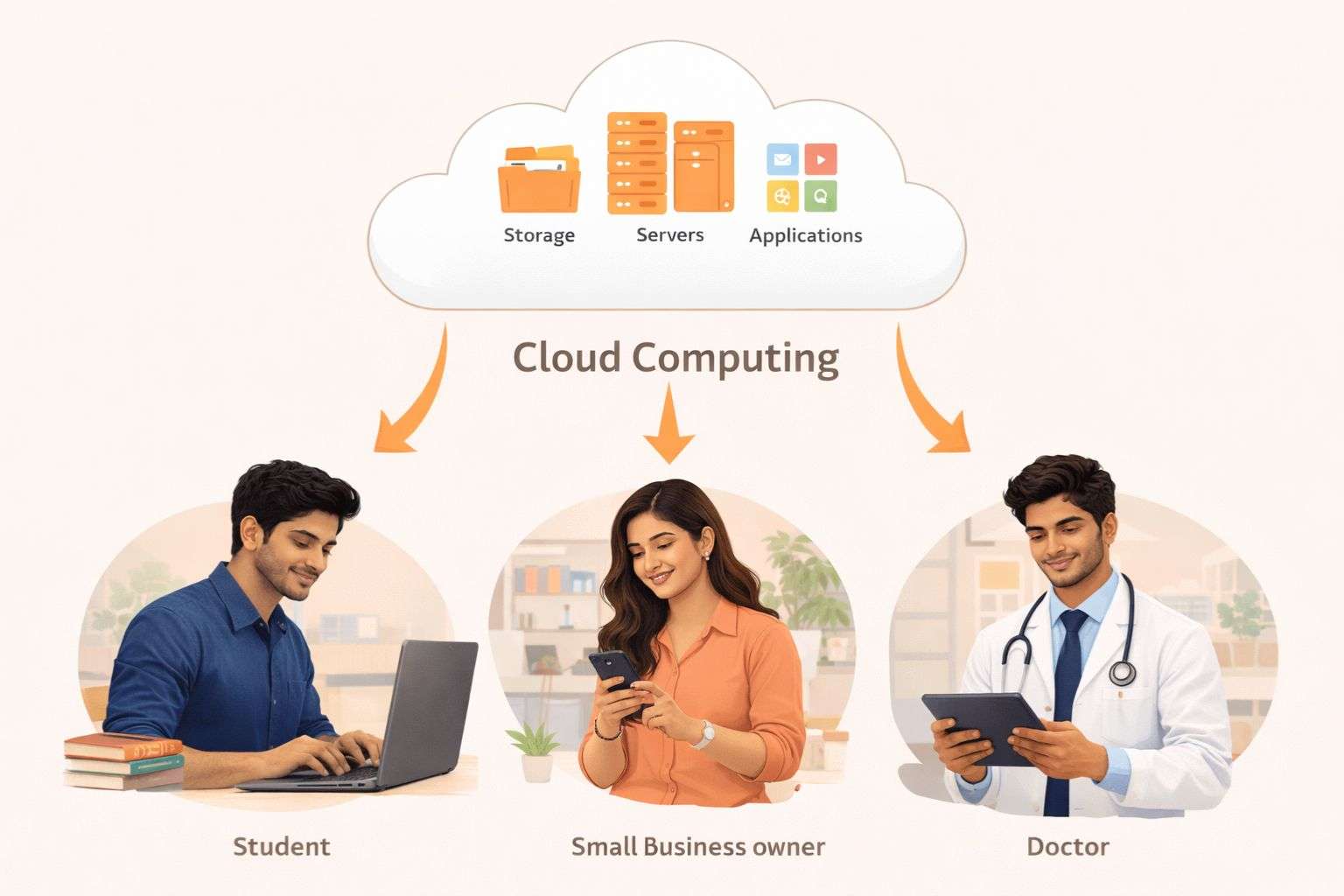
What is cloud computing India 2026 — simple illustration showing cloud services accessed by different users
Before we get into the roadmap let me explain what cloud computing actually means in plain language. Because the term gets thrown around constantly and most students have a vague sense of what it is without a clear understanding of what working in it actually involves.
Cloud computing means using someone else’s computers — accessed over the internet — rather than owning and managing your own physical servers. When a company stores its data on Amazon Web Services instead of buying its own servers and keeping them in a room somewhere — that is cloud computing. When an app runs on Google Cloud’s infrastructure instead of a company’s own data centre — that is cloud computing.
The three companies that provide most of the world’s cloud infrastructure are Amazon Web Services — AWS — Microsoft Azure, and Google Cloud Platform. These three platforms together power an enormous proportion of the internet and virtually every serious Indian IT company uses at least one of them.
What working in cloud computing means day to day depends on your specific role. But at the entry level in Indian companies in 2026 it typically involves setting up cloud environments for applications to run in, managing storage and databases in the cloud, monitoring cloud systems to make sure they are running correctly, helping migrate existing systems from physical servers to cloud platforms, and managing the security and costs of cloud resources.
None of this requires you to be a systems programming expert or a hardware engineer. It does require you to understand how these platforms work, how to use their tools, and how to think about infrastructure as a set of configurable services rather than physical machines.
Why Cloud Computing Is the Right Career Choice for Indian Students in 2026
The case for pursuing a cloud computing career in India in 2026 rests on three specific realities that are simultaneously true right now.
Reality 1 — The demand is genuine and growing. India’s digital transformation is not a trend — it is a multi-year structural shift that is still in its early stages. Most Indian companies are either in the process of moving to the cloud or planning to. That migration requires cloud professionals at every level. And the pipeline of trained cloud professionals in India is nowhere near sufficient to meet that demand.
Reality 2 — The entry path is more accessible than most students realise. Cloud computing has a reputation for being a field for experienced infrastructure engineers. That reputation is increasingly outdated. All three major cloud platforms — AWS, Azure, and Google Cloud — offer foundational certifications specifically designed for beginners. Indian companies hiring junior cloud engineers and cloud support roles are genuinely willing to hire freshers with these foundational certifications combined with practical hands-on experience on the platforms.
Reality 3 — The salary trajectory is exceptional. Cloud computing professionals in India are among the highest-paid IT professionals at every career stage — from fresher to senior level. The combination of high demand and limited supply creates salary premiums that are visible even at entry level and grow significantly with two to three years of genuine experience.
Cloud Computing Career Roadmap India 2026 — The Three Platforms and Which One to Start With
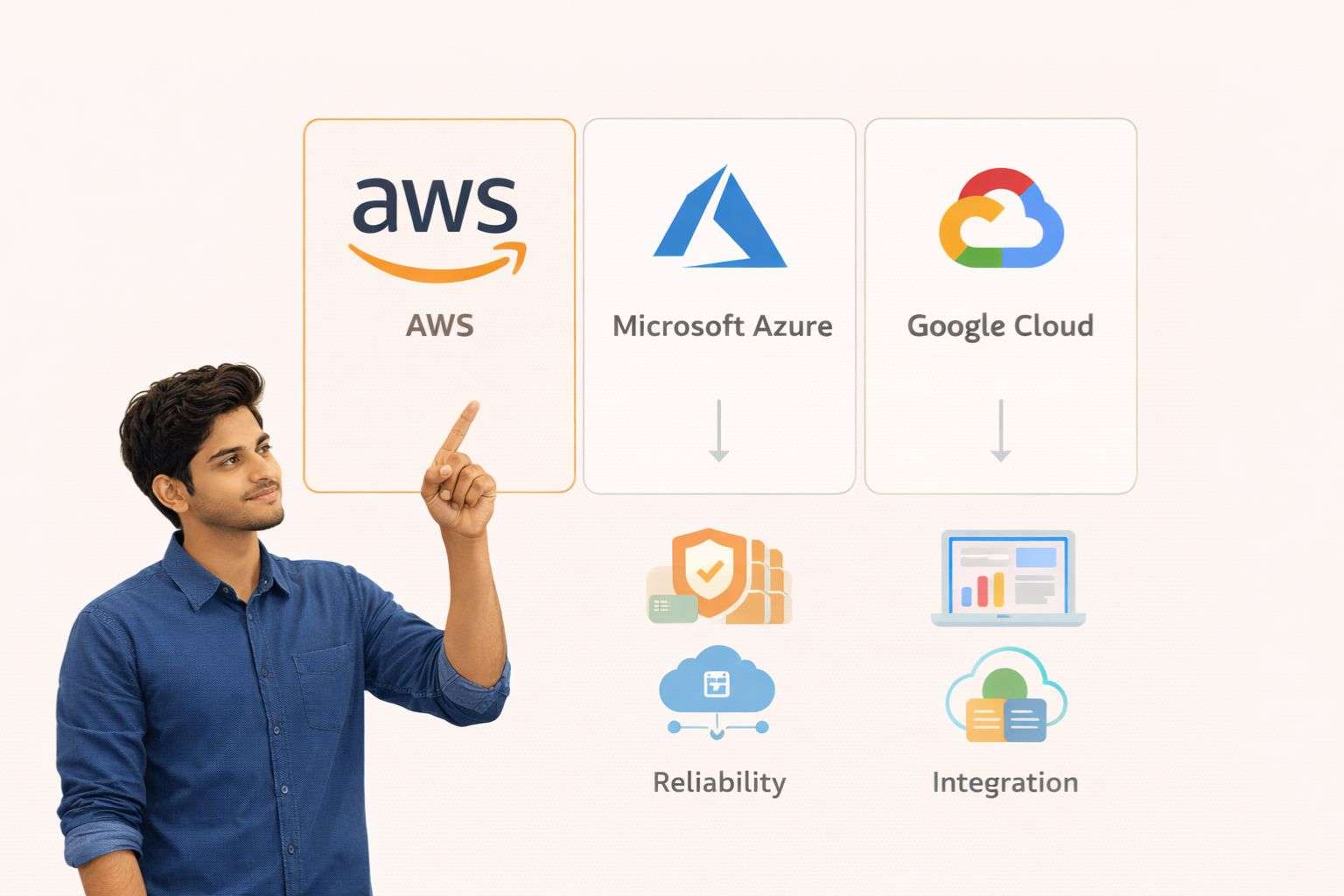
Cloud computing career roadmap India 2026 — AWS vs Azure vs Google Cloud which to learn first
The most common question students ask when they decide to pursue cloud computing is — which platform should I learn first. AWS, Azure, or Google Cloud?
Let me give you a direct answer based on the Indian job market in 2026 rather than a diplomatic “it depends” that leaves you no closer to a decision.
Start with AWS.
Here is why. AWS is the most widely adopted cloud platform in India in 2026. It has the largest share of Indian enterprise cloud usage. It has the most fresher-friendly entry certification — AWS Cloud Practitioner — that is genuinely recognised by Indian recruiters. And it has the largest ecosystem of free learning resources, free tier services for practice, and community support for beginners.
That does not mean Azure and Google Cloud are not worth learning. Azure is dominant in Indian companies that use Microsoft products — which includes a very large proportion of Indian banking, insurance, and enterprise companies. Google Cloud has a particularly strong presence in Indian startups and data-heavy companies. Both are worth adding to your profile eventually.
But trying to learn all three simultaneously as a beginner is one of the most common preparation mistakes I see. The fundamental concepts of cloud computing are platform-independent — learn them on one platform and they transfer to the others. Pick AWS. Go genuinely deep. Add Azure or Google Cloud as your second platform once your AWS foundation is solid.
Cloud Computing Career Roadmap for Indian students 2026 — Stage by Stage
Stage 1 — Cloud Fundamentals — Weeks 1 to 4
Before you touch any cloud platform you need to understand the concepts that underpin all of them. These fundamentals are platform-independent — they apply equally to AWS, Azure, and Google Cloud — and they are what every cloud computing interview in India tests for before getting into platform-specific details.
What you need to understand at the end of Stage 1:
What is virtualisation and why does it matter for cloud computing. What is the difference between a virtual machine and a container. What is the difference between Infrastructure as a Service, Platform as a Service, and Software as a Service — and what real-world examples of each look like. What is the difference between public cloud, private cloud, and hybrid cloud. What does scalability mean and why does it matter. What does high availability mean and how do cloud platforms achieve it. What is the basic concept of cloud security and why does it differ from traditional IT security.
None of these require technical implementation experience at this stage. They require conceptual understanding clear enough that you can explain each one in plain language to someone who has never heard of cloud computing.
Free resource for Stage 1: AWS’s own Cloud Practitioner Essentials course — available free on AWS Skill Builder — covers all of these fundamentals in the context of AWS specifically. It is the best free starting point available and directly prepares you for the AWS Cloud Practitioner certification exam.
🔗 Visit: explore.skillbuilder.aws
Rooman cloud program sponsored by Govt. of Odisha
Stage 2 — AWS Cloud Practitioner Certification — Weeks 5 to 8
The AWS Cloud Practitioner certification is the right first credential for Indian students starting a cloud computing career in 2026. Here is why specifically.
It is genuinely recognised by Indian recruiters. Unlike some entry-level certifications that look impressive but are unfamiliar to hiring managers, the AWS Cloud Practitioner appears frequently enough in Indian IT job listings and resumes that recruiters know what it means and value it accordingly.
It is achievable for a student with no prior cloud experience. The exam covers cloud concepts, AWS core services, security fundamentals, billing and pricing, and basic cloud architecture. A student who completes Stage 1 properly and spends three to four weeks of dedicated exam preparation can realistically pass it on their first attempt.
It creates a genuine foundation for every subsequent cloud learning stage. The concepts covered in Cloud Practitioner form the vocabulary and mental framework that makes every more advanced cloud concept easier to understand.
What the exam covers: Cloud concepts — approximately 26 percent of the exam. Security and compliance — approximately 25 percent. Technology — approximately 33 percent. Billing and pricing — approximately 16 percent.
The exam costs approximately ₹8,000 to ₹10,000 in India. AWS offers exam vouchers through various programs including AWS Educate for students — worth investigating before paying full price.
Free preparation resources: AWS Skill Builder free tier. freeCodeCamp’s free AWS Cloud Practitioner course on YouTube. ExamPro’s free Cloud Practitioner course. These three together provide comprehensive free preparation for the certification exam.
🔗 Visit: aws.amazon.com/certification | aws.amazon.com/education/awseducate
Stage 3 — Core AWS Services Hands-On Practice — Weeks 9 to 16
A certification proves you understand cloud concepts. Hands-on experience with actual AWS services proves you can use them. Indian companies hiring junior cloud roles in 2026 want both — and the hands-on experience is what most freshers with cloud certifications are missing.
AWS offers a free tier that gives you twelve months of access to a wide range of AWS services at no cost. This free tier is your laboratory. Use it.
The specific services to build hands-on experience with during Stage 3:
EC2 — Elastic Compute Cloud This is AWS’s virtual machine service. Launch an EC2 instance. Connect to it using SSH. Install a web server on it. Access it from your browser. Understand the difference between different instance types and when you would use each one. This is the most fundamental AWS service and the one most commonly discussed in cloud interviews.
S3 — Simple Storage Service This is AWS’s object storage service. Create an S3 bucket. Upload files to it. Set permissions appropriately. Host a static website from it. Understand the difference between public and private access. S3 is used by virtually every AWS-based application and understanding it well is essential.
RDS — Relational Database Service This is AWS’s managed database service. Launch an RDS instance with MySQL or PostgreSQL. Connect to it from your EC2 instance. Understand why a managed database service is different from running your own database on a virtual machine. This connects directly to the database knowledge from your full stack or data science preparation.
IAM — Identity and Access Management This is how AWS manages who can access what. Create IAM users and roles. Understand the concept of least privilege — giving each user or service only the permissions it specifically needs. IAM is tested in virtually every AWS technical interview because security is consistently the most important concern in cloud environments.
Lambda — Serverless Computing Lambda lets you run code without managing a server. Write a simple Lambda function that responds to an event. Understand what serverless means and why companies use it. Serverless computing is one of the fastest-growing areas of cloud adoption in Indian companies in 2026.
The project goal for Stage 3: Deploy a complete working web application on AWS using EC2, S3, and RDS together. This single project demonstrates that you can connect AWS services into a working system — which is the core skill every junior cloud role in India requires.
Stage 4 — Networking and Security Fundamentals — Weeks 17 to 22
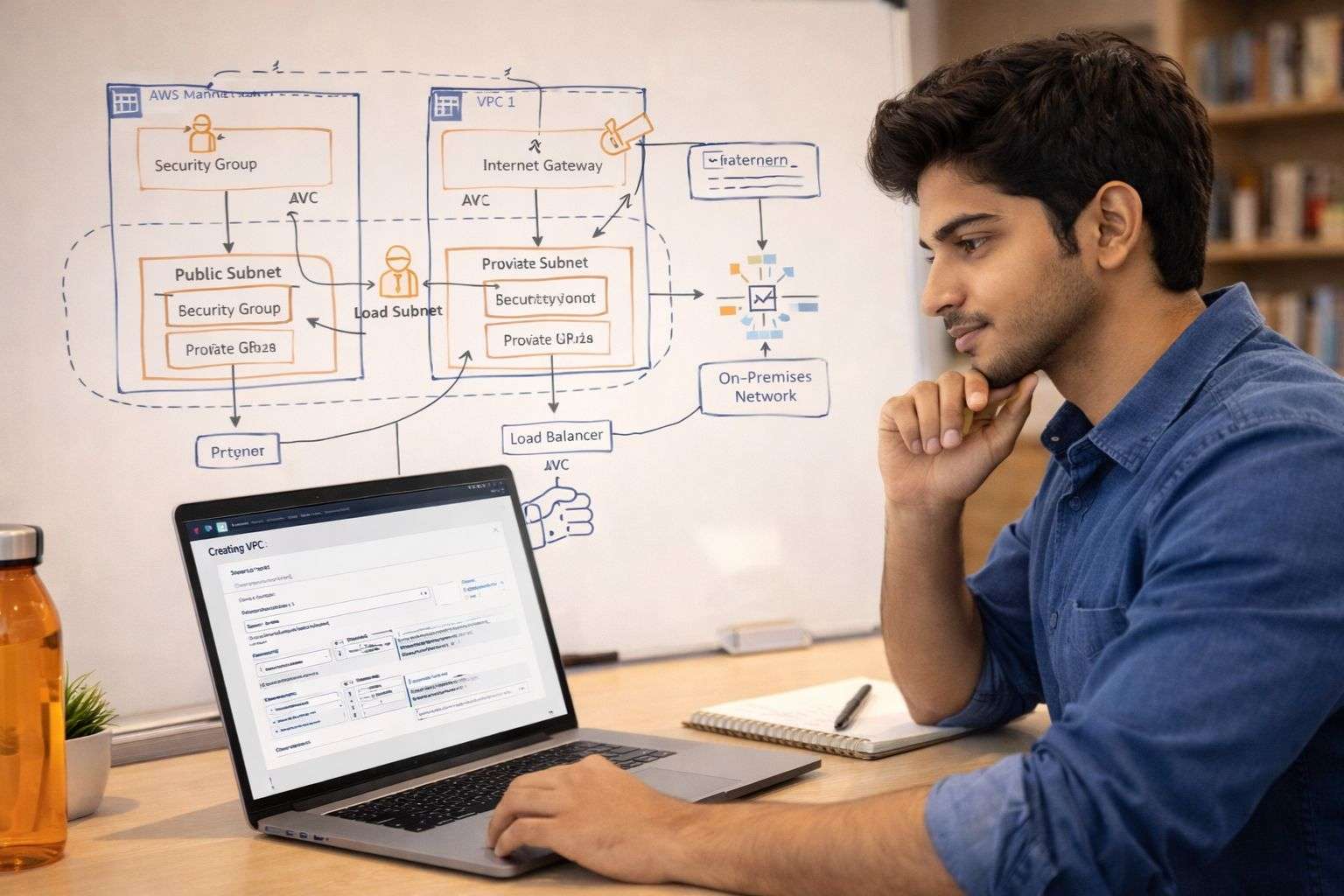
Cloud computing career roadmap India 2026 stage 4 — student with cloud networking architecture diagram
This is the stage that most students skip or rush through — and it is consistently the stage that separates junior cloud candidates from strong junior cloud candidates in Indian technical interviews.
Cloud networking and security are not optional advanced topics for later. They are core competencies that every cloud role in India — from support engineer to DevOps engineer to cloud architect — requires from day one.
What you need to understand at the end of Stage 4:
VPC — Virtual Private Cloud A VPC is your own private section of the AWS cloud where you can run your resources in an isolated network environment. Understanding how to design a basic VPC with public and private subnets, internet gateways, and NAT gateways is tested in virtually every AWS technical interview at Indian companies. It is the cloud equivalent of understanding network architecture in traditional IT — non-negotiable for anyone serious about cloud computing.
Security Groups and Network Access Control Lists These are the mechanisms that control what traffic is allowed into and out of your cloud resources. Understanding the difference between them and knowing how to configure them correctly is a security fundamental that every cloud interview tests.
Load Balancing and Auto Scaling Load balancers distribute incoming traffic across multiple servers. Auto scaling automatically adds or removes servers based on demand. Together they are what makes cloud applications handle varying amounts of traffic without either crashing under heavy load or wasting money on unused capacity during quiet periods. These concepts come up in every cloud architecture discussion at Indian companies.
Cloud Security Fundamentals Encryption at rest and in transit. The concept of shared responsibility — what the cloud provider is responsible for securing versus what you are responsible for securing. Basic compliance concepts that Indian banking and healthcare companies specifically care about.
Stage 5 — Infrastructure as Code — Weeks 23 to 28
Infrastructure as Code means defining your cloud infrastructure — servers, databases, networking, security settings — in configuration files rather than clicking through a cloud console manually. It is one of the most practically important cloud skills in Indian IT companies in 2026 and one of the clearest differentiators between freshers who understand cloud conceptually and those who are ready to work in a real cloud environment.
The two tools most widely used for Infrastructure as Code in India in 2026 are Terraform — which works across AWS, Azure, and Google Cloud — and AWS CloudFormation — which is AWS-specific.
Start with Terraform. It is more widely applicable and more commonly mentioned in Indian cloud job descriptions than CloudFormation. Learn to write basic Terraform configurations that define AWS resources. Use Terraform to deploy and destroy the same infrastructure you built manually in Stage 3. The experience of defining infrastructure in code and watching it create and delete real cloud resources is one of the most practically valuable things you can do for your cloud career preparation.
🔗 Visit: learn.hashicorp.com — Terraform’s own free learning platform. Comprehensive and well-structured.
Stage 6 — Build a Portfolio Project and Get Certified Further — Weeks 29 to 36
Cloud computing career roadmap India 2026 stage 6 — student with deployed AWS architecture and certification
This final stage combines two parallel activities that together create a job-ready cloud computing profile for Indian freshers in 2026.
The portfolio project: Build and deploy a complete cloud architecture on AWS that demonstrates the skills from every previous stage. A three-tier web application — frontend in S3, backend on EC2, database on RDS — deployed in a properly configured VPC with security groups, a load balancer, auto scaling, and basic monitoring through CloudWatch. Define the entire infrastructure using Terraform so it can be recreated from code. Document the architecture in a clear README on GitHub.
That single portfolio project — complete, deployed, and documented — is worth more in a cloud computing interview than any combination of certificates without practical evidence. It answers the most important question every cloud hiring manager asks — can this person actually build something on AWS.
The next certification: After completing the Cloud Practitioner certification in Stage 2 the next credential worth pursuing is AWS Solutions Architect Associate. This is the most widely recognised intermediate AWS certification in India and appears in a significant number of Indian cloud job descriptions even at junior levels. It covers cloud architecture concepts in depth and validates that you can design complete cloud solutions rather than just use individual services.
The exam is more challenging than Cloud Practitioner and requires genuine hands-on experience — which is exactly what Stages 3 through 5 of this roadmap provide before you attempt it.
What Cloud Computing Roles Pay in India in 2026
Let me give you honest salary numbers from actual offer letters.
Cloud Support Engineer — Entry Level At large IT service companies — ₹3.5 to ₹6 LPA At Indian product companies — ₹6 to ₹10 LPA At global companies with India presence — ₹10 to ₹18 LPA
Junior Cloud Engineer or DevOps Engineer At Indian product companies and startups — ₹8 to ₹15 LPA At global companies — ₹15 to ₹25 LPA
Cloud Architect — Mid Level, Three to Five Years Experience At Indian product companies — ₹20 to ₹35 LPA At global companies — ₹35 to ₹60 LPA
The salary growth trajectory in cloud computing in India is one of the steepest in the entire IT sector — driven by the genuine shortage of experienced cloud professionals relative to the rapidly growing demand.
🔗 Related Read: Fresher Salary in India 2026 🔗 Related Read: Top 10 IT Companies in India Hiring Freshers in 2026
Three Mistakes That Derail Students on the Cloud Computing Career Roadmap India 2026
Mistake 1 — Collecting certifications without hands-on practice. A cloud certification without the ability to actually use the platform is the cloud computing equivalent of a driving licence without ever having sat behind a wheel. Indian cloud hiring managers test practical knowledge in interviews. Certifications that are not backed by genuine hands-on experience fall apart within the first ten minutes of a technical interview.
Mistake 2 — Trying to learn all three platforms simultaneously. AWS, Azure, and Google Cloud all at once is a recipe for shallow knowledge of all three rather than genuine proficiency in any one. The concepts transfer between platforms once you have genuinely mastered one. Master one first. Add others later from a position of strength.
Mistake 3 — Skipping networking and security. Students who skip Stage 4 consistently struggle in cloud interviews because every real-world cloud scenario involves networking and security considerations. A cloud environment with no networking understanding is like a house with no plumbing — it looks complete from the outside but it does not actually work. Do not skip this stage.
Internal Links — Read These Next
- 📌 Data Science Career Roadmap India 2026
- 📌 Artificial Intelligence Career in India 2026
- 📌 Full Stack Developer Roadmap India 2026
- 📌 Top Tech Skills Employers Look for in Freshers in India 2026
- 📌 Best Free Online Courses for IT Students in India 2026
- 📌 GitHub Profile for Indian Students 2026
- 📌 Fresher Salary in India 2026
- 📌 Top 10 IT Companies in India Hiring Freshers in 2026
- 📌 Python vs Java vs C++ for Indian Students 2026
- 📌 Cybersecurity Internships in India 2026
FAQs — Cloud Computing Career Roadmap for Indian students 2026
FAQ 1 — Can Indian students from non-CS backgrounds — ECE, Mechanical, Civil — realistically build a cloud computing career in 2026 and how should they approach the transition?
This is a question I get from students across engineering disciplines who are drawn to cloud computing but worried that their non-CS background creates an insurmountable gap. My honest answer after watching this transition play out across multiple students from diverse engineering backgrounds is that the gap is real but significantly smaller than most students assume.
Cloud computing at the entry level in India in 2026 is fundamentally about understanding how infrastructure works and how to use cloud platform tools — not about writing complex algorithms or building software from scratch.
The core skills required — understanding networking concepts, managing cloud services through a console and command line, reading documentation and following configuration procedures, troubleshooting infrastructure issues methodically — are skills that engineering students from any discipline can build through structured preparation.
What non-CS students need to invest extra time in before starting the cloud roadmap is basic Linux command line familiarity and a fundamental understanding of networking concepts — IP addresses, DNS, HTTP, and how data moves across networks. These are prerequisites that CS students typically cover in their degree but that ECE, Mechanical, and Civil students often have not formally studied. Two to three weeks of focused learning on these specific topics fills that gap sufficiently to begin the cloud roadmap productively.
The career paths within cloud computing most accessible to non-CS engineering backgrounds are cloud support engineering, cloud operations, and infrastructure management. The paths that require more CS-specific preparation — cloud software engineering, serverless application development — are harder to access from a non-CS background without additional programming skill development but are not impossible with sufficient preparation.
Consultant’s note — I have helped students from ECE and even Mechanical Engineering backgrounds build credible cloud computing career profiles that led to junior cloud roles at Indian IT companies. The common thread in every successful case was not their engineering background.
It was their willingness to invest four to six months in building the specific prerequisite skills — Linux, networking basics, and then the cloud roadmap itself — before applying. The background question becomes less relevant remarkably quickly once you have a completed portfolio project and a genuine AWS certification to show.
FAQ 2 — What is the realistic difference in career outcomes between an AWS certification alone versus AWS certification combined with hands-on project experience for Indian freshers in 2026?
This question cuts to the heart of the most important preparation decision a cloud computing fresher in India can make — and I want to answer it with complete clarity rather than diplomatic balance.
An AWS Cloud Practitioner certification alone — without hands-on project experience — will get you shortlisted for some cloud-adjacent roles at large IT service companies that use certifications as a basic screening filter. It will not get you through the technical interview that follows that shortlisting. Every genuine technical interviewer for a cloud role in India in 2026 will ask you questions that require practical knowledge of how AWS services actually behave — and that knowledge comes only from having used them, not from having passed a multiple choice exam about them.
AWS certification combined with a genuine hands-on portfolio project — a deployed three-tier application, a real AWS architecture with VPC, EC2, S3, RDS, and a load balancer configured correctly — produces dramatically better interview outcomes at Indian companies. The interviewer can see from your portfolio that you have actually built something on AWS. The technical questions they ask about your architecture decisions — why you chose specific services, how you handled security,
what you would do differently — are questions you can answer specifically and confidently because you made those decisions yourself.
The salary difference between candidates who clear interviews versus those who do not is not marginal. It is binary — you either get the offer or you do not. And the difference between candidates who clear cloud interviews and those who do not is almost always whether they have genuine hands-on experience or only certification knowledge.
Consultant’s note — I tell every student I counsel on cloud computing careers the same thing. The certification opens the door. The hands-on experience is what gets you through it. Spend as much preparation time on building real things in AWS as you spend on exam preparation.
More if anything.
The exam knowledge and the practical knowledge reinforce each other — students who build hands-on experience find the certification exam significantly easier because the concepts make intuitive sense from having seen them in action.
FAQ 3 — How is a cloud computing career different from a cybersecurity career and should Indian students consider combining both in 2026?
This is a thoughtful question that reflects a genuine overlap between two of the most in-demand IT career paths in India right now. Understanding the relationship between them helps you make a better decision about where to focus your preparation energy.
Cloud computing and cybersecurity are distinct career paths that overlap significantly in one specific domain — cloud security. Every cloud environment requires security expertise. Every security professional increasingly needs to understand cloud environments. The intersection of these two fields — called cloud security — is one of the fastest-growing and highest-paying specialisations in Indian IT in 2026.
A pure cloud computing career focuses on building, managing, and optimising cloud infrastructure. The primary skills are platform knowledge, infrastructure design, automation, and performance optimisation. The typical career progression goes from cloud support engineer to cloud engineer to cloud architect or DevOps engineer.
A pure cybersecurity career focuses on protecting systems, identifying vulnerabilities, and responding to security incidents. The primary skills are threat understanding, security tools, compliance frameworks, and incident response. The typical progression goes from security analyst to penetration tester or security engineer to security architect or CISO.
The cloud security specialisation combines elements of both — understanding how to secure cloud environments specifically, conduct cloud security assessments, implement cloud compliance frameworks, and monitor cloud environments for threats. This specialisation commands premium salaries in India in 2026 because it requires both cloud platform expertise and security knowledge that most professionals have developed in only one domain.
For Indian students deciding between the two paths my honest guidance is this. If you are more drawn to building and optimising infrastructure — cloud computing is your primary path. If you are more drawn to protecting systems and understanding how attacks work — cybersecurity is your primary path. Either path is excellent.
The cloud security specialisation is worth pursuing after you have built genuine competence in whichever primary path you choose — because the combination of cloud depth and security depth is where the most significant career differentiation and salary premium exists in India’s IT market in 2026.
Consultant’s note — I have seen students try to pursue cloud computing and cybersecurity simultaneously from the beginning and almost always end up with surface-level knowledge of both rather than genuine competence in either. The better sequence is depth in one first — twelve to eighteen months of genuine cloud or cybersecurity foundation building — and then deliberate movement toward the intersection.
Students who followed that sequence consistently reached the cloud security specialisation faster and with stronger foundations than those who tried to build both simultaneously from day one.
FAQ 4 — How much does a complete cloud computing roadmap actually cost an Indian student end to end, including exam fees, and are there ways to reduce that cost?
This is a question every student should ask before they start — because cloud computing has a reputation for being expensive that is only partly true. Let me break down the real numbers.
The AWS Cloud Practitioner exam costs approximately ₹8,000 to ₹10,000 in India.
If you go on to attempt AWS Solutions Architect Associate in Stage 6, that exam costs approximately ₹12,000 to ₹15,000. Beyond exam fees, the AWS free tier covers twelve months of hands-on practice on EC2, S3, RDS, and Lambda at no cost — which means the hands-on portion of this roadmap, the part that matters most, is essentially free if you stay within free tier limits.
Where students actually overspend is on paid bootcamps and courses that repackage information already available free on AWS Skill Builder, freeCodeCamp, and ExamPro. A student who follows this roadmap using only free resources and pays only for the two certification exams can complete the entire Stage 1 to Stage 6 journey for under ₹25,000 total.
There are ways to reduce even that. AWS Educate offers exam vouchers and credits specifically for students — genuinely worth applying for before paying full price. Some Indian training partners, including government-supported programs like the one Rooman Technologies runs in Odisha, bundle certification vouchers with structured mentorship at a lower combined cost than buying everything separately.
The honest guidance is this — do not let cost anxiety stop you from starting. The free tier and free learning resources cover the majority of this roadmap. Budget specifically for the two exam fees and treat everything else as free unless you specifically need structured mentorship to stay accountable.
Consultant’s note — I have counselled students who delayed starting their cloud computing preparation for months because they assumed it needed a ₹50,000 or ₹1 lakh course investment. It does not. The AWS free tier and the certification exam fees are the only unavoidable costs, and together they are under ₹25,000. Spend your money on the exam. Spend your time on the free tier. That combination works.
FAQ 5 — Is it better to learn cloud computing through a paid bootcamp or self-study using free resources for Indian freshers in 2026?
Students ask me this constantly, and my honest answer depends less on the platform and more on the student’s own discipline.
Self-study using free resources — AWS Skill Builder, freeCodeCamp, ExamPro, and the AWS free tier — works completely well for a student who can maintain a consistent weekly schedule without external accountability. The content quality is genuinely comparable to paid alternatives because AWS itself produces the free material. Students who are naturally self-directed, who set weekly goals and stick to them, get exactly the same outcome from free resources as they would from a paid course.
A structured program adds value in one specific area — accountability and mentorship, not content quality. Students who have started and abandoned self-learning attempts before, who need someone checking on their progress, or who want a mentor to explain concepts when they get stuck benefit genuinely from a paid or government-sponsored program.
This is where programs like the Rooman Technologies cloud computing track sponsored by the Government of Odisha add real value — not because the AWS content is different, but because the structure and mentorship keep students on track through all six stages instead of stalling at Stage 2 or Stage 3, which is where most self-study attempts quietly die.
My honest recommendation — try disciplined self-study first for two to three weeks. If you are completing modules consistently and staying on schedule, continue with free resources through the entire roadmap. If you notice yourself skipping days and losing momentum, that is your signal to invest in structured mentorship rather than a signal that you are not cut out for cloud computing.
Consultant’s note — I do not push every student toward a paid program, and I never will. What I have seen after 27 years of watching students learn is that the roadmap itself is identical either way. The only variable that actually predicts whether a student finishes is whether they have someone checking on their progress. If you know yourself well enough to be that person for yourself, save your money.
FAQ 6 — Can a student complete this cloud computing roadmap while still preparing for campus placements, or should it come after placements are settled?
This is one of the most practical scheduling questions I get from third and final-year students, and the honest answer is that it depends entirely on which stage of placements you are in.
If you are in your third year and campus placements are still six months to a year away, this is genuinely the best window to run the cloud roadmap in parallel with your regular placement preparation. The two activities reinforce each other rather than compete. Cloud computing knowledge strengthens your technical interview performance across the board — even for roles that are not cloud-specific — because networking, security, and system design concepts from Stages 1 and 4 come up in general technical interviews too.
If you are in final year and placement season has already begun — meaning companies are actively visiting your campus within the next two to three months — my honest advice changes. Do not try to complete the full six-stage roadmap from scratch during active placement season. Instead, prioritise whichever stage gets you the most interview-ready fastest.
If you already have the Cloud Practitioner certification, spend this window entirely on the Stage 3 hands-on project, because a working AWS project is what actually gets discussed in interviews. If you have neither the certification nor hands-on experience, your placement season time is better spent on general technical and aptitude preparation, with the cloud roadmap picked up seriously once placements conclude.
The mistake I see most often is students trying to do both at full intensity simultaneously during peak placement season and doing neither well. Sequence matters more than simultaneity here.
Consultant’s note — I tell final-year students exactly this. If placement season has already started and you have not touched AWS yet, do not panic-start the full roadmap now. Get through placements with whatever preparation you already have, and come back to this roadmap with full focus once the pressure is off. A rushed, half-finished cloud profile helps you less in an interview than a completed one started three months later.
FAQ 7 — Does a cloud computing career require strong coding skills, and how much programming should a student actually learn alongside this roadmap?
This question comes up in almost every career counselling session I run on cloud computing, usually from students who are anxious about their coding ability or from non-CS students specifically. The honest answer is that cloud computing requires far less coding than most students assume — but not zero.
At the entry level — cloud support engineer, junior cloud engineer, cloud operations — the primary skills are configuration, troubleshooting, and using platform tools through a console and command line, not writing software from scratch. You do not need to be able to build a full application in Python or Java to succeed in these roles. What you do need is comfort with scripting — basic Python or Bash scripts that automate repetitive tasks, read configuration files, or process log data. This is a meaningfully lower bar than software engineering-level coding.
As you move toward more advanced cloud roles — DevOps engineer, cloud architect, or especially serverless application development using Lambda — programming ability matters more. Writing Lambda functions, building automation scripts, and working with Infrastructure as Code tools like Terraform all benefit from stronger scripting and programming comfort. Students aiming specifically at DevOps or serverless specialisations should invest more deliberately in Python.
My honest guidance — basic Python competence, enough to write and understand a fifty-line script, is sufficient to start and progress through this entire roadmap. You do not need data structures and algorithms mastery. You do not need to compete with software engineering candidates on coding ability. Cloud computing rewards infrastructure thinking and platform fluency far more than it rewards coding depth.
Consultant’s note — Every year I meet students who avoid cloud computing because they assume it needs the same coding depth as software development roles. It does not. I have placed students with only basic scripting ability into junior cloud roles because their AWS hands-on project and certification carried the interview. Do not let coding anxiety keep you away from this roadmap.
FAQ 8 — How do Indian companies verify that a candidate’s AWS portfolio project is genuine and not copied from a tutorial?
This is a sharp question, and the honest answer is that experienced technical interviewers can tell the difference within the first few minutes of discussion, without needing any special verification tool.
The verification happens through the depth of your explanation, not through checking your GitHub commit history. An interviewer will ask why you chose a specific EC2 instance type, why you configured your VPC subnets the way you did, what would happen if your RDS instance failed, or how you would reduce the cost of your architecture. A student who copied a tutorial without genuinely understanding it can describe what they built but cannot explain the reasoning behind the decisions — and that gap becomes obvious within two or three follow-up questions.
A student who built the project themselves, even if they initially followed a tutorial as a starting structure, can discuss trade-offs, mistakes they made along the way, and what they would change with more time. That depth of discussion is what genuinely differentiates candidates, and it is exactly why Stage 6 of this roadmap asks you to document your architecture decisions in your GitHub README, not just the final result.
My honest advice — do not worry about interviewers “catching” you using a tutorial as a starting point. Almost every student’s first cloud project starts from a tutorial or guide. What matters is that you genuinely understood every decision by the time you deployed it, and that you can explain those decisions in your own words during an interview.
Consultant’s note — I coach students specifically on this before interviews. I ask them to explain their own AWS project to me the way they would to an interviewer. The students who stumble are almost always the ones who followed a tutorial exactly without understanding the reasoning behind each step. Understand the why, not just the how, and this question stops being something to fear.
FAQ 9 — What happens to cloud computing jobs in India as AI tools automate more infrastructure tasks — is this still a safe career choice in 2026?
This is a genuinely important question, and students are right to ask it rather than assume every tech career is automation-proof.
AI tools are changing how cloud work gets done, not eliminating the need for people who understand cloud infrastructure. AI coding assistants and infrastructure automation tools can generate Terraform configurations, suggest architecture patterns, and flag potential security misconfigurations. What they cannot do reliably is understand your specific business context, make judgment calls about trade-offs between cost and performance, or take accountability when something goes wrong in production.
The practical effect I am seeing in Indian companies in 2026 is that cloud roles are shifting toward requiring more judgment and less repetitive manual configuration. A cloud engineer today is expected to review and validate AI-suggested configurations rather than write every line manually — which actually raises the bar for genuine understanding rather than lowering it. Someone who only knows how to click through a console without understanding the underlying concepts from Stages 1 and 4 of this roadmap will struggle more in this environment, not less, because they cannot evaluate whether an AI-suggested configuration is actually correct and secure.
This connects directly to why this roadmap emphasises conceptual understanding in Stage 1 and security fundamentals in Stage 4 rather than just tool usage. The students who will do well in cloud computing careers through the AI era are the ones who understand what is happening underneath the automation, not the ones who can only follow steps.
Consultant’s note — I tell every student the same thing I tell them about software engineering roles generally. AI is not removing the need for cloud professionals. It is removing tolerance for cloud professionals who do not actually understand what they are doing. Build genuine understanding through this roadmap, not just tool familiarity, and you are positioning yourself correctly for where these roles are heading.
FAQ 10 — Should a student target a service-based company or a product-based company for their first cloud computing job in India?
This decision matters more for cloud computing than for some other IT career paths, because the nature of cloud work differs meaningfully between the two.
Service-based companies — the large IT services firms — typically hire cloud support engineers and junior cloud engineers into client-facing infrastructure roles, often supporting cloud environments for the company’s clients rather than building products in-house. The advantage here is the volume of hiring and genuine openness to freshers with certifications, plus broad exposure to different client environments and industries. The trade-off is that the work can be more process-driven and less about independent architecture decisions early in your career.
Product-based companies and startups hire fewer freshers into pure cloud roles, but the roles that do exist tend to involve more ownership of architecture decisions and closer collaboration with the engineering team building the actual product. The hiring bar is generally higher — a strong hands-on portfolio project matters more here than at service-based companies, which sometimes screen primarily on certification.
For a first cloud computing job specifically, my honest guidance is that service-based companies are usually the more realistic entry point for most freshers, purely because of hiring volume and certification-friendly screening. Two to three years of genuine cloud experience at a service-based company, combined with continued certification progress toward Solutions Architect Associate, builds a strong enough profile to move to a product-based company afterward if that is your goal.
Consultant’s note — I do not tell students to chase a product-based company for their first cloud role unless their portfolio project is genuinely exceptional. Get real hands-on experience first, wherever that door opens for you. The company name on your first job matters far less than the depth of cloud experience you build in your first two years.
What to Do This Week — Your Cloud Computing Career Action Plan
Whatever year of college you are in right now here are the specific actions that move you genuinely closer to your first cloud computing role in India in 2026.
If you are in first or second year — Create a free AWS account today. Enable the free tier. Open the AWS console and spend thirty minutes clicking through the service menu — just exploring what services exist and what they are called. This familiarisation exercise is more valuable than it sounds. Create a free account on AWS Skill Builder and enroll in the Cloud Practitioner Essentials course. Complete the first module before you close your laptop today. That beginning — however small — starts the journey that eight months from now produces a certified, portfolio-backed cloud computing profile.
If you are in third year — Honestly assess which stage of this roadmap you are currently at. If you have the Cloud Practitioner certification but no hands-on experience — open your AWS console today and launch your first EC2 instance. Follow the AWS documentation step by step. Get it running. Connect to it. That hands-on experience begins the portfolio building that your certification currently lacks. If you do not yet have the certification — start the Skill Builder course today and set a target of appearing for the exam within eight weeks.
If you are in final year — Your most urgent priority is a portfolio project you can show in an interview. If you have AWS experience but no deployed project — this week commit to building and deploying a complete three-tier application before your placement season peaks. Even a simple version with basic features demonstrates more genuine cloud ability than any certification alone. If you are starting from scratch — appear for Cloud Practitioner as your immediate priority and build hands-on experience simultaneously using the AWS free tier.
The cloud computing career roadmap India 2026 rewards students who build consistently and honestly over time. Every hour of genuine hands-on practice on AWS is an investment that pays returns in every cloud interview you sit. Start today. Build something real this week. Deploy it. Document it. Put it on GitHub.
The shortage of 2 million cloud professionals that India faces by 2027 is your opportunity. The students who start preparing today will be two years into their cloud careers when that shortage peaks. Position yourself to be one of them.
Completing your career roadmap preparation? Read our guides on Data Science Career Roadmap India 2026 and Full Stack Developer Roadmap India 2026 to understand how cloud computing connects to the broader technology career landscape for Indian students in 2026.






22 Comments