
Full Stack Developer Roadmap for Indian Freshers in 2026 — What to Learn, In What Order and Where to Get Hired
Follow the real full stack developer roadmap for Indian freshers in 2026. A 27-year IT career consultant shares what to learn, in what order, and which companies are actually hiring.
Full Stack Developer Roadmap for freshers India 2026 — And Why Most Students Are Learning the Right Things in the Wrong Order
Full stack developer roadmap India 2026 is one of the most searched career preparation phrases among Indian engineering students right now.
And here is the number that explains why.
Software development roles — including full stack development — account for over 40 percent of all IT fresher job openings in India in 2026. That is not a niche opportunity. That is the single largest category of IT hiring available to engineering graduates in the country. Companies across every sector — fintech, e-commerce, ed-tech, health-tech, logistics, and traditional enterprise — are building digital products and they all need people who can work across the full technology stack.
Yet despite this enormous demand I consistently see two problems when I review student profiles and preparation approaches in my career counselling sessions.
The first problem is that students are learning the right skills in the wrong order. They start with the most complex frameworks before building the foundational understanding that makes those frameworks make sense. They use React before they genuinely understand HTML and CSS. They use Express before they understand what a server actually does. They use MongoDB before they understand basic database concepts. That approach produces students who can follow tutorials but freeze when they need to build something independently.
The second problem is that students are learning skills in isolation without understanding how they connect. Full stack development is not a collection of separate skills. It is a connected system — frontend communicating with backend through APIs, backend communicating with databases through queries, everything deployed on infrastructure that makes it accessible to users. Students who learn each piece without understanding the connections between them cannot build real applications independently — which is exactly what every full stack developer interview tests.
After 27 years as an IT career consultant I have watched hundreds of students navigate this preparation journey. The ones who got full stack developer roles at good Indian companies followed a specific sequence — one that builds genuine understanding at each stage before moving to the next. That sequence is what this blog is going to give you.
What Full Stack Development Actually Means in Indian Companies in 2026
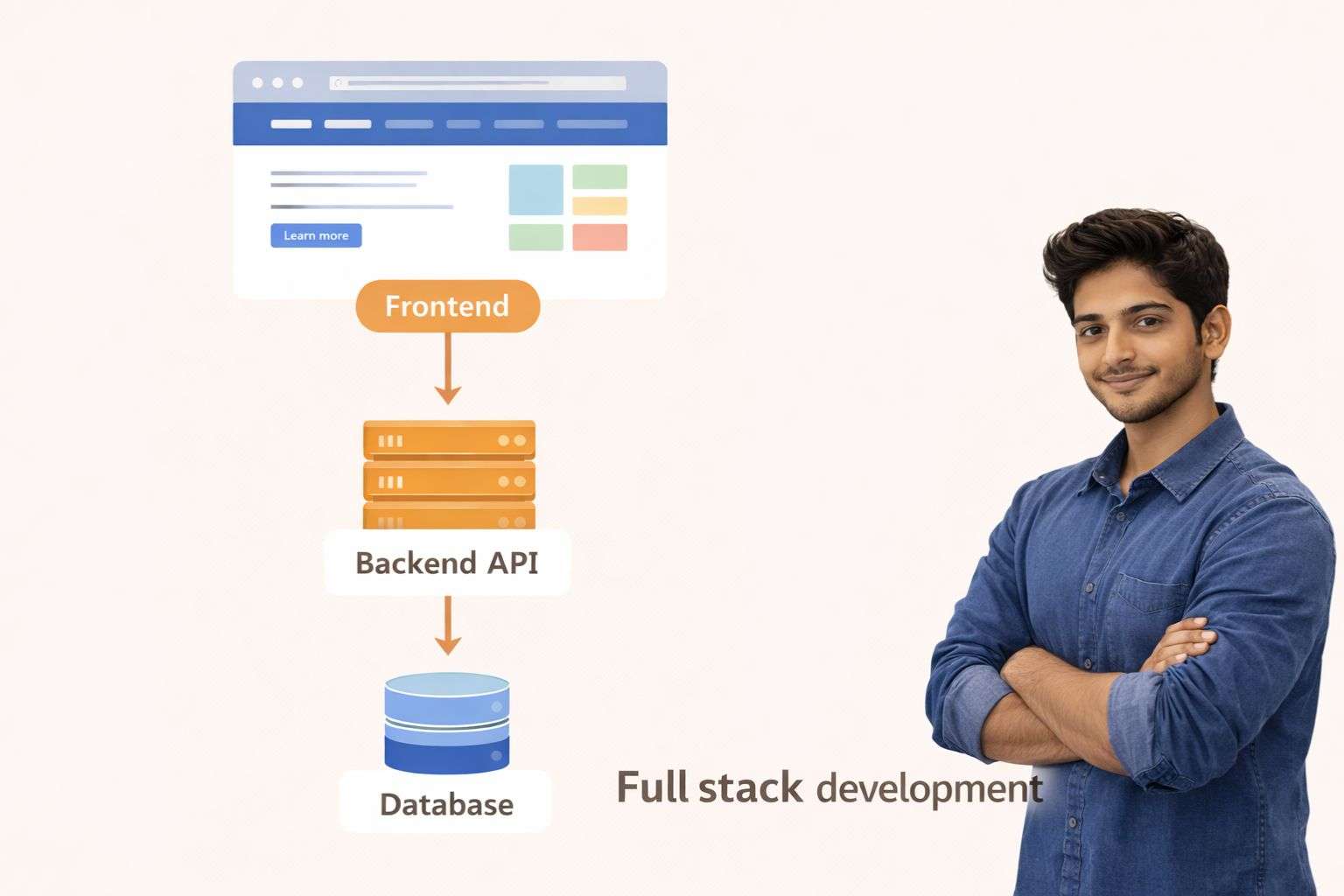
Image Alt Text: Full stack developer roadmap India 2026 — what full stack development layers look like explained visually
Before we get into the roadmap, let me clarify what full stack development actually means in Indian companies in 2026 — because the term is used differently in different contexts and understanding the specific meaning helps you prepare for the right things.
Full stack development means being able to build both the part of an application that users see and interact with — the frontend — and the part that runs on servers, handles business logic, and communicates with databases — the backend. A full stack developer can take a product requirement and build it end to end without needing a separate frontend specialist and a separate backend specialist for every task.
In Indian product companies and startups in 2026 the most common full stack combination being hired for is a JavaScript-based stack. React on the frontend. Node.js with Express on the backend. MongoDB or PostgreSQL for the database. This combination — sometimes called the MERN stack when MongoDB is used — appears in more Indian full stack job descriptions than any other technology combination right now.
A Python-based full stack combination is also widely hired for — particularly at analytics-heavy companies and AI-adjacent startups. React or Vue on the frontend. Django or Flask on the backend. PostgreSQL or MySQL for the database.
The roadmap I am going to give you works for both combinations — because the foundational concepts are identical. Only the specific languages and frameworks differ.
The Full Stack Developer Roadmap for freshers India 2026 — In the Order That Actually Works
This is the sequence I recommend to every student I counsel who wants to become a full stack developer. Built from watching which preparation patterns produce which interview outcomes — not from what makes a compelling course syllabus.
Stage 1 of the Full Stack Developer Roadmap for freshers India 2026 — HTML and CSS Foundations — Weeks 1 to 4
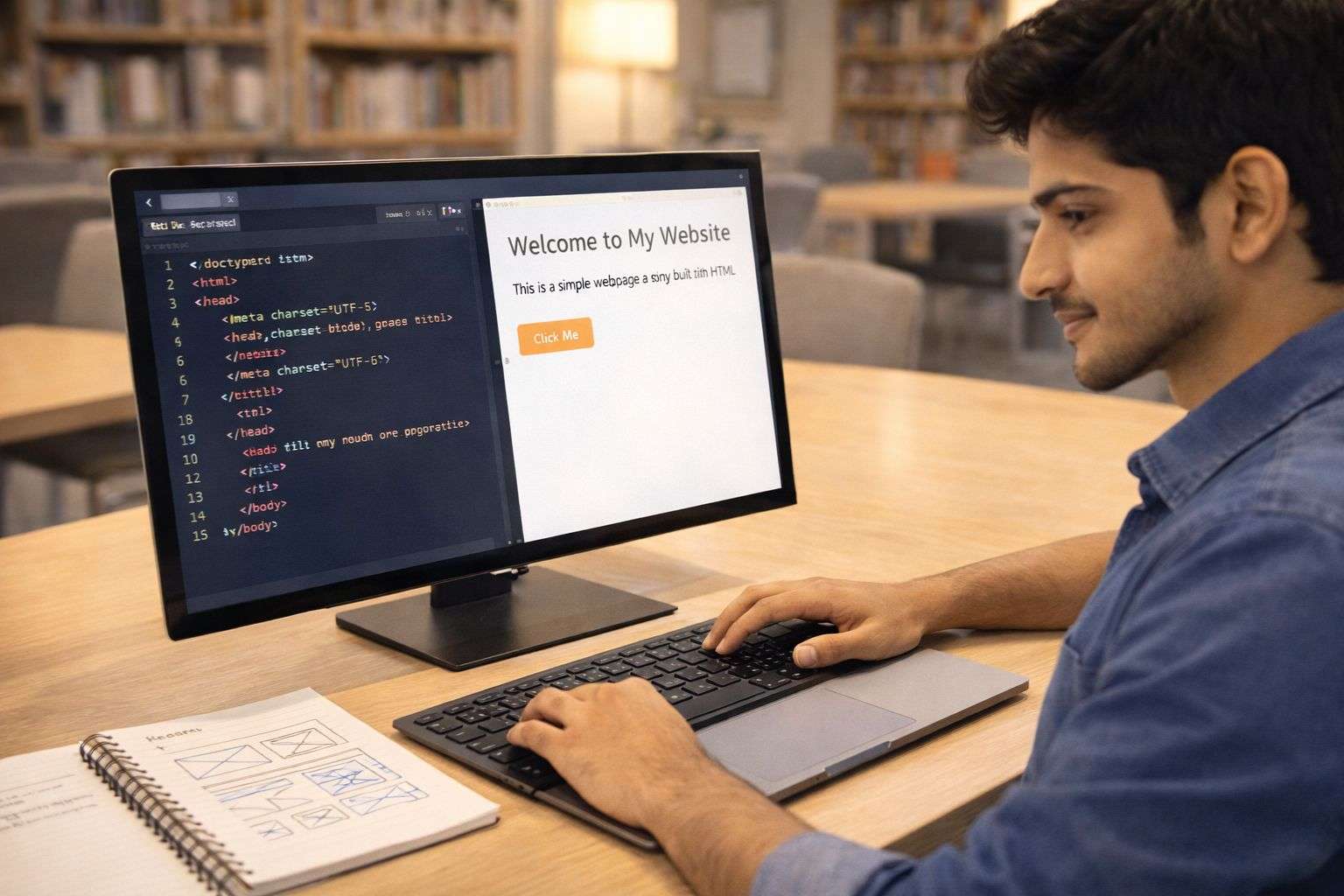
Full stack developer roadmap India 2026 stage 1 — student building first webpage with HTML and CSS
Start here. Not with React. Not with Node. Not with any framework or library.
HTML and CSS first.
This is the stage most students want to skip because it feels too basic. Every student who skips it pays for it later when they cannot understand why their React components look broken or why their styled components are not behaving as expected. The browser is where users experience your application. Understanding how the browser renders HTML and applies CSS is the foundation everything else is built on.
What you need to build by the end of Stage 1 is simple but specific. A complete multi-page static website built from scratch — no templates, no frameworks, no shortcuts. A personal portfolio website is ideal. It has a navigation bar, multiple sections, a contact form, and responsive design that works on both desktop and mobile screens.
That project — built entirely with raw HTML and CSS — tells you whether you genuinely understand the fundamentals or whether you just know how to follow along with tutorials.
Free resources for Stage 1: The Odin Project’s Foundations course covers HTML and CSS comprehensively and is completely free. freeCodeCamp’s Responsive Web Design curriculum is also excellent. Both are project-based rather than lecture-based, which is the right way to learn this stage.
🔗 Visit: theodinproject.com | freecodecamp.org
Stage 2 of the Full Stack Developer Roadmap India 2026 — JavaScript Fundamentals — Weeks 5 to 10
JavaScript is the language of the web. Everything that makes a webpage interactive — form validation, dynamic content updates, API calls, animations — is built with JavaScript. And it is also the language of Node.js on the backend — which means investing in JavaScript fundamentals pays double returns across the full stack.
But here is the mistake most students make at this stage. They rush toward a JavaScript framework — React specifically — before they have genuinely solid JavaScript fundamentals. Then they spend months building React applications without understanding why the patterns they are using work the way they do. That surface-level understanding falls apart in technical interviews where interviewers probe for genuine JavaScript knowledge rather than React usage patterns.
Spend six weeks on pure JavaScript before you touch any framework. Variables, data types, functions, arrays, objects, loops, conditionals — the basics. Then closures, callbacks, promises, and async/await — the concepts that underpin modern JavaScript development and that Indian technical interviewers consistently ask about. Then DOM manipulation — how JavaScript interacts with HTML to make pages dynamic.
Build one project using only vanilla JavaScript with no frameworks — a todo application, a weather app using a public API, a simple quiz. That project proves to yourself and to interviewers that your JavaScript knowledge is genuine rather than framework-dependent.
What the full stack developer roadmap India 2026 requires you to know in JavaScript: The concept of asynchronous programming — why it exists and how promises and async/await solve the problem it creates — is tested in virtually every full stack developer technical interview at Indian companies. Understand it genuinely. Not just how to write the syntax. Why it works the way it does.
🔗 Visit: javascript.info — the most comprehensive free JavaScript resource available anywhere.
Stage 3 of the Full Stack Developer Roadmap India 2026 — React Frontend — Weeks 11 to 18
Now — and only now — React.
React is the most widely used frontend framework in Indian full stack job descriptions in 2026. It is how the majority of Indian product companies and startups build their user interfaces. Learning it after building a solid HTML, CSS, and JavaScript foundation means you will understand why React makes the choices it does — which makes you both a better React developer and a better interview candidate.
What React proficiency means at the fresher level in India in 2026 is being able to build a complete multi-page web application using React components, manage application state using React hooks, fetch data from an API and display it dynamically, and handle routing between different pages using React Router.
The project goal for Stage 3 is a complete React application connected to a real public API. A movie search app. A weather dashboard. A news aggregator. The specific topic does not matter. The technical requirements do — components, state management with hooks, API integration, and routing. That combination covers the React skills that Indian companies test for in full stack fresher interviews.
Free resources for Stage 3: React’s own official documentation — updated and genuinely excellent for 2026. The Odin Project’s React curriculum. freeCodeCamp’s Front End Development Libraries certification.
Stage 4 of the Full Stack Developer Roadmap India 2026 — Backend with Node.js and Express — Weeks 19 to 26
The backend is where the logic lives. User authentication. Business rules. Data processing. Communication with databases. All of this happens on the backend — and understanding it is what separates a full stack developer from a frontend developer.
Node.js lets you use JavaScript on the server — which means students who have invested in JavaScript fundamentals can move into backend development without learning a completely new language. That continuity is one of the reasons the JavaScript full stack combination is so popular among self-taught and course-taught developers in India.
Express is the most widely used Node.js framework for building web server backends and REST APIs. It is lightweight, flexible, and appears in more Indian full stack job descriptions than any other Node.js framework.
What backend proficiency means at the fresher level is being able to build a REST API with Express that handles the four fundamental operations — Create, Read, Update, Delete — against a database. Being able to implement basic user authentication using JWT tokens. And being able to handle errors gracefully and return meaningful error responses to the frontend.
The project goal for Stage 4 is a complete REST API that the React frontend you built in Stage 3 can connect to. Turning a static React application into a dynamic full stack application — where the frontend fetches real data from a backend you built — is one of the most satisfying moments in this entire learning journey. It is also exactly what Indian full stack developer interviews ask candidates to demonstrate.
Stage 5 of the Full Stack Developer Roadmap India 2026 — Databases — Weeks 27 to 32
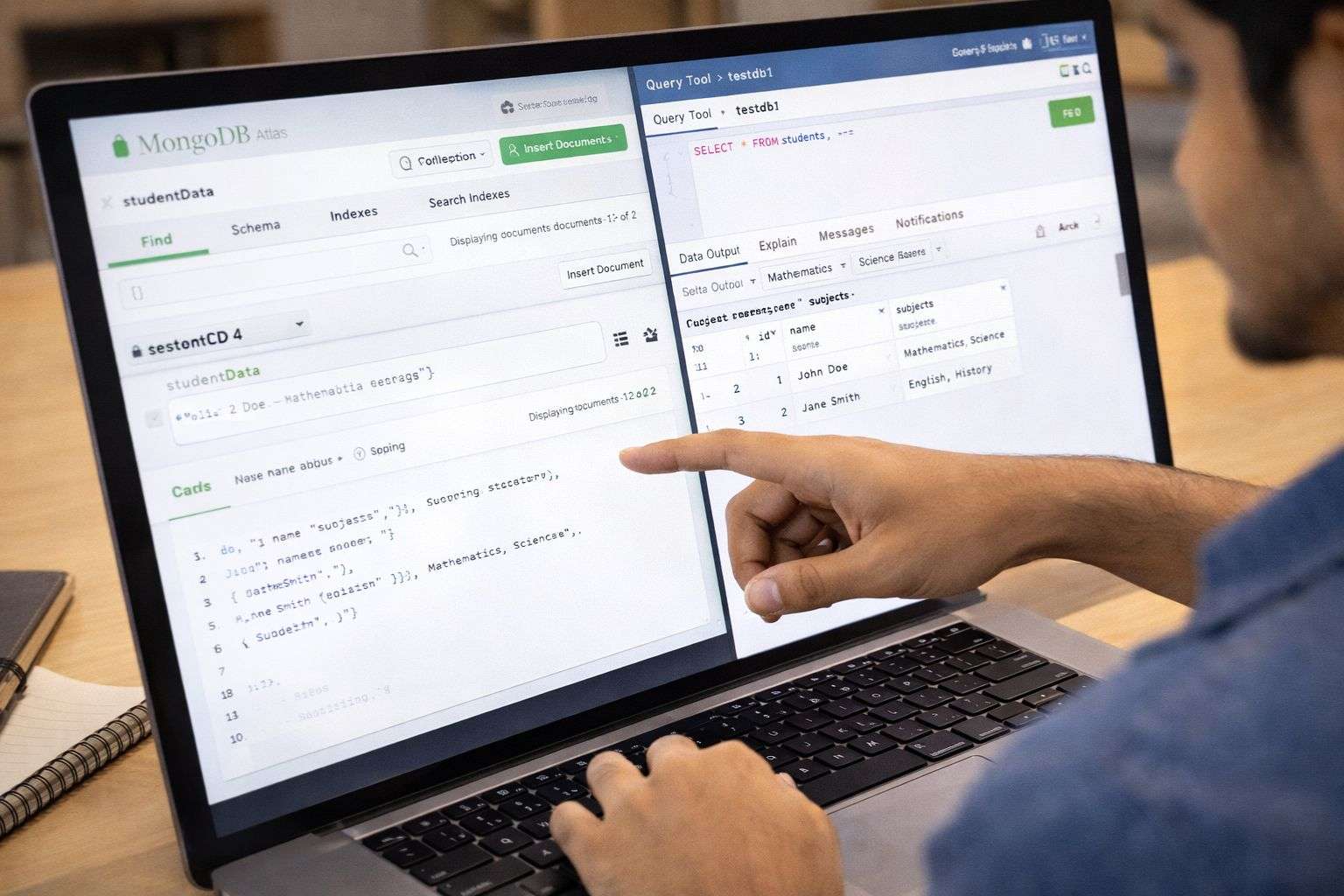
Full stack developer roadmap India 2026 stage 5 — student comparing MongoDB and PostgreSQL databases
Every application needs to store data somewhere. Understanding databases — how they work, how to design them well, and how to query them efficiently — is a core full stack developer skill that Indian technical interviewers test consistently.
There are two broad categories of databases that a full stack developer in India in 2026 should understand. Relational databases — like PostgreSQL and MySQL — store data in structured tables with defined relationships between them. They use SQL for querying. Non-relational databases — like MongoDB — store data in flexible document formats without requiring a fixed schema.
SQL is non-negotiable. It is the most consistently tested database skill in Indian full stack developer interviews. Being able to write JOIN queries, GROUP BY queries, subqueries, and basic database schema design is expected at the fresher level across virtually every company.
MongoDB is worth learning as your second database — particularly if you are building on the MERN stack — but should not replace SQL knowledge. Indian companies that use MongoDB for their product databases still expect their developers to understand relational database concepts.
The project integration goal for this stage is connecting your backend API to a real database — storing user data, retrieving it efficiently, and designing a schema that makes sense for your application’s needs.
🔗 Related Read: Data Science Career Roadmap India 2026
Stage 6 of the Full Stack Developer Roadmap India 2026 — Build a Complete Project and Deploy It — Weeks 33 to 40
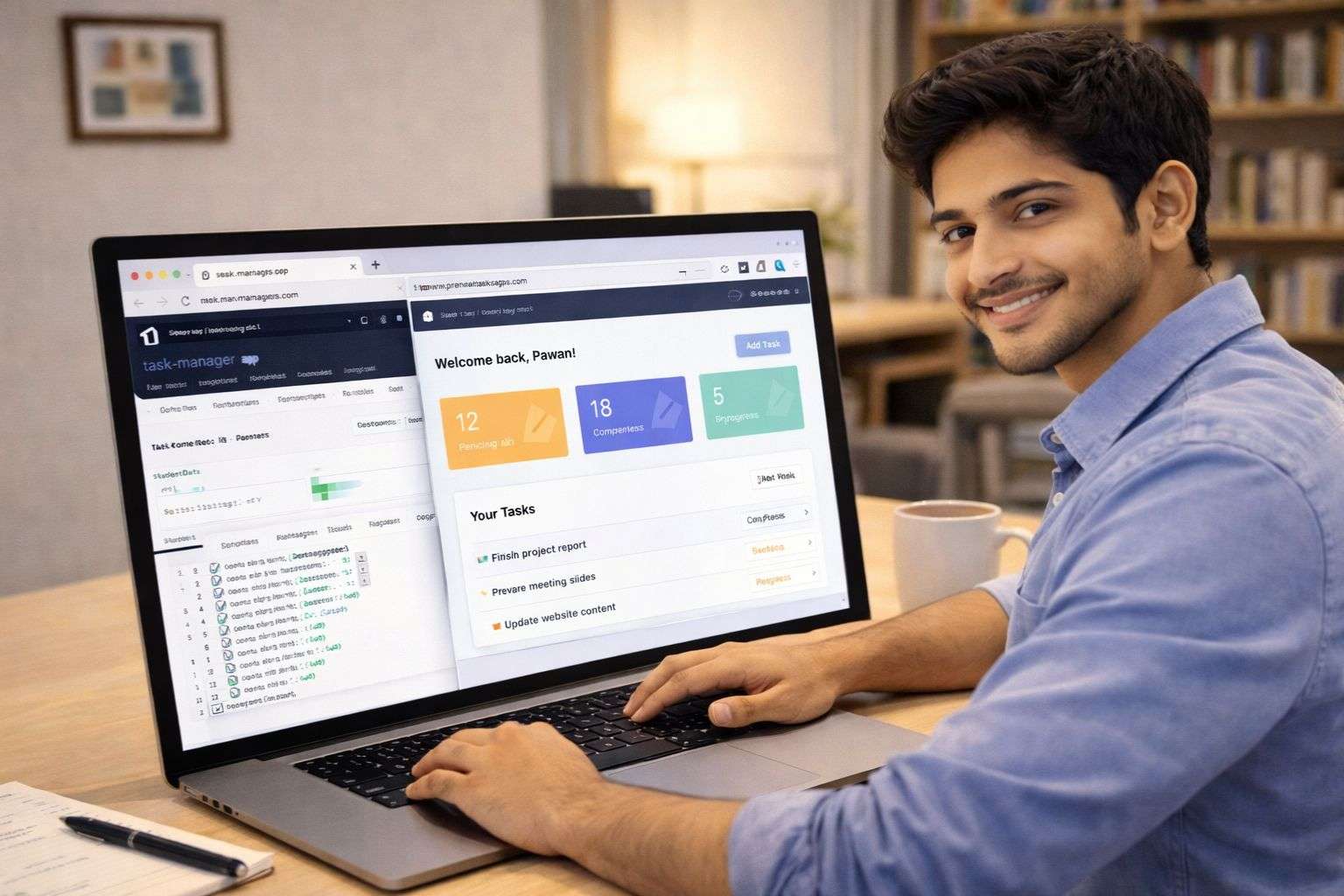
Full stack developer roadmap India 2026 stage 6 — student with deployed full stack application live
This is the stage that separates students who are learning full stack development from students who are ready to work as full stack developers.
Building a complete, deployed, publicly accessible full stack application is the single most powerful portfolio piece available to a fresher targeting full stack developer roles in India in 2026. It demonstrates every skill in the roadmap simultaneously — frontend, backend, database, and deployment — in a way that no certificate and no incomplete project can.
The project requirements for a portfolio-worthy full stack application are specific. A React frontend deployed and publicly accessible. A Node.js and Express backend connected to a database — either MongoDB or PostgreSQL. User authentication — registration, login, and protected routes. At least three complete features that demonstrate real application functionality. Clean, readable code pushed to a public GitHub repository with a comprehensive README.
The specific type of application matters less than the completeness and quality of execution. A task management application built completely is worth more than an ambitious social media platform that is half-finished.
Deployment is specifically important. Indian full stack developer interviewers increasingly ask candidates to share a link to their deployed project rather than just a GitHub link. Being able to say “here is the live application — you can create an account and try it right now” during an interview is a powerful differentiator.
Free deployment options for student projects include Vercel for React frontends, Render for Node.js backends, and MongoDB Atlas for databases. All offer free tiers that are sufficient for portfolio projects.
🔗 Visit: vercel.com | render.com | mongodb.com/atlas 🔗 Related Read: GitHub Profile for Indian Students 2026
What Full Stack Developer Roles Pay in India in 2026
Let me give you honest salary numbers from actual offer letters rather than the inflated figures that coding bootcamp advertisements use.
At large IT service companies — TCS Infosys Wipro Full stack developer roles at service companies for freshers fall within the standard fresher salary band — ₹3.5 to ₹7 LPA depending on which profile track you join. The work involves building and maintaining web applications for enterprise clients.
At Indian product companies and funded startups This is where full stack developer salaries become genuinely compelling for freshers. Companies like Zoho, Freshworks, Razorpay, Groww, and similar product companies offer ₹8 to ₹18 LPA for strong fresher full stack developer candidates with genuine portfolio evidence.
At global product companies with India presence Amazon, Microsoft, Google, and similar global companies hiring full stack developers in India offer ₹18 to ₹35 LPA for exceptionally strong fresher candidates. The bar is significantly higher and requires both strong algorithmic ability alongside full stack skills.
At early-stage startups Salary varies enormously — from ₹4 to ₹15 LPA. The lower end comes with equity that may or may not be valuable. The learning and responsibility at early-stage startups is often significantly higher than at service companies at equivalent salary levels.
🔗 Related Read: Fresher Salary in India 2026 🔗 Related Read: Top 10 IT Companies in India Hiring Freshers in 2026
Where to Find Full Stack Developer Jobs in India in 2026
The platforms that work best for finding full stack developer roles for freshers in India are different from the general job search platforms.
LinkedIn is the most effective platform for full stack developer job searching in India in 2026. Product companies and startups post full stack roles here before they appear anywhere else. Use the job filter — entry level, full stack developer or software engineer, India — and apply within twenty-four hours of a listing going live.
Wellfound and AngelList have a disproportionately high concentration of full stack developer roles at Indian startups. Startups building products need full stack developers more urgently than any other engineering role — and they hire from these platforms actively.
Company career pages directly — particularly for companies like Zoho, Freshworks, Razorpay, and similar product companies — are worth checking monthly. Many product companies post full stack developer roles exclusively on their own career pages rather than on general job boards.
GitHub is increasingly functioning as a passive job search tool for full stack developers. Recruiters at Indian product companies actively search GitHub for candidates with real project repositories in the technologies they use. A well-maintained GitHub profile with a complete deployed full stack project makes you findable without you needing to apply anywhere.
🔗 Related Read: LinkedIn Profile Tips for Students India 2026 🔗 Related Read: Remote Jobs for Freshers in India 2026
Three Mistakes That Derail Students on the Full Stack Developer Roadmap for Freshers India 2026
Mistake 1 — Framework first, fundamentals never. Starting with React before genuinely understanding HTML, CSS, and JavaScript is the most common and most damaging mistake on this roadmap. Framework knowledge built on weak fundamentals collapses in technical interviews. Build the foundation first. The framework makes sense after that.
Mistake 2 — Tutorial dependency without independent building. Watching tutorials and building along with them feels like learning. It is not the same as learning. The real test of whether you have learned something is whether you can build it independently without the tutorial running in the background. After every tutorial — close it. Build the same thing again from scratch without looking at it. That exercise is where genuine learning actually happens.
Mistake 3 — Building projects but not deploying them. A GitHub repository that requires someone to clone it, install dependencies, and run it locally to see what it does is a significantly weaker portfolio piece than a deployed application with a live link. Deploy everything you build. It is free, it is not technically difficult, and it immediately makes your portfolio more impressive to every interviewer who looks at it.
Read These Next-
- 📌 Data Science Career Roadmap India 2026
- 📌 Artificial Intelligence Career in India 2026
- 📌 Python vs Java vs C++ for Indian Students 2026
- 📌 GitHub Profile for Indian Students 2026
- 📌 Top Tech Skills Employers Look for in Freshers in India 2026
- 📌 Best Free Online Courses for IT Students in India 2026
- 📌 Fresher Salary in India 2026
- 📌 Top 10 IT Companies in India Hiring Freshers in 2026
- 📌 Remote Jobs for Freshers in India 2026
- 📌 LinkedIn Profile Tips for Students India 2026
FAQs — Full Stack Developer Roadmap India 2026
FAQ 1 — How long does the full stack developer roadmap actually take for an Indian student starting from basic programming knowledge in 2026 and is it realistic to complete before final year placements?
This is the most practically important question on this list and I want to give you a genuinely honest answer rather than the optimistic timelines that coding bootcamp advertisements typically offer.
The full stack developer roadmap I have described above — from HTML foundations through a complete deployed project — takes approximately eight to ten months of consistent daily practice for a student starting with basic programming knowledge. That timeline assumes one to two hours of focused daily practice with genuine project building at each stage rather than passive tutorial consumption.
Students who try to compress this into two or three months through intensive courses almost always arrive at the end with surface-level knowledge that falls apart under technical interview questioning. The depth comes from building things independently at each stage — which requires the time to get stuck, figure things out, and build genuine problem-solving confidence. That process cannot be meaningfully compressed.
For a final year student whose campus placement season starts in August or September the practical implication is clear. If you are currently in your second year — start today and you will have a genuine full stack portfolio ready before your placement season begins. If you are currently in your third year — start today and you will have a partial but genuinely useful portfolio ready. If you are in your final year with placements starting in three months — be honest with yourself about what is achievable and focus your energy on the stages most relevant to the specific roles you are targeting.
For service company roles at TCS, Infosys, and Wipro — Stage 2 JavaScript fundamentals and basic backend understanding is sufficient alongside strong aptitude preparation. For product company and startup full stack roles — you need Stages 1 through 6 genuinely completed with a deployed project as evidence.
Consultant’s note — The students I have helped get full stack developer roles at Indian product companies in 2026 almost all started their preparation in their second or early third year.
The ones who tried to build full stack credentials in the last four months before placements consistently got service company offers rather than product company ones — not because they were less capable but because four months is genuinely not enough time to build the portfolio depth that product companies evaluate. Start early. The roadmap is achievable. It just requires the time it requires.
FAQ 2 — Should an Indian student learn the MERN stack or the Python Django stack for full stack development in 2026 and which one leads to better job opportunities?
This is one of the most debated questions in Indian developer communities right now and I want to give you a practical answer based on actual job market data rather than framework preference opinions.
Both stacks are genuinely well-represented in Indian full stack job listings in 2026. The right choice depends on your existing skills and your target company type rather than on which stack is objectively superior.
The MERN stack — MongoDB, Express, React, Node.js — appears in more total full stack job listings in India in 2026 than any other combination. This is primarily because JavaScript’s ability to run on both frontend and backend makes it the most accessible entry point for self-taught developers and the most commonly taught stack in bootcamps and online courses. If you are starting from scratch with no existing programming background the MERN stack offers the advantage of learning one language — JavaScript — that applies across the entire stack.
The Python and Django or Flask stack appears significantly in job listings at data-heavy companies, analytics firms, AI-adjacent startups, and fintech companies where Python is already used for data science work. If you have existing Python skills from data science or scripting work the Python full stack path leverages that existing knowledge rather than requiring you to learn a new language.
It also positions you well at the intersection of full stack development and data engineering — a particularly valuable combination in India’s current market.
The honest recommendation for most Indian students in 2026 is to choose based on your existing strongest language.
If you have invested in Python through data science or scripting preparation — the Python full stack path leverages that investment. If you are starting fresh with no strong language preference — the JavaScript full stack path gives you the widest range of total job opportunities in the Indian market.
Consultant’s note — I have placed students in full stack roles through both paths with roughly equal success rates. The stack matters less than the depth of the student’s understanding of whichever stack they choose. A student with genuinely deep MERN stack knowledge will always outperform a student with shallow knowledge of both stacks in a technical interview. Depth in one beats surface familiarity in two. Every time.
FAQ 3 — What does a full stack developer technical interview at an Indian product company or startup actually look like in 2026 and how is it different from service company interviews?
This is the question most students do not think to ask until they are sitting in the interview — which is too late to adjust their preparation accordingly. The difference between product company and service company full stack developer interviews is significant and affects how you should prepare.
At large IT service companies — TCS, Infosys, Wipro — the full stack developer technical interview at the fresher level focuses primarily on concepts rather than live coding. OOP principles, database basics, basic JavaScript or Java knowledge, and your final year project are the primary evaluation areas. The bar is calibrated for freshers and the depth required is moderate. A student who has completed Stages 1 through 4 of this roadmap and built one good project will be well-prepared for this type of interview.
At Indian product companies and funded startups the technical interview for a full stack developer role is significantly more rigorous. You will almost certainly be asked to write actual code — either on a shared coding platform where the interviewer can see you work in real time, or through a take-home assignment completed before the interview. The questions test genuine understanding rather than conceptual familiarity. You may be asked to build a small feature, debug broken code, explain a design decision in your existing project, or walk through how you would architect a simple system.
The communication dimension also differs. Service company interviews evaluate whether you can answer technical questions correctly. Product company interviews evaluate whether you can think out loud about technical problems — explaining your reasoning, considering trade-offs, asking clarifying questions, and arriving at a solution collaboratively. That difference requires deliberate practice — specifically the practice of verbalising your thinking while you code, not just producing code silently.
Consultant’s note — The preparation gap I most consistently observe between students who get service company full stack offers and those who get product company full stack offers is exactly this — the ability to think out loud while solving a technical problem. Service company interview preparation builds the habit of knowing answers.
Product company interview preparation requires building the habit of thinking visibly. Both are learnable. But they require different practice formats. Mock interviews where you talk through every decision as you make it are the only preparation that genuinely builds the second skill.
Your Full Stack Developer Roadmap for freshers india Action Plan — Start This Week
The full stack developer roadmap India 2026 is eight to ten months of consistent daily work. Here is how to start this week regardless of where you currently are.
If you are in first or second year — Open The Odin Project today. Create a free account. Start the Foundations curriculum from the very beginning. Solve one HTML exercise before you close your laptop today. That single action begins the journey that eight months from now produces a deployed full stack application that gets you noticed in interviews.
If you are in third year — Honestly assess which stage of this roadmap you are currently at. If you have not started — start Stage 1 today with The Odin Project. If you have done some HTML and CSS — build the complete static portfolio website project that Stage 1 requires before moving to JavaScript. If you have JavaScript basics — start building a vanilla JavaScript project this week before touching React.
If you are in final year — Identify the two or three stages most relevant to your target companies and focus entirely on those. For service company targets — strong JavaScript fundamentals and basic backend understanding. For product company targets — a complete deployed project however simple is your most urgent priority. Deploy something this week even if it is imperfect.
The full stack developer roadmap India 2026 rewards students who build consistently over time rather than those who study intensively for short bursts. Start today. Build something every week. Deploy everything you build. Your portfolio is your proof — and proof is what gets full stack developer offers at good Indian companies in 2026.
Completing the career roadmap series? Read our guides on Data Science Career Roadmap India 2026 and Artificial Intelligence Career in India 2026 to understand how full stack development connects to the broader technology career landscape in India.





5 Comments