Here Is the Exact 6-Month AI Career Roadmap for BTech Freshers to ₹7 LPA+ ML Roles in India in 2026
An AI career roadmap for BTech freshers is the most searched career topic among Indian engineering students right now — and most of what you find online is either outdated, generic, or written by someone who has never sat across from a hiring manager.
For 27 years, I have counselled students from Bhubaneswar, Sambalpur, Rourkela, and dozens of Tier-2 cities across India. I have seen students with 6 pointers land ₹8 LPA roles. I have seen 9-pointer students struggle for 14 months because they prepared the wrong way.
This blog is not a motivational pep talk. It is a month-by-month plan. Follow it and you give yourself a real shot at an ML job offer before your BTech result card even dries.
Why the AI Career Roadmap for BTech Freshers Cannot Wait Until Final Year
Here is the number that should change how you think today.
India’s AI and ML job market is expected to host over 1 million AI and ML roles by 2026, with average salary growth running at 15–20% year on year.
That demand is already here. Companies are not waiting for postgraduates. They are hiring BTech freshers who can demonstrate one thing — the ability to actually build something with AI.
And here is the part that stings a little.
General CSE graduates at service companies start at ₹4–6 LPA. Graduates who have a verified AI and ML specialisation or portfolio are already starting at ₹8–14 LPA at product companies.
That difference at age 22 adds up to lakhs over just three years.
The AI career roadmap for BTech freshers I am giving you here is built on one idea — skills and proof beat marks and luck every single time.
Consultant’s Note: I have placed students from non-IIT colleges in ₹7 LPA+ AI roles in 2025 and 2026. Not because they were the smartest. But because they started early, built something real, and could talk about it with confidence. That is what this roadmap trains you to do.
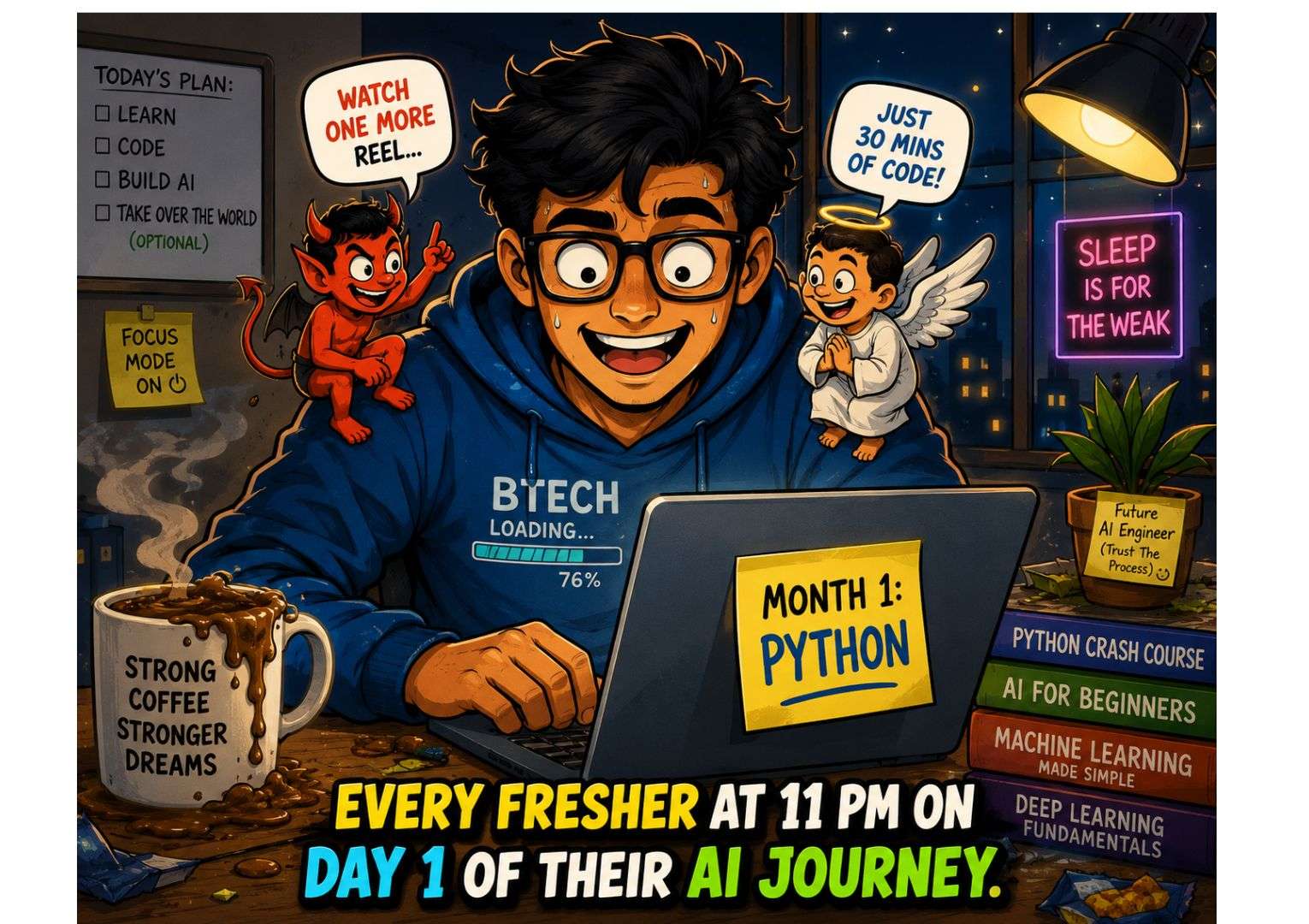
Month 1 — Build Your Python Foundation on the AI Career Roadmap
Python is the language of machine learning. No shortcuts here.
But here is what most students get wrong. They spend three months learning Python syntax and never write a single line that does anything useful.
Do not do that.
What to do in Month 1:
Start with the basics — variables, loops, functions, lists, dictionaries. Spend two weeks on this. Use W3Schools Python or freeCodeCamp’s Python course on YouTube.
Then spend the next two weeks on three libraries — NumPy, Pandas, and Matplotlib. These are not optional. Every ML job uses them daily.
By the end of Month 1 you should be able to load a CSV file, clean messy data, do basic calculations, and plot a simple graph.
That is it. That is the Month 1 goal.
Do not touch machine learning yet. Do not watch tutorials on neural networks. Just master these basics.
If you are wondering which branch qualifies for this roadmap, the answer is all of them. ECE, Mechanical, Civil, IT, CSE. Python does not ask for your marksheet. See how to align your data science career path with your background here.
Consultant’s Note: Every student I have mentored who tried to skip Python basics and jump to ML directly ended up coming back two months later to fix the foundation. Build it once, build it right.
Month 2 — Statistics and Math That Actually Matters for ML
This is the month most students skip. And it is the reason most students fail ML interviews.
You do not need a maths degree. But you need to understand five concepts clearly.
The five concepts:
- Mean, Median, Mode, Standard Deviation — how data behaves
- Probability basics — what the chance of something happening actually means
- Correlation — how two things relate to each other
- Normal Distribution — why most ML models assume bell-curve data
- Linear algebra basics — vectors and matrices (nothing more than that)
Use StatQuest with Josh Starmer on YouTube. His videos explain ML maths in plain English. No textbooks needed.
Spend 45 minutes every day on this. Watch one StatQuest video. Rewrite what you understood in your own words in a notebook. Do five practice problems.
This is not glamorous. This is what separates candidates who crack ML interviews from those who cannot explain how their own model works.

Month 3 — Core Machine Learning on Your AI Career Roadmap
Now you are ready.
Month 3 is where the AI career roadmap for BTech freshers gets real. This is where you learn the algorithms that power every product you use daily.
What to learn:
- Linear Regression and Logistic Regression — start here, no exceptions
- Decision Trees and Random Forests
- Support Vector Machines — conceptual understanding is enough
- K-Means Clustering for unsupervised learning
- Train-test split, overfitting, underfitting, cross-validation
Use scikit-learn in Python for all of this. It is the industry standard library for classic ML.
The best free course for this is Andrew Ng’s Machine Learning Specialisation on Coursera. Apply for financial aid and you get it free. This is not optional. This is the course that shaped an entire generation of ML engineers globally.
By end of Month 3 you should have built three small projects:
- A house price predictor using Linear Regression
- A spam email classifier using Logistic Regression
- A customer segmentation model using K-Means
Put all three on GitHub. A blank GitHub profile is the biggest red flag for any hiring manager in 2026.
For how to build and position these projects effectively, also read our guide on fresher resume and LinkedIn strategies for IT roles.
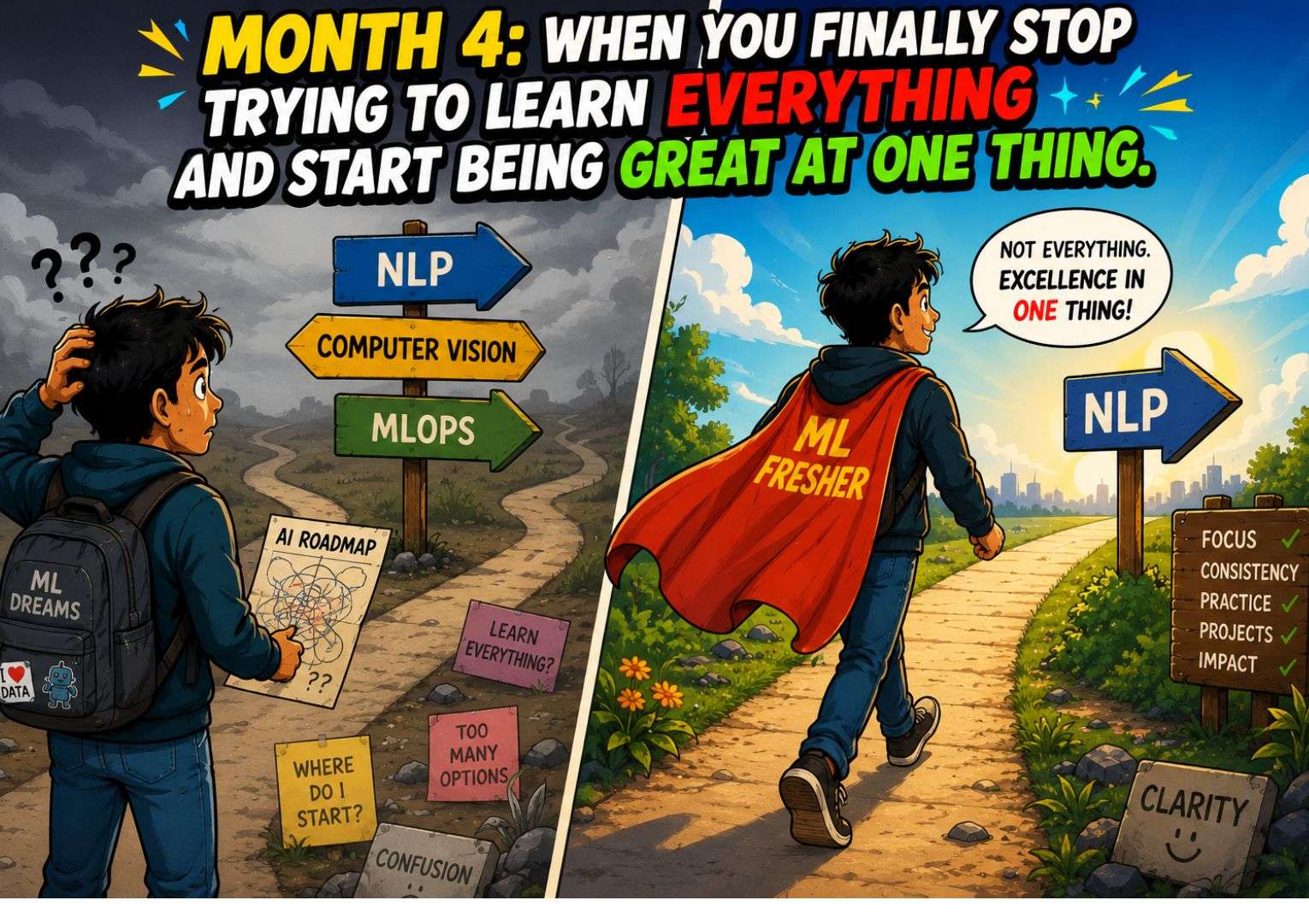
Month 4 — Deep Learning Basics and One Specialisation
This is where you pick your lane.
Deep learning powers image recognition, speech, recommendation systems, and generative AI. You need to understand the basics. But more importantly, you need to pick one area and go deeper.
The three lanes most relevant for Indian freshers in 2026:
- NLP (Natural Language Processing) — best fit if you want to work on chatbots, text classification, and sentiment analysis. Very high demand right now.
- Computer Vision — image classification and object detection. High demand in manufacturing and healthcare.
- Tabular ML and MLOps — structured data prediction. Most jobs in BFSI and retail need this.
Pick one. Do not try to learn all three.
What to learn this month:
- Neural networks and how they actually work
- Activation functions, backpropagation (conceptual)
- Keras and TensorFlow basics OR PyTorch basics
- Build one project in your chosen lane
Skills in Python, TensorFlow, PyTorch, and MLOps can boost ML salaries by 20–35%. This is why Month 4 specialisation matters so much.
Watch this excellent YouTube walkthrough for beginners on deep learning in Python: Deep Learning with Python and TensorFlow — freeCodeCamp.
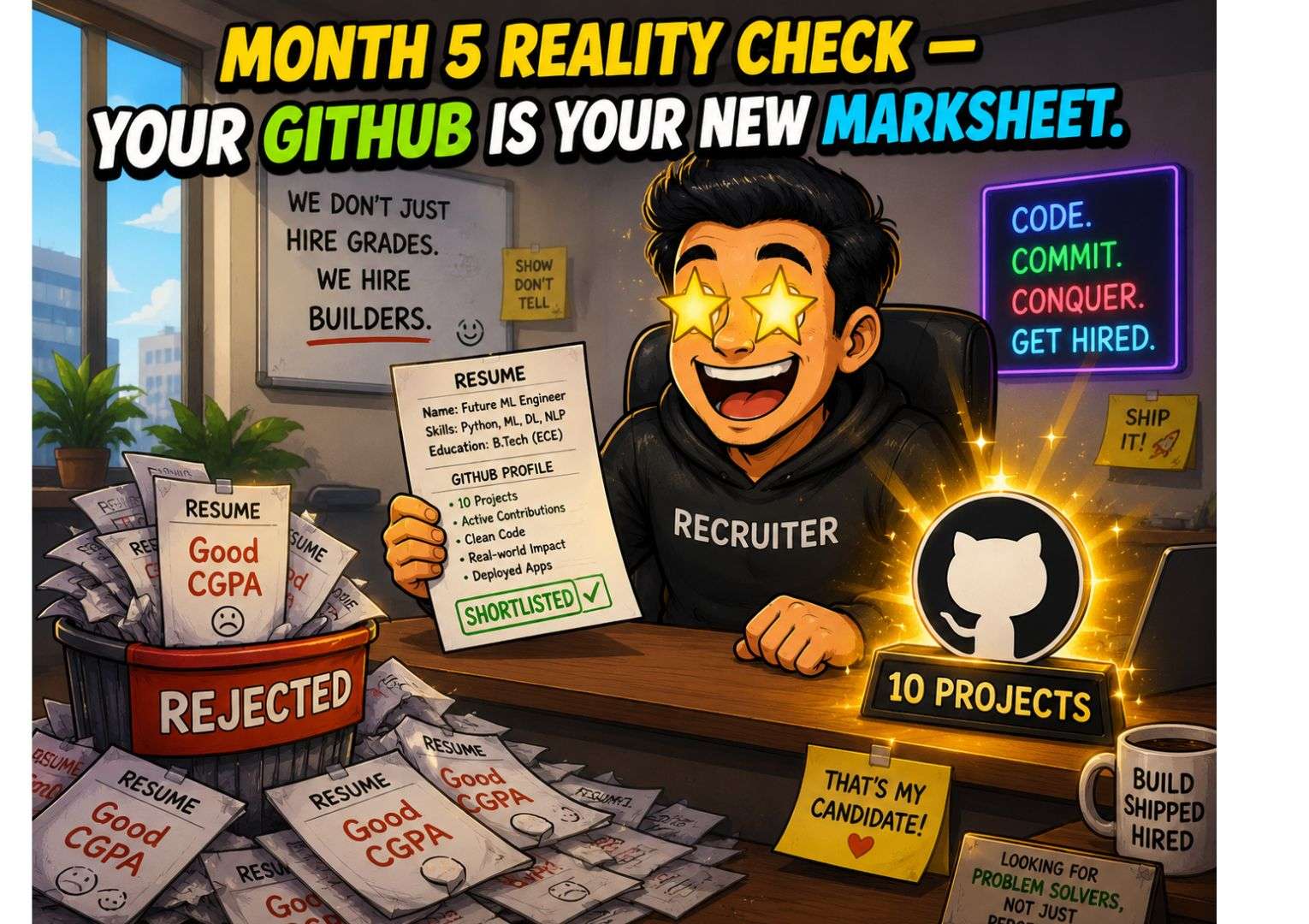
Month 5 — Build a Portfolio Project That Hiring Managers Actually Notice
This is the month that changes everything.
One good project beats 10 certificates. I have seen it happen too many times to count.
Your Month 5 project needs to tick four boxes:
- Real dataset — not a tutorial dataset, not MNIST. Use Kaggle, government open data, or scrape something relevant.
- End-to-end — data collection, cleaning, model building, evaluation, deployment
- Deployed somewhere — even a simple Streamlit app on Hugging Face Spaces counts
- Documented on GitHub — clean README, what the project does, why you built it, what results you got
Good project ideas for Indian freshers:
- Fake news detector using NLP (very relevant in 2026)
- Crop disease identifier from leaf images using CNN
- Bank fraud detection using tabular ML
- Resume screening tool using NLP and scoring logic
- Air quality predictor using regression for Indian metro cities
Write one blog post about your project on LinkedIn. Explain what problem you solved, what you tried, what failed, what worked. Hiring managers read these posts. Recruiters bookmark them.
Portfolios matter more than certifications for raising your salary. Building end-to-end ML systems, LLM applications, and MLOps pipelines is what gets you noticed.
This is also the month to get on LinkedIn properly. Build your profile to show your journey, not just your degree. For a full guide on positioning yourself for AI jobs, read our complete LinkedIn and resume guide for IT freshers.
Month 6 — Interview Preparation and Applying Smart
The final month is about converting preparation into offers.
Most freshers apply to 200 companies randomly and hear nothing. That is not a job search. That is spam.
Apply smart.
Where to apply:
- Product startups — check AngelList, YCombinator jobs, LinkedIn startup filters. These are where ₹7–10 LPA fresher ML offers come from.
- Mid-size IT companies — Sigmoid, Fractal Analytics, Tiger Analytics, Mu Sigma, Bridgei2i all hire fresh ML talent.
- Service companies with AI wings — TCS AI, Infosys AI CoE, Wipro AI teams. Salary is lower (₹4–6 LPA) but it gets your foot in the door.
- Remote global companies — many US and European AI startups hire Indian freshers remotely at dollar salaries.
What the ML interview tests:
- Python coding on a platform like HackerRank or LeetCode (easy to medium level)
- ML concept questions — what is overfitting, explain bias-variance tradeoff, what is regularisation
- Case-based questions — “you have imbalanced data, what do you do?”
- Project walkthrough — they WILL ask you to explain your portfolio project in detail
Practise answering “Tell me about your ML project” out loud for 2 minutes without stopping. Record yourself. Watch it back. This sounds awkward but it works.
Also prepare for aptitude and verbal rounds, especially for service companies. Our guide on cracking IT campus placements as a fresher in 2026 covers this in detail.
What Does a ₹7 LPA+ ML Job Actually Pay in 2026?
Here is the honest picture.
ML and AI freshers in India typically earn ₹5–9 LPA depending on technical skills, project experience, and location.
The typical pay range for a Machine Learning Engineer in India sits between ₹8.9 LPA at the 25th percentile and ₹22.6 LPA at the 75th percentile, with average compensation around ₹14 LPA across all experience levels.
For freshers specifically targeting that ₹7 LPA+ bracket:
- Product companies and funded startups → ₹7–12 LPA for strong portfolios
- Mid-size analytics firms → ₹6–9 LPA with good project experience
- MNCs with AI teams → ₹8–15 LPA at product companies like Google, Microsoft, Amazon
- Service company AI divisions → ₹4–6 LPA, with growth potential after 1–2 years
The ₹7 LPA target is achievable. But it requires the portfolio, the GitHub, and the ability to talk about your work confidently. Without those three, even a 9.5 CGPA will not help.

Three Things That Derail Students on This AI Career Roadmap
I see these mistakes every single week in my counselling sessions.
Mistake 1 — Tutorial Hell
You watch 40 hours of video courses and feel ready. Then you open a blank Python file and freeze. Tutorials give you the feeling of learning without the actual skill. After every tutorial, close the video and build something from scratch. Even if it breaks. Especially if it breaks.
Mistake 2 — Collecting Certificates Instead of Building Projects
A certificate from an online platform tells a recruiter you finished a course. A deployed project tells them you can actually do the work. Do both. But if you have to choose, build the project.
Mistake 3 — Waiting Until Final Year
The students who get ML jobs in campus placements started in their second or third year. The students who start in August of their final year are competing with people who have 18 months of practice. Start now. Not after exams. Not next semester. Now.
Also read our honest breakdown of AI vs data science vs full stack — which is right for you in 2026 before finalising your path.
Your AI Career Roadmap Action Plan — By College Year
If you are in First or Second Year: This week, install Python and complete your first “Hello World” script. Open a free Coursera account. Bookmark the StatQuest YouTube channel. You have time on your side — use it.
If you are in Third Year: This week, finish Month 1 of this roadmap and open your GitHub account today. Upload anything — even a basic Python calculator. Start building the habit.
If you are in Final Year: This week, pick one of the project ideas from Month 5, find the dataset on Kaggle, and start building. Apply for Andrew Ng’s Coursera course with financial aid. Submit one application to a fresher ML role on LinkedIn just to understand what they are asking for.
Regardless of your year: Subscribe to our YouTube channel at cguru.co.in for weekly career videos covering AI jobs, placement updates, and live Q&A sessions for Indian engineering students.
10 FAQs — AI Career Roadmap for BTech Freshers in India 2026
FAQ 1 — Can a non-CS BTech graduate (ECE, Mechanical, Civil) realistically land an ML job by following this roadmap, or is it only for CS students?
Yes — and this is one of the most important things I tell students from non-CS branches every week.
Machine learning does not belong to computer science alone. ECE students already have a strong foundation in signal processing and mathematics, which maps beautifully to ML concepts. Mechanical students who understand data and statistics have gotten into ML roles in manufacturing and predictive maintenance.
Civil students have cracked ML roles in construction tech and real estate analytics. What matters is your Python skill, your portfolio project, and your ability to explain your work. Companies hiring for ML in 2026 care about what you can build, not which department issued your degree.
I have personally placed ECE and Mechanical graduates into data and ML roles over the past three years. Your branch is not the barrier — your preparation is.
Consultant’s Note: I tell non-CS students to lean into their domain advantage. An ECE student who builds an ML model for antenna pattern optimisation will stand out far more than a generic house price predictor. Use your background as differentiation, not as a limitation.
FAQ 2 — What is a realistic CGPA floor for getting an ML job through this roadmap?
There is no universal cutoff, but here is the honest picture. Many large IT companies and MNCs use a 60% or 6.5 CGPA filter during initial screening, so anything below that may screen you out automatically at those companies.
However, product startups, analytics firms, and most mid-size companies in the ML space care far more about your GitHub and your ability to solve a problem than your CGPA. I have seen students with 5.8 CGPA land ₹7 LPA ML roles at startups because their portfolio was strong and they interviewed well.
The roadmap in this blog is specifically designed to build the portfolio and skills that override a low CGPA filter. Focus on the skills. The numbers will do less damage than you think if your project work is strong.
Consultant’s Note: A deployed ML project on Hugging Face Spaces with 200 users tells a recruiter more than a 9.0 CGPA ever will. Build it.
FAQ 3 — Should I do a paid bootcamp or certification to follow this AI career roadmap, or can I do it entirely free?
You can do almost all of this for free. Andrew Ng’s Coursera course has a financial aid option that costs nothing. StatQuest, freeCodeCamp, Kaggle Learn, fast.ai — all free. Hugging Face Spaces to deploy your model — free. GitHub — free. The only thing you cannot get free is time. Invest that instead of money.
Paid bootcamps and certificates can supplement your learning, but they should never replace building actual projects. Some students spend ₹80,000 on a bootcamp and still have an empty GitHub. That is the wrong order. Free resources plus hard project work beat a paid certificate every single time.
Consultant’s Note: If you genuinely want to invest money, spend it on computing time for training models or on a good internet connection to collaborate globally. Not on a shiny certificate.
FAQ 4 — How many hours per day should I realistically spend on this AI career roadmap as a college student?
Two hours on weekdays and four to five hours on weekends is enough to complete this roadmap in six months. That is not a huge number. It is less than the time most students spend on social media daily.
The key is consistency, not intensity. Two focused hours every day beats one 10-hour weekend session followed by four days off. Put it in your calendar as a fixed slot. Treat it like a college class you cannot bunk. Morning slots before college work best — your brain is sharper and there are fewer interruptions.
Consultant’s Note: I ask every student I counsel to show me their GitHub contribution graph after one month. Green squares do not lie. If they are missing, the habit has not formed yet.
FAQ 5 — Which companies in India actually hire BTech freshers into ML roles at ₹7 LPA or above?
Startups and mid-size analytics companies are your best bet as a fresher. Companies like Sigmoid, Fractal Analytics, Mu Sigma, Tiger Analytics, Bridgei2i, Locus.sh, Skit.ai, and dozens of Series A and B funded AI startups regularly hire BTech freshers into ML roles at ₹7–10 LPA.
On the MNC side, TCS iON AI, Infosys BPO AI CoE, and Wipro AI teams also have ML fresher roles, though typically at ₹5–6 LPA. Remote-first global companies are a growing channel — many EU and US AI startups hire Indian freshers at ₹8–12 LPA equivalent for remote roles. Keep an eye on LinkedIn, AngelList, and Instahyre for these postings.
Consultant’s Note: I tell students to follow the LinkedIn company pages of 20 AI startups relevant to their chosen specialisation. When they post a fresher role, you apply that same day. Timing matters more than people think.
FAQ 6 — Is a Masters degree (MTech or MS abroad) necessary to get into ML, or is the BTech plus this roadmap sufficient?
A BTech plus strong portfolio is sufficient to get your first ML role in India in 2026. Companies including Google, Microsoft, Amazon, Infosys, and TCS are running active campus drives for undergraduate students across India. A Masters degree is worth considering after 2–3 years of industry experience when you want to move into research roles or senior positions.
Doing an MTech immediately after BTech without industry experience often delays your career start and adds debt without proportionally increasing your initial offer. Build the skills, get the first job, accumulate real experience, then decide on higher education with an employer who might even fund it.
Consultant’s Note: I have seen students delay their career by two years waiting for IIT MTech admission. Meanwhile their batchmates who started working are now team leads. Industry experience at 22 is worth more than a Masters degree at 24 with zero work experience.
FAQ 7 — What should my GitHub profile look like for an ML job application to stand out?
Your GitHub should have at minimum three to five repositories by the time you apply. Each repo needs a clear README that explains what the project does, what dataset you used, what model you trained, and what results you achieved. Include a screenshot or demo link if possible.
Pin your best four projects at the top. Use a professional GitHub username — ideally your real name. Write commit messages that are readable, not just “update” or “fix.” Recruiters who check GitHub spend less than three minutes on it. Make those three minutes count. A good README is more important than perfect code for a fresher.
Consultant’s Note: I review student GitHub profiles before they apply. The most common problem is four repositories named “ml-project-1,” “ml-project-2,” and all four have a single commit called “initial upload.” That tells a recruiter nothing. Name your project after what it does, not what number it is.
FAQ 8 — How important is LeetCode for ML job interviews compared to ML knowledge?
It depends on the company. Service companies and some MNCs do have a LeetCode-style coding round as part of their ML hiring process. You need to be comfortable with easy-to-medium level problems in Python — arrays, strings, basic data structures.
But pure ML-focused companies and startups care more about your ML knowledge and your project work than competitive programming. Spend 30 minutes a day on LeetCode (2–3 problems) during Month 6 and you will be adequately prepared. Do not let LeetCode obsession eat into your project time. Both matter, but the ML project is your differentiator.
Consultant’s Note: In 27 years, I have never seen a hiring manager reject an ML candidate because they could not solve a Hard LeetCode problem. I have seen many rejected because they could not explain their own project.
FAQ 9 — Should a BTech fresher targeting ML jobs learn cloud (AWS, GCP, Azure) as part of this roadmap?
Basic cloud knowledge is a strong bonus in 2026 — not a hard requirement for your first ML role, but it will significantly improve your chances. Cloud skills on AWS, Azure, or GCP for deploying and scaling AI models are essential for enterprise-level ML projects.
If you have time after completing the six months, spend two weeks on AWS SageMaker or Google Cloud Vertex AI basics. Even deploying your portfolio project on a cloud platform instead of just Hugging Face Spaces gives your resume a visible edge. For a full cloud learning roadmap, read our cloud computing career guide for Indian students.
Consultant’s Note: A student who can say “I deployed my ML model on AWS SageMaker and it handles 500 predictions per day” in an interview is in a completely different conversation than one who only trained a model locally.
FAQ 10 — What if I am already in my final semester and have only 3 months instead of 6? Can I still follow this roadmap?
Yes. Compress Months 1 and 2 into one month of intense daily study. Then follow Months 3 and 4 together, focusing only on your chosen specialisation lane. Use all of Month 3 to build one strong portfolio project instead of three small ones. And spend the final month entirely on applications and interview prep.
Three months of focused preparation is still far better than eight months of random watching and no building. The students who surprise me the most are the ones who start late but make every hour count. Also register on platforms like Instahyre, Cutshort, and LinkedIn Jobs with “actively looking” turned on so recruiters find you.
Consultant’s Note: I have placed students in their first ML role with just 90 days of preparation. The roadmap was compressed, not compromised. Quality of practice matters more than duration.
Watch These to Stay on Track
Two YouTube resources I recommend every student bookmark right now:
📺 Machine Learning for Beginners — Andrew Ng (Stanford, YouTube) — The clearest explanation of how ML actually works. Watch this in Week 1 of Month 3 before you touch a single line of Scikit-learn.
📺 Python for Data Science — Full Course (freeCodeCamp YouTube) — A 12-hour free course covering Python, NumPy, Pandas, and Matplotlib. This is your Month 1 resource.
Read These Next on cguru.co.in
- Cloud Computing Career Roadmap for Indian Students 2026
- Full Stack Developer Career Roadmap for Indian Freshers
- Data Science Career Guide for Engineering Students in India
- How to Crack TCS NQT 2026 — Complete Guide
- Infosys InfyTQ Preparation Strategy for BTech Students
- Resume and LinkedIn Guide for IT Freshers in India 2026
This blog was written by Aslam Rahman, IT career consultant with 27 years of experience in IT hiring, training, and mentoring across India. Based in Bhubaneswar, he has counselled thousands of engineering students from Tier-2 cities on navigating IT placements, AI roles, and career development. For personalised career guidance, visit cguru.co.in or explore our career counselling services.