
Placement Season Guide October December — What a 27-Year IT Career Consultant Tells Final-Year Students to Do, Week by Week
This placement season guide October December is the one I wish every final-year student in Odisha had in hand on the first of October.
Let me tell you why.
A few years ago, a BTech student from Berhampur walked into my Bhubaneswar office in the first week of October. I’ll call him Rakesh. He had a 7.4 CGPA, no backlogs, and a calm face. He told me he would “start seriously after the Puja break.”
I asked to see his resume. The file was named “resume final final 2.” It was two pages long. His project section said “Developed a web application using modern technologies.”
I asked him what the project did. He took almost a minute to explain it.
That is not a bad student. That is a student who has not yet been asked the right questions. And October is exactly when those questions start arriving, whether you are ready or not.
We sat down and made a simple twelve-week plan. Nothing fancy. He got his first offer in the third week of November. Not a dream company. A decent one. More important, he walked into the next drive without shaking.
This blog is that same placement season guide October December plan, written for you. Read this placement season guide October December once fully. Then keep it open on your phone for the next three months.
Why the Next Twelve Weeks Matter: Placement Season Guide October December
In most colleges I work with across Odisha, a large share of campus drives happen between October and December. Not all of them. Some colleges start in August. Some run drives until March. But the pace picks up in these three months, and that is what catches students off guard.
You will have a company test on Monday. A college internal on Wednesday. An interview on Friday. And your mother asking if you ate.
So a placement season guide October December has to be about rhythm, not just preparation. You cannot study for twelve hours a day for twelve weeks. Nobody can. What you can do is a steady, small routine that does not break when life gets busy.
Here is how a typical drive runs. The company does a pre-placement talk. Then comes an online test with aptitude and sometimes coding. Shortlisted students go to a technical interview. Then an HR round. Results come the same day or a few days later.
Every company does it a little differently. If you are targeting a specific one, read our guides on the Capgemini hiring process and TCS Digital vs TCS Ninja before you sit for their test.
October in This Placement Season Guide October December: Get Your Base Ready (Weeks 1 to 4)
October is not for sitting every drive. October is for getting ready so that November does not feel like a storm.
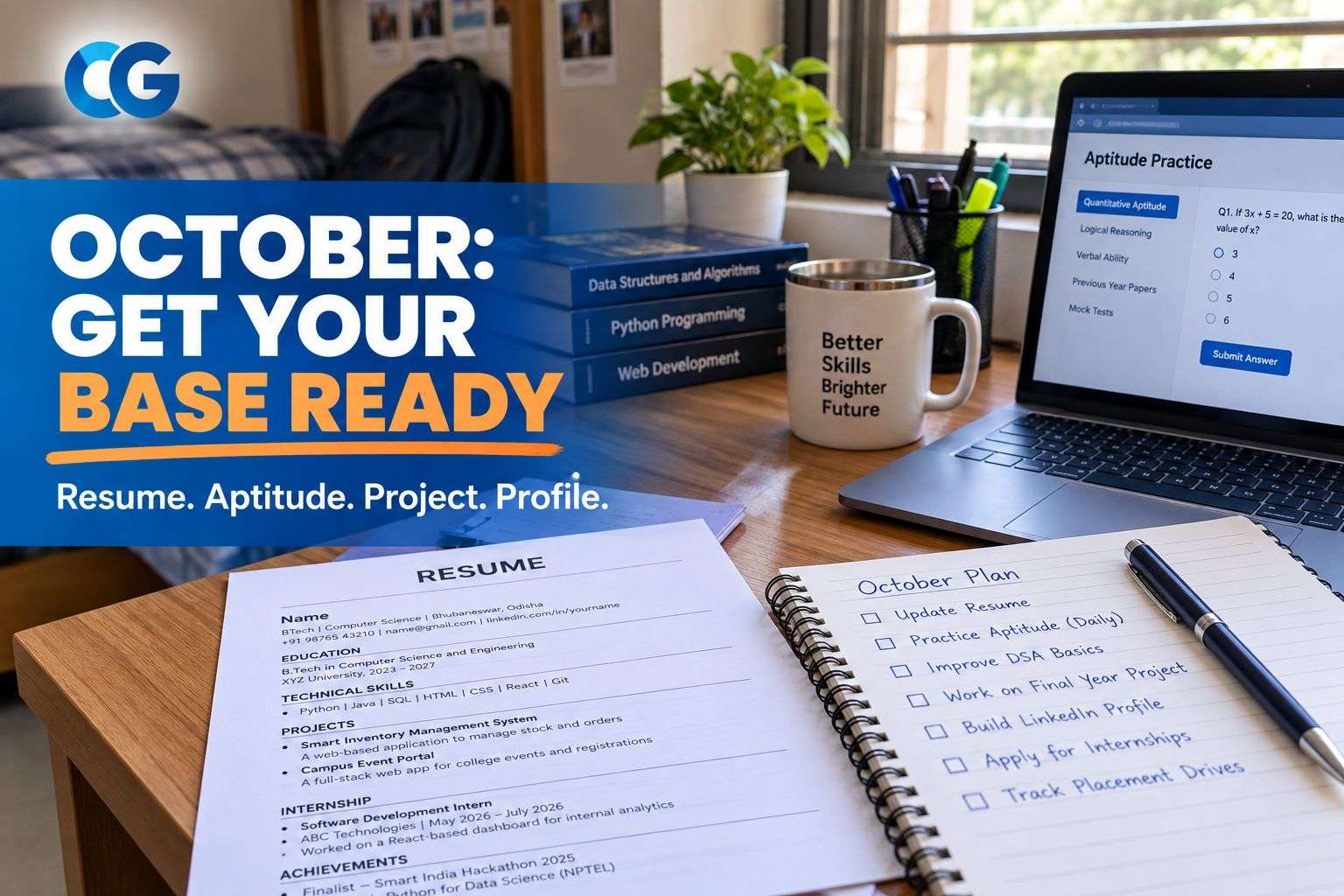
Here is what this placement season guide October December asks you to finish in the first four weeks.
1. Fix the resume. One page. One font. No photo unless the company asks. Put your projects in plain words. Say what the project does, what you built, and what tools you used. Two lines each.
Rakesh’s line changed from “Developed a web application using modern technologies” to “Built a hostel mess feedback app with login, ratings and a weekly report for the warden. Used Java and MySQL.” Same project. Now it sounds like a person made it.
2. Clean up your online profiles. Recruiters do check LinkedIn. Some check GitHub. If you have not touched either, our guides on LinkedIn profile for freshers and GitHub profile tips will take you an afternoon each.
3. Register everywhere. Your college placement portal. Company career pages. The assessment platforms your college uses. Missing a registration deadline is the most painful way to lose a chance. I have seen it happen more times than I can count.
4. Start aptitude today. Forty-five minutes a day. Same time. Quant one day, logical reasoning the next, verbal after that. Most students fail at the first filter, not the interview. Aptitude is the filter.
5. Pick two strong subjects. Interviewers love to ask about what you say you know. Choose two subjects from your branch and get them solid. For CS students, that could be DBMS and OOP. For others, pick the two subjects you scored best in and actually liked.
6. Be able to explain your project in two minutes. Practise it out loud. To a friend. To a wall. To your younger cousin. If you stumble, you do not know it yet.
7. Prepare your “tell me about yourself.” This one question opens almost every interview. Mine has a full guide here: How to Answer Tell Me About Yourself in an IT Interview.
If you want a quick video to see how the whole process fits together, this one walks through aptitude, coding and HR step by step: Placement Preparation, Step by Step.
One small thing about the Puja break. Take it. Rest for two or three days. But set one fixed hour daily, even during the holidays. Keep the habit alive. Students who go fully silent for ten days often take two weeks to get their rhythm back.
November in This Placement Season Guide October December: Drive Weeks (Weeks 5 to 8)
November is when things get real. Companies visit. Tests happen. Some of you will get rejected in the first round. That is normal, and I will say more on it below.
First, a few habits from this placement season guide October December that help.
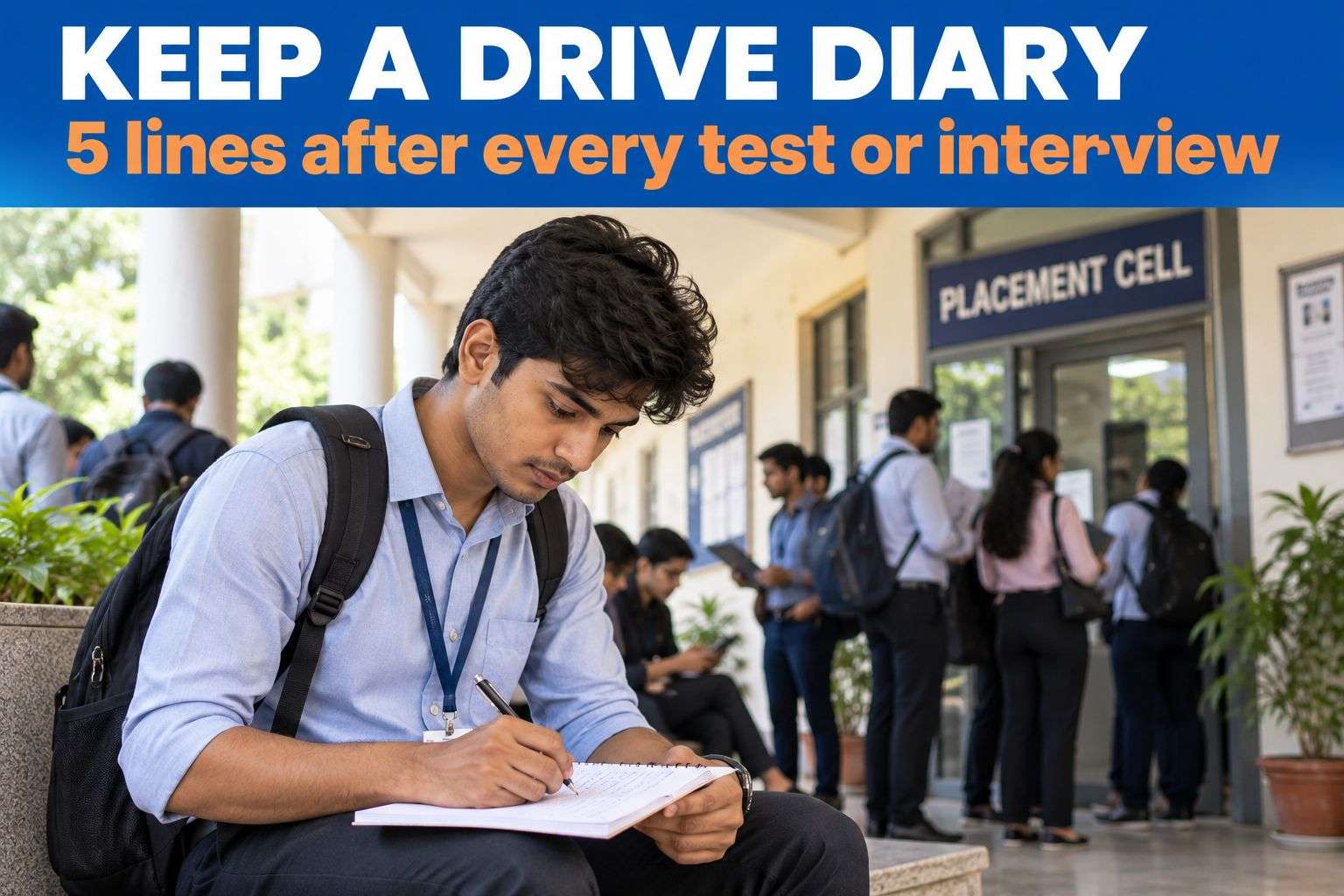
Keep a drive diary. After every test or interview, write down five things. The company. The rounds. The questions you remember. What went well. What went badly. It takes ten minutes. After four drives, you will see your own pattern. One student of mine noticed he lost every interview at the same point: when the interviewer asked about his second project. He did not know it well. He fixed that in a week.
Know the company before you walk in. What do they do? Which roles are they offering? What did last year’s batch face? Our guides on Cognizant vs Infosys vs Wipro and HCL Tech careers for freshers will help with the big names.
Have a test-day routine. Sleep by eleven the night before. Charge your laptop. Check the link and your ID proof. Reach the lab early. Keep water with you. Sounds boring. It saves marks.
Have an interview-day routine. Wear clean, simple formals. Carry printed resumes, even if the interview is on a laptop. Keep your phone on silent and out of sight. Greet the receptionist like you would greet the interviewer. People notice.
Do not skip your college exams. Some students pour everything into placements and then get a backlog. A backlog can close doors that took months to open. Protect your internals and semester exams. They are part of the plan, not a distraction from it.
The HR round trips up more students than the technical one. If yours is coming, watch this video on the top 10 HR questions for freshers and then practise your own answers. Not the video’s answers. Yours. You can also go through our list of fresher interview questions for IT companies.
What to do when you get rejected
You will probably get rejected at least once. Most students do.
The first rejection feels heavy. The second feels heavy too. By the fourth, most students learn to treat it like a mark on a practice test. It tells you where you lost points.
Spend one evening with your drive diary. Keep your placement season guide October December routine going while you do it. Find the round you lost. Fix that one thing. Then sit the next drive.
If your mind is getting loud, step away for a day. Walk. Talk to a friend who is not in placements. I have written about this in 5 stress-busting strategies for engineers. It is worth ten minutes of your time.
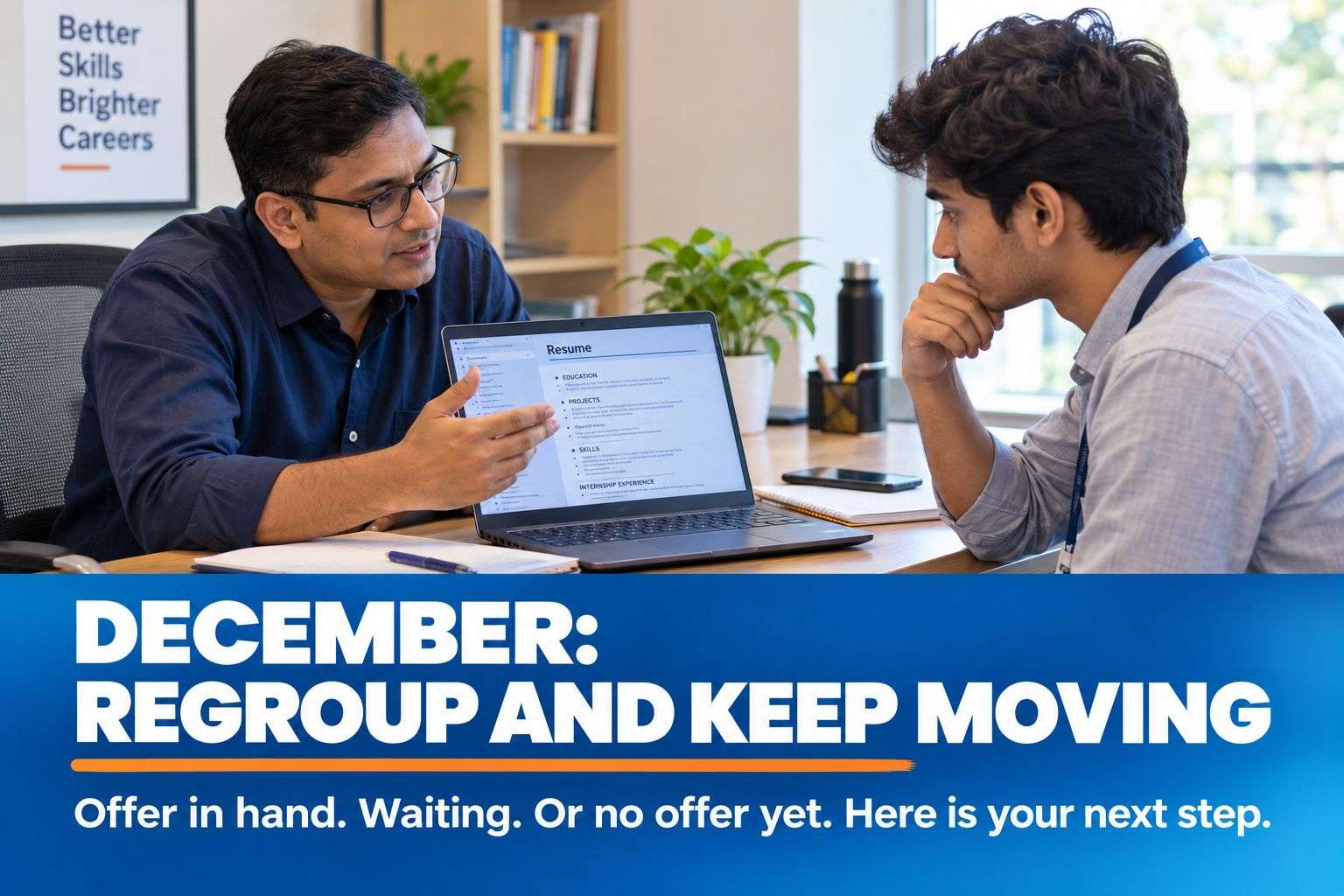
December in This Placement Season Guide October December: Regroup and Keep Moving (Weeks 9 to 12)
By December, students fall into three groups. Some have an offer. Some have shortlists and are waiting. Some have nothing yet.
I will speak to each one honestly.
If you have an offer
Congratulations. Really. Take a full day to enjoy it.
Then do these things. Read the offer letter twice. Check the role, location, joining date and any bond terms. If something is unclear, ask the placement cell in writing. Do not ask only on a phone call.
Do not stop learning, and keep your placement season guide October December habits alive. Offer letters in IT often come with a wait. Some freshers sit on the bench for weeks or months before getting a project. Read about it early, so you are not surprised: Bench Period in IT. And when you do join, our list of first day mistakes at an IT company is worth a read the night before.
One more thing. If you are a student who got a lower package than you hoped, do not feel small. Your first job is a start, not a verdict. I have seen people move to much better roles within two or three years. You can read what freshers are earning in our fresher salary guide to keep your expectations realistic.
If you are waiting on results
Stay in the game. The placement season guide October December routine still applies to you. Keep your aptitude practice alive. Keep practising interview answers. Waiting is the hardest part, and the best use of it is to stay busy with small, useful work.
Also look at your skills. Our guide on the top tech skills employers look for in freshers can show you what to add before the next round of drives.
If you have no offer yet
Take a breath. This is not the end. It is a change of route. A placement season guide October December does not stop on 31 December.
Campus drives are one door. There are others. Off-campus hiring runs through the whole year. Smaller companies, startups and GCCs hire freshers outside campus cycles. Referrals matter. So does a clean LinkedIn profile. [INTERNAL LINK HERE: Off-campus placement strategies post]
Some students also use January to March to build one strong skill. A cloud, testing or data course with real practice can change your profile. If you want a structured option, government-supported programmes like Rooman Technologies’ cloud computing and DevOps course are one path. I work with Rooman in Odisha, so I know how the programme runs. It suits students who need structure and someone checking on them. If you study well alone, free resources will do the job.
Before you pay for any course anywhere, ask one question: “Will I build something I can show in an interview?” If the answer is no, walk away.
If you want to see how AI is changing HR rounds this year, this video on 8 AI-era HR interview questions is worth twenty minutes.
Four Mistakes That Break a Placement Season Guide October December Plan
Mistake 1: Applying to everything and preparing for nothing. Sitting fifteen drives with no preparation teaches you nothing. Sitting five with proper preparation teaches you a lot.
Mistake 2: Comparing yourself with the topper. Your friend with the 9 CGPA got an offer early. Good for him. His path is not yours. Your only competition is your last practice test.
Mistake 3: Ignoring communication. Many students can solve the problem but cannot explain it. Practise speaking in full sentences. Record yourself. Listen back. It is uncomfortable, and it works.
Mistake 4: Going silent on everyone. Some students hide their struggles from family and friends. Tell one person. A friend, a cousin, a teacher. You do not have to carry this alone.
A Note for Non-CS Branches on This Placement Season Guide October December
If you are from ECE, Mechanical, Civil or Electrical, this season is for you too. IT companies hire from all branches, and core companies visit too. Prepare both paths if you can.
If you want to move into IT from a non-CS branch, read my full roadmap: Switch to IT Career From a Non-CS Branch. It is honest about what extra effort you need.
For a wider view of what to learn alongside your drives, the best certifications for freshers page will help you pick one thing, not five.
If you want an outside view of how placement prep is structured, Hirist’s placement preparation guide and Rungta’s list of common campus interview questions are good companions to this post.

Internal Links — Read These Next After This Placement Season Guide October December
- 📌 How I Help Students Crack IT Interviews in 30 Days
- 📌 Fresher Job Interview Questions for IT Companies in India
- 📌 How to Answer “Tell Me About Yourself” in an IT Interview
- 📌 Bench Period in IT — What Actually Works in 2026
- 📌 Fresher Salary in India 2026
- 📌 Top 10 IT Companies in India Hiring Freshers in 2026
FAQs — Placement Season Guide October December
FAQ 1 — Is it too late to start preparing in October if I have not done anything so far?
No, it is not too late. I say this every year, and every year some student proves it. Twelve weeks is enough to build a solid base if you work in a steady routine. You will not cover everything. You do not need to.
Focus on three things first: a clean one-page resume, daily aptitude practice and a clear two-minute explanation of your project. Those three alone move you ahead of a large number of students in any drive.
Do not try to start DSA from scratch in the same week you begin aptitude. Pick one track, build a habit, then add the next. The placement season guide October December plan in this post is built for exactly this kind of late start.
The students who struggle are not the ones who start late. They are the ones who start big, burn out in ten days and quit.
Consultant’s Note — I have seen students get their first offer in November after starting in the last week of September. What they had in common was not talent. It was a fixed hour every day and a willingness to hear “you are not ready yet” from me without arguing.
FAQ 2 — How many hours should I study each day during placement season?
For most students, two to three focused hours on weekdays is enough. On weekends, four to five hours with breaks works well. More hours do not always mean more learning. I have met students who sat nine hours a day and remembered almost nothing because they were tired and distracted. Split your time into small blocks. Forty-five minutes of aptitude. One hour of coding or core subjects. Thirty minutes for interview practice. Then stop. Sleep and food matter more than you think. During drive weeks, your study hours may drop, and that is fine. Use that time for the drive itself.
The placement season guide October December approach is to stay consistent, not heroic. Consistency for twelve weeks beats two weeks of extreme effort followed by collapse.
Consultant’s Note — Whenever a student tells me they study twelve hours a day, I ask them to show me what they learned yesterday. Most cannot. Three good hours beat twelve blurry ones.
FAQ 3 — Should I sit for every company drive, even the ones I am not excited about?
My honest answer is yes, for the first few. Every drive gives you practice with real tests and real interviewers. You learn how the rooms feel, how the questions come, and how your nerves behave. That experience is hard to copy at home. But do not sit every drive blindly. Check the eligibility, the role and the package. If a company’s role has nothing to do with your goal, and you already have an offer, skip it and use the time for preparation. If you have no offer yet, sit as many as you reasonably can, especially in October and November.
Think of early drives as practice matches. Keep your best energy for the companies you really want. A placement season guide October December works best when you treat each drive as both an opportunity and a lesson.
Consultant’s Note — One student of mine sat eleven drives before getting an offer. By the eleventh, he was the calmest person in the room. He told me later that the first three taught him more than six months of preparation.
FAQ 4 — Should I accept the first offer I get, or wait for a better one?
This depends on your situation, and I will not give you a one-line answer. If you have no other offer and your family is waiting for you to get placed, accept it. A first job gives you income, experience and a stronger profile for the next move. If you are in a college where several good companies are still to visit, and your first offer is a weak one, talk to your placement officer about the policy. Some colleges allow only one offer. Some allow more. Know the rule before you decide.
Do not reject an offer in the hope of a better one without a clear plan. I have seen students wait and end up with nothing. Your first job is a starting point. Most careers in IT grow through moves in the first three years. Check the offer letter carefully for location, bond and role details before signing anything.
Consultant’s Note — In 27 years I have seen far more people regret waiting than regret accepting. The salary gap between a first job and a second job closes faster than most students expect, but only if you actually get on the ladder.
FAQ 5 — What if I have a backlog? Can I still sit for placements?
It depends on the company and on your college’s rules. Many companies ask for no active backlogs at the time of applying. Some allow backlogs if they are cleared before joining. Read each company’s eligibility criteria carefully. Do not assume. If you have a backlog, your first step is to speak to your placement officer and find out which companies allow it. Your second step is to clear the backlog as early as possible.
In the meantime, keep preparing, because your skills do not disappear while you fix your paper. If you are eligible for only a few drives, prepare extra well for them. A placement season guide October December is still useful for you. The plan is the same. You just have a narrower set of doors to knock on, so each knock has to count.
Consultant’s Note — A backlog is a setback, not a label. Some of the best engineers I know cleared a backlog, then went on to do very well. Be honest with recruiters if they ask. Honesty is remembered.
FAQ 6 — I am from a non-CS branch. Do I have a real chance in IT placements?
Yes, you do. Many IT companies hire from all engineering branches, and I have placed ECE, Mechanical and Civil students in software roles. The test pattern is usually the same for everyone: aptitude, basic coding, then interview. So your first job is to be comfortable with aptitude and one programming language. Python or Java is enough to start. Then build one small project that shows you can apply logic. Do not hide your branch.
Explain why you want IT and what you have done to get ready. Interviewers respect a clear story more than a perfect background. Also keep your core options open if your branch has strong core hiring. The placement season guide October December works for you too. You may need a few extra weeks on coding basics, so start that in October and keep it steady.
Consultant’s Note — The non-CS students who succeed are the ones who can say, in two sentences, why they made the switch and what they have built since. Practise those two sentences.
FAQ 7 — How do I balance college exams and placement drives in November and December?
This is where many students slip. The first thing to do is put your exam dates and known drive dates on one calendar. Seeing both on one page removes a lot of panic. Then decide your priorities for each week. In an exam week, study for exams first and do only 30 minutes of light aptitude to keep the habit. In a drive week, spend your hours on company-specific preparation.
Talk to your placement cell early. Many colleges try to avoid clashes, and some let you request a change. Do not skip an exam for a drive unless your college has a clear policy. Do not skip a drive for a minor internal if you can reschedule it. Good planning with a placement season guide October December mindset means you will not be surprised by the clash. You will have seen it coming a month ago.
Consultant’s Note — I ask students to write down their next three weeks every Sunday evening. It takes ten minutes. The students who do this seldom miss a deadline or a drive.
FAQ 8 — I keep failing the aptitude round. What should I change?
First, find out what you are failing on. Is it speed, accuracy or a specific topic? Take one full timed mock test and review it line by line. Most students find the problem in one or two areas, often percentages, time and work, or logical puzzles. Fix those first.
Second, practise under time pressure. Solving a question in ten minutes at home is not the same as solving it in ninety seconds in a test. Use a timer every day.
Third, learn to skip. If a question takes too long, mark it and move on. Many students lose marks by getting stuck on one hard question.
Fourth, give it four weeks of daily practice before judging yourself. Aptitude improves with repetition, not with talent. This is one reason a placement season guide October December begins with aptitude in the first month. Early practice gives you time to improve before the big drives.
Consultant’s Note — I have not met a student yet who could not improve aptitude scores with thirty daily minutes over a month. The ones who do not improve are usually the ones who practise only when they feel like it.
FAQ 9 — Should I start a certification during placement season?
Only if it is small, relevant and does not steal time from your core preparation. A short certification can help when it matches the role you are targeting. But collecting certificates is not a strategy. Most interviewers will ask you what you built, not what you paid for. If you are in October and have nothing ready yet, put your time into aptitude, your resume and your project first. After your drives settle, pick one certification that fits your target role.
You can see my view on which ones are worth it in the guide on best certifications for freshers. A single good certificate, with a small project attached, tells a stronger story than five certificates with nothing behind them. Keep your placement season guide October December focus on things that show up in the interview room.
Consultant’s Note — When a student shows me six certificates and no project, I gently ask, “Which one did you use?” The room usually goes quiet. Use what you learn. Then add it to your resume.
FAQ 10 — What should I do if December ends and I still have no offer?
First, do not panic, and do not hide. Tell your family plainly that you are continuing with off-campus hiring. That one sentence takes away a lot of pressure. Then review your drive diary. Find the round where you lost most often and fix it over the next four weeks. Next, widen your search. Apply off-campus on company career pages and job portals. Ask seniors for referrals.
Update your LinkedIn profile and make sure your headline says what you do. If your skills feel thin, pick one area and build it properly in January and February. A placement season guide October December is a twelve-week plan, but your career is longer than that. Many students I know got their first offer in March, April or even later, and went on to do well. Keep your routine alive. Do not stop at the first closed door.
Consultant’s Note — Every year I meet students who were sure January was too late. Some of them got offers in February. What they did differently was keep showing up, even when it stopped being exciting.

What to Do This Week — Your Placement Season Action Plan
Whatever year you are in right now, here is one small thing to do this week.
If you are in first or second year. Do not wait for final year to start. Open your college placement records and see which companies visited last year and what they asked. Start a simple habit of twenty minutes of aptitude three times a week. Build one small project and write two lines about it. By the time your own placement season guide October December arrives, you will be two years ahead.
If you are in third year. This is your best window. Finish one good project. Learn one programming language properly. Clean your resume and your LinkedIn. Ask a final-year senior to tell you honestly how their drives went. Sit a mock test on a weekend.
If you are in final year and the season has started. This week, fix your resume, register for every drive you are eligible for and start a daily forty-five-minute aptitude routine. Write your “tell me about yourself” and say it aloud ten times. Start your drive diary from the next test.
If you have passed out and are still searching. Write down your target roles. Update your resume and LinkedIn. Apply to ten relevant openings this week, each with a short note. Pick one skill to sharpen and set a four-week goal.
The placement season guide October December plan is not complicated. Fix the basics in October. Face the drives in November. Regroup and keep moving in December. Take care of your sleep. Talk to someone when it gets heavy.
Twelve weeks from now, you will look back on this season as the time you learned how to show up. The offer, when it comes, will be a bonus on top of that.
Start today. One small thing. Then another.
Completing your placement preparation? Read our guides on How I Help Students Crack IT Interviews in 30 Days and Top Tech Skills Employers Look for in Freshers in India 2026 to see how everything connects.
I read all my emails. Can write your queries to [email protected]
WhatsApp – 9777278853