Skill-First Hiring in India – A 27-Year IT Career Consultant’s Honest Guide for Engineering Students in 2026
Skill-first hiring is the phrase every placement cell, every LinkedIn post, and every career coach is using right now, and I want to start with the number that should make you sit up before you believe any of it completely.
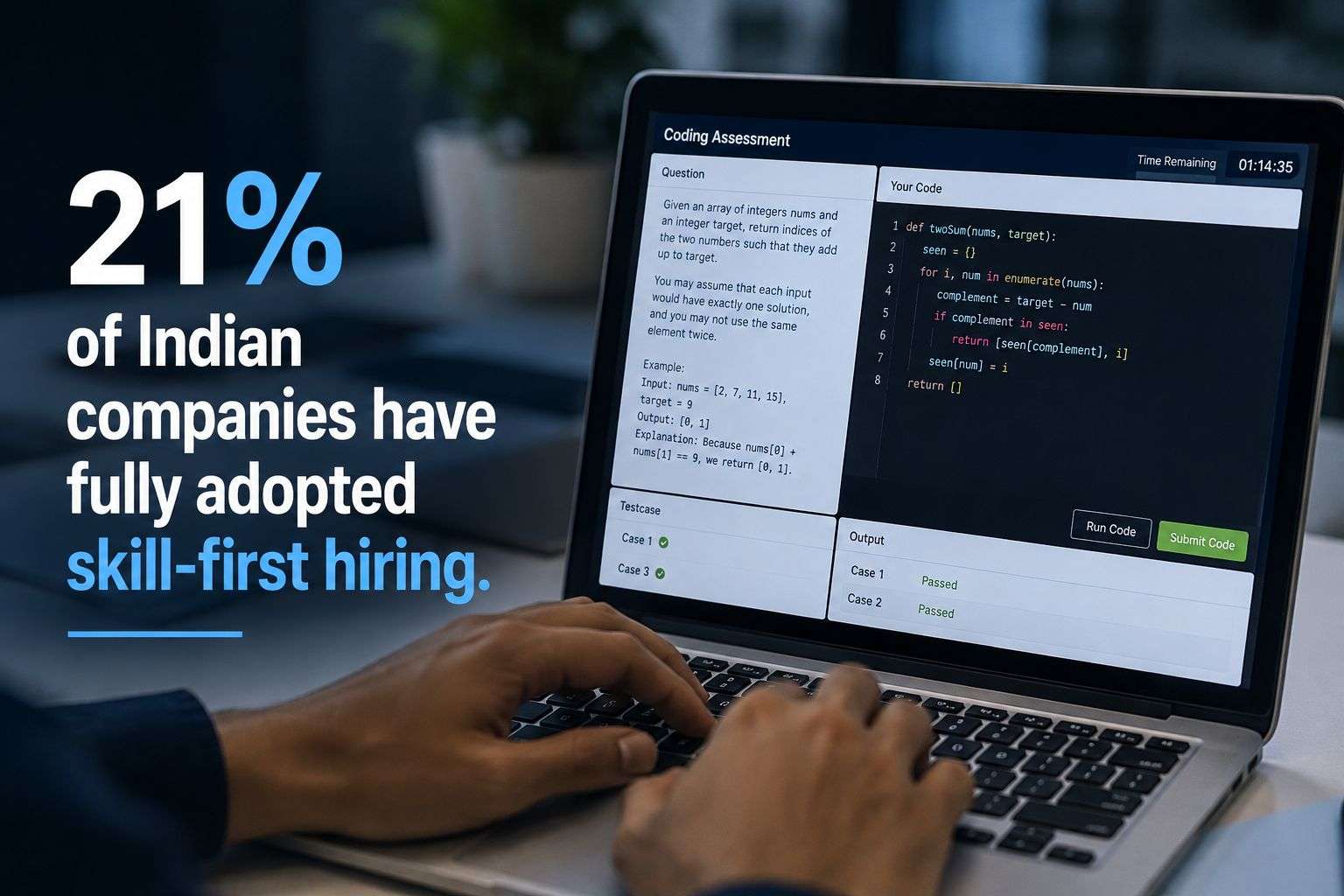
Only 21 percent of Indian corporates have fully adopted skill-first hiring, while 51 percent still let CGPA influence their final hiring decision, according to HirePro’s State of College Hiring in India 2026 report.
I have spent 27 years counselling BTech students across Bhubaneswar, Cuttack, Rourkela, and Berhampur, and I am not going to sell you a fairy tale about degrees becoming useless overnight. I am going to tell you exactly what skill-first hiring means today, where it is real, where it is still marketing talk, and what you should do about it starting this semester.
What Skill-First Hiring Actually Means
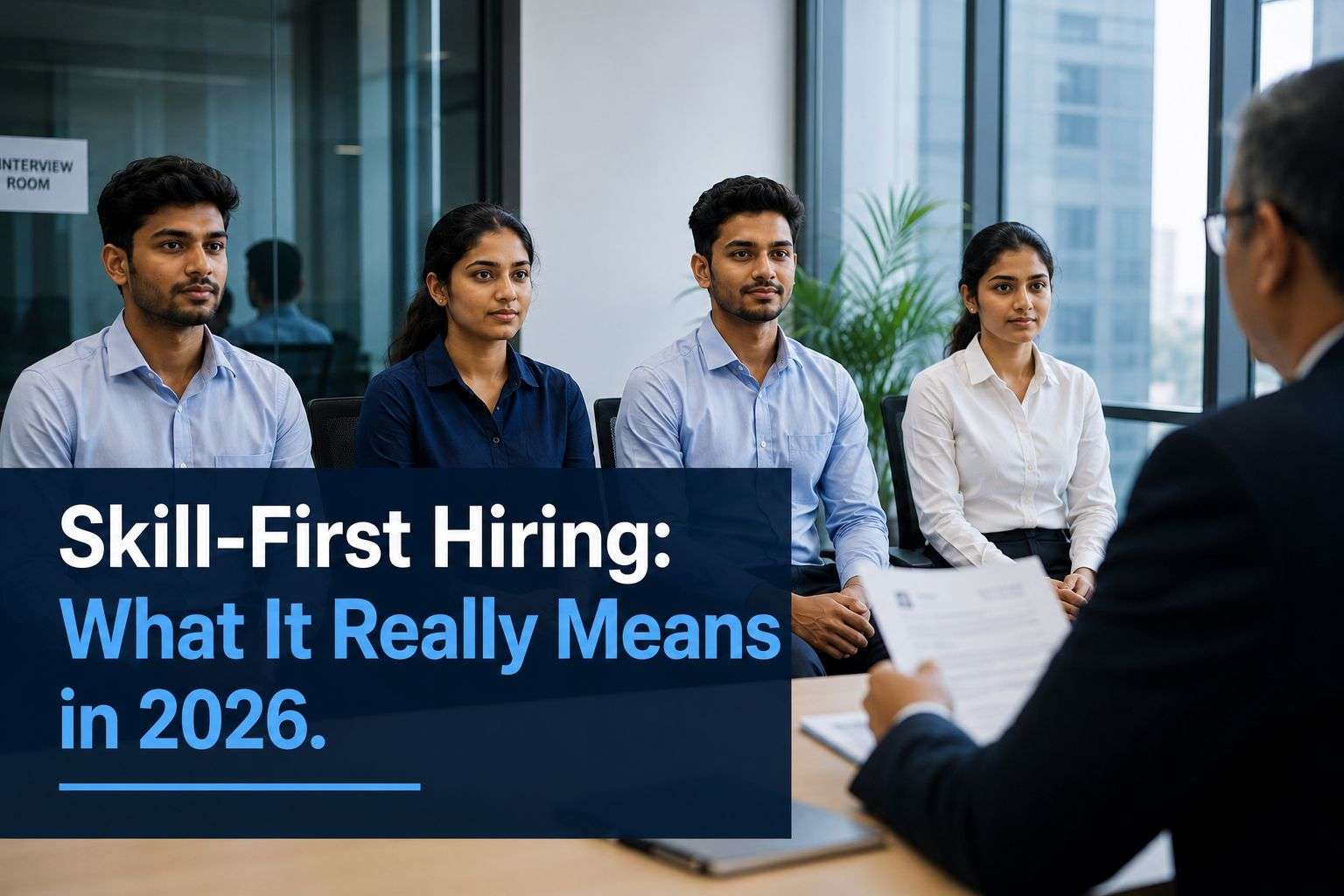
Skill-first hiring is a recruitment approach where companies judge you by what you can demonstrably do, not only by which college stamp sits on your marksheet. It does not mean your degree stops mattering. It means your degree stops being the only filter that decides whether a recruiter opens your resume.
In the old model, your college name and CGPA decided everything before a human ever read your project section. Under skill-first hiring, a recruiter also looks at your GitHub, your certifications, your project work, and how you perform in a live coding or aptitude test. Global companies including IBM, Google, and Microsoft removed degree requirements from many roles years ago, and Indian companies are following, but unevenly, and that unevenness is the part nobody explains clearly to students.
The Real Numbers Behind Skill-First Hiring in India in 2026
Let me give you the honest data instead of the motivational version.
HirePro’s State of College Hiring in India 2026 report found that skill-first hiring has only been fully adopted by 21 percent of corporates, while another 42 percent are somewhere in transition, meaning they run skill-based tests alongside CGPA cutoffs rather than instead of them. And 51 percent still let CGPA shape their final decision, whether they announce it openly or not.
Here is the part that stung when I first read it. The same BusinessToday report on this shift found that 96 percent of colleges believe corporates have already gone fully skill-first, while corporate responses tell a very different story. That gap between what your college tells you and what companies actually do is exactly why students get blindsided during placements.
On the positive side, separate industry surveys put the share of Indian employers who now weigh skills more heavily than degrees alone at around 80 percent, and close to 30 percent of them are actively building skill-based recruitment methods into their process. So skill-first hiring is real. It is growing. It is just not as complete or as uniform as the social media version makes it sound.
Why Skill-First Hiring Is Growing in Indian IT and Beyond
Three forces are pushing skill-first hiring forward, and understanding them helps you see this is not a passing trend.
Curriculum lag. Technology moves faster than university syllabi get updated. A student can graduate with a full four-year degree and still not have touched the tools their first employer expects on day one. Companies are responding by testing what you can do, not trusting what your syllabus says you learned.
Cost pressure. Training a new hire from scratch is expensive. A candidate who arrives already able to do the job, proven through a project, a certification, or a coding test, needs less hand-holding. Skill-first hiring is partly a cost-saving decision dressed up as a fairness story, and I think you deserve to hear that honestly rather than being told it is pure generosity from employers.
AI-led assessment tools. Companies now use AI-driven coding tests, project evaluations, and skill assessments at scale, which makes it cheaper for a large company to run a genuine skill-first hiring process across thousands of applicants instead of relying only on college tier and CGPA cutoffs to shortlist.
If you want to see how this connects to what is already happening on Indian campuses, I wrote in detail about the 82,000-fresher hiring surge across TCS, Infosys, HCLTech, and Wipro this year, and skill-first hiring is a big part of why that hiring is structured the way it is.
Where Skill-First Hiring Still Has Not Reached
This is the part I will not soften, because false comfort helps nobody.
Skill-first hiring has not eliminated pedigree. At startups and product companies especially, a candidate from a top-tier institute and a candidate from a tier-2 or tier-3 college with identical demonstrated skills still often land different starting salaries and different access to interviews. Promotions, leadership tracks, and premium compensation bands still lean on credential signals more than companies admit publicly.
Indian IT services, which likes to present itself as a skill-first hiring pioneer, still carries a strong preference for IIT and NIT graduates in many of its higher bands. Skill-first hiring at the entry-level screening stage does not always translate into skill-first hiring at the promotion and leadership stage, and a report by Careers360 on the India Skills Report 2026 shows employability still varies sharply by degree type and stream, which tells you pedigree signals have not disappeared from the system.
I am telling you this not to discourage you, but because a student who understands this clearly makes smarter choices than one who believes the degree has stopped mattering. It has not. It has stopped being sufficient on its own.
[IMAGE 3 HERE]

Skill-First Hiring vs Degree-First Hiring – What Actually Changes for You
Under the old degree-first model, your resume got filtered by college name and CGPA before a human ever read your project section. Under skill-first hiring, that first filter is being replaced or supplemented by a skill test, a portfolio review, or a certification check.
Practically, for a student from a tier-2 city in Odisha, your BPUT college name will not open every door the way an IIT name would. But skill-first hiring gives you a second, fairer door. If you can prove you know cloud fundamentals, or you can show three solid GitHub projects, or you clear a live coding round, a company running a genuine skill-first hiring process will look past your college tier.
The catch is that you have to actually build that proof. Skill-first hiring rewards preparation, not hope. It is not a shortcut. It is a different, and in many ways harder, path that asks you to build a visible track record instead of leaning on institutional reputation.
How to Prepare for Skill-First Hiring, Year by Year
First year. Skill-first hiring starts paying off years before placements. Pick one programming language and get genuinely comfortable with it. Build a GitHub profile, even with small practice projects. Skill-first hiring assessments often start with basic logic and coding fluency, so this is the year to build that foundation without exam pressure.
Second year. This is when you choose a direction, cloud, data, cybersecurity, or core development. Start one real project a semester, however small, and take one credible certification relevant to your direction. Skill-first hiring recruiters increasingly scan for demonstrated specialisation, not generic “good at everything” resumes.
Third year. Treat this as your proof-building year. Contribute to at least one open-source project or build a portfolio piece you can explain in detail during an interview. Start attempting mock skill assessments and aptitude tests regularly, since skill-first hiring processes at most large recruiters now include a timed skill round before the interview stage.
Final year. Sharpen what you already have instead of starting new things. Polish your top two or three projects, update certifications, and practice explaining your skills out loud, because skill-first hiring interviews increasingly ask you to walk through your actual work rather than recite textbook answers. If you want a structured plan for this exact stage, I laid one out in how to crack campus placement in three months.
Common Mistakes Students Make With Skill-First Hiring
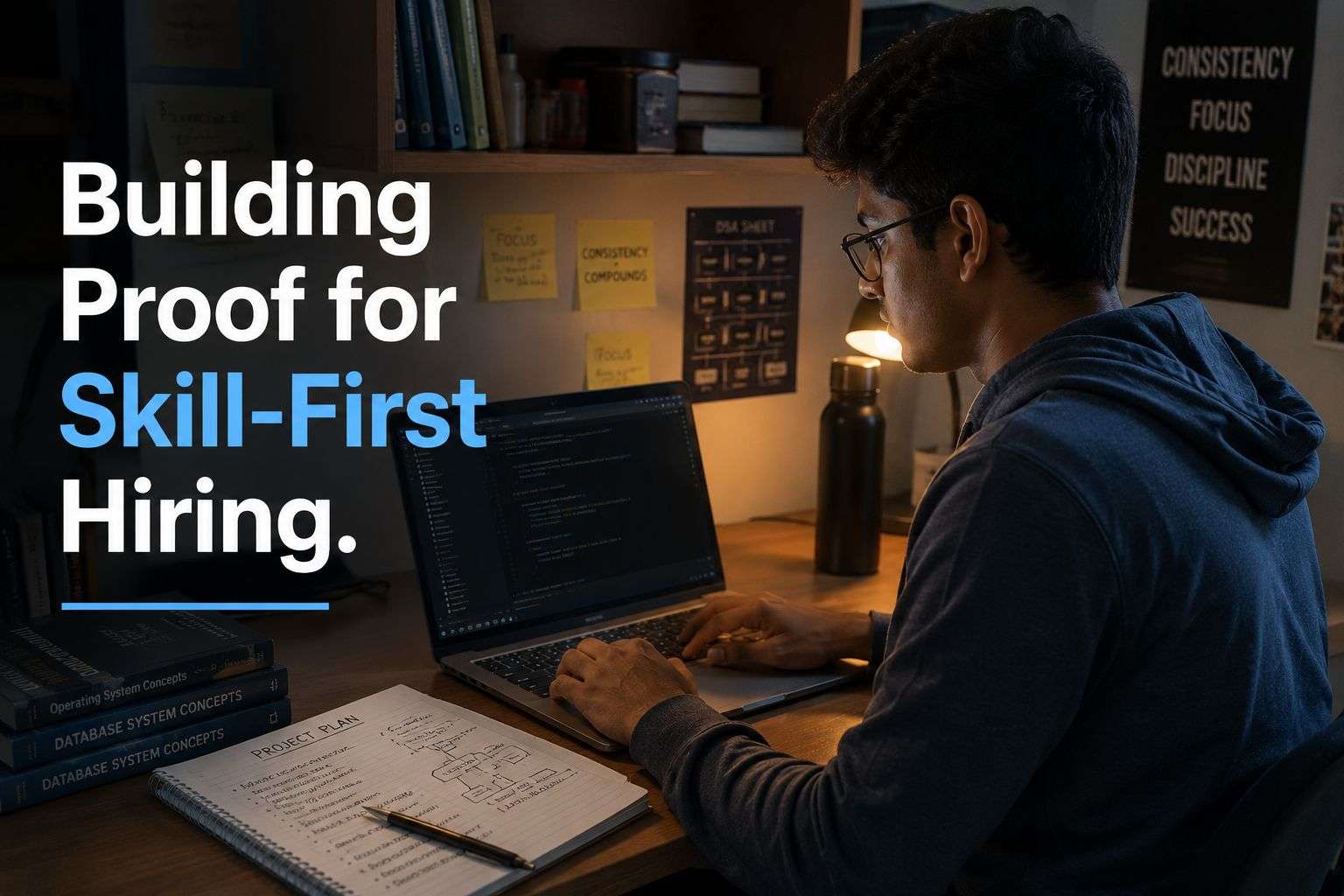
The biggest mistake is collecting certificates without proof of use. Skill-first hiring recruiters do not just want a certificate on your resume, they want to see you apply that skill somewhere, in a project, an internship, or a real assignment. I go deeper into which certifications are genuinely worth your money and time in are online certifications worth it for freshers.
The second mistake is assuming skill-first hiring means your college and CGPA no longer matter at all. As the data above shows, 51 percent of corporates still let CGPA influence decisions. Do not sabotage a strong CGPA while chasing skills. Build both.
The third mistake is picking skills based on hype rather than role fit. Skill-first hiring rewards depth in a chosen direction more than shallow exposure to five trending tools. I covered how AI-related skills specifically affect starting pay in AI skills salary premium for freshers, and the honest answer there is also nuanced, not purely hype.
Internal Links — Read These Next
- 📌 AI Skills Salary Premium for Freshers in 2026
- 📌 Campus Placements 2026 Are Back
- 📌 Are Online Certifications Worth It for Freshers?
- 📌 How to Crack Campus Placement in 3 Months
- 📌 AI Tools for Freshers Placement 2026
FAQs — Skill-First Hiring for Indian Engineering Students in 2026
FAQ 1 — Does skill-first hiring mean degrees don’t matter anymore?
This is the question I hear most, and the honest answer is no, not even close. Skill-first hiring means degrees are no longer sufficient on their own, not that they are irrelevant. HirePro’s 2026 report shows 51 percent of Indian corporates still let CGPA influence hiring, and pedigree continues to shape access to premium roles and pay bands, especially at product companies and in leadership tracks.
A degree still opens the first door in many places, particularly at large IT services companies and in core engineering sectors. Skill-first hiring simply adds a second, parallel door that rewards proof of ability alongside it. Students who drop their academic effort because they have heard skill-first hiring has “replaced” degrees are making a decision based on a headline, not on how Indian hiring actually works in 2026.
Treat your degree and your skill-building as two separate investments that compound together, not one replacing the other.
Consultant’s note — In my 27 years of counselling, I have never once told a student to skip their degree because of a hiring trend, and I am not starting now. Skill-first hiring rewards students who do both well, not students who abandon one for the other.
FAQ 2 — Which sectors have adopted skill-first hiring the fastest in India?
IT services, GCCs, and product-based tech companies have moved fastest on skill-first hiring, largely because of talent shortages and the availability of scalable, AI-driven skill assessment tools that make large-scale skill testing affordable. BFSI and fintech are close behind, driven by rapid digitisation of customer-facing roles.
Core engineering sectors like mechanical, civil, and electrical are moving more slowly, though even there, digital tool proficiency, CAD software fluency, and automation familiarity are starting to matter more than they used to. If you are targeting IT or IT-adjacent roles specifically, skill-first hiring will affect your application process far more directly than if you are targeting a traditional core engineering role at a manufacturing company.
The pace of adoption also varies by company size.
Larger, more digitally mature organisations have the infrastructure to run genuine skill-first hiring assessments, while smaller and mid-sized companies often still default to CGPA and college-tier filters simply because they lack the resources to build anything more sophisticated.
Consultant’s note — Students from non-CS branches ask me this constantly, and my honest answer is that skill-first hiring has reached IT-adjacent roles faster than anywhere else. If your branch is not core-CS, look specifically at how digitised your target sector already is before assuming skill-first hiring applies equally everywhere.
FAQ 3 — How do I prove my skills if I don’t have a strong college brand?
Build a portfolio you can defend in a conversation. This means real projects, not tutorial copies, a clean GitHub profile with meaningful commit history, and one or two certifications tied directly to your target role rather than a scattered collection unrelated to each other.
Skill-first hiring recruiters and their AI-driven assessment tools are specifically designed to surface capable candidates regardless of college tier, but only if you give them something concrete to evaluate. A resume with claims and no evidence still gets filtered out, skill-first hiring or not, because an unverifiable claim is not a skill signal an assessment tool or a recruiter can act on.
The strongest proof is depth over breadth. One project you can explain for ten minutes without notes, including the mistakes you made and what you would change, carries more weight in a skill-first hiring evaluation than five shallow projects you cannot discuss beyond the surface level.
Consultant’s note — I have seen tier-3 college students out-place tier-1 students purely because their project work was more convincing in the interview room. Skill-first hiring genuinely rewards that kind of preparation, but only when the depth is real.
FAQ 4 — Are skill-first hiring assessments hard to clear without expensive coaching?
They are learnable with consistent, structured practice, not necessarily expensive coaching. Most skill-first hiring assessments test coding fundamentals, logical reasoning, and applied problem-solving rather than obscure theory that requires specialised tutoring to understand.
Free and low-cost platforms can get you most of the way there if you practice regularly starting from your second year rather than cramming in the final semester. What separates students who clear these assessments from those who do not is rarely access to paid coaching, it is consistency of practice over many months.
Structured programs, including the ones we run in partnership with Rooman Technologies, help mainly with discipline and feedback loops, not because the underlying content is unlearnable through free resources alone. They matter most for students who know they need external accountability to stay consistent.
Consultant’s note — The students who struggle most with skill-first hiring assessments are not the ones who lack ability, they are the ones who started practising too late. Begin in your second year, not your final semester.
FAQ 5 — Does skill-first hiring apply to government and PSU jobs too?
Largely no, not yet. Government and PSU recruitment in India still relies heavily on standardised exams, degree eligibility criteria, and reservation frameworks that operate independently of the private-sector skill-first hiring trend discussed throughout this article.
If your target is a PSU or government role, your preparation strategy should remain exam-focused rather than portfolio-focused. Building a GitHub profile and stacking certifications will do very little for a PSU application compared to disciplined exam preparation, so do not divide your limited time equally between both if government roles are your genuine priority.
Skill-first hiring, as discussed here, is primarily a private-sector and especially a tech-sector phenomenon in 2026. Some newer government skilling initiatives are beginning to reference skill-based frameworks, but they have not yet reshaped core PSU recruitment processes in any meaningful way.
Consultant’s note — Do not mix your PSU exam prep and your skill-first hiring prep into one vague plan. They need genuinely different strategies, and trying to do both half-heartedly serves neither.
FAQ 6 — How does skill-first hiring affect fresher salaries?
It creates a wider salary spread than before. Freshers who can prove specialised, in-demand skills, such as AI tools, cloud, or cybersecurity, are increasingly commanding a noticeable premium over freshers with only a general degree and no demonstrated specialisation, particularly at product-based and global capability centre employers.
I covered the specific salary numbers behind this shift in detail separately, and the gap is real but not universal across every role or every company type. Skill-first hiring rewards depth in a chosen area more than a broad, shallow skill list, which means two freshers from the same college with the same CGPA can land meaningfully different offers based purely on demonstrated specialisation.
This salary spread is likely to widen further as more companies formalise their skill-first hiring assessments, because a wider gap between proven and unproven candidates gives employers more room to differentiate pay at the offer stage.
Consultant’s note — I tell students to pick one lane and go deep, because skill-first hiring pay premiums favour depth over breadth almost every time I have watched offer letters come in.
FAQ 7 — Can final-year students still benefit from skill-first hiring with limited time left?
Yes, but the focus should shift from building new skills to polishing and presenting existing ones convincingly. With limited months before placements, final-year students get more return from strengthening two or three strong projects and practising how to explain them clearly than from starting five new certifications they will not have time to genuinely absorb.
Skill-first hiring interviewers often care more about how well you can discuss your work than how many badges you hold on your resume. A candidate who can walk confidently through one real project, including the decisions and trade-offs involved, consistently outperforms a candidate with a longer but shallower list of credentials.
If you are in this position right now, resist the urge to panic-start new learning paths. Go back to what you already have and make it interview-ready instead.
Consultant’s note – Depth of explanation beats breadth of certificates in almost every final-round interview I have sat through. If you are in your last few months before placements, polish, do not expand.
FAQ 8 — Is skill-first hiring the same as “no CGPA cutoff”?
Not necessarily, and this is a common and costly misunderstanding. Some companies running skill-first hiring processes still apply a minimum CGPA as an initial eligibility filter, even while weighing demonstrated skills more heavily in the rounds that follow.
Skill-first hiring is better understood as a shift in emphasis and an additional evaluation layer, not a guaranteed removal of every traditional filter a company has historically used. Always check a specific company’s actual eligibility criteria before an application cycle rather than assuming skill-first hiring means no academic threshold applies anywhere.
This distinction matters most for students sitting right at a CGPA borderline. Assuming skill-first hiring will rescue you from a weak CGPA can mean missing out on eligibility entirely before your skills are ever evaluated.
Consultant’s note — I have seen students skip CGPA improvement entirely on this assumption, and it has cost some of them real opportunities. Check the fine print of every company’s eligibility criteria yourself.
FAQ 9 — How can tier-2 city students access the same skill-first hiring opportunities as metro students?
Most skill-first hiring assessments and application processes now run online, which genuinely levels the geographic playing field more than older, campus-visit-dependent hiring ever did. A student in Berhampur can now sit the same online coding assessment as a student in Bengaluru, on equal footing, at the same moment.
What tier-2 city students need most is not proximity to a metro, it is consistent access to project ideas, mentorship, and structured practice, which is exactly the gap programs run through partners like Rooman Technologies are designed to close in Odisha specifically. Skill-first hiring reduces the geographic disadvantage more than it removes it entirely, since access to guidance and infrastructure still varies by city.
The students who benefit most from this shift are the ones who treat the levelled online playing field as an opportunity to prepare seriously, rather than assuming equal access alone guarantees equal outcomes.
Consultant’s note — Location matters less in a skill-first hiring world than it used to, but structured guidance still matters a great deal. Do not confuse equal access with equal preparation.
FAQ 10 — What is the single most important thing to do about skill-first hiring this year?
Build one project you can talk about for ten minutes without notes. That single piece of proof, backed by a certification and a clear explanation of the problem it solves, does more for you under a skill-first hiring evaluation than a long, unfocused list of half-finished courses sitting unused on your resume.
Start now, whichever year you are in, because skill-first hiring rewards consistency over last-minute effort every single time I have watched a placement season unfold. Students who begin building real, demonstrable work early consistently outperform students who wait for a “perfect” moment to start.
If you are unsure where to begin, pick the specialisation you are most naturally curious about rather than the one trending hardest online, because you will sustain the consistency skill-first hiring rewards only if the work itself holds your interest.
Consultant’s note — If a student asks me for one action step today, this is always my answer. Skill-first hiring is not won in the last month before placements, it is built quietly over years.
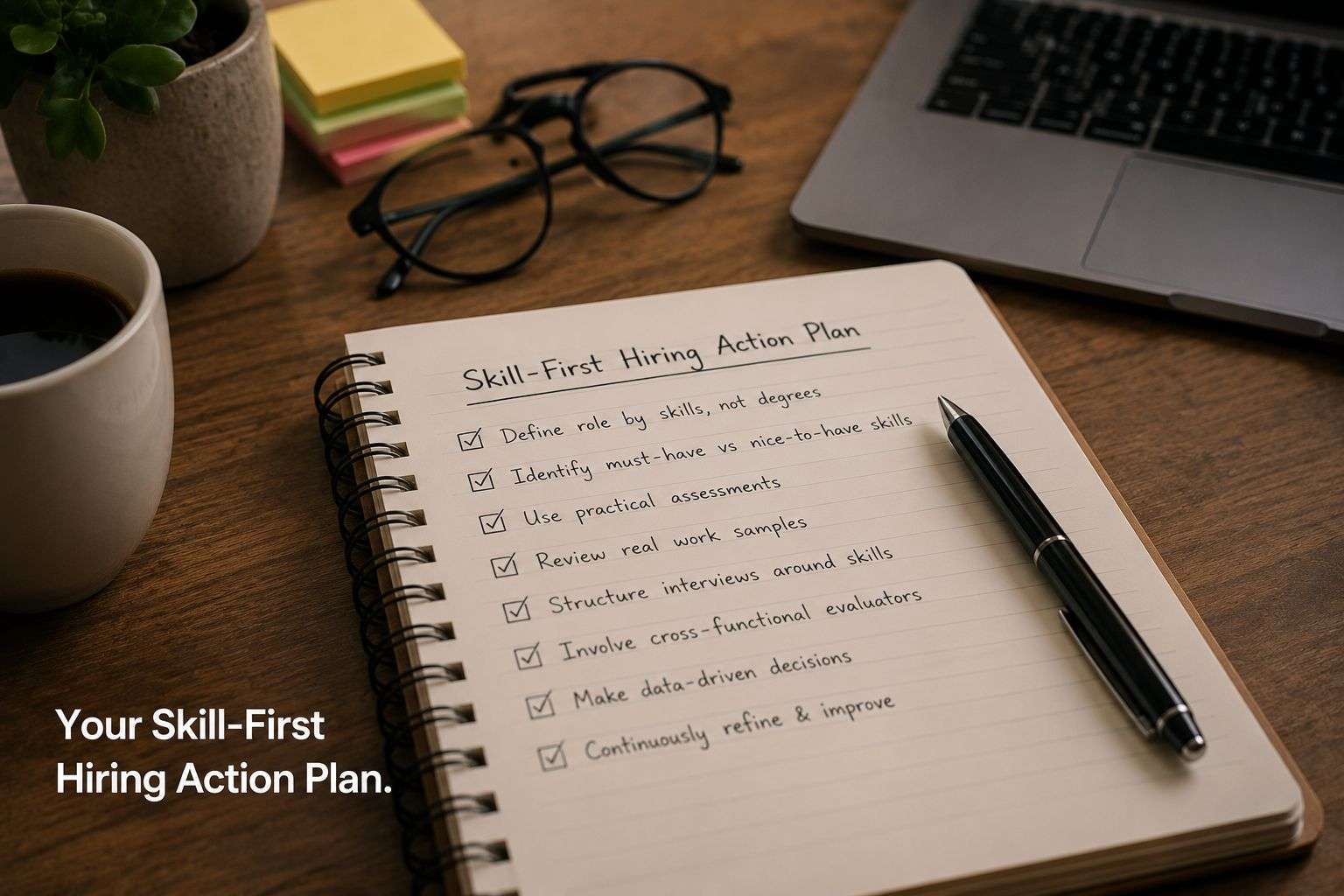
What to Do This Week — Your Skill-First Hiring Action Plan
If you are in first or second year – Pick one specialisation and start one small project this week. Create or clean up your GitHub profile today.
If you are in third year – Attempt one mock skill assessment this week and identify your weakest area honestly. Start one certification tied directly to your chosen direction.
If you are in final year – Pick your strongest existing project and practice explaining it out loud today, start to finish, including what you would improve.
Regardless of year – Track your CGPA and your skill-building side by side. Skill-first hiring has not made either one optional.
A Final Word
Skill-first hiring is not a rescue plan and it is not a myth either. It is a real, uneven shift that rewards students willing to build proof of their ability instead of waiting on their college name to do the work for them. I have counselled BTech students across Odisha for 27 years, and the ones who do well under skill-first hiring are never the ones who found a shortcut. They are the ones who started building early and kept at it consistently.
If you want a structured way to build that proof, whether through a certification path, a mentorship session, or a skilling program through Rooman Technologies, reach out to us at Career Guru on WhatsApp at 9777278853, or explore more honest, no-hype career guides at cguru.co.in/blogs.