
Cognizant GenC Guide 2026 — Complete Your Four-Company Service Assessment Cluster and Walk Into Placement Season With Four Real Chances
A 27-year IT career consultant explains the Cognizant GenC exam pattern, eligibility, section-wise preparation, interview rounds, salary, and how this fourth assessment completes your full service company placement strategy.
Cognizant GenC Guide 2026 — The Assessment Most Students Add Last But Should Have Planned First
Cognizant GenC preparation is the conversation I have with students after they have already cleared TCS NQT, registered for InfyTQ, and started Wipro NLTH prep.
By that point, they are exhausted.
And then someone tells them — “Cognizant is also hiring. There is a GenC drive coming up.”
The student looks at me with tired eyes.
“Sir, is it worth it at this stage?”
Every single time, my answer is the same.
Yes. Absolutely yes.
Here is the number I always start with.
Cognizant is one of the top five IT employers of freshers in India. It hires over 40,000 freshers in a good year. The GenC programme — which stands for Generate Next — is not a side pathway. It is Cognizant’s primary fresher hiring engine. If you are a final-year student in 2026 and Cognizant has not visited your campus, GenC off-campus is your direct door in.
But here is what makes Cognizant GenC different from TCS NQT, InfyTQ, and Wipro NLTH.
It is the one assessment in this cluster where your English communication skills matter as much as your aptitude and coding. Cognizant places unusual emphasis on verbal ability and reading comprehension — more than any other service company test at this level.
That changes how you prepare.
I have spent 27 years watching Indian students navigate placement seasons. I have seen brilliant coders fail GenC because they underestimated the English section. And I have seen average coders clear it because they spent three focused weeks on verbal ability.
This guide is your complete, honest Cognizant GenC preparation roadmap. Pattern. Eligibility. Section-wise plan. Interview guidance. Salary. And exactly how this fourth assessment completes your service company cluster.
Let us start from the beginning.
What Cognizant GenC Actually Is — And Why the Name Matters
Cognizant runs two fresher hiring programmes. Most students confuse them.
GenC is the standard fresher hiring track. It is open to all eligible graduates. The joining salary is around ₹4 LPA.
GenC Elevate is the higher track. It is for students with stronger academic scores and better technical ability. The joining salary is around ₹5.5 to ₹6 LPA.
Both go through the same initial assessment process. Your score determines which offer you receive. A higher score on the same test can move you from a GenC offer to a GenC Elevate offer. That is important. It means preparation quality directly affects your salary — not just whether you get selected.
The word “Generate Next” in GenC tells you something about Cognizant’s philosophy. They are not just hiring workers. They are building a pipeline of people they can train, grow, and retain. The training period after joining is structured and significant. Students who go in with the right learning attitude tend to do well.
Consultant’s Note: In my experience, students who understand what the company is actually looking for — not just the exam pattern — always prepare better. Cognizant wants communication, learning ability, and basic technical competence. Keep that in mind every time you sit down to prepare.
Cognizant GenC Exam Pattern 2026 — What the Test Actually Looks Like
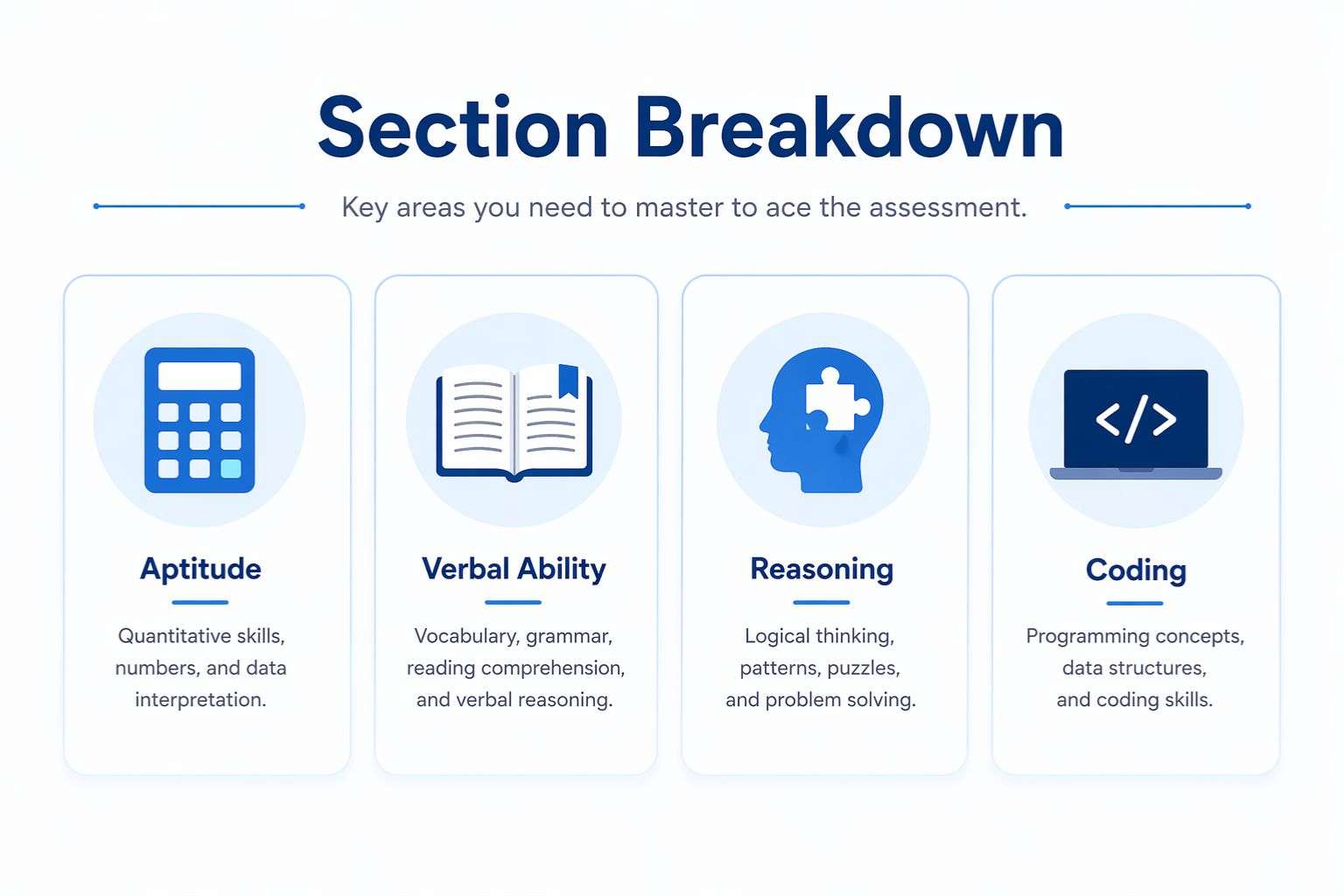
The Cognizant GenC online assessment has four sections. Here is the full breakdown.
Section 1 — Aptitude Questions: 16 Time: 16 minutes Topics: Percentages, ratios, time and work, speed and distance, profit and loss, simple and compound interest, averages, number systems.
Section 2 — Reasoning Ability Questions: 16 Time: 14 minutes Topics: Logical reasoning, blood relations, seating arrangement, syllogisms, directions, coding-decoding, series completion.
Section 3 — Verbal Ability Questions: 25 Time: 25 minutes Topics: Reading comprehension, sentence correction, fill in the blanks, para jumbles, synonyms, antonyms, error spotting.
Section 4 — Coding Questions: 2 Time: 45 minutes Languages allowed: C, C++, Java, Python.
The total test duration is approximately 100 minutes. There is no negative marking reported in recent drives. Sectional cut-offs apply — you cannot clear just one section and ignore the rest.
The most important thing to notice here.
The Verbal Ability section has 25 questions. That is more questions than Aptitude and Reasoning combined. Cognizant is telling you directly — English matters here. Yet most students spend 80% of their prep time on aptitude and coding and then lose marks in the section that carries the most weight.
After 27 years of watching placement patterns, I can tell you — the students who take Verbal seriously in GenC are the ones who come out with GenC Elevate offers, not just GenC.
Cognizant GenC Eligibility 2026 — Are You Qualified to Apply?
Before you start preparing, confirm you meet the eligibility criteria. These are the standard requirements as per recent GenC drives. Always verify the official Cognizant careers page before applying, as these can change.
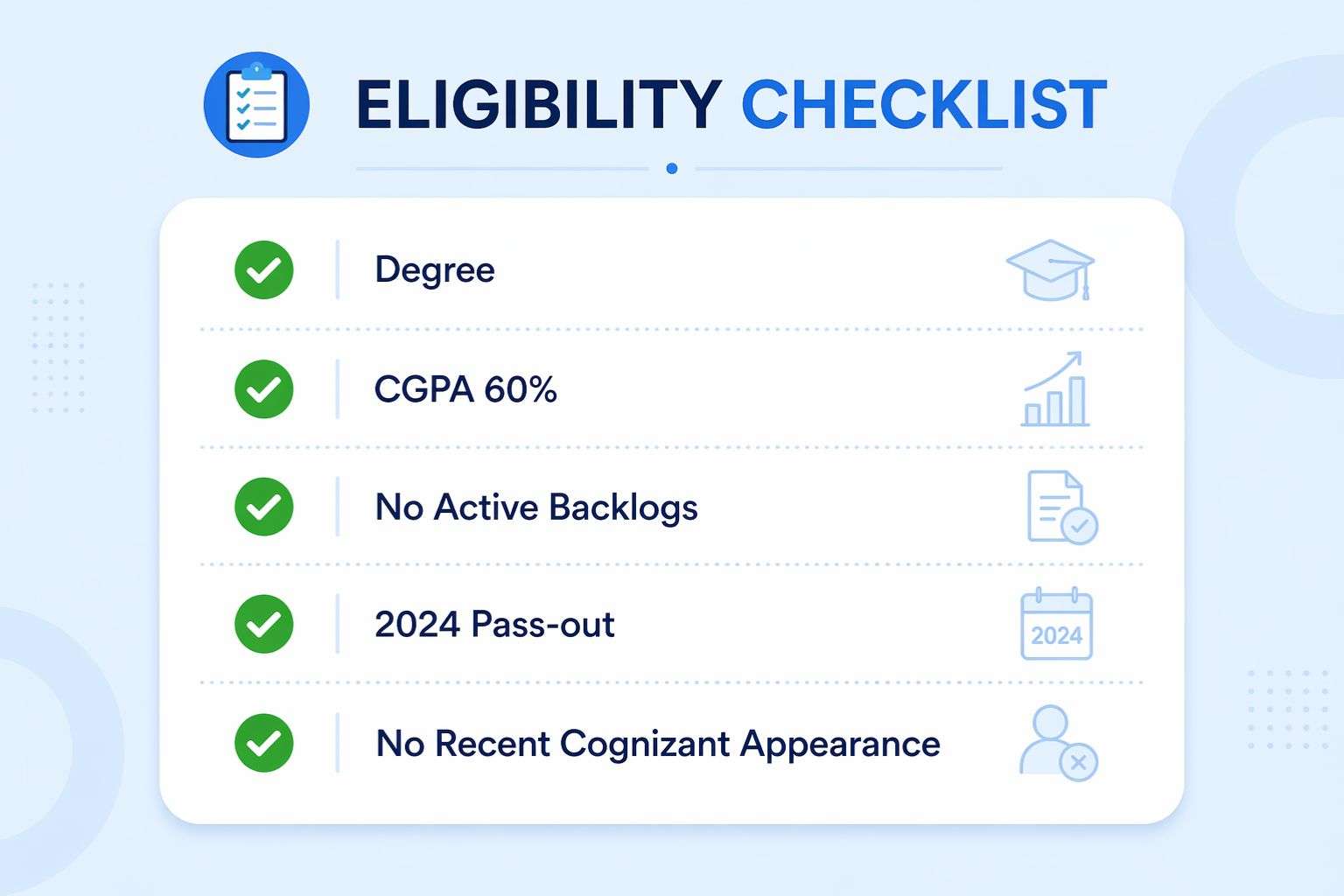
Degree: BE, BTech, ME, MTech, MCA, MSc (Computer Science or IT related) Graduation Year: 2024 pass-outs (sometimes 2023 — check the specific drive notice)
Academic Score: Minimum 60% or 6.0 CGPA throughout 10th, 12th, and degree
Backlogs: No active backlogs at the time of appearing for the test
Gap Year: Maximum one year of study gap is typically acceptable
Previous Cognizant Appearance: A cooling period of six months applies if you have appeared before
What about students with 58% or 59%?
Cognizant is firm on the 60% threshold. There is no rounding off at this stage. If you are below 60%, focus your energy on TCS, which has a 60% threshold with slightly different application, or on Wipro NLTH which I have covered in the Wipro NLTH Guide for Indian Students 2026.
Non-CS branches — ECE, Mechanical, Civil:
Yes, you can apply. Cognizant GenC is open to all engineering branches. But your coding section will require more dedicated preparation than a CS student who has been coding since first year. Plan at least four additional weeks for the coding section if you are from a non-CS background.
Cognizant GenC Section-Wise Preparation Plan — Eight Weeks to Ready
This is the part most blogs skip. They tell you the pattern. They do not tell you how to actually prepare for it in the time you have.
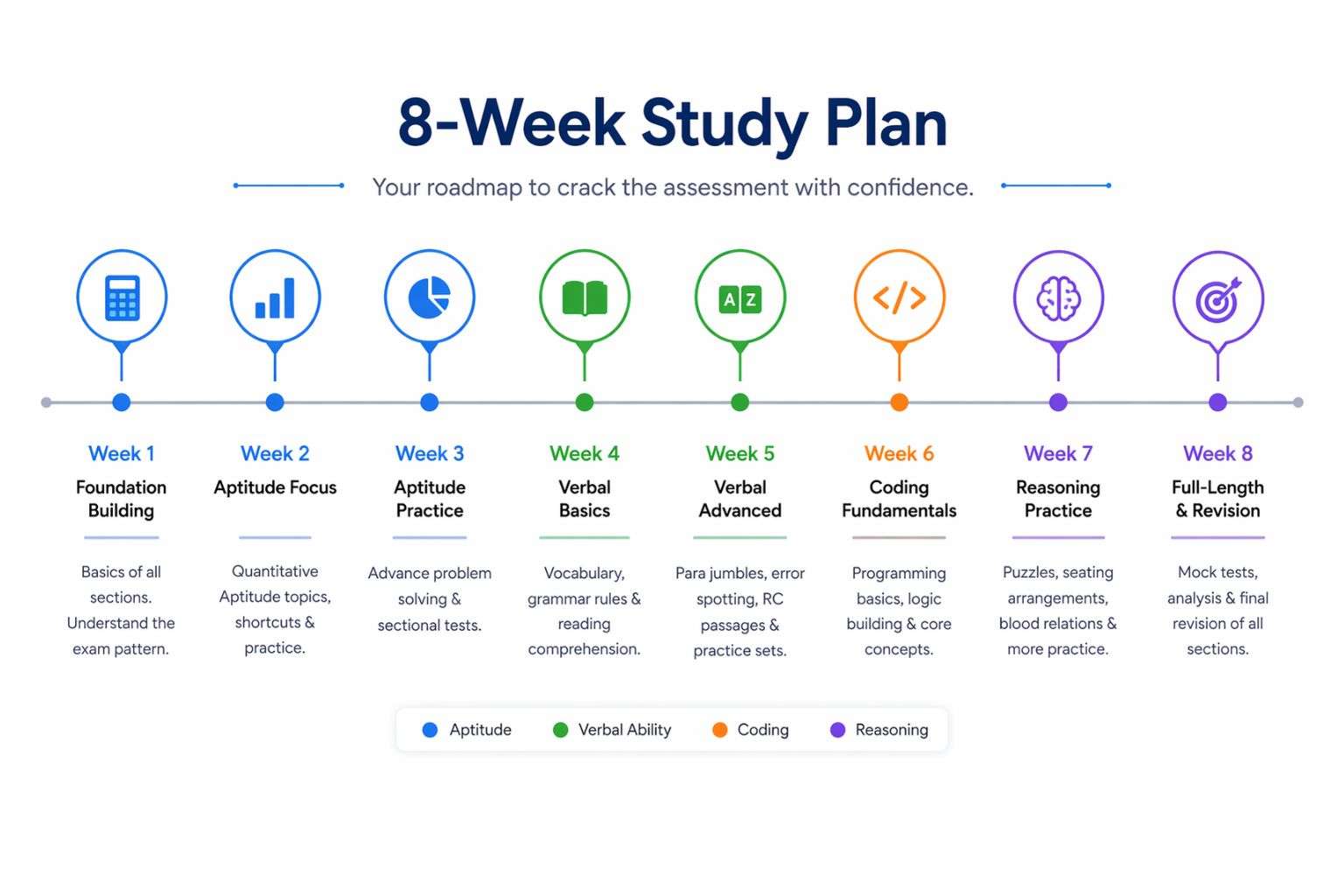
Here is the plan I give students who have eight weeks before their GenC assessment.
Aptitude Preparation — Weeks 1 to 3
Start with the basics. Do not jump to shortcuts.
Most GenC aptitude questions are at a moderate level. They are not designed to trick you. They are designed to check if you can calculate quickly and accurately under time pressure.
Focus topics in order: percentages and ratios first, then time-work and speed-distance, then profit-loss and interest, then averages and number systems.
Daily target: 20 questions minimum. Time yourself from day one.
Resources I recommend:
- R.S. Aggarwal Quantitative Aptitude — chapters 1 to 15 are enough
- IndiaBIX for practice questions with explanations
- Previous Cognizant GenC question papers (available on PrepInsta and Freshersworld)
Consultant’s Note: The 16-minute time limit for 16 questions means one minute per question. That sounds comfortable. It is not, when you are nervous and the screen is counting down. Time yourself every single day from week one. Speed under pressure is a skill. It builds slowly.
Reasoning Preparation — Weeks 2 to 4 (Run Parallel)
Reasoning in GenC is straightforward but time-sensitive.
Seating arrangement and blood relations questions take the most time. Practice them first. If you get stuck on one question for more than 90 seconds during the actual test — skip it and come back.
Focus topics: Seating arrangement, blood relations, syllogisms, coding-decoding, series.
Daily target: 15 to 20 questions. Mixed types.
Verbal Ability Preparation — Weeks 1 to 8 (Run Every Day)
This is the section that decides your offer level. Run this preparation in parallel with everything else, every single day.
Week 1 to 2: Reading comprehension. Read one passage daily. Time yourself. Aim for 5 minutes per passage and 2 minutes for questions. Use editorial sections of The Hindu or Economic Times.
Week 3 to 4: Grammar fundamentals. Subject-verb agreement, tenses, articles, prepositions. RS Aggarwal’s English section covers this well.
Week 5 to 6: Vocabulary building. Learn 10 new words a day. Context matters more than definitions — learn words in sentences.
Week 7 to 8: Mock tests focusing only on the Verbal section. Time yourself to 25 minutes for 25 questions. That is one minute per question. It feels fast. Practice until it feels normal.
Consultant’s Note: Reading comprehension is not just an English exam skill. It is a work skill. Cognizant’s consultants read client documents, project briefs, and emails all day. When you improve your RC speed, you are improving a skill that actually matters on the job.
Coding Preparation — Weeks 3 to 8
Two coding questions. Forty-five minutes. That is 22 minutes per question if you divide the time evenly.
The questions are typically at easy to medium difficulty. Arrays, strings, loops, basic functions. They are not DSA challenge-level problems.
CS branch students: Focus on clean, working code in your preferred language. Practice basic array and string problems.
Non-CS branch students: Start with Python. It is the most readable and fastest to write under pressure. Focus on loops, conditionals, functions, and basic data structures.
Resources:
- HackerRank (practice Python/Java tracks)
- LeetCode Easy problems — do 30 of them minimum before your test
- GeeksforGeeks — Cognizant previous year coding questions
Consultant’s Note: In GenC, full marks for a correct solution matter more than partial marks for a clever but incomplete one. If you solve both problems fully with basic logic — even with a few extra lines of code — you score better than someone who attempted a complex solution and left it half-finished.
Cognizant GenC Interview Rounds — What Happens After You Clear the Test
Clearing the online assessment gets you to the interview stage. Most students are less prepared for this than for the test itself.
Cognizant GenC typically has two to three rounds after the online assessment.
Round 1 — Technical Interview
This round is 30 to 45 minutes. The interviewer focuses on your core CS fundamentals and one or two programming concepts.
Expect questions on:
- OOPS concepts — encapsulation, inheritance, polymorphism, abstraction (explained, not just defined)
- Data structures — arrays, linked lists, stacks, queues
- Basics of DBMS — SQL queries, normalization
- Your final year project — be ready to explain it clearly and honestly
- One or two coding problems on paper or screen
What Cognizant is actually looking for in Round 1: Can you explain what you know in simple language? Can you think through a problem step by step? Are you calm under pressure? The interviewer is not expecting a senior developer. They are expecting a fresher who thinks clearly.
Round 2 — HR Interview
This is where communication skills matter most. The HR interviewer is assessing three things: your personality, your communication ability, and your cultural fit.
Common questions:
- Tell me about yourself (have a two-minute answer ready — not a paragraph recitation)
- Why Cognizant?
- Where do you see yourself in three years?
- Are you open to relocation?
- Do you have any questions for us?
Consultant’s Note: The answer to “Why Cognizant?” that impresses HR is not “Because it is a reputed company.” Everyone says that. Mention something specific — their Synapse programme, their consulting-led delivery model, their presence in your target domain. Specific answers show research. Research shows seriousness.
Round 3 — Communications Assessment (Some Drives)
In some GenC drives, particularly for 2024 and 2025 batches, Cognizant has added a spoken English assessment round. This is typically conducted through a digital platform — you speak responses into a microphone and they are scored for fluency, pronunciation, and coherence.
If your drive includes this round, practice speaking answers aloud every day from week five. Record yourself on your phone. Listen back. Improve one specific thing each week.

Cognizant GenC Salary 2026 — The Actual Numbers
Let us talk about money. Because students deserve honest numbers, not vague ranges.
GenC (standard track): ₹4,00,000 per annum (CTC) GenC Elevate (higher track): ₹5,50,000 to ₹6,00,000 per annum (CTC)
Your in-hand monthly salary will be lower than CTC. After PF deductions, variable components, and other adjustments, a GenC fresher typically takes home ₹28,000 to ₹32,000 per month.
How does this compare to the rest of the cluster?
- TCS NQT (Digital/Ninja): ₹3.36 to ₹7 LPA depending on track
- InfyTQ (SE/DSE): ₹3.6 to ₹5 LPA
- Wipro NLTH (Turbo/Elite): ₹3.5 to ₹6.5 LPA
Cognizant GenC Elevate sits comfortably in the middle to upper band of the service company range. It is a genuine offer worth having.
One important thing about Cognizant joining.
Cognizant has had variable joining timelines in recent years. Students have reported delays between offer and actual joining. Keep this in mind when planning. Do not decline other offers without careful thought, especially if your GenC offer date is uncertain.
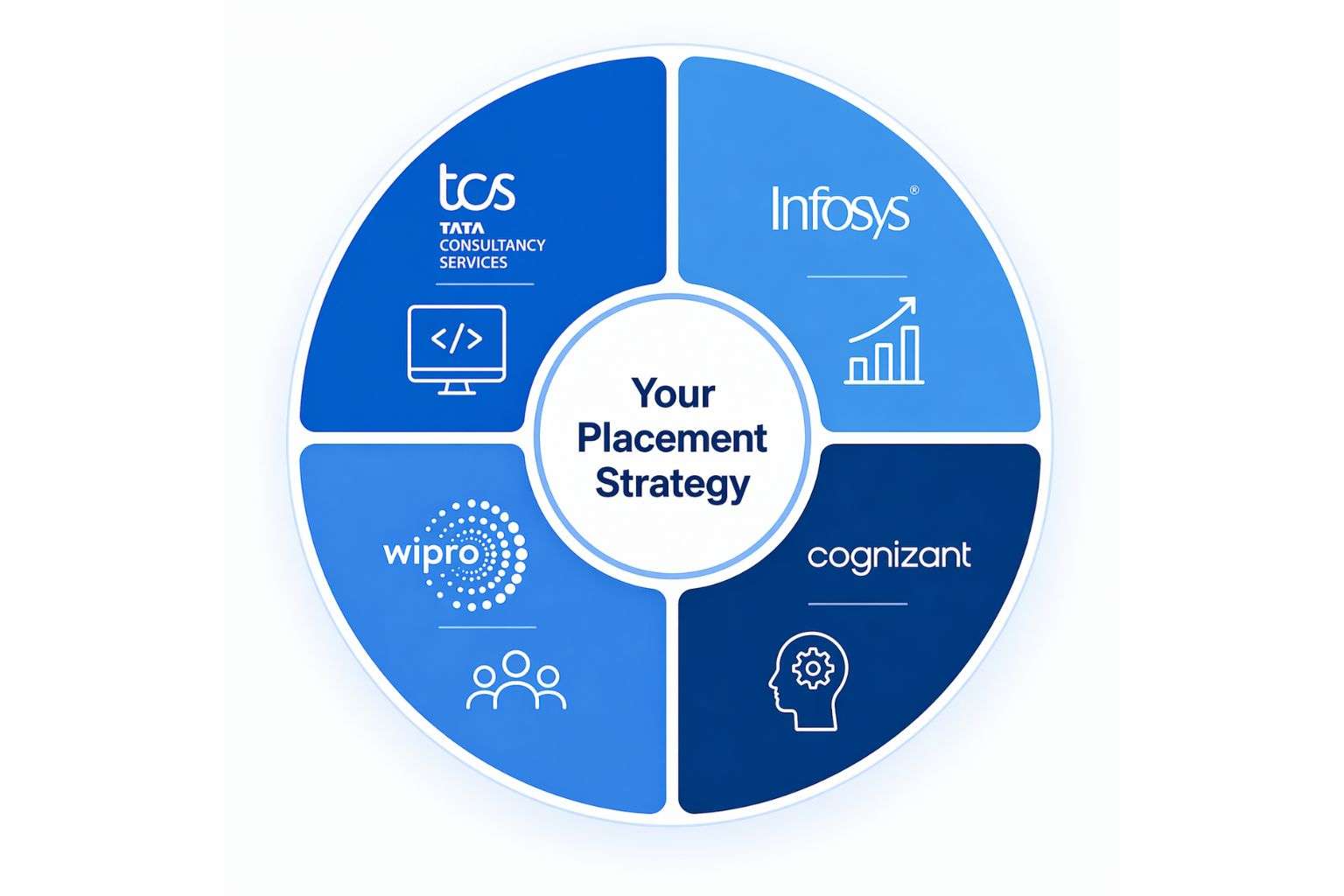
How Cognizant GenC Completes Your Four-Company Cluster
This is the strategic part of this guide. And it is the part most students miss.
When I work with students on their placement strategy, I always say the same thing.
One test is a gamble. Two tests is a strategy. Four tests is a plan.
Here is why the four-company cluster works.
TCS NQT — India’s largest fresher hiring exam. Multiple tracks. Wide eligibility. Should be your first attempt.
Infosys InfyTQ — Platform-based learning plus certification. Unique among the four because studying for it actually builds your skills, not just your test score.
Wipro NLTH — Strong verbal and spoken English component. Good stepping stone if you are building communication skills alongside technical prep.
Cognizant GenC — The fourth and final piece. Heavy verbal weight. Two salary tracks. Off-campus friendly. Completes your cluster.
When you prepare for all four, something interesting happens. The preparation starts to overlap.
Aptitude practice for TCS NQT helps your GenC aptitude section. Verbal practice for Wipro NLTH directly helps your GenC verbal section. Coding practice for InfyTQ is exactly what you need for GenC coding. You are not doing four times the work. You are doing the same core preparation with four sets of potential outcomes.
That is the power of the cluster approach.
Consultant’s Note: I have watched students clear all four in the same placement season. I have watched students clear one and spend months waiting for that single offer to convert to a joining date. The mental and financial cost of waiting on one offer is real. Give yourself options. Four assessments, four chances. That is not greedy. That is smart planning.
Three Mistakes That Cost Students Their Cognizant GenC Offer
I see the same three mistakes every year. Here they are, so you can avoid them.
Mistake 1 — Treating Verbal as Easy and Skipping It
Twenty-five questions. Twenty-five minutes. More marks than aptitude or reasoning. Students who score low on verbal rarely make it past the cut-off, even with perfect aptitude scores. Sectional cut-offs are real. Verbal is not optional preparation.
Mistake 2 — Writing Code That Works Partially and Submitting It Hoping for Partial Credit
A working solution to a simple problem beats a broken solution to a hard one. Always. In the GenC coding section, get both problems to run correctly. If you cannot, get one to run perfectly and submit a basic attempt for the second. Do not spend 40 minutes on one problem and leave the second blank.
Mistake 3 — Going Into the HR Round Without Knowing Anything About Cognizant
“Why do you want to join Cognizant?” answered with silence or a generic answer kills offers that the technical round secured. Spend 20 minutes reading Cognizant’s website before your interview. Know their business model. Know a project or programme that interests you. That is all it takes to give a specific, impressive answer.
What to Do This Week — Your Cognizant GenC Action Plan
Here is a concrete, seven-day starting plan. Not a vague suggestion. A real daily action.
Day 1: Go to Cognizant’s official careers page. Check if a GenC drive is currently active or upcoming. Register if open. Bookmark the page.
Day 2: Take one full mock test for Cognizant GenC on PrepInsta or Freshersworld. Do not prepare first. Just take the mock. You need to know your starting point honestly.
Day 3: Review your mock test results by section. Write down your score, your weak areas, and the three types of questions that took you the longest.
Day 4: Start verbal preparation. Read one editorial from The Hindu. Summarise it in three sentences in your own words. Look up every word you did not know.
Day 5: Solve 20 aptitude questions from RS Aggarwal. Time yourself. Record your accuracy and your speed.
Day 6: Practice two easy coding problems on HackerRank in your preferred language. Run the code. Fix errors. Submit only when it runs completely.
Day 7: Watch one YouTube video about Cognizant — their business, their services, their recent news. Take three notes you could use in an HR interview.
Repeat this weekly structure. Add one mock test every week. Review every mock before the next one.
If you are simultaneously preparing for the other three assessments in the cluster, read these posts next:
- How to Crack Infosys InfyTQ 2026
- Wipro NLTH Guide for Indian Students 2026
- Fresher Job Interview Questions for IT Companies in India
- Does CGPA Matter for Jobs in India 2026
- Soft Skills for Freshers in India
External resources:
- Cognizant Official Careers Page — for live drive notifications
- PrepInsta Cognizant Mock Tests — free section-wise practice
- HackerRank Python Practice — for coding preparation
FAQs — Cognizant GenC Guide 2026
FAQ 1 — Is Cognizant GenC harder than TCS NQT and should I attempt both in the same season?
Yes, you should attempt both. And here is the honest difficulty comparison.
TCS NQT is longer and tests more domains. The Digital track has a higher coding difficulty level. The Ninja track is more forgiving. Cognizant GenC is shorter but more demanding in Verbal Ability than TCS NQT. The coding section in GenC is easier than TCS Digital but roughly comparable to TCS Ninja.
If you are preparing for TCS NQT with serious commitment, you are already doing 70% of the preparation needed for GenC.
The verbal section is the additional gap. Add three to four weeks of dedicated verbal prep to your TCS preparation schedule and you are ready for both.
The students who tell me they cannot prepare for two tests at once are usually not studying in a structured way for either one. The overlap between these assessments is significant.
You are not doubling your work. You are adding about 20 to 25% more targeted effort to unlock a second company’s selection process. That is always worth it.
Consultant’s Note: I tell every student I work with — prepare for the cluster, not the single test. The mental pressure of waiting on one offer is genuinely damaging to your productivity and your wellbeing. Options protect your peace of mind. Options protect your career.
FAQ 2 — My college does not have Cognizant for campus placements. Can I still apply for GenC off-campus and what is the process?
Absolutely yes. This is one of the most important things to know about Cognizant GenC.
The off-campus process for GenC is entirely separate from campus placements. Cognizant periodically opens registration drives on its official careers portal. These drives are not advertised widely. Many students miss them because they are not monitoring the page.
The way to not miss a drive is simple — register on the Cognizant careers portal with your real email address, set up job alerts, and check the page once a week.
When an off-campus drive opens, registration is typically open for one to two weeks. The online test date is usually two to four weeks after registration closes. If you are already prepared when the drive opens, you can register and sit the test within the same month.
Students from tier two and tier three cities have cleared GenC off-campus and joined Cognizant with no campus connection whatsoever. The assessment is the same whether you come from a campus drive or an off-campus drive. Your score is your entry. Nothing else.
Consultant’s Note: I have seen students from Bhubaneswar, Raipur, Ranchi, and Patna clear Cognizant off-campus drives. Geography and college tier do not matter inside the test. Preparation does. Use that.
FAQ 3 — What happens during Cognizant’s training period after joining and what should freshers expect?
Cognizant runs what is called the SYNAPSE training programme for GenC joiners. It is a structured on-boarding and technical training period that typically lasts between three to six months depending on the project pipeline and batch.
During this period, freshers are placed in a training cohort. You study technical modules, take assessments, and are eventually allocated to a project team. Performance during training affects your project allocation and, in some programmes, your salary increment timeline.
Many students underestimate the training period. They think the hard part is getting selected. It is not. The first year in Cognizant is about demonstrating that you can learn quickly, work in a team, and communicate professionally with clients. The verbal and communication skills you build while preparing for GenC are not just interview skills. They are day-one job skills.
Students who go into training with a growth mindset — willing to ask questions, admit gaps, and improve quickly — tend to get the better project allocations. Students who coast because they already cleared the exam tend to get stuck in holding queues.
Consultant’s Note: The GenC exam gets you the offer. Your attitude in the first six months gets you the career. Those are two different things. Prepare for both.
FAQ 4 — What is the difference between Cognizant GenC and GenC Elevate and is it possible to get Elevate without specifically targeting it?
Yes, it is possible to get a GenC Elevate offer without knowing that you were competing for it.
Both offers come from the same assessment. Cognizant does not separate GenC and GenC Elevate into different tests. They use your overall score — and in some drives, your academic score — to determine which offer you receive.
A student who scores in the top percentile of the assessment cohort for that drive, with 60% or above throughout academics, is likely to receive a GenC Elevate offer. A student who clears the cut-off but scores in the lower band receives a standard GenC offer.
The salary difference is meaningful. GenC Elevate at ₹5.5 to ₹6 LPA versus standard GenC at ₹4 LPA is a gap of ₹1.5 LPA at the starting point. Over three years, with increments applied to a higher base, that gap compounds.
So treat every section of the assessment — especially Verbal — as if your salary depends on it. Because it does.
Consultant’s Note: Most students aim to clear the cut-off. Students who aim for Elevate prepare with a different intensity. Aim for Elevate. Even if you land standard GenC, you are better prepared and you scored higher, which means you probably cleared other companies too.
Consultant’s Closing Perspective — Why Cognizant GenC Is the Right Fourth Step
I want to end this guide the way I end every placement conversation I have with students.
The four-company service cluster — TCS NQT, InfyTQ, Wipro NLTH, and Cognizant GenC — is not about brand prestige. It is not about which company sounds better at a family gathering. It is about giving yourself four real chances in a job market where one chance is not enough.
India produces over 1.5 million engineering graduates a year. The top service companies collectively hire around 150,000 freshers annually. That is a 10:1 competition ratio before you account for quality of preparation.
The students who walk into placement season with four assessments completed — and three cleared — are not lucky. They planned. They ran parallel preparation. They did not wait for campus placement to tell them which companies would visit.
Cognizant GenC is your fourth layer of protection. The verbal focus makes it different enough from TCS and Wipro that clearing it proves something about you. The two-track offer structure means strong performance is directly rewarded with higher salary.
Prepare for it with the same seriousness you gave TCS NQT.
Then come back here and tell me you cleared all four.
I will be very pleased to hear it.
Written by Aslam Rahman — IT Career Consultant with 27 years of experience in IT hiring, fresher placement strategy, and career guidance for Indian students. Based in Bhubaneswar, Odisha. Founder of Career Guru — cguru.co.in.







6 Comments