

Business Analyst Career for BTech Freshers — A 27-Year IT Career Consultant’s Honest Guide to India’s Best Non-Coding Job in 2026
A business analyst career for BTech freshers is the question I get asked almost every week now, usually by a student who is good with logic but does not enjoy writing code eight hours a day. I understand that feeling completely. Not every engineer wants to be a developer. Some of you want to solve business problems, not just technical ones. And I want to tell you upfront, before you read one more word, that this is a real career, not a backup plan for “weak coders.” I have placed students into this role for years now, and the good ones out-earn many of their coding batchmates within three years.
I have counselled engineering students in Bhubaneswar, Cuttack, Rourkela, and Berhampur for 27 years. I have watched this role grow from something nobody understood to one of the most searched career options among final-year students. So let me walk you through it properly, the way I would in my own office, with real numbers and no hype.
What Does a Business Analyst Actually Do?
Before we go further into a business analyst career for BTech freshers, let’s clear up what the job actually involves. A business analyst sits between the business side of a company and the technical team. Sales wants a new feature. Operations wants a process fixed. The tech team needs to know exactly what to build. The business analyst is the person who talks to everyone, writes it all down clearly, and makes sure the final product actually solves the real problem.
Think of it like this. An engineering college wants a new online admission system. Someone has to ask the admin staff what they need, ask the finance team how fees should be tracked, ask the IT team what is technically possible, and then turn all of that into one clear document the developers can follow. That translator role is the business analyst.

This is why a business analyst career for BTech freshers works so well for engineering graduates specifically. You already understand how systems work. You just need to add the business thinking and communication layer on top of your technical base.
Why This Path Fits BTech Freshers Who Don’t Want to Code Full-Time
Let me be direct about something. Not every BTech student loves coding, and that is completely fine. I have counselled hundreds of students who cleared their engineering with good grades but genuinely disliked spending their whole career writing and debugging code. For them, a business analyst career for BTech freshers is one of the most honest non-coding paths available.
You do not stop using your technical background. You use it differently. Instead of building the system, you decide what the system should do. You still need to understand databases, still need to read a bit of SQL, still need to understand how software projects work. But your main tools become communication, documentation, and structured thinking, not programming languages.
I have seen mechanical, electrical, and civil engineering students move into this role just as successfully as computer science students. This is one of the very few non-coding tech jobs where your branch barely matters. What matters is whether you can listen carefully, ask the right questions, and write clearly.
The Skills You Actually Need
A business analyst career for BTech freshers rests on two kinds of skills, and freshers usually only prepare for one of them.
Technical skills companies expect:
- Excel, at an advanced level, not just basic formulas
- SQL, enough to pull and understand data yourself
- Power BI or Tableau, for building simple dashboards
- Basic understanding of how software projects run, especially Agile and Scrum
- Documentation tools like MS Office and Visio for process flows
Soft skills that decide who actually gets hired:
- Asking clear questions instead of vague ones
- Writing requirements in plain language, not jargon
- Listening to a client without jumping to conclusions
- Managing disagreement between business teams and tech teams calmly
- Presenting findings in a way non-technical people understand
Here is something I tell every student directly. Companies can teach you a tool in two weeks. They cannot teach you how to listen properly or write a clear requirement document in two weeks. That skill takes practice, and it is exactly what separates a fresher who gets hired from one who does not.

Do You Need a Certification?
This is one of the most common questions I get about a business analyst career for BTech freshers, so let me answer it honestly. You do not need a certification to get your first job. Many BAs I know started with zero certifications and learned entirely on the job.
That said, if you want to stand out on a fresher resume, the ECBA (Entry Certificate in Business Analysis) from IIBA is worth considering. It is designed exactly for students and freshers, requires no prior work experience, and signals to a recruiter that you understand business analysis fundamentals before you even join. Higher certifications like CCBA and CBAP only make sense once you have actual years of BA experience, so do not chase those as a fresher.
My honest advice is this. Spend your final year building one real project using Excel, SQL, and a documentation tool, rather than collecting certificates. A recruiter trusts a small real project more than a certificate with no proof behind it.
Business Analyst Salary for BTech Freshers in India
Let’s talk numbers, because this is where a business analyst career for BTech freshers genuinely surprises people. Fresher salaries typically fall between ₹4 LPA and ₹7 LPA across most Indian companies. Product companies and BFSI firms sometimes go higher, especially for candidates who come in with strong Excel, SQL, and communication skills already proven through internships or projects.
Compare that to many entry-level coding roles at service-based companies, where fresher packages often sit closer to ₹3.5 LPA to ₹4.5 LPA. A business analyst career for BTech freshers frequently starts at a similar or higher band, and the growth curve tends to be steep. By the three-to-five-year mark, experienced BAs regularly cross ₹10 to ₹14 LPA, and specialists in banking or consulting environments go well beyond that.
I am not saying this to hype the role up. I am saying it because most students never check these numbers before writing this career off as “not technical enough to pay well.” A business analyst career for BTech freshers pays well because it solves a real, expensive problem for companies: wasted development time caused by unclear requirements.
Who Hires Business Analysts in India
A business analyst career for BTech freshers is not limited to one industry, which is part of what makes it attractive. Here is where the actual demand sits right now.
- IT services companies — TCS, Infosys, Wipro, and similar firms hire BAs for client-facing project roles
- BFSI and fintech — banks and financial platforms need BAs to translate compliance and process needs into systems, a space I covered in detail in my BFSI IT jobs for freshers guide
- Consulting firms—Deloitte, Accenture, and similar companies run structured fresher BA hiring tracks
- Product companies — e-commerce, SaaS, and fintech products hire BAs to work directly with product managers
- GCCs (Global Capability Centres) — increasingly hiring BAs for India-based teams supporting global operations
This spread across sectors is exactly why a business analyst career for BTech freshers is considered one of the safer non-coding bets. You are not depending on one industry’s hiring cycle. Even when one sector slows down its hiring for a season, another sector tends to pick up, which is not something every career path in IT can claim right now.
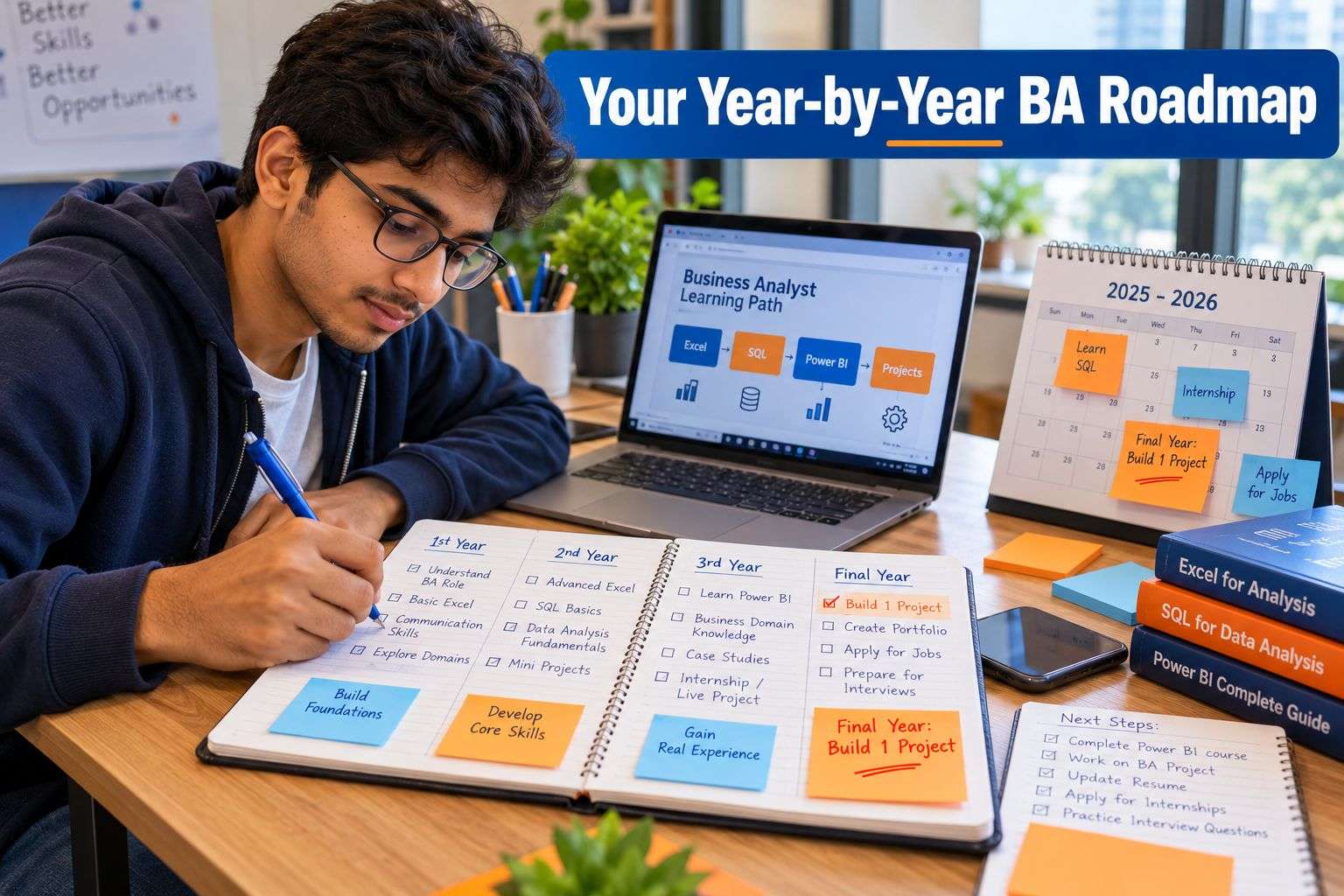
How to Actually Break Into This Role, Year by Year
I get asked constantly how to prepare, so here is the honest, practical action plan I give my own students who want a business analyst career for BTech freshers.
Second year of college
Start learning Excel properly, beyond basic formulas. Learn pivot tables, VLOOKUP, and basic data cleaning. Join a college club or event team where you handle coordination between people, since that builds your communication muscle early.
Third year of college
Learn SQL from scratch and practice on real datasets. Pick up Power BI or Tableau and build two or three small dashboards using public data. Do a short internship, even an unpaid one, where you get exposure to how a real project runs.
Final year of college
Build one complete mock project: pick a real problem, write a requirements document for it, map the process, and present it like you would to a client. Apply specifically to BA and business operations analyst fresher roles, not just generic “IT jobs.” Practice explaining your project out loud, since interviews for this role are conversation-heavy, not just technical tests.
After placement, in your first year on the job
Ask questions constantly, even ones that feel basic. Document everything you learn about how the business actually works, not just the tools. Build a habit of writing clear notes after every meeting, since this single habit is what makes BAs good at their job over time.
Common Mistakes Freshers Make in This Career
I want to flag a few mistakes I see again and again, because avoiding them puts you ahead of most other candidates chasing a business analyst career for BTech freshers.
The first mistake is treating this as a “non-technical, easy” role. It is not easy. You are expected to understand both business and technology well enough to bridge them, which is genuinely demanding. The second mistake is skipping SQL entirely, assuming Excel is enough. Most interviewers test basic SQL now, even for fresher BA roles. The third mistake is writing a resume full of generic phrases like “good communication skills” with no proof. Show a real project or internship instead of just claiming the skill.
The fourth mistake, and this one costs students the most, is applying only to companies with “Business Analyst” in the job title. Many BA-type roles are listed as Business Systems Analyst, Process Analyst, Product Analyst, or Junior Consultant. Widen your search, or you will miss most of the actual openings.
I will add a fifth mistake here, since I see it constantly. Students preparing for a business analyst career for BTech freshers often practice only technical questions and ignore the behavioural ones completely. This role is judged as much on how you handle a disagreement between two stakeholders as it is on your SQL skills. Practice both, not just one.
Is a Business Analyst Career Future-Proof for BTech Freshers?
I get this question in almost every counselling session now, so let me answer it directly. A business analyst career for BTech freshers is not immune to change, but it is one of the more resilient non-coding paths I track. AI tools are already speeding up documentation, basic reporting, and even some requirement summarising. That part of the job is genuinely getting faster.
What AI cannot replace easily is the human part of the role: sitting in a room with two teams who disagree, understanding what a client actually means when they say “make it simpler,” and making a judgment call when the data and the business politics point in different directions. That is exactly why a business analyst career for BTech freshers still looks solid to me heading into the next few years. The freshers who learn to use AI tools to work faster, instead of fearing them, will do even better than the ones who ignore this shift completely.
Consultant’s Note
I have watched this role go from something students barely understood to one of the most asked-about non-coding paths in my counselling sessions. What convinces me it is genuine, and not a passing trend, is that every industry I work with, from IT services to BFSI to product companies, keeps hiring for it every single year. If you are analytical, patient with people, and comfortable writing things down clearly, give this path a serious look before you assume coding is your only option.
Frequently Asked Questions– Business Analyst Career for BTech Freshers
FAQ 1. Is a business analyst career for BTech freshers actually a good option, or is it a fallback for weak coders?
I want to answer this one clearly, right at the top, because it is the single biggest doubt I hear.
It is a genuine career, not a fallback. I say this after placing many engineering graduates into this role over the years, some of whom were strong coders who simply preferred business problem-solving over writing code all day. Companies specifically look for candidates who understand technology well enough to talk to developers but who also enjoy working with people and processes.
If anything, the role demands more well-rounded thinking than a narrow coding role does, since you need to understand both sides of a project. Do not let anyone tell you this is an “easy” alternative. It has its own difficulty, just a different kind.
Consultant’s Note: I have seen toppers choose this path deliberately, not because they struggled with coding, but because they found more satisfaction in solving business puzzles.
FAQ 2. Which branch of engineering is best suited for a business analyst career for BTech freshers?
This question comes up in nearly every session I run on a business analyst career for BTech freshers, so let me settle it here. Honestly, almost any branch works, and that surprises most students. Computer science and IT graduates have an easier start because they already understand software systems.
But I have placed mechanical, electrical, civil, and even chemical engineering graduates into strong BA roles. What matters more than your branch is whether you can think in structured steps, communicate clearly, and pick up basic technical tools like SQL and Excel. If your branch taught you how to break a big problem into smaller parts, you already have half the skill set.
Consultant’s Note: Some of my best BA placements have come from non-CS branches, simply because those students worked harder to prove their technical readiness.
FAQ 3. How much can a fresher realistically earn in a business analyst career for BTech freshers?
Based on what I see across companies right now, fresher BA salaries in India typically range between ₹4 LPA and ₹7 LPA. Product companies, consulting firms, and BFSI organisations sometimes offer higher packages to candidates who walk in with strong SQL, Excel, and communication skills already demonstrated through internships or projects. This range can shift based on your city, the company type, and how well you perform in interviews.
Do not chase the highest number you see online without checking whether it applies to freshers specifically, since many published averages blend fresher and experienced salaries together. Overall, salary is one of the strongest arguments in favour of a business analyst career for BTech freshers.
Consultant’s Note: I always tell students to negotiate based on skills demonstrated, not just the offer they see on a job portal.
FAQ 4. Do I need to know coding for a business analyst career for BTech freshers?
You do not need to write production code, but you do need enough technical comfort to work with data and talk to developers. SQL is the single most useful technical skill here, since it lets you pull and verify data yourself instead of depending on someone else. Basic understanding of how software gets built, tested, and released also helps enormously. Think of it as technical fluency rather than technical mastery. You need to understand the language of technology well enough to translate it for business teams, without necessarily being the one who builds the system.
Consultant’s Note: Students who learn just enough SQL to be dangerous, in a good way, always interview better than those who skip it entirely.
FAQ 5. What certifications actually help freshers in this field?
For someone just starting out, the ECBA from IIBA is the most relevant certification, since it is designed specifically for students and requires no prior work experience. It signals that you understand core business analysis concepts before you even join a company. Higher-level certifications like CCBA and CBAP require actual years of verified BA work experience, so they are not useful as a fresher.
My honest suggestion is to treat certification as a bonus, not a requirement. A strong mock project and clear interview answers will get you further than a certificate with no practical backing.
Consultant’s Note: I have seen freshers with no certification outperform certified candidates simply because they could explain their project clearly.
FAQ 6. How is a business analyst different from a data analyst?
This confuses a lot of freshers, so let me separate it clearly. A data analyst focuses mainly on numbers: cleaning data, running analysis, and building reports to answer specific questions.
A business analyst focuses more broadly on understanding business problems, gathering requirements from people, and working with both business and technical teams to design solutions.
There is overlap, especially around tools like Excel and SQL, but the core skill for a BA leans more toward communication and requirements writing, while a data analyst leans more toward statistical and analytical depth. Many freshers actually start in one role and move toward the other once they discover which side they enjoy more.
Consultant’s Note: If you enjoy talking to people as much as you enjoy analysing numbers, lean toward business analysis over pure data analytics.
FAQ 7. Which companies hire the most business analyst freshers in India?
IT services companies like TCS, Infosys, and Wipro run structured fresher BA hiring tracks, often through campus placements. Consulting firms such as Deloitte and Accenture also hire freshers into business operations and BA-type roles regularly.
BFSI companies and fintech platforms have grown into strong hiring sources too, since banking projects constantly need people who can translate compliance and process requirements into working systems. Product companies and GCCs (Global Capability Centres) are newer but growing sources of fresher BA roles.
My advice is to widen your search beyond exact job titles, since many of these openings are listed under names like Business Systems Analyst or Process Analyst. This is exactly how most successful business analyst career for BTech freshers stories actually begin, through a title that does not say “Business Analyst” at all.
Consultant’s Note: I have seen students miss good openings simply because they searched only for the exact words “Business Analyst” in the job title.
FAQ 8. How should I prepare for a business analyst interview as a fresher?
Interviews for this role are conversation-heavy, so prepare to talk through a real project clearly, not just list your skills. Be ready to explain how you gathered requirements, what challenges came up, and how you documented your work. Expect basic SQL questions, questions about how you would handle disagreement between two stakeholders, and scenario-based questions like “how would you gather requirements for a new mobile app feature.”
Practice explaining technical concepts in simple language, since that is exactly the skill the interviewer is testing. Mock interviews with a friend or mentor help enormously here, more than they do for purely technical roles.
Consultant’s Note: The freshers who prepare a clear, well-structured story about one real project almost always outperform those who just memorise definitions.
FAQ 9. Is this career path considered safe from AI-related job changes?
This question comes up a lot right now, and I addressed the wider concern in my AI killing engineering jobs guide. For business analysts specifically, AI tools are changing how documentation and basic reporting get done, but the core skill of understanding people, resolving conflicting requirements, and making judgment calls between business needs is still very human.
If anything, BAs who learn to use AI tools to speed up documentation and analysis will become more valuable, not less. I would not avoid this career out of AI fear. I would instead make sure you build strong human-facing skills alongside your technical ones, since that combination is what stays hardest to automate.
Consultant’s Note: The BAs I see thriving right now are the ones using AI tools to work faster, not the ones ignoring them.
FAQ 10. Can I switch into a business analyst career later, even after joining as a developer?
Yes, and this happens often. Many experienced BAs I know started as developers or testers and moved into business analysis after a couple of years, once they realised they enjoyed the requirement-gathering and client-facing side of projects more than pure coding. If you are a fresher unsure right now, joining a technical role first and switching later is a completely valid path too.
It even gives you an advantage, since you will understand the technical side more deeply than someone who never coded at all. There is no single “right” entry point into a business analyst career for BTech freshers, only different starting positions that lead to the same destination.
Consultant’s Note: Some of the strongest BAs I have mentored spent their first two years coding before making the switch, and it made them better at the job, not worse.
Action Steps for a Business Analyst Career for BTech Freshers
- If you are in second year, start Excel and basic data handling now, and join any team activity that builds your coordination skills
- If you are in third year, learn SQL and Power BI, and try to get even a short internship for real project exposure
- If you are in final year, build one complete mock BA project and start applying to BA, Business Systems Analyst, and Process Analyst roles, not just “Business Analyst” titles
- If you have just started your first BA job, focus on writing clear meeting notes and asking questions without hesitation
- At every stage, keep checking real job postings to see what tools and skills companies are actually asking for right now

Where to Learn More
If you are serious about pursuing a business analyst career for BTech freshers, structured training helps you move faster than learning everything on your own. A guided path also helps you avoid the trial and error that slows most freshers down in their first year. I work closely with Rooman Technologies as their State Business Partner in Odisha, and their business analytics and IT training programs cover exactly the tools and skills mentioned in this guide, from SQL to Agile fundamentals to real project work. It is worth checking whether their current batch fits your timeline, especially if you are heading into your final year.
For more career guidance built specifically for students in tier-2 cities, take a look at my guide on tier-2 engineering jobs in India, my breakdown of skill-first hiring in India, and my guide to how AI-powered ATS systems screen freshers, since your resume needs to pass that screening before any human sees it. If you are also weighing whether location matters, my guide on remote tech jobs for freshers is worth reading too.
You can also watch these videos to see the role explained visually: Business Analyst Salary in India 2026, Is Business Analyst Still Worth It in 2026?, and the Business Analyst Full Course 2026 by Simplilearn if you want to go deeper into the fundamentals.

To close this out, a business analyst career for BTech freshers is not a shortcut and it is not a backup plan. It is a real, well-paying path for engineering graduates who think clearly and communicate well. If that sounds like you, start building the skills now, not after placements begin. If you want to talk through whether this path fits you specifically, you know where to find me.
I read all my emails. You can reach out to me – [email protected] or WhatsApp – 9777278853