
AI Skills Salary Premium for Freshers in 2026 — A 27-Year IT Career Consultant’s Honest Take on the 40% Pay Gap
AI skills salary premium for freshers is not a marketing line anymore. It is a number I am watching show up on real offer letters, in real counselling sessions, in Bhubaneswar, Cuttack, Rourkela, and Berhampur. I have spent 27 years telling students to ignore hype. I am not going to start hyping this one. But I am also not going to hide a number this large from you, because it is changing who gets the good offer and who does not, in this very placement season.
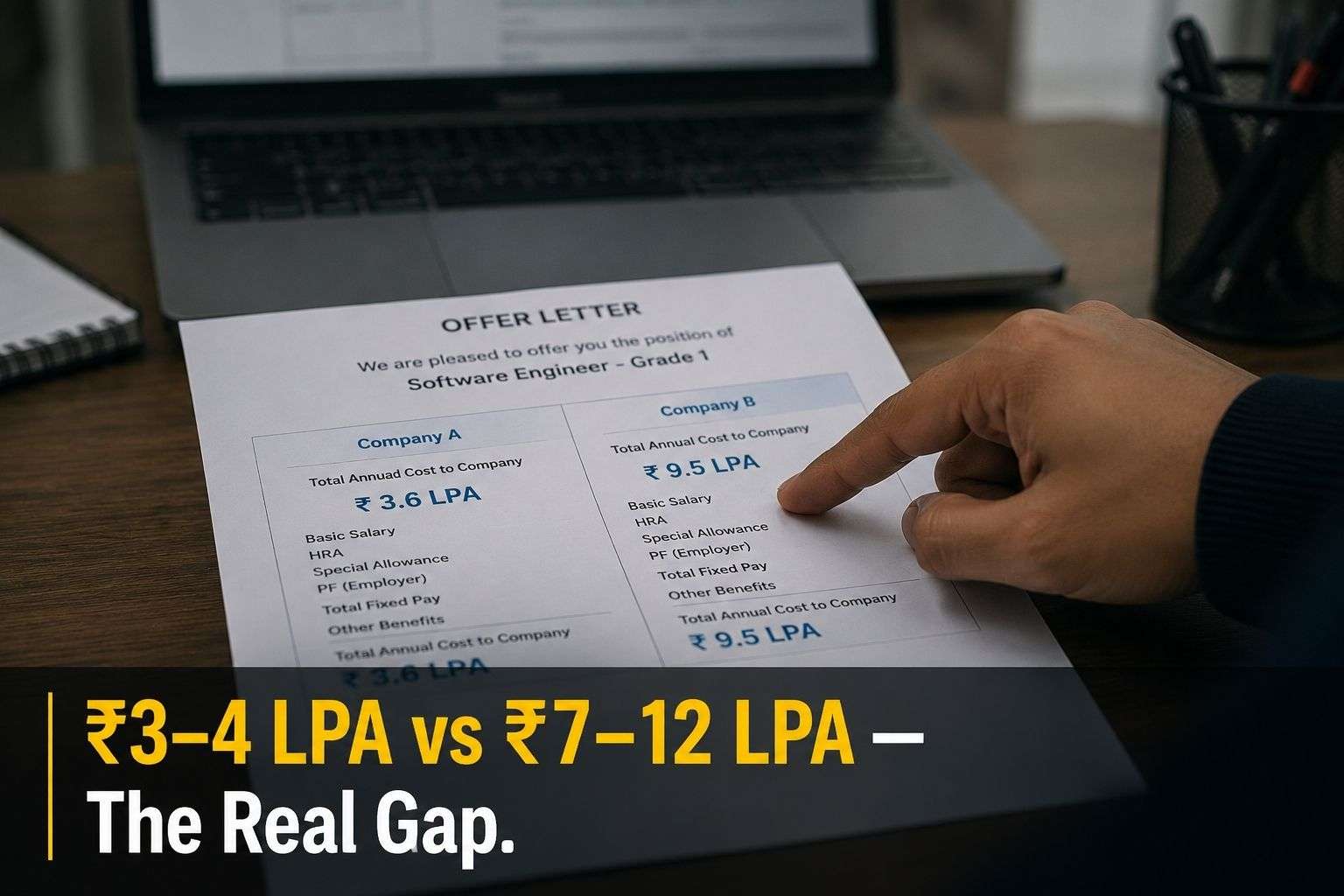
Here is the number that should make you sit up. Early trends from the 2026 placement season show the old ₹3–4 lakh fresher salary band is giving way to offers in the ₹7–12 lakh range, and recruiters are saying openly that this shift is driven by demand for AI skills. At one large IT services company, nearly 65 percent of fresher offers this year came in at the higher Digital and Prime bands — the bands built specifically for candidates who show AI-linked skills. That is not a small gap. That is close to double, sitting between two students from the same college, same branch, same CGPA.
This blog is my honest answer to the question I now hear every week. Is the AI skills salary premium for freshers real, or is it another thing colleges and coaching centres are selling you? I will give you the actual numbers, the skills that genuinely carry a premium, and the ones that do not, so you can decide where to spend your remaining months before placement season.
Why the AI Skills Salary Premium for Freshers Is Happening Right Now
Three forces are pushing this gap wider, and none of them are temporary hype cycles.
First, AI is quietly taking over the easiest coding and testing work — the exact work freshers used to be hired to do. A senior placement officer I spoke with put it plainly: entry-level jobs built around routine code generation are shrinking, because AI tools now do that work faster than a fresher can. Companies still need freshers. They need fewer of the old kind and more of a new kind — freshers who can direct AI tools, verify their output, and do the judgment work AI cannot do on its own.
Second, the supply of genuinely skilled candidates is nowhere close to the demand. Fewer than 3 percent of applicants who claim AI or ML skills on their resume can actually demonstrate them in an interview. Companies desperate to staff their AI initiatives are competing hard for that small pool, and salary is the bluntest tool they have to win that competition.
Third, employer type multiplies the gap even further. Global Capability Centres and product-first companies pay 40 to 70 percent more than traditional IT services firms for the same AI-linked skill set, at the same experience level. This means the AI skills salary premium for freshers is not one number — it depends heavily on which door you are trying to walk through.
I have written separately about how this connects to the wider hiring surge this season — read Campus Placements 2026 Are Back if you have not seen the full fresher hiring numbers yet.
What Counts as an “AI Skill” — In Plain Language, Not Jargon
I want to clear up the biggest confusion before we go further, because I hear it in almost every session.
Employers offering the AI skills salary premium for freshers are not all asking for machine learning PhDs. There are two very different tiers here, and mixing them up costs students opportunities.
The first tier is AI-native technical work — building, fine-tuning, or deploying AI systems. This includes generative AI application building, retrieval-augmented generation, prompt engineering for production systems, and AI agent development. This tier carries the biggest premium, but it also needs real, demonstrable project work, not a certificate alone.
The second tier is AI-fluent professional work — knowing how to use AI tools like ChatGPT, Copilot, or Excel’s AI features to do your actual job faster and more accurately, whatever that job is. This tier does not need you to write a line of machine learning code, but it still carries a real, measurable premium over a fresher who cannot do this. I have covered this second tier in detail already — see AI Tools for Freshers Placement 2026 for the exact tool list recruiters expect.
Most freshers reading this should aim for strength in tier two immediately, and build toward tier one only if their branch and interest genuinely support it.
The Real 2026 Numbers Behind the AI Skills Salary Premium for Freshers
Let me give you actual figures, not rounded-up marketing numbers, so you can judge your own situation honestly.
A general fresher entering a service-based IT company today typically starts around ₹3.5 to ₹6 LPA. A fresher who can show demonstrable AI-linked skill, at the very same company, is increasingly landing in the ₹7 to ₹12 LPA Digital or Prime band. That alone is close to a 40 to 100 percent jump, and it is happening at the entry level, not five years in.
Move into a dedicated AI-adjacent role and the numbers shift again. Fresher AI and machine learning roles generally pay ₹5 to ₹12 LPA depending on city and company type. Within that, generative AI specialisation — the highest-premium skill set in 2026 — pays entry-level freshers ₹8 to ₹12 LPA where a generalist AI fresher role tops out lower. Specialisation inside a specialisation is where the real premium concentrates.
Agentic AI, meaning the ability to build systems using frameworks like LangChain or CrewAI that let AI act semi-independently on multi-step tasks, is being called the single hottest skill of the year, commanding a 40 to 50 percent premium over a regular machine learning engineer’s pay at the same experience level. I have written a full breakdown of this specific path — read Agentic AI Careers in India 2026 if this direction interests you.
City and company type still matter enormously on top of all this. Bangalore leads AI salaries in India, with Hyderabad and Gurgaon close behind, and a 15 to 25 percent premium over Pune or Chennai for the same role. And as I mentioned earlier, product companies and GCCs consistently outpay service companies by a wide margin for identical AI skill sets.
Which AI Skills Actually Carry the Salary Premium in 2026
Not every AI-adjacent skill is priced the same. Here is the honest ranking I give students, based on what is actually driving offer numbers this season, not what sounds impressive on a resume.
Generative AI application building sits at the top. Working with large language models, building retrieval-augmented generation pipelines, and understanding how to evaluate and constrain AI outputs are the skills recruiters are paying the most to secure right now, because the field is genuinely new and genuinely short on talent.
Agentic AI and orchestration frameworks come next. Freshers who can demonstrate a working project built with an agent framework are commanding a visible premium over generalist candidates, because very few freshers can currently show this at all.
Prompt engineering as a standalone skill carries a smaller but real premium, and it is the most accessible entry point on this list because it needs no programming background at all — it is about knowing how to instruct AI tools precisely and verify what they return.
MLOps and cloud AI deployment matters most for candidates who already have core coding strength and want to move toward the engineering side of AI systems rather than the pure model-building side.
General AI tool fluency — ChatGPT, Copilot, Canva’s AI features, AI features inside Excel — carries the smallest premium individually, but it is now close to a baseline expectation rather than a differentiator, the way basic computer literacy became non-negotiable two decades ago.
The honest advice I give every batch is this. Do not chase the top of this list before you have the bottom secure. A fresher who is fluent with everyday AI tools and has one solid generative AI project will out-earn a fresher who claims deep AI expertise but cannot explain their own project under a follow-up question.
Three Mistakes Freshers Make Chasing the AI Skills Salary Premium
Mistake 1 — Collecting certificates instead of building projects. A certificate tells a recruiter you sat through a course. A project tells a recruiter you can actually do the work. If you have to choose where to spend your limited time, choose the project every time.
Mistake 2 — Claiming AI skills you cannot explain. I have watched this backfire in real interviews. A student lists “Generative AI” on their resume, gets asked one specific follow-up question about how retrieval-augmented generation actually retrieves context, and cannot answer. That single moment costs more credibility than never mentioning AI at all.
Mistake 3 — Assuming the premium applies everywhere equally. As the numbers above show, the same AI skill set can be worth a 40 percent premium at one company and almost nothing at another, depending on employer type and city. Research the specific companies you are targeting before you assume your AI skills will automatically translate into a bigger number.

Your AI Skills Salary Action Plan, By College Year
If you are in first or second year — Start with tier-two fluency now. Use ChatGPT or Gemini for one real academic task every week, not just for entertainment. Open a free account on a generative AI learning platform and complete one beginner project before your third year begins. This early head start compounds by the time you sit for placements.
If you are in third year — Pick one direction from the premium skills list above, based on your branch and genuine interest, not just the highest number. Build one project you can speak about in real depth — not a tutorial you copied, but something you can explain line by line. Start tracking which companies in your target list actually pay the premium you are chasing, because not all of them do.
If you are in final year — Rebuild your resume this week to lead with your strongest AI-linked project, not a list of tools you have merely touched. Rehearse explaining that project out loud until you can handle any follow-up question calmly. If you are deciding between a service-based offer and a product-based offer with an AI-linked role, read my honest comparison in Service Based vs Product Based Company for Freshers before you sign anything, and once you have an offer in hand, check what that number actually means for your monthly take-home in In-Hand Salary vs CTC Explained.

Read These Next
- AI Tools for Freshers Placement 2026
- Agentic AI Careers in India 2026
- AI Recruiter Resume for Indian Freshers in 2026
- Service Based vs Product Based Company for Freshers
- In-Hand Salary vs CTC Explained
Reference Read —
- AI skills driving the ₹7–12 lakh fresher band → Nasscom Community — From AI-Proficient to AI-Native — confirms early 2026 placement trends showing the shift from the ₹3–4 lakh band toward ₹7–12 lakh, driven by AI skill demand.
- GenAI and Agentic AI salary premiums → BuildFastWithAI — AI Jobs in India Salary 2026 — confirms GenAI engineers earning 20–70 LPA against 10–40 LPA for traditional ML roles, and fewer than 3% of applicants having demonstrable AI skills.
- India’s AI skilling and adoption context → Careers360 — India Skills Report 2026 — confirms the scale of AI tool adoption across the Indian workforce entering 2026.
For students who want to see how this premium plays out on camera, I have covered related breakdowns on the Career Guru YouTube channel, and two independent explainers worth watching are The 10 Highest Paid AI Skills in 2026 and Why AI Skills Pay More.

FAQs — AI Skills Salary Premium for Freshers 2026
FAQ 1 — Is the AI skills salary premium for freshers real, or is it exaggerated by coaching institutes trying to sell courses?
I understand this suspicion completely, because for years every new technology came wrapped in exaggerated coaching-institute marketing, and students learned to distrust the numbers on principle. This time the caution is fair, but the underlying number is not fabricated.
What I am seeing directly, through the students I counsel and through Rooman Technologies’ placement partnerships, is that companies themselves are structuring separate, higher salary bands specifically for candidates who show AI-linked skill, not because a coaching institute told them to, but because their own AI initiatives are understaffed and they are competing for a genuinely small talent pool. The premium shows up on real offer letters, at real companies, this placement season.
Where the exaggeration does creep in is in how big some coaching marketing claims the premium is, and in how easy some claim it is to earn. The honest range is 25 to 70 percent depending on skill, city, and company type — not the “become a lakhpati overnight” framing some paid courses use to sell seats.
Consultant’s Note — I tell students to trust the range I have given in this blog, sourced from placement data and industry reporting, and to be sceptical of any single course or consultant who promises a specific guaranteed number. Nobody can guarantee your individual offer. What is guaranteed is that the skill itself is being priced higher across the market right now.
FAQ 2 — Do I need a machine learning or AI specialisation degree to access this salary premium, or can any engineering branch benefit?
This is one of the most common worries I hear from Mechanical, Civil, and ECE students, and the honest answer is more encouraging than most of them expect.
The larger part of the AI skills salary premium for freshers, the tier-two fluency premium I described earlier, is completely branch-agnostic. Knowing how to use AI tools effectively to do your actual job — whatever that job is — carries a real premium regardless of what your degree says on the cover page. A Mechanical engineering fresher who can use AI to speed up documentation, analysis, and reporting is priced higher than one who cannot, in the exact same interview room.
The tier-one premium, the deeper generative AI and agentic AI specialisation, is more accessible to CS and IT branches simply because of prior coding exposure, but it is not closed off to other branches. I have guided ECE and ECE-adjacent students into genuine AI-linked roles when they put in the project work themselves, outside their core curriculum.
Consultant’s Note — Do not let your branch decide this for you before you have even tried. Start with tier-two fluency regardless of your branch. If you find you enjoy the deeper technical side, build one project in your own time and see where it takes you. The market is currently rewarding demonstrated ability far more than it is rewarding your degree title.
FAQ 3 — How much of this salary premium is real cash difference versus just a fancier job title with the same actual pay?
This is a sharp question, and I want to answer it honestly rather than reassure you blindly, because I have seen both patterns in real offer letters.
The premium tied to genuine company salary bands — like the Digital and Prime tiers at large IT services firms — is real cash, confirmed in the CTC figure on the offer letter itself, not just a title change. Companies are moving actual budget into these bands because they need to win a competitive hiring race for AI-linked talent.
Where you do need to watch carefully is at smaller companies or in roles where “AI Associate” or similar titles get attached to what is functionally the same entry-level work as before, with only a marginal pay bump. Always compare the actual CTC number, not the job title, and if you are unsure what a CTC figure really means for your monthly income, read my full breakdown in In-Hand Salary vs CTC Explained before you accept anything.
Consultant’s Note — I ask every student to bring me their actual offer letter, not a verbal description of it, before we discuss whether an AI-linked offer is genuinely better than an alternative. Titles can be inflated. Numbers on a signed letter cannot.
FAQ 4 — I have only a few months left before placements. Is it realistic to build genuine AI skills in that time, or am I too late?
This question carries real anxiety, and I want to be honest rather than falsely comforting, because both extremes — “it’s too late” and “you can master everything in six weeks” — are wrong.
You cannot become a deep AI specialist in a few months if you are starting from zero, and no honest consultant should tell you otherwise. What you can realistically do in a few months is build strong tier-two fluency across the everyday AI tools recruiters expect, and complete one focused, well-understood project in a tier-one direction that genuinely interests you. One well-explained project beats five shallow ones every time in an interview.
The students I have seen move fastest in a short window picked one narrow AI skill — often prompt engineering or a small generative AI application — went deep enough to explain it confidently, and paired that with strong general AI tool fluency everywhere else on their resume and in conversation.
Consultant’s Note — If you have three months, I tell students to spend the first month on tier-two fluency across the board, the next six weeks building one real project, and the final weeks rehearsing how to explain that project under pressure. Depth on one thing beats a shallow list every time.
FAQ 5 — Are product-based companies and GCCs really paying that much more for AI skills than service-based companies, or is that gap overstated?
The gap is genuinely large, and I want to give you the honest range rather than round it up for effect. GCCs and AI-native product companies pay roughly 40 to 70 percent more than traditional IT services firms for the same AI-linked skill set at the same experience level. That is one of the widest gaps I have tracked across any skill category in my 27 years in this field.
The reason is structural, not arbitrary. GCCs and product companies are typically serving international markets or running in-house AI products where the cost of getting AI implementation wrong is high, so they are willing to pay significantly more for verified skill. Service companies, by contrast, are often building AI capability into large existing teams at scale, and their pay bands, while genuinely raised this year, are still built around volume hiring economics.
If a career at a GCC or product company genuinely interests you, I have written specifically about the growing GCC opportunity in our state — read Odisha GCC Policy 2025 for what this expansion means for Odisha freshers specifically.
Consultant’s Note — I never tell a student to chase a GCC or product offer purely for the higher number if the role itself does not fit their strengths. But I do tell every student the gap is real, so factor it honestly into your decision rather than assuming all AI-linked offers pay roughly the same.
FAQ 6 — Will the AI skills salary premium for freshers still exist in two or three years, or is this a short-term window?
This is the single most important long-term question in this entire topic, and I owe you an honest answer rather than false certainty in either direction.
My honest read, based on how similar technology-driven premiums have played out over my 27 years in this field, is that the very top of this premium — the extreme scarcity pricing you see for agentic AI and cutting-edge generative AI skills right now — will compress somewhat as more engineers enter the field and supply catches up with demand. That compression is a normal pattern, not a warning sign specific to AI.
What I do not expect to disappear is the underlying baseline. AI tool fluency is following the same path basic computer literacy followed two decades ago — it started as a premium-earning differentiator and settled into a non-negotiable baseline expectation. The premium for having it will shrink over time, but the penalty for not having it will grow.
Consultant’s Note — I tell students not to treat this premium as a permanent lottery ticket. Treat the current window as a genuine opportunity to build a skill that will remain valuable even after the extra salary premium normalises, because the underlying capability outlasts the pricing spike.
FAQ 7 — How do I prove my AI skills to a recruiter if I do not have a formal AI certification or internship on my resume yet?
This worry stops more students from even trying than any other single factor, so let me be direct about what actually convinces a recruiter.
A recruiter evaluating AI skill in a fresher is not primarily looking at your certificate list. They are looking for one clear, well-explained project you can walk them through — what problem it solved, what you built, what went wrong, and what you learned from fixing it. A single GitHub repository with a working generative AI or agentic AI mini-project, explained confidently, carries more weight than three unrelated online course certificates.
If you genuinely have neither a project nor a certificate yet, the honest and still credible path is to start immediately with a small, scoped project — even something as simple as a basic RAG-based chatbot using free tools — and be ready to discuss it honestly, including its limitations, rather than waiting until you feel “ready” to start showing anything at all.
Consultant’s Note — I have watched students with zero certificates outperform students with three, purely because the zero-certificate student had one project they understood completely. Start building before you feel ready. Understanding beats credentials in every interview I have sat through this year.
FAQ 8 — Does the AI skills salary premium apply the same way to freshers from tier-2 city colleges, or do we start at a disadvantage?
This question comes up in almost every session I run across Bhubaneswar, Cuttack, Rourkela, and Berhampur, and I want to give you a genuinely honest answer rather than empty encouragement.
Tier-2 college freshers do face a real, structural disadvantage in one specific area — access to on-campus recruiters who specifically hire for AI-linked roles, since many product companies and GCCs concentrate their campus drives at a narrower set of institutions. That part of the disadvantage is real and I will not pretend otherwise.
What is genuinely equal, however, is how the skill itself is evaluated once you get in front of an interviewer, on or off campus. A well-explained AI project from a tier-2 college student is judged on the same terms as one from a top-tier college student, because the interviewer is testing understanding, not pedigree. This is exactly why building a strong project and a strong off-campus search strategy matters more for our students, not less — read my honest playbook in How to Crack Campus Placement in 3 Months for the exact off-campus approach I give students in this situation.
Consultant’s Note — I have placed tier-2 college students into GCC and product-company AI-linked roles, and every single time, the deciding factor was a project they could explain with total confidence, not their college name. Do not let college tier decide your ceiling before you have even tried.
FAQ 9 — Should I take a lower-paying non-AI offer now for safety, or hold out and prepare longer for an AI-linked, higher-paying role?
This is a genuinely difficult, personal decision, and I will not pretend there is one universally correct answer, but I can give you the honest framework I use with students facing exactly this choice.
If you already have a reasonable non-AI offer in hand and no strong AI-linked project or preparation yet, taking the safer offer while continuing to build AI skill on the side is usually the more stable path, especially if your family situation makes an income gap risky. A job in hand, with continued self-improvement, is not a failure — it is a reasonable, honest decision that many successful professionals I know made early in their careers.
If you do not yet have any offer, and you have real, uninterrupted time before placement season genuinely closes, investing that specific window into one solid AI-linked project before you start interviewing broadly is often the higher-return choice, because the salary gap this blog has laid out is large enough to be worth a focused delay of a few weeks, not months.
Consultant’s Note — I never tell a student to gamble their financial safety for a theoretical higher number. If you must choose, protect your safety net first, and treat AI skill-building as a parallel, ongoing investment rather than an all-or-nothing bet on one placement season.
FAQ 10 — Is the 40 percent figure in this blog’s title an average, or the maximum possible premium a fresher could see?
I want to be precise here because rounded headline numbers can mislead if you take them too literally, and precision is something I owe every student reading this.
The 40 percent figure represents the realistic upper range of what a fresher can see moving from a standard entry-level offer to an AI-linked band at the same company or a comparable one, based on the ₹3–4 lakh to ₹7–12 lakh shift reported this placement season, and on documented 25 to 45 percent premiums for specific generative AI and agentic AI skill sets. It is not a guaranteed number for every candidate, and in some cases, particularly at the highest specialisation levels or at GCCs and product companies, the actual gap runs even higher than 40 percent.
The honest average, across all AI-linked skill levels and company types, sits somewhere in the 20 to 40 percent range for most freshers who build genuine, demonstrable skill. Treat 40 percent as a realistic strong outcome to aim for, not a floor you should expect automatically.
Consultant’s Note — I would rather give you an honest, slightly conservative range you can actually hit than an inflated headline number that sets you up for disappointment. Build the skill properly, and the number this blog describes is genuinely within reach — not guaranteed, but realistic.

Preparing your placement season toolkit? Read our guides on AI Tools for Freshers Placement 2026 and Agentic AI Careers in India 2026 to make sure your AI skill-building plan is as strong as your interview prep.