AI Killing Engineering Jobs in India ?! — A 27-Year IT Career Consultant’s Honest Take on Why Your College Already Did (2026)
AI killing engineering jobs in India is the sentence every final-year student is typing into Google at 1 AM, and I want to stop you before panic makes the decision for you. I have counselled engineering students in Odisha for 27 years. I have watched three separate “the sky is falling” moments come and go — the 2008 recession, the 2016 automation scare, and the 2020 pandemic freeze. Each time, the fear was real.
Each time, the actual cause was not what students thought it was. This one feels different because the headlines are louder. But when I sit down with the actual numbers, the honest picture is not “AI killing engineering jobs in India.” It is closer to this: a system that stopped preparing students properly, for a decade, just got caught out by a fresher hiring bar that suddenly demands real skill.
Let me show you the data, not the drama.
The Numbers Behind the AI Killing Engineering Jobs in India Panic
Here is what is actually true, and I am not going to soften it. A Rest of World investigation found that at one top Indian engineering institute, fewer than 25 percent of a graduating class of 400 students had secured job offers with their course ending in May 2026. “Everyone is so panicked”: Entry-level tech workers describe the AI-fueled jobpocalypse Globally, entry-level hiring at big tech companies has dropped by more than 50 percent over the last three years, and only 7 percent of new hires at major firms were recent graduates. In India specifically, tech job openings fell to a 28-month low in mid-2026, down 17 percent year-on-year.
Those numbers are real. I will not tell you they are exaggerated. But here is the number that the “AI killing engineering jobs in India” headlines leave out: the India Skills Report 2026 found that computer science graduates have 80 percent employability, and IT engineering graduates have 78 percent — among the highest of any stream in the country, and the number has barely moved despite three years of AI headlines.
India Skills Report 2026 courtesy of Careers360.com:
National graduate employability has actually climbed, from 46.2 percent in 2022 to 56.3 percent in 2026. If AI were simply erasing engineering jobs, both of those numbers should be falling, not holding steady or rising.
So what is going on? Two different things are happening at the same time, and students are treating them as one crisis.
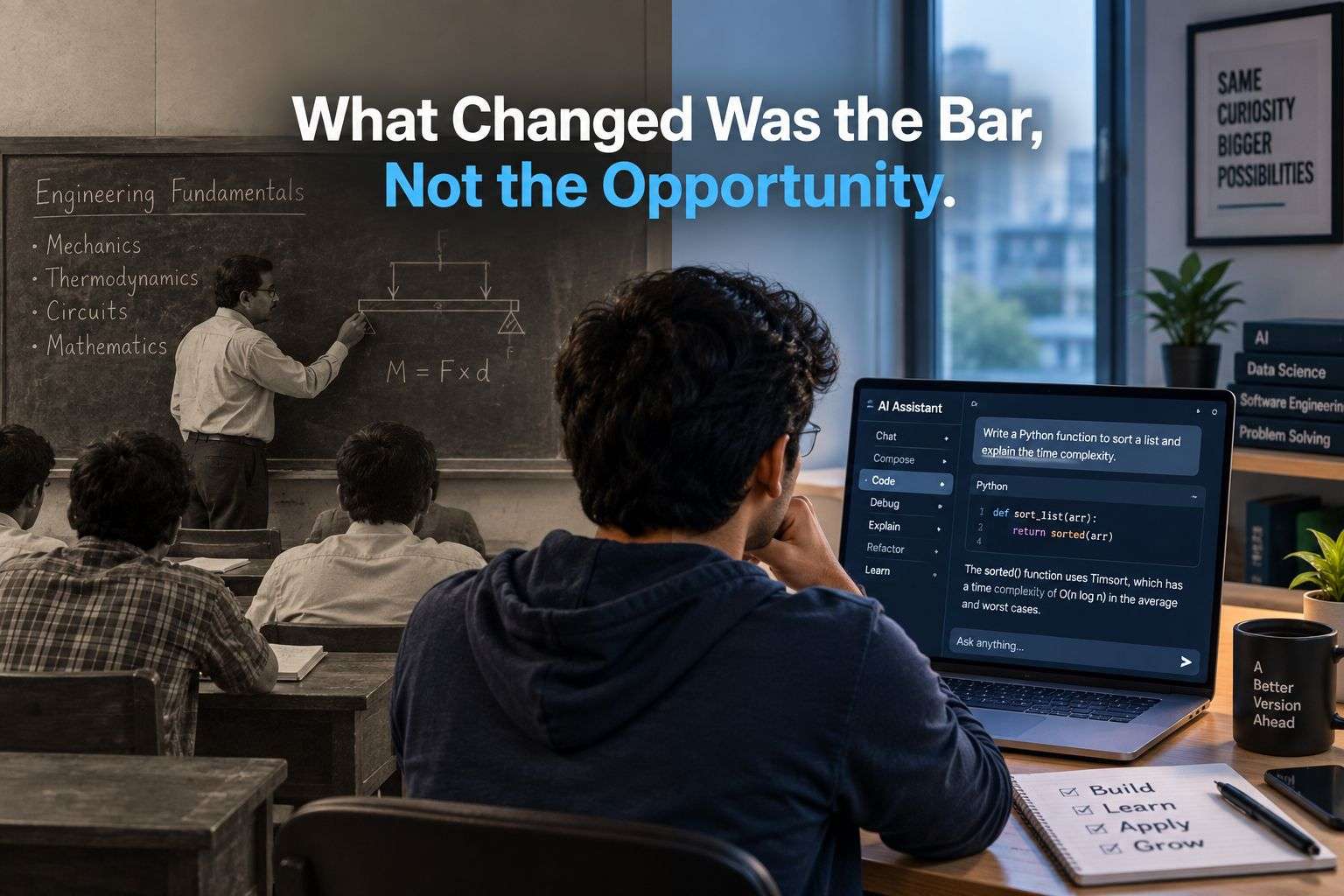
What AI Actually Removed vs What Your College Never Gave You
AI has genuinely removed a layer of work. Basic manual testing, routine debugging, simple documentation, and first-draft code for well-defined problems — AI tools do this faster than a fresher today. That layer used to be the “training wheels” job. A fresher could get hired to do it badly for six months while learning on the job. That safety net is gone, and I will not pretend otherwise.
But here is what AI did not remove: the ability to understand a messy business requirement, debug something that only breaks in production, explain your reasoning to a non-technical manager, or take ownership when something goes wrong. These were always the skills that separated an employable engineer from an unemployable one. The difference is that colleges never taught them in the first place. For years, a weak curriculum could hide behind an easy fresher market. Companies would take anyone with a degree and train them from zero.
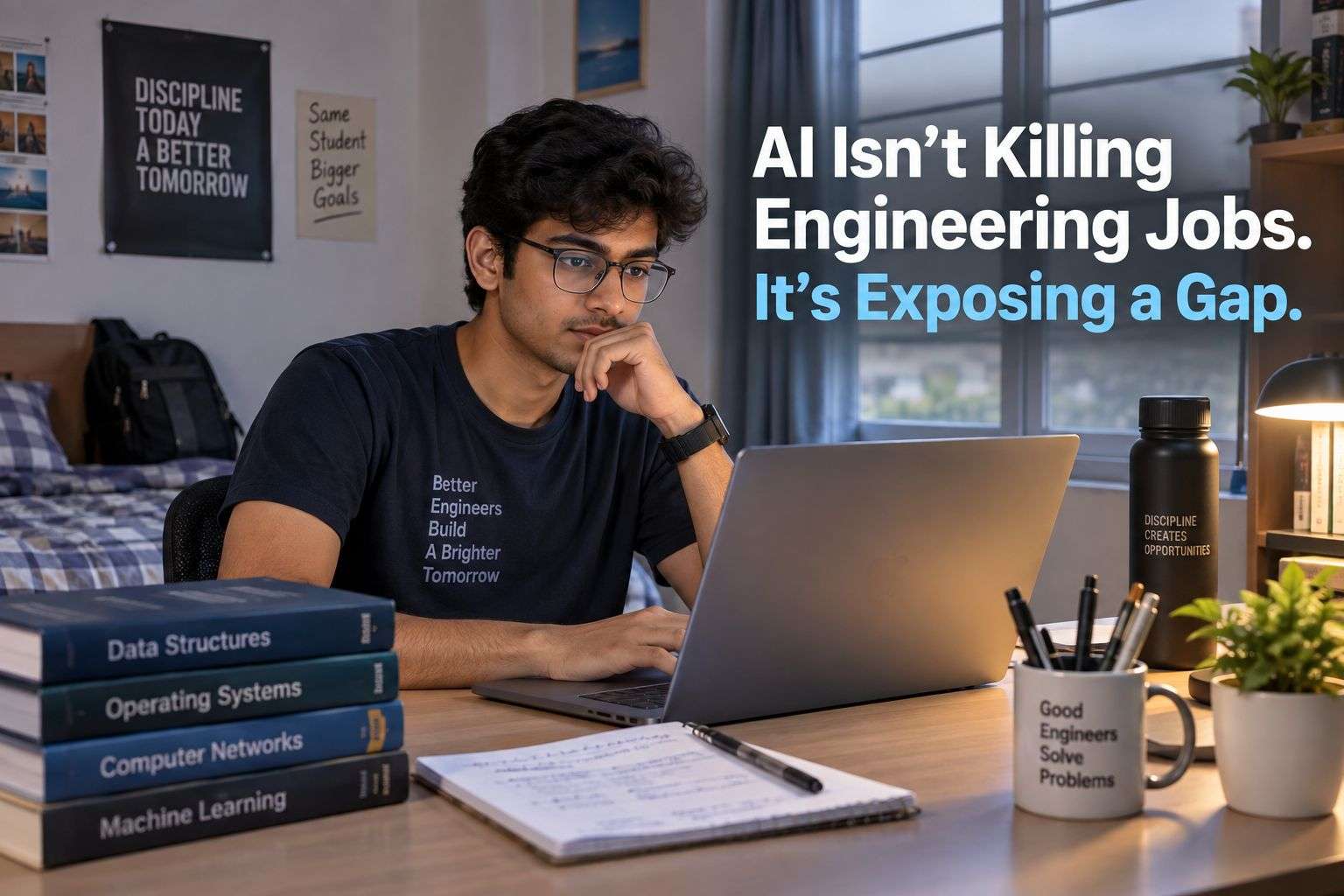
Now that companies are more selective, the gap in what colleges actually teach is fully exposed. AI killing engineering jobs in India is the convenient headline. The curriculum gap doing the real damage is the story nobody wants to put on a poster.
I see this every week in my counselling sessions. A student with a 8.5 CGPA cannot explain a single real-world problem they solved outside their syllabus. Another student with a 6.8 CGPA has two working projects on GitHub, has done a proper internship, and gets shortlisted every time. The CGPA never predicted which one would get hired. It never did. AI just made the gap impossible to hide behind marks anymore.
Why “AI Killing Engineering Jobs In India” Is the Wrong Fear to Carry
I want to be blunt with you, because that is the only kind of advice I give. If you spend your final year believing AI killing engineering jobs in India is an unstoppable wave, you will do nothing, because why prepare for a flood you cannot swim against? That belief is more dangerous than AI itself. It produces students who wait, scroll LinkedIn doom-posts, and blame a headline instead of building the two things that still get you hired in 2026: a demonstrated skill and proof you can apply it.
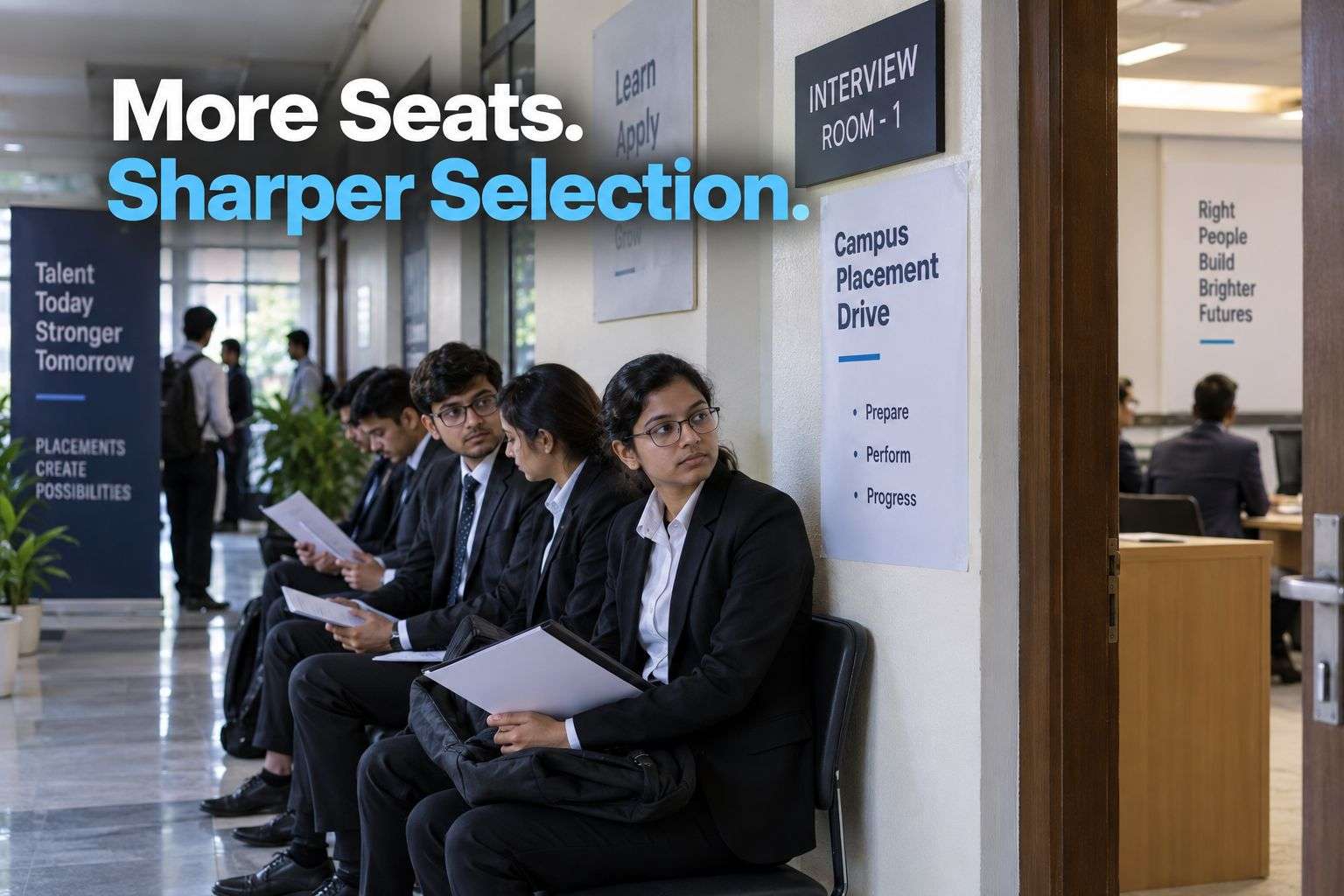
Look at what is actually driving hiring right now. TCS reported that AI-skilled graduates made up 60 percent of its fresher hires in FY26, up from 10 to 15 percent just three years ago. That is not AI killing engineering jobs in India — that is AI changing which engineering students get chosen. Campus placements are also not dead. Top IT firms — TCS, Infosys, HCLTech, Wipro — planned to onboard close to 82,000 freshers this financial year, a real recovery after three difficult years. I wrote about that shift in detail in my Campus Placements 2026 guide, and the pattern holds: volume hiring came back, but the bar for who gets picked from that volume rose sharply.
The honest reframe I give my students is this: AI did not kill your job. It killed the version of you that shows up with only a degree and no proof of skill. That version was always going to struggle, AI or no AI. The difference now is you cannot get five more years to figure that out on the company’s payroll.
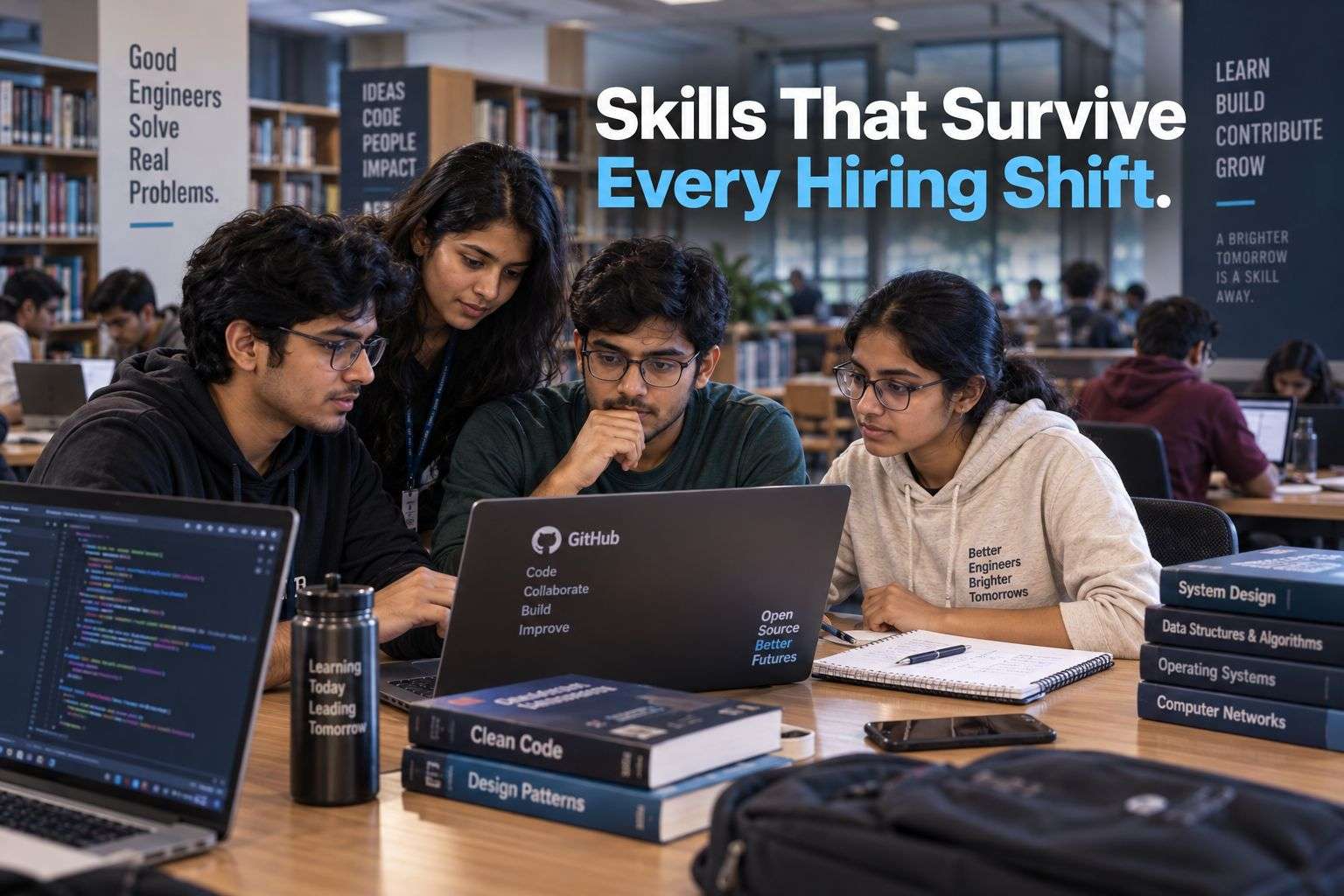
The Skills That Survive the AI Killing Engineering Jobs In India Narrative
If AI killing engineering jobs in India were the full story, no fresher role would exist anywhere. That is not what is happening. Roles are shifting toward AI-augmented work, not disappearing. Naukri’s AI Jobs Report recorded 38 percent year-on-year growth in AI and ML job postings in one quarter alone, with AI skills commanding a real, verifiable salary premium over non-AI roles. I have written about that pay gap in detail in my AI Skills Salary Premium guide — it is not hype, it is showing up on real offer letters I see in my own counselling sessions in Odisha.
What does “AI-augmented” actually mean for a BTech student in a tier-2 city? It means you are not expected to build AI models from scratch. You are expected to know how to use AI tools competently inside your own engineering work — writing better prompts, reviewing AI-generated code critically instead of copy-pasting it, using AI to speed up testing and documentation so you can spend your time on the harder problems. I go through the specific tools students should actually learn, not the trendy ones, in my AI Tools for Freshers Placement guide.
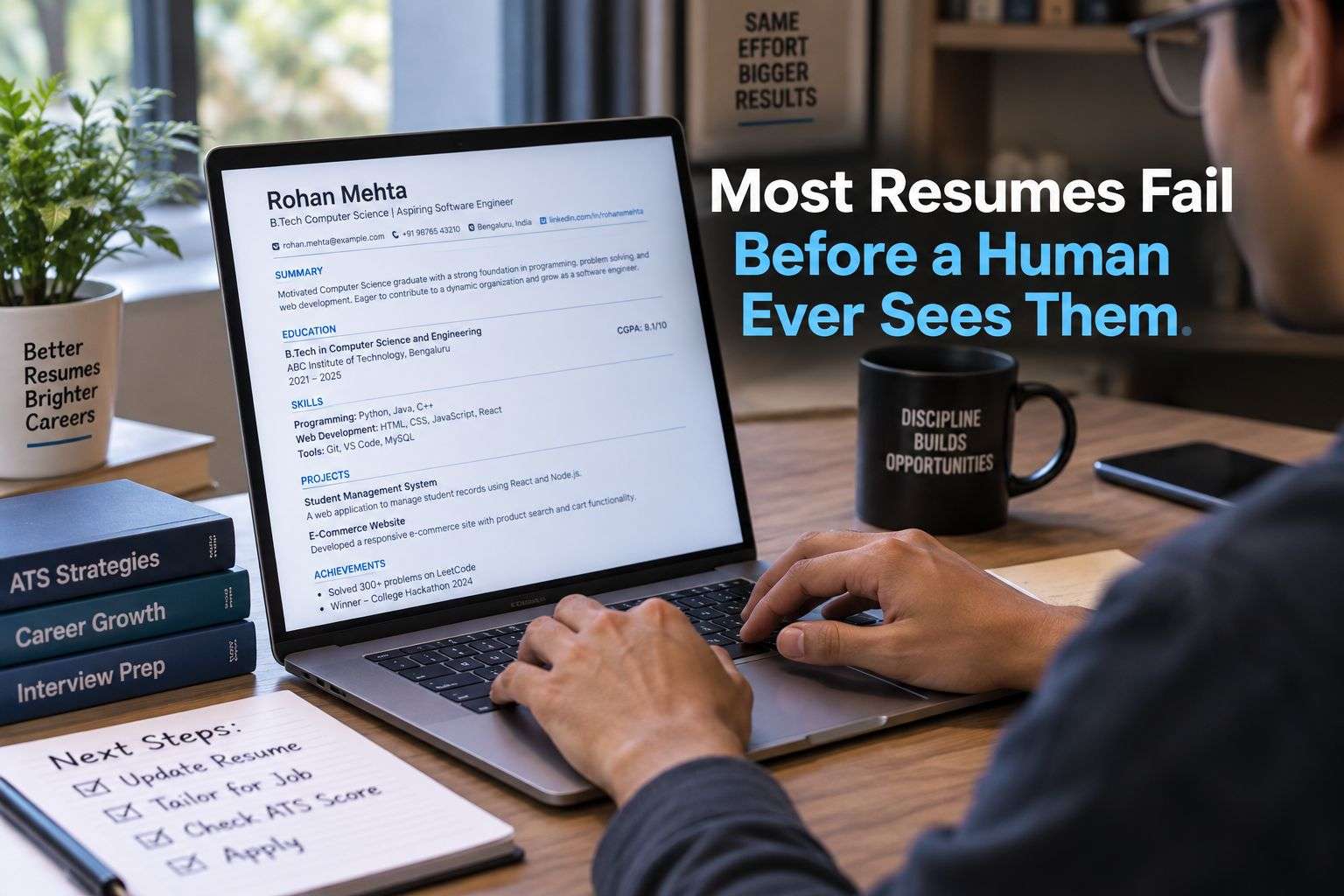
Recruiters have also changed how they screen. Many companies now run AI-powered applicant tracking systems that reject a resume before a human ever reads it, purely on keyword and format mismatches. I explain exactly how these systems work, and how to beat them, in my AI-Powered ATS Systems guide. This is another example of the same pattern — it looks like “AI killing engineering jobs in India,” but it is really AI exposing which resumes were never built properly in the first place.
What Skill-First Hiring Really Means for You
The clearest evidence against the AI killing engineering jobs in India narrative is the rise of skill-first hiring. Only 21 percent of Indian corporates have fully adopted skill-first hiring today, while 51 percent are moving toward it — meaning marks and college brand name matter less every single year, and demonstrated ability matters more. I wrote a full breakdown of what this shift means practically in my Skill-First Hiring guide.
This should actually excite a tier-2 city student, not frighten one. For decades, students from Odisha competed against IIT and NIT brand names they could never match. Skill-first hiring removes that ceiling. A student from a lesser-known BPUT-affiliated college with two solid projects and a clean GitHub profile now gets evaluated on the same page as a student from a bigger name. That is the opposite of AI killing engineering jobs in India — that is AI-era hiring finally levelling a playing field that was never fair to begin with.
I am not saying this to comfort you. I am saying it because it is the honest reading of the data in front of me, from three separate reports, all pointing the same direction.
Action Steps: What to Do Instead of Panicking
First-year students Build your foundation properly instead of only chasing exam marks. Learn one programming language deeply rather than five languages shallowly. Start a habit of reading about your branch’s industry, not just your syllabus. Open a GitHub account now, even if it is empty for a few months.
Second-year students Pick one project you can build end to end, even a small one, and finish it. Start learning how to use AI tools inside your actual coursework — not to cheat, but to work the way industry already works. Attend at least one webinar or workshop outside your college syllabus every month.
Third-year students Apply for internships aggressively, even unpaid ones, even in your second-choice domain. Build two projects that solve a real, specific problem — not generic to-do list apps. Start mock interviews with seniors, alumni, or a career counsellor. Get your resume reviewed by someone outside your friend circle.
Final-year students Stop adding more certificates and start applying. Tailor your resume for every single application instead of mass-sending one version. Practise explaining your projects out loud until you can do it in under two minutes. If your placement cell is slow, go off-campus — do not wait passively for one drive.

A Straight Word From Me
I have sat across the table from thousands of students over 27 years. The ones who struggled were rarely the least intelligent ones. They were the ones who believed the fear before they tested it against their own effort. AI killing engineering jobs in India is a headline built for clicks. The real story — a curriculum gap the market has finally stopped forgiving — is less dramatic, but it is something you can actually fix, starting this week.
Frequently Asked Questions- AI killing engineering Jobs in india-
1. Is AI killing engineering jobs in India right now, in 2026?
No, not in the way the headlines suggest. The data shows engineering employability holding steady or even rising slightly, with computer science and IT graduates sitting at 78 to 80 percent employability according to the India Skills Report 2026. What has changed is the type of role available and the bar to get selected for it. Entry-level tasks that used to be “training wheels” work — basic testing, simple documentation, routine debugging — have genuinely shrunk because AI tools now handle them faster.
But total fresher hiring by major IT firms is actually recovering, with close to 82,000 planned onboarding this year across TCS, Infosys, HCLTech, and Wipro. The honest read is that AI reshaped which freshers get chosen, not whether freshers get chosen at all.
Consultant’s Note: I tell every batch I counsel the same thing — stop asking whether AI will take your job, and start asking whether your current preparation would have gotten you hired even before AI existed. Most of the time, the answer tells you exactly what to fix.
2. Which engineering branches are most affected by AI in 2026?
Computer science and IT branches face the most direct exposure because a large share of entry-level coding, testing, and documentation work overlaps with what AI tools now do well. But this does not mean CS and IT are the worst branches to choose — they still show the highest employability numbers in the India Skills Report 2026, at 78 to 80 percent. Mechanical, civil, and electrical branches are less directly automated in their core work, but they face a different problem: fewer core-sector jobs exist compared to IT sector volume, so students from these branches often pivot into IT roles anyway.
The real dividing line is not the branch name. It is whether a student in any branch has built applied, demonstrable skills beyond the classroom syllabus.
Consultant’s Note: I have placed mechanical engineering students into IT-adjacent roles like technical support, QA, and even some GCC operations roles, purely because they built one real project and could explain it clearly. Branch matters less than most students think.
3. Should I switch from engineering to another degree because of AI?
I would not recommend switching your degree at this stage unless you have a genuine, independent interest pulling you elsewhere. Switching degrees mid-way rarely solves the actual problem, because the actual problem for most struggling students is a lack of applied skill and project experience, not the choice of degree itself. Every field — commerce, arts, even law — is being reshaped by AI in some way right now, so there is no “AI-proof” degree to run to. What matters far more than the degree name is what you build on top of it.
A BTech student who spends the next year building two real projects and gaining one internship is in a stronger position than a student who switches degrees and starts the skill-building process over from zero.
Consultant’s Note: In 27 years, I have seen very few students regret finishing their engineering degree properly. I have seen many regret switching out of panic and losing a year they could never get back.
4. What skills should I learn to stay relevant if AI is changing engineering jobs?
Focus on three layers. First, strengthen your core engineering fundamentals — data structures, problem-solving logic, and your branch’s technical basics — because AI tools amplify a strong foundation but cannot replace a missing one.
Second, learn to use AI tools competently inside your actual work, including prompt writing, reviewing AI-generated code critically, and using AI to speed up routine tasks so you can focus on harder problems.
Third, and most overlooked, build communication and ownership skills — the ability to explain your work clearly, take responsibility when something breaks, and work with a team under pressure. Recruiters increasingly test for all three layers together, not just technical knowledge in isolation.
Consultant’s Note: The students who impress me most in mock interviews are rarely the ones who know the most tools. They are the ones who can explain, in plain language, why they made a specific decision in their project.
5. Are campus placements actually recovering in 2026, or is that misleading?
Campus placements are genuinely recovering in volume after three difficult years, with major IT firms planning close to 82,000 fresher hires this financial year. But volume recovery does not mean the selection process got easier — if anything, it got sharper. Companies are running additional AI-readiness assessments, stricter aptitude cutoffs, and more rigorous technical rounds than they did five years ago.
So the recovery is real, but it favours prepared students disproportionately over unprepared ones. A student walking into a 2026 campus drive with no project experience and weak communication skills will find it just as hard as during the slowdown years, even though more seats exist overall.
Consultant’s Note: I always tell final-year students in Odisha the same thing — more opportunities does not mean less competition. It just means more people you are competing against are also trying harder.
6. How do I know if my resume will survive an AI-powered ATS screening?
Most freshers lose the ATS battle before a human recruiter ever opens their resume, purely due to formatting and keyword mismatches. Avoid tables, columns, images, and unusual fonts in your resume, since many ATS parsers cannot read them correctly and will drop your application from the shortlist automatically.
Match the exact keywords used in the job description, including specific tool names and skill phrases, without copy-pasting the whole description. Keep your resume to one page for freshers, use a simple reverse-chronological format, and quantify your project impact with real numbers wherever possible.
A resume that looks good to your own eyes on a laptop screen can still fail an ATS scan completely, which is why testing it against a free ATS checker tool before applying is worth the ten minutes it takes.
Consultant’s Note: I have watched genuinely strong students get zero callbacks for months, purely because of formatting mistakes that had nothing to do with their actual ability.
7. Is skill-first hiring actually replacing degree-based hiring in India?
Skill-first hiring is growing steadily but has not fully replaced degree and college-brand-based hiring yet. Only about 21 percent of Indian corporates have fully adopted skill-first hiring as of the latest data, while roughly 51 percent are actively moving in that direction, which tells you the shift is real but gradual, not complete. For students in tier-2 cities, this trend is genuinely encouraging, because it reduces the historical advantage that IIT and NIT brand names held over other colleges.
A well-built project portfolio and demonstrated skill can now compete directly with a bigger college name in a growing share of hiring processes. The practical takeaway is to treat skill-building as insurance regardless of which way your specific college or degree is currently weighted by recruiters.
Consultant’s Note: I tell my Odisha students this every single session — the playing field is finally tilting toward what you can prove, not just where you studied, and that shift favours you if you act on it now.
8. What is the realistic starting salary for freshers in 2026 given all this AI disruption?
Realistic starting salaries vary widely by company tier, and clickbait headlines about fifty-lakh fresher packages are true only for a tiny number of candidates, mostly from top IITs and NITs with strong publication or competitive coding records. For the vast majority of engineering freshers from tier-2 colleges, service-tier IT companies typically offer starting packages in a modest but stable range, while product companies and AI-track roles at the same companies can pay two to three times more for candidates who clear stricter skill assessments.
AI skills specifically carry a real, measurable salary premium in the market right now, sometimes cited as high as 40 to 56 percent above non-AI roles at comparable experience levels. The honest advice is to set realistic salary expectations based on your specific skill level and company tier, rather than anchoring your expectations on outlier headlines you see shared on social media.
Consultant’s Note: I have seen students turn down decent honest offers while waiting for a headline-sized package that was never realistic for their profile, and lose months in the process.
9. How can a student from a tier-2 city in Odisha compete with metro city students for AI-era jobs?
Location matters far less today than it did even five years ago, largely because remote work, off-campus hiring platforms, and Odisha’s own growing GCC and IT ecosystem have opened doors that simply did not exist for tier-2 city students a decade ago. The Odisha GCC Policy has already started attracting global capability centres to set up operations closer to home, meaning strong local opportunities are genuinely growing rather than shrinking. What actually differentiates a tier-2 city student in a national applicant pool is the same thing that differentiates any student anywhere — demonstrated project work, internship experience, and clear communication in interviews. Students in Odisha, who invest in these fundamentals are increasingly landing roles at companies they once assumed only hired from metro cities.
Consultant’s Note: I have personally placed students from smaller Odisha colleges into GCC and product-company roles that would have seemed impossible to them ten years ago — the ceiling has genuinely moved.
10. What is the single biggest mistake students make when they believe “AI is killing engineering jobs”?
The single biggest mistake is treating the fear as a reason to freeze instead of a reason to prepare more precisely. Students who believe the job market is unfixable often stop building projects, stop applying broadly, and wait for a “safe” moment that never arrives, while the actual hiring bar keeps rising around them. The students who do well in this environment are not necessarily the most naturally talented ones — they are the ones who kept building skills and applying consistently despite the noise around them.
Fear used as motivation to prepare harder is useful; fear used as an excuse to do nothing is the actual career risk in 2026, far more than AI itself. Every report I have reviewed for this article, without exception, shows opportunity still exists for prepared candidates even as the overall market tightens.
Consultant’s Note: In 27 years, the students I worry about most were never the ones facing a tough market — they were always the ones who let the tough market talk them out of trying.
Sources
- Rest of World — “AI is wiping out entry-level tech jobs, leaving graduates stranded”
- Careers360 — “India Skills Report 2026: CS, IT engineers most employable”
- Storyboard18 — “2026: The year enterprises move AI work in-house from startups and agencies”
Verified YouTube links
- https://www.youtube.com/watch?v=OPvsQrN_M8w — “The Lie That’s Destroying Indian Engineers in 2026 (IT Job Collapse)”
- https://www.youtube.com/watch?v=ZrC5BxWpU6I — “No AI Jobpocalypse? Andrew Ng’s Bold Prediction Could Change How India’s IT Sector Sees AI”
- https://www.youtube.com/watch?v=ZoYnNFZmHIw — “India is patient zero for AI job loss onslaught”
SUGGESTED TO READ–
- Campus Placements 2026 Are Back -A 27-Year IT Career Consultant’s Honest Take on the 82,000 Fresher Hiring Surge
- AI Skills Salary Premium for Freshers in 2026 — A 27-Year IT Career Consultant’s Honest Take on the 40% Pay Gap
- AI Tools for freshers placement 2026-An Indian IT Consultant’s Honest List
- How AI-Powered ATS Systems Screen 10,000+ Applications — A 27-Year IT Career Consultant’s Honest Guide for Indian Freshers in 2026
- Skill-First Hiring in India – A 27-Year IT Career Consultant’s Honest Guide for Engineering Students in 2026