

Odisha GCC Policy 2025 — A 27-Year IT Career Consultant Explains What It Means for Engineering Freshers
The Odisha GCC Policy landed quietly in November 2025, and most students I counsel still have not heard of it. That is a problem, because this is not a small government notice — it is a five-year plan that could change where you get hired without ever leaving your home state.
Here is the number that should make you sit up. The Odisha GCC Policy targets more than ₹1,000 crore in investment, at least five new GCC hubs, and over 50,000 direct and indirect jobs, all inside Odisha.
After 27 years of guiding engineering students across Bhubaneswar, Cuttack, Rourkela, Berhampur, and Sambalpur, I have watched two kinds of policy announcements — the kind that never touches a student’s life, and the kind that quietly reshapes a district’s job market five years later. The Odisha GCC Policy belongs to the second kind, and I want you to understand exactly why before your placement season starts.
What Is a GCC — In Plain Language
Before the Odisha GCC policy makes sense, you need to understand what a GCC actually is.

A Global Capability Centre, or GCC, is not an outsourcing office. It is a full in-house unit that a multinational company sets up in India to run real parts of its global business — product engineering, AI research, finance operations, cybersecurity, and design. Companies like Goldman Sachs, Google, and Microsoft run entire product lines and business divisions out of their GCCs. A software engineer inside one often works on the same codebase used by the company’s US or European headquarters, not a scaled-down local version of it. This is why GCC salaries and exposure both tend to beat a typical Indian service-based IT company — you are not maintaining someone else’s product from a distance, you are part of building it.
India already hosts close to 1,800 GCCs employing about 21 lakh people, mostly in Bengaluru, Hyderabad, and Pune. The Odisha GCC Policy is Odisha’s attempt to pull a meaningful share of that growth into the state.
Odisha GCC Policy — What the State Cabinet Actually Approved
The Odisha Cabinet cleared the Global Capability Centres Policy 2025 on 21 November 2025, under Chief Minister Mohan Charan Majhi. With this, Odisha became the eighth state in India to launch a dedicated GCC policy, joining Karnataka, Maharashtra, Andhra Pradesh, Gujarat, Madhya Pradesh, Uttar Pradesh, and Bihar.

The core numbers are worth remembering, since they will come up again in interviews and career conversations over the next few years: over ₹1,000 crore in targeted investment, at least five state-of-the-art GCC hubs, more than 50,000 direct and indirect jobs, and a five-year policy window running from 31 December 2025.
The policy is designed as a companion to the Odisha IT Policy 2025, and eligible GCC units can access both sets of benefits together — subsidies on land rates, lease rentals, power tariffs, interest costs, human capital upskilling, SGST reimbursement, and PF and ESI contribution support. For a company deciding between five states, that combination is a real reason to choose Odisha over a more expensive metro.
Odisha GCC Policy Hubs — Where the Jobs Will Actually Land
This is the part students ask me about first, since it decides whether this policy is relevant to their own city.
The Odisha GCC Policy plans five hubs across two economic corridors — Bhubaneswar-Cuttack-Puri-Paradip, and Bargarh-Jharsuguda-Sambalpur.
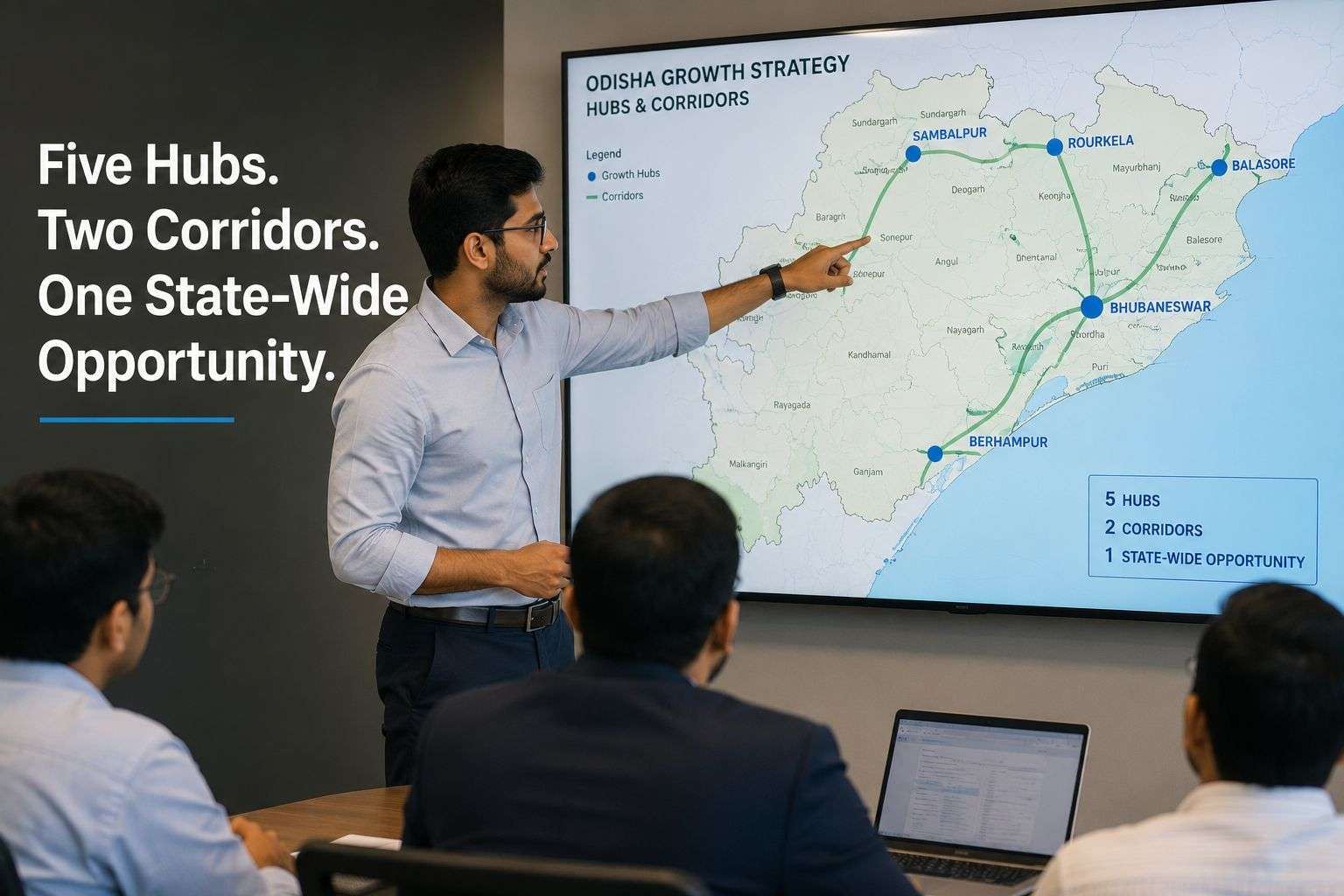
If you study near Bhubaneswar, Cuttack, Puri, or Paradip, you are inside the state’s first and largest planned corridor. Infocity and Infovalley in Bhubaneswar already host Infosys, Wipro, TCS, and Accenture, and this is the natural next step for that existing IT base.
If you are in Bargarh, Jharsuguda, or Sambalpur, do not assume this policy skips you — the second corridor exists precisely to spread GCC jobs into western Odisha too. Students from BPUT-affiliated colleges in this belt should watch it closely, since early movers into a new hub often face less competition than students entering an already crowded one.
Odisha GCC Policy — Why This Matters More Than a Normal IT Job Announcement
I want to be honest about something most coverage of this policy skips. A policy on paper does not create a job on day one — GCCs take time to set up, hire leadership, build teams, and start recruiting freshers in real numbers. Some students hear “50,000 jobs” and expect openings next month. That is not how this works, and I do not want you walking into placement season with the wrong timeline.
What this policy does give you, right now, is direction. Tier-2 cities across India are already seeing GCC hiring grow at roughly twice the pace of metro markets, and Bhubaneswar is repeatedly named among the cities benefiting from this shift. A fresher who builds the right skills over the next twelve to eighteen months is positioning for a hiring wave that is genuinely coming, not a speculative one — the same pattern I watched play out with Bhubaneswar’s original IT boom two decades ago, where the students who prepared early walked into the first offers.
Odisha GCC Policy — Skills That Actually Matter for These Roles
GCCs do not hire the same way as traditional Indian IT service companies, and this is where most students prepare incorrectly.
For technical readiness, focus on strong fundamentals in one core area — software engineering, cloud, data, or cybersecurity — rather than a shallow spread across many; real project work, ideally deployed and demonstrable, not just certificates; comfort with global teams and asynchronous communication; and domain awareness relevant to the GCC’s parent sector — BFSI, healthcare, retail, or manufacturing.

For soft-skill readiness, focus on: clear written communication, since GCC teams rely heavily on documentation and async updates; and comfort presenting your own reasoning, not just your final answer.
Rote learning and last-minute cramming rarely work for GCC interviews. These companies interview closer to product-company standards than typical service-company standards, so your preparation timeline needs to start earlier than you might expect.
Odisha GCC Policy — Realistic Salary Expectations for Freshers
Let me give you honest numbers rather than inflated ones.
Entry-level GCC roles in India, 2026 — Typically ₹6 to ₹12 LPA for freshers with strong fundamentals and at least one solid project, against ₹3.5 to ₹6 LPA at many traditional service-based companies for the same experience level.
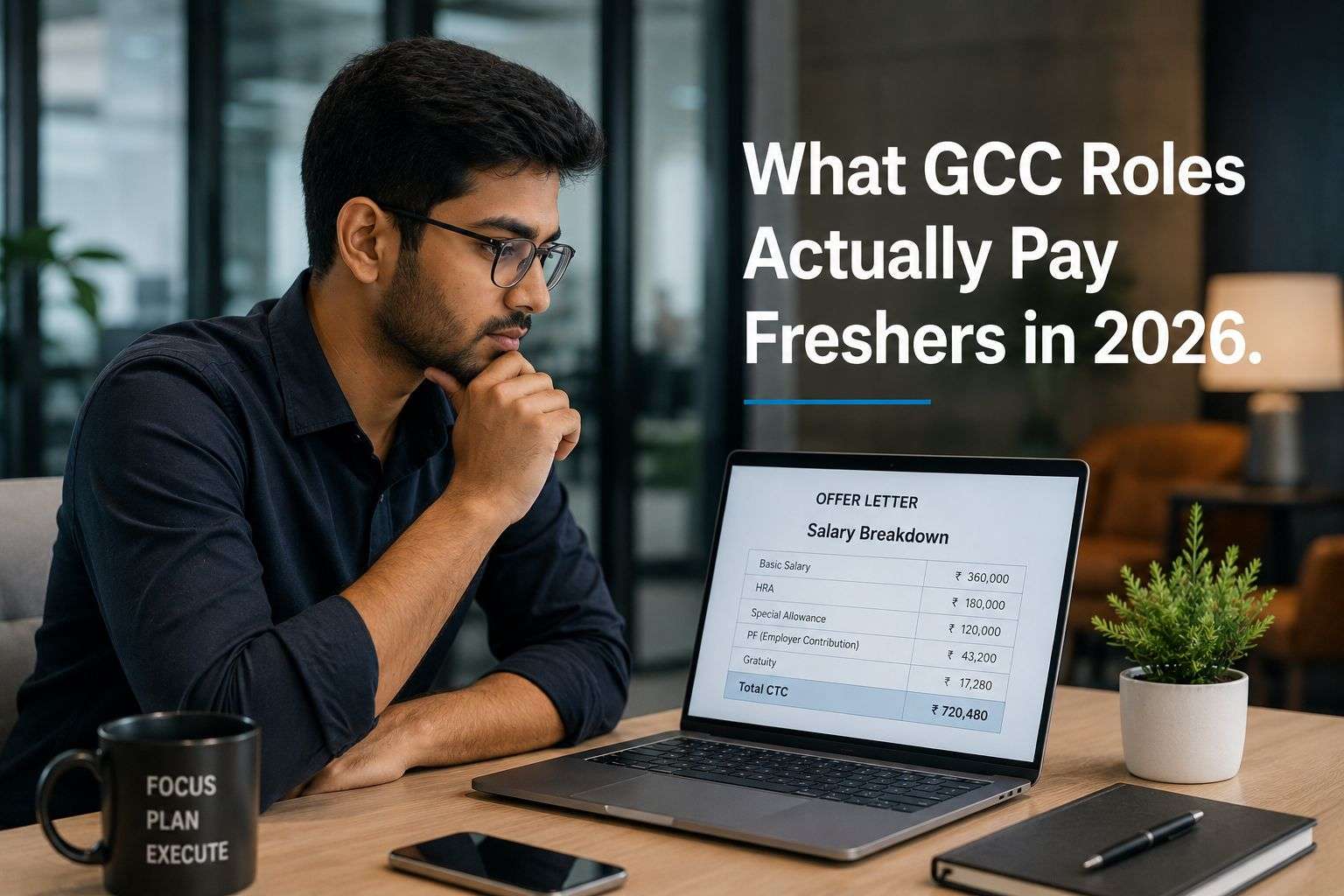
AI and data-heavy GCC roles — Freshers with demonstrated AI or ML skills are commanding 25 to 40 per cent premiums over classical IT roles, and GCCs are among the biggest buyers of this specific skill set.
Newly established hubs, including Odisha’s planned corridors — Expect early-stage packages closer to the lower end of the national GCC range while the hub is scaling, with room to grow as it matures and takes on more strategic work.
The honest takeaway: a GCC job inside Odisha under this policy will very likely pay better than an equivalent role at a traditional Bhubaneswar IT services company, but it takes real preparation to be considered for one, not just a degree and a resume.
Three Mistakes Students Are Already Making With the Odisha GCC Policy
Mistake 1 — Waiting for job postings before starting preparation. By the time a GCC opens visible hiring drives in Odisha, students who prepared eighteen months earlier are already ahead.
Mistake 2 — Assuming this only helps Bhubaneswar students. The second corridor around Bargarh, Jharsuguda, and Sambalpur exists specifically to spread this opportunity into western Odisha.
Mistake 3 — Treating a GCC job like a typical service-company job in preparation. GCC interviews lean closer to product-company standards. Our guide on Service Based vs Product Based Company for Freshers explains this difference, and the same preparation gap applies directly to GCC hiring.
Suggested Next Read
- 📌 GCC Jobs for Freshers India 2026 — What They Are and Why They Pay So Much More
- 📌 Service Based vs Product Based Company for Freshers
- 📌 Top 5 In-Demand Skills for Freshers in 2026
- 📌 Off-Campus Placement for Freshers in 2026
- 📌 In-Hand Salary vs CTC Explained
FAQs — Odisha GCC Policy-what is there for engineering freshers.
FAQ 1 — What exactly is the Odisha GCC Policy, in one sentence?
The Odisha GCC Policy is a five-year state government plan, approved in November 2025, designed to attract multinational companies to set up Global Capability Centres in Odisha through land, tax, and hiring incentives, with a target of over 50,000 jobs across at least five hubs.
It works alongside the Odisha IT Policy 2025, so an eligible GCC unit can access both sets of benefits together, which makes Odisha a more attractive option than states offering only one policy layer.
For students, the practical meaning is simpler. More large companies now have a real financial reason to open serious technology and business operations inside Odisha over the next five years, rather than only in traditional metro hubs.
Consultant’s note — I tell students not to memorise every clause of this policy. Memorise the outcome instead — more GCC hiring, inside Odisha, over the next five years. That single sentence is what should shape your preparation.
FAQ 2 — When will Odisha GCC Policy jobs actually start appearing for freshers?
There is no fixed public date, and I want to be honest about that rather than promise a timeline the government has not confirmed. Setting up a GCC hub involves land allocation, infrastructure, leadership hiring, and team building before fresher-level recruitment scales up in real numbers.
Based on how similar state GCC policies have played out elsewhere in India, meaningful fresher hiring typically starts eighteen months to three years after approval, then accelerates. Since this policy was approved in late 2025, students currently in second or third year BTech are well positioned for the first real hiring wave.
Consultant’s note — Students always want an exact date. I never give one, because no consultant honestly has it. What I do give students is a preparation window, and that window is open right now.
FAQ 3 — Does the Odisha GCC Policy only benefit students in Bhubaneswar?
No, and this is one of the most misunderstood parts of the policy. It plans five hubs across two separate corridors — Bhubaneswar-Cuttack-Puri-Paradip, and Bargarh-Jharsuguda-Sambalpur — specifically so western Odisha is not left out of this growth.
Students from BPUT-affiliated colleges around Sambalpur, Jharsuguda, and Bargarh should track this hub closely, since it is likely to see less competition in its early years than the already-established Bhubaneswar corridor.
Consultant’s note — I have counselled students from Sambalpur who assumed every good opportunity requires moving to Bhubaneswar. This policy is one of the clearest signs yet that Odisha’s job map is genuinely widening.
FAQ 4 — What skills should a first-year or second-year BTech student start building now because of this policy?
Start with strong fundamentals in one clear direction — software development, cloud, data, or cybersecurity — rather than spreading yourself thin. GCC hiring rewards depth over breadth far more than typical service-company hiring does.
Alongside that, build clear written communication and basic exposure to how global product teams operate — GCC panels consistently look for candidates who can explain their reasoning, not just produce a correct final answer.
Consultant’s note — I tell first and second-year students the same thing regardless of which policy is in the news. Depth in one skill, started early, beats a wide but shallow skill list every single time.
FAQ 5 — Will Odisha GCC Policy jobs pay as well as GCC jobs in Bengaluru or Hyderabad?
In the early years of a new hub, packages usually sit closer to the lower end of the national GCC salary range while the centre is still scaling, then rise as it takes on more strategic work. Even at the lower end, a GCC role under this policy is very likely to pay meaningfully more than an equivalent role at a traditional Bhubaneswar IT services company.
The bigger long-term advantage is not matching Bengaluru rupee for rupee — it is accessing GCC-level work and exposure without relocating.
Consultant’s note — Students often ask me to promise Bengaluru-level salaries in Bhubaneswar from day one. I never promise that. What I do tell them honestly is that the gap is closing, and staying home no longer means settling for less
FAQ 6 — How is a GCC job different from working at TCS, Infosys, or Wipro in Odisha?
A traditional IT services role in Odisha typically means working on a client’s project under an outsourcing arrangement, often maintaining an existing system.
A GCC role means working as part of the company’s own in-house team, frequently on core product or business functions used globally. This affects both your day-to-day work and your long-term resume story — GCC experience tends to carry strong weight with product companies and other GCCs later in your career.
Consultant’s note — I am not telling students to reject service-company offers while waiting for GCC roles. I am telling them to understand the difference clearly, so whichever offer they accept is a genuinely informed choice.
FAQ 7 — Should I choose my final-year projects differently because of the Odisha GCC Policy?
Yes, with one clear adjustment. GCC panels respond strongly to projects that show real-world business thinking, not only technical correctness — a project that solves a genuine operational problem, even a small one, interviews better than a purely academic exercise.
Pick a domain relevant to GCCs likely to enter Odisha — BFSI, healthcare, manufacturing, or retail technology, given the sectors named in the policy — and document your reasoning clearly, since interviews often probe your decision-making as much as your final output.
Consultant’s note — The strongest final-year projects I have guided were never the most complex ones. They were the ones students could explain clearly, end to end, including what they would improve with more time.
FAQ 8 — Are diploma holders and non-CS branch students eligible for these GCC opportunities?
Yes, though the path looks somewhat different. Many GCCs hire for roles beyond core software development — data operations, quality assurance, business analysis, and domain-specific engineering support — all open to ECE, mechanical, and other branches who build the right supporting skills.
A diploma holder or non-CS student who invests in one focused skill area — Python scripting, basic cloud fundamentals, or domain knowledge relevant to a specific GCC sector — can build a credible profile within six to nine months of focused effort.
Consultant’s note — I have placed non-CS branch students into strong technology-adjacent roles before, and the deciding factor was never their original branch. It was whether they built one real, demonstrable skill instead of waiting for their degree to do the work.
FAQ 9 — How should I track when Odisha GCC Policy hiring actually opens up?
Follow the Electronics and Information Technology Department of Odisha for official updates, and watch LinkedIn company pages for any MNC announcing a new Odisha centre, since these usually come months before fresher-level hiring opens.
Local placement cells and bodies like NASSCOM also tend to flag new GCC entries into a state — I track this closely for my own students and share verified updates rather than speculation.
Consultant’s note — I would rather tell a student “not yet, but soon” than give a false date. That honesty has served every batch I have guided far better than false urgency ever could.
FAQ 10 — What is the single most useful thing I can do this month because of the Odisha GCC Policy?
Pick one technical direction and go deep for the next few months, while building one real project you can explain clearly in an interview.
Do not wait for a specific Odisha GCC job posting before you start preparing — by the time it appears, the students who started early will already be ahead. Alongside this, follow verified updates so you understand which hub and sector is moving fastest and shape your project and internship choices accordingly.
Consultant’s note — Every meaningful policy shift I have watched over 27 years rewarded the same type of student — the one who started preparing before the opportunity was fully visible to everyone else. This is your version of that window.
YouTube Videos Referenced:
- How GCCs Actually Hire — The Real End-to-End Hiring System Explained
- How to Get a JOB at a GCC in 2026 — Warikoo Careers Hindi
- India’s GCC Revolution: What Does It Mean for You?
What to Do This Month- Your Odisha GCC Policy Action Plan
If you are in first or second year, pick one technical direction — software development, cloud, data, or cybersecurity — and go deep rather than wide. Follow the Odisha Electronics and IT Department for real updates instead of rumours, and notice which sectors – BFSI, healthcare, and manufacturing – keep appearing in GCC news.

If you are in third year, choose a final-year project connected to a real business problem in a domain this policy supports. Build the communication habits GCC interviews test for — clear written updates, structured explanations of your work — and track which companies are announcing new Odisha centres.
If you are in final year – Your priority is one deployed, well-documented project you can discuss confidently, alongside genuine readiness for product-company-style interviews. Do not wait passively for these jobs to appear in placement drives — apply directly to GCCs already operating in India while your local hub scales up, and stay ready to move quickly once Odisha-based openings appear.
The Odisha GCC Policy will not create a job for you automatically. It creates a genuine reason for serious companies to look at Odisha differently over the next five years. Whether that reason turns into your job depends on whether you start preparing now or wait until the opportunity is obvious to everyone else too.
Curious how a GCC job actually compares to a traditional IT offer? Read our full GCC Jobs for Freshers India 2026 guide and Service-Based vs Product Based Company for Freshers to plan your next move with more clarity.
External References Used: