

How to Crack Campus Placement in 3 Months — The Exact Plan I Give My Students
How to crack campus placement in 3 months is the question I get asked in almost every counselling session I run with final-year BTech students in Bhubaneswar, Cuttack, Rourkela, and Berhampur.
And I understand why the question comes with panic attached. A recent industry report found that 85 percent of engineering graduates from the 2026 batch remained unplaced despite companies actively hiring — a gap the report called structural rather than a temporary slowdown. That number scares students. It should not, because it is not describing you specifically. It is describing what happens when students prepare without a plan.
After 27 years of watching students walk into placement season either ready or completely unprepared, I can tell you the difference is never talent. It is always structure. This blog is the exact three-month, week-by-week plan I give my own students — the same one I would give my own child if they were sitting for placements this year.

Why Most Students Fail to Crack Campus Placement Even When They Study Hard
Before the plan, you need to understand why so many sincere, hardworking students still fail to crack campus placement.
It is almost never a knowledge problem. Employability data backs this up. According to the India Skills Report, over 70 percent of BTech graduates are technically employable on paper — yet only a small fraction of those actually walk out with an offer. Communication is a bigger blocker than most students expect — a large share of graduates lose interviews because of how they present themselves, not because of what they know.
So the students who crack campus placement are rarely the toppers of the class. They are the students who prepared in the right order, practised speaking out loud, and stopped treating placement prep as something to squeeze in between assignments.
That is exactly what this three-month plan fixes.
The 3-Month Framework — How to Crack Campus Placement Stage by Stage
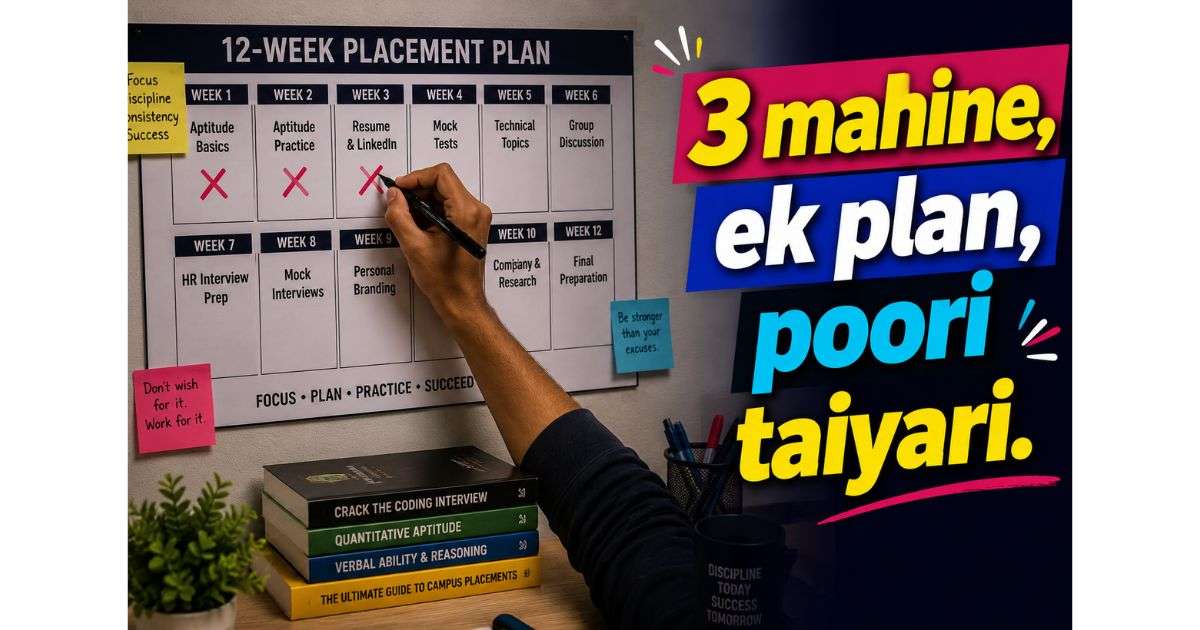
I break this plan into three clean blocks of four weeks each. Each block has one job. Do not skip ahead. Students who jump straight to mock interviews without fixing their fundamentals first are the ones who freeze the moment a recruiter asks a follow-up question.
Month 1 — Foundation. Aptitude, resume, and profile. Month 2 — Depth. Technical preparation and communication. Month 3 — Execution. Mock interviews, applications, and real drives.
Let’s go stage by stage.
Month 1, Weeks 1–2 — Fix Your Aptitude First
If you want to know how to crack campus placement, start here, because aptitude is the first filter almost every company applies — TCS, Infosys, Wipro, Capgemini, and every GCC that visits Odisha campuses run an aptitude or online assessment before anything else.
Spend these two weeks on quantitative aptitude, logical reasoning, and verbal ability. Do not try to master every topic. Focus on the ones that appear most often in placement tests — percentages, profit and loss, time and work, number series, and basic data interpretation. Thirty focused minutes daily beats three unfocused hours on a Sunday.
What to do this week: Pick one aptitude book or one structured YouTube playlist and stick with it. Do not switch resources mid-way — that is the single biggest time-waster I see in students trying to crack campus placement fast.
🔗 Watch: Aptitude Preparation for Campus Placement playlist
Month 1, Weeks 3–4 — Fix Your Resume, LinkedIn, and GitHub
If you are serious about how to crack campus placement, your profile matters as much as your preparation. By week three you should shift entirely to your visibility — because a recruiter deciding whether to shortlist you spends less than a minute on your resume and profile before moving on.
A one-page resume, a LinkedIn profile that actually says something specific about you, and a GitHub profile that shows real project work — even two or three small projects — matter more at this stage than one more aptitude topic. AI-assisted resume screening is now used by the majority of large recruiters, which means keyword-matched skills and a clean, specific resume genuinely change whether you get seen at all.
If you have not touched your LinkedIn profile since creating it, this is the week to fix that.
🔗 Read: LinkedIn Profile for Freshers in India 2026 🔗 Read: GitHub Profile Tips That Actually Get Indian Students Noticed

How to Crack Campus Placement in Month 2 — Technical Depth and Communication
Month two is where students who crack campus placement start to separate from students who merely attend it. This is the depth month.
Month 2, Weeks 5–6 — Core Technical Preparation
This is where students who want to crack campus placement in a competitive market build real depth. Whatever your branch, pick the two or three subjects your target companies actually test — for CS and IT branches this usually means data structures, DBMS basics, and OOP concepts. For core branches, it means your core subject fundamentals plus basic programming logic, because most service-based companies test general logical and coding aptitude regardless of branch.
Do not try to learn a new programming language in month two. Go deep on one language you already know reasonably well. Depth beats breadth every single time in a placement interview.
🔗 Read: Best Certifications for Freshers in India in 2026
Month 2, Weeks 7–8 — Fix Your Communication and HR Round Answers
This is the stage most students skip, and it is exactly why so many technically sound students still fail to crack campus placement despite knowing the syllabus cold.
Practise saying your answers out loud — not writing them, saying them. “Tell me about yourself,” “why should we hire you,” “what are your strengths and weaknesses” — these questions decide interviews far more often than students expect, because they reveal how you think under mild pressure, not just what you know.
Record yourself on your phone answering five common HR questions. Watch it back. You will notice filler words, rushed pacing, and weak eye contact you did not know you had. This single exercise, repeated for two weeks, changes more interview outcomes than any amount of extra technical revision.
🔗 Read: Fresher Job Interview Questions for IT Companies in India with Answers

How to Crack Campus Placement in Month 3 — Mock Interviews and Real Applications
Month three is execution. Everything you built in months one and two now gets tested against real conditions.
Month 3, Weeks 9–10 — Mock Interviews, Every Week
This week decides whether you crack campus placement or fall at the final hurdle after two months of solid preparation. Do at least two mock interviews a week during this stage — with a senior, a placement cell mentor, a teacher, or a structured mock interview program. A mock interview does one thing self-study cannot: it shows you exactly where you freeze, where you ramble, and where your body language undercuts your answer.
I have watched hundreds of students walk into their first real interview only to realise it was also their first ever interview of any kind. Do not let that be you. The gap between a student’s fifth mock interview and their first real one is enormous.
🔗 Read: How I Help Students Crack IT Interviews in 30 Days 🔗 Watch: Campus Placement Preparation — Interview Tips
Month 3, Weeks 11–12 — Apply Everywhere, On-Campus and Off-Campus
Do not wait only for your college’s placement cell to schedule drives. Off-campus and pool campus drives — where companies visit clusters of colleges together — are where a large share of Odisha’s engineering students actually get placed, especially students from colleges with fewer recruiters visiting directly. Students at institutions hosting over 150 recruiters annually are nearly 2.9 times more likely to secure placements than those at campuses with limited recruiter presence, which is exactly why applying off-campus matters so much for tier-2 city students.
Apply to five to ten companies every single week during this final month, through your placement cell, LinkedIn, Naukri, and direct company career pages. Volume matters here — you need multiple shots, not one perfect application.
🔗 Watch: Placement Preparation — Step-by-Step Aptitude, Coding, and HR

Your Week-by-Week Action Plan to Crack Campus Placement
Whatever year you are in right now, here is exactly what to do based on where you stand.
If you are in your third year, six to twelve months before placements — Start this exact three-month plan now, in a relaxed, non-panicked way, so it is complete well before your final-year placement season begins. This is the ideal window because you can go deep without the pressure of active drives running alongside your preparation.
If you are in final year, placement season starting within three months — Start this plan today, exactly as written, week by week, with no skipped stages. Do not try to compress it into six weeks — the communication and mock interview stages specifically need repetition over time to actually change your interview performance.
If placement season has already started and you have less than a month left — Skip straight to month three. Do two mock interviews this week, fix your resume and LinkedIn today, and apply to every open drive you can find, on-campus and off-campus, starting immediately.
Internal Links — Read These Next
- 📌 How I Help Students Crack IT Interviews in 30 Days
- 📌 Fresher Job Interview Questions for IT Companies in India with Answers
- 📌 Best Certifications for Freshers in India in 2026
- 📌 GitHub Profile Tips That Actually Get Indian Students Noticed
- 📌 LinkedIn Profile for Freshers in India 2026
- 📌 Your First 3 Years in an Indian IT Company
FAQs — How to Crack Campus Placement in 3 Months
FAQ 1 — Is three months really enough time to crack campus placement from scratch?
How to crack campus placement in a genuinely short window is the first question almost every student asks me, usually with some anxiety in their voice, because three months sounds short when you compare it against four years of engineering.
My honest answer is that three months is enough — not because the material is small, but because campus placement preparation is narrower and more focused than most students assume. You are not relearning your entire degree. You are sharpening a specific, limited set of skills — aptitude, one or two technical areas, communication, and interview practice — that placement tests and interviews actually check.
Students who struggle in three months are almost never students who lacked time. They are students who spent the three months unevenly — two months on technical revision and two days on communication, or endless aptitude practice with zero mock interviews. The plan in this blog works because it forces even attention across all four pillars instead of letting you hide in whichever one feels most comfortable.
Consultant’s Note — I have watched students go from zero interview experience to a confirmed offer in exactly twelve weeks, using this same structure. What separated them from students who took longer was never intelligence. It was that they followed the weekly plan without skipping the uncomfortable parts — especially the mock interviews and speaking practice.
FAQ 2 — Which should I prioritise first — coding practice or aptitude preparation?
Students from CS and IT branches especially get stuck on this question because both feel urgent at the same time. My honest guidance is to start with aptitude in month one, not coding, and here is the specific reason why.
Aptitude and reasoning tests are almost always the very first filter in a placement process — before your resume gets a serious look, before any technical round, before any interview. If you cannot clear this filter, none of your coding preparation gets seen at all. Coding depth matters enormously, but it matters in month two, once you have already built the foundation that gets you past the first gate.
Consultant’s Note — I tell students every single year, do not let coding anxiety push aptitude preparation to the side. I have seen genuinely strong coders get eliminated in the very first round because they assumed aptitude was beneath their skill level and barely practised it.
FAQ 3 — I am from a non-CS branch — mechanical, civil, or electrical. Can non-CS students still crack campus placement for an IT role?
Absolutely, and I say this from direct experience mentoring students across every branch, not as a generic reassurance. Most service-based IT companies that visit Odisha campuses hire branch-agnostic for their entry-level roles — TCS, Infosys, Wipro, and Capgemini all recruit heavily from core branches into general technical or IT-support tracks, provided the candidate clears aptitude and shows basic logical and programming ability.
What non-CS students specifically need to invest extra time in is basic programming logic and a foundational understanding of how software systems work — concepts that CS students absorb through their curriculum but that mechanical, civil, and electrical students often have to build separately. Two to three focused weeks on this before starting month one closes that gap meaningfully.
Consultant’s Note — Some of the strongest placement outcomes I have seen came from mechanical and civil engineering students who took their aptitude and communication preparation more seriously than their CS classmates, precisely because they knew they could not coast on branch advantage. Do not let your branch decide your outcome. Your preparation does that.
FAQ 4 — How many mock interviews should I actually do before placement season?
My honest number is a minimum of eight to ten mock interviews spread across month three, at a pace of roughly two per week. Fewer than that and most students have not yet worked through their nervous habits — rushed speech, weak eye contact, one-word answers that need to be drawn out.
The specific value of a mock interview is not the questions themselves. It is the feedback loop.
A single mock interview with honest feedback teaches you more about your interview weaknesses than a week of silent self-study, because it forces you to perform under mild real-time pressure and shows you exactly where that pressure breaks your composure.
Consultant’s Note — I ask every student to record their own mock interviews on their phone, even the informal ones with a friend. Watching yourself back is uncomfortable the first time and genuinely transformative by the third. Do not skip this step because it feels awkward — that discomfort is exactly where the improvement happens.
FAQ 5 — Should I focus only on my campus placement cell, or also apply off-campus?
Apply through both, without question, and start the off-campus applications from month three rather than waiting to see how your on-campus drives go first. Colleges with a strong recruiter footprint give their students a real placement advantage, but a large share of Odisha’s engineering colleges do not have that same volume of recruiters visiting directly, which makes off-campus applications essential rather than optional for most students in the state.
Off-campus and pool drives — where companies invite applications from students across multiple colleges rather than visiting one campus — open up genuinely large numbers of opportunities that your own placement cell alone cannot match. Treat your placement cell as your first channel, not your only one.
Consultant’s Note — I have counselled students from smaller colleges across Odisha who assumed their placement outcome was capped by how many companies visited their specific campus. It is not. The students who applied aggressively off-campus, on top of whatever their college offered, consistently ended up with more offers to choose from, not fewer.
FAQ 6 — What if I fail my first few interviews during this three-month plan — does that ruin my chances?
No, and this is one of the most important things I tell every student who comes to me discouraged after an early rejection. Failing early interviews during a structured three-month plan is not a warning sign. It is part of how the plan is supposed to work.
Your first two or three real interviews, even after mock practice, will almost always expose something mock interviews could not fully prepare you for — real interviewer pressure, unexpected questions, or a technical gap you did not know you had. That is useful information, not failure. Adjust your preparation based on exactly what went wrong, and move to the next application.
Consultant’s Note — I tell students plainly, your third interview is never your first interview with the nerves removed. Every rejection in month three, if you actually reflect on what happened, makes the next interview measurably stronger. Students who quit after one or two rejections are the ones who genuinely run out of chances — not the ones who kept applying.
FAQ 7 — Do I need a certification to crack campus placement, or is my degree enough?
For most campus placement drives specifically, your degree combined with strong aptitude, communication, and basic technical ability is sufficient — companies visiting campus are hiring freshers precisely because they expect to train you further. A certification is not usually the deciding factor in a standard campus drive.
Where a certification genuinely helps is in off-campus applications and in differentiating you when a role has a specific technical focus — cloud, data, or a particular tool. If you have extra bandwidth in month one or two, a foundational, well-recognised certification adds real value. But do not delay your campus placement preparation waiting to finish one first.
Consultant’s Note — I have seen students spend six months chasing a certification before starting placement preparation at all. That sequencing is backwards for most students. Build your core placement readiness first. Add a certification alongside it, never instead of it.
FAQ 8 — How do I manage placement preparation alongside my regular college coursework and exams?
This is a genuinely practical constraint, not an excuse, and I take it seriously in how I structure this plan. The reason this three-month plan is broken into thirty-minute-to-one-hour daily blocks rather than long weekend sessions is specifically so it can run alongside your coursework without demanding you choose between the two.
If a particular week has heavy exams, protect at minimum your daily aptitude or communication practice, even in a reduced form, rather than skipping the week entirely. Consistency across twelve weeks matters more than intensity in any single week — a placement preparation habit that survives your exam weeks is far more valuable than one that only works when your schedule is completely free.
Consultant’s Note — Every batch of students I mentor has exams somewhere inside this three-month window. The students who still crack campus placement are not the ones with the lightest academic load. They are the ones who protected a small, non-negotiable daily block regardless of what else was happening that week.
FAQ 9 — What is the single biggest mistake students make when trying to crack campus placement in a short timeframe like three months?
The single biggest mistake, without close competition, is preparing everything at once instead of in sequence — trying to fix aptitude, technical depth, resume, and interview skills simultaneously from week one. This produces shallow progress across all four areas rather than genuine readiness in any of them.
The second most common mistake is skipping speaking practice entirely and assuming technical knowledge alone will carry the interview. I have watched technically excellent students lose offers specifically because they could not communicate their knowledge clearly and confidently under interview pressure.
Consultant’s Note — If you take only one idea from this entire blog, take this one. Sequence beats simultaneity. Do month one properly before you rush to month two. Students who respect the order of this plan consistently outperform students who try to do everything at once from day one.
FAQ 10 — After I crack campus placement, what should I focus on before joining?
Once you have an offer in hand, use the remaining weeks before joining to build basic workplace readiness — not more technical cramming, but practical preparation for your first few months on the job. Understand your company’s onboarding process, brush up on basic professional communication and email etiquette, and go in with realistic expectations about what your first year actually looks like.
The transition from campus to your first job is its own adjustment, separate from the placement process itself, and starting that adjustment early — even informally — makes your first few months noticeably smoother.
Consultant’s Note — I always tell placed students the same thing before they join. Cracking the placement was the test. Succeeding in your first year is the real exam, and it starts on day one, not after your probation period. Read up on what your specific company expects, and walk in prepared rather than surprised.

What to Do This Week — Your Campus Placement Action Plan
Whatever stage you are at right now, here is what moves you closer to cracking your campus placement this week.
Pick one aptitude resource and complete your first module today, before you close this tab. Update your resume with one specific, measurable line about a project or achievement — not a generic sentence. Open your LinkedIn profile and fix your headline so it says something specific about you rather than just your college name and branch.
If you are already deep into placement season, book your next mock interview this week, not next month.
Structured mentorship programs — including the government-supported cloud and IT skilling tracks that Rooman Technologies runs across Odisha — can help students who specifically need external accountability to stay consistent through all three months rather than losing momentum by week six. That structure is not necessary for every student, but for students who know they need someone checking on their progress, it genuinely closes the gap between a plan on paper and a plan that gets finished.
How to crack campus placement in three months is not a mystery, and it never was. It is a sequence — aptitude, depth, execution — followed honestly and consistently, week after week, without skipping the uncomfortable parts. Start this week. Twelve weeks from now, you will know exactly why this plan works.
Continuing your placement preparation? Read our guides on How I Help Students Crack IT Interviews in 30 Days and Fresher Job Interview Questions for IT Companies in India to go deeper into interview-specific preparation.