
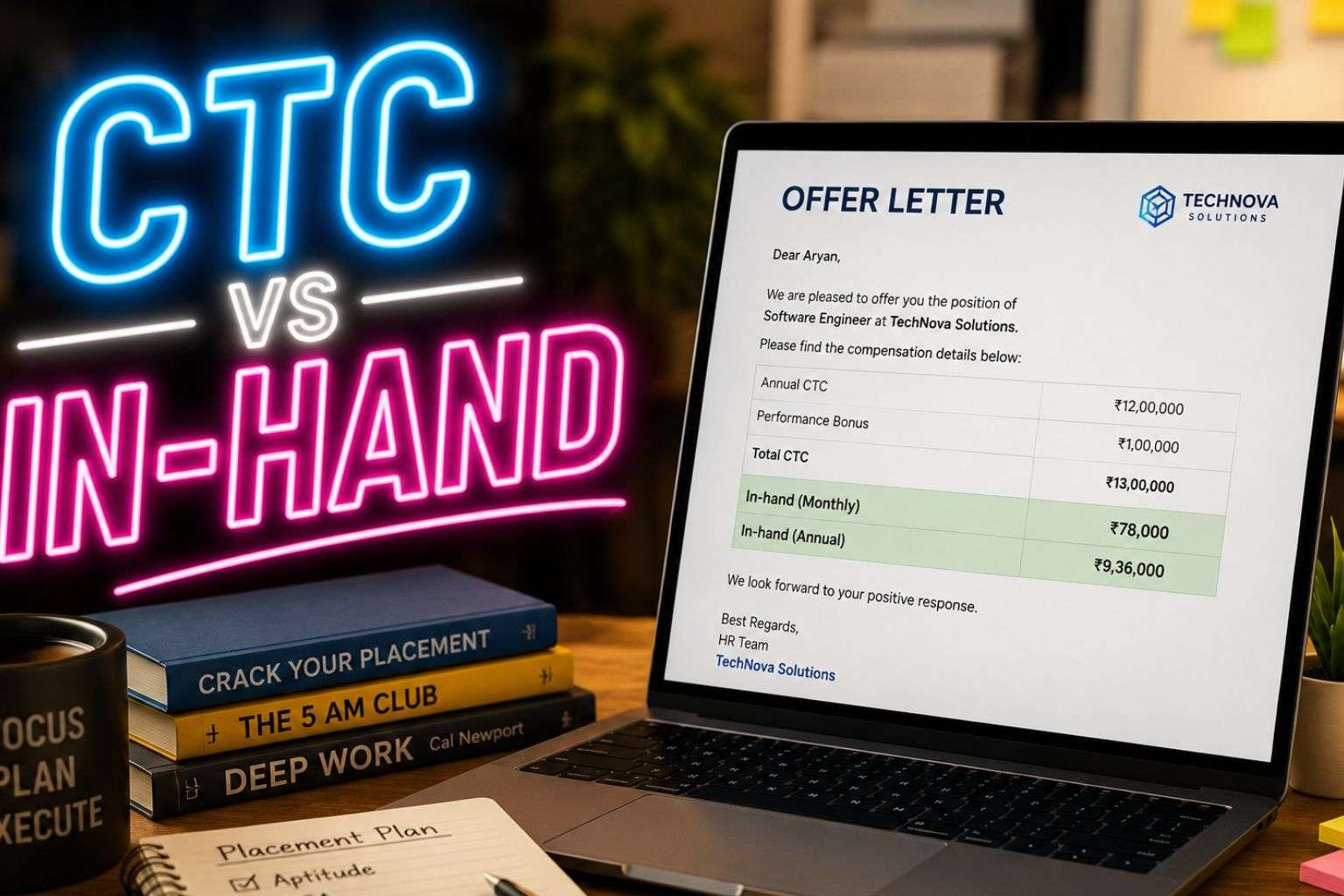
In-Hand Salary vs CTC Explained — Why Your First Payslip Feels Smaller (2026 Guide)
In-hand salary vs CTC is the question that lands in my WhatsApp inbox every single week, usually with a screenshot attached.
The screenshot is always the same story. A student got an offer letter that says ₹6 LPA. They did the maths in their head — ₹6 lakh divided by 12, so around ₹50,000 a month. Then the first payslip arrived. And it said ₹40,583.
“Sir, kahan gaya baaki paisa?”
I have heard that exact question more times than I can count in 27 years of guiding engineering students through their first jobs. So let me settle this once and for all, with real numbers, no jargon, and no confusion left at the end.

What Is CTC? The Number on Your Offer Letter
CTC stands for Cost to Company. It is the total amount your employer spends on you in one year — not just your salary.
It includes your basic pay. Your allowances. Your employer’s contribution to your Provident Fund. Your gratuity, which you only get after five years. Sometimes even your health insurance premium and your laptop.
When a company writes ₹6 LPA on your offer letter, that is CTC. Not your salary. Not what lands in your bank account. It is the full package of what you cost the company, on paper, for one year.
This is the first thing every fresher must understand about in-hand salary vs CTC. They are not the same number, and they were never meant to be.
What Is In-Hand Salary? The Number in Your Bank Account
In-hand salary is the amount that actually reaches your bank account every month. It is also called take-home salary or net salary.
It is what remains after your employer removes their own contributions from the CTC, and then removes your personal deductions — your own PF contribution, professional tax, and income tax.
This is the real number. The one you use to pay rent, send money home, and figure out how much you can save. Everything else on your offer letter is a projection. This is reality.
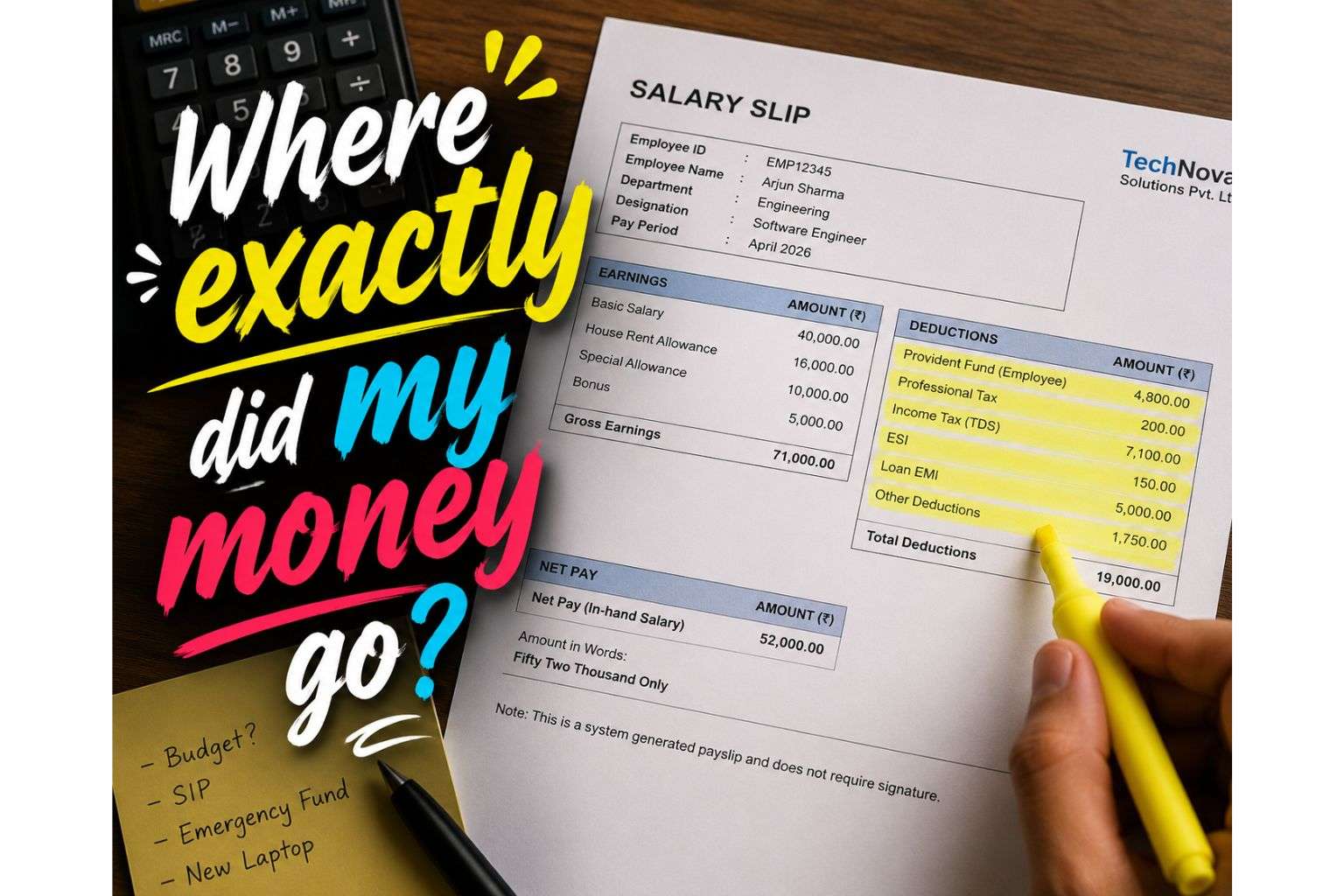
In-Hand Salary vs CTC — Every Component Explained
To really understand in-hand salary vs CTC, you need to know where the gap comes from. It is not one big deduction. It is several small ones, stacked together.
Employer PF Contribution. Your employer puts 12 per cent of your basic pay into your Provident Fund every month. This money is yours. But it sits in your PF account, not your bank account, until you retire or withdraw it under specific conditions.
Gratuity. Your employer sets aside roughly 4.8 per cent of your basic pay as gratuity. You only receive this if you complete five years with the company. Until then, it is included in your CTC but you will never see it in a payslip.
Employee PF Contribution. You also contribute 12 per cent of your basic pay to your own PF account. This is deducted from your salary every month, same as the employer share, but this portion comes out of what would have been your take-home.
Professional Tax. This is a small state-level tax, capped at ₹2,500 a year. It varies from state to state, and some states do not charge it at all.
Income Tax, also called TDS. This is usually the biggest deduction once your salary crosses a certain level. Under the new tax regime for FY 2026-27, income up to roughly ₹12 lakh is effectively tax-free after the standard deduction and rebate, which is genuinely good news for most freshers starting out.
Put these together, and you get the real gap between in-hand salary vs CTC. It is not a trick. It is not the company cheating you. It is how salary structuring works everywhere in India.
In-Hand Salary vs CTC — Real Numbers for ₹3.5 LPA, ₹6 LPA and ₹10 LPA
Let me stop talking in percentages and show you real numbers. These are approximate, based on standard salary structuring and the new tax regime for FY 2026-27. Your actual numbers will shift slightly depending on your company’s structure and your state.
₹3.5 LPA CTC Monthly in-hand salary is roughly ₹27,000 to ₹28,500. Most of the gap here comes from PF, since income tax is usually zero at this level.
₹6 LPA CTC Monthly in-hand salary is roughly ₹40,000 to ₹41,000. Again, income tax stays at zero or close to it under the new regime, so PF and professional tax account for most of the difference.
₹10 LPA CTC Monthly in-hand salary is roughly ₹68,000 to ₹78,000, depending on how your basic pay and allowances are structured. At this level, income tax starts playing a slightly bigger role, though the Section 87A rebate still keeps many freshers close to zero tax.
Notice something important here. At every single one of these levels, the gap between in-hand salary vs CTC is real, but it is not the disaster students assume it is when they first see their payslip. Most of the gap is money going into your own PF account. It is not lost. It is delayed.
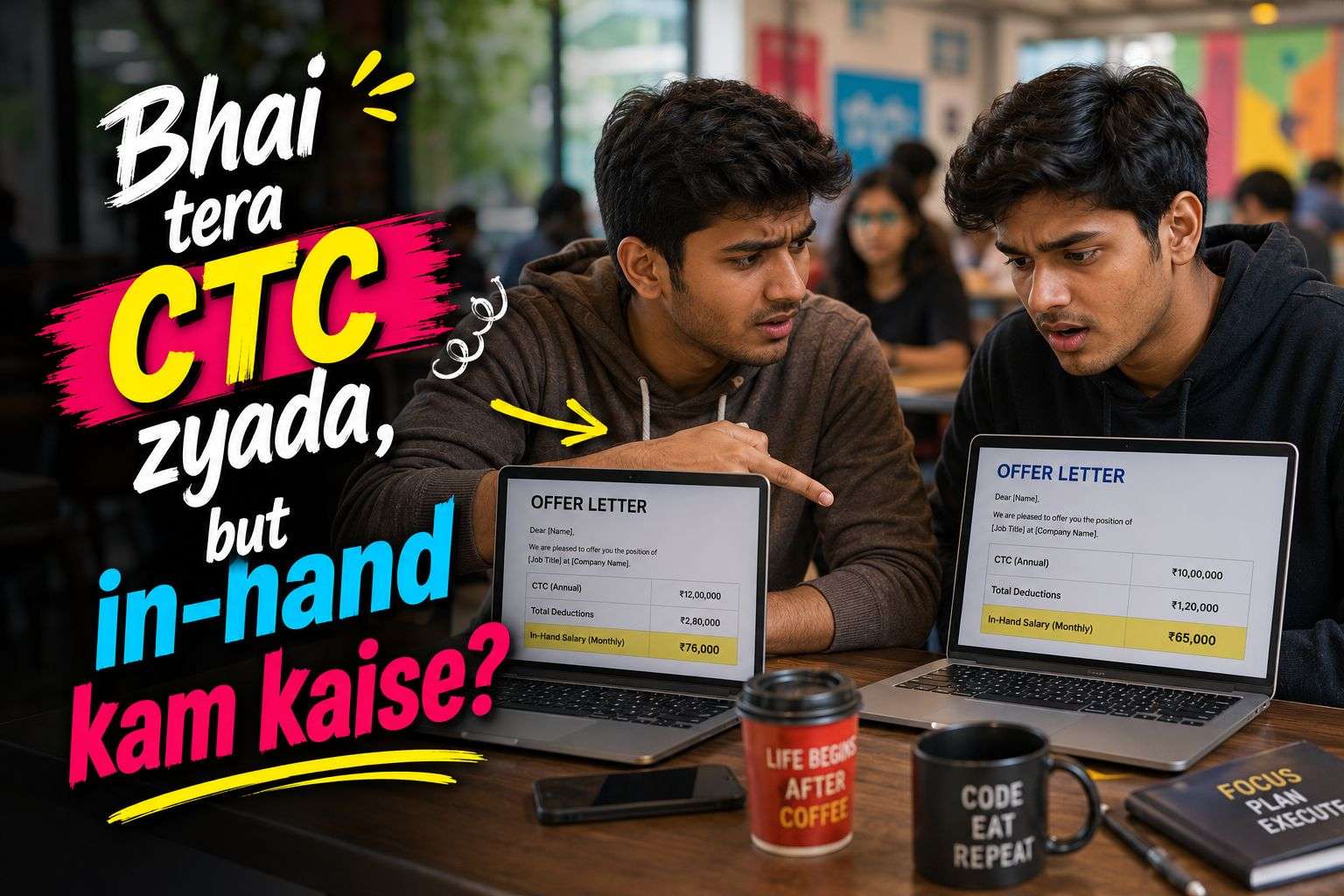
Why In-Hand Salary vs CTC Confuses So Many Freshers
I have sat across from hundreds of students the week their first salary hits their account. The confusion follows a pattern every single time.
They compare offer letters using CTC alone. Two students, two friends, one gets ₹6 LPA and the other gets ₹6.5 LPA. The second one feels like they won. But if the ₹6.5 LPA offer has a heavier PF structure or a lower basic pay percentage, the actual in-hand difference could be tiny, or even reversed.
They forget that CTC includes money they will never touch monthly. Gratuity is the biggest offender here. Students see it in their CTC breakup, mentally add it to their expected salary, and then feel cheated when it never appears in a payslip. It was never supposed to.
They do not ask for a salary breakup before joining. This is the single biggest mistake I see. A proper offer letter should show basic pay, HRA, allowances, employer PF, and gratuity separately. If a company only gives you one number, ask for the breakup. Every fair employer will give it to you.

Three Mistakes Freshers Make With In-Hand Salary vs CTC
Mistake 1 — Signing an offer without asking for the breakup. A CTC number alone tells you almost nothing about your monthly reality. Always ask HR for the detailed salary structure before you accept.
Mistake 2 — Comparing two offers by CTC alone. A ₹7 LPA offer with a low basic pay and heavy variable component can pay you less monthly than a ₹6.5 LPA offer with a straightforward structure. Compare in-hand numbers, not headline numbers.
Mistake 3 — Panicking at the first payslip instead of understanding it. Your PF money is not gone. It is growing, tax-free, for your future. Once you understand where every rupee goes, the gap between in-hand salary vs CTC stops feeling like a betrayal and starts feeling like basic financial literacy.

Watch These for a Clearer Picture
If numbers make more sense to you on video, these three are genuinely useful and accurate.
🎥 Why is your In-hand Salary Less than your CTC — Vantage with Palki Sharma
🎥 CTC vs In-Hand Salary — Full Breakdown
🎥 Monthly Salary Breakdown — CTC vs In-Hand

Useful Tools and Official Sources
For the exact numbers on your own offer letter, use a proper calculator rather than guessing.
🔗 EPFO Official Portal — to understand how your own PF contribution works 🔗 Income Tax Department — Tax Slabs FY 2026-27 — for the latest official tax rules 🔗 ClearTax Salary Calculator — for a quick CTC to in-hand estimate
Read These Next
📌 Fresher Salary in India 2026 📌 How to Ask for a Salary Hike After Probation in India 📌 TCS vs Infosys vs Wipro for Freshers 📌 Off-Campus Placement for Freshers in 2026 📌 Job Hunting Guide 2026 for Indian Graduates
FAQs — In-Hand Salary vs CTC
FAQ 1 — Why does my in-hand salary vs CTC gap feel bigger than what my friend explained to me?
The gap depends entirely on how your company structures your basic pay. A higher basic pay means higher PF deduction, which lowers your in-hand salary but grows your retirement savings faster. A lower basic pay means a smaller PF cut and a higher in-hand number, but slower long-term savings. Two people with the same CTC can have noticeably different in-hand salaries simply because of this structuring choice.
Consultant’s Note — I always tell students to ask HR one specific question before joining: what percentage of my CTC is basic pay. That single number tells you more about your real in-hand salary vs CTC gap than anything else on the offer letter.
FAQ 2 — Is the money that goes into PF actually mine, or is it lost?
It is completely yours. Both your contribution and your employer’s contribution sit in your PF account, earning tax-free interest. You can withdraw it in specific situations, like a medical emergency or buying a home, and you receive the full amount with interest when you retire or leave the workforce.
Consultant’s Note — I remind every fresher of this because the word “deduction” sounds like loss. It is not a loss. It is forced saving, and most freshers would never save this consistently on their own.
FAQ 3 — Why is my first-year in-hand salary vs CTC gap smaller than what my seniors experience?
Freshers typically fall into lower income slabs where income tax is minimal or zero under the new regime. As your salary grows year after year, income tax starts taking a bigger share, which widens the gap between in-hand salary vs CTC over time.
Consultant’s Note — This is exactly why understanding this concept early matters. The habits and expectations you build in your first job carry into every salary negotiation after it.
FAQ 4 — Does gratuity really never appear in my salary until five years?
Correct. Gratuity is a retention benefit under Indian labour law. It is calculated and shown in your CTC, but it is only paid out when you complete five continuous years with the same employer, or in certain other specific circumstances.
Consultant’s Note — I have seen students switch jobs at year four thinking they are close to gratuity. They are not. Plan your job switches around your career growth, not around a gratuity date.
FAQ 5 — Can I negotiate the in-hand salary vs CTC split before joining?
In many companies, yes, especially around how much goes into basic pay versus allowances. Some companies also offer flexible benefit plans where you can choose how certain allowances are structured. It is always worth asking, politely, whether any flexibility exists.
Consultant’s Note — Freshers rarely negotiate this because they assume the offer letter is final. Asking a respectful question about structure has never cost any student I have guided an offer.
FAQ 6 — Why did my in-hand salary change slightly in my second month?
This usually happens because your first month’s salary is sometimes prorated based on your joining date or because certain reimbursements and allowances only start from the second cycle. It is normal and not a sign of any error.
Consultant’s Note — Always check your payslip in the second month, not just the first. That is the number that reflects your true monthly in-hand salary vs CTC pattern.
FAQ 7 — Should I choose the old tax regime or the new tax regime as a fresher?
For most freshers with limited investments and no home loan, the new tax regime usually works out better because of the higher rebate threshold and standard deduction. If you have significant investments under 80C or pay rent through HRA claims, it is worth comparing both regimes using a calculator before deciding.
Consultant’s Note — I tell every student to actually run both numbers through a calculator rather than guessing. A five-minute check can save thousands of rupees over the year.
FAQ 8 — Does professional tax apply in every state, including Odisha?
Professional tax rules vary by state, and not every state charges it. Where it applies, it is a small monthly amount capped at ₹2,500 a year, so it has a minimal impact on your overall in-hand salary vs CTC comparison compared to PF and income tax.
Consultant’s Note — Do not let professional tax worry you. It is the smallest piece of this entire puzzle by a wide margin.
FAQ 9 — How do I calculate my exact in-hand salary before I even join?
Use an online CTC to in-hand calculator, enter your CTC, your basic pay percentage if known, and your state. This gives you a close estimate. For the exact figure, ask your HR team for a detailed salary breakup before your joining date.
Consultant’s Note — I encourage every student I counsel to do this calculation before accepting an offer, not after the first payslip. It removes the shock completely.
FAQ 10 — Will my in-hand salary vs CTC gap shrink as I get promoted?
Not exactly shrink, but the composition of the gap changes. PF contributions stay proportionally similar, but income tax takes a growing share as your salary rises. Understanding this early helps you plan your finances realistically at every stage of your career, not just your first job.
Consultant’s Note — This is the conversation I have with students years after their first job, when they come back for a salary negotiation. The fundamentals never change. Only the numbers grow.
What to Do This Week — Your Action Plan
If you have an offer letter in hand right now, Ask HR for the detailed salary breakup today. Do not wait until joining day. Run the numbers through a calculator so your first payslip holds no surprises.
If you are still preparing for placements, learn this in-hand salary vs CTC concept now, before your first offer arrives. When two offers land on the same day, you will be the student comparing real numbers instead of headline figures.
If you have already received your first payslip and feel confused, go back to your offer letter, match each deduction to what you learnt here, and you will find every rupee accounted for. Nothing is missing. It is simply structured differently than you expected.
Understanding in-hand salary vs CTC is not complicated once someone breaks it down honestly. It just needs someone to explain it without hiding behind jargon. That is exactly what I have tried to do here.
Still confused about your specific offer letter? Read our guides on Fresher Salary in India 2026 and How to Ask for a Salary Hike After Probation to plan your first year in the workforce with full clarity.







2 Comments