

Why Indian Freshers Fail Interviews Despite Good Grades — The Soft Skills for Freshers in India No One Talks About (2026)
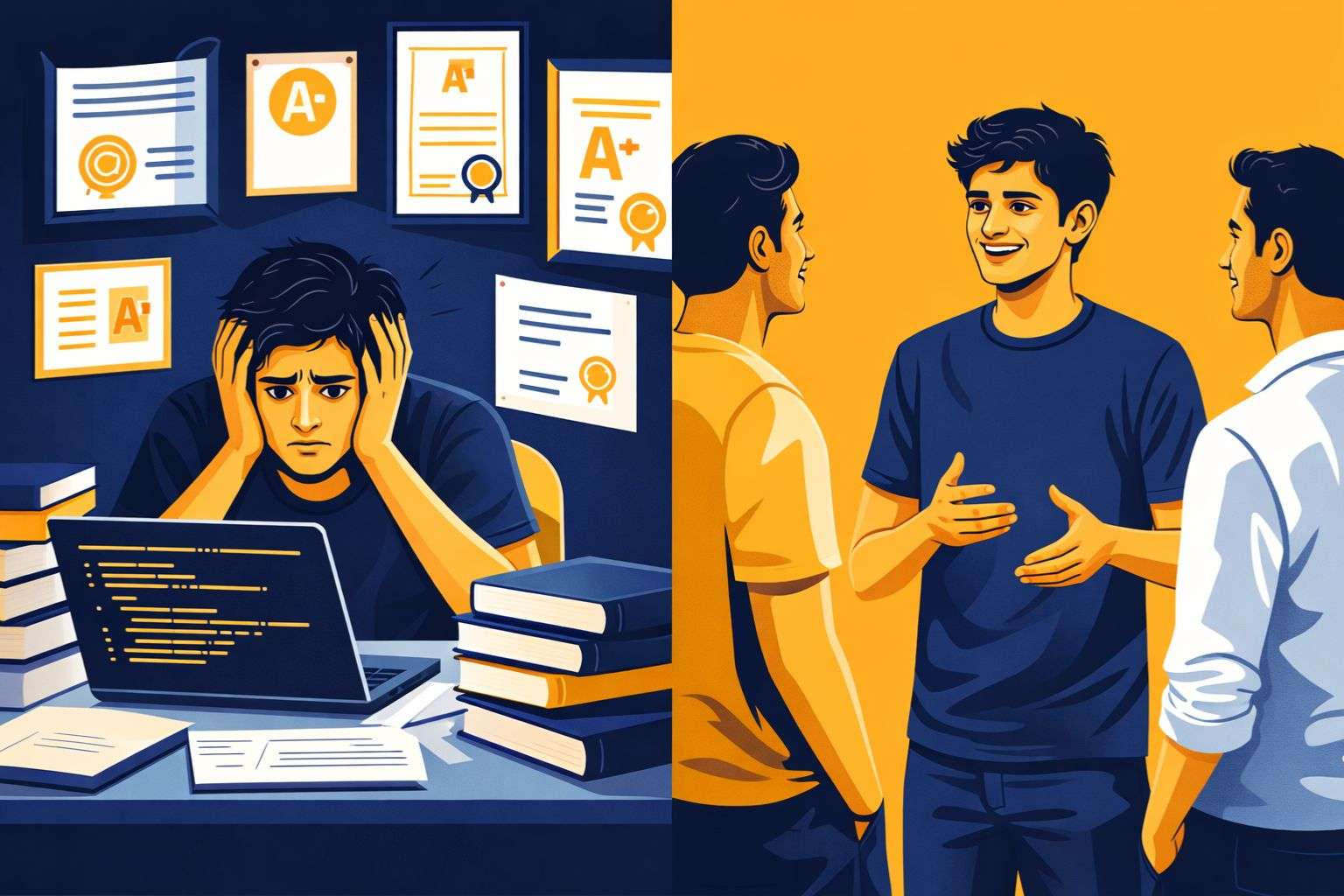
A 2024 NASSCOM report found that over 60% of Indian engineering graduates are not industry-ready — not because of poor coding skills, but because of poor communication, low confidence, and weak teamwork.
You scored 8.5 CGPA. You cleared the aptitude round. You even revised your DSA the night before. But the offer never came.
In 27 years of watching freshers enter the IT industry, I have seen this story repeat itself more times than I can count.
The technical gap is closing fast. The soft skills gap is widening.
Understanding which soft skills for freshers in India matter most in 2026 is no longer optional — it is the difference between a shortlist and a rejection email.
This blog will tell you exactly which soft skills Indian employers are looking for in 2026, why most freshers fall short, and what you can do about it starting this week.
What Are Soft Skills for Freshers in India — And Why Most Underestimate Them
Soft skills are the non-technical behaviours that determine how you work with people, handle pressure, communicate ideas, and solve problems in a team environment.
In India, most engineering colleges spend four years teaching you what to think. Very few teach you how to speak, how to listen, or how to disagree professionally. That is not your fault. But in 2026, it is your problem.
Here is what I observe repeatedly: A fresher joins a TCS or Infosys project. The technical onboarding takes three weeks. What decides whether that fresher gets a good project, a fast promotion, or a performance improvement plan in year one is almost never their Java knowledge. It is how they communicate with their team lead, how they handle feedback, and whether they can manage their own stress without it showing up as silence or defensiveness.
Hiring managers know this. That is why behavioural rounds exist. That is why group discussions are still part of campus placement at most top companies. They are not testing your personality. They are testing your professional readiness.
The most important soft skills for freshers in India in 2026 are not the ones listed on a course certificate — they are the ones visible in how you carry yourself through an interview room.
The 7 Soft Skills Indian Employers Are Actively Looking For in 2026
1. Communication — Spoken and Written
This is not about speaking like a news anchor. It is about being understood clearly, the first time.
In IT interviews, communication is tested in three ways — how you introduce yourself, how you explain a technical concept to a non-technical interviewer, and how you respond when you do not know an answer.
Most freshers rehearse their self-introduction until it sounds robotic. They freeze when asked to explain a project simply. And when they do not know an answer, they either go completely silent or ramble until the interviewer stops them.
How to Prepare for TCS, Infosys and Wipro Interview in 2026
What employers want is a fresher who can say: “I am not sure of the exact answer, but based on what I know about X, I would approach it this way.” That single sentence shows confidence, honesty, and structured thinking — three things a hiring manager is looking for simultaneously.
Written communication matters equally. Every email you write to a recruiter, every message you send on LinkedIn, every follow-up after an interview — these are soft skill signals before you even walk into the room.
Consultant’s Note: I once watched a fresher lose a final-round offer because he sent a thank-you email with three spelling errors and no subject line. The technical interview was perfect. The email undid it. Write every professional communication like it is being evaluated — because it is.
2. Active Listening
Most freshers prepare so hard for what they will say that they forget to listen to what the interviewer is actually asking.
Active listening means you hear the full question before forming your answer. It means you notice when an interviewer gives you a hint or redirects you. It means you do not interrupt, you do not assume, and you do not answer a different question because you rehearsed that one more.
In a group discussion, active listening means you can build on what someone else said rather than just waiting for your turn to speak. Hiring panels notice this immediately. The fresher who listens well and responds to the actual conversation stands out in a room of freshers who are all performing their prepared scripts.
Consultant’s Note: In every hiring panel I have sat on, the candidate who listened carefully and referenced something another panelist said earlier in the discussion was always rated higher — even when their individual points were not the strongest. Listening is a leadership signal, not a passive skill.
3. Adaptability and Learning Agility
The IT industry in 2026 is not the same as 2023. AI tools are changing workflows. Projects shift scope. Teams restructure. A fresher who can only do what they were taught in college will struggle inside a live project environment within months.
Employers are not expecting you to know everything. They are expecting you to learn fast, ask the right questions, and not shut down when something unfamiliar comes up.
In interviews, adaptability is tested through situational questions: “Tell me about a time you had to learn something new quickly.” “How did you handle a project that changed direction midway?” If you have never had an internship, use academic projects, hackathons, or college events where you had to adjust under pressure.
If you have nothing to draw on, that itself is feedback — go get an internship or project experience before your next placement cycle begins.
Top Tech Skills Employers Look for in Freshers in India 2026
Consultant’s Note: I have seen freshers with 7 CGPA outperform 9-pointers in their first year simply because they adapted faster. Learning agility is not intelligence. It is an attitude. And attitude shows in how you talk about challenges — not how you list your technical certifications.
4. Teamwork and Collaboration
Every IT project is a team effort. No fresher joins a company to work alone. Yet most placement interviews reveal that candidates have never genuinely reflected on what it means to contribute to a team — they just say “I am a team player” as a reflex.
How to Convert Your Summer Internship Into a Full-Time Job in India
Employers in 2026 want specifics. Who did you work with? What was your role? What happened when there was a disagreement? How did you handle it?
If your honest answer is “we divided the work and everyone did their part,” that is fine for a college project — but it is not a strong interview answer. Reframe it: “We had three people with different working styles. I took responsibility for coordinating our submission deadlines and keeping the group aligned when one member fell behind.” That shows collaboration as a skill, not just a fact.
Consultant’s Note: Teamwork is not about being agreeable. It is about being reliable. In 27 years, the freshers who grew fastest were not the loudest in the room. They were the ones their teammates could count on — to show up, to communicate blockers early, and to take ownership of their piece without being chased.
5. Problem-Solving Under Pressure
Every technical interview has a moment designed to make you uncomfortable — a question you cannot answer, a case study you have not seen, or a follow-up that challenges your answer. How you behave in that moment is the interview within the interview.
Freshers who panic, go silent, or immediately say “I don’t know” and wait for rescue score poorly not because they got the answer wrong — but because they revealed they cannot think under pressure.
What to do instead: Think out loud. “Let me break this down. If I assume X, then Y would follow. I am not certain of Z, but I would check by doing this.” Even a wrong answer delivered with structured thinking signals a trainable mind. An empty silence signals risk.
Consultant’s Note: I always told freshers in my mentoring sessions — the interviewer often already knows you do not know the answer. They are watching whether you fall apart or stay composed. Composure under pressure is one of the rarest and most valued skills in any IT professional, at any level.
6. Professional Attitude and Work Ethic Signals
This one does not have a certificate. You cannot add it to your resume with a course name. But it shows up in everything — your punctuality, your body language, your follow-through on small commitments, and how you treat everyone in the room from the receptionist to the panel head.
In 2026, Indian IT companies — especially service giants like TCS, Wipro, and Cognizant — are hiring for culture fit alongside skill. They want freshers who take ownership, who do not make excuses, and who show up prepared even for the small interactions.
Some concrete signals hiring panels watch: Did you research the company before the interview? Did you arrive early or scramble in at the last minute? Did you bring a printed copy of your resume or assume everything would be on screen? Did you ask a thoughtful question at the end or just say “no questions”?
Why Your Resume Is Getting Rejected in India 2026
Consultant’s Note: One of the simplest ways to signal a professional attitude is to ask one good question at the end of every interview. Not “what is the salary?” — that comes later. Ask something like “What does the first 90 days typically look like for a fresher joining this team?” That question tells the interviewer you are thinking about the job, not just the offer.
7. Emotional Intelligence — Self-Awareness and Empathy
This is the soft skill most freshers have never heard of in a placement context — and the one that matters most for long-term career growth.
Emotional intelligence (EQ) means you understand your own reactions, you can manage them under stress, and you can read a room well enough to adjust your approach. In an interview, high EQ looks like this: you notice the interviewer seems unimpressed, and instead of continuing on the same track, you pause and ask “Would you like me to go deeper on any part of that?” In a team, high EQ means you notice a colleague is struggling and offer to help rather than waiting to be assigned.
In 2026, with AI handling more routine IT tasks, the skills that remain distinctly human — empathy, self-awareness, situational judgement — are becoming the actual differentiators between good and great professionals.
How to Get an Off Campus Job in India 2026
Consultant’s Note: EQ is not something you develop overnight. But you can start by doing one thing: after every interview or group interaction, ask yourself two honest questions. What did I do well? What would I do differently? Freshers who practise that reflection consistently are the ones who improve the fastest.
Why Indian Colleges Are Not Teaching These Soft Skills
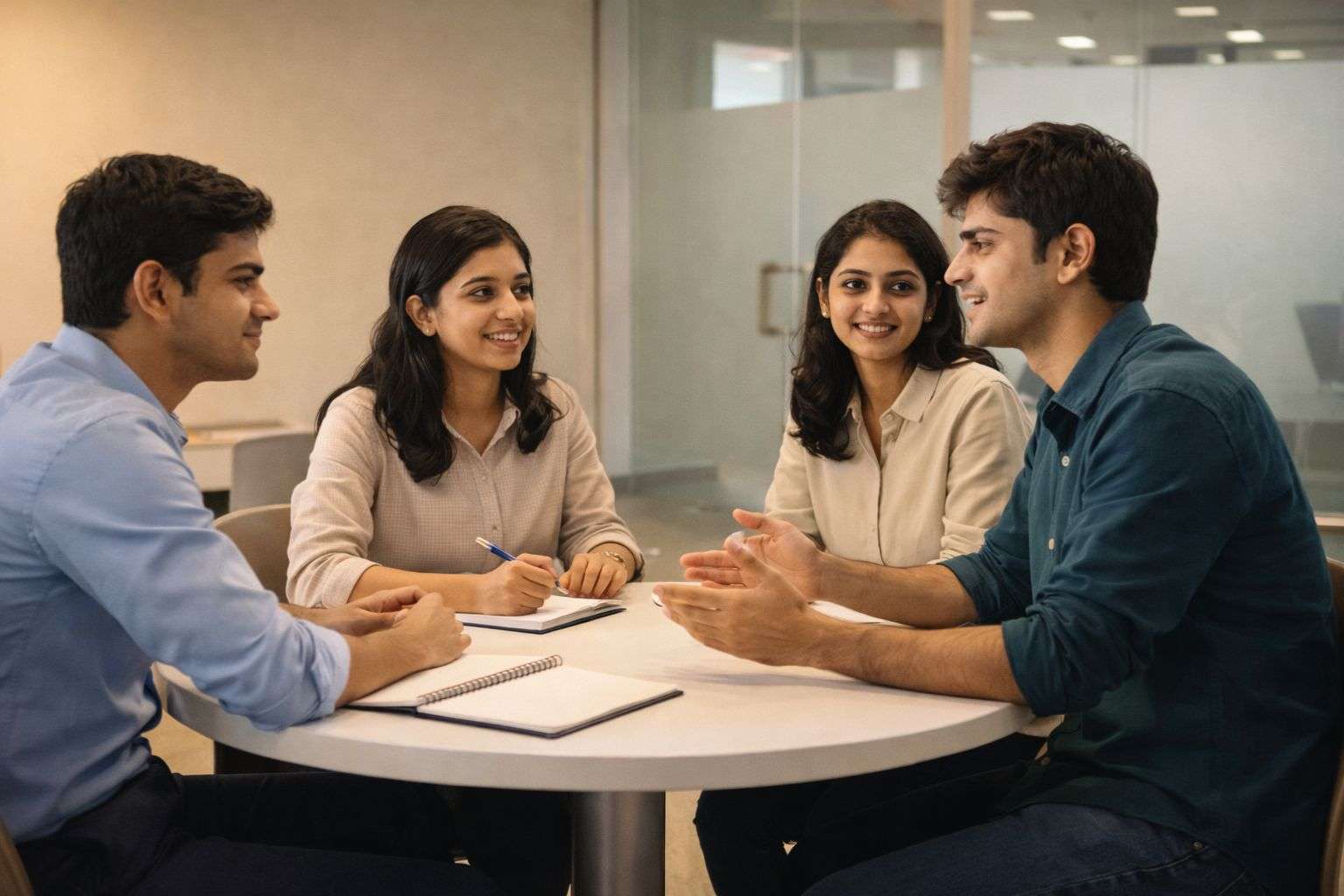
This is not a criticism of Indian engineering education — it is an observation from watching thousands of freshers over nearly three decades.
The college system is designed to produce graduates who can pass exams. Exams reward individual knowledge, correct answers, and performance under structured conditions. The workplace rewards collaboration, ambiguous problem-solving, communication, and emotional resilience — none of which appear on a mark sheet.
Add to this the competitive pressure of entrance exams and CGPA battles, and what you get is a generation of technically capable graduates who have spent four years in environments that actively discouraged the very soft skills for freshers in India that employers now value most.
The good news is that soft skills can be learned and practised deliberately. Unlike a programming language, you do not need a laptop. You need awareness, repetition, and honest feedback.
Does CGPA Really Matter for Jobs in India in 2026
How to Build These Soft Skills Before Your Next Interview
You do not need a six-month course. You need a deliberate daily habit over the next four to eight weeks.

For communication: Record yourself answering one interview question every day. Watch it back. Notice your filler words, your pace, and whether your answer actually addressed the question. This is uncomfortable. Do it anyway.
For active listening: In your next five conversations — with friends, family, or professors — make it a rule that you will not speak until the other person has fully finished. No interrupting, no overlapping. Just listen, then respond.
For adaptability: Take on one unfamiliar task every week — a new tool, a new topic, a small project outside your comfort zone. Document what you learned. These become your interview stories.
For teamwork: Volunteer to coordinate something — a college event, a group project, a study group. Coordination teaches you about people, not just tasks.
Benefits of an Internship for Students in India 2026
For EQ: Keep a two-minute reflection journal after every significant interaction. What happened? How did you respond? What would you change?
None of this requires money. All of it requires consistency.
Frequently Asked Questions
Q 1- Which soft skills for freshers in India matter most when getting hired in 2026?
If I had to name one, it is communication — but not for the reason most freshers think. Communication is not just about speaking well. It is the delivery system for every other skill you have. You can be highly adaptable, emotionally intelligent, and a strong team player — but if you cannot express those qualities clearly in an interview or on the job, the employer will never know.
Communication is the skill that makes all other skills visible. In my experience, freshers who improve their spoken and written communication first see the fastest overall improvement in their interview performance, their confidence, and ultimately their placement outcomes. Start there. Everything else builds on it.
Soft skills for freshers in India are not a checklist to memorise — they are professional disciplines to practise daily, and communication is the one that unlocks all the others.
Consultant’s Note: The best communicators I have hired were not the most fluent — they were the most honest. They said what they meant, clearly and without filler. That is the standard to aim for.
FAQ 2-Can soft skills be learned by introverted freshers or is it only for extroverts?
This is one of the most common misconceptions I encounter — that soft skills belong to extroverts. They do not. Soft skills are professional behaviours, not personality types. Some of the strongest communicators and most effective team collaborators I have worked with over 27 years were introverts.
What introverts often bring naturally is active listening, careful thinking before speaking, and deep focus — all of which are valuable soft skills in their own right. What introverts sometimes need to practise is initiating communication, being visible in group settings, and advocating for themselves in performance discussions. The work is different, not harder. Introversion is not a disadvantage in the IT workplace — it is just a different starting point.
Consultant’s Note: Do not try to become an extrovert. Become a more intentional version of who you already are. That authenticity will come through in interviews more powerfully than any performed confidence.
FAQ 3- How do I demonstrate soft skills on my resume when I have no work experience?
Most freshers make the mistake of listing soft skills as keywords — “good communicator,” “team player,” “quick learner” — with nothing to back them up. Recruiters have been reading those phrases for decades. They mean nothing without evidence.
Instead, demonstrate soft skills through what you did, not what you are. Led a team of five for your final year project? That is teamwork and leadership.
Organised a college technical fest? That is coordination, communication, and deadline management. Explained a complex topic to juniors as a study group mentor? That is communication and empathy.
Every soft skill has an action behind it. Find the action, describe the outcome, and let the soft skill be the natural inference. Knowing which soft skills for freshers in India to highlight — and how to prove them without a job title — is what separates a strong fresher resume from a weak one.
How to Write a Resume for Internship With No Experience in India 2026
Consultant’s Note: If you genuinely have no examples to draw on, that is your signal — not your excuse. Go create the experience now. Join a committee, take on a coordination role, mentor a junior batch student. You have more time than you think, and these experiences will serve you for the next ten years of interviews.
FAQ 4- Do Indian IT companies like TCS, Infosys, and Wipro actually test soft skills during campus placement?
Yes — and more systematically than most freshers realise. The group discussion round at mass recruiters is entirely a soft skills assessment. They are watching how you initiate, how you listen, how you handle disagreement, whether you dominate or contribute, and whether you can bring the group to a conclusion.
The HR interview round that follows the technical round is also a soft skills round — every behavioural question is designed to reveal how you think, communicate, and handle pressure. Even the technical round has soft skill signals embedded — how you respond when you do not know an answer is as important as the answers you get right.
Every stage of Indian campus placement is, in some way, a test of the soft skills for freshers in India that this blog covers.
How to Crack Campus Placements in India 2026
Consultant’s Note: Freshers who treat the HR round as a formality after passing the technical round are making a serious mistake. In many placement processes I have observed, the HR round is where final decisions are made when two candidates are technically equal — which, in mass recruitment, happens constantly.
FAQ 5- How long does it take to genuinely improve soft skills before placement season?
The honest answer is: meaningful improvement is visible in four to six weeks of daily, deliberate practice — not years. The reason most freshers see no improvement is not lack of time. It is lack of feedback.
You cannot improve communication by talking more. You improve by recording yourself, watching it back, identifying specific weaknesses, and adjusting. You cannot improve active listening by deciding to listen — you improve by catching yourself interrupting and stopping.
The mechanism is awareness plus repetition plus honest feedback. Four weeks of that beats four years of generic college training. The soft skills for freshers in India that seem hardest to build are usually the ones that have simply never been practised with any intention. Start today, not after your exam results come out.
Consultant’s Note: The freshers I have mentored who improved the fastest were not the ones who read the most books on communication. They were the ones who practised something small every single day and took the feedback seriously — even when it was uncomfortable.
Consultant’s Closing Perspective
In 27 years of hiring, consulting, and watching freshers navigate some of the most competitive job markets India has seen, I have arrived at one clear conviction: technical skills get you considered. Soft skills get you hired — and kept.
The most important soft skills for freshers in India in 2026 are not the ones listed on a course certificate — they are the ones visible in how you carry yourself through an interview room, how you respond when a project goes sideways, and how you treat the people around you when no one is watching.
The IT industry is changing faster than any college curriculum can track. AI is automating the routine. What remains — and what will always remain — is the human layer. How you communicate under pressure. How you collaborate with people who think differently. How you adapt when the project changes on day three. How you recover when you make a mistake without making it someone else’s problem.
These are not personality traits you are born with. They are professional disciplines you build deliberately. Every fresher reading this blog has the same starting point — today. What you do with the next four weeks before your placement season begins will matter more than what you did in the last four years.
The gap is real. But it is closable. Start closing it.
What To Do This Week
- Record yourself answering “Tell me about yourself” — watch it back once, fix one thing
- Send one professional email or LinkedIn message with zero spelling errors and a clear subject line
- In your next group conversation, practise not speaking until the other person has fully finished
- Identify one soft skill from this list that is your weakest — decide on one daily action to improve it
How to Crack Infosys InfyTQ 2026 — Preparation Guide
Read Next:-
LinkedIn Profile Tips for Students and Freshers in India 2026
TCS NQT 2026 Complete Guide for Freshers



8 Comments