

Best Certifications for Freshers in India in 2026 — A 27-Year IT Career Consultant Tells You Which Ones Actually Get You Hired
Best certifications for freshers in India in 2026 — there are hundreds of options out there. Most of them are a waste of your time and money. This is my honest list of the ones that actually matter.
Best Certifications for Freshers in India in 2026 — And Why Most Students Pick the Wrong Ones
Best certifications for freshers in India in 2026 is something every engineering student searches for.
But here is what I have noticed in my 27 years of career consulting.
Students collect certificates the way some people collect trophies. Display them, forget about them, never use them.
I have sat across from freshers who have five, six, sometimes eight certificates on their resume. Udemy course completion. A random online Python badge. A college-level machine learning workshop certificate. And they cannot answer a single technical question in the interview room.
That is not a certification problem. That is a strategy problem.
The right certification — chosen correctly, prepared for seriously, and backed by hands-on practice — changes your job prospects in a real and measurable way. The wrong one is a line on your resume that experienced interviewers will ignore, or worse, ask you about and catch you unprepared.
I am based in Bhubaneswar. Most of the students I work with are from tier-two cities in Odisha and Eastern India. They do not have the luxury of a Delhi or Bangalore college brand name. For them, the right certification is not optional. It is the thing that creates the difference.
This blog tells you exactly which certifications matter for Indian freshers in 2026, which ones are overrated, and how to choose the right one for where you want to go.
Why Certifications Matter More for Indian Freshers in 2026 Than Ever Before
Let me be direct about why this matters right now — in 2026 specifically.
India’s IT hiring environment has changed. Companies like TCS, Infosys, and Wipro have tightened their fresher hiring numbers compared to the peak years. Competition for every open role is higher. And recruiters in 2026 are screening resumes faster than before — often using automated tools before a human ever reads your name.
In that environment, the right certification does three specific things for a fresher.
It signals preparation. A globally recognised certification tells a recruiter that you did not just study the concept in your college classroom. You sat for an external exam. You were assessed by an independent body. You passed. That signal of initiative and preparation is increasingly important when hundreds of resumes look identical.
It fills the experience gap. Freshers in India face a frustrating paradox. Companies want experienced candidates. But how do you get experience without a job? The right certification — especially one with hands-on lab components — is the closest thing to a substitute for job experience that exists in the Indian fresher market.
It gives you something specific to discuss in the interview. The best interviews are conversations, not interrogations. When you have a genuine certification backed by real preparation, the interviewer asks about it. You talk about what you learned, what you found difficult, how you prepared. That conversation shows depth that a vague “I know Java” claim on a resume never can.
How to Choose the Right Certification — Before You Look at the List
Before I give you the list, I want to give you the filter.
Because the right certification for you depends on three things that are specific to your situation.
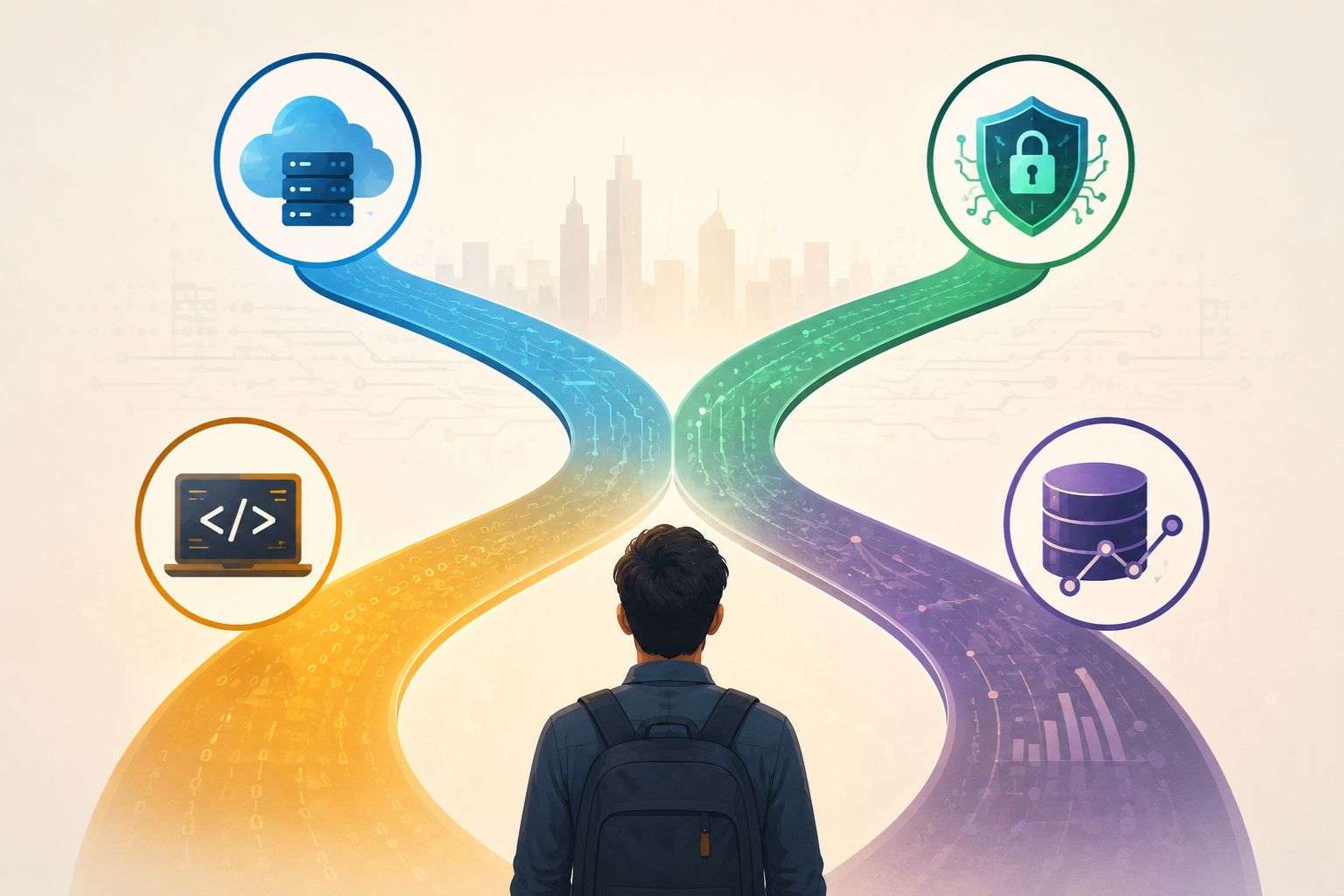
1. Which career path do you want? Cloud computing? Cybersecurity? Full stack development? Data analytics? Networking? Each path has its own certifications that carry weight with recruiters. A cloud certification will not help you get a cybersecurity role. Choose based on where you want to go — not based on what your friend is doing.
2. What is your technical baseline? Some certifications have meaningful prerequisites. AWS Solutions Architect Associate, for example, is accessible to freshers — but it requires genuine hands-on practice to pass, not just watching videos. CCNA requires a solid understanding of networking fundamentals. Be honest about where you are before you commit to a certification timeline.
3. What is your budget and time? Some certifications cost ₹8,000 to ₹15,000 for the exam alone. Others have free exam vouchers for students. Some take 4 weeks to prepare for with focused effort. Others realistically take 3 to 4 months. Plan accordingly.
With that filter in place, here is my honest list.
The Best Certifications for Freshers in India in 2026 — The Honest List
1. AWS Certified Cloud Practitioner — Best First Certification for Cloud Aspirants
If I had to recommend one certification to an Indian engineering fresher in 2026 who is not yet sure which cloud platform to learn — this is it.
The AWS Certified Cloud Practitioner is the entry point to the world’s most widely used cloud platform. It is genuinely recognised by Indian recruiters. It appears in job descriptions across large IT service companies and mid-size product firms alike.
What makes it right for freshers specifically? It does not require prior cloud experience. It tests conceptual understanding of cloud services, basic security, billing, and core AWS offerings. A student with no prior cloud background can prepare for it seriously in 6 to 8 weeks.
But here is what I always tell students — pass the certification AND build something real on AWS. The AWS free tier gives you 12 months of access to core services at no cost. Use it. Deploy a simple application. Launch an EC2 instance. Set up an S3 bucket. The certificate without the hands-on practice falls apart in the first five minutes of a technical interview.
Who this is for: Students targeting cloud roles at TCS, Infosys, Wipro, Capgemini, or any company moving infrastructure to the cloud.
Exam cost: Approximately ₹8,000 to ₹10,000 in India.
Preparation time: 6 to 8 weeks with focused daily study.
Salary impact: Entry-level cloud roles in India start at ₹3.5 to ₹6 LPA at large IT service companies, and ₹6 to ₹10 LPA at product companies.
🔗 Prepare with structured training: Cloud Computing & DevOps — Job Guaranteed Course, Rooman Technologies — covers AWS, Azure, GCP, Docker, and Kubernetes with placement assistance and 300 hours of hands-on training.
🔗 Official exam registration: aws.amazon.com/certification
🔗 Read more: Cloud Computing Career Roadmap for Indian Students in 2026
2. CCNA — Cisco Certified Network Associate — Best for Networking and Infrastructure Roles
The CCNA has been on this list for over 20 years. It is still here in 2026 for a simple reason — it still works.
Cisco’s CCNA is the global standard for networking fundamentals. In India, it is recognised across IT service companies, telecom companies, banking infrastructure teams, and every company that manages its own network infrastructure. And that is a very large number of companies.
For an Indian fresher targeting networking roles — network engineer, network administrator, IT infrastructure support — CCNA is not optional. It is the baseline credential that separates candidates who get interviews from those who do not.
The current CCNA exam covers a broad range of topics. IP addressing and subnetting, routing and switching fundamentals, network security basics, automation and programmability, and wireless networking. It is a genuinely rigorous certification — not a participation certificate. Students who pass it have demonstrated real technical knowledge.
Preparation is typically 3 to 4 months for a fresher starting from basic networking knowledge. The exam is challenging. But the career door it opens — especially in India’s telecom and banking infrastructure sectors — makes that investment worthwhile.
Who this is for: Students targeting network engineering, IT infrastructure, or telecom roles.
Exam cost: Approximately ₹20,000 to ₹25,000 in India.
Preparation time: 3 to 4 months.
Salary impact: Entry-level networking roles with CCNA in India — ₹3 to ₹6 LPA at IT service companies, ₹6 to ₹10 LPA at telecom and banking companies.
🔗 Structured CCNA preparation: CCNA — Cisco Certified Network Associate, Rooman Technologies — 50 hours of certification-focused training from certified Cisco trainers with 281,349 learners.
🔗 For advanced networking after CCNA: CCNP — Cisco Certified Network Professional, Rooman Technologies

3. Certified Ethical Hacker — CEH — Best for Cybersecurity Aspirants
Cybersecurity is one of the fastest-growing career areas in India in 2026. Every company — from banks to hospitals to e-commerce platforms — has been impacted by cyber threats. The demand for skilled cybersecurity professionals is outpacing supply at every experience level, including freshers.
The CEH — Certified Ethical Hacker — from EC-Council is the most widely recognised entry-level cybersecurity certification in India. It teaches you how attackers think and work — so you can defend against them. Topics covered include network scanning, system hacking, web application attacks, social engineering, and malware threats.
For Indian freshers, the CEH signals something important to recruiters — that you are serious about cybersecurity as a career, not just curious about it. Companies hiring for cybersecurity analyst roles in India in 2026 frequently list CEH as a preferred or required credential.
One honest note — CEH is not the only cybersecurity certification worth having. CompTIA Security+ is another strong option, particularly for students targeting global companies or MNCs with India offices. But for the Indian domestic IT market in 2026, CEH has higher name recognition among Indian recruiters.
Who this is for: Students targeting cybersecurity analyst, penetration testing, or information security roles.
Exam cost: Approximately ₹20,000 to ₹35,000 depending on the exam format.
Preparation time: 2 to 3 months with structured study.
Salary impact: Entry-level cybersecurity roles in India — ₹3.5 to ₹7 LPA at IT service companies, ₹7 to ₹15 LPA at product and security-focused companies.
🔗 Structured CEH preparation: Networking & Cybersecurity — Job Guaranteed Course, Rooman Technologies — 300 hours of training covering network security, ethical hacking, and incident response with placement assistance.
🔗 Related read: Cybersecurity Internships in India 2026
4. Java Certification — Oracle Certified Associate Java Programmer — Best for Development Roles
Java is not going anywhere. In India’s IT sector in 2026, Java remains the dominant backend programming language across banking software, enterprise applications, and large-scale IT service delivery. TCS, Infosys, Wipro, and Cognizant collectively employ hundreds of thousands of Java developers.
The Oracle Certified Associate Java SE Programmer — commonly called OCA Java — is the entry-level Java certification from Oracle, the company that owns the Java platform. It tests your understanding of Java fundamentals — data types, operators, control flow, arrays, object-oriented programming, and exception handling.
For freshers targeting software development roles at large IT service companies, an OCA Java certification signals something that your college degree alone does not — that you have tested your Java knowledge against an external standard and passed. Indian recruiters for Java development roles recognise it and respect it.
Who this is for: Students targeting Java developer, software engineer, or backend development roles.
Exam cost: Approximately ₹8,000 to ₹12,000 in India.
Preparation time: 6 to 10 weeks with dedicated practice.
Salary impact: Entry-level Java developer roles in India — ₹3.5 to ₹6 LPA at IT service companies, ₹6 to ₹12 LPA at product companies and startups.
🔗 Structured Java training: Java Full Stack Development — Job Guaranteed Course, Rooman Technologies — 400 hours covering Java, Spring Boot, Angular, and React with NASSCOM, NSDC, and Skill India-recognised certification.
🔗 Java Certification Programming course: Java Certification Programming, Rooman Technologies

5. Microsoft Azure Fundamentals — AZ-900 — Best for Students Targeting Microsoft-Heavy Companies
Azure Fundamentals — also called AZ-900 — is Microsoft’s entry-level cloud certification. It is the Azure equivalent of AWS Cloud Practitioner.
Why does this belong on the list separately from AWS? Because the Indian IT landscape in 2026 is not exclusively AWS. A significant proportion of Indian banking, insurance, and large enterprise companies run on Microsoft infrastructure. These companies — when they move to the cloud — move to Azure. And they specifically look for Azure familiarity in their cloud candidates.
If you are targeting banking IT, insurance IT, or any large enterprise company that uses Microsoft products heavily — which in India is a very large category — Azure Fundamentals is the more strategically relevant certification than AWS Cloud Practitioner.
If you are unsure which cloud platform your target companies use, research the job descriptions for those specific companies. You will see patterns quickly.
Who this is for: Students targeting cloud roles at banking IT companies, insurance IT, or large Microsoft-stack enterprises.
Exam cost: Approximately ₹3,800 to ₹4,500 in India (significantly cheaper than AWS).
Preparation time: 3 to 5 weeks.
Salary impact: Similar to AWS Cloud Practitioner at the entry level — ₹3.5 to ₹7 LPA depending on company type.
🔗 Structured Azure training: Microsoft Azure Solution Architect, Rooman Technologies — covers Azure fundamentals through advanced architecture with placement support.
🔗 Free official preparation: learn.microsoft.com — Microsoft’s own free learning paths for AZ-900 are genuinely comprehensive.
6. Data Science and Machine Learning Certification — Best for Analytics-Focused Students
Data is the career path with the steepest learning curve and the highest salary ceiling in Indian IT in 2026.
I want to be completely honest with you about this one — because data science certifications have a complicated reputation among Indian recruiters.
A generic “Data Science” certificate from a random online platform carries almost no weight in a serious interview. The Indian data science job market in 2026 has matured. Recruiters have seen thousands of resumes with online data science certificates from students who cannot write a functional Python script or explain what a regression model actually does.
So what does carry weight?
Certifications that are paired with genuine project experience. A student who has a structured data science certification, can write Python and SQL confidently, and has built one actual end-to-end analysis project — even a simple one — is dramatically more employable than a student with five certificates and no project work.
The certification programmes worth pursuing in data science in 2026 are those with structured curricula, hands-on project components, and recognised issuing bodies — IBM Data Analyst certification on Coursera, Google Data Analytics Professional Certificate, or a structured institutional programme from a recognised training provider.
Who this is for: Students targeting data analyst, business analyst, or junior data scientist roles.
Preparation time: 3 to 6 months for a genuinely skill-building programme.
Salary impact: Entry-level data analyst roles in India — ₹4 to ₹8 LPA at IT service companies, ₹8 to ₹18 LPA at product and analytics companies.
🔗 Structured data science training: Data Science & Machine Learning — Job Guaranteed Course, Rooman Technologies — 350 hours covering Python, ML, AI, and data analytics with 100% placement assistance and 1000+ hiring partners.
🔗 Related read: Data Science Career Roadmap India 2026

7. Red Hat Certified System Administrator — RHCSA — Best for Linux and Infrastructure Roles
This one surprises students when I mention it. It is not as flashy as cloud or data science certifications. But it is consistently one of the most valuable certifications for freshers targeting IT infrastructure and Linux administration roles in India.
Linux runs the internet. Most cloud servers run on Linux. Most large-scale applications in India’s IT sector run on Linux infrastructure. And the RHCSA — from Red Hat, the world’s leading enterprise Linux company — is the global standard credential for Linux system administration.
For students who enjoy working with systems rather than applications — who prefer configuring servers, managing users, and handling infrastructure over writing application code — the RHCSA is an excellent strategic choice. It is genuinely rigorous. It requires hands-on lab work. And it commands respect from technical hiring managers who know what it means to pass it.
Who this is for: Students targeting Linux administrator, system administrator, IT infrastructure, or DevOps support roles.
Exam cost: Approximately ₹20,000 to ₹25,000 in India.
Preparation time: 2 to 3 months with daily hands-on practice.
Salary impact: ₹3 to ₹6 LPA at entry level, with strong growth to ₹8 to ₹12 LPA with 2 to 3 years of experience.
🔗 Structured RHCSA preparation: Red Hat Certified System Admin — RHCSA, Rooman Technologies — comprehensive curriculum covering RHEL administration, networking, security, and containers with placement assistance.
Three Certifications That Are Overrated for Indian Freshers in 2026
Honesty is the point of this blog. So I need to tell you which certifications I see on fresher resumes that do not carry the weight students think they do.
Udemy course completion certificates Udemy is an excellent learning platform. I recommend specific Udemy courses to students regularly. But a Udemy “certificate of completion” is not a certification. It is a receipt showing you watched some videos. No Indian recruiter in 2026 treats it as a credential. Use Udemy to learn and prepare — then sit for a real external certification exam.
Coursera course certificates from non-specialisation programmes Similar situation. A Coursera certificate for a single course carries minimal weight. A Coursera Specialisation certificate or a professional certificate — like Google Data Analytics or IBM Data Analyst — carries more weight because it involves a series of structured assessments. Know the difference before you list it on your resume.
Random “AI and Machine Learning” certificates from unknown platforms The AI certification market in 2026 is flooded. There are hundreds of platforms offering AI and ML certificates that required nothing more than watching 5 hours of video content. Indian recruiters know this. Listing four or five of these without any project work or a genuine established credential behind them actually hurts your profile — because it signals that you value appearances over substance.

How Many Certifications Should a Fresher Have?
This is a question I get in almost every counselling session.
My honest answer — one well-prepared certification is worth more than five casual ones.
Go deep on one. Prepare seriously. Pass the exam with a good score. Build the hands-on practice that backs it up. Put it on your resume and be ready to talk about everything you learned — in detail.
Then, and only then, consider a second certification — ideally one that complements the first. AWS Cloud Practitioner followed by CCNA is an unusual combination. AWS Cloud Practitioner followed by AWS Solutions Architect Associate makes logical sense. CCNA followed by CEH makes logical sense for a networking-to-security path.
Build a coherent story. Not a trophy case.
Internal Links — Read These Next
- 📌 How I Help Students Crack IT Interviews in 30 Days
- 📌 Cloud Computing Career Roadmap for Indian Students in 2026
- 📌 Top Tech Skills Employers Look for in Freshers in India 2026
- 📌 Fresher Job Interview Questions for IT Companies in India 2026
- 📌 Top 10 IT Companies in India Hiring Freshers in 2026
- 📌 Fresher Salary in India 2026
- 📌 Best Free Online Courses for IT Students in India 2026
- 📌 Data Science Career Roadmap India 2026
- 📌 Full Stack Developer Roadmap for Indian Freshers in 2026
- 📌 Cybersecurity Internships in India 2026
FAQs — Best Certifications for Freshers in India in 2026
FAQ 1 — I am a non-CS engineering student — ECE or Mechanical — can I still pursue IT certifications and get placed in IT companies in 2026?
This is one of the most common questions I get from students sitting across from me in my office — and I want to answer it with full honesty rather than false encouragement.
Yes. Non-CS engineering students can and do get placed at Indian IT companies in 2026. The IT sector in India has never exclusively hired CSE graduates. A significant proportion of employees at TCS, Infosys, Wipro, and other large IT service companies have engineering backgrounds from ECE, EEE, Mechanical, and Civil.
The difference in 2026 compared to five years ago is that the bar for technical preparation is higher — and a certification that demonstrates genuine IT skills carries more weight for a non-CS student than for a CSE student whose degree already implies a technical foundation.
For non-CS freshers, the certifications that offer the clearest path into IT hiring in India in 2026 are AWS Cloud Practitioner, CCNA, and the Java certification track. These are skills-based credentials that do not depend on a CSE background — they depend on genuine preparation and the ability to pass an external assessment.
What non-CS students need to invest extra time in is the foundational layer that CSE students covered in their degree — basic programming concepts, networking fundamentals, and an understanding of how software systems work. Two to three months of focused foundational preparation before pursuing a certification is the realistic starting point.
The students I have counselled from non-CS backgrounds who have successfully entered IT careers shared one common trait — they did not treat their background as an excuse. They treated it as a challenge that required more focused preparation. With the right certification backed by genuine hands-on practice, the degree stream becomes significantly less relevant in the interview room.
Consultant’s Note — I placed a Mechanical Engineering student from Bhubaneswar at a mid-size IT company in Hyderabad after she spent four months preparing for and passing her AWS Cloud Practitioner certification and building a three-tier web application on AWS.
The interviewer spent twenty minutes asking about her AWS project. Her branch never came up. The right preparation genuinely changes what the conversation is about.
FAQ 2 — Is it worth spending ₹20,000 to ₹35,000 on a certification exam when I have not yet secured a job and money is tight?
This is a completely legitimate concern and I want to address it practically, not just theoretically.
The honest answer is — it depends on which certification and how seriously you are going to prepare for it.
Spending ₹20,000 on a CCNA exam when you have genuinely studied for three months, practised on Cisco Packet Tracer every day, and can configure a basic network from memory is a good investment. The certification will help you get placed, and the salary of even an entry-level networking role in India will recover that cost within the first month of employment.
Spending ₹20,000 on a CCNA exam after watching some YouTube videos for two weeks is money wasted. You will likely fail the exam. And even if you pass, you will not be able to support the credential in an interview.
For students with tight budgets, there are two practical strategies. First, start with lower-cost certifications that still carry genuine weight — AWS Cloud Practitioner at ₹8,000 to ₹10,000, or Microsoft AZ-900 at around ₹4,000 — before committing to the more expensive exams. Second, look seriously at government-sponsored certification paths.
Rooman Technologies, as an NSDC-partner institution, offers courses under PMKVY — the Pradhan Mantri Kaushal Vikas Yojana scheme — that can significantly reduce the cost of structured IT training and certification preparation.
The question to ask yourself honestly is not “can I afford this certification” — it is “am I genuinely prepared to pass it and back it up in an interview.” The answer to that question tells you whether the investment makes sense right now or whether you need three more months of preparation first.
Consultant’s Note — I never encourage a student to pay for a certification exam before they are ready. The cost of failing — not just financially but in terms of confidence and timeline — is too high.
Prepare first. Sit for the exam when you are consistently passing mock tests. The investment makes sense at that point, not before.
FAQ 3 — Will certifications become less relevant as AI takes over IT jobs — should Indian freshers even bother in 2026?
This is a question I am hearing more and more from students who are reading headlines about AI replacing software developers and IT professionals. I want to answer it directly, without the panic that those headlines are designed to generate.
AI is changing IT work. That is real and I will not pretend otherwise after 27 years of watching technology change what IT professionals do. But the specific change that AI is creating in Indian IT hiring in 2026 is not replacement — it is elevation.
The tasks that AI tools are handling well are repetitive, well-defined tasks. Generating boilerplate code. Writing basic test cases. Summarising documentation. Formatting data.
What AI cannot do — at least not in 2026 — is the work that requires genuine technical judgement. Designing a cloud architecture for a specific business requirement. Diagnosing a complex network issue. Identifying why a security breach happened and how to prevent the next one. Managing and interpreting data from a real business context.
The certifications on this list are specifically valuable because they validate technical judgement — not just information recall. AWS Solutions Architect, CCNA, CEH — these are credentials that require you to think through scenarios, make decisions, and demonstrate understanding that goes beyond pattern matching.
If anything, the AI wave makes genuine technical certification more valuable for Indian freshers — not less. Because the bar for what counts as “technical” has risen. Students who can only claim to know Java because they took a college course are now in a much tighter job market. Students who can demonstrate that their Java knowledge meets an external certification standard — and can explain their reasoning in an interview — are more differentiated than ever.
Consultant’s Note — After 27 years of watching technology waves, I can tell you — every wave creates anxiety and opportunity simultaneously. The students who respond to AI not by panicking, but by going deeper into genuinely technical skills and certifications, will be the ones who look back on 2026 as the year they positioned themselves correctly.
The ones who waited for the uncertainty to pass will be two years behind.

Your Action Plan — What to Do This Week
Whatever year of college you are in right now, here is exactly what to do next.
If you are in first or second year — You have the most valuable thing — time. Do not waste it collecting random online course certificates. Pick one career path that genuinely interests you. Then read the specific career roadmap for that path on this blog. Start building the foundational skills that path requires. The certification comes later — built on a real foundation, not rushed in the final semester.
If you are in third year — Your placement season is approaching. This is the moment to choose your certification deliberately. Look at job descriptions for five companies you actually want to work at. What certifications do they mention? What technical skills do they list? Use that research to confirm which certification from this list aligns with your target. Then register for a structured preparation programme and commit to a timeline.
If you are in final year — Your priority is one certification — chosen carefully and prepared for seriously — combined with one hands-on project that demonstrates the skills that certification covers. Do not try to add three certifications in your final semester. Go deep on one. Pass it. Build the project. Enter your placement season with a clear, specific, and demonstrable technical identity.
If you have already graduated and are job-hunting — The right certification can still change your trajectory. I have seen students who graduated without strong technical preparation spend three to four months on a structured certification programme and then get placed in IT roles they could not have accessed six months earlier. The window is not closed. But the action needs to start now, not next month.
The best certifications for freshers in India in 2026 are the ones you choose deliberately, prepare for seriously, and back up with genuine hands-on practice. Any certification on this list can change your career prospects when pursued that way.
The question is which one are you starting today.
Want personalised guidance on which certification is right for your profile and target companies? Reach out to us at cguru.co.in or call 9777278853. I personally work with engineering students and freshers across Bhubaneswar and Odisha to help them choose the right path and prepare for it properly.Read next: How I Help Students Crack IT Interviews in 30 Days and Top 10 IT Companies in India Hiring Freshers in 2026





7 Comments