

Your First 3 Years in an Indian IT Company — What a 27-Year IT Career Consultant Has Seen Make Freshers Succeed Fast and What Makes Others Stay Stuck for Years
Getting placed is only the beginning. After 27 years of watching freshers join Indian IT companies, here is the honest truth about what those first three years actually look like — and exactly what you need to do to get noticed, grow fast, and earn a promotion before most of your batchmates.
Your First 3 Years in an Indian IT Company Begin the Moment You Sign That Offer Letter
Your first 3 years in an Indian IT company will shape your entire career.
Not your college. Not your CGPA. Not even which company you joined.
The first three years.
I have watched this play out hundreds of times over 27 years. Two students join the same company on the same day. Same college. Same marks. Same salary. Three years later, one is a team lead with a 40% salary jump. The other is doing the same work they were doing on day one — wondering why nothing has changed.
The difference was never talent.
It was what they did inside those three years.
Here is the number that should tell you how much this matters.
In most Indian IT companies, the difference between a fresher who grows fast and one who stays stuck is visible within the first six months — not three years. Managers form opinions early. Project allocations follow those opinions. Salary increments follow project allocations. The first year sets everything in motion.
This guide tells you exactly what to expect in year one, year two, and year three — and what to do in each phase to make sure you are the fresher growing fast, not the one wondering why nothing is moving.
What Nobody Tells You About Joining an Indian IT Company
Most students expect joining day to feel exciting.
It does. For about a week.
Then the training begins. And training in a large IT company is not like college. There are assessments. Attendance is tracked. Some sessions are genuinely useful. Some are not. You sit in a room with 50 other freshers from across India. You do not always know what you are being trained for yet.
This phase feels uncertain. That is completely normal.
What is not normal — and what costs students — is going through this phase passively. Just attending. Just passing the assessments. Just waiting to be told what comes next.
The students who stand out during training are not always the smartest ones. They are the ones who ask questions, participate visibly, and treat every session like it matters. Because it does. Training assessments, trainer feedback, and batch participation all go into the file that your manager sees when project allocation happens.
Consultant’s Note: In 27 years, I have never seen a fresher get a great first project by being invisible during training. The training phase is not a waiting room. It is your first performance review. Treat it that way.

Year One — Surviving Is Not Enough
Year one in an Indian IT company has three phases inside it.
Phase 1 — Training (months 1 to 3)
You learn the company’s tools, processes, and technology stack. You take assessments. You get allocated to a project team.
What to focus on: Visibility. Participation. Questions. Be the person your trainer remembers positively.
Phase 2 — Project ramp-up (months 3 to 6)
You join a project team. You have a team lead. You start getting actual work. At first, the tasks are small — bug fixes, documentation, testing, minor code changes. This feels frustrating. Many freshers complain privately that they are not doing “real” work.
Here is the truth about this phase.
Nobody hands a fresher complex work before they have seen how the project runs. The small tasks you are given in this phase are also an observation period. Your team lead is watching. Are you delivering on time? Are you asking for help when stuck or are you sitting silently for three days? Are you communicating clearly when something goes wrong?
What to focus on: Deliver every small task completely. Never leave a task half done and silent. If you are stuck, say so within a few hours — not after three days. Update your team lead proactively. These habits build trust faster than any technical skill.
Phase 3 — Settling in (months 6 to 12)
By month six, you know the project. You know the team. You have a rhythm. This is where many freshers make the biggest year-one mistake.
They get comfortable.
Comfortable is the enemy of growth in year one. The moment you stop learning actively, you plateau. And in IT companies, a plateau in year one looks exactly the same from the outside as being genuinely stuck. Both show up the same way in the appraisal.
What to focus on: Pick one new skill to build in this phase — a certification, a new tool, a deeper understanding of your project’s technology. Make it visible. Mention it in your monthly one-on-one with your team lead.
What the First Appraisal Actually Looks Like — And Why Most Freshers Are Disappointed
Most Indian IT companies do the first fresher appraisal at 12 months.
Before you get to that conversation, I want to prepare you for what it is really like.
The appraisal is not a reward for existing. It is a structured review of your contribution versus your expectations.
Most large service companies — TCS, Infosys, Wipro, Cognizant, Accenture — give freshers a standard increment in year one. The range is typically 8 to 15 percent for a standard performer. An exceptional performer — someone who has been visible, delivered well, built new skills, and has strong manager feedback — can get 15 to 25 percent.
The difference between standard and exceptional is not working harder. It is working visibly.
Here is what your manager needs to justify a higher increment to their manager:
A specific project contribution they can name. A skill you built that the team actually used. Positive feedback from someone else on the team. A situation where you went beyond what was asked.
If none of those things happened in year one, the standard increment is what you get.
Plan year one with the appraisal in mind from day one. Not month eleven.
Consultant’s Note: I tell every fresher I counsel — treat your career like a project. Define what you want to achieve. Set milestones. Review progress monthly. The freshers who reach month twelve with nothing specific to say in their appraisal are the ones who were not thinking about it in months one through ten.

Year Two — The Year That Separates the Fast Growers From the Rest
Year two is where the gap opens up between your batchmates.
In year one, most freshers are close together. Same tasks. Same learning curve. Same nervousness. Same standard increment.
In year two, that changes.
Some freshers start getting more interesting work. Better projects. More responsibility. Client-facing tasks. Some freshers are still doing what they were doing in month six of year one.
What decides which group you are in?
Three things.
1. The quality of your relationships inside the team.
Your team lead is your most important professional relationship in year two. Not your HR. Not your skip-level manager. Your team lead.
A team lead who trusts you and speaks well of you to their manager opens every door in year two. Better tasks, better projects, faster visibility, stronger appraisal language.
How do you build that trust? Deliver reliably. Communicate proactively. Do not bring problems without having thought about solutions. Cover your commitments every single time.
2. Whether you built a visible skill in year one.
The fresher who comes into year two with one extra certification — AWS, Azure, Salesforce, Python data analysis, whatever is relevant to their project — immediately stands out. Not because the certification is magic. But because it signals initiative. It signals someone who is building themselves without being told to.
Companies promote people they believe will keep growing. A certification in year one is visible proof of that belief.
For cloud-related certifications relevant to your project, read the Cloud Computing Career Roadmap for Indian Students 2026 on cguru.co.in.
3. Whether you started building your profile outside the company.
Year two is when smart freshers start updating their LinkedIn actively. They share what they are learning. They connect with people in their domain. They make their name searchable for better opportunities — whether they plan to move or not.
I have a full guide on this at cguru.co.in if you need to build this from scratch.
Consultant’s Note: Year two is when I see the first exits — freshers who are restless, underutilised, or underpaid and decide to move. If that is you, read the fresher salary negotiation guide before you move. Know your market value. Move for the right reasons at the right time — not out of frustration alone.
How to Get a Promotion in Your First 3 Years in an Indian IT Company
Most freshers think promotion means waiting for someone to notice them.
It does not.
Promotion means making it impossible for your manager to justify not promoting you. Those are different things. One is passive. One is active.
Here is what fast promotions in Indian IT companies actually look like — from the inside.
Step 1 — Deliver reliably before you ask for more.
No manager promotes someone who cannot be trusted with current responsibilities. Before you want more, be excellent at what you already have. Every. Single. Time.
Step 2 — Make your work visible to the right people.
Your manager should never be surprised by your work. Send a short weekly update — three bullet points. What you completed. What you are working on. Any blocker you need help with. This takes five minutes. It keeps you visible in a good way every single week.
Step 3 — Ask for stretch tasks directly.
In your one-on-one with your team lead, say this: “I want to take on more responsibility in the next quarter. What would I need to demonstrate to be considered for [specific next-level task or role]?” That sentence does three things. It signals ambition. It shows you respect their judgment. It gets you a specific answer — a roadmap for what to do next.
Step 4 — Build one domain-specific skill that the team genuinely needs.
Look at what problems your project team struggles with. Then go and build competence in exactly that area. Become the person the team goes to for that one thing. That is not just useful. That is how you become irreplaceable before promotion conversations happen.
Step 5 — Document your contributions specifically.
When appraisal time comes, you need to say something specific — not “I worked hard.” You need to say: “I reduced the testing time on Module X by two days by writing an automation script. I led the client demo in month eight. I resolved a critical bug three hours before the release window.” Specific contributions, specific outcomes.
Write these down every month. Do not try to remember them in month twelve.

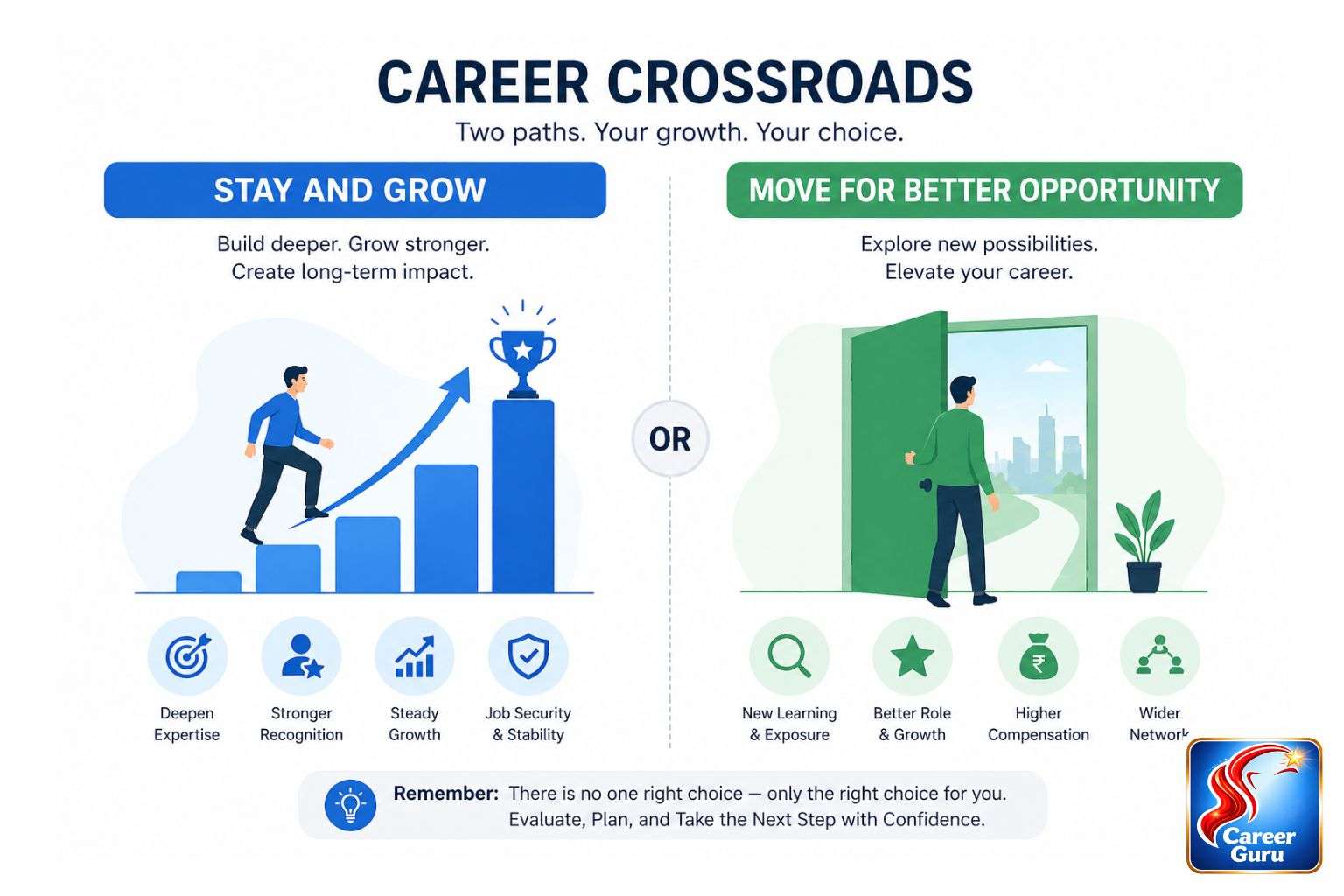
Year Three — The Crossroads Every IT Professional Reaches
By year three, most freshers face the same decision.
Stay and grow within the company. Or move to a new company for a higher salary and a new challenge.
Both are valid. Both have costs. Here is how to think about it honestly.
Stay if: You are getting meaningful work. You have a manager who is investing in your growth. Your salary trajectory feels real. You can see what year four and five look like for you specifically.
Move if: Your salary has not kept pace with the market. Your work has not grown in complexity for more than six months. Your manager gives you no visibility. You have a specific opportunity — not just a slightly higher number — waiting on the other side.
The salary benchmark for a 3-year experienced IT professional in India in 2026 is approximately ₹7 to ₹12 LPA depending on company, city, and tech stack. If you are significantly below that range and your company is not closing the gap — the market is ready to correct it for you.
Moving in year three with 3 years of experience is not disloyal. It is how careers are built in Indian IT. Most hiring managers understand and respect it. What they do not respect is someone who moves every 8 months chasing every small salary bump.
Three years at one company before your first move is a strong story. It shows stability, commitment, and the ability to grow somewhere. Those are all positives.
Consultant’s Note: Do not move just because a recruiter called you. Move because you have thought about it, compared your options, and found something genuinely better — in terms of work, growth, and compensation together. Salary alone is a weak reason. Salary plus better work plus a stronger team — that is a real reason to move.
The Soft Skills That Actually Decide Your Growth in Your First 3 Years
Nobody talks about this directly. So I will.
Technical skills get you hired. Soft skills get you promoted.
In 27 years of watching IT careers, I have never seen a technically weak person get promoted purely on soft skills. But I have seen technically strong people stay stuck for years because of poor soft skills. The combination decides everything.
Here are the specific soft skills that matter most inside an Indian IT company.
Communication — written and spoken. Can you write a clear email? Can you explain a problem to a non-technical stakeholder? Can you speak in a client call without stumbling? These are daily job requirements. They are also the primary things your manager observes between project tasks.
Ownership. Do you own your tasks completely — from start to finish? Or do you hand off at the first obstacle and wait for someone to unblock you? Ownership is the rarest quality in early-career professionals. Managers notice it immediately and reward it consistently.
Learning speed. Technology in Indian IT changes faster than any training programme can keep up with. The professionals who grow fast are the ones who teach themselves — through courses, documentation, peer learning, and practice. If you are waiting for your company to teach you everything, you are already behind.
Professional relationships. I do not mean being popular. I mean being someone people trust to do what they say they will do. That reputation — reliable, communicative, trustworthy — travels faster inside a company than any project achievement.
For a deeper look at the soft skills that specifically separate fast-growing freshers from those who stay stuck, read Why Indian Freshers Fail Interviews Despite Good Grades on cguru.co.in. The same skills that hurt in the interview phase hurt again in years one through three.

What to Do This Week — Your First 3 Years Action Plan
Whether you have just joined or are already one year in — start here.
If you just joined: Go into your first training session tomorrow with one goal. Ask one question. It does not matter how small. Raise your hand. Speak. Be visible from day one.
If you are in months 3 to 6: Schedule a one-on-one with your team lead this week. Ask directly — “What would a strong performance look like in my role over the next three months?” Write down the answer. Work towards it specifically.
If you are approaching your first appraisal: Open a document today and write down everything you have done in the last 11 months that was beyond your basic task. List projects. List problems you solved. List any feedback you received. That document is your appraisal preparation. Make it specific.
If you are in year two: Pick one certification to complete in the next 90 days. Relevant to your project technology. Start this week — not next month. One hour a day is enough.
If you are in year three: Do a salary market check. Go to AmbitionBox and LinkedIn Salary. Compare your current salary to the market range for your role and experience level. If the gap is significant — start planning. Read the fresher salary negotiation guide for how to have that conversation — whether inside your company or at a new one.
Read these alongside this guide:
- How to Negotiate Your First Salary as a Fresher in India
- Why Indian Freshers Fail Interviews Despite Good Grades
- Cloud Computing Career Roadmap for Indian Students 2026
- Full Stack Developer Roadmap for Indian Freshers 2026
- Fresher Job Interview Questions for IT Companies India
- How to Crack Group Discussion in Campus Placements 2026
External resources:
- AmbitionBox Salary Tool — check your market salary by role and experience
- LinkedIn Learning — certifications relevant to your tech stack
- Coursera India — free audit option for most technical courses
- NASSCOM FutureSkills — India-specific tech upskilling platform
FAQs — Your First 3 Years in an Indian IT Company
FAQ 1 — I joined a service company but I am not getting any real technical work. All I do is testing and documentation. Is this normal and will it affect my growth?
Yes. It is normal. And yes — it can affect your growth if you let it.
In large service companies — TCS, Infosys, Wipro, Cognizant, Accenture — freshers almost universally start with support tasks. Testing, documentation, minor bug fixes, data entry for client tools. This is not punishment. It is how large project teams onboard new people without putting critical work at risk.
The problem is not the work you are given. The problem is only if you stay there.
Here is what I tell students in this situation. Do the support tasks excellently. Be the person who catches bugs that others missed. Be the person whose documentation is actually readable. Be the person who submits before the deadline. Build that reputation in the first three months.
Then — and this is the move most freshers miss — go to your team lead and say: “I want to understand the core system better. Can I shadow one of the developers during the next sprint? I will not get in the way — I just want to learn how the pieces connect.”
Nine out of ten team leads say yes to that request. Because it signals maturity, initiative, and a genuine interest in the project — not just in punching out at 6 PM.
After you understand the core system, ask to be assigned one small development task — even a minor one. From there, it builds.
Support work is where most freshers start. Development work is where you go when you have earned the trust. Earn it fast.
Consultant’s Note: The freshers who complain loudest about doing only testing are usually also the ones who have not delivered their testing work reliably. Earn the trust in the work you are given before you ask for the work you want. That sequence works every time.
FAQ 2 — My manager does not talk to me much and I have no idea whether I am performing well or badly. What should I do?
This is very common in large IT teams — particularly in service companies where managers have ten to twenty direct reports. You are not forgotten. You are just not being managed actively.
The fix is simple. You manage up.
Ask your team lead for a 15-minute monthly one-on-one. Frame it as “I want to make sure I am working on the right things and heading in the right direction.” Most team leads will say yes — it takes 15 minutes and it makes their job easier.
In that meeting, do three things. First — share what you completed since the last check-in. Be specific. Second — mention what you are currently working on and whether you have any blockers. Third — ask one question about how you can do your current work better.
That is the entire meeting. It takes 10 minutes. It puts your name in your manager’s mind in a positive context every single month.
The freshers who do this consistently are never the ones who are surprised by their appraisal rating. They know exactly where they stand because they kept that channel open all year.
Consultant’s Note: Nobody is going to chase you to give you feedback in a large IT company. The system is too big and your manager is too busy. Build the feedback loop yourself. Ask for it. Create it. Own it.
FAQ 3 — Should I do additional certifications while working and will my company pay for them?
Yes to both parts of this question — with some specifics.
Additional certifications in your first three years are one of the fastest ways to separate yourself from your batchmates. A cloud certification — AWS Solutions Architect, Azure Fundamentals, Google Cloud Associate — takes two to three months of part-time preparation. It costs between ₹8,000 and ₹15,000 to write the exam. And it immediately puts your profile in a different category during internal project allocation and external job applications.
Now — will your company pay for it?
Many large IT companies in India have a learning budget or a certification reimbursement programme. TCS has iEvolve. Infosys has Lex. Accenture has its own internal learning platform. Most of these programmes reimburse certification costs either fully or partially — especially for certifications that are relevant to active project technologies.
The catch is that most freshers never ask about these programmes. They either do not know the programme exists or they assume they are not eligible in year one.
Ask your HR or your team lead directly: “Is there a certification reimbursement programme I can access? I want to pursue [specific certification].” The worst answer is no. The best answer saves you ₹10,000 to ₹15,000 and shows your manager you are serious about growth.
If your company does not reimburse — pay for it yourself. The return on a ₹12,000 certification that moves your salary by ₹80,000 in your next appraisal or your next job is not difficult to calculate.
Consultant’s Note: The right certification is not the most impressive-sounding one. It is the one most relevant to the work your current project does or the direction you want your career to go. Relevant certifications get used. Used certifications get noticed. Noticed certifications get rewarded.
FAQ 4 — I am two years in and I feel stuck. My salary has barely moved and my work has not changed. Should I leave or is there something I can do from inside?
This is the hardest question I get from early-career IT professionals. And I want to give you an honest answer — not a motivational one.
First — check whether you are actually stuck or whether you feel stuck.
Stuck means: your salary is significantly below market rate, your manager has no growth plan for you, and your work has not changed in complexity for more than nine months. If all three of those are true — you are probably genuinely stuck.
If only one or two are true — there is usually still something you can do from inside.
If you are genuinely stuck, here is the process.
Have one direct conversation with your manager. Say this: “I want to grow within this team and this company. Can we talk about what a promotion or a more senior role would require and what the timeline looks like?” Give them the chance to respond. Some managers will surprise you. Some will confirm that there is no path available for you right now.
If the conversation confirms there is no path — then you have your answer. The market is ready. Prepare your move properly. Update your LinkedIn. Build your skills on the side. Apply selectively — not desperately. Target roles that offer growth in work quality alongside salary, not just a higher number.
And read the salary negotiation guide before any offer conversation — whether internal or at a new company. Know your market value going in.
Consultant’s Note: Leaving out of frustration without a clear destination is the most expensive career move I see young professionals make. Leave when you have something better to go to — not just something worse to leave from. Those are different motivations and they lead to very different outcomes.
Consultant’s Closing Perspective — Why Your First 3 Years in an Indian IT Company Are Not About Survival
I want to end this guide with something I say to every young professional I work with.
The first three years in an IT company feel long when you are inside them. They feel short when you look back.
What you build in those three years — your reputation, your skills, your professional relationships, your visibility — follows you for the rest of your career. The habits you form in year one are the habits you carry into year five, year ten, year twenty.
The student who was active during training becomes the professional who seeks feedback. The fresher who delivered reliably on small tasks becomes the senior who can be trusted with large ones. The second-year who asked for stretch assignments becomes the team lead who creates stretch assignments for their own team.
None of this is automatic. None of it happens by just showing up.
But it is all entirely within your control.
You do not need to be the smartest person on your team. You do not need a famous college name or a perfect CGPA to build a strong career in Indian IT.
You need to show up with intention. Every day. For three years.
That is all.
The career you want is built one year at a time — starting right now.
Written by Aslam Rahman — IT Career Consultant with 27 years of experience in IT hiring, fresher placement strategy, and career guidance for Indian students. Based in Bhubaneswar, Odisha. Founder of Career Guru — cguru.co.in.







6 Comments