
Government Jobs vs IT Jobs in India in 2026 — A 27-Year IT Career Consultant Gives the Honest Answer He Gives His Own Students When They Cannot Decide
This is the most personal career decision most Indian families face. After 27 years of guiding students through it, here is the complete, honest comparison — money, stability, growth, family pressure, and what nobody tells you about either side.
Government Jobs vs IT Jobs in India — The Question That Follows Every Indian Engineering Student Home
Government jobs vs IT jobs in India is not just a career question.
It is a family conversation. A dinner table debate. Sometimes an argument that goes on for months.
On one side — parents who want security. A pension. A government quarter. The respect that comes with saying “my son is in a government job” at a family function.
On the other side are students who have seen their seniors at TCS or Infosys buy bikes in their first year, work on international projects by year three, and switch jobs for double the salary by year five.
Both sides are right about something. Both sides are missing something.
I have spent 27 years in the middle of this conversation. I have guided students who chose IT and thrived. Students who chose government service and built deeply satisfying careers. Students who chose IT, burnt out, and wished they had thought harder. Students who chose government, stagnated, and quietly regretted it.
The honest answer is not “IT is better” or “government is safer.”
The honest answer is — it depends on which version of a good life you are actually trying to build.
This guide helps you figure that out.
I stopped giving a single definitive answer to this question around 2010. A student came to me — brilliant, 8.2 CGPA, clearly capable of clearing any IT campus placement. His father was a retired government teacher. His mother had never worked outside the home. He was the first person in his family who had a real shot at either path.
I asked him — what does your life look like at 45 if everything goes well? He thought for a long time. Then he said: “I want to know what day I am going home. I want to coach my children’s cricket team on Saturdays.” That answer told me everything. IT was probably not his path. Not because he could not do it. Because what he wanted from life did not match what IT would give him in exchange.
What Government Jobs vs IT Jobs in India Actually Means in 2026
Before the comparison, let us be clear about what we are actually comparing.
‘Government jobs’ in this context means central and state government positions filled through competitive examinations — UPSC Civil Services, SSC CGL, IBPS for banking, GATE for PSUs like BHEL, ONGC, NTPC, ISRO, DRDO, and state-level PSC examinations.
IT jobs means private sector technology companies — from large service companies like TCS, Infosys, Wipro, Accenture, HCL, and Cognizant to product companies, funded startups, and mid-size technology firms.
The comparison is not between a clerk’s post and a software engineer. It is between a well-prepared government career and a well-prepared IT career. Both require effort. Both require planning. Neither is a default option.
This matters because I often see students treat government job preparation as the fallback when IT placements do not work out — and IT jobs as the backup when government exams do not crack. Neither attitude produces good outcomes in either path. Both careers reward people who chose them deliberately and prepared for them specifically. Half-hearted preparation for either produces half-hearted results.
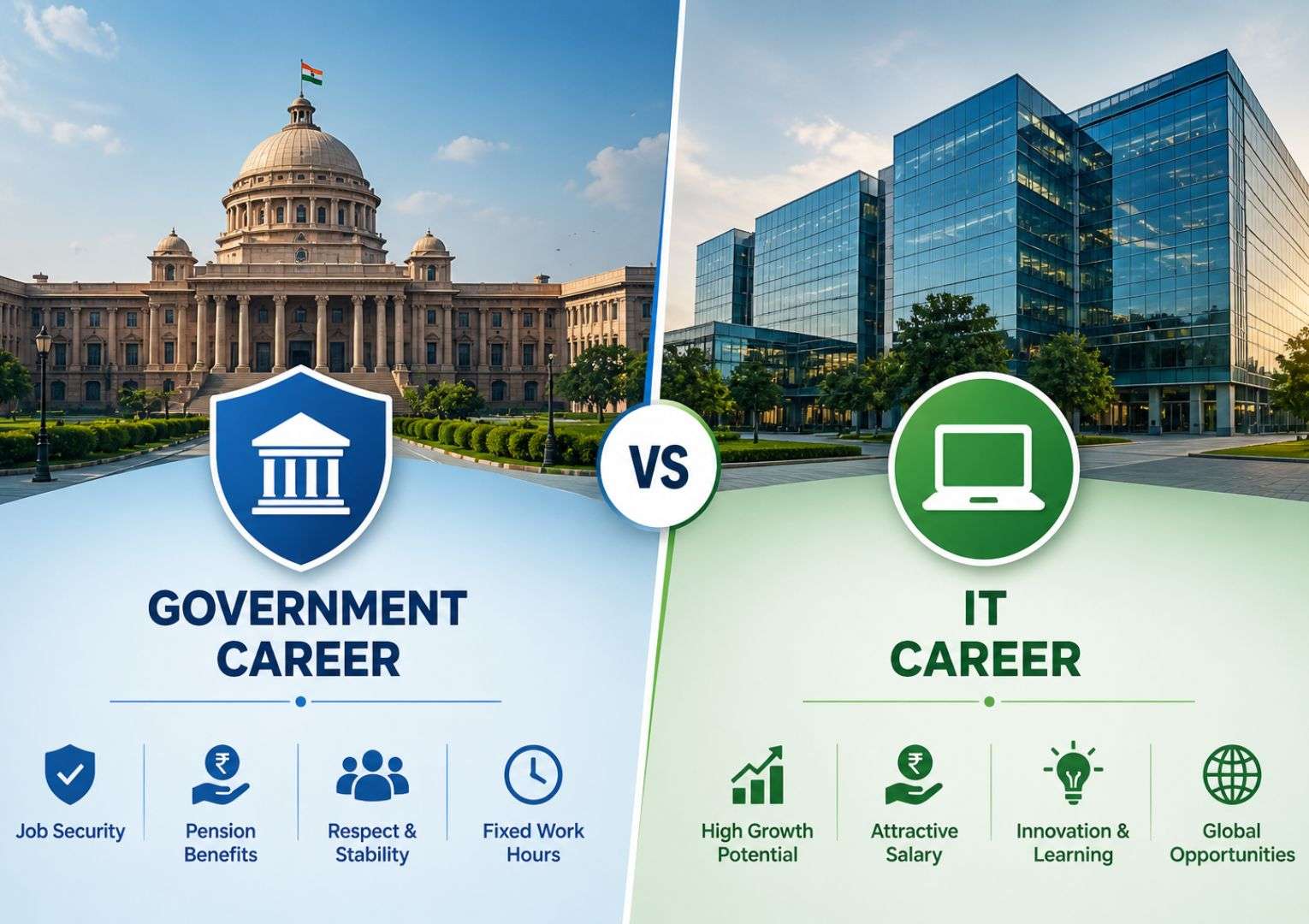
Salary Comparison — Government Jobs vs IT Jobs in India in 2026
Let us start with money. Because pretending it does not matter is not honest.
Starting Salary
IT jobs — fresher starting salary: Large service companies: ₹3.36 LPA (TCS Ninja) to ₹6.5 LPA (Accenture specialist) Product companies and funded startups: ₹6 LPA to ₹15 LPA depending on role and company Average for a reasonably well-placed IT fresher in 2026: ₹4 to ₹5 LPA
Government jobs — starting salary: IAS/IPS (Group A): ₹56,100 basic pay + DA + HRA + other allowances — effective in-hand approximately ₹80,000 to ₹1,00,000 per month in many postings SSC CGL (Group B/C): ₹35,400 to ₹44,900 basic pay — in-hand approximately ₹45,000 to ₹60,000 per month after allowances PSU through GATE (BHEL, ONGC, NTPC): ₹50,000 to ₹70,000 per month CTC in early years IBPS Bank PO: ₹52,000 to ₹55,000 per month including allowances
The honest starting salary picture:
A PSU through GATE or an IAS officer earns more than the average IT fresher in year one — after allowances are counted. A bank PO earns more than a TCS Ninja fresher from month one.
The IT fresher who joins a product company at ₹12 LPA earns more than most government entrants. But that offer requires exceptional preparation and is not the median outcome.
For most average IT freshers at service companies — government starting salaries, when allowances are included, are actually comparable or higher.
This surprises a lot of students when I show them the numbers. The assumption is always that IT pays more. At the starting point, for the median candidate, that assumption is often wrong. Where IT genuinely and decisively wins is in salary growth after year three. That is the real comparison.
Salary Growth Over 10 Years
This is where the picture changes fundamentally.
IT career — salary trajectory: Year 1: ₹4 to ₹5 LPA Year 3: ₹7 to ₹12 LPA (with job change or internal promotion) Year 5: ₹12 to ₹20 LPA (with consistent growth and one job change) Year 10: ₹20 to ₹50 LPA for a reasonably strong performer — significantly higher for specialists in AI, cloud, or product management
The jump from year 3 to year 5 in IT is the most dramatic income shift most professionals experience in any career. It is driven by market demand, skill premiums, and the leverage of having one company’s offer to negotiate against another.
Government career — salary trajectory: Year 1: ₹50,000 to ₹1,00,000 per month depending on position Year 5: Pay commission revision + increments — roughly 10 to 15% improvement on base Year 10: Senior grade pay — significant jump in allowances but the base salary growth is structured and slower
Government salaries grow through Pay Commission revisions — which happen every 10 years — and annual increments. The growth is predictable. It is also slow compared to IT.
The 10-year verdict on salary:
IT wins — decisively — for high performers who manage their career actively. The ceiling in IT is dramatically higher than in government service.
Government wins for average performers who want a guaranteed, predictable income with no career management effort required.
The critical word is “average.” In IT, average performance produces average salary. In government, average performance still produces the full salary, the full pension, and the full benefits.
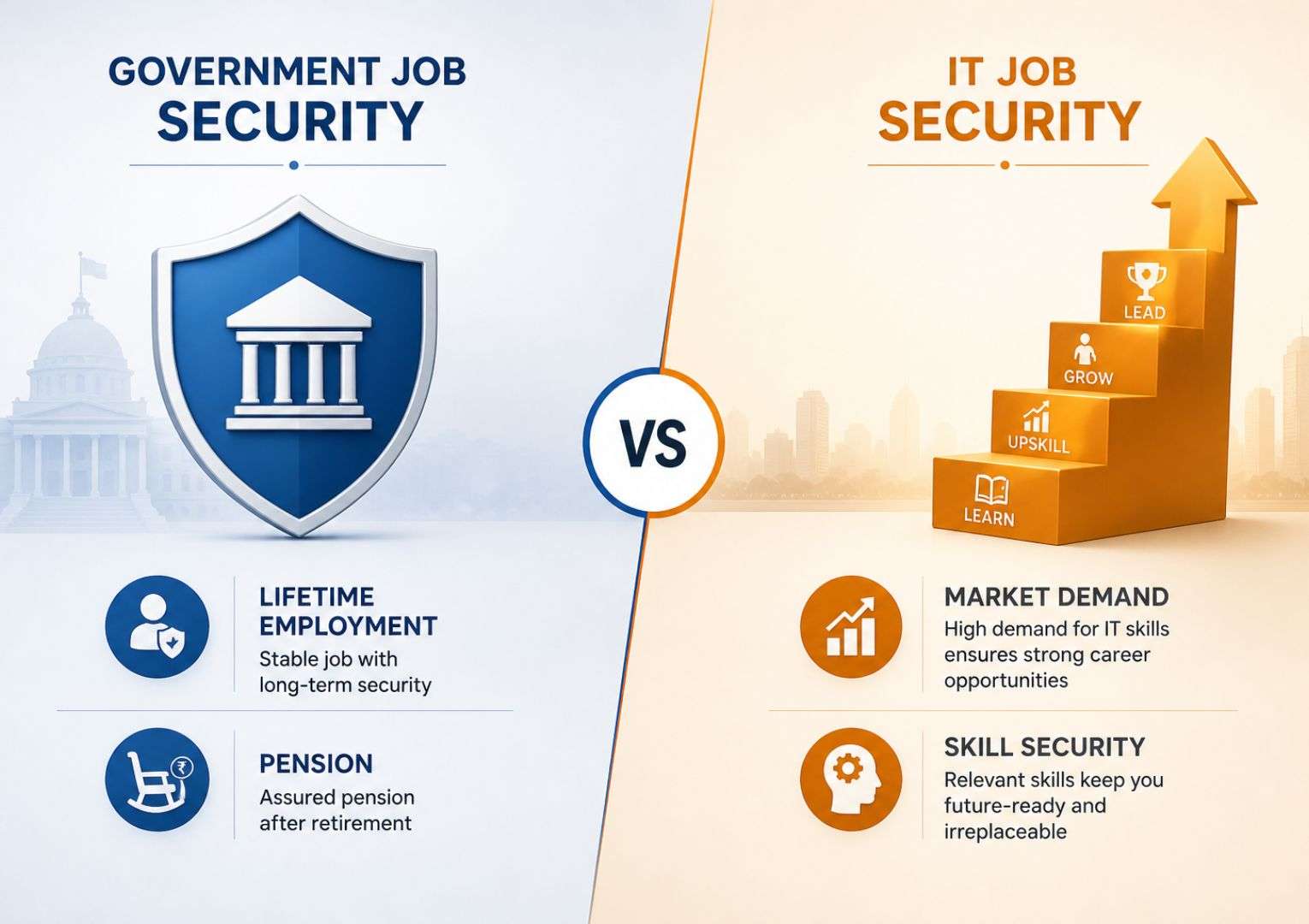
Job Security — Government Jobs vs IT Jobs in India
This is the conversation that dominates most family discussions. And it deserves an honest answer rather than a dismissive one.
Government job security:
A confirmed government employee in India — central or state — is extraordinarily difficult to terminate. The process involves departmental inquiries, legal procedures, and years of documentation. For practical purposes, a government job is lifetime employment for anyone who does not commit a serious misconduct.
The pension — particularly the old pension scheme where it still applies — provides income for life after retirement. This is a guarantee no private sector job in India offers.
I want to be honest about why this matters — because too many IT career advisors wave it away. Pension security is real. For a student from a lower-middle-class family where the parents have no retirement savings, where the family depends on the earning member, where a medical emergency without insurance would be catastrophic — a pensioned government job is not just a preference. It is rational risk management. I do not say this to discourage IT. I say it because the advice has to fit the actual life the student is living, not the life they might have if everything goes perfectly.
IT job security:
IT jobs in India are at-will employment. Companies can and do conduct layoffs — TCS, Infosys, and Wipro have all had reduction exercises in recent years. Startups shut down. Projects get cancelled. Roles get automated.
The honest answer on IT job security is this. The security is not in the company. It is in the skill.
A software professional with current, in-demand skills — cloud, AI, full-stack development, cybersecurity — is never truly unemployed for long. The market demand for strong technical talent in India in 2026 is genuine and ongoing. But that security requires constant upskilling. The moment your skills stop being current, the security erodes.
The security verdict:
Government wins on institutional security — the job itself cannot be taken away.
IT wins on market security — if your skills are current, the market will always have a place for you.
These are genuinely different kinds of security. Know which one matters more to your specific situation.
Work-Life Balance — The Comparison Nobody Talks About Honestly
This one is more complicated than the salary comparison.
Government job work-life balance:
Government jobs — with notable exceptions — offer more predictable working hours than IT roles. A 10 AM to 5 PM working day with defined holidays, earned leave, medical leave, and child care leave is genuinely available in most central government positions.
Field postings — particularly for IAS and IPS officers — are demanding and involve irregular hours, transfers across the state, and significant personal disruption. But desk roles at PSUs and central ministries are genuinely more controlled in terms of hours than most IT jobs.
Government employees also get defined transfer policies, government accommodation in many postings, children’s education allowances, and LTC — leave travel concession — for family travel. These non-cash benefits add up to real quality-of-life value that does not show in salary comparisons.
IT job work-life balance:
This varies enormously by company type.
Large service companies — TCS, Infosys — have relatively structured hours for most roles. Nine to six, Monday to Friday, with weekend work for project deadlines. Overtime is common but not constant.
Product companies and startups can demand much more — particularly in crunch periods before product launches or funding rounds. Twelve to fourteen hour days during critical phases are not uncommon.
Client-facing roles at consulting-adjacent companies — Accenture, Cognizant — can involve travel, client time zones, and deadline pressure that disrupts personal time significantly.
The balance verdict:
Government wins on predictability of personal time — especially for family planning, parental responsibilities, and personal health management.
IT wins on flexibility of work location — remote and hybrid work is now standard across most IT companies in India in a way that government positions simply cannot match.
If you need to know what time you will be home every day — government service delivers that more reliably.
If you need to work from home three days a week — IT delivers that more reliably.
Social Respect and Family Expectations — The Factor Everyone Considers and Nobody Admits To
Let me say something directly that most career guides avoid.
Social respect matters. Family expectations matter. Pretending they do not is advice that floats above the reality of how most Indian families actually function.
A government job — particularly an IAS, a PSU position, or a bank officer role — carries social weight in India that an IT job does not. At family gatherings, at weddings, in matrimonial conversations — “he is in government service” or “she is a bank officer” still carries more social currency in large parts of India than “he is a software engineer at TCS.”
This is changing in urban areas. In cities like Bengaluru, Hyderabad, Pune, and Chennai — IT careers are fully socially normalised and respected. In smaller cities and towns — including many in Odisha, Bihar, Rajasthan, and UP — government service still holds the highest social position.
I am based in Bhubaneswar. I see this directly. A student who joins NALCO or NTPC through GATE is celebrated differently by his extended family than a student who joins Wipro — even if the Wipro student earns more. This is not something to be ashamed of or dismissed. It is something to factor in honestly when you are deciding a path you will live with for decades. The approval of people who matter to you is a real input into life satisfaction. Include it consciously — do not pretend it does not exist.

Career Growth — Government Jobs vs IT Jobs in India
Government career growth:
Government career growth follows a defined seniority ladder. Promotions happen through departmental examinations, seniority, and annual performance ratings. The timeline is largely fixed — you know roughly what position you will hold at year five, year ten, year fifteen.
This predictability is comforting to some. To others it feels like a ceiling.
The exception is lateral mobility through competitive examinations — an SSC CGL officer who clears UPSC, or a PSU engineer who moves to a higher-grade PSU through a GATE score improvement. These jumps are possible but require the same preparation intensity as the original examination.
IT career growth:
IT career growth is entirely market-driven and self-managed. There is no fixed timeline. A strong performer can reach a senior role in four years. An average performer can stay at the same level for eight.
The ceiling in IT is genuinely high. Product managers, engineering managers, and senior architects at top product companies earn ₹50 to ₹1 crore annually within 10 to 15 years of starting. That ceiling simply does not exist in government service.
The floor in IT is also lower. A government employee in their tenth year has a defined salary regardless of performance. An IT professional at year ten who has not managed their skills and career actively may find their salary and role stagnating in a way government service protects against.
For a deeper look at how to manage IT career growth actively, the First 3 Years in an Indian IT Company guide on cguru.co.in covers exactly this.
The Preparation Reality — What Each Path Actually Demands
This section matters more than most students account for.
Preparing for government jobs:
UPSC Civil Services — two to three years of dedicated preparation for most candidates. The failure rate across all attempts is over 99%. This is not an exaggeration. UPSC declares approximately 900 to 1000 selections per year from over 500,000 applicants.
GATE for PSUs — six months to one year of focused preparation. More achievable than UPSC but still highly competitive. Top PSUs like ISRO and DRDO have cutoffs that require near-perfect GATE scores.
SSC CGL and IBPS — three to six months of focused preparation for a reasonably strong candidate. More accessible than UPSC and GATE in terms of preparation volume.
The hidden cost of government preparation:
The years spent preparing are years of zero income. For a student whose family needs financial contribution, this is a real cost. A student who spends three years preparing for UPSC and does not clear it has also missed three years of IT salary growth and career momentum.
I have watched students from financially stressed families spend three years preparing for UPSC, not clear it, and then struggle to re-enter the IT market because their skills are three years behind their peers. That outcome is painful to watch. It does not mean government preparation is wrong. It means the decision needs to account for the family’s financial reality — not just the student’s ambition.
Preparing for IT jobs:
Campus placement preparation — three to six months of structured preparation for aptitude, coding, and interviews. More immediately accessible than government examination preparation.
For a full preparation roadmap for IT placements, read the Fresher Resume guide, How to Answer Tell Me About Yourself, and the company-specific guides on cguru.co.in.

Who Should Choose Government Jobs — And Who Should Choose IT Jobs in India
Let me be direct. After 27 years, here is what I have consistently seen.
Government service tends to be the better fit if:
You genuinely value stability over growth speed. Not as a compromise — as an actual preference. Some people sleep better knowing exactly what tomorrow looks like. That is not weakness. That is self-knowledge.
Your family has immediate financial dependence on you and cannot sustain three to four years of low or zero income during preparation.
You want your work to have a direct, visible impact on public systems — infrastructure, policy, education, healthcare at scale. That satisfaction is real and not available in IT.
You value predictable personal time more than income growth. If coaching your child’s cricket team on Saturdays matters more to you than a promotion — as one of my students told me — government service is probably the honest answer.
You are from a social context where government job respect matters deeply and the psychological cost of going against that would be genuinely high.
IT tends to be the better fit if:
You are genuinely energised by technology – building things, solving problems, learning new tools. Not because it pays well. Because the work itself interests you.
You are comfortable managing your own career actively – upskilling, networking, and making lateral moves. IT rewards self-directed professionals. It does not carry anyone.
You have an appetite for income growth that compounds significantly faster than government increments — and you are willing to put in the work that growth requires.
You are comfortable with uncertainty — in job security, in project scope, in organisational changes. Some people find this energising. Others find it exhausting. Know which one you are.
You want geographic flexibility — to work remotely, to work from different cities, to potentially work internationally.
Can You Do Both — The Parallel Preparation Strategy
Yes. And for the right student, this is the smartest approach.
IT campus placements happen in the final year of engineering. Government examination results take one to three years. These timelines do not completely overlap.
A student who clears campus placements, joins an IT company, and simultaneously prepares for GATE or SSC CGL while working is not being indecisive. They are being strategic.
An IT salary during government preparation funds the preparation itself. It eliminates the financial pressure that derails so many full-time UPSC and GATE aspirants. And if the government examination does not work out after two genuine attempts, the IT career is already underway.
This strategy requires honesty with yourself about bandwidth. Preparing for GATE while working in IT is demanding. It requires early mornings, structured study, and genuine commitment. It is not for everyone.
But for the student who has a genuine pull toward government service and needs financial stability to pursue it — joining IT first and preparing alongside is a real and viable path.
I have seen this work beautifully. A student joins TCS at ₹3.6 LPA. Spends two years preparing for GATE in the mornings before work. Clears GATE in the second attempt with a score that gets him into NTPC. Joins at ₹60,000 per month with pension. The IT experience actually made him a stronger engineering candidate. Both years of IT salary funded his preparation without any family financial strain. That outcome required planning. It did not happen accidentally.

What to Do This Week — Your Decision Action Plan
Whether you are trying to decide or have already decided, here is what to do right now.
If you are still deciding:
Write down the answer to this question honestly — what does your life look like at age 45 if everything goes well? Not your salary. Your actual day. Who is around you? What does your work involve? What time do you come home? That picture will tell you more than any salary comparison.
Then write down your family’s financial reality. Can you afford two to three years of zero income if you go the government preparation route? If not — what is the plan?
If you have decided on government service:
Start preparation this week — not next month. Identify which examination — UPSC, GATE, SSC CGL, IBPS — and find the syllabus today. Read one relevant topic for 30 minutes this evening. Identify one coaching programme or online resource to follow consistently.
If you have decided on IT:
Start your placement preparation immediately. Read the Fresher Resume guide. Register on the careers pages of TCS, Infosys, Wipro, Cognizant, Accenture, and HCL today. Start the company-specific preparation guides on cguru.co.in.
If you want to try both:
Clear IT placements first. Join a company. Stabilise financially. Then begin government examination preparation in a structured, time-boxed way — two hours every morning, six days a week. Give yourself two genuine attempts. Then make a final decision.
Read these alongside this guide:
- Your First 3 Years in an Indian IT Company
- How to Write a Fresher Resume for IT Companies in India 2026
- How to Answer Tell Me About Yourself in an IT Interview
- How to Negotiate Your First Salary as a Fresher in India
- Cloud Computing Career Roadmap for Indian Students
- Accenture Hiring Process for Freshers 2026
- HCL Tech Careers for Freshers 2026
- Wipro NLTH Guide for Indian Students 2026
External resources:
- UPSC Official Website — for civil services examination calendar and syllabus
- GATE Official Portal — for GATE 2026 registration and syllabus
- IBPS Official Website — for banking examination calendar
- SSC Official Website — for SSC CGL and other central government examinations
- AmbitionBox — Government vs Private Salaries — employee-reported salary data for both sectors
FAQs — Government Jobs vs IT Jobs in India in 2026
FAQ 1 — My parents want me to do a government job but I genuinely enjoy coding and want to work in IT. How do I have this conversation with them?
This is the most emotionally difficult version of this question. And it deserves a real answer — not just “follow your passion.”
Your parents’ preference for government service almost certainly comes from a genuine place. They have watched people around them lose private sector jobs. They have seen colleagues face medical bills without insurance. They want security for you because they love you. The preference is not irrational. It comes from a different experience of risk than yours.
The conversation works better when you address their actual concern — security — rather than defending your preference — IT.
Instead of “I want to do IT because I enjoy coding,” try “I want to do IT because the skills I build make me employable across many companies — my security is not tied to one employer the way it might feel. And I want to show you that within two years of joining.”
Then back it up. Research the salary. Show them the numbers. Show them that strong IT professionals in India in 2026 are not unemployed between jobs — they are choosing between multiple offers.
And give them a safety net. Tell them you will give IT five years with genuine commitment. If at the end of five years you feel the uncertainty is genuinely unmanageable, you will revisit.
That commitment — five years, full effort — is a more mature conversation than “I just want to do what I like.”
I have mediated this conversation with families dozens of times over 27 years. The parents who eventually support the IT path are almost never convinced by the salary number alone. They are convinced when they see that their child has thought seriously about the risks and has a plan for them — not just enthusiasm. Enthusiasm fades. A plan gives parents something to trust.
FAQ 2 — Is it true that IT jobs are becoming less secure because of AI and automation in 2026 — and does that change the government vs IT comparison?
This is a genuine question and it deserves a direct answer — not a dismissive reassurance.
Yes, AI and automation are changing what IT jobs look like. Certain categories of work — routine coding, basic testing, templated documentation — are being partially or fully automated. Companies are doing more with smaller teams in some areas.
Does this mean IT careers are becoming insecure? Not for the right kind of IT professional.
The demand for software professionals who can work with AI tools, build AI systems, manage cloud infrastructure, secure digital systems, and solve complex product problems is growing — not shrinking. The nature of the work is changing. The demand for skilled professionals is not collapsing.
What is changing is the floor. Basic IT skills — the kind that get you a Ninja-track offer at TCS in 2026 — are more at risk from automation than they were in 2019. The professionals who stay secure are the ones who build skills that AI assists rather than replaces.
Does this shift the comparison toward government service? Slightly — for professionals who do not want to continuously upskill. Government service does not have this pressure in the same way.
But the ceiling comparison remains unchanged. A proactive IT professional who builds current skills will always earn more and have more options than an equivalent-talent government employee over a 15-year career. Automation changes the floor. It has not touched the ceiling.
For the cloud and AI skills that future-proof an IT career, the Cloud Computing Career Roadmap on cguru.co.in is the right starting point.
FAQ 3 — I have already joined an IT company but I am not happy and want to try for government exams. Is it too late and how do I manage both?
It is not too late. Not even close.
Many of the strongest government examination candidates I have seen over the years came from IT backgrounds. Their analytical discipline, their structured problem-solving approach, and — crucially — their financial stability during preparation gave them an advantage over full-time aspirants who were financially stressed.
The practical question is not whether it is possible. It is whether you have the bandwidth to do it seriously alongside work.
Here is the honest framework. Two hours every morning before work — five to six days a week — is enough preparation time for GATE and SSC CGL if used consistently. It is not enough for UPSC, which typically requires six to eight hours daily for most candidates.
For UPSC from an IT job — you will likely need to eventually take a break from work to give the examination the preparation it requires. The question is when. Most people who successfully clear UPSC from IT backgrounds prepare alongside work for one year — building foundation knowledge — and then take one to two years of unpaid leave or resignation for the intensive final preparation phase. The savings from the IT years fund that period.
For GATE and PSU examinations — the timeline is more manageable alongside a full-time job. It requires discipline. It requires giving up some weekends. But it does not require leaving your job.
I know a student who cleared GATE rank 47 in his second attempt — while working full-time at Infosys in Bengaluru. He studied from 5 AM to 7 AM every morning for eleven months. He joined ONGC six months later. His Infosys salary paid his Bengaluru rent and left him money for preparation materials.
That discipline is not rare. It is reproducible. The question is whether you want it badly enough to find those two morning hours every day.
FAQ 4 — Which is genuinely better for a girl — government job or IT job — given safety, transfer postings, and family expectations in India in 2026?
I want to answer this with the same honesty I would give to any student sitting across from me — and that means acknowledging that this question has dimensions that a generic career comparison misses.
Both paths have genuine advantages for women in India in 2026 — and both have real considerations.
Government service advantages for women:
Maternity leave provisions in central government are significantly more generous than most private companies — 26 weeks of paid maternity leave, with provisions for child care leave beyond that.
Transfer policies, while sometimes disruptive, come with government accommodation in most postings which reduces the housing insecurity that affects many working women in new cities. Government workplaces in established ministries and PSUs tend to have more defined working hours — which matters for women managing dual responsibilities at home and work.
IT advantages for women:
Remote and hybrid work options — now standard across most IT companies — give women significantly more geographic flexibility than most government postings allow. A woman in IT can work from her home city, manage family responsibilities more flexibly, and avoid the transfer disruption that affects government careers. Large IT companies in India have also invested substantially in women’s safety, return-to-work programmes after career breaks, and mentorship networks. The income growth in IT, particularly in product companies, means greater financial independence faster.
What I tell women students who ask me this directly:
The answer depends entirely on what your specific constraints and priorities are — not on a general rule about which path is better for women as a category.
A woman in a city with a strong support system, comfortable with career mobility, who wants income growth and flexible hours — IT is probably the stronger fit. A woman who needs predictable hours, defined maternity protection, and accommodation support in a new posting — government service offers that more reliably. Both are valid. Neither is the automatically correct answer.
In my 27 years I have guided women into both paths successfully. The ones who struggled were not the ones who chose wrong. They were the ones who chose based on what their family expected rather than what they actually needed. That advice applies equally to men — but the family pressure on women to choose the “safer” option is often more intense. Make the decision yourself.
With full information. With the people who matter included in the conversation honestly. That is the best I can offer.
The Last Honest Thing I Want to Say
I want to close this guide the way I close every career conversation when a student asks me government or IT.
Neither path is the right answer for everyone.
But one path is the right answer for you specifically — if you are honest about what you value, what your family needs, what your risk tolerance actually is, and what your daily life should feel like at 40.
The students I have watched struggle most are not the ones who chose wrong. They are the ones who chose without thinking — who drifted into IT because everyone else was doing campus placements, or drifted into government preparation because their parents expected it — without ever asking themselves what they actually wanted.
Government jobs vs IT jobs in India is not a debate with a winner.
It is a mirror.
Look into it honestly. The answer is already there.
Written by Aslam Rahman — IT Career Consultant with 27 years of experience in IT hiring, fresher placement strategy, and career guidance for Indian students. Based in Bhubaneswar, Odisha. Founder of Career Guru — cguru.co.in.