
Manual Testing Jobs for Freshers in AI Era – Is Testing Dead? A 27+ Years Career Mentor’s Honest Guide (2026)
Manual testing jobs for freshers in AI era is a search full of fear right now. One number sits behind most of it.
Sixty-five percent.
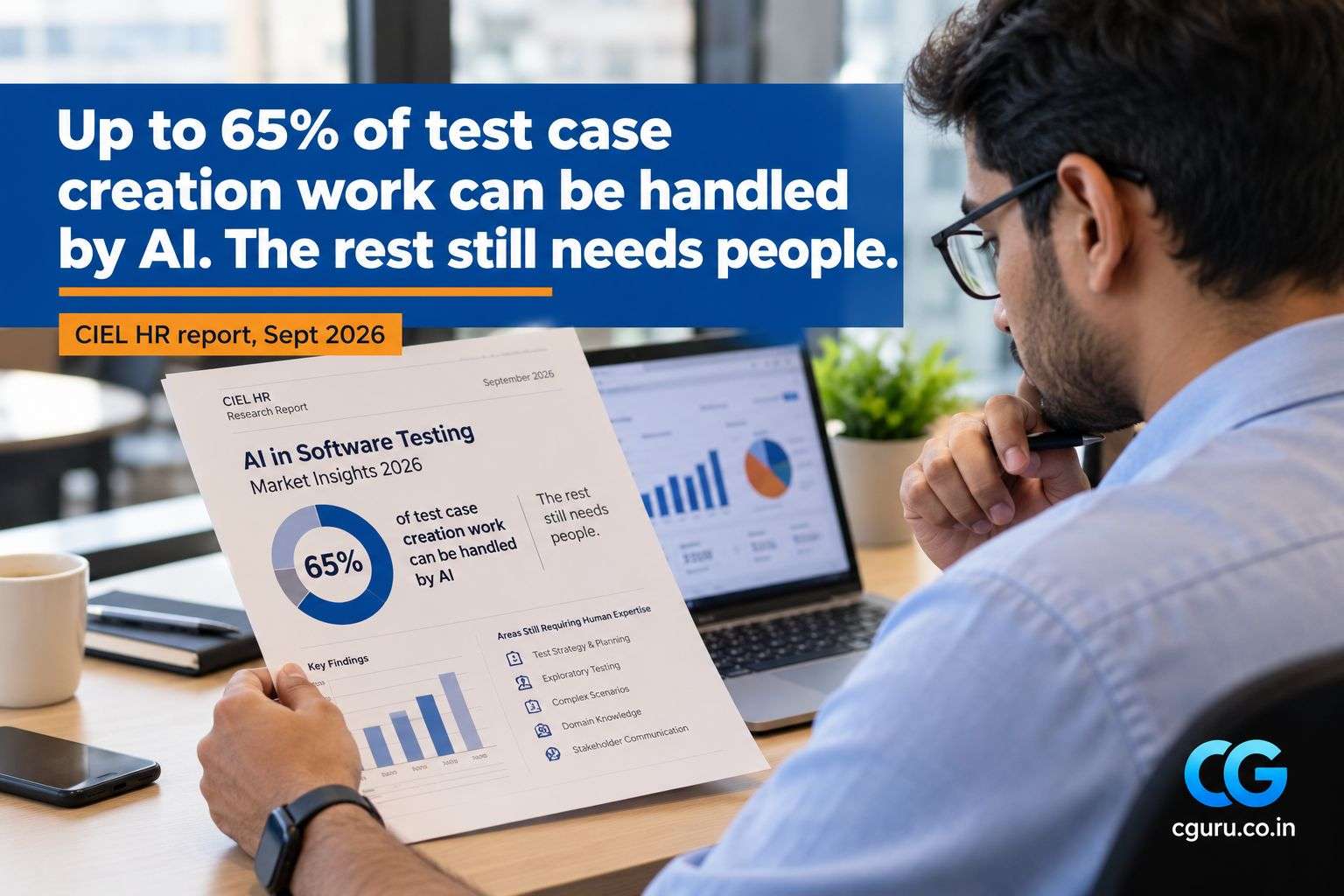
A report released in September 2026 says AI can handle up to 65 percent of the workload in test case creation. If you just joined a testing team, or you are about to, that line hits hard. I understand why.
Now read the next line of the same report. It says the remaining work still needs humans.
That gap is what this blog is about. I call it the manual testing jobs for freshers in AI era question. I have mentored BTech students for 27+ years. I have watched testing change many times. New tools arrive. Headlines say testing is finished. Then the job changes shape and people adapt.
Here is my honest view of manual testing jobs for freshers in AI era. Some parts of the job are shrinking. Other parts are growing. You need to know which is which. And you need a plan for the next 90 days.
I traced every number in this blog back to its source. I also tell you where a number is weak.
What the Report Really Says About Manual Testing Jobs for Freshers in AI Era
The report comes from CIEL HR, an HR solutions provider. PTI carried the story. Outlook Business published it on 8 September 2026. It looked at job postings and professional profiles from March 2024 to May 2026.
Here is what it says about our topic.
AI can handle up to 70 percent of the workload in ticket resolution and report generation. It can handle up to 65 percent in test case creation. The report places support, reporting and manual quality assurance among the functions with the highest potential for task-level automation. It also says the remaining workload still needs human involvement.
Now look at three small words. “Up to”. “Task-level”. “Remaining”.
“Up to” is a ceiling. It is not an average. “Task-level” means pieces of a job, not the whole job. “Remaining” means there is work left for people.
The article gives no number for jobs lost. So if someone tells you 65 percent of testers will lose their jobs, they are reading something the report did not say.
The same report shows where hiring is growing. Demand for engineers who build AI systems that act on their own rose 260 percent in 2026 compared with last year. The report also lists growth for AI solution designers, AI product owners and the engineers who run AI systems in production.
Companies are not hiring less. They are hiring for different skills. That is the real message behind the manual testing jobs for freshers in AI era headlines.
Which Tasks AI Takes First in Manual Testing Jobs for Freshers in AI Era
Let me explain in simple words. Testing has two kinds of work.
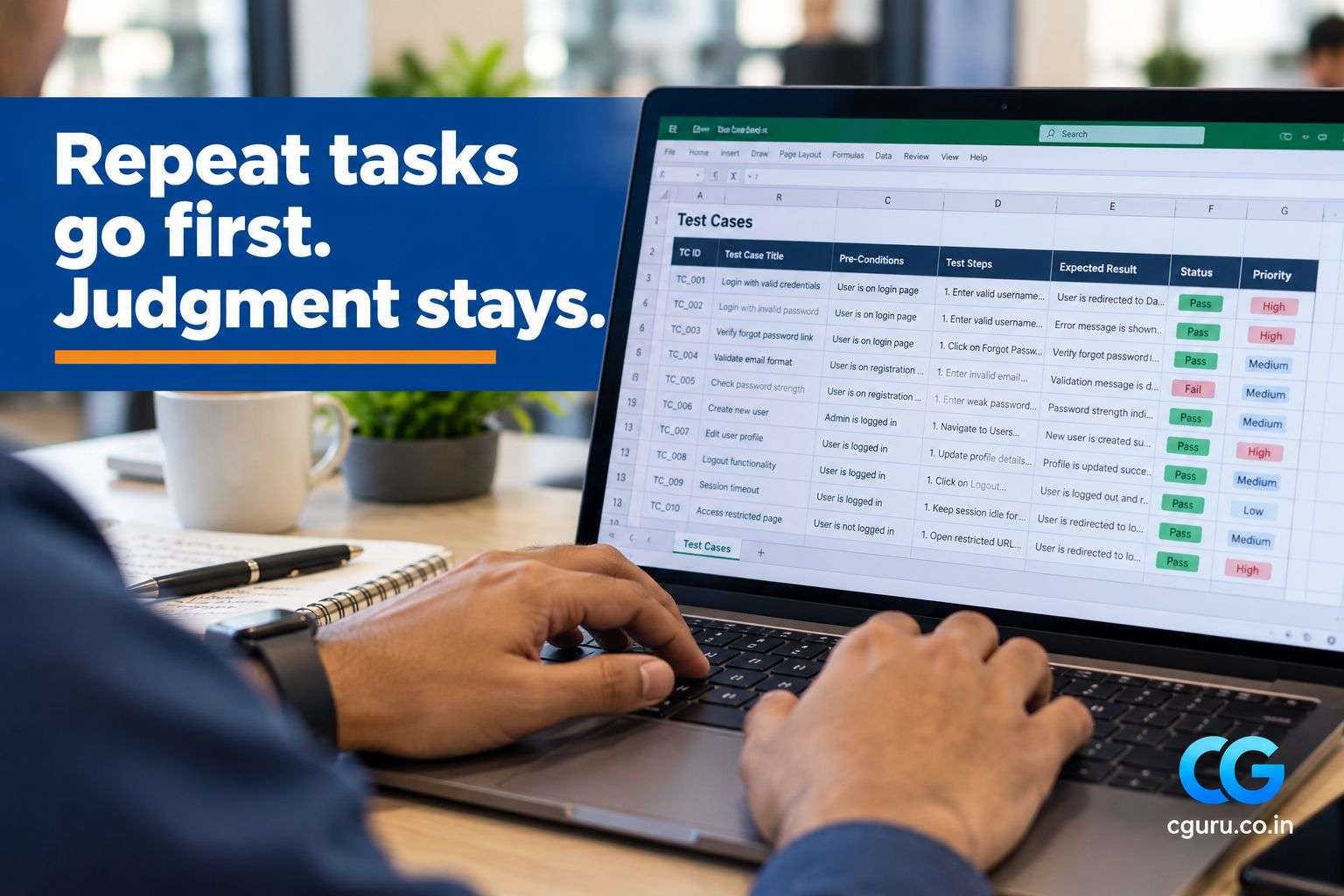
The first kind repeats. You run the same steps after every new release. You check the same fields. You write the same type of report. Checking that old features still work after a change is called regression testing. Machines are good at this.
The second kind needs thinking. You wonder how a real user might break the app. You notice that a screen feels wrong, even when it technically works. You ask why the requirement says one thing and the business needs another. Machines struggle here.
Katalon is a testing software company. In its July 2026 analysis of its own survey, it lists what AI is taking first. Scripted regression runs. Basic checks on form fields. Quick smoke tests after a new build. A smoke test is a short check that the main paths work. And test documents written from clear requirements.
Notice the pattern. Every item is a repeat task with a known right answer.
So here is the line I tell students. If your whole job is running pre-written test cases and marking pass or fail, that part is at risk. The tester is not at risk. The task is.
The same survey says 45 percent of teams already automate regression testing. That tells you where manual testing jobs for freshers in AI era pressure is highest.
Why Manual Testing Jobs for Freshers in AI Era Are Not Disappearing
Fear needs balance. Worry about manual testing jobs for freshers in AI era is fair, but the data has another side. Here it is, with sources.
Katalon’s State of Software Quality Report 2025 surveyed more than 1,400 QA professionals. QA means quality assurance, the team that protects software quality. It found three things.
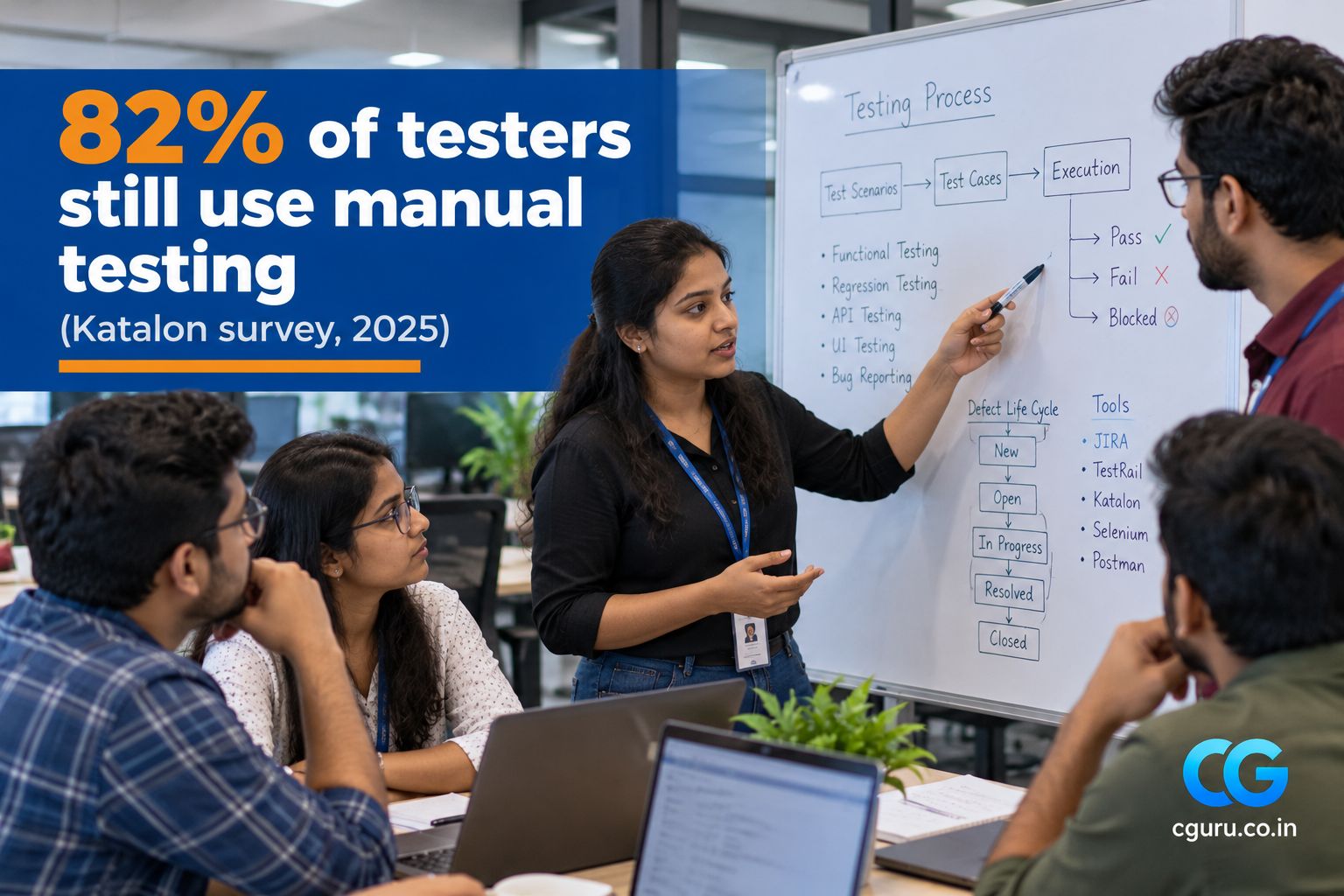
- 82 percent still use manual testing in their daily work.
- 82 percent say AI skills are critical to the future of testing.
- Only 20 percent are very worried about AI taking their job.
Only 11 percent of teams have reached the most advanced stage of testing maturity. Most teams are still building their process.
Two cautions. Katalon sells testing tools. And the survey covers North America, Europe and Asia-Pacific, not only India. Use it as a signal, not as a promise.
PractiTest runs a yearly survey too. Its 2025 report came out in January 2025. It found that 45.65 percent of respondents had not yet brought AI tools into their testing. A year earlier that figure was 60 percent. So adoption is rising fast. The same report found that large testing teams grew from 17 percent to 30 percent in two years. PractiTest also sells testing software. Still, two surveys from two sellers point the same way. Many teams were early in this change. The gap is closing.
Now think about the other direction. AI writes more code. Who checks it?
CodeRabbit sells code review tools. It studied 470 open-source pull requests. A pull request is a set of code changes sent for review. AI-written changes had about 10.83 issues each. Human-only changes had 6.45. That is about 1.7 times more. The Register reported the study in December 2025. It is a small study from a company with a product to sell. CodeRabbit itself admits it cannot be sure every human-labelled change was written only by humans. The same article notes that other studies reached different results. So I would not build a career on one study. But the direction makes sense. More AI code means more checking work.
One more point. Gartner forecasts that 80 percent of enterprises will use AI-assisted testing tools by 2027, up from about 15 percent in 2023. Tricentis, a vendor, shares this forecast. It is a forecast, not a fact. But it tells you what employers will expect. They will expect testers who can work with these tools.
What Changes Inside the Job for Manual Testing Jobs for Freshers in AI Era
Let me split it in two.
What is shrinking. Running the same checklist every release. Typing test cases line by line from a clear requirement. Writing basic bug report text. Copying results into sheets.
What is growing. Exploratory testing. This means testing without a script, by thinking like a user. Katalon found 44 percent of teams use it. API testing. This means checking the back end that sits behind the screen. Reading automation results. You must tell a real failure from a flaky one. A flaky test fails sometimes for no real reason. Reviewing requirements before coding starts. Checking AI-written work. And testing AI features themselves, like chatbots.
That last one is new. ISTQB is the global body for testing certification. It now has two AI paths. One covers testing with generative AI. The other covers testing AI-based systems. I come back to them below.
Katalon calls the new profile a “hybrid tester”. Someone who mixes manual judgment, automation and AI tools. I like the idea. A fresher who builds this mix early has a head start.
Manual Testing Jobs for Freshers in AI Era vs Application Support — Where Each Fits
I have already written a full guide on the application support route. Read it here: [Application Support Engineer guide — ADD LINK]. This blog stays on testing.
Here is the short difference. A tester looks for problems before the software goes live. A support engineer handles problems after it goes live.
The same report put ticket resolution at up to 70 percent. So support work faces the same pressure. The good news is that the fix is almost the same for both roles. SQL, tool skills and AI skills help in both.
Five Skills That Protect Your Place in Manual Testing Jobs for Freshers in AI Era
These five skills answer the manual testing jobs for freshers in AI era question better than any certificate does.

1. SQL. SQL is the language you use to ask a database questions. A tester uses it to check that saved data is correct. Learn SELECT, WHERE, JOIN and GROUP BY. Two weeks of daily practice is enough to start. This free freeCodeCamp video is a solid base: SQL Tutorial — Full Database Course for Beginners.
2. API testing with Postman. An API is how two programs talk to each other. Testing it means checking the back end without any screen. Postman is a free tool for this. This freeCodeCamp course covers requests, tests and automation: Postman API Tutorial. It was published in 2021, so screens may look a little different today. The ideas have not changed.
3. One automation tool. Pick one. Playwright or Selenium. Look at ten job posts in your city. See which one they name. Then learn that one well. The ideas carry over. This one-hour freeCodeCamp course from March 2026 uses Playwright and shows where AI tools fit: Software Testing with Playwright. You will need basic coding too. Read my guide on Python vs Java vs C++ for Indian students to pick a language. Learn enough to read and edit a 50-line script.
4. AI tools, used with care. Ask an AI assistant to draft test cases for a login page. Then review each one. Add what it missed. Delete what is wrong. Keep notes on its mistakes. That review habit is the skill. Employers pay for the person who catches the error. They do not pay for the person who pasted the output.
5. Clear writing and sharp questions. A good bug report lets a developer fix the problem without calling you. A good question in a requirement meeting prevents ten bugs. AI can draft both. It does not know your product’s business rules.
Certification. Start with the ISTQB Foundation Level. The generative AI specialist exam needs it first. ISTQB approved that syllabus in July 2025 and released version 1.1 in 2026. It covers prompts, risks and checking AI output in testing. Do it after you have a project, not before. A certificate helps a resume pass the first filter. A project helps you pass the interview. My guide on best certifications for freshers covers the wider picture.
A 90-Day Plan for Manual Testing Jobs for Freshers in AI Era
Every student who asks me about manual testing jobs for freshers in AI era gets this plan. It is simple on purpose.
Days 1 to 21: SQL. One hour a day. Practise on a free sample database. Write 30 queries.
Days 22 to 42: Postman. Test a free public practice API. Write ten test cases. Save them in a collection.
Days 43 to 75: Playwright or Selenium. Automate five flows on a practice website. Login, search, add to cart, checkout, logout. Put the code on GitHub with a clear README. My GitHub profile tips show how.
Days 76 to 90: AI review project. Pick a real website. Ask an AI assistant for test cases. Run them by hand. Mark which ones were wrong or missing. Write a one-page note on what the AI missed.
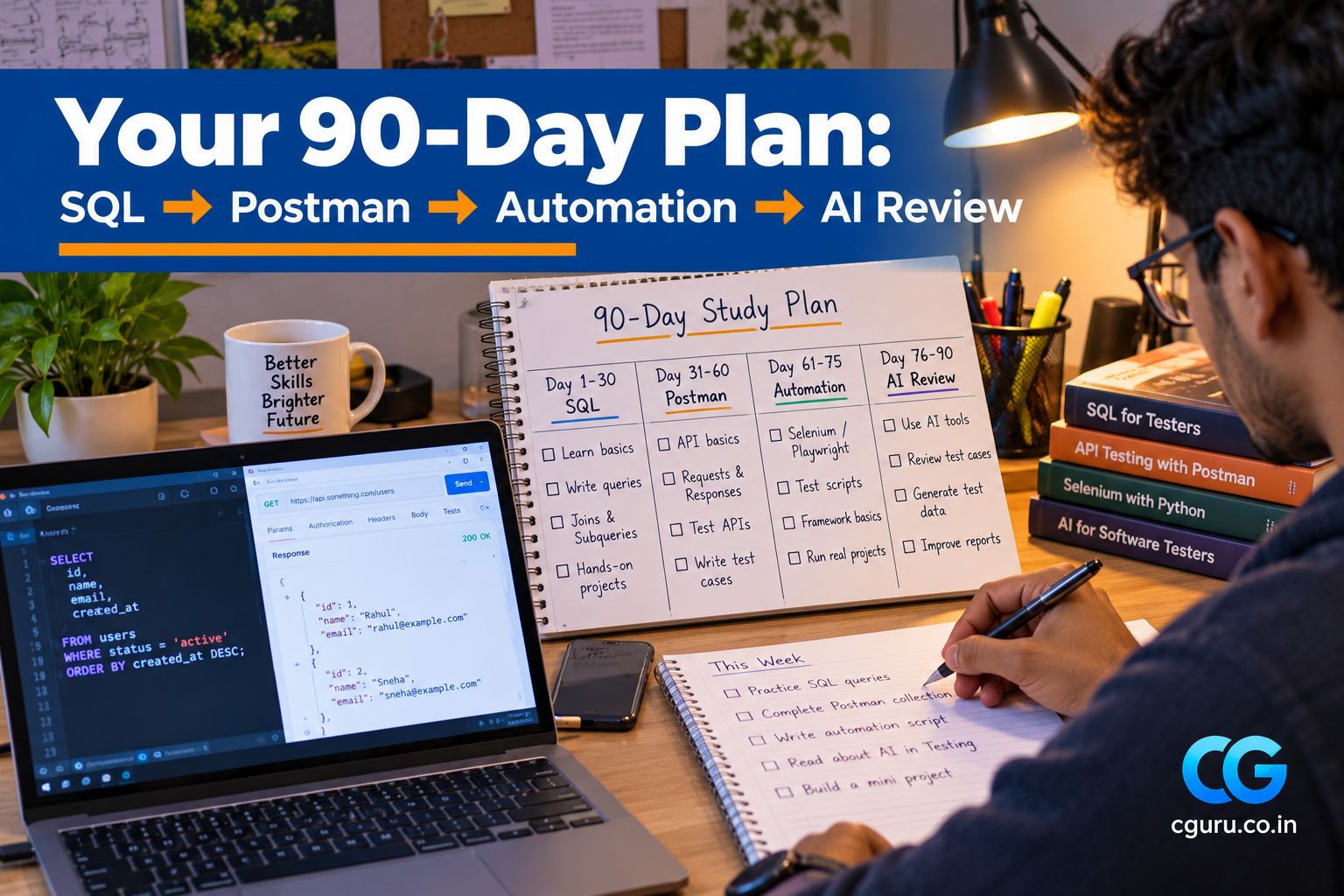
At the end you hold four proof points. SQL, API tests, automation scripts and an AI review note. That is a stronger fresher profile than a certificate alone. It also reads well next to the skills in what employers look for in freshers.
What Testers Earn — Honest Numbers With Honest Limits
I promised to tell you where data is weak. Salary data on manual testing jobs for freshers in AI era is the weakest of all.
AmbitionBox is a salary site built on user reports. It shows fresher pay for junior software testers in the ₹1 lakh to ₹4 lakh per year range. Its page is marked as updated in 2025. Payscale shows an average total pay of about ₹2.47 lakh for testers with under one year of experience. But that figure rests on seven salary reports from older data. Treat both as hints, not facts.
Pay depends on company, city and skills. I could not find a clean, recent public number for the pay gap between manual and automation testers at fresher level. So I will not invent one.
Ask this in every interview. Which tools will I use, and how much of the testing is automated? The answer shows your growth path. For wider context, read my fresher salary guide and the post on in-hand salary vs CTC.
Three Mistakes That Derail Students Chasing Manual Testing Jobs for Freshers in AI Era
Three errors come up again and again when students discuss manual testing jobs for freshers in AI era.
Mistake 1 — Stopping at manual testing. Manual skills are the base. They are not the whole house. Add SQL, API testing and one automation tool.
Mistake 2 — Jumping to tools without testing basics. Some students copy automation scripts without knowing what to test. A script is only as good as the test idea behind it. Learn test design first.
Mistake 3 — Believing either headline. “Testing is dead” is wrong. “AI cannot touch my job” is also wrong. Both give you a reason to do nothing.
Read These Next –
- 📌 Application Support Engineer guide
- 📌 Best Certifications for Freshers in India in 2026
- 📌 Fresher Salary in India 2026
- 📌 Software Engineering in the AI Era 2026
- 📌 Top Tech Skills Employers Look for in Freshers in India 2026
- 📌 GitHub Profile Tips for Indian Students
- 📌 SRE vs DevOps Career for Freshers
FAQs — Manual Testing Jobs for Freshers in AI Era
FAQ 1 — Is manual testing dead in the AI era, and will freshers still get hired for manual testing jobs in 2026?
Manual testing is not dead. But it is changing. Manual testing jobs for freshers in AI era worries are fair, and the data tells a mixed story. The CIEL HR report says AI can take up to 65 percent of test case creation work. It also says the rest still needs people. Katalon’s survey found that 82 percent of testers still use manual testing every day. Companies still hire testers.
What they want has changed. They want people who can test without a script, check data with SQL and test APIs. They also want people who can use AI tools and check the output. A fresher who only runs written test cases will find fewer doors. A fresher with the added skills will find more.
Consultant’s Note — Read the AI news as a reason to add skills. It is not a reason to quit testing. A student who adds two or three skills from this blog in a few months looks very different from one who waits.
FAQ 2 — Should a fresher learn manual testing first or go straight to automation?
Learn manual testing first, but keep that phase short. You need to know how to design a test case. You need to write a clear bug report. You need to think like a user. Automation without these skills is just copying scripts. A script checks only what you tell it to check.
Spend three to four weeks on the basics. Cover test cases, the bug life cycle and the main types of testing. Then start SQL and Postman while you practise on a real website. Start one automation tool after that. Do not wait for perfect manual skills. Overlap is fine.
Consultant’s Note — On the manual testing jobs for freshers in AI era question, the order matters less than the overlap. The profiles that stand out show both a testing mind and a few tool skills. Aim for that mix.
FAQ 3 — Which should I learn first for manual testing jobs for freshers AI era roles, Selenium or Playwright?
There is no single right answer. Look at ten job posts in your city. See which tool they name most. Selenium has been around longer, so many older teams use it. Playwright is newer, and the freeCodeCamp course in this blog uses it.
Both let you control a browser with code. The core ideas are the same. You find an element on the page. You act on it. You check the result. Pick one and build one small project. Moving to the other later should take far less time than learning the first.
Consultant’s Note — Do not spend a month choosing. Spend that month building. A finished project in either tool beats a half-finished plan to learn both.
FAQ 4 — Do I need to know coding to get a testing job?
For a pure manual role, you may not be asked to code. But those roles are the ones facing the most pressure from automation. The manual testing jobs for freshers in AI era shift hits them first.
Automation roles need coding. You do not need deep coding. You need to read a short script, edit it and run it. Pick Python, Java or JavaScript. SQL counts as a skill too, and many testers use it daily. If coding scares you, start with SQL and Postman. They need very little code. Build confidence there first. Then move to a browser automation tool.
Consultant’s Note — I meet many students who avoid testing automation because they think it needs a software developer’s skill. It does not. Fifty lines of readable code and a clear test idea take you a long way.
FAQ 5 — Can non-CS students from ECE, Mechanical or Civil branches enter testing?
Non-CS students ask me about manual testing jobs for freshers in AI era all the time. The short answer is yes. Many testing and support job posts accept any engineering branch. Read each post to confirm. Your branch can help too. A Civil student may understand a construction app better than a CS student.
An ECE student may understand a telecom or device product better. That domain knowledge is useful when you test software built for that field. You still need the basics. Learn test design, SQL and API testing. Then add one automation tool. My guide on switching to IT from a non-CS branch covers the full path.
Consultant’s Note — Do not hide your branch. Use it. When you tell an interviewer you can test an app for your own field, you give them a reason to pick you over a general candidate.
FAQ 6 — How can I use AI tools in my testing preparation without looking like I just copied the output?
Use AI as a draft maker. Do not use it as an answer maker. Used well, it helps you prepare for manual testing jobs for freshers in AI era interviews. Ask it for test cases on a page you know well. Then review each case by hand. Mark the wrong ones. Mark the missing ones. Keep a simple log. In an interview, explain what the AI got wrong and how you caught it. That shows judgment.
Never put AI output in a resume project if you cannot explain it. An interviewer will ask why, and you need an answer. The CodeRabbit study suggests AI output carries more issues. Checking it is real work.
Consultant’s Note — The review log is your best asset. One page showing where an AI tool failed is worth more in an interview than ten pages of perfect-looking test cases.
FAQ 7 — Is the ISTQB certification worth it for freshers in India?
It can help. For manual testing jobs for freshers in AI era roles, the Foundation Level is the base certificate. It can help your resume pass a first filter at some companies. It will not replace a project. The generative AI specialist exam needs the Foundation Level first. It is newer and focuses on prompts, risks and checking AI output. Take it after you build skills, not before.
Check the exam fee and providers on the ISTQB website. Fees and providers change, and they differ by country. Compare the cost with what you can learn free from the videos in this blog.
Consultant’s Note — A certificate is a door opener. A project is what you talk about once inside. If money is tight, build the project first and add the certificate later.
FAQ 8 — Which is safer for a fresher in the AI era, manual testing or application support?
Neither is safe because of its job title. The report behind the manual testing jobs for freshers in AI era debate covers both roles. It says AI can take up to 70 percent of ticket resolution work and up to 65 percent of test case creation work. Skills protect you, not labels. Testing focuses on quality before release. Support focuses on service after release. If you like finding bugs, lean towards testing.
If you like solving live problems under time pressure, lean towards support. Many support roles include rotational shifts, so read the job post. SQL helps in both. I cover the support route in my Application Support Engineer guide
Consultant’s Note — Do not choose by fear. Choose by what you can stand doing for two years. Then add the same skill stack. It works for both roles.
FAQ 9 — How should a fresher answer “Will AI replace testers?” in an interview?
Give a short, balanced answer. Say that AI will take repeat tasks like regression runs and basic test case writing. Say that testers who add judgment, automation and AI review will stay useful. Then show proof. Say you are learning SQL, Postman and one automation tool. Say you used an AI assistant to draft test cases and then reviewed them.
You can mention the CIEL HR report on manual testing jobs for freshers in AI era. It says AI can handle up to 65 percent of test case creation, and the rest still needs people. Do not argue. Do not sound scared. Stay calm and specific. My guide on fresher interview questions helps you practise.
Consultant’s Note — Interviewers ask this question to see how you think. A calm answer with one real example beats a long speech about the future.
FAQ 10 — Should I join a paid testing course or learn on my own?
Free resources cover most skills in this blog. A good course should reflect the manual testing jobs for freshers in AI era changes, not just an old syllabus. The three videos, a practice website and a free public API are enough to start. A course adds structure and someone who checks your progress.
If you have started and stopped before, that may help. Ask four questions before paying. Does it teach SQL, API testing, one automation tool and AI use? Does it include real projects?
Who teaches it? What placement record can it show with names and dates? If a course teaches only manual testing for three months, skip it.
Consultant’s Note — I never push every student towards a paid course. The skills are the same either way. What changes is whether someone keeps you on track. Know yourself, then decide.
What to Do This Week — Your Action Plan for Manual Testing Jobs for Freshers in AI Era
If you are in first or second year — Start SQL today. Watch the first hour of the SQL video. Write ten simple queries before the week ends. Then pick one app you use daily, like your college portal. Write five test cases for its login page. That is real testing practice, and you can do it without any tool.
If you are in third year — Start Postman this week. Finish the first part of the course. Test a free public API. Write ten test cases. Open a GitHub repository and save them there. Look for testing internships. Add Playwright or Selenium once Postman feels easy. That is how you prepare for manual testing jobs for freshers in AI era interviews.
If you are in final year — Do not start everything at once, especially during placement season. Pick one project you can explain, like your API tests. Revise SQL joins. Write your answer to “Will AI replace testers?” and say it aloud. Apply for testing and support roles together. Continue the 90-day plan on weekends after you join.
If you already work as a manual tester — Ask your team lead which task repeats every release. Automate that one task first. Then show the time you saved. That is the strongest proof you can give.
Manual testing jobs for freshers in AI era will keep changing. Do not wait for the news to settle. Start SQL today. Add one skill every three weeks. In 90 days you will look like a different candidate.
About the author: Aslam Rahman is a 27+ years career mentor based in Bhubaneswar. He founded Career Guru and Rtek Digital Pvt Ltd and works with Rooman Technologies as State Business Partner.
I read all me emails. Any query feel free to write [email protected] or WhatsApp 9777278853.