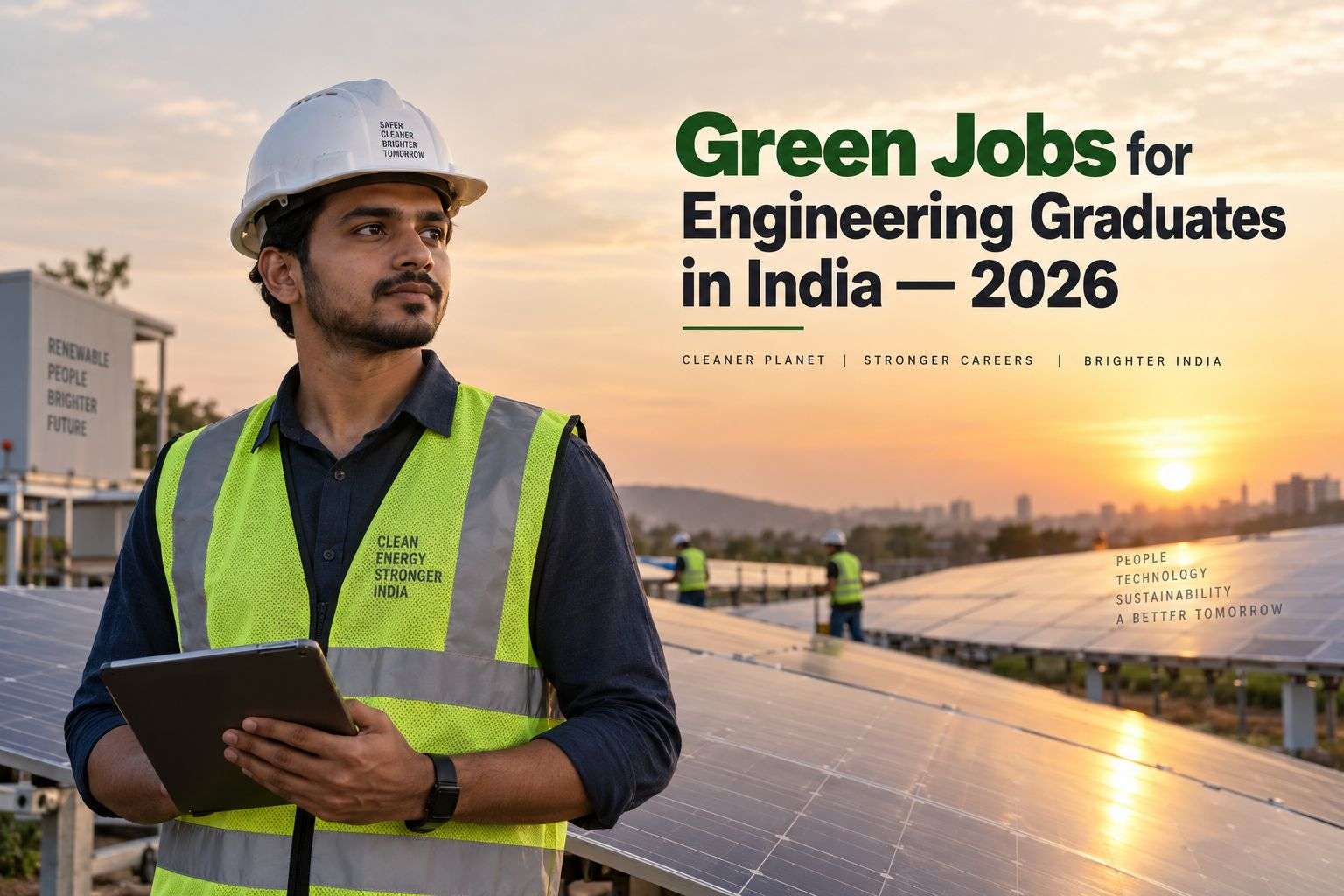
Green Jobs for Engineering Graduates in India 2026-A 27-Year IT Career Consultant’s Honest Guide to Sustainability Careers in 2026
Green jobs for engineering graduates in India are no longer a side conversation in my counselling room. They are becoming the main one. I have spent 27 years telling students which technology wave to bet their first job on, and I want to start this guide with a number that surprised me too.
India already has 1.02 million green jobs, placing the country among the world’s top five for green employment, and industry estimates now put India’s green sector on track to create 7.29 million jobs by FY28. That is not a distant, futuristic promise. It is a hiring wave that is already moving through solar companies, EV manufacturers, and sustainability teams across the country, right now, in 2026.
And yet when I ask engineering students in Bhubaneswar, Cuttack, Rourkela, and Berhampur whether they are preparing for a green career, most of them look at me the way they used to look at me when I first mentioned cloud computing or AI three or four years ago. They assume it is for environmental science students, not for engineers. That assumption is wrong, and this guide is here to correct it honestly.
What “Green Jobs” Actually Means for an Engineering Graduate
Before we go further, let me clear up the confusion I hear most often. Students assume green jobs means planting trees or working for an NGO. It does not.
A green job, in the way India’s own Skill Council for Green Jobs defines it, is any role that has a positive impact on the environment — whether that role sits inside solar power, wind energy, electric vehicles, waste management, or corporate sustainability reporting. Many of these roles are pure engineering roles. They need the same core skills you are already building in your BTech — electrical systems, mechanical design, power electronics, data analysis, and process thinking. The “green” part is the sector, not a different skill set.
This matters because it changes how you should think about your final-year project, your internship choice, and the certifications you add to your resume over the next twelve months.
Why Green Jobs for Engineering Graduates in India Are Growing So Fast
Three forces are converging at the same time, and each one on its own would already be significant.
Government targets are creating real, funded demand. India has committed to 500 GW of renewable energy capacity by 2030 and net-zero carbon emissions by 2070. The National Green Hydrogen Mission alone is expected to create over six lakh jobs by 2030, according to the Skill Council for Green Jobs. These are not vague ambitions sitting in a policy document. They come with budget outlays, PLI schemes, and factories that are already under construction.
Manufacturing is scaling up domestically. The EV battery PLI scheme has committed ₹18,100 crore to build India’s own cell manufacturing capacity, and companies including Ola Electric, Amara Raja, Exide, and Reliance New Energy are now producing battery cells on Indian soil rather than importing them. Every gigafactory that comes online needs battery engineers, process engineers, quality engineers, and plant technicians on day one.
Corporates are legally required to report sustainability data. Since FY2022-23, India’s market regulator has mandated Business Responsibility and Sustainability Reporting for the country’s largest listed companies. That single regulation created an entire hiring category — ESG analysts, sustainability reporting associates, and carbon accounting specialists — almost overnight, and demand for that talent has only grown since.
Put these three together and you get a labour market that needs engineers, not just environmentalists.
Green Jobs for Engineers — The Roles That Actually Exist in 2026
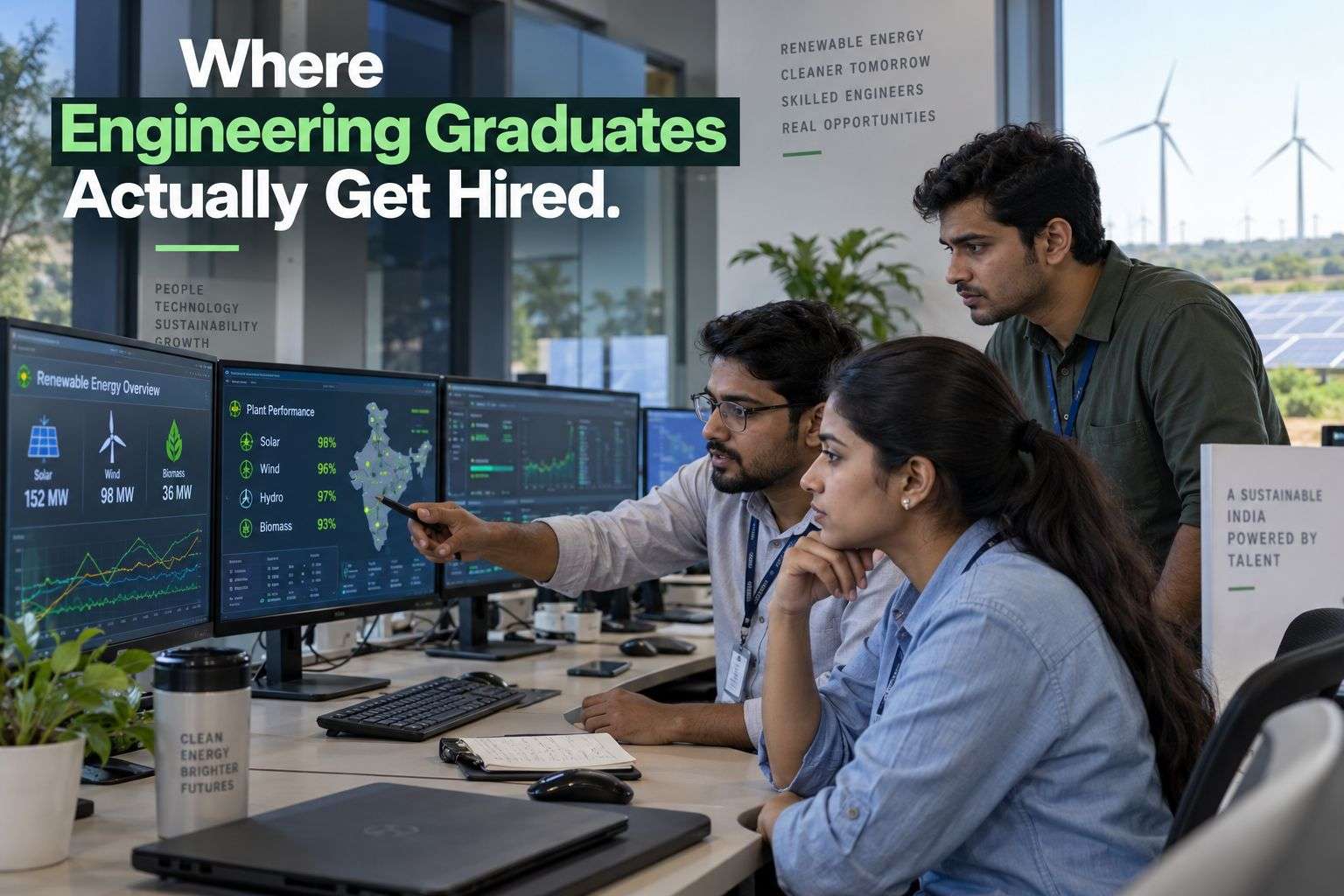
Let me walk you through the roles I actually see engineering freshers getting hired into, branch by branch, honestly.
Solar Design Engineer. You design photovoltaic systems — panel layout, cabling, inverter sizing, and shading analysis. This is the most common entry point for Electrical and Electronics graduates. Fresher salaries typically run ₹3.0 to ₹5.5 LPA at design and EPC firms, rising quickly with two to three years of hands-on project experience.
Solar PV Installation and Site Engineer. More hands-on, more field-based. You oversee installation quality, run commissioning tests, and troubleshoot on-site issues. Fresher pay is generally ₹2.5 to ₹4.8 LPA at solar EPC companies, with faster growth for engineers who also pick up energy-yield software skills.
Wind Energy Engineer. Covers turbine performance analysis, maintenance planning, and grid integration work. Mechanical and Electrical graduates fit naturally here. Entry salaries sit around ₹3.5 to ₹6.0 LPA.
Battery Systems Engineer (EV). This is where the real premium sits right now. You design battery packs, build thermal management systems, and write battery management system logic. Entry-level pay at Tier 1 EV and battery companies runs ₹6 to ₹14 LPA — genuinely comparable to a strong software engineering offer, and it is open to Electrical, Electronics, Instrumentation, and even Mechanical graduates with the right project experience.
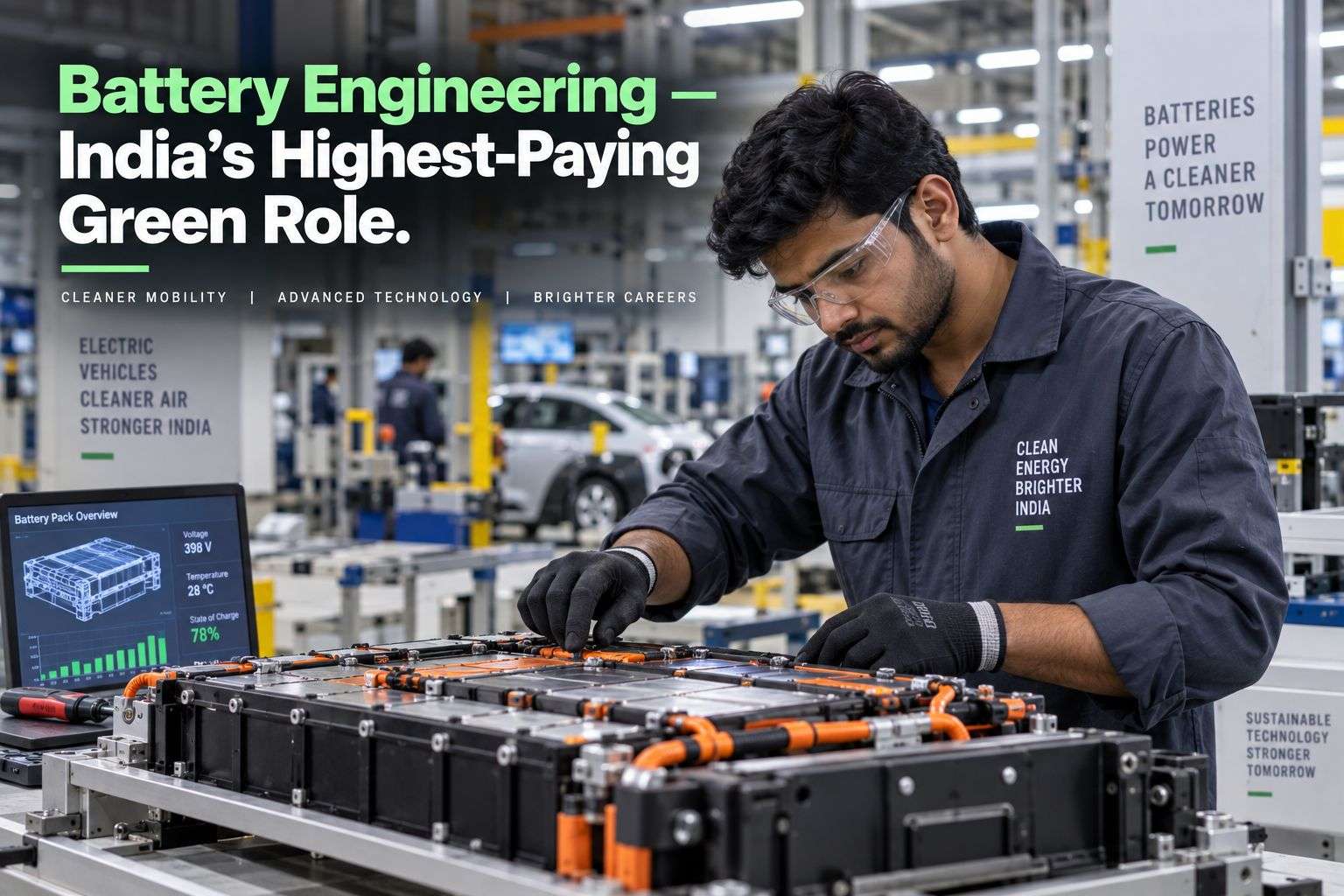
EV Powertrain and Power Electronics Engineer. Covers motor design, inverters, and on-board chargers. Fresher salaries at strong companies start around ₹6 to ₹10 LPA, with senior power electronics specialists earning significantly more.
Green Hydrogen Process Engineer. A newer, smaller field but growing quickly as electrolyser plants come online in Odisha, Gujarat, and Rajasthan. Chemical and Electrical graduates are best placed here. Entry pay currently sits around ₹4.5 to ₹8.0 LPA.
Sustainability Analyst / ESG Data Analyst. This is the role for engineering graduates who are strong with data and reporting but do not want a purely technical field role. You collect emissions data, prepare sustainability disclosures, and support compliance teams. Entry salaries at large companies and consulting firms run ₹4.5 to ₹8.0 LPA, with the ₹6 to ₹14 LPA band open to candidates who add a recognised ESG or GRI certification.
Energy Auditor. You assess how much energy a factory, building, or campus wastes and recommend fixes. This role suits Mechanical and Electrical graduates who enjoy problem-solving over pure design work. Entry pay is around ₹3.0 to ₹5.5 LPA.
Notice something across every single one of these roles. None of them require you to abandon your core engineering branch. They require you to point your existing skills at a growing sector.
The Odisha Angle — Why This Matters Close to Home

I do not want this guide to feel like it is describing opportunities happening somewhere else. Odisha is one of the states leading this shift, and most students I counsel have not connected the dots yet.
Under the Odisha Renewable Energy Policy 2022, the state has targeted 10,960 MW of renewable energy capacity by 2030, spread across floating solar, ground-mounted solar, rooftop solar, wind, and small hydro. GRIDCO has been designated the nodal agency, and a single-window clearance system has already approved projects worth over ₹12,318 crore.
The scale of recent investment is significant. Axis Energy Ventures and Evren signed an MoU worth ₹47,750 crore with GRIDCO to develop 5,000 MW of renewable and green hydrogen capacity in Odisha, expected to generate nearly 15,000 direct and indirect jobs. Separately, OREDA has formed a joint venture with NLC India Renewables to develop 1,000 MW of wind and floating solar projects across the state. On the green hydrogen side, the Ministry of New and Renewable Energy has specifically flagged Odisha’s coastal location near Paradip and Gopalpur as strategically positioned for green hydrogen and green ammonia exports.
If you are studying engineering anywhere in Odisha right now, you do not need to relocate to Gujarat or Tamil Nadu to build a green career. The projects are being approved in your own state, close to campuses in Bhubaneswar, Cuttack, and Berhampur.
How to Build a Green Jobs Profile — By College Year

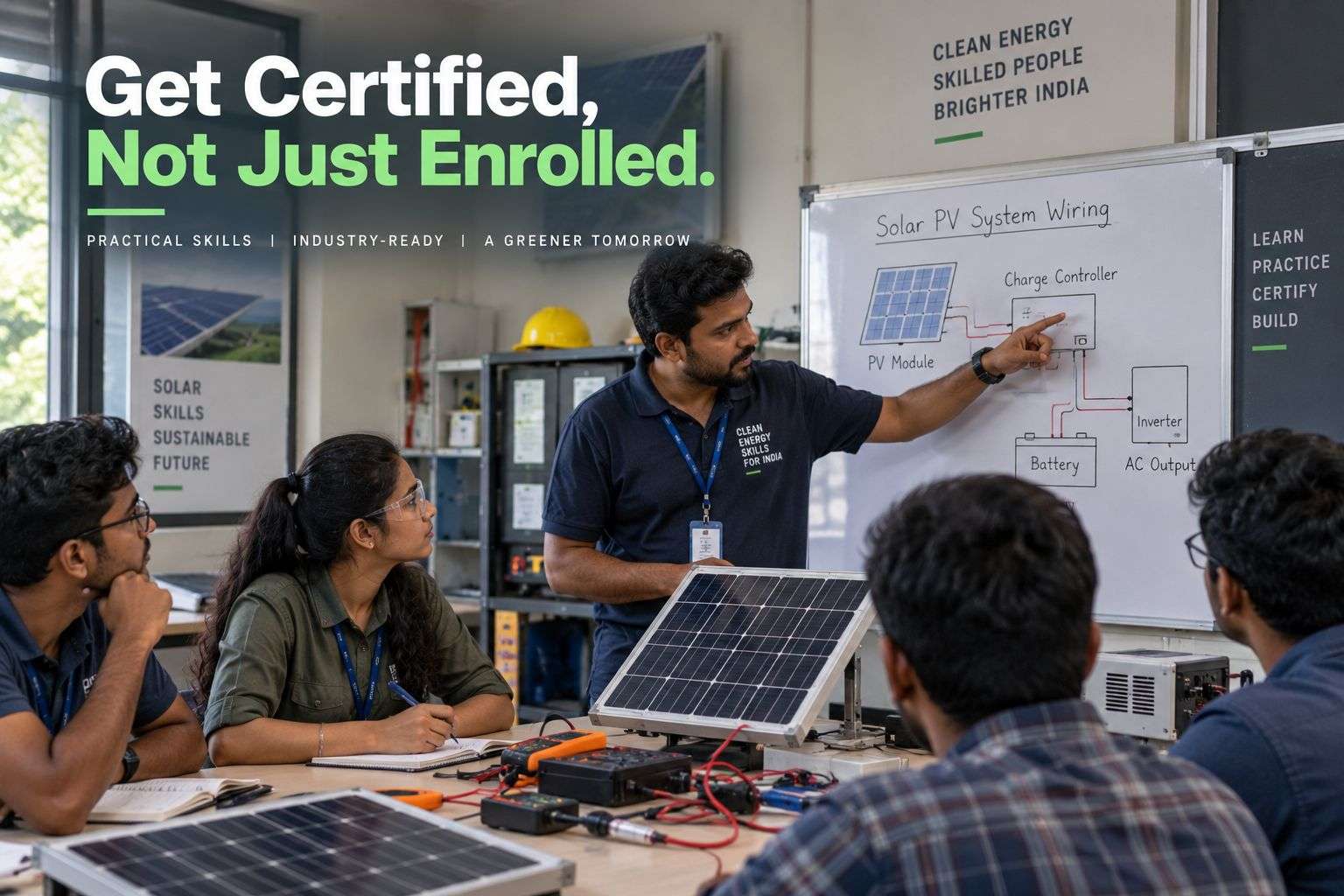
First and second year. Do not specialise yet — build the foundation instead. Strengthen your core subjects, especially power systems, thermodynamics, and materials, because every green role builds on these fundamentals. Watch a handful of genuine explainer videos on how solar PV and wind systems actually work, so the vocabulary stops feeling foreign. If your college offers an NSDC-aligned short course through a partner like Rooman Technologies, a beginner renewable energy or green skills module is a low-risk way to test your interest early.
Third year. This is your window to build real evidence. Pick a final-year or mini-project connected to renewable energy, EV systems, or energy efficiency — a solar-powered charging station, a battery management system prototype, or an energy audit of your own campus building are all realistic, achievable projects. Apply for a summer internship at a solar EPC firm, an EV startup, or a sustainability consulting team, even if the stipend is modest. The experience on your resume matters more than the pay at this stage. Start one recognised certification — the Skill Council for Green Jobs offers NCVET-approved qualifications specifically in solar, wind, and green hydrogen that Indian recruiters genuinely recognise.
Final year. Convert your project and internship into interview-ready stories. Be ready to explain the technical decisions you made, not just the final result — this is exactly what separates candidates who clear technical rounds from those who do not. Apply broadly across solar EPC companies, EV manufacturers, and the sustainability or ESG teams of large corporates, because this sector hires across service companies, product companies, and manufacturing plants simultaneously. If you have not started a certification yet, complete at least one short, recognised green-skills course before placement season — even a foundational one signals genuine intent to a recruiter scanning hundreds of resumes.
Three Honest Warnings Before You Commit
Warning 1 — Not every “green job” advertisement is an engineering job. A large share of solar and green energy postings you will find on job portals are for site technicians and installation staff with diploma-level qualifications, paying ₹15,000 to ₹30,000 a month. These are real jobs, but they are not the entry point for a BTech engineering graduate. Target design, engineering, and process roles specifically, not general “solar job” listings.
Warning 2 — Certifications without fundamentals will not carry you through a technical interview. A short green-skills certificate looks good on a resume, but an interviewer at a solar EPC firm or an EV battery company will test your understanding of power systems, thermal behaviour, or circuit design underneath it. Do not skip your core engineering fundamentals to chase a green-sector label.
Warning 3 — Salary hype is uneven across this sector. Battery systems and power electronics roles genuinely pay well from day one. Site-level solar installation and entry-level sustainability data roles pay modestly at first and grow with experience. Go in with accurate expectations for the specific role you are targeting, not the highest number you saw in a LinkedIn post.
Internal Links — Read These Next
- 📌 Semiconductor Jobs in India — A 27-Year IT Career Consultant’s Honest Guide
- 📌 Odisha GCC Policy 2025 — What It Means for Engineering Freshers
- 📌 Fresher Salary in India 2026
- 📌 Campus Placements 2026 Are Back
- 📌 Switch to IT Career From Non-CS Branch — Complete Honest Roadmap
Read Further-
Skill Council for Green Jobs (on the green-job definition)
Odisha Renewable Energy Policy 2022 (on the 10,960 MW state target)
MNRE on Odisha’s green hydrogen positioning (on the Paradip/Gopalpur point)
FAQs — Green Jobs for Engineering Graduates in India
FAQ 1 — Which engineering branches are best placed for green jobs in India, and are non-core branches like CSE and IT completely shut out?
This is the first question almost every student asks me, and the honest answer is that core branches have a natural head start, but the field is more open than most students assume.
Electrical and Electronics graduates fit most directly into solar design, wind energy, and battery systems roles because the underlying physics and circuit knowledge transfer directly. Mechanical graduates are strong candidates for wind turbine maintenance, thermal management in EV battery packs, and energy auditing, where mechanical systems thinking matters most. Chemical engineering graduates have a genuine advantage in the growing green hydrogen and battery chemistry space, which most students overlook entirely.
CSE and IT graduates are not shut out — they are simply pointed toward a different layer of the same sector. Every renewable energy plant, every EV fleet, and every sustainability reporting function increasingly runs on software — monitoring dashboards, predictive maintenance algorithms, energy management platforms, and ESG data systems all need developers and data engineers who understand the green sector’s specific requirements.
A CSE graduate who builds even one project connecting their coding skills to renewable energy data — a solar output prediction model, for instance — stands out immediately in this space precisely because so few CSE students think to make that connection.
Consultant’s note — I tell CSE students the same thing I tell them about fintech or healthcare tech. You do not need to become a domain expert. You need one project that proves you can apply your existing skills to this sector’s specific problems. That single project changes how a green-sector recruiter reads your entire resume.
FAQ 2 — What certifications actually matter for a green jobs career in India, and which ones are a waste of money?
Students ask me this constantly because the certification market around green skills has grown crowded very quickly, and not all of it is worth paying for. The certifications that genuinely matter are the ones recognised by India’s own Skill Council for Green Jobs, an NCVET-accredited body that has developed over 75 qualifications across solar, wind, green hydrogen, and sustainability.
These certifications are specifically designed around what Indian employers in this sector actually test for, and recruiters at solar EPC firms and renewable energy companies recognise them by name.
Beyond SCGJ, sector-specific credentials also carry weight — a NABCEP-style solar design fundamentals course, a recognised battery management systems course for EV-focused roles, or a GRI or BRSR-aligned sustainability reporting course for students targeting ESG analyst roles. What I tell students to avoid are generic, unaccredited “green energy expert” certificates from platforms with no industry recognition and no assessment rigour behind them — they cost money, take up resume space, and mean nothing to an actual hiring manager.
Consultant’s note — I always ask a student the same question before they pay for any certification in this space. Can you name the specific company or job role this certification is meant to prepare you for? If they cannot answer that clearly, I tell them to hold off and research the actual employer requirements first.
FAQ 3 — How much can a fresh engineering graduate realistically earn in a green job in India in 2026?
I want to give you honest numbers rather than the inflated figures that circulate on social media. Solar design engineers typically start between ₹3.0 and ₹5.5 LPA at EPC and design firms. Wind energy engineers start slightly higher, around ₹3.5 to ₹6.0 LPA. Energy auditors and sustainability analysts generally begin in the ₹3.0 to ₹8.0 LPA range depending on the employer’s size and sector.
The clear outlier, and the one students get most excited about once they learn the real figures, is battery and power electronics engineering in the EV sector.
Entry-level battery systems and BMS roles at strong Tier 1 companies — the gigafactories being built by Ola Electric, Amara Raja, Exide, and similar players — start between ₹6 and ₹14 LPA, which genuinely rivals a strong core software engineering offer. This premium exists because battery chemistry and thermal safety expertise is still scarce relative to the pace at which India is building domestic cell manufacturing capacity.
Consultant’s note — I tell students not to chase the headline battery-engineer salary blindly. It requires genuinely strong fundamentals in electrochemistry, thermal systems, or power electronics, built through real coursework and project work, not just a certificate. If your fundamentals are not there yet, a solar or energy-audit role is a completely respectable, genuinely useful starting point that still leads somewhere strong.
FAQ 4 — Do I need an MTech or a specialised master’s degree to work in green jobs, or can a BTech graduate enter directly?
This is a genuine and important question because the green sector does have some highly specialised research-oriented roles that do expect an MTech or PhD — particularly in advanced battery chemistry research or green hydrogen catalysis work at research institutions. But the large majority of engineering roles I see freshers actually hired into — solar design, site engineering, EV battery pack design, energy auditing, sustainability reporting — are BTech-entry roles at the fresher level.
What separates a BTech graduate who gets hired directly from one who does not is almost never the absence of a master’s degree. It is the absence of a demonstrable project or internship connected to the sector. Companies hiring for these roles are looking for evidence that you understand the practical side of the work, not an additional degree.
Consultant’s note — I have placed BTech-only graduates directly into solar design and EV battery roles at strong companies. In every single case, what got them the offer was a genuine project — something they had actually built or analysed — not a certificate, and not an advanced degree they did not yet have.
FAQ 5 — Are green jobs in India stable long-term careers, or is this a temporary hiring trend tied to current government schemes?
Students are right to ask whether this is a genuine long-term career path or a short-lived policy-driven bubble, because I have watched other “hot” sectors cool down faster than expected. My honest assessment, based on the underlying commitments involved, is that this is structurally different from a short-term trend.
India’s 500 GW renewable energy target and 2070 net-zero commitment are backed by binding international commitments, not just domestic political promises, which makes policy reversal unlikely regardless of which government is in power. The EV and battery manufacturing investments — PLI-backed gigafactories from Ola Electric, Amara Raja, Reliance, and others — represent capital already committed and factories already under construction, not proposals that can be quietly shelved. And the ESG reporting mandate for large listed companies is now a standing regulatory requirement, not a voluntary initiative that companies can simply stop doing.
Consultant’s note — I tell students to judge a sector’s stability by how much capital and regulation is already locked in, not by how loud the marketing around it is. On that measure, green jobs in India look considerably more durable than several hyped tech trends I have watched come and go over 27 years.
FAQ 6 — How is a green jobs career different from a regular core engineering job at a traditional company, and is the day-to-day work actually different?
This question comes from students who assume “green” changes everything about the work itself, and the honest answer is more nuanced than that. The core technical skill — electrical design, mechanical analysis, process engineering, data analysis — is largely the same skill you would use at a traditional power, automotive, or manufacturing company. What genuinely differs is the specific technology you are applying that skill to and often the regulatory and sustainability context you are working within.
A solar design engineer uses the same circuit and load-calculation fundamentals as a traditional electrical engineer but applies them to photovoltaic systems instead of conventional grid infrastructure. An EV battery engineer uses core electrochemistry and thermal engineering principles that also apply to traditional battery and energy-storage industries, but within the specific safety and performance demands of vehicle applications. The day-to-day is recognisably engineering work — not a fundamentally different career.
Consultant’s note — I tell students who are unsure whether they will enjoy this shift to think of it less as changing careers and more as changing the industry their existing engineering skills serve. That framing makes the decision feel far less risky than it initially seems.
FAQ 7 — Which companies in India are actually hiring engineering freshers for green jobs right now, in 2026?
Students always want specific names rather than sector generalities, and that is fair. In solar, established EPC and manufacturing players like Tata Power Solar, Waaree, Adani Solar, and ReNew are among the largest fresher recruiters, alongside a growing number of regional EPC firms doing project execution work. In EV and battery manufacturing, Ola Electric’s gigafactory, Amara Raja Energy and Mobility, Exide Industries, and Reliance New Energy are all actively scaling hiring as their cell manufacturing lines ramp up.
Traditional automotive players including Tata Motors, Mahindra Electric, and Ather Energy are also expanding EV-specific engineering teams.
For sustainability and ESG roles, large listed companies across every sector — including major IT and BFSI names — are building internal sustainability reporting teams, alongside specialist boutique ESG consultancies and the sustainability practices within the Big Four professional services firms.
Consultant’s note — I always tell students to check a company’s own careers page directly for “renewable,” “sustainability,” or “EV” specific job families rather than relying only on general job portals, because these specific teams inside large companies are often under-advertised relative to how actively they are actually hiring.
FAQ 8 — Can an engineering student in a tier-2 city in Odisha realistically access these green job opportunities, or are they concentrated only in Gujarat and Tamil Nadu?
I understand why students in Bhubaneswar, Cuttack, Rourkela, and Berhampur ask this, because a lot of green-energy media coverage focuses on Gujarat’s solar parks and Tamil Nadu’s wind corridors. But Odisha itself is now a genuine green energy hub in its own right, and the opportunity is closer to home than most students realise.
The state’s own renewable energy policy targets nearly 11,000 MW of capacity by 2030, and recent large-scale investments — including the ₹47,750 crore Axis Energy Ventures and Evren project and the OREDA joint venture with NLC India Renewables — are together expected to create thousands of direct jobs within the state. Odisha’s coastal location near Paradip and Gopalpur has also been specifically flagged by the central Ministry of New and Renewable Energy as strategically positioned for green hydrogen production.
Consultant’s note — I tell my Odisha students the same thing I told them about the GCC policy. You do not need to move to Pune or Ahmedabad to catch this wave. Watch the project announcements coming out of GRIDCO and OREDA directly, because that is where the earliest Odisha-based hiring will surface first.
FAQ 9 — Will AI and automation reduce the number of green engineering jobs available to freshers over the next few years?
This is a smart question, and students are right to ask it about every growing sector rather than assume it is automation-proof by default. My honest read, watching how automation has affected other engineering fields, is that AI tools are changing how green engineering work gets done without eliminating the need for engineers who understand the underlying systems.
AI-assisted design tools can now generate solar layout suggestions, flag potential battery thermal risks, and automate parts of sustainability data collection. What these tools cannot do reliably is make final engineering judgment calls, validate whether a suggested design is actually safe and cost-effective for a specific site, or take accountability when a system underperforms or fails. The practical effect I am already seeing is that entry-level roles are shifting toward requiring engineers who can review and validate AI-generated outputs, which actually raises the bar for genuine technical understanding rather than lowering it.
Consultant’s note — I tell students in every sector the same thing, not just green jobs. Build understanding of what is happening underneath the tools, not just familiarity with the tools themselves, and you position yourself on the right side of automation rather than the wrong side of it.
FAQ 10 — What is the single biggest mistake engineering students make when trying to break into green jobs in India?
After counselling students through this exact transition, I can answer this one without hesitation. The single biggest mistake is treating “green jobs” as a separate career track that requires starting over, rather than recognising it as an application of the engineering skills they are already building. Students who make this mistake spend their final year anxiously searching for entirely new courses and credentials instead of simply redirecting their existing final-year project, internship search, and core subject strength toward the renewable energy, EV, or sustainability sector specifically.
The second, closely related mistake is applying only to generic “green job” listings on job portals without distinguishing between technician-level site roles and genuine engineering design or process roles — and then feeling discouraged when the salary numbers look modest, without realising they were looking at the wrong tier of role for their qualification.
Consultant’s note — Every student I have successfully guided into this space did the same simple thing. They picked one green-sector project in their third year, built it properly, and let that single piece of real evidence carry their entire application. Start there. Do not try to reinvent your whole profile at once.
What to Do This Week — Your Green Jobs Action Plan
Whatever year of college you are in, here is what actually moves you closer to a green engineering career in India in 2026.
If you are in first or second year — spend thirty minutes this week researching how solar PV systems and EV battery packs actually work, in plain language, so the vocabulary stops feeling unfamiliar. Look into whether your college or a partner like Rooman Technologies offers a beginner renewable energy or green skills module, and note it as an option for next semester.
If you are in third year — commit to a specific final-year or mini-project connected to solar, EV systems, or energy efficiency this week, not next month. Shortlist three solar EPC firms, EV startups, or sustainability teams in your city and note their internship application windows. Look up the Skill Council for Green Jobs qualification most relevant to your branch and register for it.
If you are in final year — review your existing projects and internships for anything connected to energy, sustainability, or EV systems, and rewrite your resume this week to foreground that experience clearly. If nothing connects yet, target the fastest realistic entry point — an energy audit exercise or a short recognised certification — before placement season peaks.
Green jobs for engineering graduates in India are not a future promise anymore. The projects are approved, the factories are under construction, and the hiring is happening in 2026, including here in Odisha. Point your existing engineering skills at this sector deliberately, and you position yourself years ahead of classmates who are still waiting for the trend to become obvious.
Building your career roadmap? Read our guides on Semiconductor Jobs in India and Odisha GCC Policy 2025 to understand how India’s manufacturing and policy shifts are reshaping career options for engineering graduates.