

AI Infrastructure Jobs for Freshers- Honest Take on the “Silicon Tsunami” Story Every Student Is Sharing (2026)
AI infrastructure jobs for freshers are not the headline you saw this week. The headline you saw said things like “Silicon Tsunami” and “$500 billion” and “Stargate Project.” It named OpenAI, Anthropic, Amazon, SpaceX. It felt like a story about American billionaires fighting over computer chips. Nothing to do with a BTech student in Rourkela.
I want to start with what actually happened in my office last week.
A second-year student, I will call him Ankit, walked in with his father’s newspaper folded to the business page. He pointed at a wave-shaped graphic labelled “Silicon Tsunami” and asked me one question: “Sir, is this going to affect my placement?” His father was standing behind him, arms crossed, waiting for my answer like it was a verdict.
I did not give him a quick yes or no. I want to give you the same honest, unhurried answer here, because Ankit is not the only one asking.
What the “Silicon Tsunami” Story Actually Says
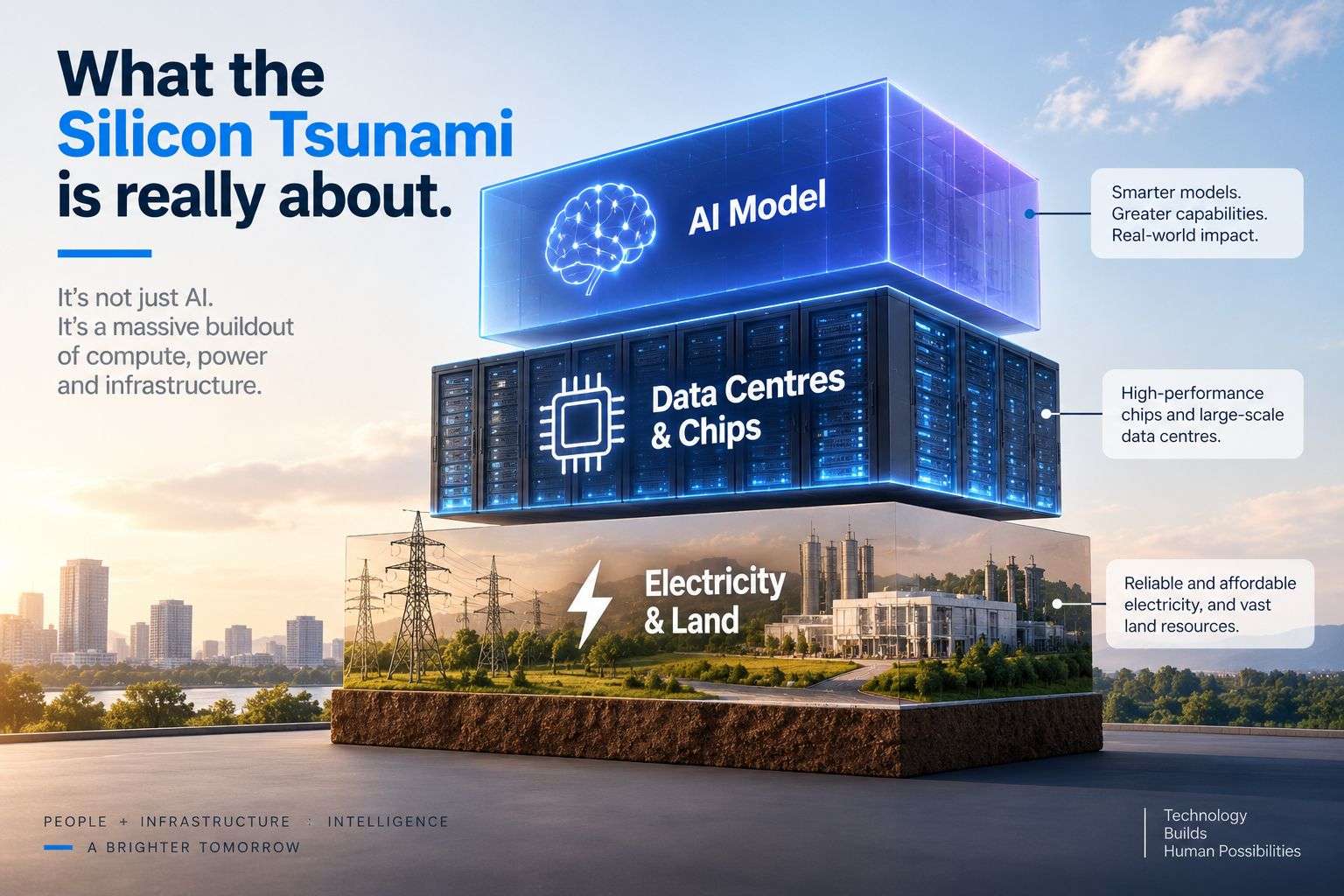
Strip away the drama and the story is simple. OpenAI and Anthropic, the two companies behind ChatGPT and Claude, are spending unimaginable amounts of money on computing power. Not on hiring researchers. Not on marketing. On raw infrastructure — chips, data centres, electricity, cooling systems.
OpenAI’s Stargate Project alone is a $500 billion plan built with Nvidia, Oracle, SoftBank, and Microsoft. Amazon is putting $50 billion into OpenAI’s compute needs. Anthropic has struck a $45 billion infrastructure deal in the UK, is in talks with Samsung to manufacture custom chips, and is working with SpaceX on space-based compute. Both companies are now designing their own chips instead of only buying Nvidia’s.
That is the entire story. Two AI companies are building the physical plumbing behind artificial intelligence, on a scale usually reserved for national infrastructure projects, not private startups.
Why an American Chip War Landed on an Indian Newspaper
Here is where most students stop reading, and where I want you to start paying attention.
This is not only a Silicon Valley story anymore. It has an Indian address now. Google has committed $15 billion to build its largest AI hub outside the United States in Visakhapatnam, branded officially as “AI City Vizag.” Andhra Pradesh has secured investment agreements worth $175 billion across 760 projects tied to this AI infrastructure push. Anthropic opened its first Indian office in Bengaluru this year, calling India its second-largest market after the United States.
None of this is theoretical. Land is being allocated. Contracts are being signed. Hiring is beginning. This is the part of the story that connects directly to your career, even if you never write a line of AI research code in your life.
Does This News Change Anything for a BTech Fresher? My Honest Answer
I told Ankit this, and I will tell you the same thing. This news does not mean you need to become an AI scientist. It does not mean four years of your electronics or mechanical degree just became worthless. It also does not mean you can ignore it and scroll past the next headline like it is just another news item.
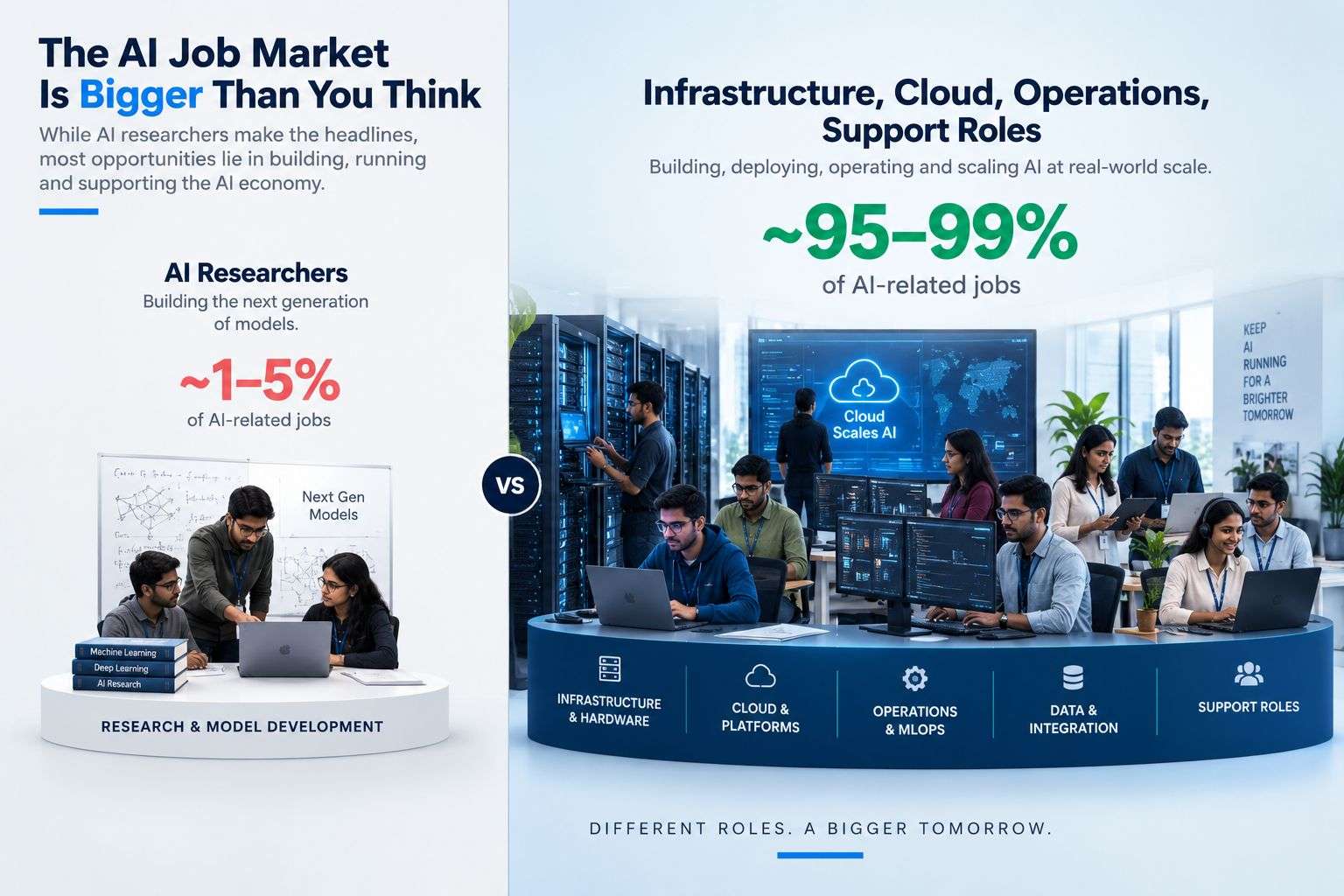
The honest answer sits in the middle. AI infrastructure jobs for freshers are opening up, but they are not the jobs the headlines are shouting about. Nobody is hiring a fresh graduate to design a custom AI chip. Somebody is absolutely hiring fresh graduates to run the data centres those chips sit inside, to manage the cloud systems that connect to them, to test the hardware, to handle the networking, and to support the thousands of ordinary IT jobs that come attached to a $15 billion facility landing in your state.
Think of it like an airport being built in your city. You will probably never fly the plane. But cargo handling, ground staff, security systems, catering, IT support for the terminal — an entire economy grows around that one big project. The AI data centre boom works the same way.
The Panic Trap – What Not to Do With This News
I have watched students make the same mistake for 27 years, and AI news makes it worse. The mistake is reacting to a headline instead of a hiring pattern.
Do not drop your core branch subjects to chase an “AI course” you saw advertised on Instagram last night. Do not tell your parents you want to switch your entire career plan because of one newspaper clipping. Do not assume that because OpenAI and Anthropic are American companies, this has no bearing on a placement drive in Bhubaneswar or Cuttack. And do not assume the opposite either — that every AI headline is your cue to panic-buy a certification.
The students who struggle most are not the ones who ignore the news. They are the ones who overreact to it every single time, jumping from one shiny keyword to the next, never building depth in anything.
Where the Jobs Actually Show Up — AI Infrastructure Jobs for Freshers
This is the part Ankit’s father wanted to hear, so let me lay it out plainly.
AI infrastructure jobs for freshers cluster around a few real, learnable skill areas, and none of them require you to be a genius researcher.
Cloud computing fundamentals sit right at the centre of this. Every AI data centre runs on cloud infrastructure principles — provisioning, storage, networking, monitoring. If you are choosing between paths, I have already written in detail about cloud developer versus cloud engineer roles and which one suits which kind of student.
Semiconductor and hardware-adjacent roles are the second cluster, and they are growing fastest in India right now because of the government’s own chip manufacturing push. I broke down the real numbers behind this in my semiconductor jobs guide for engineering graduates.
Basic AI tool fluency is the third piece, not because you will build the next Claude, but because every recruiter now expects you to work comfortably alongside AI tools in your daily work. I have listed the tools worth learning in my AI tools for freshers placement guide.
And do not overlook state-level opportunity. If you are an Odisha student, the Odisha GCC policy is quietly building the same kind of infrastructure-linked hiring pipeline closer to home.
None of these four areas demand a PhD. All four are things a disciplined third-year or final-year student can start building in six months.
My Three-Filter Framework for Reading This Kind of News
Ankit’s real question was bigger than one headline. He wanted to know how to read AI news going forward without either panicking or ignoring it. So I gave him a filter I use myself, and I am giving it to you.
Filter one: is this about spending, or is this about a new job category? A company announcing it will “spend billions” on infrastructure is not the same as a company announcing new roles. Spending news tells you where the ground is shifting. Hiring news tells you where to apply.
Filter two: does this touch Indian soil? An American AI lab’s internal chip design decision rarely reaches you directly. A $15 billion data centre in Visakhapatnam, an Anthropic office in Bengaluru, a GCC policy in your own state — these reach you. Always ask where the money is physically landing.
Filter three: does this change a skill you can learn in six months, or a career you spent four years building? If the news only threatens a skill, adapt the skill. If it threatens your entire degree, that is almost never true, and you should be suspicious of anyone telling you otherwise.
Run every AI headline through these three filters before you let it change your mood, your plans, or your parents’ blood pressure.
Your Action Plan
Do not just read this and close the tab. Here is exactly what I want you to do over the next thirty days.
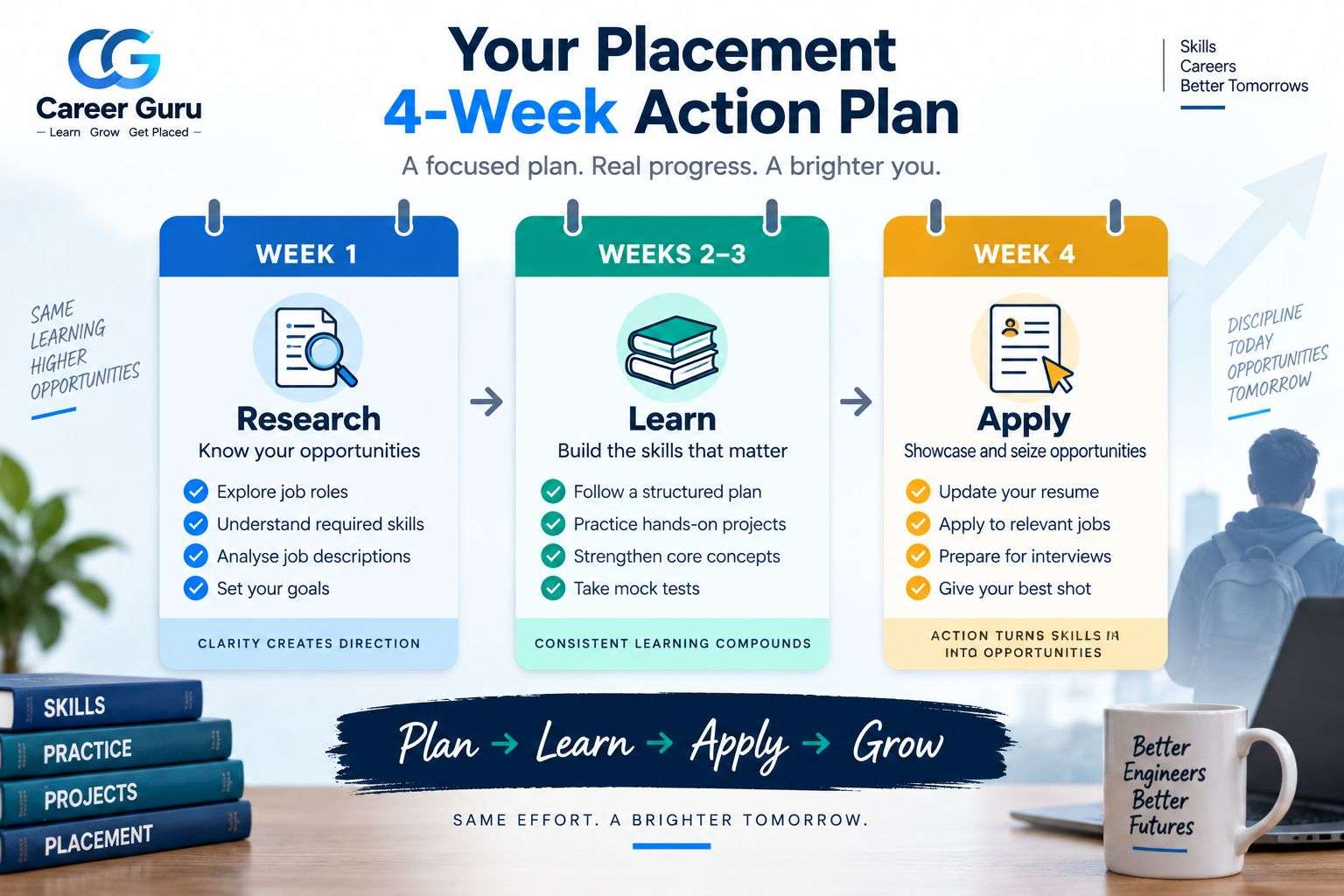
Start by picking one of the four skill areas above based on your branch and interest, not based on what your friend is doing. Spend week one only researching — read the linked guides above, watch two or three genuine YouTube explainers, and write down what a beginner role in that area actually looks like. Spend weeks two and three doing one small, structured course or certification in that area, ideally a free or low-cost one, so you are not gambling money on untested excitement.
In week four, find one real example — a LinkedIn post, a job listing, a company career page — of a fresher role that uses this skill, and study exactly what it asks for. Then repeat this cycle every month, always checking new AI infrastructure news through the three-filter test before you let it pull you in a new direction.
This is slow by design. Slow and steady is how you avoid becoming the fresher who has eleven certificates and zero clarity.
Frequently Asked Questions-
FAQ 1- Should BTech students read AI infrastructure news like the OpenAI-Anthropic chip war or ignore it as irrelevant?
You should read it, but read it the way an investor reads a market report, not the way a fan reads sports news. Most of this news will never touch your career directly, and that is fine — you are not meant to react to every headline. What matters is training yourself to spot the small number of stories that do have an Indian address attached, like a new data centre, a new office opening, or a new state policy.
Skimming five AI headlines a week and asking “does this touch Indian soil?” is a far better habit than either binge-reading everything or ignoring the topic completely. Over a few months, this habit alone will make you noticeably sharper in interviews, because recruiters increasingly ask freshers about current industry direction, not textbook definitions.
Consultant’s Note: I ask every student I counsel one simple test question — can you name one AI-related news story from the last month that actually affects hiring in your state? Most cannot. That gap is exactly what this habit closes.
FAQ 2- Will AI infrastructure investments like Stargate or the Anthropic-Amazon deal actually create jobs for Indian freshers, or is this only for American engineers?
Both, but not in equal measure. The core research and chip design roles inside OpenAI and Anthropic will remain small, highly specialised, and largely based in the United States for now. What creates volume hiring for Indian freshers is the infrastructure layer that gets built to support this — data centres, cloud operations, hardware testing, networking, facility IT support, and the broader Global Capability Centre ecosystem that Indian cities are competing to host.
Andhra Pradesh’s $175 billion AI City Vizag project and Anthropic’s own Bengaluru office are concrete proof this hiring is already starting in India, not five years away.
The volume of jobs will always be larger at the infrastructure and operations layer than at the research layer, which is exactly why I keep steering students toward cloud and infrastructure fundamentals rather than chasing AI research dreams.
Consultant’s Note: I have counselled students who assumed “AI job” meant “AI researcher” and then felt discouraged when that door looked impossibly narrow. Widen your definition of an AI job and the door gets much bigger.
FAQ 3- What is the fastest way for a final-year student to become eligible for AI infrastructure jobs for freshers without starting a new degree?
You do not need a new degree, and you should be suspicious of anyone who tells you that you do. The fastest realistic path is a focused, six-month layer of practical skill-building on top of whatever branch you are already in — a foundational cloud certification, a basic understanding of how data centres and networking work, and comfort using AI tools in your daily workflow. Pair this with genuine project work, even something as simple as a small cloud-hosted application, because recruiters trust demonstrated work far more than a certificate alone.
Avoid stacking five unrelated certifications in five different domains; depth in one relevant area beats breadth across many. This approach works whether you are from computer science, electronics, mechanical, or civil, because infrastructure and operations roles pull from multiple branches, not just core CS.
Consultant’s Note: The students who get hired fastest are rarely the ones with the most certificates. They are the ones who can explain, in plain language, one real thing they built or fixed.
FAQ 4- Is it risky to ignore AI news completely and just focus on traditional placement preparation like aptitude, coding, and interview skills?
It is not risky in the sense of failing your placement, but it is a missed opportunity. Traditional placement preparation — aptitude, coding fundamentals, communication, interview practice — remains the foundation, and no amount of AI awareness replaces that foundation. But recruiters, especially in product companies and GCCs, increasingly ask freshers questions about current industry trends to gauge genuine curiosity, not just rehearsed answers.
A student who can casually mention how AI infrastructure investment is affecting hiring in their state stands out from a student who cannot. So the honest answer is: do not let AI news distract you from your core preparation, but do not let your core preparation become an excuse to stay uninformed either. The two should sit side by side, with core preparation always getting the larger share of your time.
Consultant’s Note: I tell students to spend ninety percent of their preparation time on fundamentals and ten percent staying current. That ten percent is often what tips a close interview decision in your favour.
FAQ 5-How can a student in a tier-2 city like Bhubaneswar, Cuttack, or Rourkela access these emerging AI infrastructure jobs when the big projects are in cities like Visakhapatnam or Bengaluru?
Physical distance from a mega-project matters less than most students assume, because these projects create demand for remote-capable cloud, support, and operations skills that do not require you to relocate before you are hired.
What matters more is building the right foundational skill and being visible on the platforms where these companies and their vendors actually hire, including LinkedIn and campus placement drives that increasingly bring GCCs and infrastructure-linked companies to tier-2 campuses.
Odisha’s own GCC policy is a direct example of the state trying to bring this kind of hiring closer to home instead of leaving it only to Bengaluru and Hyderabad. Your job is to build the skill now, so that when these companies do come looking, whether through campus drives or off-campus hiring, you are already prepared instead of starting from zero.
Consultant’s Note: I have seen this exact pattern before with cloud computing and semiconductor hiring — the opportunity always looks distant until the month it suddenly is not, and the students who prepared early are the ones who move fastest.
FAQ 6- What specific technical skills should a fresher actually learn to qualify for AI infrastructure jobs, beyond just “cloud computing” as a broad term?
Break “cloud computing” down into pieces you can actually practise, because the broad term is where most students get stuck. Start with basic networking concepts — how data moves, what a server rack does, what latency means in plain language — because every data centre job assumes this baseline. Add one hands-on cloud platform, AWS or Azure or Google Cloud, and go deep enough to deploy something small yourself rather than just watching tutorials.
Learn basic Linux commands, since almost every server environment runs on it, and this alone separates candidates who can be productive from day one from those who need months of hand-holding.
Finally, understand at a conceptual level how AI models actually run on hardware — what a GPU does differently from a CPU, why cooling and power matter — even if you never touch a chip yourself, because interviewers test for this awareness constantly now. None of this requires an advanced degree; it requires roughly four to six months of consistent, hands-on practice rather than passive video-watching.
Consultant’s Note: I have started asking students in mock interviews to explain, in one minute, the difference between a CPU and a GPU. Almost none can. That one gap tells me more about their readiness than their CGPA does.
FAQ 7- Is the AI infrastructure jobs trend a genuine long-term shift, or is this a hype cycle that will fade before today’s second-year students even graduate?
I have counselled students through enough hype cycles to know the difference between a bubble and a foundation, and this one has the markers of a foundation, not a bubble. Hype cycles are usually built on promises — a company saying it will do something someday.
This trend is built on physical construction — land allocated, data centres under construction, government policy signed, foreign direct investment already landed in Andhra Pradesh and elsewhere. Physical infrastructure does not get abandoned the way a marketing trend does, because too much real money is already committed to walls, cooling systems, and electricity contracts.
That said, I always tell students that “long-term shift” does not mean “guaranteed for you personally” — you still need to build real skill and show up prepared, because infrastructure investment creates opportunity, not automatic jobs. Treat this as a multi-year wave you have time to prepare for, not a ninety-day scramble.
Consultant’s Note: The safest sign that something is not hype is when governments start signing land and power agreements around it. Andhra Pradesh did not commit $175 billion because of a headline; it committed because the underlying demand is real.
FAQ 8- Should students from non-computer-science branches like mechanical, electrical, or civil engineering also pay attention to AI infrastructure jobs, or is this only relevant to CS and IT students?
is is one of the biggest misunderstandings I correct in my counselling sessions, and it matters especially for tier-2 college students who often assume AI news is only for CS branches.
A data centre is not only a room full of servers; it is a massive physical facility that needs electrical engineers to design and maintain power systems, mechanical engineers to handle cooling and HVAC at an industrial scale, and civil engineers to plan and construct the buildings themselves.
Andhra Pradesh’s own minister spoke openly about wanting the companies that make cooling systems and water infrastructure, not only chip makers, which tells you the hiring net is far wider than software alone.
If you are from a core branch, do not chase a CS-only skill path just because the headlines mention AI; instead, look for how your existing branch connects to this infrastructure boom, because that connection often already exists and is under-explored by your classmates. This is genuinely one of the few AI-adjacent trends where core branch students have a real, direct advantage over CS students, not a disadvantage.
Consultant’s Note: I tell mechanical and electrical students this often — you do not need to become a coder to benefit from the AI boom. You need to see that your branch already sits inside its supply chain.
FAQ 9- How does this AI infrastructure trend connect to the semiconductor jobs boom in India that you have written about separately?
They are two threads of the same rope, and understanding how they connect will make you sound genuinely informed in an interview rather than someone repeating buzzwords. The semiconductor push is about India manufacturing the chips themselves through government-approved fabrication and assembly projects. The AI infrastructure push, the one behind this “Silicon Tsunami” story, is about where those chips get deployed and used, inside data centres and compute clusters.
A student working in semiconductor testing or assembly is closer to the manufacturing end of this chain, while a student working in cloud or data centre operations is closer to the deployment end. Both threads are being pulled by the same global demand for AI compute, and both are creating fresher-level roles in India right now, so you do not need to choose one as “more correct” than the other. Pick whichever matches your branch and interest, and read my semiconductor jobs guide alongside this one to see the full picture.
Consultant’s Note: Students often ask me which trend is “bigger.” Wrong question. Ask which one your branch and location give you a faster route into, and start there.
FAQ 10- What role does a state-level policy like the Odisha GCC policy play in bringing AI infrastructure jobs closer to students who cannot relocate to Bengaluru or Hyderabad?
State GCC policies exist precisely to solve the problem you are worried about, so it is worth understanding how they work rather than assuming all the opportunity sits far away.
When a state government offers incentives, land, and infrastructure support to Global Capability Centres, it is actively competing to bring the kind of hiring that normally clusters in Bengaluru or Hyderabad closer to its own cities instead.
Odisha’s GCC policy is a direct example of this strategy, aimed at bringing infrastructure-linked and IT-linked employers into Bhubaneswar and nearby hubs rather than leaving that hiring entirely to other states. This does not mean a $15 billion AI hub is landing in Odisha tomorrow, and I want to be honest about that instead of overselling it.
What it does mean is that the broader ecosystem of cloud, IT services, and operations roles connected to this AI infrastructure wave has a real, state-backed reason to grow closer to home over the next few years.
Track this policy the same way you track any other piece of local job-market news, because it is often more directly relevant to you than a foreign headline.
Consultant’s Note: I ask Odisha students the same question every counselling season — do you know your own state’s GCC policy better than you know the OpenAI org chart? Most know the org chart better. That balance needs to flip.
Where This Leaves You
Ankit left my office that day without a certificate, without a new course enrolled, and without a changed career path. He left with one instruction: read the next AI headline through the three-filter test before reacting to it, and spend the next month exploring one infrastructure skill area seriously.
That is genuinely all I am asking of you too. The “Silicon Tsunami” story is real, and it is bigger than most students realise. But it is not a wave that will drown you if you ignore it, and it is not a wave you need to chase blindly either. Read it carefully. Filter it honestly. Then go build the one skill that actually connects to where the money is landing in your own country.
If you want help figuring out exactly which of these paths fits your branch, your city, and your timeline, that conversation is what I do every day. Reach out on WhatsApp at 9777278853, or read through the other guides linked above first — they will save you a lot of guesswork.