
Are Online Certifications Worth It for Freshers? Coursera vs Udemy vs NASSCOM FutureSkills – A 27-Year Career Consultant’s Honest Answer (2026)
Are online certifications worth it for freshers? I get asked this almost every week, and here is the number that should make you pause before you swipe your card. Indian students and freshers spend an estimated ₹8,000 to ₹15,000 a year, on average, on paid course subscriptions – and a large share of them never finish a single course.
That is not a guess. Completion rates on paid online courses sit around 30 to 40 per cent globally, and Indian numbers are not much better. So before we even get to Coursera versus Udemy versus NASSCOM FutureSkills, the real first question is simpler. Will you actually finish what you pay for?
I have counselled BTech students across Bhubaneswar, Cuttack, Rourkela, Berhampur, and Sambalpur for 27 years. In that time, certifications have gone from a nice-to-have line on a resume to something students treat almost like a lucky charm. Buy the course, get the certificate, and hope it opens a door. It rarely works that way.
This guide gives you the honest answer. Not the marketing answer. Are online certifications worth it for freshers in India in 2026? Sometimes yes. Sometimes it is money and time you will never get back. Let me show you exactly when each platform earns its place in your career plan.
Are Online Certifications Worth It for Freshers — The Honest Answer First
Let me answer the headline question directly, because you deserve a straight response before the details.
Online certifications are worth it for freshers only when three things line up together. The certificate comes from a recognised source. You back it with a real project you can show in an interview. And you pick it for a skill that Indian recruiters are actually hiring for right now.
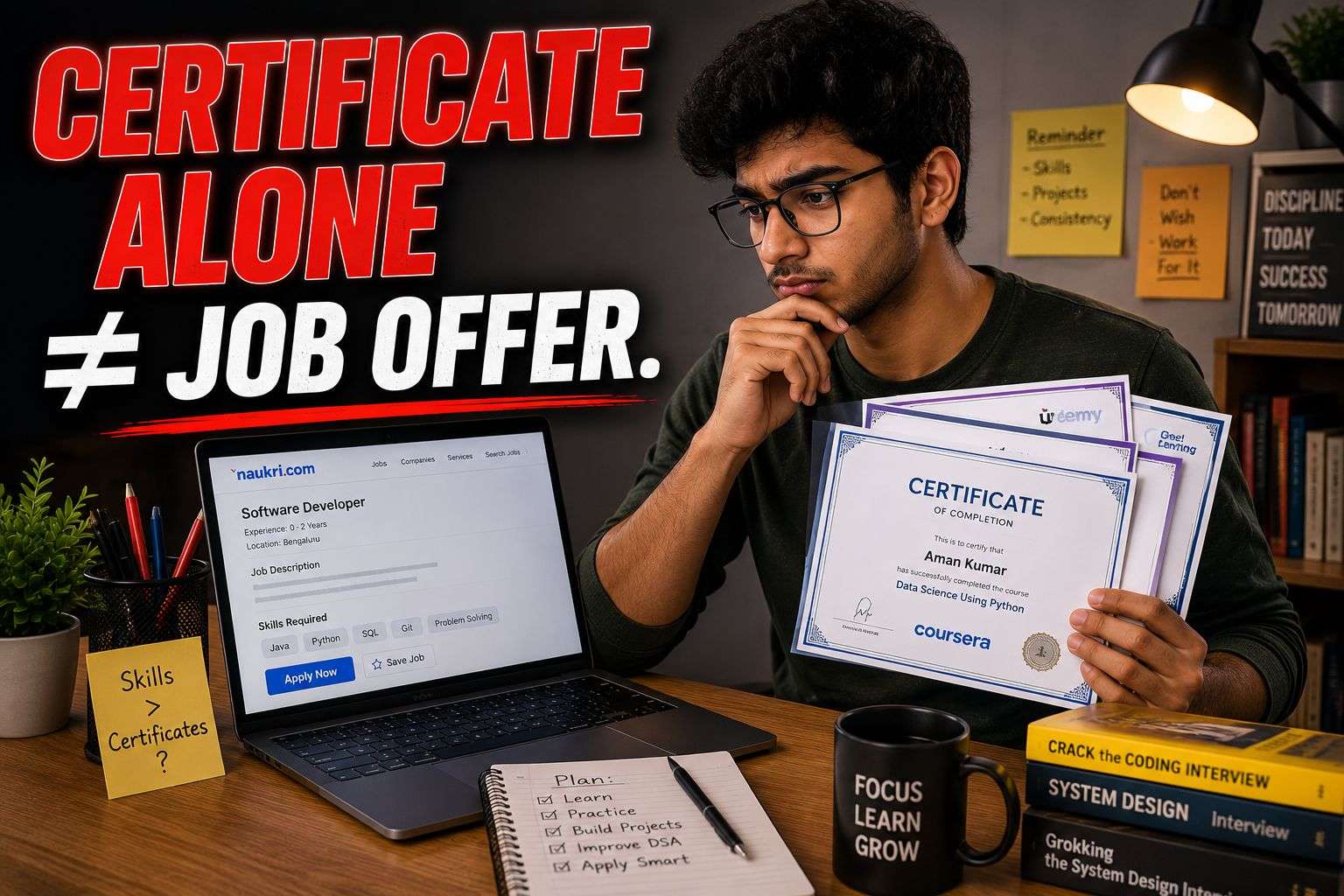
Miss any one of those three, and the certificate becomes a PDF sitting in your downloads folder. I have seen students with six or seven certifications and zero interview calls. I have also seen students with one focused certificate and a working project land offers within weeks. The difference was never the number of certificates. It was whether the certificate proved something real.
So the question is not really “are online certifications worth it for freshers.” The better question is “which certification, on which platform, backed by what proof.” That is what the rest of this guide answers.
What Each Platform Actually Offers Freshers in India
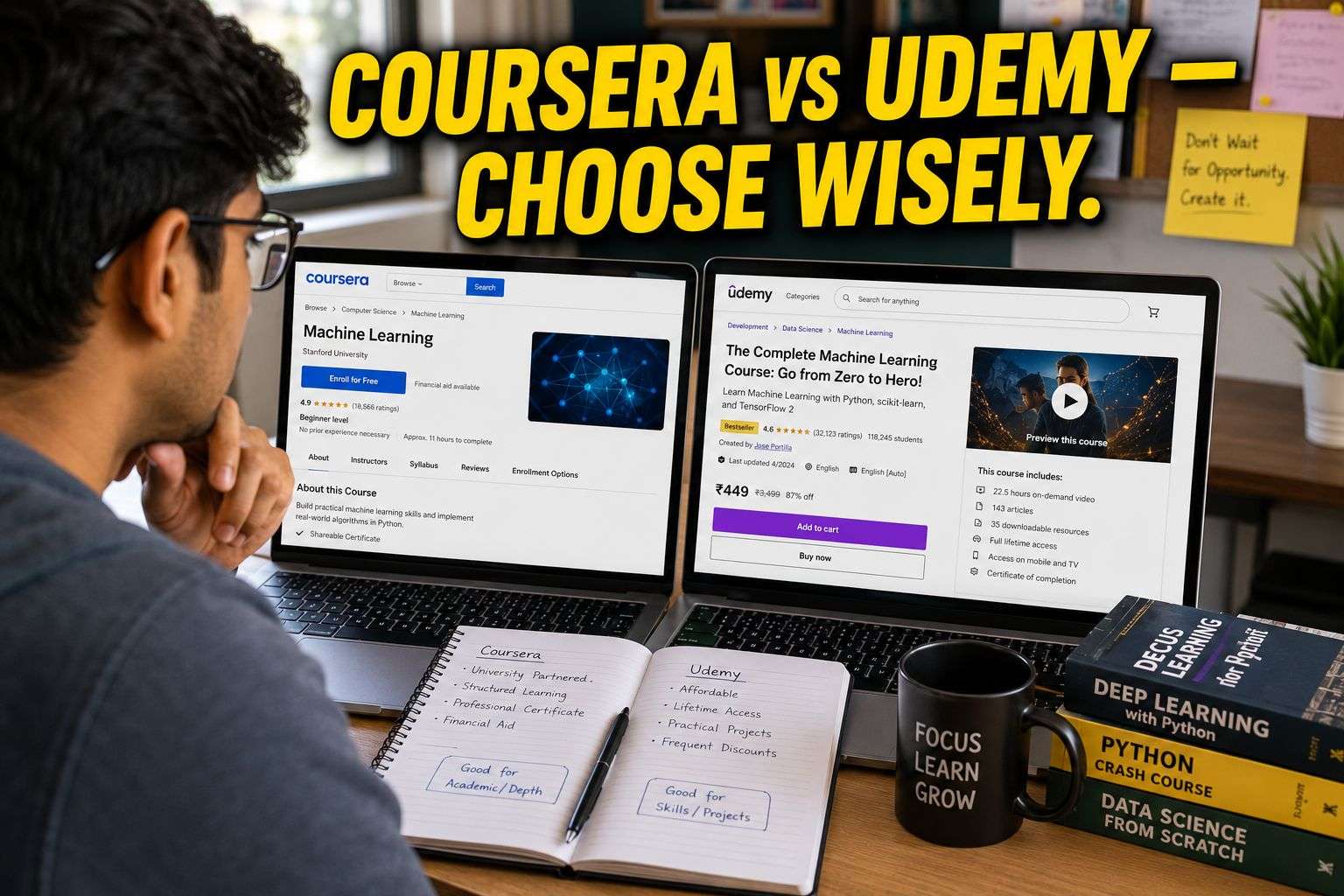
Before deciding whether online certifications are worth it for freshers, you need to understand what you are actually buying on each platform. The three names students ask me about most are Coursera, Udemy, and NASSCOM FutureSkills Prime. Each one plays a completely different role.
Coursera for Freshers — Cost, Certificates, and Recruiter Perception
Coursera partners with universities and companies like Google, IBM, and Meta to deliver Professional Certificates. In India, Coursera Plus — the annual subscription that unlocks most of the catalogue — has been priced around ₹7,500 to ₹8,000 during regional offers, sometimes climbing closer to ₹14,000 at full price. A single Professional Certificate bought on its own can run ₹3,000 to ₹4,000 across its full duration.
Here is why this matters for the question of whether online certifications are worth it for freshers. Coursera certificates carry weight because they are issued by the company or university that built the course. A Google Data Analytics certificate is not a random instructor’s opinion of your work. It is Google’s name attached to a structured, assessed curriculum. Indian recruiters, especially at GCCs and product companies, recognise these names.
The catch is completion. If you are not confident you will finish two or three certificate programs within the year, a single-course purchase is often cheaper and less wasteful than the annual plan.
Udemy for Freshers — Cost, Certificates, and Recruiter Perception
Udemy is a completely different animal, and freshers often confuse the two. Udemy courses regularly go on sale for ₹399 to ₹499, sometimes even less. At that price, Udemy is one of the cheapest ways in the world to actually learn a skill — Python, React, Excel, AWS basics, anything.
But here is the part students skip past. Udemy certificates are completion certificates. Anyone can publish a course on Udemy, and there is no admissions bar, no standard curriculum review, and no verified assessment behind most certificates. Recruiters I speak with in Bhubaneswar and across Odisha’s IT hiring circles are candid about this — a Udemy certificate rarely moves your resume to the top of the pile on its own.
So are online certifications worth it for freshers when the platform is Udemy? Yes, for the learning. No, if you are buying it purely for the certificate. Use Udemy to build the skill. Use the project you build during that course as your actual proof.
NASSCOM FutureSkills Prime for Freshers — Free and Government-Backed
This is the platform most students in tier-2 Odisha cities have not properly explored, and it deserves far more attention than it gets. NASSCOM FutureSkills Prime is a joint initiative of NASSCOM and India’s Ministry of Electronics and Information Technology. It offers free courses across twelve digital technologies, including AI, cloud computing, cybersecurity, and data analytics, with NASSCOM-certified assessments at the end.
Because NASSCOM represents thousands of Indian IT companies, a FutureSkills certification is not an unknown name to Indian recruiters the way a random Udemy instructor might be. Some companies, including large IT service firms, use FutureSkills Foundation courses directly inside their own fresher onboarding programmes. That alone tells you how seriously the industry treats this platform.
The final assessment usually carries a small fee, often a few hundred rupees, which is a fraction of what Coursera or paid bootcamps charge. For students asking whether online certifications are worth it for freshers on a tight budget, this is often the strongest starting point.
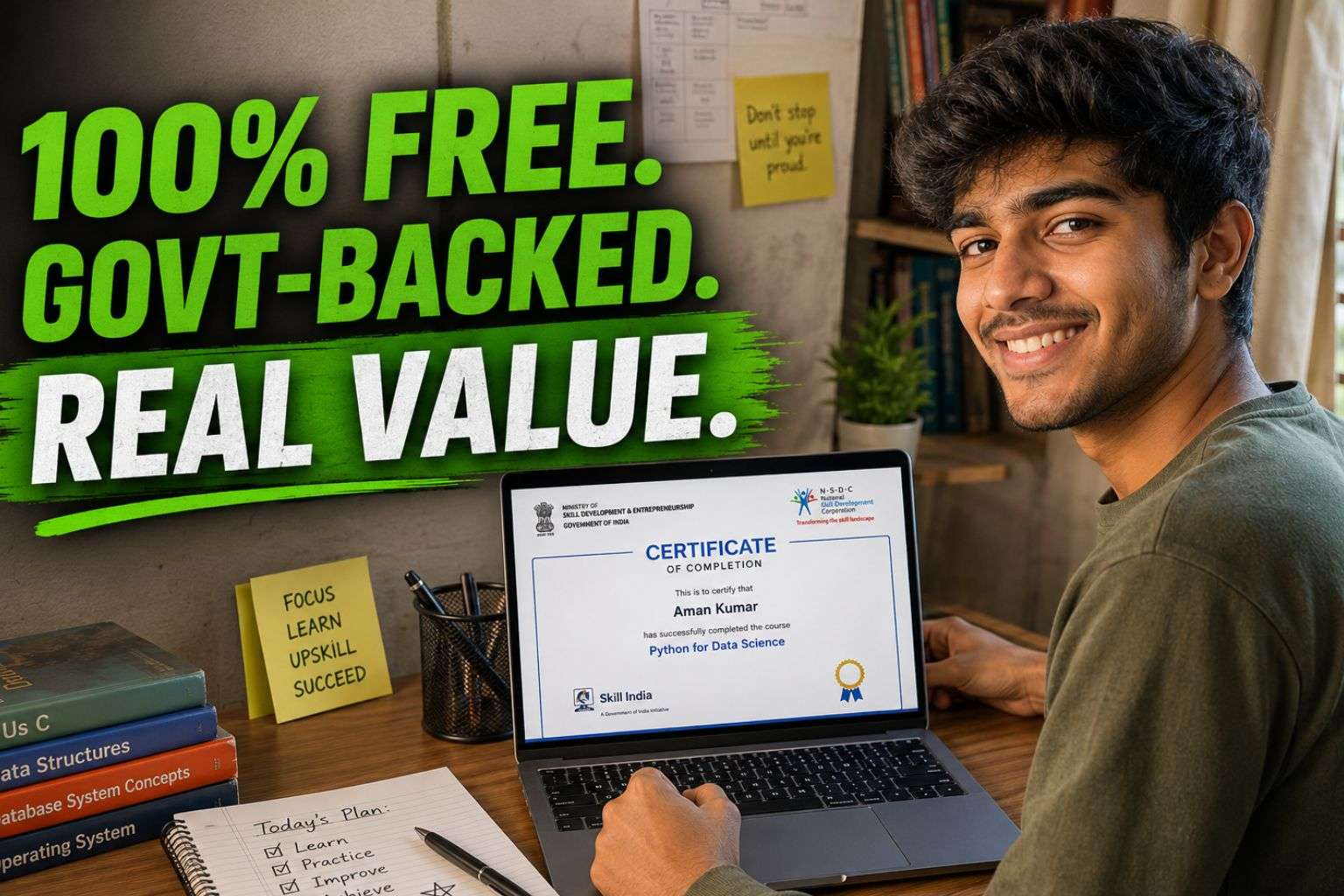
Image prompt 3: Indian student at a small study desk in a modest home setting, laptop screen showing a certificate completion page, proud expression, warm natural lighting. Bold green text overlay reads “100% FREE. GOVT-BACKED. REAL VALUE.” Alt text:
Coursera vs Udemy vs NASSCOM FutureSkills — Side by Side
Students want a quick comparison before they decide whether online certifications are worth it for freshers, so here it is in plain terms.
On cost, Udemy wins easily for casual, single-skill learning. NASSCOM FutureSkills wins for freshers who want a recognised, government-backed credential without a heavy fee. Coursera sits in the middle — expensive upfront, but genuinely cheaper per certificate if you complete two or more programs in a year.
On recruiter recognition, Coursera’s branded Professional Certificates and NASSCOM FutureSkills both carry real weight because a known institution stands behind the assessment. Udemy certificates carry almost none on their own, though the skills you build absolutely do.
On structure and accountability, Coursera offers the most guided path with graded assignments and peer review. NASSCOM FutureSkills follows a structured curriculum aligned to National Occupational Standards. Udemy is entirely self-paced, which is exactly why so many students buy courses and never finish them.
On relevance to Indian hiring, all three can work — but only when the specific certificate maps to a skill that is genuinely in demand. A cloud, AI, or data analytics certificate opens doors right now. A generic soft-skills certificate rarely moves the needle by itself.
If you want to go deeper on which specific certificates are worth pursuing this year, I have laid out the full list in my guide on the best certifications for freshers in India in 2026.
When Are Online Certifications Worth It for Freshers — And When They Are Not
Let me be specific, because vague advice does not help you decide what to buy this week.
Online certifications are worth it for freshers when you are filling a genuine skill gap that a job description keeps mentioning. If three job postings you want in a row ask for AWS basics, and you have zero cloud exposure, a focused certification closes that gap fast and cheaply.
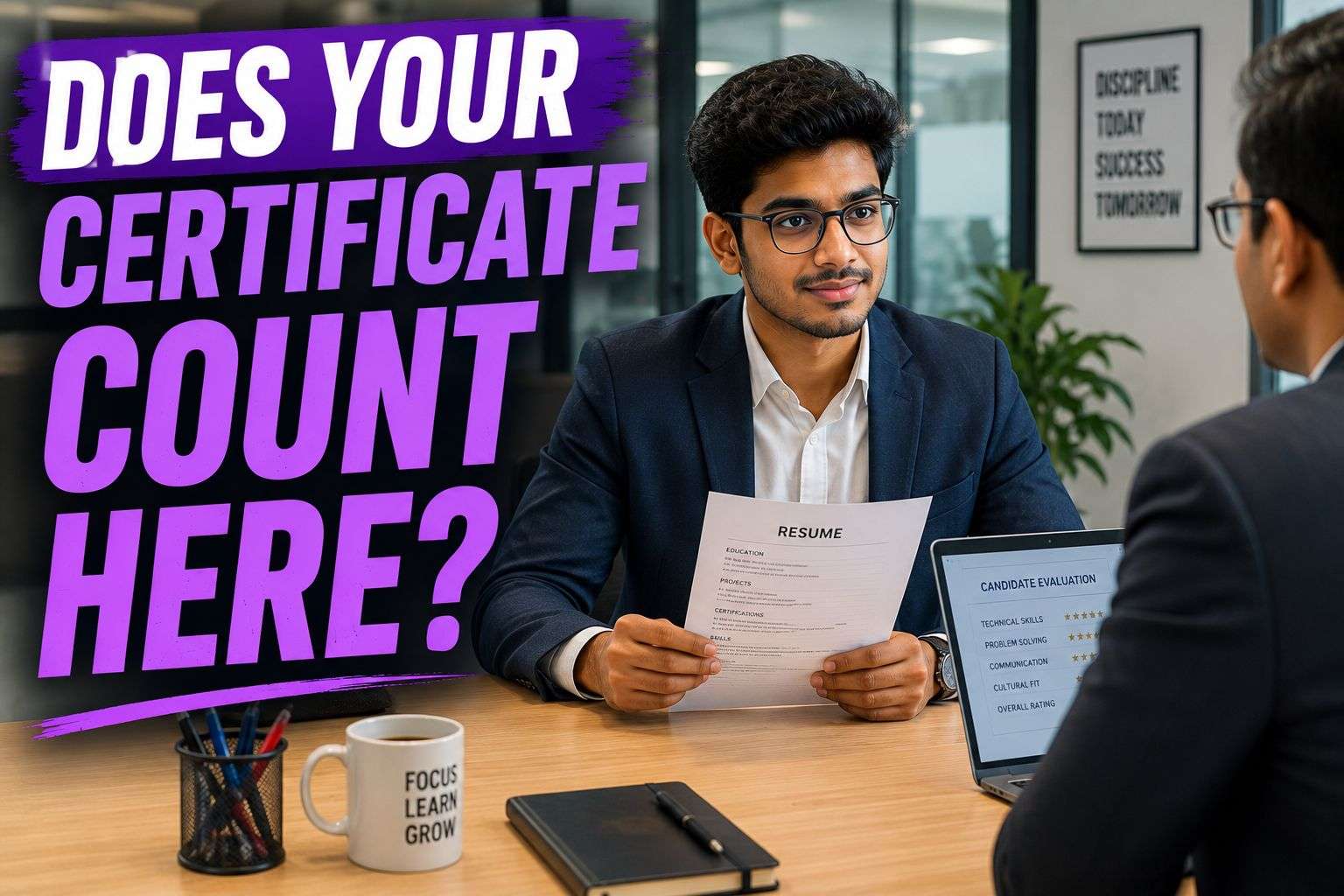
Online certifications are worth it for freshers when you pair the certificate with a project. A Coursera Google Data Analytics certificate next to a real dashboard you built and pushed to GitHub tells a recruiter something a certificate alone never can — that you can actually do the work.
Online certifications are not worth it for freshers when you are collecting them to feel productive without applying anything. I have counselled students with eight completed courses and no portfolio to show for any of them. That is activity, not progress.
Online certifications are also not worth it for freshers when campus placement or internship experience already covers the same ground. A certificate cannot compete with six months of hands-on internship work on the same skill. If you have that experience, spend your certification budget somewhere the gap is real.
Three Mistakes Freshers Make With Online Certifications
Mistake one — buying certificates instead of building skills. The certificate is a byproduct of learning, not the goal. Students who chase the badge rush through videos without absorbing anything, then fail the first technical interview question that tests real understanding.
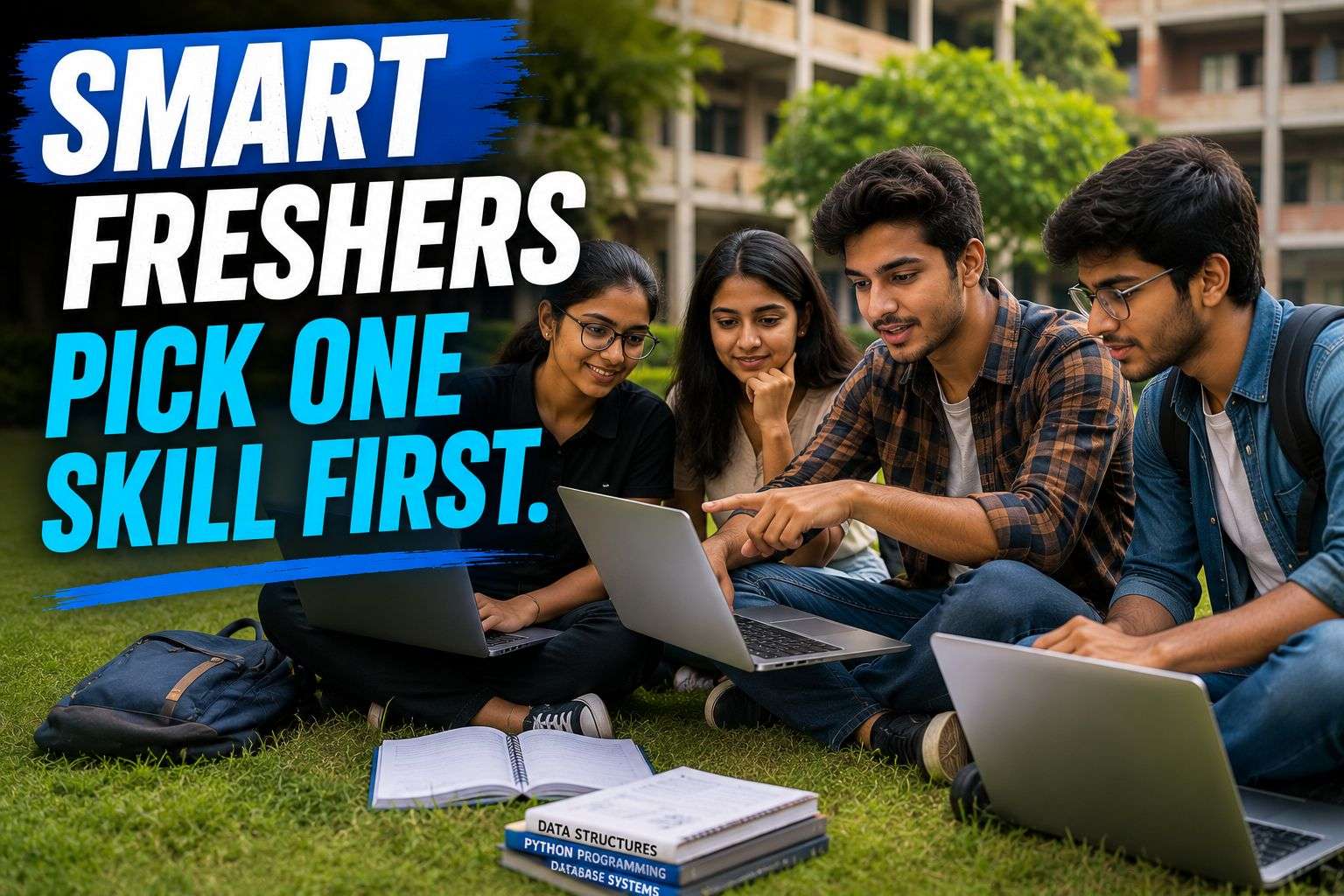
Mistake two — spreading budget across too many platforms. I regularly meet students with a Coursera subscription, a stack of Udemy courses, and a half-finished NASSCOM course, all started in the same month. None of them get finished properly. Pick one certification target, finish it, then decide what is next.
Mistake three — ignoring free, government-backed options first. Before you pay for anything, check whether NASSCOM FutureSkills Prime, SWAYAM, or NPTEL already covers what you need. For students in Odisha working with a tight budget, this single habit alone answers a good part of the question of whether online certifications are worth it for freshers.
If you want the full list of legitimate free options before you spend a rupee, I have covered this in detail in my post on best free online courses for IT students in India.
What I Tell Every Student Who Asks Me This Question
When a student walks into my counselling session in Bhubaneswar and asks me directly whether online certifications are worth it for freshers, my answer is always the same sequence.
Start with what is free. NASSCOM FutureSkills Prime, SWAYAM, and NPTEL cover a genuine range of in-demand skills at little to no cost, and the certificates carry industry recognition. This should be your first stop, not your last resort.
Move to Udemy only when you know exactly what skill you want and you are confident you will finish the course. Treat the certificate as a bonus, not the reason you bought the course. The project you build is the real outcome.
Reserve Coursera for a specific, branded credential that a target company or role genuinely values — a Google certificate for a data role, an IBM certificate for a specific tool. Do not buy the annual plan unless you have a clear plan to complete more than one program.
And whatever platform you choose, always finish with proof. A GitHub repository. A live project link. A short write-up of what you built and why. Recruiters remember proof. They forget certificates.
If you are still deciding which skills to prioritise before choosing a platform, my guide on top tech skills employers look for in freshers in India is a useful next read, and pairs well with my breakdown on realistic fresher salary expectations in India once you start applying.
Internal Links — Read These Next
- 📌 Best Certifications for Freshers in India in 2026
- 📌 AWS Certification for Freshers 2026
- 📌 Best Free Online Courses for IT Students in India
- 📌 Top Tech Skills Employers Look for in Freshers in India 2026
- 📌 Fresher Salary in India 2026
Useful external resources:
- NASSCOM FutureSkills Prime — Official Platform
- Coursera Plus — India Pricing
- Udemy — Course Catalogue
Related videos worth watching:
- Top 5 Online Certifications That Are Actually Worth It in 2026
- Unlock Career Opportunities With NASSCOM Certifications on FutureSkills Prime
- Coursera vs Udemy: Which One Actually Gets You Hired?
FAQs — Are Online Certifications Worth It for Freshers
FAQ 1 — Are online certifications worth it for freshers who have no internship experience at all?
Yes, and this is exactly the situation where a certificate helps the most. When you have no internship and no project history, a certificate is one of the few concrete things you can point to in an interview. But it only works if you treat it as a starting point, not a finish line.
Pick a certificate tied to a skill you can immediately demonstrate. If you complete a Python certification, build something small with it — a script, a scraper, a simple app — and put it on GitHub. That combination, certificate plus project, does far more for a fresher with zero prior experience than the certificate alone ever could.
Recruiters know a first-timer will not have years of work behind them. What they are checking for is initiative and follow-through, and a completed certificate with a working project shows exactly that.
Consultant’s note — I have watched students with no internship walk into interviews with nothing but a certificate and a small project and get shortlisted over students with a longer resume but no proof of actual skill. The certificate opens the conversation. The project keeps it going.
FAQ 2 — Between Coursera, Udemy, and NASSCOM FutureSkills, which one should a first-year student start with?
For a first-year student, I almost always recommend starting with NASSCOM FutureSkills Prime or an equivalent free platform like SWAYAM. At this stage in college, you are still exploring what interests you, and it makes little sense to spend money before you know which direction you want to take.
Use the free platforms to sample two or three areas — cloud, AI, cybersecurity, data — over your first year. Once you find the direction that genuinely holds your attention, that is the point where a paid Udemy course or a Coursera specialisation becomes worth considering, because now you are investing with clarity instead of guessing.
Consultant’s note — First-year students who spend money too early usually end up switching direction by second year anyway. Explore free first. Pay once you know exactly what you are paying for.
FAQ 3 — Do Indian IT companies like TCS, Infosys, and Wipro actually check for online certifications during hiring?
Large IT service companies in India do look at certifications, but not the way most students imagine. Certifications rarely function as the deciding factor. They function as a filter and a talking point. A relevant certificate listed in your resume can help you get shortlisted for certain roles, particularly if the job description specifically mentions that skill or platform.
Once you are in the interview, though, the certificate stops mattering unless you can speak to it confidently. If your resume lists an AWS certification and the interviewer asks you a basic question about EC2 or S3 and you cannot answer, that certificate actively works against you. It signals that you collected the credential without absorbing the content.
Consultant’s note — I tell every student the same thing before interviews. Never list a certification you cannot defend in conversation. It is safer to leave it off than to be caught not knowing what you claimed to know.
FAQ 4 — Is it worth paying for Coursera Plus as a fresher, or should I buy individual certificates?
This depends entirely on how many certificate programs you realistically plan to complete in a year. If you are committed to finishing two or more professional certificate programmes within twelve months, Coursera Plus at its India pricing works out cheaper than buying each certificate individually.
If you only want one specific certificate — say, a single Google Data Analytics or IBM certificate — buying that program individually is often less expensive and avoids the temptation to enrol in courses you will never finish. Be honest with yourself about your completion habits before you commit to the annual plan. A subscription only saves money if you use it.
Consultant’s note — I have seen students buy the annual plan with big ambitions and finish one course out of ten enrolled. That single completed course usually costs more per certificate than buying it standalone would have.
FAQ 5 — Are Udemy certificates useless, or is there still value in taking Udemy courses?
Udemy certificates are not useless, but they are also not what most freshers think they are. There is no admissions standard for Udemy instructors and no independent verification of what you actually learned before the certificate is issued. Because of that, recruiters generally do not weigh a Udemy certificate the way they weigh a university-backed or NASSCOM-backed credential.
Where Udemy genuinely delivers value is in the learning itself. At ₹399 to ₹499 during sales, it is one of the most affordable ways to build a specific, practical skill — a programming language, a tool, a framework. Take the course for what you learn. Then prove that learning through a project rather than relying on the certificate to prove it for you.
Consultant’s note — I tell students to think of Udemy as a gym membership, not a diploma. Nobody asks to see your gym membership card. They look at whether you can actually lift the weight.
FAQ 6 — How many certifications should a final-year BTech student realistically have before placement season?
There is no magic number, and chasing a count is the wrong approach entirely. What matters far more than quantity is depth and relevance. One or two certifications, each backed by a real project and directly aligned to the role you are targeting, will outperform five or six scattered certificates every time.
By final year, your priority should be a focused, demonstrable skill set rather than a long list of credentials. If you are targeting cloud roles, one solid AWS or Azure foundational certification with a deployed project is worth more in an interview than a stack of unrelated certificates covering everything from marketing to Excel to Python basics.
Consultant’s note — In every mock interview I run, I ask students to pick their strongest certificate and explain what they built with it. Students who can answer confidently in two minutes always outperform students who list seven certificates and struggle to explain any of them in depth.
FAQ 7 — Are online certifications worth it for freshers targeting government jobs or PSU roles instead of private IT companies?
For government and PSU roles, the calculation changes quite a bit. Most government recruitment in India runs through structured written exams, and a private platform certificate typically carries little to no weight in that selection process. Your preparation time is far better spent on exam-specific study material.
That said, if the PSU role itself is technical — engineering, IT, or a specialised function — a relevant certification can still help you perform better once you are shortlisted through the exam, and it can strengthen your profile for interview rounds that assess practical knowledge. But it will not substitute for exam preparation, and treating it as a shortcut around the exam process would be a mistake.
Consultant’s note — Students preparing for both a PSU exam and industry certifications at once often end up doing neither well. If your primary target is a government exam, let that be your main focus and treat certifications as a secondary, occasional activity.
FAQ 8 — Can a fresher from a non-CS branch use online certifications to switch into an IT career?
Yes, and I have guided many ECE, Mechanical, and Civil engineering students through exactly this path. Online certifications are genuinely valuable here because they give you a structured, recognised way to demonstrate IT-relevant skills that your degree did not cover.
The key is sequencing. Start with foundational free courses to confirm the direction genuinely interests you. Then move to a focused paid certification — Coursera or NASSCOM FutureSkills tend to carry more weight here than Udemy alone — paired with a hands-on project that proves you can apply what you learned. Recruiters evaluating non-CS candidates are specifically looking for evidence that you can do the technical work despite your degree, and a certificate plus project combination is the clearest way to provide that evidence.
Consultant’s note — I have a detailed roadmap for exactly this transition if you want the full month-by-month plan for switching from a non-CS branch into IT.
FAQ 9 — Do certifications expire, and does that affect whether they are worth it for freshers?
Some do, and it matters more than students expect. Cloud certifications from AWS, Azure, and Google Cloud typically expire after two to three years and require recertification. NASSCOM FutureSkills and most Coursera Professional Certificates generally do not expire, though the underlying content can become outdated as technology moves forward.
For a fresher, this means picking certifications tied to skills that stay relevant, not just trending topics that fade in a year or two. It also means being prepared to keep learning after you get your first job, since the certificate that got you hired will eventually need updating or supplementing as the technology evolves.
Consultant’s note — I remind students that a certificate is a snapshot of what you knew on a specific date. Your actual value in the job comes from continuing to learn after that date, not from the certificate itself.
FAQ 10 — What is the single biggest mistake freshers make when deciding whether online certifications are worth it for them?
The single biggest mistake is treating the certificate as the destination instead of a checkpoint. Freshers buy a course, finish the videos, download the certificate, add it to LinkedIn, and consider the job done. But recruiters are not hiring certificates. They are hiring people who can do the work the certificate claims they can do.
The fix is straightforward, even if it takes discipline. Every certification you pursue should end with something you built, not just something you completed. A project, a repository, a working demo, a short write-up explaining your decisions. That output is what actually answers the question of whether online certifications are worth it for freshers — because it turns a passive credential into active proof.
Consultant’s note — Every single student I have placed successfully using certifications had one thing in common. They could open their laptop in the interview and show something real. Not just describe it. Show it.
Action Steps — What to Do Based on Your College Year
If you are in first or second year – create a free account on NASSCOM FutureSkills Prime and SWAYAM this week. Explore two or three technology areas without spending a rupee. Note which one holds your attention past the first module. That is your early signal for where to specialise.
If you are in third year, pick one certification target based on the skill gap you keep seeing in job postings for your desired role. Choose the platform that matches your budget and completion habits — free FutureSkills course if money is tight, a single Udemy course if you know exactly what you need, or a Coursera Professional Certificate if the role specifically values that brand. Commit to finishing it within eight weeks and start a small project alongside it.
If you are in final year — Stop collecting new certifications and start proving the ones you have. Pick your one or two strongest certificates, build or finish a project around each, and prepare a two-minute explanation of what you built and why. Update your resume and LinkedIn to show the certificate next to the project link, not the certificate alone. That pairing is what actually moves your placement season forward.
Whatever year you are in, the honest answer to whether online certifications are worth it for freshers comes down to one habit. Finish what you start, and prove what you finish. That is the difference between a certificate that sits in your downloads folder and one that gets you shortlisted.




hi
worth going through.. my son has benefitted out of this information.
all the best and looking forward more such articles for freshers.