

AI and ML Jobs in India 2026 — What a 27-Year IT Career Consultant Tells Engineering Students Who Are Worried About Being Replaced
The fear is real. The opportunity is also real. After 27 years of watching technology reshape Indian IT careers, here is the honest, complete guide to what AI and ML actually mean for engineering students in India — the jobs, the skills, the salaries, and exactly what to do starting this week.
AI and ML Jobs in India — The Question Every Engineering Student Is Actually Asking
AI and ML jobs in India are the most searched career topic among engineering students right now.
But the question underneath that search is not really about jobs.
It is about fear.
Every week a student sits across from me and asks some version of the same thing. Sir, will AI take my job before I even get one? I have spent four years studying engineering. Is it already too late?
After 27 years of watching technology cycles reshape Indian IT — I have seen this fear before. I saw it when automation came for manufacturing jobs. I saw it when cloud computing was going to make server engineers redundant. I saw it when low-code tools were going to eliminate developers.
Here is what actually happened each time.
The engineers who understood the new technology early got the best jobs. The engineers who waited and worried got left behind. Not because AI replaced them. Because they replaced themselves — by refusing to learn what was changing.
The same thing is happening right now with AI and ML.
Here is the number that should reframe this entire conversation for you.
India needs approximately 1 million AI and ML skilled professionals by 2026 according to NASSCOM’s workforce projections. Right now the country has roughly 200,000. That gap — 800,000 people — is not a threat. It is the largest career opportunity in Indian engineering in a generation.
This guide tells you exactly how to position yourself for it.
What AI and ML Are Actually Doing to Engineering Jobs in India — The Honest Picture
Let me separate the noise from the reality because both the fear and the hype are exaggerated.
What AI is actually replacing:
Routine, repetitive tasks. Basic data entry. Template-based code generation. Standard testing scripts. Form-filling processes. These were never the valuable parts of an engineer’s job — they were the parts engineers disliked most. AI is taking them. Good.
What AI is not replacing:
Problem definition. Client communication. System architecture decisions. Debugging complex failures. Creative engineering solutions. Cross-functional collaboration. Ethical judgment on technology deployment. Mentoring junior engineers.
These require human context, human relationships, and human accountability. AI does not have those things. It will not have them within the career horizon of anyone reading this blog.
What AI is creating:
Entirely new roles that did not exist five years ago. Machine Learning Engineer. AI Application Developer. Prompt Engineer. MLOps Engineer. AI Ethics Reviewer. Data Pipeline Architect. These roles pay significantly more than the standard IT fresher salary — and they are desperately short of candidates in India right now.
I have watched three major technology waves reshape Indian IT in my career. In each one, the students who panicked lost ground. The students who got curious got ahead. AI is the fourth wave. The pattern is the same. Get curious. Get specific. Get moving.

How AI and ML Are Reshaping Specific Engineering Roles in India
The impact of AI is not uniform across all engineering disciplines. Here is what is actually changing — role by role.
Software Engineers
This is the largest group asking the question. And the answer is nuanced.
AI coding tools — GitHub Copilot, Amazon CodeWhisperer, and similar — are changing how software is written. They generate boilerplate code, suggest completions, and catch common errors. A software engineer using these tools well can do in two hours what previously took eight.
Does that mean fewer software engineers? Not yet. What it means is that software engineers who know how to work with AI tools produce far more than those who do not. Companies are not halving their engineering teams. They are raising the output bar.
A software engineer in 2026 who cannot use AI tools effectively is like a software engineer in 2006 who could not use Google effectively. It is a skill gap that will cost you.
Data Engineers and Analysts
This is the field that has grown most directly because of AI. Every AI system needs clean, structured, well-managed data. The engineers who build and maintain those data pipelines are in extreme demand. Companies report this as one of their hardest roles to fill in India right now.
Mechanical and Civil Engineers
AI is entering these disciplines more slowly — but it is entering. Structural analysis tools now use ML models to predict failure points. Manufacturing plants use AI for predictive maintenance. An engineer in these disciplines who understands AI-assisted design tools will get significantly better projects than one who does not.
Electronics and Communication Engineers
Signal processing and communications engineering are deeply connected to ML. Wireless network optimisation, embedded systems for IoT, image and voice processing — all of these are now AI-adjacent fields. ECE students who add Python and basic ML to their skill set have a genuine edge in the current job market.
AI and ML Jobs in India — The Roles, The Salaries, The Reality
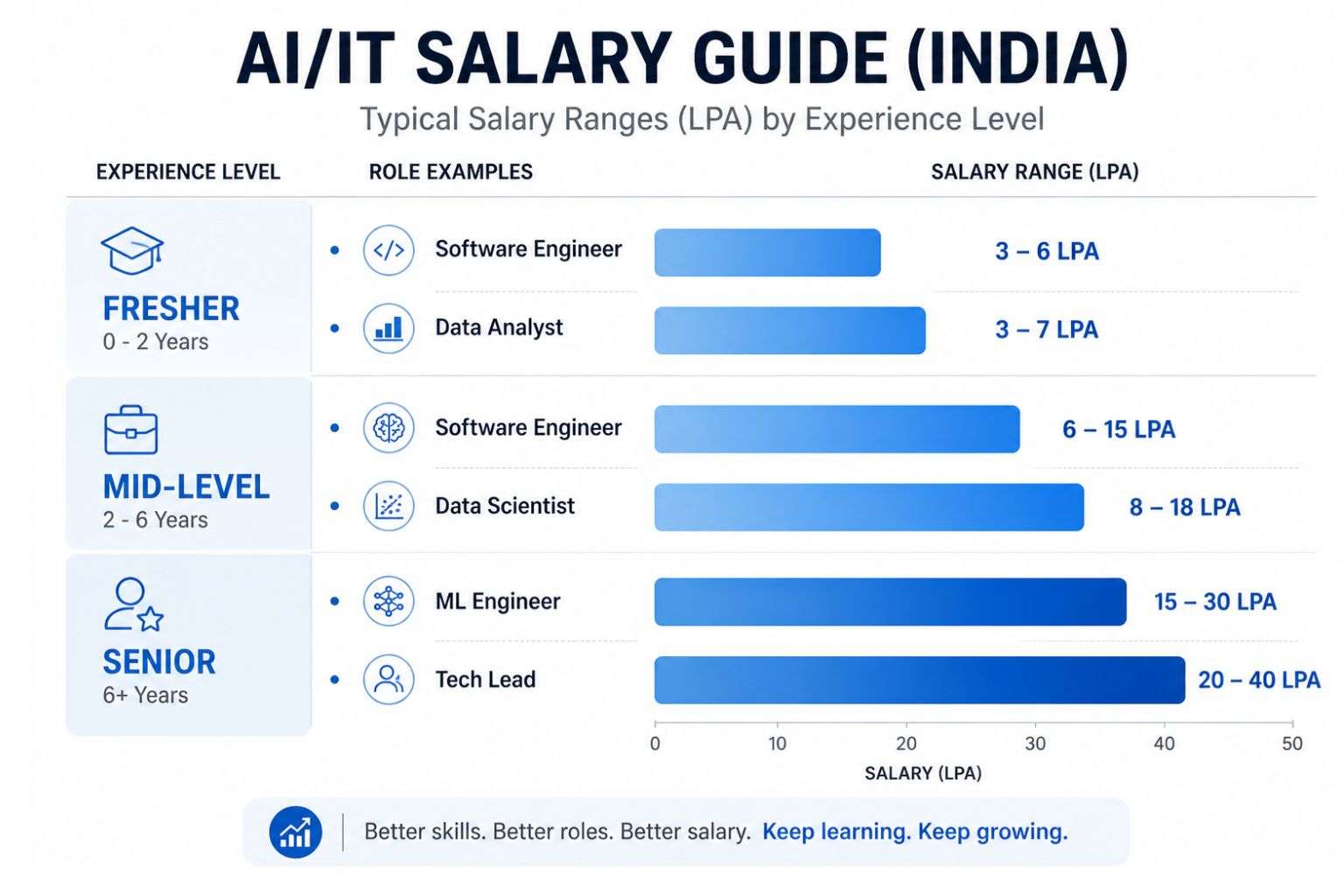
This is the section most students come looking for. Here are the honest numbers for 2026.
Fresher AI and ML Roles
| Role | Starting Salary (CTC) | Key Skills Required |
| Junior ML Engineer | ₹6 to ₹8 LPA | Python, TensorFlow/PyTorch, basic statistics |
| Data Engineer (entry) | ₹5 to ₹7 LPA | SQL, Python, cloud basics, data pipelines |
| AI Application Developer | ₹6 to ₹9 LPA | Python, API integration, LLM tools |
| MLOps Engineer (entry) | ₹7 to ₹10 LPA | Python, Docker, cloud platforms, CI/CD |
Mid-Level (3 to 5 years experience)
| Role | Salary Range (CTC) |
| ML Engineer | ₹12 to ₹18 LPA |
| Data Scientist | ₹14 to ₹20 LPA |
| AI Product Manager | ₹16 to ₹24 LPA |
| MLOps Engineer | ₹15 to ₹22 LPA |
Senior Level (7 to 10 years)
| Role | Salary Range (CTC) |
| Senior ML Engineer | ₹25 to ₹40 LPA |
| AI Research Engineer | ₹30 to ₹50 LPA |
| Head of AI/ML | ₹45 to ₹80 LPA |
Here is what these numbers mean in practical terms. A fresher who joins a large IT service company at ₹4 LPA and builds ML skills over two years can move to a junior ML role at ₹7 to ₹8 LPA. That is a 75 to 100% salary jump in two years — driven entirely by skill addition, not years of experience. I have watched students make this jump. It is real. But it requires deliberate, structured skill-building — not passive exposure.
The Skills That Actually Get You AI and ML Jobs in India
Not every skill listed on every AI course syllabus is equally useful for getting a job in India in 2026.
Here is what actually matters — in order of priority.
Priority 1 — Python
Everything else on this list depends on this one.
Python is the primary language of AI and ML. Not Java. Not C++. Not R — though R has its uses. Python. If you are starting today, start here. One hour daily for three months will take you from zero to genuinely useful.
Platforms to use: HackerRank Python track for basics. Kaggle Learn for applied ML with Python. Both are free.
Priority 2 — Statistics and Mathematics Fundamentals
You do not need a PhD in mathematics to work in AI and ML. But you do need to understand linear algebra basics, probability, and statistics at a working level.
Why? Because when an ML model gives you a wrong output — and they do, regularly — you need to understand why. Engineers who cannot read a confusion matrix or interpret a probability distribution cannot debug AI systems. They can only run them.
What to study: Khan Academy statistics. 3Blue1Brown’s linear algebra series on YouTube. Free. Clear. Enough.
Priority 3 — One ML Framework
TensorFlow or PyTorch. Pick one. Do not try to learn both at once.
PyTorch is more popular in research. TensorFlow is more common in production deployments at large Indian IT companies. If you are targeting service companies — TensorFlow first. If you are targeting product companies or startups — PyTorch first.
Priority 4 — Basic Cloud Platform Knowledge
Every AI system in production runs on cloud infrastructure. AWS, Google Cloud, or Azure. You do not need deep cloud engineering skills at the fresher level — but you need to know the basics. What a virtual machine is. What a storage bucket is. How to deploy a basic ML model to a cloud endpoint.
AWS has a free tier and a free Cloud Practitioner study path. Start there.
Priority 5 — SQL and Data Handling
ML engineers spend more time cleaning and managing data than they spend building models. Students who understand SQL, Pandas, and basic data pipeline concepts are immediately more useful to a team than those who only know model training.
Priority 6 — Communication — Technical and Otherwise
This is the skill most AI and ML courses leave out entirely. And it is the one that separates the engineers who get promoted from the ones who stay technical contributors forever.
I have seen brilliant ML engineers stay at the same level for four years because they could not explain their model’s output to a non-technical business stakeholder. And I have seen average ML engineers rise fast because they could walk a product manager through a precision-recall tradeoff in plain language. Communication is not a soft skill in AI work. It is a technical requirement.

Where the AI and ML Jobs Actually Are in India in 2026
The Major Hubs
Bengaluru remains the largest AI and ML job market in India. Every global tech company — Google, Microsoft, Amazon, Meta — has AI research or engineering presence there. Indian product companies like Flipkart, PhonePe, and Razorpay run significant ML teams from Bengaluru.
Hyderabad has grown into India’s second AI hub. Microsoft’s largest AI research lab outside the US is in Hyderabad. Amazon, Apple, and Google also have substantial AI engineering presence there.
Pune is strong in AI for manufacturing — predictive maintenance, quality inspection, supply chain optimisation. For ECE and mechanical engineers interested in AI, Pune offers sector-specific AI roles that Bengaluru and Hyderabad do not.
NCR — Delhi, Gurugram, Noida is growing fast in AI for fintech, edtech, and healthcare. Startups in these sectors are active AI hirers.
The tier-two city opportunity — including Bhubaneswar:
This is a shift I am watching closely from Bhubaneswar. Remote and hybrid AI work has genuinely opened AI roles to engineers outside the major hubs. Several Global Capability Centres — GCCs — of large multinationals are now setting up AI teams in tier-two cities specifically to access talent at lower cost than Bengaluru.
Engineers in Bhubaneswar, Patna, Raipur, and similar cities who build genuine AI skills are now competitive for remote roles at companies based anywhere in India. That was not possible five years ago. It is possible now.
Companies Hiring AI-ML Engineers in India
Large IT service companies: TCS, Infosys, Wipro, HCL, and Cognizant are all building internal AI practices. They are hiring freshers with ML skills into dedicated AI teams — separate from their standard fresher hiring tracks. The salaries in these tracks are higher than standard fresher bands.
Global tech companies with India presence: Google, Microsoft, Amazon, Adobe, and SAP all run active AI hiring in India. These roles are competitive but accessible to students from strong engineering programmes with genuine project portfolios.
Indian product companies: Flipkart, Swiggy, Zomato, Paytm, CRED, and PhonePe all run ML teams that handle recommendation systems, fraud detection, demand forecasting, and personalisation. These companies hire ML engineers with strong Python and data skills.
Startups: India’s AI startup ecosystem is active. Companies in healthtech, agritech, edtech, fintech, and legaltech are all building AI-driven products and hiring engineers who can work on smaller, faster teams with more ownership.
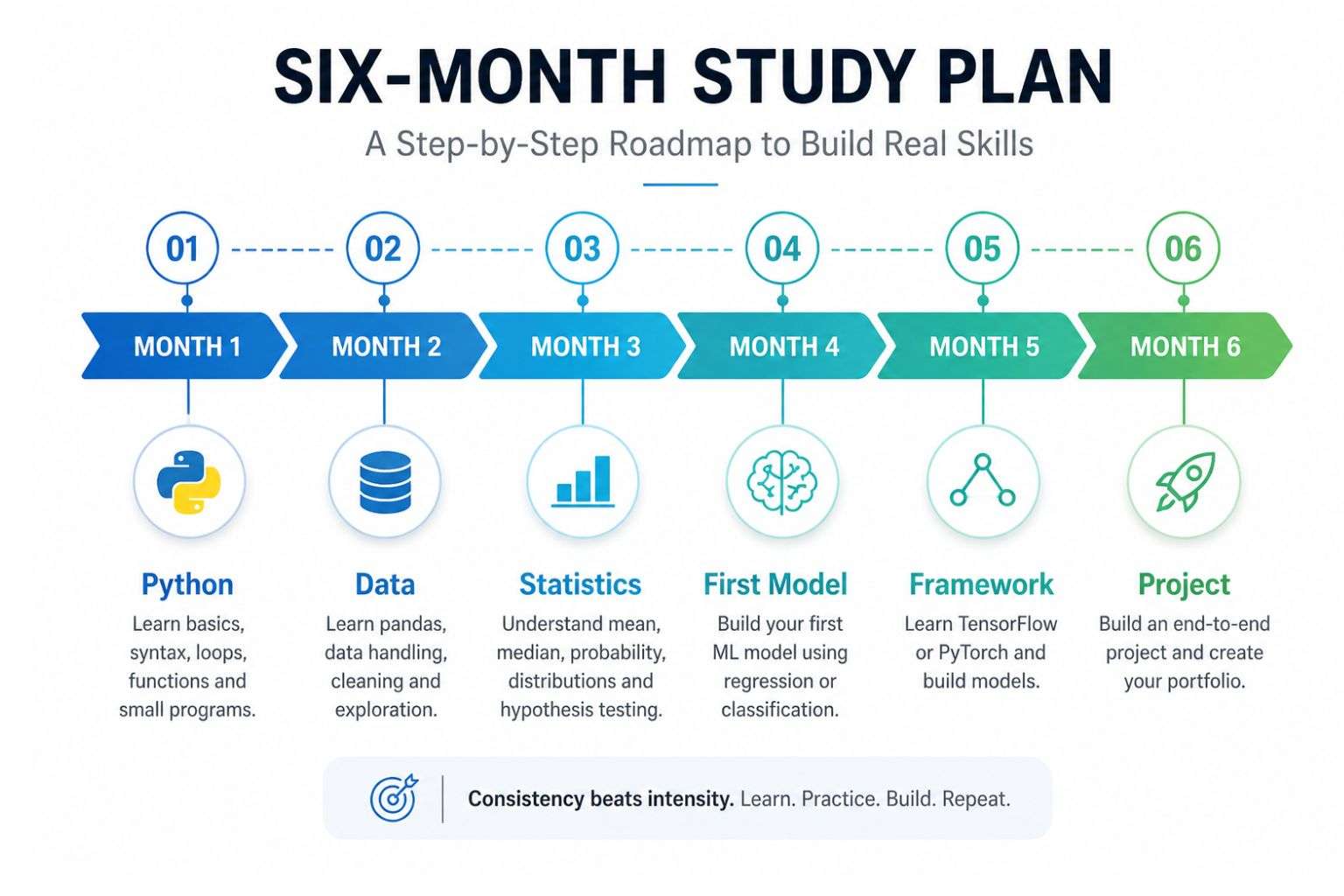
How to Build Your AI and ML Career — A Real Month-by-Month Plan
Not a vague suggestion. A specific plan. Starting today.
Month 1 — Python foundation
Install Python. Start the HackerRank Python track. Complete the 30-day Python challenge — 30 minutes a day. Do not move to ML yet. The foundation must be solid.
Month 2 — Data handling
Learn Pandas and NumPy. Download one real dataset from Kaggle — start with the Titanic dataset. Clean it. Explore it. Visualise it using Matplotlib. This is not glamorous. It is essential.
Month 3 — Statistics fundamentals
Watch 3Blue1Brown’s statistics playlist. Complete Khan Academy’s statistics and probability course. Apply what you learn to the dataset from month two.
Month 4 — First ML model
Work through Kaggle Learn’s Intro to Machine Learning course. Build your first model — a simple decision tree or linear regression. Run it. Evaluate it. Understand why it got things wrong.
Month 5 — Framework introduction
Pick TensorFlow or PyTorch. Work through the official beginner tutorial. Build a simple image classifier using a provided dataset. Get it working. Document what you built and why.
Month 6 — Project and portfolio
Build one original project. It does not need to be complex. A sentiment analyser for product reviews. A house price predictor for your city. A crop yield model using public agricultural data. Put it on GitHub. Write a clear README explaining what it does, what data you used, and what the model’s performance metrics were.
That GitHub project — plus six months of structured learning — is enough to apply for entry-level AI and ML roles at Indian IT companies and mid-size startups.
Six months. One hour a day. That is the actual commitment. Students who tell me they do not have time are usually spending three hours daily on YouTube and Instagram. The time exists. The decision to use it differently is what is missing.
AI and ML Across Industries — What It Means for Your Job Search
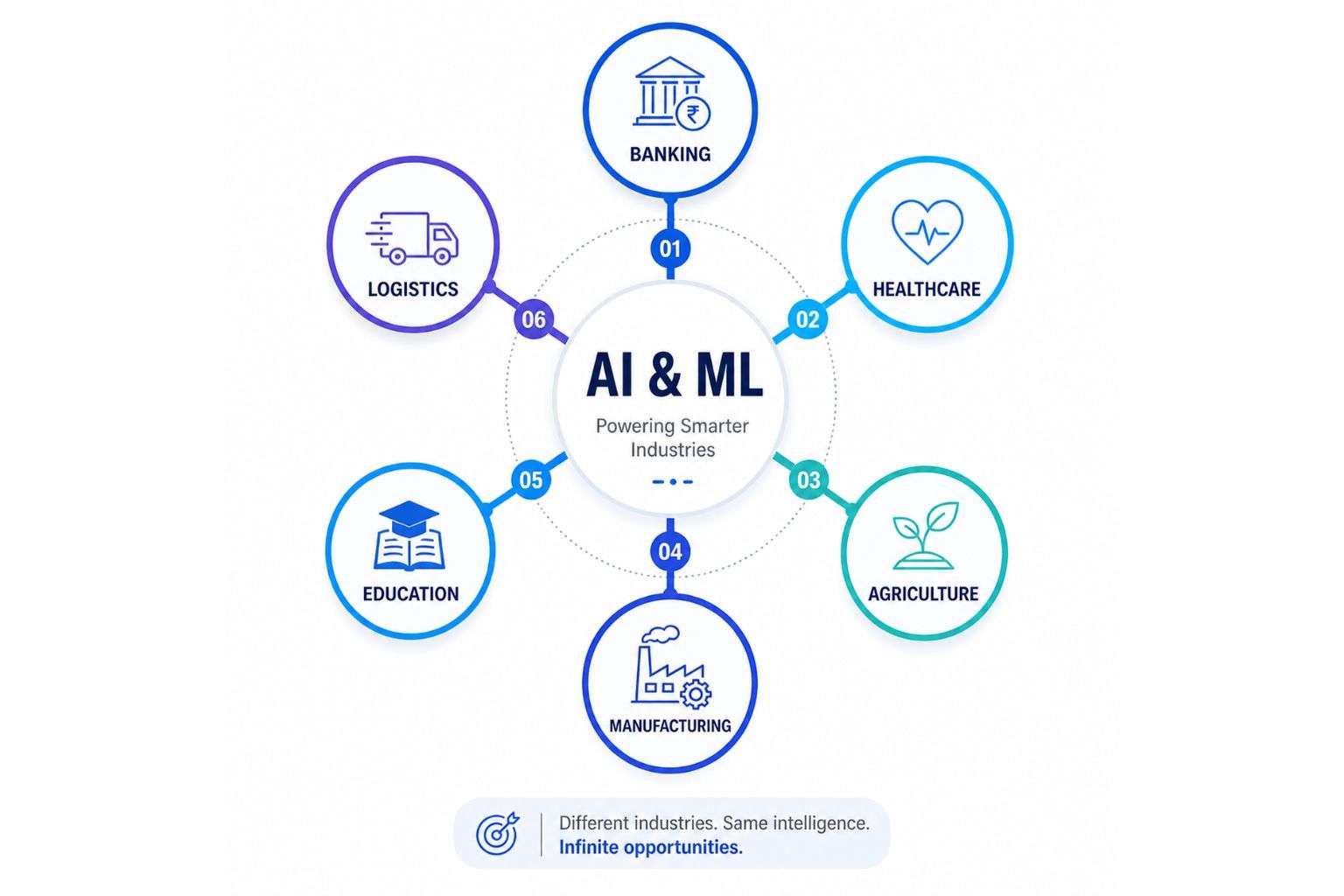
AI is not just a technology company story. It is an every-industry story. And for an engineering fresher in India, this means the job options are much wider than most students realise.
Banking and Financial Services: Fraud detection, credit scoring, customer churn prediction, algorithmic trading. Banks like HDFC, ICICI, and Axis are building internal data science teams. Fintech companies like Paytm and Razorpay run significant ML operations.
Healthcare: Medical image analysis, patient readmission prediction, drug discovery support. Companies like Manipal Health, Apollo, and dozens of healthtech startups are hiring ML engineers.
Agriculture: Crop yield prediction, disease detection from satellite imagery, weather-based irrigation planning. Startups in this space are active in India and often hire engineers from non-CS backgrounds who understand the domain.
Manufacturing: Predictive maintenance, quality inspection using computer vision, supply chain optimisation. This is where ECE and mechanical engineers with ML skills have a genuine edge — they understand the physical systems the AI is monitoring.
Education: Adaptive learning platforms, student performance prediction, content personalisation. India’s edtech sector — even after its correction — runs significant ML operations.
The practical point for your job search: do not only look at tech companies. Look at the industry you understand best from your engineering background. An ECE student who builds ML skills and understands manufacturing processes is more valuable to a manufacturing AI team than a CS student with the same ML skills but no domain context.
What to Do This Week — Your AI and ML Career Action Plan
Seven days. One action each day. Start tonight.
Day 1: Install Python on your laptop. Go to python.org. Install it. Open the terminal. Type “python.” If it runs — you have started.
Day 2: Create a free HackerRank account. Find the Python track. Complete the first five challenges. Time yourself.
Day 3: Create a free Kaggle account. Download the Titanic dataset. Open it in a spreadsheet. Just look at it. Understand what each column means.
Day 4: Watch the first three videos of 3Blue1Brown’s Essence of Linear Algebra series on YouTube. Write down three things you did not know before watching.
Day 5: Read the Cloud Computing Career Roadmap for Indian Students on cguru.co.in. Understand how cloud and AI connect for your career planning.
Day 6: Search “junior ML engineer” on LinkedIn Jobs. Look at five job descriptions. Write down the skills that appear in all five. Compare that list to what you currently have.
Day 7: Write down your six-month plan based on the month-by-month guide above. Specific. Dated. One page. Put it somewhere you will see it daily.
Read these alongside this guide:
- Cloud Computing Career Roadmap for Indian Students 2026
- Full Stack Developer Roadmap for Indian Freshers
- How to Write a Fresher Resume for IT Companies in India 2026
- Your First 3 Years in an Indian IT Company
- Best Certifications for Freshers in India 2026
- Internship to PPO in India 2026
- Government Jobs vs IT Jobs in India 2026
- How to Get AI Jobs in India in 2025 and Beyond
External resources:
- Kaggle Learn — free, project-based ML courses with real datasets
- fast.ai — practical deep learning course, free, respected globally
- Google Machine Learning Crash Course — free, beginner-friendly
- NASSCOM FutureSkills AI Courses — India-specific AI upskilling platform
- 3Blue1Brown YouTube — best visual mathematics explanations for ML foundations
- Machine Learning for Financial Analysis – Rooman Industry-ready Financial Analysis using AI & ML
FAQs — AI and ML Jobs in India for Engineering Students 2026
FAQ 1 — I am a final-year engineering student with no AI or ML background. Is it too late to start and can I realistically get an AI-ML job after graduation?
Not too late. Not even close.
Here is the honest truth about where most students start. The majority of engineering freshers applying for AI and ML roles in India in 2026 have six to eighteen months of self-taught Python and ML behind them — not a formal AI degree. There are almost no formal AI degree programmes in India that have produced significant batches of graduates yet. The field has outpaced the curriculum.
This means the starting line is more level than you think. A final-year student who begins structured AI and ML preparation today and completes the six-month plan above will be more prepared than most candidates applying for the same roles after graduation.
The realistic expectation is this. Six months of genuine preparation will make you competitive for entry-level data engineering roles, junior ML engineer positions at mid-size companies, and AI-adjacent roles at large IT service companies. It will not get you a research engineer role at Google Bengaluru. That takes two to three years of progressive specialisation.
Start with the accessible entry point. Build from there. The AI and ML field rewards consistent learners over quick starters.
Two things to do this week if you are a final-year student. First — add Python and any ML project work to your resume immediately, even if it is a basic Kaggle notebook project. Second — read the Fresher Resume Guide to understand exactly how to frame this experience so it stands out.
FAQ 2 — I am from a non-CS background — ECE or Mechanical Engineering. Can I still get AI and ML jobs in India or is it only for Computer Science students?
Not only for CS students. And in some cases — specifically for domain-specific AI roles — non-CS students have a genuine advantage.
Here is why. An ML model that monitors industrial equipment for failure patterns is more useful when it is built by someone who understands how that equipment actually works. A medical imaging AI model is more robust when the engineer building it understands radiology at some level. Domain expertise combined with ML skills is rarer — and more valuable — than pure ML skills alone.
ECE students have a natural bridge to AI through signal processing, embedded systems, and communications engineering. All of these are ML-adjacent. Adding Python, basic TensorFlow, and cloud fundamentals to an ECE foundation creates a profile that manufacturing and telecommunications companies specifically seek.
Mechanical engineers with AI skills are in demand for predictive maintenance, simulation optimisation, and autonomous systems roles. The manufacturing sector’s AI adoption in India is accelerating fast and the talent pool of mechanical engineers with ML skills is genuinely small.
The preparation path is the same as for CS students — Python first, then statistics, then ML frameworks. But the application strategy is different.
Target industries where your engineering domain matters — manufacturing for mechanical, telecommunications for ECE, healthcare for biomedical. Your domain knowledge is your differentiation.
FAQ 3 — Which is better for getting AI and ML jobs in India — a master’s degree or self-taught certifications and projects?
This question does not have a single answer. It depends on what kind of AI role you are targeting.
For research engineering roles — positions at Google, Microsoft Research, Adobe Research, or academic research labs — a Master’s degree or PhD is almost always required. These roles require deep theoretical foundations that are genuinely difficult to build through self-study alone.
For applied ML engineering roles — the majority of AI and ML job openings in India — a strong portfolio of projects, relevant certifications, and demonstrable Python and ML framework skills will carry you further than a generic Master’s degree from a low-ranked institution.
The specific question I ask students is this. Which Master’s degree? A two-year MTech in AI from IIT or NIT — with access to good research mentorship and industry connections — is worth the time and investment. A two-year MTech from a college without an active AI research group is likely to be two years of delayed career start with a modest credential at the end.
If the Master’s option is not a top-15 institution — build the project portfolio instead. Apply for fresher AI roles. Get industry experience. Revisit the Master’s question after two years in the field if you want to pivot to research.
Certifications worth having: Google Professional Machine Learning Engineer, AWS Machine Learning Specialty, and TensorFlow Developer Certificate. These are assessed, industry-recognised, and signal genuine capability to hiring managers at Indian companies.
FAQ 4 — Will AI take my software engineering job within five years and should I be building AI skills defensively or because there is real opportunity?
Build them because there is real opportunity. Not defensively.
Here is the honest five-year view.
Software engineering jobs are not disappearing in India within five years. The demand for software engineers in India is driven by a global shortage of technical talent that AI has not resolved and will not resolve in that timeline. What is changing is the kind of software engineering work that gets done and the productivity expectations per engineer.
The software engineer who is vulnerable in five years is the one who does only one thing — writes code that follows clearly specified requirements, in a well-understood framework, without system design input or cross-functional judgment. That specific profile of work is being significantly assisted — and in some cases replaced — by AI code generation tools.
The software engineer who is not vulnerable — and is actively growing — is the one who can define what should be built, evaluate whether AI-generated code is correct and secure, architect systems that include AI components, communicate with non-technical stakeholders, and take ownership of outcomes rather than just tasks.
AI is raising the floor of what it means to be a useful engineer. It is also raising the ceiling of what the best engineers can deliver. Both things are true simultaneously.
Build AI and ML skills because they open genuinely well-paying, genuinely interesting career paths. Build them because the market is short of people who have them. Build them because the work is more complex and more rewarding than routine coding.
Those are the right reasons. Fear is not a good career strategy. Curiosity and deliberate skill-building are.
The Last Honest Thing About AI and ML Jobs in India
I want to close this guide the way I close every conversation about AI with students who are worried.
AI is not the enemy of your engineering career.
Passivity is.
The engineers who will struggle in the next ten years are not the ones who could not learn Python or TensorFlow. They are the ones who watched the wave coming and stayed on the beach, waiting to see what would happen.
The engineers who will build strong, well-paid, interesting careers are the ones who got curious. Who spent an hour a day for six months building something they did not fully understand at the start. Who made mistakes with code, debugged them, and learned more from the debugging than from the code that worked.
That curiosity is available to every engineering student in India reading this right now.
The AI wave is not a threat to your career.
It is the biggest invitation your generation has received.
Accept it.
Written by Aslam Rahman — IT Career Consultant with 27 years of experience in IT hiring, fresher placement strategy, and career guidance for Indian students. Based in Bhubaneswar, Odisha. Founder of Career Guru — cguru.co.in.







3 Comments