

How to Answer “Tell Me About Yourself” in an IT Interview in India — What a 27-Year IT Hiring Consultant Has Heard Go Brilliantly and What He Has Heard Make Interviewers Quietly Switch Off
Every IT interview in India starts with the same question. Most freshers answer it the same wrong way.How to Answer “Tell Me About Yourself” in an IT Interview in India Here is exactly what works — with real examples, a word-for-word formula, and the mistakes I have been watching students make for 27 years.
“Tell Me About Yourself” — The Question Every IT Interview in India Starts With and the One Most Freshers Answer Wrong
“Tell me about yourself” is the first question in almost every IT interview in India.
TCS. Infosys. Wipro. Accenture. Cognizant. HCL.
Every company. Every round. Every year.
And yet — after 27 years of sitting in and observing IT interviews — I can tell you with complete certainty that this is also the question most freshers answer the worst.
Not because they are not capable. Because nobody ever told them what the question is actually asking.
Here is the number that sets the scene.

In a typical campus placement drive, an interviewer meets 12 to 15 candidates in a single day. Every one of them is asked this question. And in my experience, 10 out of those 15 give an answer that sounds identical to the previous candidate’s answer. Same opening. Same structure. Same ending.
The interviewer has heard the same answer so many times that they stop listening.
That is the problem this guide solves.
I remember sitting in on a placement drive at a college in Odisha — must have been around 2019. The interviewer told me afterwards, half-laughing: “I heard the same answer fourteen times today. Name. College. Branch. Hobbies. Career goal. Thank you sir.” He said he had started writing his grocery list by candidate seven. That stayed with me. Because those students were not bad candidates. They just had no idea that their answer was putting the most important person in the room to sleep.
This guide wakes that answer up.
What “Tell Me About Yourself” Is Actually Asking — And What It Is Not
Most freshers think this question is asking for their autobiography.
It is not.
It is asking one thing. In a professional way. With polite language around it.
Why should I hire you?
That is it. That is the whole question.
The interviewer is not curious about where you were born. They are not interested in your father’s profession. They do not need to know that you enjoy listening to music in your free time.
They want to know three things in two minutes.
Who are you professionally? What have you done that is relevant to this role? And why are you sitting in this chair today?
Everything in your answer should serve those three questions. Anything that does not serve them is filler. And filler is what makes interviewers write grocery lists.
Here is how I explain it to students. Imagine you are in a lift with the hiring manager. You have 90 seconds before the doors open and they walk out. You are never going to see them again after that. What do you say? That is your “tell me about yourself” answer. Not your life story. Not your college history. The 90 seconds that make them want to meet you properly.

The Formula That Works — Every Time
Here is the structure I have used to coach hundreds of students over 27 years.
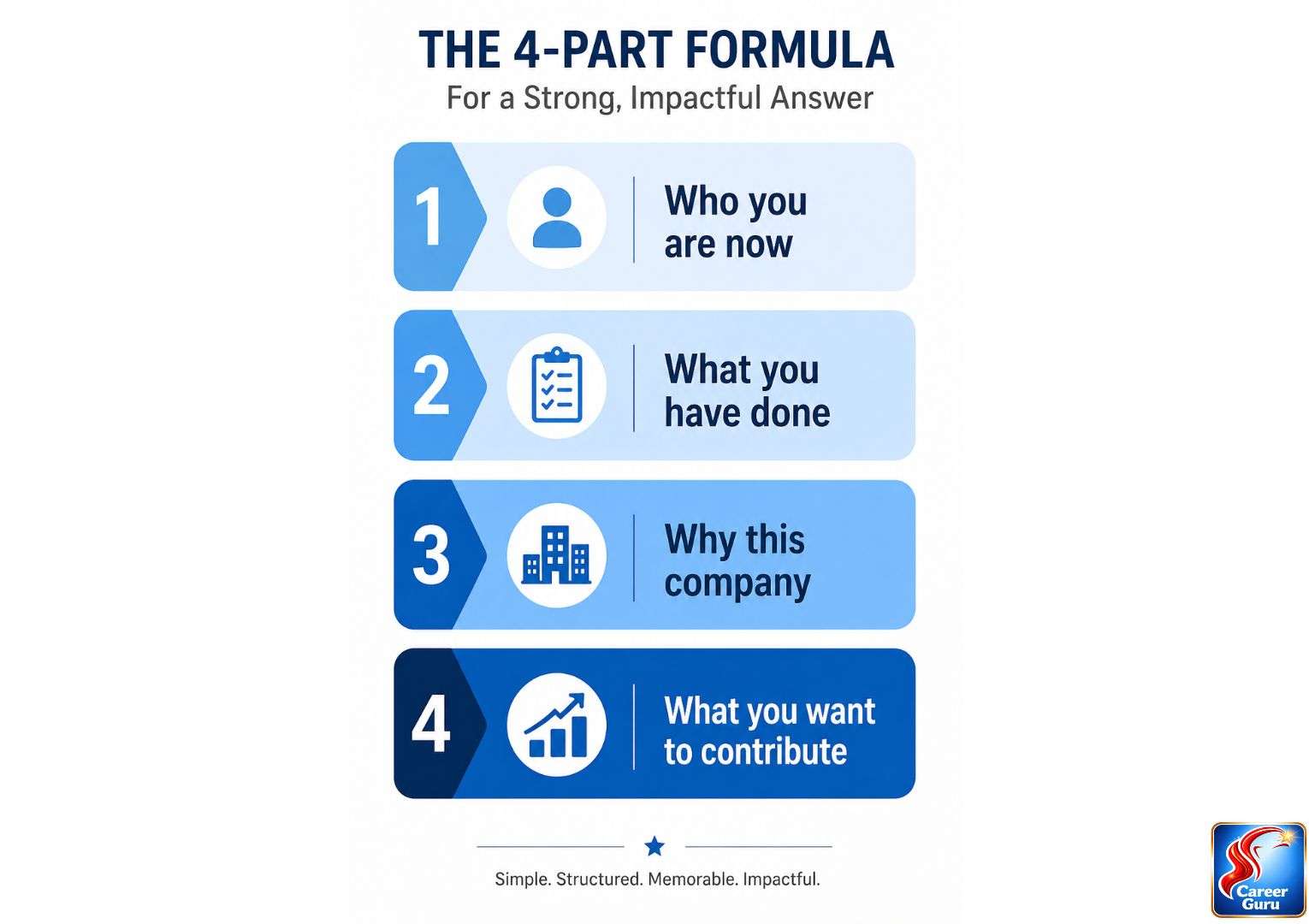
It has four parts. Each part does one specific job.
Part 1 — Who you are right now. (Two sentences.)
Start with your current reality. Your name, your degree, your college, your graduation year. That is it. No childhood. No hometown unless it is directly relevant.
Part 2 — What you have done that matters. (Two to three sentences.)
This is where most freshers skip straight to their hobbies. Do not do that. Talk about your project, your internship, your certification — whatever is the strongest evidence of your capability. One specific thing done well beats a list of five vague things.
Part 3 — Why this company specifically. (One to two sentences.)
Not “because it is a reputed company.” That sentence is the interview equivalent of a shrug. Something specific. Something you actually know about them. One sentence that shows you researched before you walked in.
Part 4 — What you want to contribute. (One sentence.)
End with forward momentum. Where you want to go and how this role fits into that. Brief. Specific. Confident.
The whole answer should take 90 seconds to two minutes. Not five minutes. Not 45 seconds. Two minutes of substance is the target.
The Formula in Action — Three Real Examples
Let me show you exactly what this looks like. Not in theory. In actual words.
Example 1 — Computer Science Fresher Applying to TCS
“My name is Priya Sharma. I am a final-year Computer Science student at KIIT University in Bhubaneswar, graduating this May with a 7.4 CGPA.
During my third year, I built a hospital management system using Python and MySQL as my major project — it was designed for a small clinic in my neighbourhood and it actually reduced their patient record time by about 40%. I also completed a Python for Data Science certification on Coursera last year.
I want to join TCS specifically because of the scale of projects they handle — I want to see how software actually runs at enterprise level, not just in a college lab. That context is something I cannot get anywhere else at this stage of my career.
I am looking to start in a software development role where I can contribute to real systems from day one while continuing to build my technical depth.”
That answer is 150 words. It takes 90 seconds to say comfortably. It answers who, what, why, and where next. The interviewer now knows exactly what to ask you — and you have given them three specific threads to pull on.
Example 2 — ECE Fresher Applying to Wipro
“I am Rahul Verma, a final-year Electronics and Communication Engineering student from NIT Rourkela, graduating in June 2026 with 68%.
My core interest has always been on the software side. I taught myself Python over the last two years — I built an IoT dashboard project that pulled data from temperature sensors and displayed real-time readings on a web interface. That project is what made me certain I wanted to work in software development rather than hardware.
Wipro’s focus on digital transformation projects is what drew me to this opportunity — especially the kind of cross-domain work that connects hardware understanding with software delivery. My ECE background gives me a different lens on system-level problems than a pure CS student.
I want to start in a role where I can apply that background while developing strong software skills on real projects.”
Notice what this does. It addresses the elephant in the room — ECE student applying for IT — before the interviewer asks. It turns a potential weakness into a specific strength. That is not accidental. That is preparation.
Example 3 — Fresher with Internship Experience Applying to Accenture
“My name is Sneha Patnaik. I am a computer science graduate from BPUT, Bhubaneswar, class of 2025.
Last summer I did a two-month internship at a fintech startup in Bhubaneswar where I worked on their customer onboarding module using React and Node.js. The work was actually deployed — real users went through the flow I helped build. That experience of shipping something that real people used changed how I think about software.
Accenture’s consulting-led delivery model is what I find genuinely interesting — the idea that technology decisions are connected to business outcomes, not just technical ones. I want to understand that connection from early in my career.
I am looking for a role where I can bring both my technical base and my internship experience into real client-facing projects.”
This answer does something the other two cannot. It has a specific professional outcome — “real users went through the flow I helped build.” That sentence makes an interviewer sit forward. Because very few freshers have that. And even fewer know how to say it clearly.
What Most Freshers Actually Say — And Why It Does Not Work
I want to show you the answer I hear most often. Not to embarrass anyone. But because seeing it written down makes it immediately obvious why it does not land.
“Good morning sir. My name is Amit Kumar. I am from Patna, Bihar. I completed my schooling from DAV Public School and scored 82% in Class 12. I then joined ABC Engineering College where I am studying Computer Science. My hobbies are playing cricket, listening to music, and browsing the internet. I am a hardworking and dedicated person. I want to work in a good company and grow my career. Thank you sir.”
Read that again slowly.
How much of that answer tells the interviewer anything useful about Amit as a professional candidate?
His hometown — irrelevant. His school name — irrelevant to this role. His hobbies — generic. His self-description — every candidate says hardworking and dedicated. His goal — so vague it applies to literally every person in the building.
The interviewer learned nothing. And now they have to ask follow-up questions just to find out the basics — which Amit’s answer should have already given them.
That answer — or a version of it — is what I have heard thousands of times over 27 years. Students practise it at home and it feels complete to them. It has a beginning, a middle, and an end. It mentions hobbies and career goals. What it does not have is anything specific that tells an interviewer why Amit is in that chair and not the next candidate. The answer describes a person. It does not make a case for a professional.
The Five Mistakes That Kill a “Tell Me About Yourself” Answer
Fix these before your next interview. Even if your next interview is tomorrow.
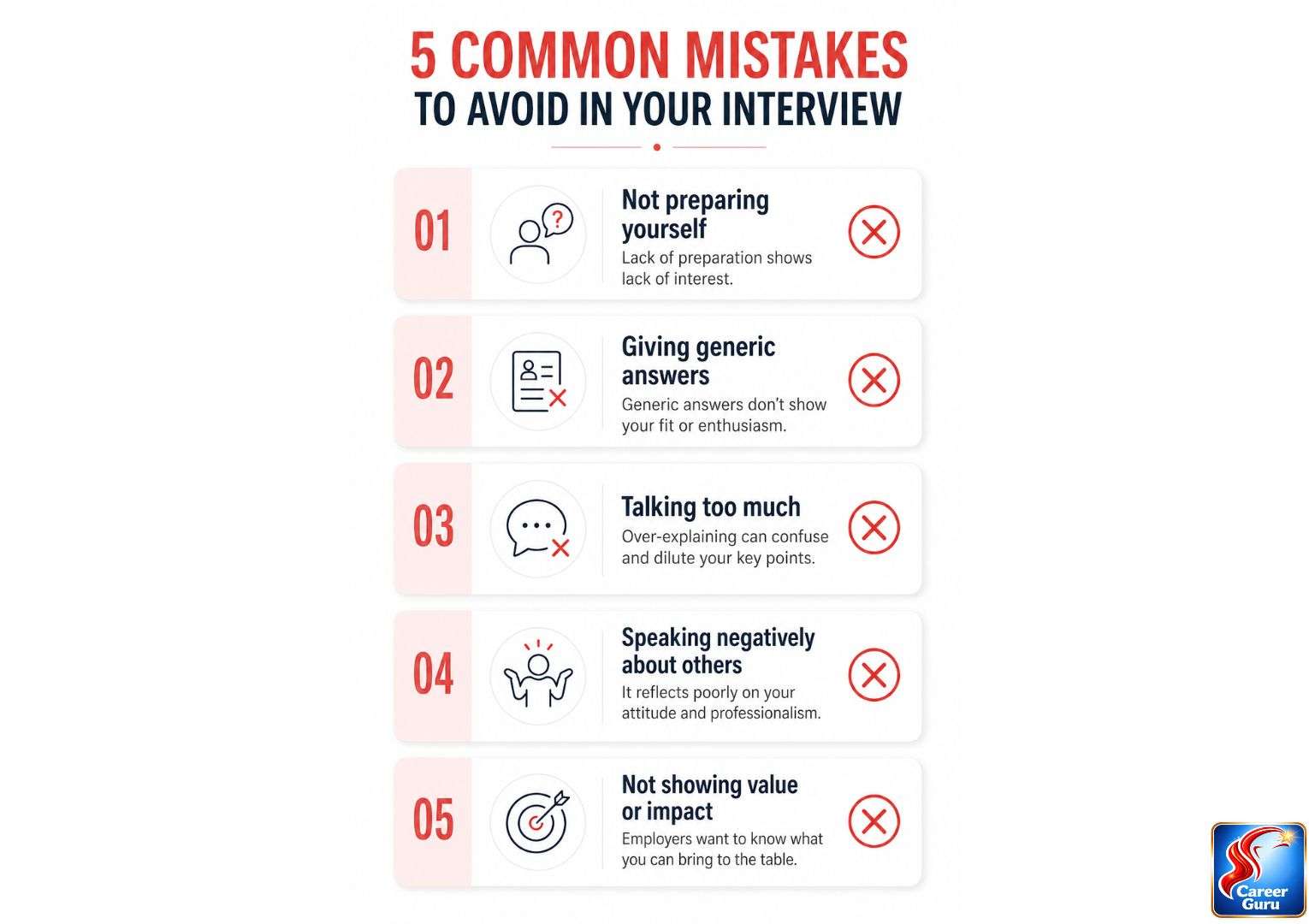
Mistake 1 — Starting with your hometown or school.
Where you grew up is not the first thing a professional interviewer needs to know about you. Start with your current degree and institution. Everything before college is backstory — save it for if they ask.
Mistake 2 — Listing hobbies in the first answer.
Hobbies come up in the HR round when the interviewer specifically asks about them. Volunteering them in your opening answer burns two minutes of valuable first-impression time on information that does not advance your case.
Mistake 3 — Saying “I am hardworking and dedicated.”
So is every other candidate. These words are so expected that they have become invisible. Replace them with a specific example that demonstrates the quality without naming it. “I built a Python project over three weekends without any formal training” shows dedication without saying the word.
Mistake 4 — Ending with “That is all, sir.”
That phrase is a full stop on a conversation the interviewer was hoping to continue. End with something forward-looking — what you want to contribute, what you want to learn, why this role specifically. Give the interviewer something to respond to.
Mistake 5 — Memorising it word for word.
A memorised answer sounds memorised. The pace is too even. There are no natural pauses. If you forget one word midway through, you lose the thread completely.
Memorise the four parts — who, what, why, where next. Then practise saying them in your own words each time. The structure stays fixed. The exact words stay natural.
How to Customise Your Answer for Different Companies
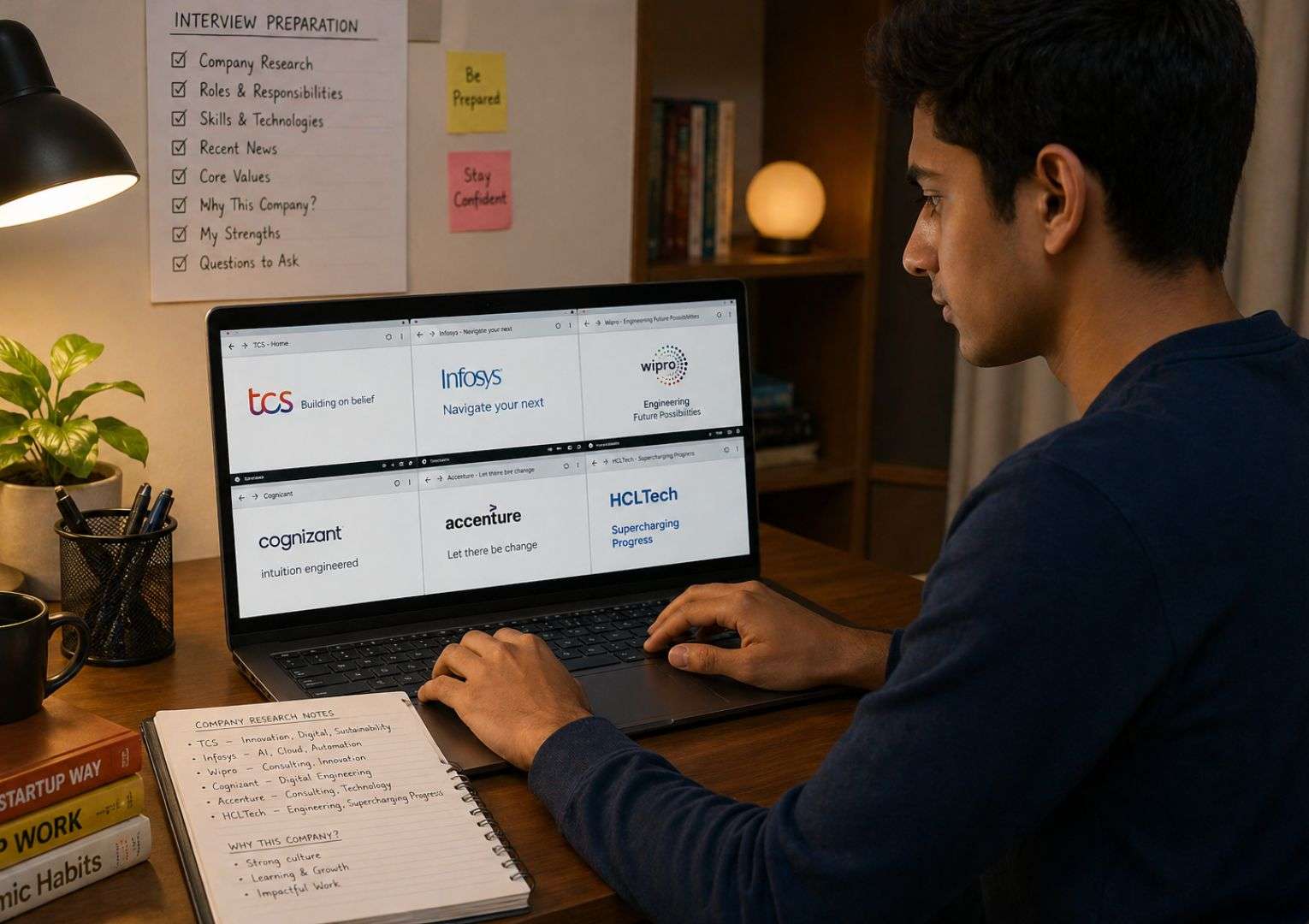
The four-part structure stays the same. Part 3 — Why this company — changes every time.
Here is what to say in Part 3 for each company in your cluster.
TCS: Mention scale. TCS handles some of the largest IT projects in the world. Mention that you want to understand how software works at that scale — something a college lab cannot teach you.
Infosys: Mention their learning culture and InfyTQ platform. If you have completed InfyTQ certifications, this is the moment to connect that to your reason for choosing Infosys. Read the Infosys InfyTQ guide for specific language.
Wipro: Mention their digital transformation work and their NLTH programme’s emphasis on building well-rounded professionals — not just coders. Read the Wipro NLTH guide for context.
Accenture: Mention the consulting-delivery connection. Accenture’s work is closer to business problems than most service companies. That angle genuinely interests a specific type of student. If that is you — say it specifically. Read the Accenture hiring process guide.
Cognizant: Mention their work in specific verticals — healthcare technology, banking, retail. If one of those verticals interests you, connect your project or coursework to it. Read the Cognizant GenC guide.
HCL: Mention their product engineering work. HCL is different from pure service companies in that they build and maintain their own products alongside client delivery. If that distinction interests you — say so. Read the HCL Tech careers guide.
Twenty minutes on each company’s website before your interview is all this research takes. I know students who spend six weeks preparing for the aptitude test and twenty minutes total preparing for the interview. The aptitude test gets you into the room. The interview decides whether you leave with an offer. Allocate your time accordingly.
How Long Should Your Answer Be — and What to Do If the Interviewer Interrupts
Two minutes. That is the target.
Not one minute — too brief, leaves the interviewer wanting and not in a good way. Not five minutes — you have lost them by minute three.
Two minutes of substance, delivered at a natural pace with natural pauses, is the ideal.
Here is a simple way to check your timing. Write out your answer. Read it aloud. Time it. If it is under 90 seconds — add one more specific detail to Part 2. If it is over two and a half minutes — cut something from Part 1 or Part 3.
What if the interviewer interrupts you mid-answer?
This happens. It is actually a good sign. It means they heard something interesting and want to go deeper.
Do not panic. Do not try to finish your prepared answer. Follow their question. Answer it fully. Then — if the opportunity arises naturally — come back to one thing you wanted to say. Something like: “Before we move on, I wanted to mention one more thing about my project that I think is relevant here.”
An interviewer who interrupts your opening answer with a question is already engaged. That is exactly where you want them.
How to Practise This — Without Sounding Rehearsed
Practise is essential. Sounding rehearsed is the enemy.
Here is how to do both at once.
Step 1 — Write the answer once. Fully.
Put every word on paper. The exact sentences. The specific details. Read it ten times until the content is in your head.
Step 2 — Never read it again.
From this point, practise only from the four-part structure. Who. What. Why. Where next. Let the exact words find themselves naturally each time.
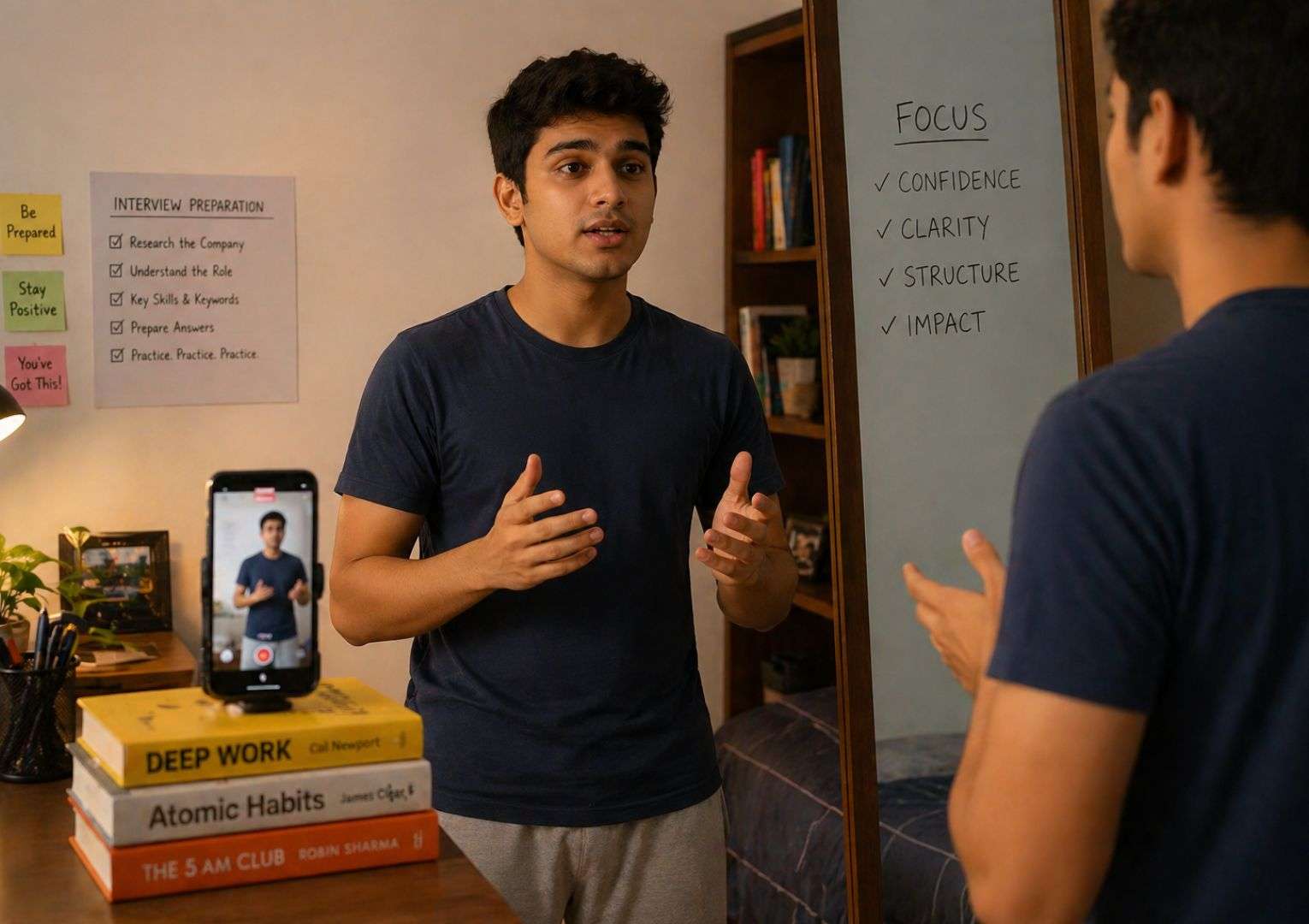
Step 3 — Practise aloud. Every day. For one week.
Not in your head. Out loud. Standing up if possible. Your voice, your pace, your pauses — these only develop through speaking, not thinking.
Step 4 — Record yourself once.
Just once. On day three. Play it back. Listen for three things — do you sound natural, do you sound nervous, does the answer have a clear end? Fix one thing after listening. Then stop watching recordings and just practise.
Step 5 — Say it to a real person before the interview.
Your roommate. Your parent. A classmate who is also preparing. Say it to them and ask one question: “Did that make you want to know more about me?” If yes — you are ready. If they look confused or bored — revise and try again.
I have coached students who practised this answer forty times in a week and it still sounded wooden in the interview. I have coached students who practised it eight times and sounded completely natural. The difference was not repetition. It was whether they were practising the words or practising the feeling of saying something true about themselves. Practise the truth, not the script.
What to Do This Week — Your Action Plan
Seven days. One action per day. Start tonight.
Day 1: Write out your four-part answer in full. Who you are. What you have done. Why this company — pick one company to start with. What you want to contribute. Write it all out completely.
Day 2: Read your written answer ten times. Out loud. Not in your head. Just read it and let the content settle.
Day 3: Put the paper away. Say the answer from the four-part structure only. Time yourself. Adjust if you are too short or too long.
Day 4: Record yourself on your phone. Play it back once. Note one thing to improve — pace, filler words, or a weak sentence. Fix that one thing.
Day 5: Write Part 3 — Why this company — for each of the other companies you are applying to. TCS, Infosys, Wipro, Accenture, Cognizant, HCL. Different sentence for each. Keep the rest of the answer the same.
Day 6: Say the answer to one real person. Ask them: “Did that make you want to know more?” Take their honest answer seriously.
Day 7: Say it three more times. Once in the morning. Once in the afternoon. Once the night before your first interview. By now it should feel like something you are saying — not something you are reciting.
Read these alongside this guide:
- How to Write a Fresher Resume for IT Companies in India 2026
- Fresher Job Interview Questions for IT Companies India
- How to Crack Group Discussion in Campus Placements 2026
- Why Indian Freshers Fail Interviews Despite Good Grades
- Accenture Hiring Process for Freshers 2026
- Cognizant GenC Guide 2026
- HCL Tech Careers for Freshers 2026
- Your First 3 Years in an Indian IT Company
- How to Negotiate Your First Salary as a Fresher in India
External resources:
- LinkedIn Interview Prep Tool — practice interview questions with AI feedback
- Glassdoor Interview Questions — TCS India — real interview questions from candidates
- AmbitionBox Interview Experiences — company-specific interview experiences from Indian candidates
- YouTube — Search “Tell me about yourself IT fresher India” — watch three different video examples and notice what makes each one stronger or weaker
FAQs — How to Answer “Tell Me About Yourself” in an IT Interview in India
FAQ 1—Should I mention my family background or hometown in my answer and will it hurt me if I skip it?
Skip it. Completely.
With confidence.
Your family background and hometown are personal information. They are not professional qualifiers. No interviewer at TCS, Infosys, Wipro, Accenture, or any IT company uses your hometown to decide whether to hire you. It is filler — and filler costs you time that your actual qualifications need.
The reason this keeps appearing in fresher answers is simple. Students in India are taught from school to introduce themselves with name, place, family. It is a social ritual. And it has leaked into a professional context where it does not belong.
The interviewer who wants to know where you are from will ask. That is perfectly fine to answer when asked. But volunteering it in your first answer — when you have 120 seconds to make a professional case for yourself — is using that time on the wrong thing.
There is one exception. If your hometown is directly relevant to something you want to say — for example, you grew up in a tier-two city and that experience shaped your interest in technology access or rural fintech — then one sentence connecting it to something professional is fine. One sentence. With a clear professional connection. Not “I am from Patna, Bihar.”
Remove it from your default answer. The two sentences you reclaim will make room for something that actually matters.
FAQ 2 — I have no internship and my project is very basic — a standard college assignment everyone did. How do I make my answer sound strong without lying?
This is the question I respect most. Because the student asking it is already thinking more clearly than the student who inflates a mediocre project into a “large-scale application.”
Here is the honest answer.
You cannot make a weak answer sound strong by using impressive words. Interviewers see through that immediately — and the follow-up questions will expose it within two minutes. What you can do is present what you genuinely have in the most specific, honest, and thoughtful way possible.
A standard college project described with genuine specificity is far more impressive than an average project dressed up in vague superlatives.
Instead of: “I developed a library management system as my project.”
Say: “My final year project was a library management system built in Java with a MySQL database. My specific contribution was the book issue and return module — I had to figure out how to handle simultaneous requests without data conflicts, which was the hardest technical problem I have solved so far.”
Same project. Completely different impression. One is a project title. The other is a professional who understands what they built and why it was hard.
If you genuinely have nothing beyond coursework — be honest about that and then immediately tell them what you are doing about it. “I have not done a formal internship yet, but I have been working through Python on Coursera for the last two months and I have a small personal project I started last week.” That honesty plus that initiative is a better answer than a fabricated story.
In 27 years I have never seen an interviewer penalise honesty. I have seen them penalise dishonesty dozens of times — usually when a student claims a skill they cannot demonstrate thirty seconds later. Be honest about where you are. Be specific about what you have done. Be forward about what you are building. That combination works.
,
FAQ 3 — How do I answer this question in the HR round versus the technical round — should it be different?
Yes. Slightly. Same structure, different emphasis.
In the technical round, the interviewer is primarily interested in your technical credentials. They will listen to your answer and then jump into technical questions. Your Part 2 — what you have done — should emphasise your project, your technical skills, and any coding or problem-solving experience. Keep Part 3 brief and Part 4 technically focused.
In the HR round, the interviewer is primarily interested in who you are as a person and whether you will fit the team and the company culture. Your Part 2 should still mention your strongest project — but you can also bring in a soft skills moment. Did you lead your project team? Did you present the project at a college event? Did you mentor a junior student? These belong in the HR version.
Part 3 — why this company — matters more in the HR round than anywhere else. The HR interviewer is specifically assessing cultural fit and genuine interest. A vague answer here hurts you more in HR than in a technical round.
Part 4 — where you want to go — can be slightly more personal in the HR version. A technical interviewer wants to hear about the kind of technical work you want to do. An HR interviewer wants to hear about the kind of professional you want to become.
Same four parts. Different colour in each part depending on who is in the room.
FAQ 4 — What if the interviewer says “I have already read your resume — just tell me something not on it.” How do I handle that?
This is a version of the same question — and it is a good one to be ready for.
When an interviewer says this, they are asking for the human being behind the document. They want to know what motivates you, what you think about, what you care about beyond your formal credentials.
This is not a trick. It is an invitation.
Have two or three things ready that are genuinely true about you and professionally relevant — even loosely.
A problem you have been trying to solve in your free time. A book or article about technology or business that genuinely changed how you think. A moment during your project when something clicked — not a technical detail, but an insight about how you work or learn. Something you are genuinely curious about in your field.
The key word in all of those is genuine. Do not manufacture a passion for open-source software if you have never contributed to any. Do not claim to be obsessed with AI if you have not looked at it beyond a college module.
Interviewers have excellent instincts for authenticity. They have heard enough performed answers to recognise a real one when it arrives.
One student I counselled answered this exact question by saying, “I have been trying to understand why the electricity billing system in my village is so inefficient — and I have been sketching out what a simple app solution might look like.”
That was a real answer. It showed curiosity, problem-solving instinct, and connection to real-world challenges. The interviewer spent ten minutes talking to him about it.
Find your real version of that. It is in there somewhere.
FAQ 5 — I get nervous and blank out mid-answer. What do I do if I lose my train of thought while saying “tell me about yourself”?
Pause. Do not fill the silence with “um” or “so basically.” A two-second pause looks composed. A stream of filler words looks panicked.
If you have genuinely lost the thread, say so simply: “Give me a moment to gather my thoughts.” No interviewer holds that against you. What they remember is not the pause — it is how you recovered from it.
The real fix happens before the interview, not during it. Blanking out usually means you memorised sentences instead of memorising the four-part structure — who, what, why, where next. Sentences are fragile. A structure is not. If you forget the exact wording of Part 2, you can still say something true about your project, because you know what Part 2 is for, not just what it says.
Consultant’s Note: I have watched a student blank out completely on Part 1 — could not remember his own CGPA for a second — and still get the offer, because he smiled, paused, said it, and moved on like it was nothing. I have also watched a student recover a memorised paragraph word-perfect and get rejected because the panic in his eyes never left the room. Interviewers hire composure under pressure. That is literally the job. Your recovery from a blank is often more persuasive than the answer you had planned.
FAQ 6 — Does this same formula work for a telephonic or video interview, or is it different online?
Same formula. Different delivery.
On a video call, the interviewer cannot read your body language the way they would in person, so your voice has to carry more of the confidence. Sit up. Look at the camera, not the screen — this is the single biggest fix that makes people look engaged on video instead of distracted.
On a phone interview, you lose visual cues entirely. Pace matters more. Slow down slightly from your normal speaking speed, because phone audio compresses your voice and fast speech becomes harder to follow.
One practical difference — keep a one-line note of your four parts visible just off-screen or next to the phone. Not a script. Just the four headers: who, what, why, where next. Nobody can see it, and it steadies you if your mind goes quiet for a second.
Consultant’s Note: During the pandemic years I coached almost every student on video-call interviews for the first time, and the pattern was consistent — the ones who treated it like a real conversation with a real person on the other side did better than the ones who treated it like reading an announcement to a screen. Look at the camera. Talk to the person, not the technology.
FAQ 7 — I am a diploma holder or from a non-BTech background applying to IT companies through a lateral entry or off-campus drive. Should my answer be different?
Yes — in one specific way. Address the path directly instead of hoping nobody notices.
If you are a diploma holder, BSc graduate, or came in through a non-traditional route, do not skip past it and hope the interviewer doesn’t ask. Own it in Part 1, briefly, and let Part 2 do the heavy lifting. “I completed my diploma in Computer Science and have spent the last year building practical projects to strengthen my fundamentals” is a stronger opening than trying to sound identical to a BTech candidate.
The ECE-fresher-applying-to-software example earlier in this guide works on the same principle. Do not hide the unusual path. Explain why it is actually relevant.
Consultant’s Note: Some of my strongest placements over the years have come from students with non-traditional backgrounds — a BSc graduate who taught herself full-stack development, a diploma holder who out-coded half his BTech batch. What separated them was not the degree on paper.
It was that they had already turned the “unusual path” question into their opening strength instead of waiting for the interviewer to ask it as a challenge.
FAQ 8 — My English is not very fluent. Will that hurt my “tell me about yourself” answer even if my technical skills are strong
Grammar matters less than you think. Clarity matters more than you think.
Interviewers at Indian IT companies are not evaluating you for a spoken English exam. They are checking whether they can follow what you are saying and whether you can communicate in a professional setting. Short, simple sentences said with confidence beat long, complex sentences said with hesitation every time.
This is actually good news for the four-part structure — it is built entirely from short sentences. There is no fluency ceiling you need to hit. There is a clarity floor you need to clear, and most students clear it comfortably once they stop trying to sound impressive and start trying to sound clear.
Practise out loud daily, as the guide describes. Fluency under pressure is a physical skill, built through repetition, not a talent you either have or do not.
Consultant’s Note: I have sat across from students whose English was far from polished and watched them get offers over more fluent candidates, because what they said was specific and honest. I have also watched a beautifully fluent answer fall flat because it said nothing. Content beats polish. Always has, in my experience.
FAQ 9 — This is a walk-in interview and I was not expecting to be called in today. Can I still use this formula without preparation time?
Yes — because the formula does not require memorisation, it requires structure, and you already have the content in your head even if you have not organised it yet.
Before you walk in — even with five minutes in the waiting area — mentally sort what you know into the four buckets. Who you are, in two lines. What you have done, pick your single strongest project or achievement. Why this company, glance at anything you know about them, even from the noticeboard outside. Where you want to go, one honest sentence.
Five minutes of sorting beats zero minutes of sorting, every time. The formula is designed to work under exactly this kind of pressure, because it does not depend on a written script.
Consultant’s Note: Walk-in drives are where I have seen the formula prove itself the most, honestly. Students with no time to overthink often give a more natural answer than students who rehearsed for a week and sound like a recording. If a walk-in catches you off guard, that is not a disadvantage. Use the five minutes you have. It is usually enough.
FAQ 10 — Should my answer change if I am applying for an off-campus or referral interview instead of a campus placement drive?
Slightly — mainly in Part 3.
In a campus drive, “why this company” can lean on general research, because you likely have not had a personal connection to the company before the drive. In an off-campus or referral interview, you usually have more specific context — how you heard about the opening, why you applied to this particular role rather than a general placement pool, or who referred you.
Use that context. “I applied to this role specifically because of the DevOps team’s work on your cloud migration project, which I read about on your engineering blog” is a stronger Part 3 than anything a campus candidate could say, because it demonstrates intent that a mass campus applicant cannot show.
Everything else in the four-part structure stays the same.
Consultant’s Note: Referral and off-campus interviews reward specificity more than campus drives do, because the interviewer already expects you to have done more homework — you sought this role out. Treat that expectation as an opportunity, not a burden. It gives you more to say in Part 3, not less.
The Last Thing I Want to Say Before You Walk Into That Room
Every student I have ever worked with has said some version of the same thing after their first interview.
“Sir, I knew the answer. I just could not say it properly.”
That is the gap this blog was written to close.
The words exist. The experience exists. The capability exists. The gap is only between what you know and what you can express — clearly, naturally, in 120 seconds — to a stranger who is deciding your career in that short window.
The answer to “tell me about yourself” is not a performance. It is not a script. It is your first professional conversation.
Go into it with four clear things to say. Say them honestly. Say them specifically. End with somewhere you are going — not somewhere you have been.
That is the whole thing.
Now go practise it out loud. Tonight. Not tomorrow.
What to Do—Your Action Plan, by College Year
If you are in your 1st or 2nd year:
You have time on your side — use it to build Part 2 material, not to write the answer itself. Take on one project beyond your coursework, even a small one. Start a habit of noting down what you learn and why it mattered, in a simple diary or notes app. This becomes the raw material your final answer will draw from. Do not try to “practise” the formula yet — there is nothing to say until you have something to say.
If you are in your 3rd year:
Start building your strongest Part 2 asset now — a project, an internship, or a certification you can speak about with real specificity by placement season. Read through the company-specific Part 3 notes in this guide and identify one or two companies you are genuinely interested in, so your research has a head start. Write a rough first draft of your four-part answer, even if it changes later. A rough draft beats a blank page when placement season arrives.
If you are in your final year and placements are approaching or underway:
This is the seven-day sprint.
- Day 1: Write out your four-part answer in full — who you are, what you have done, why this company (pick one to start), what you want to contribute.
- Day 2: Read your written answer aloud ten times. Let the content settle.
- Day 3: Put the paper away. Say the answer from the four-part structure only. Time yourself.
- Day 4: Record yourself once. Note one thing to improve. Fix that one thing.
- Day 5: Write a separate Part 3 for each company you are applying to. Keep the rest identical.
- Day 6: Say the answer to one real person. Ask them: “Did that make you want to know more?”
- Day 7: Say it three more times — morning, afternoon, and the night before your first interview.
Verified YouTube Links
- Tell Me About Yourself — Best Answer for Freshers & No Experience
- How To Answer “Tell Me About Yourself for Freshers” — With Sample Examples
- Fresher Self Introduction — Tell Me About Yourself, Best Answer for Freshers
Written by Aslam Rahman — IT Career Consultant with 27 years of experience in IT hiring, fresher placement strategy, and career guidance for Indian students. Based in Bhubaneswar, Odisha. Founder of Career Guru — cguru.co.in.







3 Comments