

How to Negotiate Your First Salary as a Fresher in India in 2026 — A 27-Year IT Hiring Consultant Tells You When to Do It, What to Say and the One Mistake That Costs Students Thousands Every Month
Most freshers either never negotiate or negotiate the wrong way. After 27 years of watching salary conversations go well and go badly, here is the honest guide Indian freshers actually need.
Fresher Salary Negotiation in India — The Conversation Nobody Teaches You Before Placement Season
Fresher salary negotiation is the one skill every Indian student needs before placement season.
And almost nobody has it.
Not because students are not capable. Because nobody taught them.
School did not cover it. College placement cells do not cover it. Most parents say — “Just take the offer. Do not create problems.” And so students walk into one of the most financially important conversations of their early career completely unprepared.
Here is the number that should make you pause.
A fresher who successfully negotiates their starting salary up by just ₹20,000 per month in 2026 — and stays at that company for three years — will earn approximately ₹7 to ₹8 lakhs more over that period than a colleague who accepted the first number without question. That is because every increment, every bonus, and every future salary hike at a new company is calculated from your base salary. The first number you accept is the foundation of your entire salary trajectory.
I have spent 27 years on both sides of this conversation. I have hired freshers. I have coached freshers. I have watched students leave enormous amounts of money on the table because they were afraid to say three sentences.
This guide tells you exactly what those three sentences are. And everything else you need to know before that conversation happens.
Why Fresher Salary Negotiation in India Is Different From What You Read Online
Most salary negotiation advice on the internet is written for experienced professionals in the US or UK.
It does not apply to you.
An Indian fresher in 2026 is negotiating in a very specific context. The rules are different here.
Here is how.
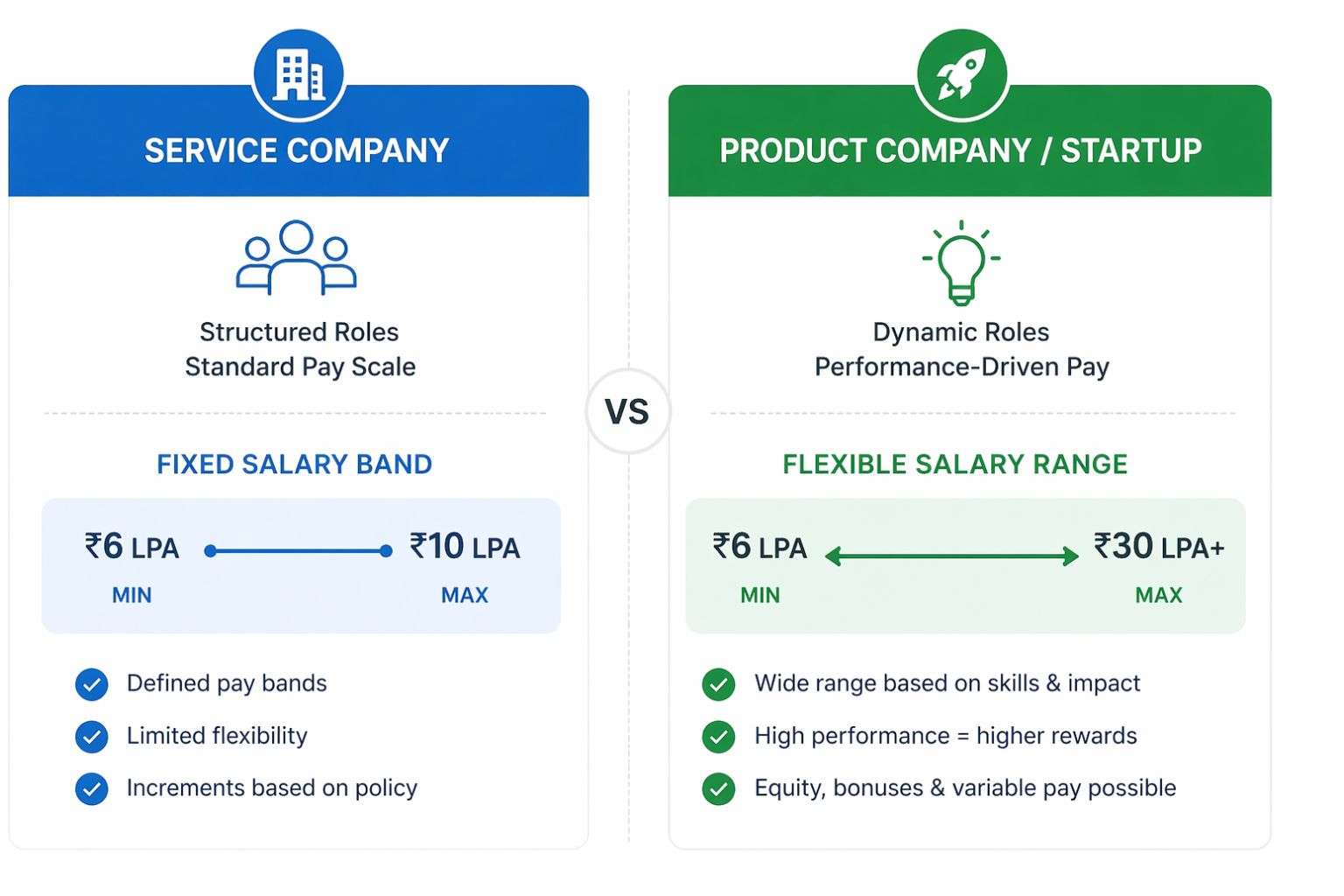
Service companies have fixed salary bands for freshers. TCS, Infosys, Wipro, and Cognizant have structured CTC slabs. For most fresher tracks, there is very limited room to negotiate base pay. The real negotiation at service companies is about joining bonus, role preference, technology track, and training pathway — not the base number.
Product companies and startups have more flexibility. If your offer is from a mid-size product company or a funded startup, there is genuine room to negotiate. These companies do not have rigid bands the way service giants do.
Your negotiation power comes from competing offers — not from desire. Wanting more money is not leverage. Another offer is leverage. This is the single most important thing to understand before you enter any salary conversation.
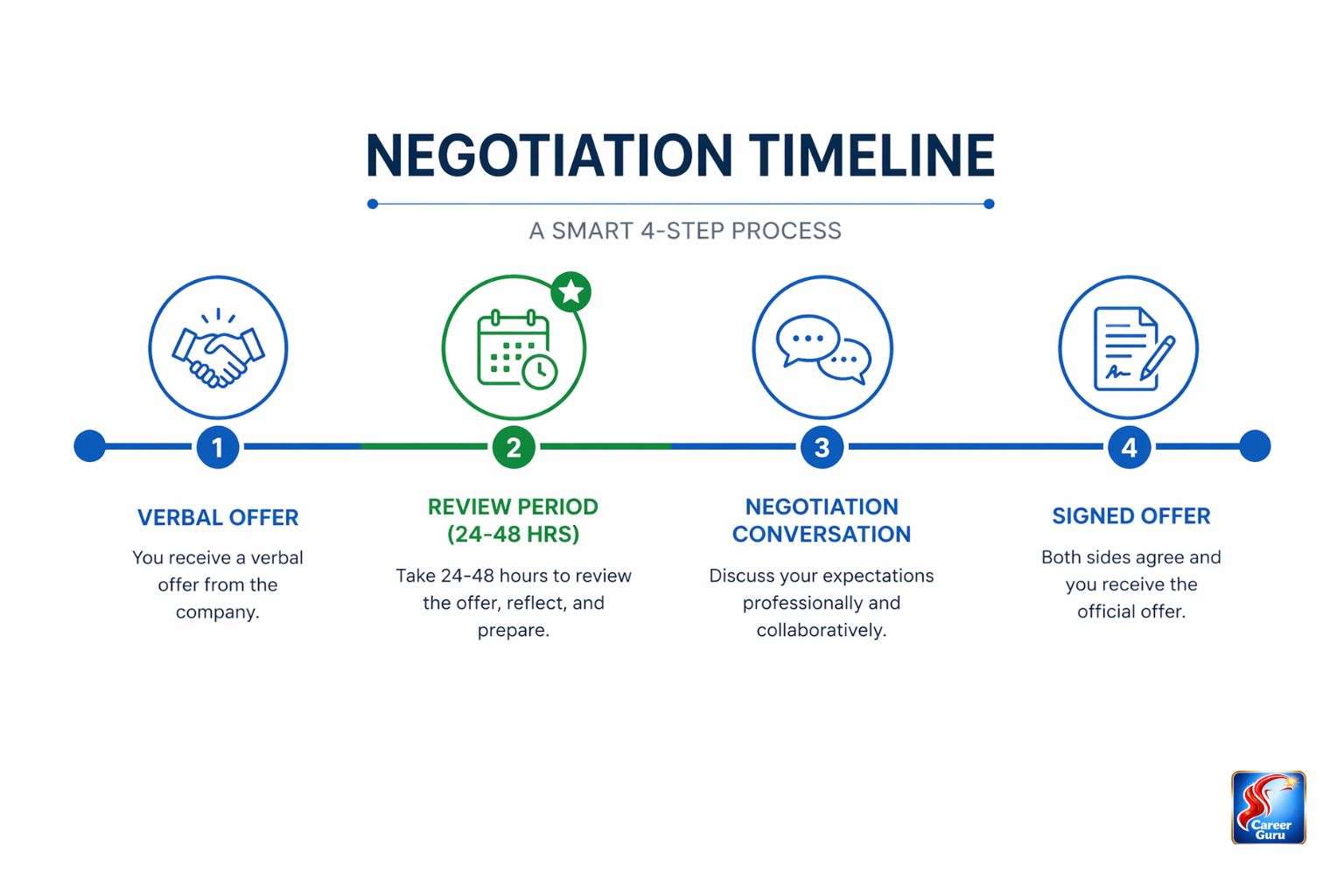
The window for negotiation is shorter than you think. Once you sign the offer letter, the conversation is over. The time to negotiate is after the verbal offer and before the signed offer.
Consultant’s Note: I have seen students try to negotiate six months after joining — asking for a “salary correction.” It almost never works at that stage. The time to negotiate is before you sign. Every single time. If you miss that window, you wait for the annual appraisal cycle. Plan accordingly.
What Fresher Salary Negotiation Actually Looks Like — The Three Scenarios
Before I give you scripts, you need to understand the three situations a fresher can be in. Each requires a different approach.
Scenario 1 — You Have One Offer and No Other Options
This is the hardest position to negotiate from. And the most common.
You cleared TCS NQT. You got a Ninja offer. It is your only offer so far. Can you negotiate?
Honestly — very little room exists in this scenario for the base salary. Service company fresher bands are set institutionally.
But here is what you can do.
Ask about the technology track or role preference during onboarding. Ask about timeline for the next appraisal. Ask whether there are internal tests you can take to move to a higher-paying track post-joining. Ask about the joining bonus if any exists.
These are soft negotiations. They do not change the number on the offer letter. But they change the trajectory of your first year.
Do not decline or stall a single offer hoping for a better one. Unless you have another offer already in hand with a confirmed timeline, this is not a risk worth taking.
Scenario 2 — You Have Two Offers From Different Companies
This is where real negotiation begins.
Two offers means you have something every negotiation requires — an alternative. An HR manager at Company A knows that if they do not improve the offer, you will take Company B’s offer. That changes the conversation.
This is also where most students make the biggest mistake. They reveal the other company’s offer immediately and ask Company A to “match it.”
Do not do that. Not yet.
I will give you the exact script shortly.
Scenario 3 — You Have One Offer and You Are Still in Process at Other Companies
This is the most common real-world situation.
You have an offer from Company A. You are still in the final rounds at Company B, which pays better.
Here you need to buy time — professionally and politely.
Ask Company A for an extension on your offer acceptance deadline. Most companies will give you 5 to 7 additional days if you ask respectfully. Use that time to complete the Company B process.
If Company B comes through — you now have Scenario 2. If Company B does not come through — you have Scenario 1, and you accept Company A’s offer.
When to Start Fresher Salary Negotiation — The Exact Timing
Timing matters more than most students realise.
Too early — before the formal offer — and you look presumptuous. The company has not decided to hire you yet. Bringing up salary expectations too early signals you are more interested in the number than the role.
Too late — after you have signed the offer letter — and you have no leverage. The conversation is closed.
The right moment is this: after the HR has verbally told you that the company wants to extend an offer — and before you have signed anything.
That gap — between verbal offer and signed letter — is your negotiation window.
In many campus placements, the verbal offer happens at the end of the HR round. Or the HR calls you a day or two later with the CTC. That is the moment.
You will feel relief that you got the offer. You will want to say yes immediately.
Do not.
Take a breath. Thank the HR warmly. And then say these words:
“Thank you so much. I am genuinely excited about this opportunity. Before I confirm, could I take 24 to 48 hours to review the offer in detail?”
That is it. That one sentence gives you time to think, research, and prepare your response.
Consultant’s Note: No professional HR manager in India will think less of you for asking for 24 to 48 hours to review an offer. It is a sign of seriousness, not hesitation. If a company rescinds an offer because you asked for 24 hours — that tells you something important about that company’s culture.
What to Say During Fresher Salary Negotiation — Word-for-Word Scripts
This is the part most guides skip. They tell you what to do in theory. I will tell you what to say in practice.
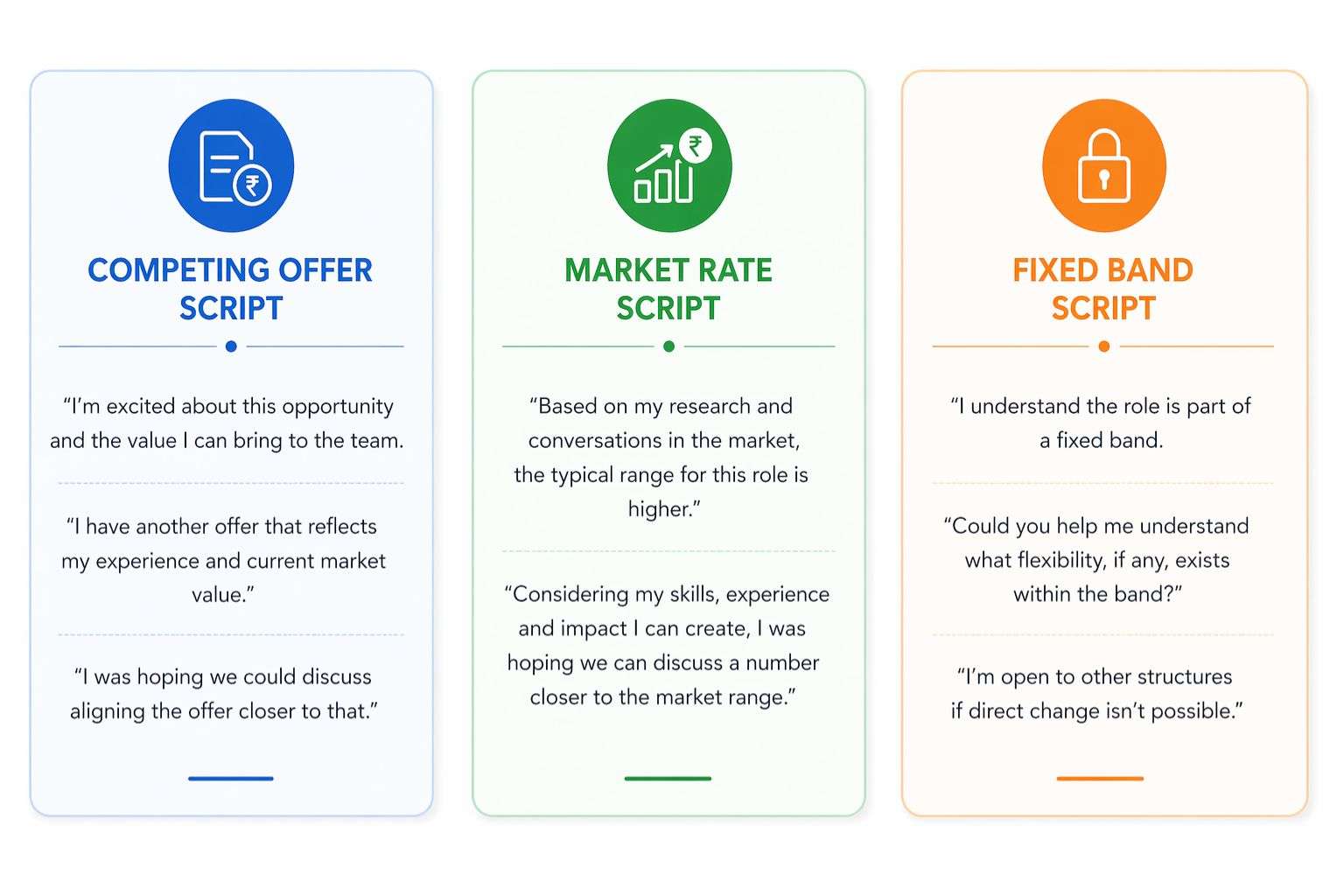
Script 1 — When You Have a Competing Offer
Context: Company A has offered you ₹3.5 LPA. Company B has offered you ₹4.2 LPA.
What to say:
“Thank you for the offer. I am very interested in joining [Company A] — the role and the team genuinely appeal to me. I want to be transparent with you. I do have another offer on the table at ₹4.2 LPA. I would much prefer to join [Company A] if we could get closer to that number. Is there any flexibility on the CTC?”
Then stop talking. Wait for the response.
Why this works: You are not making a demand. You are expressing preference for their company while being honest about your alternative. This is respectful and professional. It gives the HR manager something to take to their manager — “the candidate has a competing offer and prefers us.”
Script 2 — When You Have No Competing Offer But the Number Feels Low
Context: You have one offer at ₹3.5 LPA. You have researched and found that similar roles at similar companies pay ₹4 to ₹4.5 LPA.
What to say:
“Thank you for the offer. I am excited about this opportunity. I did some research on current market rates for this role in [city], and I found that the range tends to be around ₹4 to ₹4.5 LPA for freshers. Given my [mention one specific strength — internship, project, certification], I was hoping we could consider ₹4 LPA. Is there any room to discuss?”
What makes this work: You are using market data — not just desire. You are citing one specific qualification that justifies the ask. You are asking a question — not making an ultimatum.
Script 3 — When the Base Is Fixed But You Can Negotiate Around It
Context: Service company with a fixed fresher band. The base cannot change.
What to say:
“I completely understand the salary structure. Could you help me understand — is there a joining bonus? Are there any provisions for an early appraisal after six months? And is there any flexibility around the technology track or role preference during onboarding?”
Why this matters: You are not fighting the fixed band. You are finding other dimensions to improve your overall first-year value. Joining bonuses of ₹50,000 to ₹1,00,000 exist at some companies. Early appraisal eligibility is real at some tracks. These are worth asking about.
What NOT to Say During Fresher Salary Negotiation — The Phrases That End Conversations
Just as important as knowing what to say is knowing what to avoid.
“My family needs more money.” Personal financial circumstances are not a negotiation point. HR managers sympathise but cannot act on them. This makes you look unprepared.
“My friend got ₹X at the same company.” A colleague’s salary — whether real or rumoured — is not market data. It is hearsay. HR will not act on it. It also makes you look like you are comparing yourself to others rather than stating your own value.
“I deserve more because I worked very hard.” Effort is expected. It is not a differentiator. Every candidate who made it to the offer stage worked hard. State outcomes, not effort. “I led a final year project that won the department award” is better than “I am a very hardworking person.”
“This is my final answer — I am not accepting anything less.” Ultimatums from freshers almost never work. They put HR in a defensive position. And if the company calls your bluff — you have no good options. Ask questions. Do not make demands.
“Can you tell me what the maximum you can offer is?” This signals you are fishing without a strategy. It puts the burden on them rather than making a specific, justified ask.
Consultant’s Note: The tone of a salary negotiation matters as much as the content. Confident does not mean aggressive. Grateful does not mean a pushover. Find the tone that is warm, specific, and professional. That tone gets better results than either extreme.
How Much Can a Fresher Actually Negotiate in India in 2026 — Realistic Numbers
Students often go into this conversation with unrealistic expectations. Let me give you honest benchmarks.
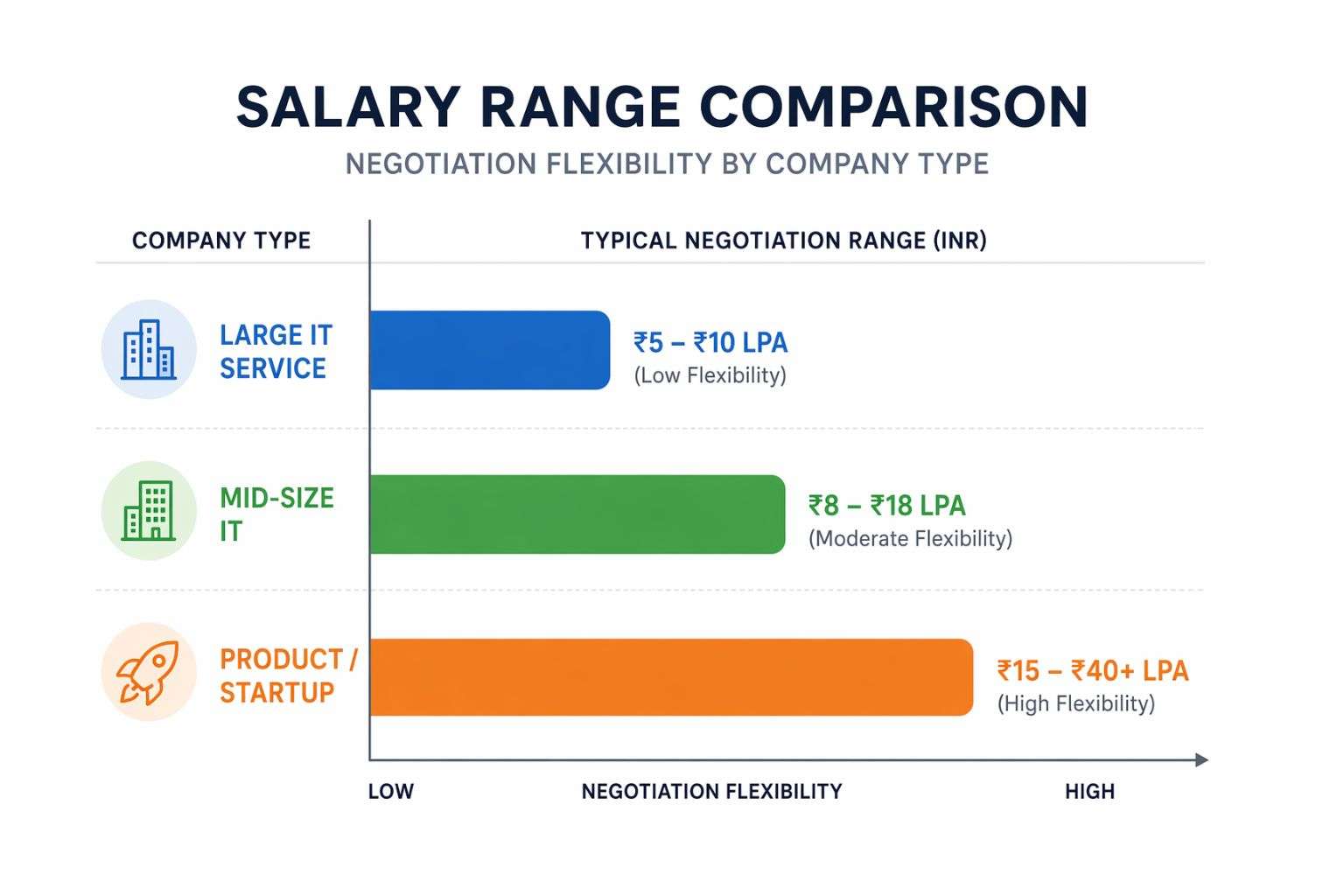
Large IT service companies (TCS, Infosys, Wipro, Cognizant): Realistic negotiation range on base salary: ₹0 to ₹30,000 annually. Bands are structured. Joining bonus where applicable: ₹25,000 to ₹1,00,000. Role/track preference: Possible in some drives.
Mid-size IT companies (Capgemini, HCL, Mphasis, L&T Infotech): Realistic negotiation range: ₹20,000 to ₹60,000 annually on base. More flexibility than tier-one service companies.
Product companies and funded startups: Realistic negotiation range: ₹50,000 to ₹1,50,000 annually. Sometimes more if you have a competing offer. Variable components, ESOPs, and joining bonuses also negotiable.
What does “realistic” mean here? It means this is the range where HR managers have reported successfully adjusting fresher offers. It does not mean every negotiation succeeds. It means these numbers are achievable with the right approach, the right timing, and the right reason.
For context on what freshers are actually earning across these companies, the Fresher Salary in IT Companies India 2026 guide on cguru.co.in breaks down exact figures by company and track.
Fresher Salary Negotiation and the Offer Letter — What to Read Before You Sign
Most freshers read the CTC number and sign.
That is a mistake.
Here is what you need to check before signing any offer letter in India.
Fixed versus variable pay split. A CTC of ₹4 LPA sounds equal regardless of company. But one company’s ₹4 LPA might be ₹3.5 lakh fixed and ₹50,000 variable. Another’s might be ₹3 lakh fixed and ₹1 lakh variable. Your in-hand monthly salary depends entirely on the fixed component.
PF deduction. Provident Fund contributions reduce your take-home. Both you and the employer contribute 12% of your basic salary. This is not optional. Factor it into your monthly calculation.
Joining location. Some companies list a CTC that includes a city-specific allowance. If you are posted in Mumbai or Bengaluru, that allowance matters. If you are posted in a tier-2 city where cost of living is lower, it matters differently.
Bond clause. Some companies include a training bond — requiring you to serve for 12 to 24 months or repay training costs. Read this carefully before signing. Know exactly what the bond covers and what the penalty is.
Consultant’s Note: I have counselled students who discovered a ₹1,50,000 training bond repayment clause six months into their job — when they wanted to leave for a better offer. Read every clause before you sign. Ask HR to explain anything you do not understand. No professional HR will mind explaining a clause to a new joiner. It is your right.
How Fresher Salary Negotiation Connects to Your Full Placement Strategy
Salary negotiation does not happen in isolation.
The stronger your overall placement preparation, the more negotiating power you have. A student with offers from TCS NQT, Cognizant GenC, and one product company walks into every HR conversation with genuine leverage.
A student with one offer has almost none.
This is why the four-company service cluster strategy I wrote about in the Cognizant GenC Guide 2026 matters beyond just selection. Multiple offers create negotiation options. One offer creates dependency.
Build your preparation to give yourself options. Then use those options in salary conversations.
Read these related posts alongside this guide:
- How to Crack Group Discussion in Campus Placements 2026
- Cognizant GenC Guide 2026
- Wipro NLTH Guide for Indian Students 2026
- Infosys InfyTQ Preparation Guide 2026
- Why Indian Freshers Fail Interviews Despite Good Grades
- Fresher Job Interview Questions for IT Companies India
External Resources:
- LinkedIn Salary Insights India — check real salary data by role and city before negotiating
- AmbitionBox Fresher Salaries — employee-reported salary ranges for Indian IT companies
- Glassdoor India Salary Tool — cross-verify CTC benchmarks before your conversation
- Naukri Salary Calculator — negotiation tips and market rates
Suggested YouTube Videos:
- Search: “Salary negotiation for freshers India Hindi” — Apna channel has practical, India-specific videos with real HR conversations demonstrated
- Search: “How to negotiate salary India fresher TCS Infosys” — multiple placement prep channels cover company-specific negotiation scenarios
- Search: “Offer letter kaise padhe India fresher” — helpful Hindi-language guides on reading Indian offer letters before signing

FAQs — How to Negotiate Your First Salary as a Fresher in India
FAQ 1 — Is it really acceptable for a fresher in India to negotiate salary or will it make the company withdraw the offer?
This is the fear that stops most students from negotiating. I want to address it directly and honestly.
In 27 years of IT hiring in India, I have never seen a job offer withdrawn because a fresher politely asked whether there was flexibility in the CTC. Not once.
Companies expect some candidates to negotiate. HR professionals are trained to handle it. The offer withdrawal fear — while understandable — is almost entirely unfounded when the negotiation is done professionally.
What can get an offer in trouble is not negotiation itself but how the negotiation is conducted. An aggressive, ultimatum-based conversation. Repeated pushback after the company has said the band is fixed. Responding to a verbal offer with an immediate counter-demand before even reviewing the full offer details. These behaviours create friction. A calm, respectful, one-time negotiation conversation creates none.
The professional way to frame it is always as a question — not a demand. “Is there any flexibility?” is a question. “I need more” is a demand. Questions open conversations. Demands close them.
Also remember — for large service companies with fixed bands, the answer to “is there flexibility” may genuinely be no. That is not a rejection. That is the honest reality of their salary structure. Accept it gracefully, thank the HR, and move forward. You asked. You received a clear answer. You can now make your decision with complete information.
Consultant’s Note: The students who never negotiate are not safer. They just earn less. The risk of a polite, professional salary negotiation is near zero. The cost of not negotiating — compounded over three years at a base that is lower than it needed to be — is real money. Take the small risk. It pays.
FAQ 2 — How do I find out what the right salary to ask for is — and how do I know if the offer I received is below market rate?
This is the most important preparation step before any salary conversation. And most students skip it.
There are four reliable ways to find salary benchmarks for your role in India in 2026.
First — AmbitionBox. It collects salary data from employees across Indian companies. Search your target company and role. Filter for fresher or 0-1 year experience. You will see a realistic salary range within two minutes.
Second — LinkedIn Salary Insights. If you have a LinkedIn account — and you should — the salary tool shows compensation data by role, location, and experience level. It is more accurate for product companies than service companies but useful for both.
Third — Glassdoor India. Similar to AmbitionBox. Particularly useful for comparing CTC across companies at the same level.
Fourth — Ask seniors. This is underused and highly valuable. A final-year student who asks a senior from the same college who joined the same company last year will get the most accurate number. Use your alumni network. Use LinkedIn to connect with people one or two years ahead of you.
Do this research before your HR interview — not during the verbal offer call. You need that number in your head before the conversation begins so you can respond calmly rather than calculating on the spot.
Consultant’s Note: Students who come into salary conversations with a specific, researched number always negotiate better than students who come in with a vague sense that they want more. “I would like to request ₹4.2 LPA based on current market rates for this role in Bengaluru” is a stronger sentence than “I was hoping for something higher.” Specificity is respect. It shows the HR you did your homework.
FAQ 3 — I accepted the offer verbally and then saw that the in-hand salary is much lower than I expected. Can I still negotiate or renegotiate at this point?
This situation is more common than it should be. And it happens because students focus on the CTC headline without understanding the in-hand calculation.
The honest answer is — it depends on where you are in the process.
If you gave a verbal acceptance but have not signed the offer letter yet — you still have a small window. Contact the HR and be honest. Tell them you have reviewed the CTC breakdown in more detail and you have a question about the fixed-variable split. Then ask your specific question. Do not describe it as a renegotiation. Frame it as a clarification that may affect your decision.
If you have already signed the offer letter — the formal negotiation window has closed. You have agreed to the terms. Attempting to renegotiate at this point puts you in a professionally difficult position. The company may accommodate you, but they are under no obligation to.
Prevention is always better than the cure here. Before verbally accepting, ask for the full CTC breakup in writing. Every company will provide this. Look at the fixed component, the variable component, the PF deduction, and the take-home estimate. Calculate the monthly in-hand number yourself before you say yes.
A quick formula to estimate monthly in-hand from CTC: (Annual Fixed Component minus PF deduction of roughly 12% of basic) divided by 12. That is your approximate monthly take-home. Know this number before you accept anything.
Consultant’s Note: I cannot stress this enough. CTC and take-home are different numbers. ₹4 LPA CTC does not mean ₹33,000 per month in hand. For most freshers in India, the in-hand is 65 to 75% of the annual CTC divided by 12. Calculate it. Know what you are agreeing to.
FAQ 4 — My parents are telling me not to negotiate and just accept the offer. How do I explain to them why negotiation is worth attempting?
This is a real conversation in many Indian households. And I understand why parents say what they say.
Their generation got jobs differently. Offers were rarer. Negotiating felt risky. “Do not bite the hand that feeds you” is genuine wisdom from a different era.
But the context has changed.
In 2026, salary negotiation — done professionally — is an accepted part of the hiring process. HR professionals expect it from some candidates. Companies budget for it. The risk of a polite negotiation request is essentially zero.
Here is how to explain it to your parents.
Tell them you are not going to demand or threaten. You are going to ask a question — politely, once, professionally. If the company says yes, the family benefits. If the company says no, you accept the offer gracefully. There is no downside to asking a calm, respectful question.
Also explain the compounding effect. A ₹20,000 annual improvement now means a higher base for every future hike. The benefit is not just this year. It follows you for three to five years.
Most parents, when they understand the actual risk — which is very low — and the actual upside — which is meaningful — will understand.
And if they still say no, that is okay too. Ultimately you know the room and the conversation better than anyone advising from outside it.
Consultant’s Note: I have had parents call me directly to ask whether it is safe to negotiate. My answer is always the same. Done professionally, with one polite question, it is safe. The money is worth the 60-second conversation. Do it.
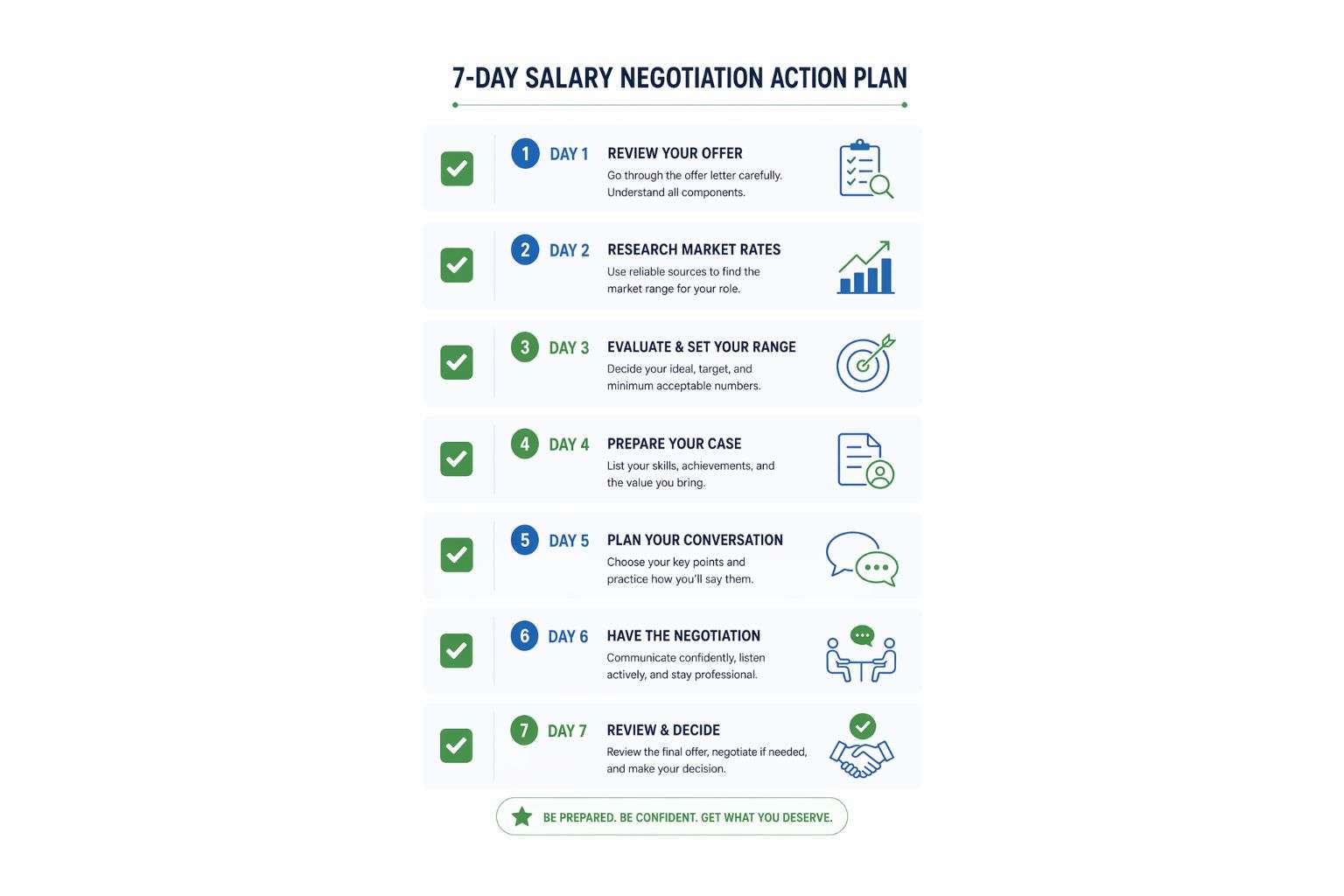
What to Do This Week — Your Fresher Salary Negotiation Action Plan
Here is a concrete seven-day plan. Start today.
Day 1: Go to AmbitionBox. Search your target company and the role you expect to receive. Note the fresher salary range for that company in your target city. Write the number down.
Day 2: Go to LinkedIn Salary. Search the same role. Cross-verify the number from Day 1. If both sources agree — you have a reliable market benchmark.
Day 3: Write out the three scripts above in your own words. Practice saying Script 1 and Script 2 aloud. Record yourself. Play it back. Fix the tone — it should sound calm and confident, not nervous or aggressive.
Day 4: Read the offer letter section of this guide again. Make a checklist of the five things to verify before signing any offer. Save that checklist on your phone.
Day 5: Ask one senior from your college who has already joined an IT company what their CTC breakup looked like. Ask them what their in-hand salary was. This real-world number will anchor your expectations better than any formula.
Day 6: Read the Cognizant GenC Guide 2026 and Wipro NLTH Guide if you have not already. More offers means more negotiation power. Build the offers first.
Day 7: Write your personal “negotiation ready” checklist. It should include: my market rate benchmark, my competing offer status, my specific strength I will mention, my target number, my fallback acceptance position. Have this ready before any offer call arrives.
Consultant’s Closing Perspective — Why Fresher Salary Negotiation Is a Skill Worth Learning Before You Need It
I want to close this guide the way I close every career counselling session on this topic.
Most students think salary negotiation is about the money.
It is not. Not entirely.
It is about learning to represent your own value clearly and professionally. That skill — stating what you bring, what you expect, and why — is one you will use for the rest of your career. In appraisal conversations. In client-facing situations. In team leadership as you grow.
The fresher who learns to negotiate their first salary professionally is building a muscle they will use for decades.
The student who skips it — who accepts the first number in silence because they were afraid — starts that first day at a disadvantage they carry forward for years.
I am not telling you to fight for every rupee. I am telling you to have the conversation.
Politely. Once. With a specific, researched ask. And then accept the outcome gracefully — yes or no.
That is all it takes.
Go prepare. Then go ask.
Written by Aslam Rahman — IT Career Consultant with 27 years of experience in IT hiring, fresher placement strategy, and career guidance for Indian students. Based in Bhubaneswar, Odisha. Founder of Career Guru — cguru.co.in.







4 Comments