
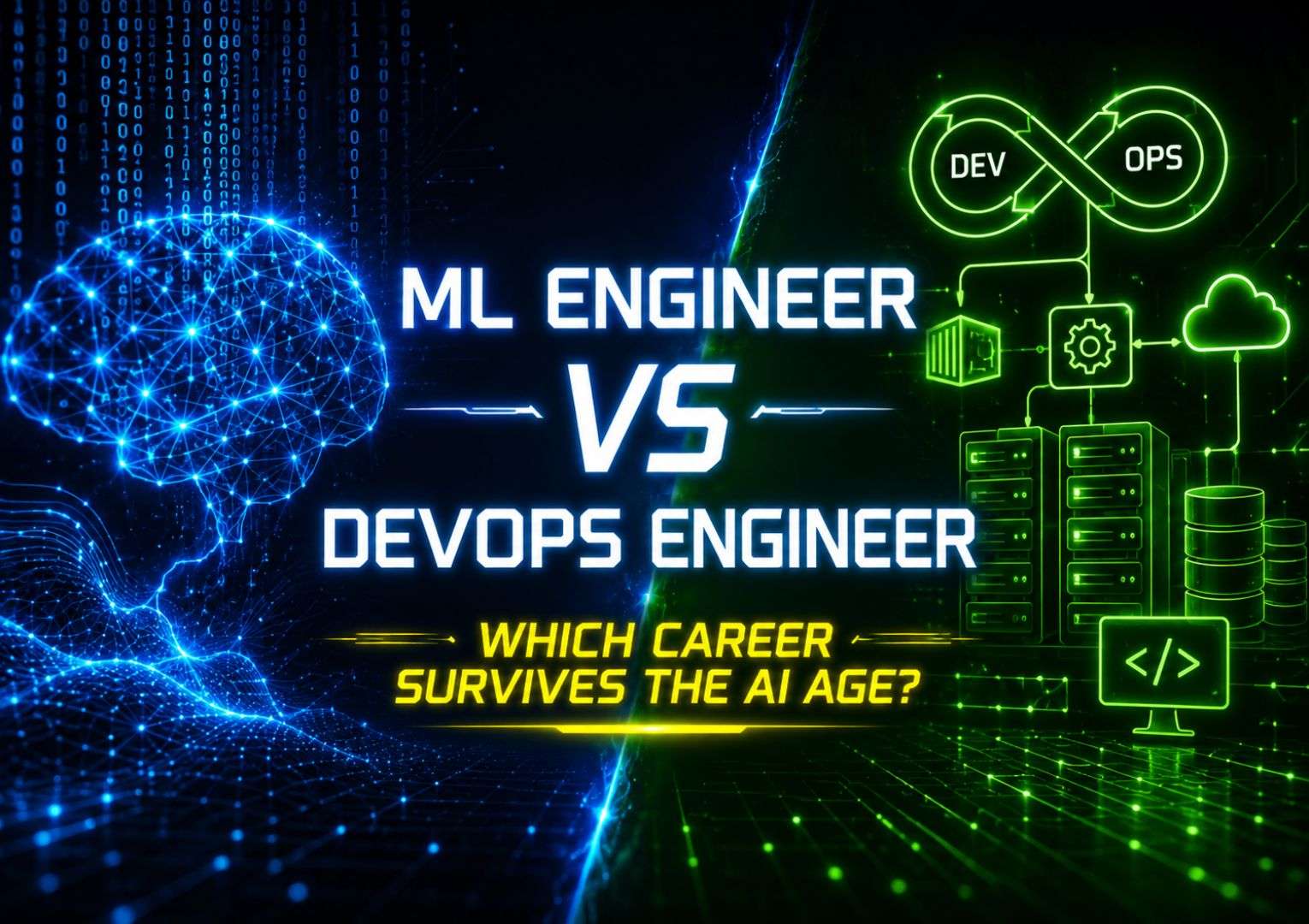
I’ve Placed Hundreds of Freshers in IT Jobs — Here’s the Honest Truth About Machine Learning Engineer vs DevOps Engineer Career in 2026
Machine Learning Engineer vs DevOps Engineer — if you have typed this into Google at 2 AM before your placement season, you are not alone.
I get this question almost every week. A student from Rourkela messages me. A BTech final year from Sambalpur calls. A fresher from a Bhubaneswar college sends a voice note. The question is always some version of: “Sir, ML or DevOps — which one will actually give me a job and keep it?”
I have been in IT hiring and career mentoring for 27 years. I have seen the Y2K boom. I have seen the dot-com crash. I have seen the cloud wave. And now I am watching the AI wave hit Indian IT hiring in real time.
So let me give you the honest answer. Not the answer that sounds exciting. The real one.
Why “Machine Learning Engineer vs DevOps Engineer” Is the Most Important Career Question of 2026
This is not just a comparison of two job titles. It is a question about where the Indian IT market is going — and where your skills will still matter five years from now.
AI is not coming to IT. AI is already inside IT. Every company — from TCS to a three-person startup in Bhubaneswar — is thinking about how to use AI. Some are training their own models. Most are deploying models built by others. All of them need engineers who can make it work.
That changes everything about how we compare these two careers.
A Machine Learning Engineer builds and trains AI models. A DevOps Engineer builds and maintains the pipelines and infrastructure that deliver software — including, increasingly, AI models — to production. They are different jobs. They use different skills. They suit different personalities. And in 2026, AI is reshaping both in very different ways.
Let me walk you through each one clearly.
What a Machine Learning Engineer Actually Does — No Jargon
Forget the LinkedIn posts showing people staring at screens full of equations. Let me tell you what the job actually looks like on a normal Tuesday.
A machine learning engineer takes data and builds models that can make predictions or decisions. They write Python code. They use libraries like TensorFlow, PyTorch, and scikit-learn. They clean data, train models, test models, and then — this is the part most students miss — they deploy those models so real applications can use them.
That last part is where it gets tricky. Building a model in a notebook is not the same as putting it into a live system that handles a million requests a day. ML engineers have to understand how to package models, how to monitor them when they go wrong, and how to retrain them when the world changes.
The skills you need to get started: Python (strong), statistics (basic to intermediate), one ML framework (TensorFlow or PyTorch), basic SQL, and some understanding of cloud platforms.
The learning curve is steep. The math can feel overwhelming at first. But the salary ceiling is very high.

What a DevOps Engineer Actually Does — No Jargon
A DevOps Engineer is the person who makes sure the code your development team writes actually reaches users — fast, reliably, and without breaking everything.
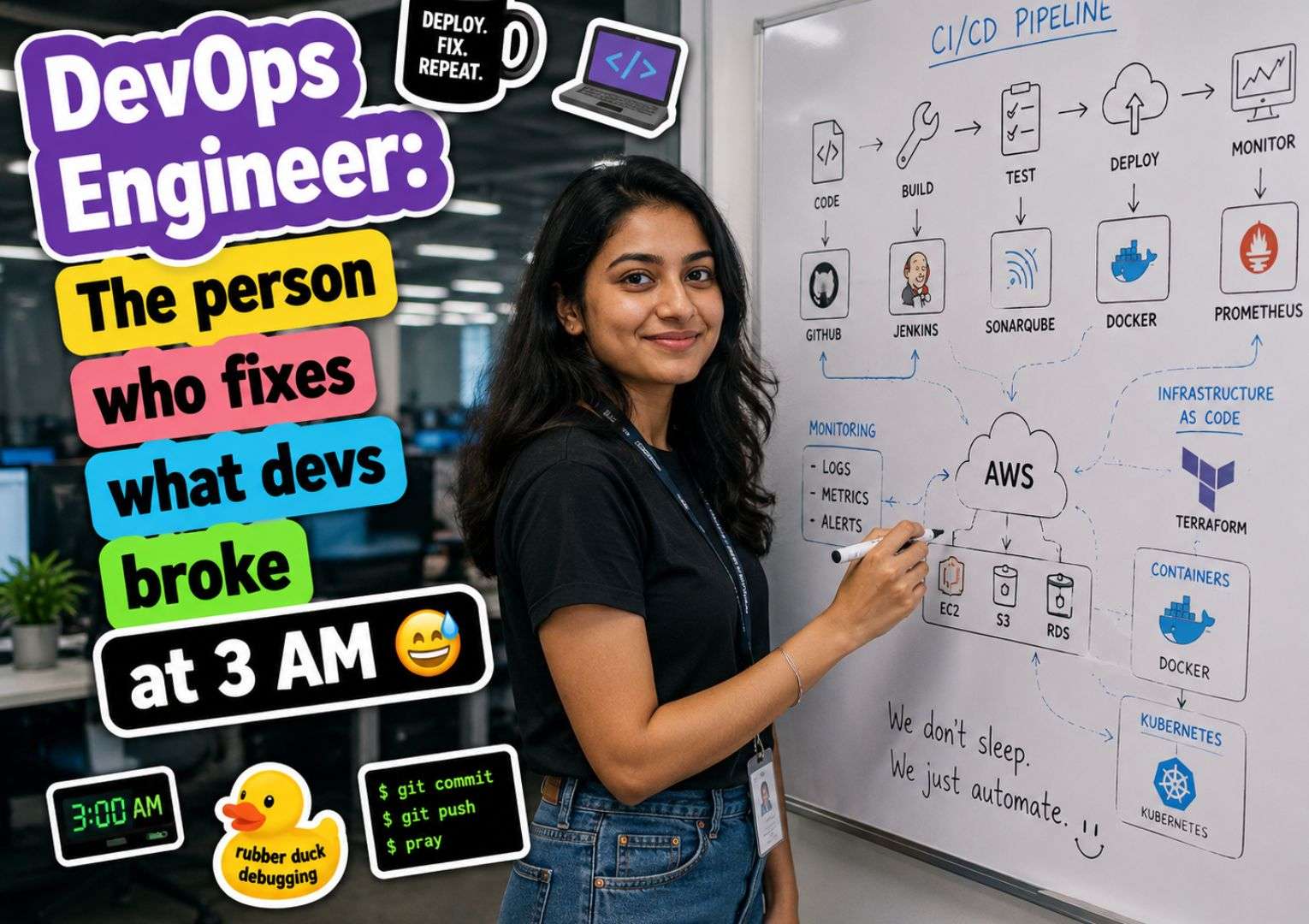
They set up pipelines. When a developer commits code, the DevOps engineer’s pipeline automatically tests it, builds it, and deploys it to servers. They work with Docker (think of it as packing an application into a box so it runs the same everywhere). They use Kubernetes to manage hundreds of these boxes at once. They work with cloud platforms — AWS, Azure, or GCP. They write automation scripts so that everything that can be automated is automated.
The skills you need: Linux basics (non-negotiable), one scripting language (Python or Bash), Git, Docker, Kubernetes, and at least one cloud platform certification.
DevOps is not just a technical role. It is a culture. The best DevOps engineers understand both the developer side and the operations side. That is actually what makes them hard to find — and valuable to hire.
Machine Learning Engineer vs DevOps Engineer: The Salary Truth for Freshers in India
Let me put the numbers on the table. These are real 2026 market figures.
Machine Learning Engineer — Fresher Salary in India: Starting packages range from ₹6 LPA to ₹8 LPA for freshers at product-based companies. At service-based companies, expect ₹4 LPA to ₹6 LPA. If you land at a top startup or an MNC with a strong AI division, ₹10 LPA to ₹12 LPA as a fresher is possible — but only with strong portfolio projects and internship experience.
DevOps Engineer — Fresher Salary in India: Starting packages range from ₹4.1 LPA to ₹7 LPA, depending on company type and certifications. Product-based companies and well-funded startups offer ₹5 LPA to ₹7 LPA for freshers. Cloud certifications (AWS, Azure) can bump your starting offer up by 20% to 30%.
On paper, ML looks like it pays more at entry level. But here is what the salary comparison misses.
Jobs available for ML freshers vs DevOps freshers is not even close.
DevOps has far more entry-level positions open right now — and across more types of companies. ML Engineer roles at the fresher level are highly competitive and mostly concentrated in product-based companies, AI startups, and research labs. DevOps roles exist in BFSI, e-commerce, healthcare, manufacturing, and every other sector undergoing digital transformation.
Consultant’s Note: In my 27 years of placing students, I have seen many engineers chase the “high-paying” title without thinking about hiring volume. The student who gets a ₹5 LPA DevOps job within three months of graduation is in a better position than the one who spends a year waiting for a ₹8 LPA ML role that requires two years of experience they do not have. Start earning. Grow from there.
📺 Watch This First: AI vs DevOps Career Comparison
Before you read further, spend 10 minutes here:
👉 AI vs DevOps | Career Comparison | Which One Should You Choose in 2025?
This video breaks down both paths clearly with real market data. Come back after you watch it.
Which Career Is More Secure in the Age of AI?
This is the heart of the question. And I will give you a nuanced answer, not a simple one.
Is AI replacing Machine Learning Engineers?
Partially — and that is the irony. AI tools are making it faster to write model code. GitHub Copilot helps with boilerplate. AutoML tools help with hyperparameter tuning. Some entry-level ML tasks that freshers previously handled are being automated.
But here is what AI cannot do: understand the business problem, decide which data actually matters, and take responsibility when the model gives wrong output at scale. Senior ML Engineers who understand the full picture are in more demand than ever. The concern is at the fresher entry level — where the tasks are most easily automated.
This means freshers entering ML need to differentiate themselves fast. A GitHub portfolio with two or three deployed ML projects is not optional. It is survival.
Is AI replacing DevOps Engineers?
No — and the evidence is clear. AI is being added into DevOps pipelines, not instead of DevOps engineers. AI-driven CI/CD tools still need humans to configure, monitor, and troubleshoot them. Companies are not laying off DevOps teams — they are asking them to learn AI tools on top of their existing skills.
The DevOps role is evolving into what the industry calls AIOps and DevSecOps. If you are a DevOps engineer who also understands how AI pipelines work, you are not threatened by AI — you are powered by it.

The Real Difference: What Kind of Person Are You?
After 27 years, I stop recommending based only on salary and job numbers. I also ask the student what kind of work they actually enjoy.
Choose Machine Learning Engineering if:
- You love mathematics and find statistics genuinely interesting
- You enjoy research — reading papers, experimenting, building things that fail 10 times before they work
- You are patient with ambiguity — ML work rarely has a clean right answer
- You want to work on problems like recommendation engines, fraud detection, medical diagnosis, or language models
- You have strong Python skills and are willing to go deeper into them
Choose DevOps Engineering if:
- You enjoy building systems and making things work reliably
- You like solving infrastructure puzzles — “why is this server slow?” type problems
- You enjoy automation — making repetitive tasks disappear
- You are comfortable with Linux, networking, and cloud platforms
- You want faster time-to-employment — DevOps roles open up more frequently
Neither path is better than the other. They suit different people. The worst mistake is picking based on what your college group chat is excited about.
Consultant’s Note: I have mentored students who switched from ML to DevOps after six months and thrived — because they realised they liked building pipelines more than building models. I have also seen DevOps engineers pivot into MLOps after two years and double their salary. The paths are not sealed. But starting in the right direction saves you precious time.
📺 Understanding MLOps — Where Both Careers Meet
This is where things get really interesting in 2026:
👉 MLOps Skills Every AI Engineer Needs Right Now
MLOps is the bridge. It combines ML model building with DevOps pipeline practices. If you are a fresher who learns both — even at a basic level — you become significantly more hireable than peers who pick only one side.
The MLOps Advantage — Why Learning Both Gives You an Edge
Here is something most career blogs do not tell you clearly.
The biggest gap in India’s IT market right now is not ML engineers. It is not DevOps engineers. It is people who understand both.
MLOps (Machine Learning Operations) is the practice of deploying, monitoring, and maintaining ML models in production — using DevOps principles. A company that builds an AI model needs someone who can package it, deploy it, scale it, and monitor it when it starts drifting. That requires ML knowledge AND DevOps knowledge.
In 2026, Kubernetes is the most in-demand MLOps tool (17.6% of AI job listings require it). Docker knowledge appears in 15.4% of ML engineer job postings. CI/CD understanding is now expected even in ML engineer roles.
This means a fresher who understands basic ML AND has Docker/Kubernetes/cloud knowledge is far more attractive than someone who knows only one side deeply.
You do not have to be an expert in both. But a working understanding of both makes you an MLOps candidate — and that is a faster-growing role than either ML engineering or DevOps alone.

Companies Hiring ML Engineers vs DevOps Engineers in India in 2026
Let me give you a clear picture of where the jobs actually are.
ML Engineer hiring companies (India):
- Product-based: Flipkart, Swiggy, Zomato, Ola, Meesho, PhonePe (strong AI/ML teams)
- MNCs with India AI labs: Google, Microsoft, Amazon, Nvidia, Adobe
- AI-first startups: Sarvam AI, Krutrim, Mad Street Den, Arya.ai, Frugal Testing
- BFSI: HDFC Bank, ICICI Bank, Bajaj Finserv (fraud and risk ML teams)
DevOps Engineer hiring companies (India):
- All IT services majors: TCS, Infosys, Wipro, HCL, Cognizant, Tech Mahindra
- Cloud-heavy MNCs: AWS India, Microsoft India, Google Cloud India
- E-commerce and SaaS: Razorpay, Freshworks, Zoho, Postman, BrowserStack
- BFSI and healthcare: Almost every digital transformation project needs DevOps
Notice something. DevOps hiring is across almost every company type. ML Engineering is concentrated in product companies and AI-first firms.
If you are from a Tier-2 city or a non-premier college, this matters. Product-based ML roles are extremely competitive. DevOps gives you a wider door to walk through — and you can pivot into MLOps from there.
Certifications That Actually Help — Not Just Sound Good
For Machine Learning Engineering:
- Google Professional Machine Learning Engineer certification
- AWS Machine Learning Speciality certification
- DeepLearning.AI courses (Andrew Ng’s specialisations on Coursera — free to audit)
- Kaggle competitions (not a certification, but treated as one by hiring managers)
For DevOps Engineering:
- AWS Certified Cloud Practitioner (start here — easiest entry point)
- AWS Solutions Architect Associate
- HashiCorp Terraform Associate
- Certified Kubernetes Application Developer (CKAD)
One important note: certifications help you get through resume screening. They do not replace projects. I have seen certified candidates lose to uncertified candidates with better GitHub portfolios every single time.
What No One Tells You About Fresher Hiring for These Roles
I want to be very direct here.
The biggest problem freshers face is not skill gaps. It is portfolio gaps.
For ML Engineering: A resume without at least two deployed ML projects is nearly invisible. “I studied TensorFlow” means nothing. “I built a crop disease detection model using CNN and deployed it on AWS Lambda with 92% accuracy” — that gets you interviews.
For DevOps: A resume without hands-on project proof is equally weak. Set up a home lab. Create a GitHub Actions pipeline for a personal project. Deploy something on AWS free tier and document it. Screenshot your monitoring dashboards. This is your proof of work.
The other thing nobody says: communication skills matter enormously in both roles. An ML Engineer who cannot explain their model’s output to a non-technical product manager is a liability. A DevOps Engineer who cannot explain a production outage to business stakeholders is a problem. Work on your communication. It is not optional.
For more on how to build a resume that stands out, read my detailed guide on How to Write a Resume That Gets You Shortlisted.
Salary Growth: Year 1 to Year 5
Here is a rough salary trajectory for both paths in India’s IT market:
Machine Learning Engineer:
- Year 0-1 (Fresher): ₹6–8 LPA
- Year 2-3: ₹10–16 LPA
- Year 4-5: ₹18–28 LPA (if specialised in NLP, computer vision, or GenAI)
DevOps Engineer:
- Year 0-1 (Fresher): ₹4–7 LPA
- Year 2-3: ₹8–14 LPA
- Year 4-5: ₹14–22 LPA (higher if you add cloud + AI skills)
On a five-year view, ML Engineering has a higher ceiling. But DevOps has more stable, linear growth — and MLOps roles can push that ceiling significantly higher for DevOps engineers who upskill.

Action Plan: What to Do Right Now Based on Where You Are
If you are in 2nd or 3rd year BTech:
- Do not pick yet. Spend one semester each exploring Python + ML basics AND Linux + Docker basics.
- See which one genuinely excites you. Your gut will tell you by the time placements begin.
- Build one small project in each domain.
If you are in final year with placements coming:
- If you have strong Python and like math → focus 80% on ML, get one Kaggle project done, and learn basic Docker for deployment.
- If you like systems and infrastructure → focus 80% on DevOps, get AWS Cloud Practitioner certified, set up one CI/CD pipeline project on GitHub.
- In both cases: document everything. Your GitHub profile is your real resume.
If you are a recent graduate without a job:
- Give yourself a 90-day sprint. Pick one path. Be ruthless about it.
- For ML: Complete one Andrew Ng course + build one project + apply to 20 companies per week.
- For DevOps: Get AWS Cloud Practitioner certified + set up a DevOps pipeline project + apply to IT services companies + startups simultaneously.
- Read my guide on fresher job search strategy for Indian IT for the full 90-day plan.
If you are working and want to switch:
- DevOps is easier to enter from a general software development background.
- ML requires dedicated upskilling — expect 6 to 12 months of serious preparation.
- MLOps is the best pivot if you already have 1-2 years of software development experience.
Also check my detailed write-up on Data Science and AI career roadmap for Indian students and the Full Stack Development career path for related comparisons.
For understanding how companies like TCS, Infosys, and Wipro view these roles, my TCS NQT 2026 preparation guide has relevant context.
10 FAQs — Machine Learning Engineer vs DevOps Engineer
FAQ 1: Which role has more job openings for freshers in India right now — Machine Learning Engineer or DevOps Engineer?
DevOps has significantly more fresher-level openings in India in 2026. This is because DevOps roles exist across virtually every industry — IT services, BFSI, e-commerce, healthcare, and manufacturing. ML engineering roles at the entry level are concentrated in product companies and AI-focused startups, which are fewer in number and highly competitive. If you are in final year and need a job within six months of graduation, DevOps gives you a wider funnel to work with.
That does not mean ML is a bad choice — it means you need to be extremely prepared if ML is your target. Strong projects, a Kaggle profile, and relevant internship experience are non-negotiable. For ML freshers without these, the wait can be 9 to 12 months. For DevOps freshers with a cloud certification and a GitHub pipeline project, three to six months is realistic.
Consultant’s Note: I have never told a student to chase only job volume. But I have always told them to be honest about where they are in their preparation. If you are not portfolio-ready for ML roles, DevOps gives you income, experience, and a launchpad. You can transition into MLOps from DevOps in 18 to 24 months if that is your goal.
FAQ 2: Will AI replace Machine Learning Engineers or DevOps Engineers first?
The honest answer is that AI is changing both roles, not eliminating either one. For Machine Learning Engineers, AI tools are automating some repetitive tasks — writing boilerplate code, hyperparameter tuning, basic model selection. This reduces the demand for low-skill ML work. But engineers who understand the full ML pipeline — from problem framing to production monitoring — remain irreplaceable. For DevOps Engineers, AI is being integrated into pipelines as a tool, not replacing the engineers who manage those pipelines.
In fact, as companies adopt AI, they need more DevOps engineers to handle the infrastructure that supports AI systems. The risk for ML is at the fresher entry level, where tasks are simpler and more automatable. The risk for DevOps is minimal in the short to medium term. Both paths are secure for skilled engineers who keep learning.
Consultant’s Note: I have watched three major technology waves in 27 years. Each time, engineers who kept learning survived and thrived. Engineers who stopped learning became obsolete — regardless of their job title. The same rule applies now.
FAQ 3: Can a student from a non-CS background (ECE, Mechanical, Civil) realistically enter ML Engineering or DevOps in 2026?
Yes — and I have personally placed non-CS students in both roles. For Machine Learning Engineering, ECE students actually have an advantage because their mathematics and signal processing background translates well to ML concepts. Mechanical and Civil students can enter ML if they have strong Python skills and a domain-specific project (for example, a Mechanical student building a predictive maintenance model).
For DevOps, non-CS students can enter through cloud certifications and Linux fundamentals — neither of which requires a CS degree. What matters is proof of skills, not the degree on your certificate.
Build the skills. Build the project. Build the GitHub profile.
Consultant’s Note: Three of the best DevOps engineers I have placed came from an ECE background. One ML engineer I placed who is now earning ₹18 LPA studied Civil Engineering. The degree is an entry ticket to some companies — skills are what keep you employed.
FAQ 4: Should a fresher first join an IT services company (TCS, Infosys, Wipro) in a DevOps role and then move to ML?
This is a smart strategy that many of my students have successfully used. IT services companies offer DevOps roles with structured training — especially in cloud and automation. You get a salary, industry experience, and the opportunity to build your skills simultaneously. After 18 to 24 months, you can pursue ML or MLOps certifications and transition to product companies or AI-focused roles.
The risk is complacency — many students get comfortable with the salary and stop learning. If you go this route, make a written 24-month plan for where you want to be and stick to it. Set specific learning goals every quarter.
Consultant’s Note: The IT services stepping stone is underrated. I see students reject ₹4.5 LPA offers from good companies waiting for ₹8 LPA ML roles that never come. Eighteen months of IT services experience plus upskilling puts you in a far stronger position for your second job than a year of unemployment.
FAQ 5: What is MLOps and is it a better choice than ML or DevOps for freshers?
MLOps stands for Machine Learning Operations. It is the practice of taking ML models from the research stage into live production — using DevOps principles to automate, monitor, and maintain them.
MLOps is genuinely the fastest-growing sub-field at the intersection of both careers. However, it is not an ideal entry point for freshers because it assumes you already understand both ML fundamentals and DevOps practices. Think of MLOps as your Year 2 or Year 3 goal — not your starting point. Begin with one of the two core paths, build your fundamentals, and then converge into MLOps.
Engineers with MLOps skills in 2026 are commanding salaries 30% to 40% above standard ML or DevOps roles at the same experience level.
Consultant’s Note: MLOps is where I see the most exciting salary jumps happening for engineers with three to four years of experience. If you are choosing between ML and DevOps right now, keep MLOps in your five-year mental map.
FAQ 6: How important are mathematics skills for a Machine Learning Engineer and can average students manage?
Mathematics is important for ML Engineering — but not in the way most students fear. You do not need to derive backpropagation from scratch in an interview. You need to understand concepts like probability, statistics, linear algebra, and basic calculus well enough to interpret model behaviour and make good decisions about model design. The good news is that most of this can be learned progressively as you work through projects.
Andrew Ng’s machine learning courses on Coursera explain the mathematics in a very accessible way. The students who struggle with ML mathematics are usually those who try to memorise formulas without understanding the intuition. Start with intuition. The formulas will follow.
Consultant’s Note: I have mentored students who failed mathematics in college and became competent ML engineers. I have also seen toppers in mathematics who could not build a single working ML pipeline. Curiosity and persistence matter more than your maths marks.
FAQ 7: Which role is better for students who want to work remotely or freelance?
Both roles have strong remote work potential, but they express it differently. Machine Learning Engineers are frequently hired by international companies on remote contracts — especially for GenAI and NLP work — and can earn in USD or EUR through platforms like Upwork, Toptal, or direct clients.
DevOps Engineers also have excellent remote opportunities, particularly in startups that need part-time or contract DevOps support. For freelancing, DevOps is slightly more accessible because the deliverables (set up a CI/CD pipeline, migrate to AWS, automate a deployment) are clearly scoped and easier to price. ML freelancing tends to require more domain-specific context. Both are realistic remote paths for skilled engineers in India.
Consultant’s Note: I have students who are earning ₹80,000 to ₹1.5 lakhs per month freelancing in DevOps from Bhubaneswar — without relocating to Bengaluru. The geography barrier is lower than ever for skilled engineers.
FAQ 8: What tools should a fresher learn first for each career path in 2026?
For Machine Learning Engineering: Start with Python, then NumPy and Pandas (data handling), then scikit-learn (classical ML), then TensorFlow or PyTorch (deep learning). Add basic SQL for data querying and learn to use Jupyter Notebooks properly. Once you have one working ML project, learn Docker to containerise and deploy it.
For DevOps Engineering: Start with Linux command line (two to three weeks of daily practice), then Git and GitHub, then Docker, then basic AWS (free tier account), then automate something using GitHub Actions or Jenkins. Once you can build a CI/CD pipeline for a basic web application, you are job-ready for entry-level positions.
Consultant’s Note: Students often ask me “how long will this take?” My answer is always: it depends on how many hours you put in per day. Five hours a day consistently for three months will make you competitive for entry-level roles in either path. Two hours a day will take six to nine months. There is no shortcut — only pace.
FAQ 9: How do I answer “ML or DevOps?” in a campus placement interview when I have been preparing for both?
Be honest and be specific. Never say “I am open to both.” Interviewers want someone who knows what they want. Pick the one you have done more work in. Describe your project. Explain your learning journey. Show your GitHub. If you genuinely have prepared both, say: “My primary focus has been DevOps — I have built a CI/CD pipeline and have my AWS Cloud Practitioner certification.
I also have a foundational understanding of ML and am interested in growing into MLOps over the next two to three years.” That answer shows direction, self-awareness, and ambition. It is far stronger than “I am interested in any role.”
Consultant’s Note: Clarity signals confidence. Confusion signals unpreparedness. Walk into interviews knowing exactly what you have built and why you chose the path you chose.
FAQ 10: From Tier-2 cities like Bhubaneswar, Rourkela, or Berhampur — do students have a realistic shot at these roles without moving to Bengaluru?
Yes — and the answer has changed dramatically in the last three years. Remote and hybrid hiring means geography is no longer the barrier it once was. I run my career consulting from Bhubaneswar and I have placed students in roles at Bengaluru-based companies without those students ever relocating. The key is that your GitHub profile, your certifications, and your project portfolio travel without you.
A student from Berhampur with a deployed ML project on GitHub is more visible to recruiters than a Bengaluru student with only a degree and a certificate. Build your digital presence. LinkedIn profile, GitHub portfolio, and two or three strong project write-ups are your ticket — regardless of your city.
Consultant’s Note: Twenty-seven years ago, geography was destiny in Indian IT. Today, skills are destiny. Use that shift in your favour.
Your Next Step — Do Not Just Read This. Act.
Reading this blog without taking action will change nothing. So here is your specific next step based on where you are:
- Decide your primary path — ML or DevOps — based on the personality fit section above. Write it down.
- Open your GitHub — if you do not have an account, create one today. This is your professional home.
- Start one course this week — Andrew Ng’s ML course (free to audit on Coursera) for ML. Or Linux Basics for Hackers (free PDF) for DevOps.
- Build one project in 30 days — not perfect, just working. Document it. Push it to GitHub.
- Get one certification in 60 days — Google Data Analytics for ML track. AWS Cloud Practitioner for DevOps track.
- Connect with me — if you want personalised guidance on which path fits you specifically, visit cguru.co.in or reach out through the contact page. I answer every message personally.
Also, bookmark these for your deeper reading:
- Cloud Computing Career Roadmap for Indian Students 2026
- Data Science Career Guide for Indian Freshers
- TCS NQT 2026 Complete Preparation Guide
- How to Build a LinkedIn Profile That Gets You Hired
About the Author: Aslam Rahman is an IT career consultant with 27 years of experience in IT hiring, training, and mentoring. Based in Bhubaneswar, he runs cguru.co.in — a career guidance platform for Indian engineering students and freshers. He has personally mentored and placed hundreds of students across Odisha and India in IT roles across all major companies.