

GCC Jobs for Freshers India 2026 — What They Are and Why They Pay So Much More
By ASLAM RAHMAN, 27-Year IT Career Consultant
Imagine landing a starting salary double your peers’ offers—all for the same degree. GCC jobs for freshers India are quietly transforming career trajectories, offering top-tier pay and global exposure that traditional IT service roles simply cannot match.
What Is a GCC — In Plain Language
A GCC, or Global Capability Centre, is an office in India that a foreign company owns and runs directly. It is not an outsourcing vendor. It is not a contractor working for someone else’s client. It is the company itself.
Think of it this way. When TCS or Infosys works for a foreign bank, they are a vendor doing project work for that bank. When that same foreign bank sets up its own office in Bengaluru or Hyderabad or Bhubaneswar, staffs it with its own employees; and has that office build technology for the bank’s global operations — that office is a GCC.
Companies like Walmart, Target, JPMorgan, Deloitte, Microsoft, and Amazon all run GCCs in India. These are not small experimental setups. Some of these India centres employ more people than the company employs in its home country.
GCC jobs for freshers India exist because these global companies have realised something simple. India has enormous engineering talent. Building your own team here, instead of paying a vendor to do it, saves money and gives you more control over the work.
That distinction — your own team versus a vendor’s team — is the entire reason GCC jobs for freshers India pay so much more than a typical IT services job.

Why GCC Jobs for Freshers India Pay So Much More
Let me give you the real numbers, not vague claims.
GCC pay scales run 25 to 60 per cent above IT services companies and 15 to 35 per cent above domestic product startups for comparable roles. This is not a marketing claim from a recruitment website. This is the structural reality of how GCCs are funded and staffed.
There are three specific reasons behind this gap.
Reason 1 — You work for the actual company, not a vendor. When a GCC hires a fresher, that fresher is doing work that directly affects the parent company’s global product or global operations. Vendor companies price their services competitively and pass savings downward through lower salaries. A GCC does not have that pressure. It pays what it needs to pay to attract talent that matches its global compensation logic.
Reason 2 — The work itself is different. GCC fresher roles increasingly involve real engineering, data work, and product contribution — not routine support tickets. Higher-value work justifies higher pay from day one.
Reason 3 — Global compensation benchmarks apply. Many GCCs set India salaries with reference to what similar roles cost the parent company worldwide, adjusted for India’s cost of living. That reference point sits well above what a typical Indian IT services company pays for the same skill level.
Here is what this looks like in real fresher offer letters in 2026.
Entry-level GCC roles at large IT-enabled GCCs — ₹4.5 to ₹8 LPA GCC roles requiring strong coding fundamentals — ₹6 to ₹10 LPA Premium GCC clusters with GenAI, data engineering, or specialised skills — ₹10 to ₹18 LPA
Compare that to a typical IT services fresher offer, which in most cases still lands between ₹3.5 and ₹4.5 LPA. The gap is not small. It is often the difference between paying off an education loan in three years or eight.
🔗 Related Read: Fresher Salary in India 2026

GCC Jobs for Freshers India — The Odisha Angle Nobody Is Talking About
Here is something specific to Odisha that most students have not heard, and it changes everything about how I am advising students this year.
The Odisha government has launched its own GCC Policy 2025 — a five-year policy specifically designed to bring Global Capability Centres to this state. The target is bold. At least five GCC hubs, starting with the Bhubaneswar-Cuttack-Puri-Paradip cluster, and a second cluster around Bargarh-Jharsuguda-Sambalpur. The policy is targeting over ₹10,000 crore in investment and more than 50,000 direct and indirect jobs.
On top of this, Bhubaneswar’s technology agency, OCAC, has issued plans for a massive new IT park at Damana Square — a 25-acre, 4.5-million-square-foot development sitting between the existing Infocity and Infovalley technology clusters. This park is explicitly designed to house GCCs, alongside other technology investment that has been waiting for available land and infrastructure.
What does this mean for a BTech student in Bhubaneswar, Cuttack, Rourkela, Berhampur, or Sambalpur? It means GCC jobs for freshers India are not just a Bengaluru or Hyderabad story anymore. Odisha is deliberately positioning itself as an alternative GCC destination, and the state government is offering companies capital subsidies, labour law flexibility, and single-window clearances to move here.
Students who prepare now — while most of their peers have never even heard the word GCC — will be the first wave hired when these Odisha-based centres start their fresher pipelines. That timing advantage does not come often.
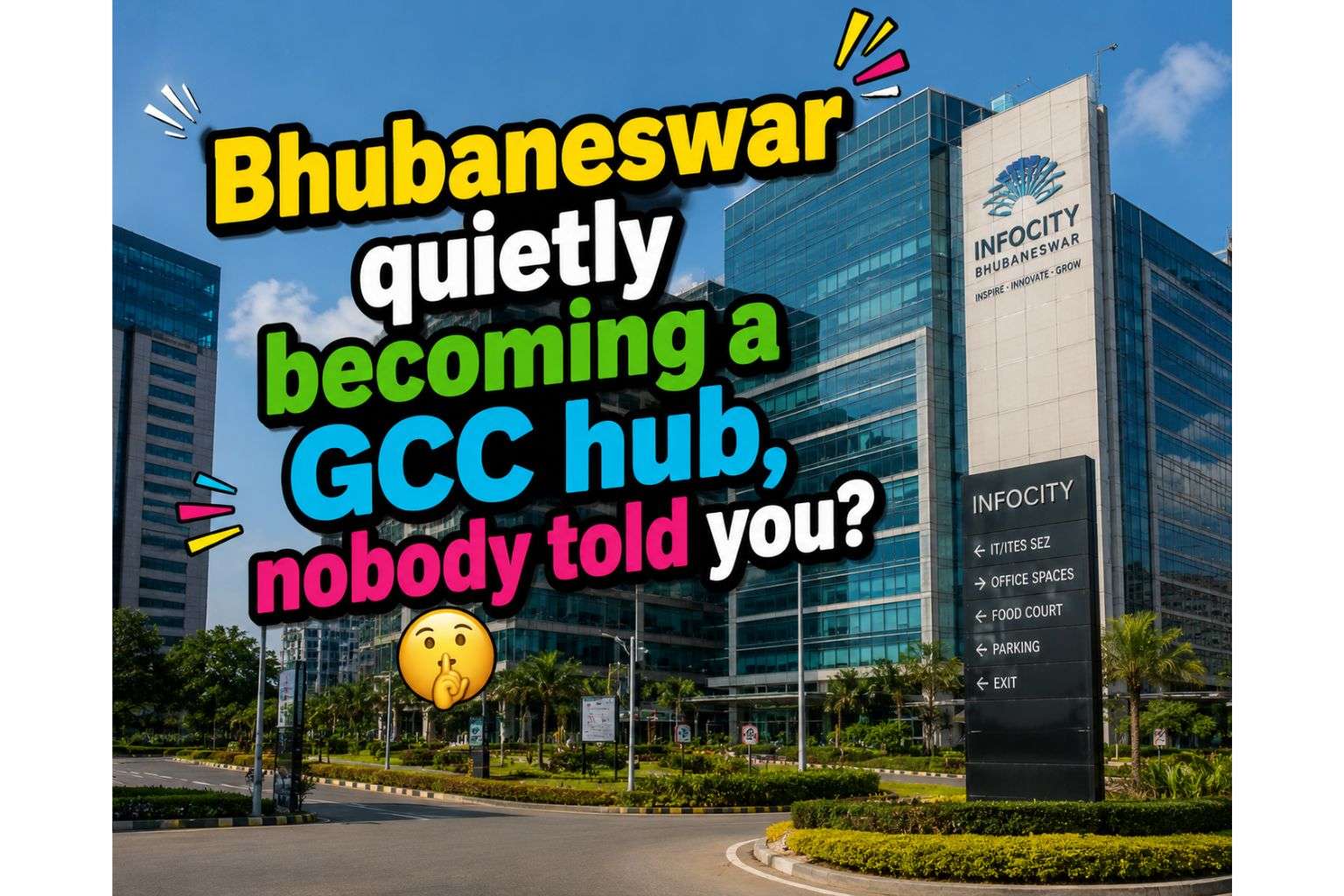
GCC Jobs for Freshers India — How Big Is This Opportunity, Really
Let me put numbers around the scale of this shift, because it explains why I am telling every student I counsel to pay attention to GCC jobs for freshers India right now.
India already has more than 1,800 GCCs employing close to 1.9 to 2.36 million people, depending on which industry report you read. More than 50,000 new GCC jobs have been announced across the country in the last twelve months alone. Industry projections put India’s GCC workforce at 2.5 to 3 million professionals by 2030 — and roughly 400,000 of those future jobs are expected to go specifically to freshers.
This is not a temporary hiring spike. It is a structural shift in how global companies choose to build technology teams, and India is the biggest beneficiary of that shift in the world.
For a fresher in Odisha, this matters for a very practical reason. GCC hiring is expanding beyond the saturated Tier-1 metros — Bengaluru, Hyderabad, Pune, Chennai — into Tier-2 cities specifically because those metros are running out of affordable, low-attrition talent. Bhubaneswar is explicitly named in multiple industry reports as one of the cities GCCs are actively expanding toward.
🔗 Related Read: IT Companies in Bhubaneswar Hiring Freshers in 2026

GCC Jobs for Freshers India — What Skills Actually Get You Hired
GCC hiring is not the same as an IT services mass campus drive. There is no walk-in test with 5,000 students. GCCs hire in smaller, sharper batches, and they look for a specific skill profile.
Non-negotiable foundation skills:
Strong programming fundamentals in Python or Java. SQL at an intermediate level — joins, aggregations, basic window functions. A working understanding of REST APIs and Git version control. Clear written and spoken English, because GCC freshers regularly interact with global teams across time zones.
Skills that create a real premium:
Any demonstrable GenAI or LLM exposure — basic prompt engineering, understanding of RAG architecture, or any hands-on fine-tuning project — immediately sets a fresher apart. A cloud fundamentals certification, AWS Cloud Practitioner or Azure Fundamentals, signals seriousness to a GCC recruiter even at entry level.
What matters most in GCC jobs for freshers India in 2026 is demonstrable skill, not the name of your college. Online coding assessments do not know which BPUT-affiliated college you studied at. Your score is your score. This is genuinely good news for students from tier-2 city colleges who have historically been overlooked by brand-name campus drives.
🔗 Related Read: Top 5 In-Demand Skills for Freshers 2026 🔗 External Reference: NASSCOM GCC industry data
Rooman Technologies, where I serve as State Business Partner for Odisha, runs structured job-guaranteed programs in exactly these foundation areas — cloud, data, and programming fundamentals — built for students who need to close this specific skill gap before appearing for GCC assessments.

GCC Jobs for Freshers India — How the Hiring Process Actually Works
This is where most students get it wrong. They assume GCC hiring looks like TCS NQT or Infosys InfyTQ. It does not.
Campus-track hiring. Large, established GCCs do run structured campus programs at select colleges, mostly IITs, NITs, and a small number of tier-1 private universities. Odisha students from BPUT-affiliated colleges are rarely on this list yet — which is exactly why the off-campus and internship routes matter more here.
Internship-to-PPO route. This is the single highest-conversion pathway into a GCC for a fresher. GCC internships typically run two to six months, and conversion rates from internship to a Pre-Placement Offer range from 40 to 70 percent — dramatically higher than IT services internship conversion rates. If you land a GCC internship, treat every single day of it as a three-month interview.
Direct lateral-style applications. Many GCCs fill roles through LinkedIn outreach, employee referrals, and direct applications before a job is ever posted publicly. This means a fresher who is actively building a LinkedIn presence and networking with people already working inside GCCs has a real advantage over someone only checking job portals.
Timeline expectations. Campus-track hiring typically takes three to six weeks from application to offer. Newly establishing GCCs — exactly the kind Odisha’s new policy is trying to attract — can move faster, sometimes two to three weeks, because they are under pressure to hit headcount targets quickly.
🔗 Related Read: Off-Campus Placement for Freshers in 2026
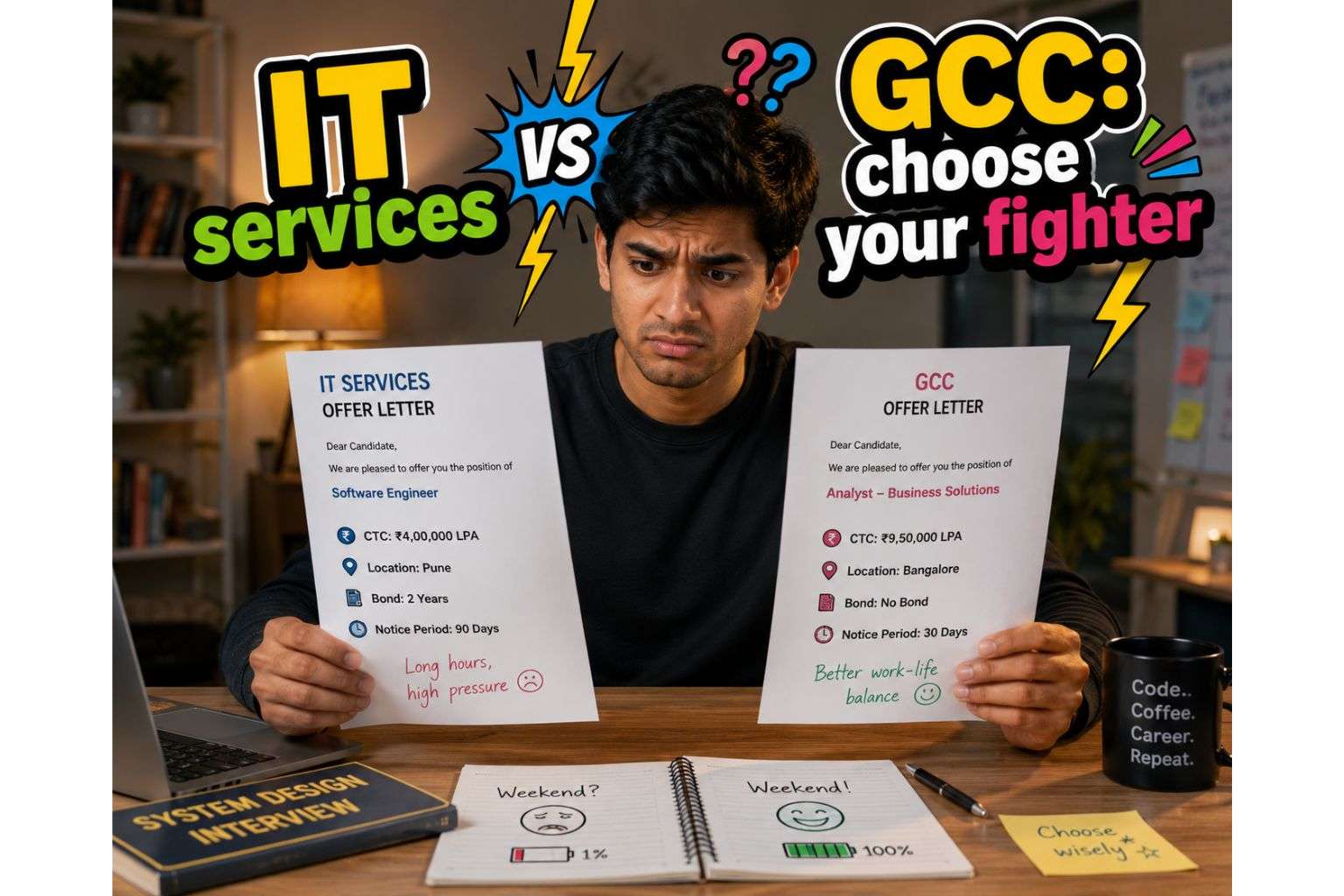
GCC Jobs for Freshers India vs IT Services — The Honest Comparison
Students ask me constantly whether they should hold out for a GCC job or accept an IT services offer in hand. Here is my honest answer.
GCC jobs for freshers India offer higher starting pay, closer contact with global teams, and product-grade work from day one. But GCC hiring windows are narrower, less predictable, and require sharper individual preparation. IT services companies still offer higher hiring volume, more predictable timelines, and a safety net for students who are not yet ready for a GCC-level technical assessment.
My honest guidance — do not reject a reasonable IT services offer while chasing a GCC job with no offer in hand. Build your GCC-specific skills in parallel. If a GCC opportunity comes through before your IT services joining date, you can always make that switch. Bhaiya-level real talk — a fresher with a ₹4 LPA offer and a genuine, prepared shot at a ₹9 LPA GCC role is in a completely different position than a fresher with no offer at all.
🔗 Related Read: TCS vs Infosys vs Wipro for Freshers 2026
Watch These Before You Start Preparing
I always tell students to hear this from more than one voice before they commit their preparation time. These three videos are worth your forty minutes.
🎥 India’s GCCs Are Hiring Freshers Like Never Before, Here’s Why
🎥 GCC Jobs Explained — How to Get a Job in a Global Capability Center
🎥 GCC 2.0 — The Safest Career Move in 2026, How to Break Into Global Capability Centers
Common Mistakes Students Make Chasing GCC Jobs
Mistake 1 — Mass applying without targeting. Sending the same generic resume to every GCC job posting rarely works. GCCs respond far better to applications that clearly connect your specific skills to their specific business function.
Mistake 2 — Skipping the referral route entirely. Internal referrals at GCCs close significantly faster than cold applications. If you know even one senior student or alumnus working at a GCC, that connection is worth more than ten cold applications.
Mistake 3 — Underselling real project work. Vague resume lines like “worked on a project” or “improved efficiency” do nothing for a GCC recruiter. Specific, measurable project descriptions do.
Mistake 4 — Ignoring English communication practice. GCC roles involve regular interaction with global stakeholders. A brilliant coder who freezes on a video call with a US or UK team will lose out to an averagely skilled candidate who communicates confidently.
GCC Jobs for Freshers India — Your Action Plan by Year
If you are in first or second year — Start building programming fundamentals in Python now. Open a GitHub account and commit your first small project this month. Follow two or three GCCs on LinkedIn and read what their India teams post. This early familiarity compounds over the next two years.
If you are in third year — This is your internship year. Actively target GCC internship postings and campus partnerships. If your college does not have a direct GCC pipeline, apply through LinkedIn and internship portals directly. Treat every internship interview as if it were the final interview for a full-time role.
If you are in final year — Do not wait for campus placement season alone. Actively apply to GCCs directly through LinkedIn and company career pages. Keep an IT services offer as your safety net if one comes through campus placement, but continue preparing and applying for GCC roles in parallel until your joining date arrives.
🔗 Related Read: Job Hunting Guide 2026 for Indian Graduates
If you want structured help closing your skill gap for GCC-level technical assessments, Rooman Technologies runs job-guaranteed programs across cloud, data, and core programming that are built exactly for this purpose. You can reach out to me directly on WhatsApp at 9777278853 for guidance on which program fits your current stage.
FAQs — GCC Jobs for Freshers India 2026
FAQ 1 — What exactly is the difference between a GCC and a regular IT services company like TCS or Infosys?
This is the single most common confusion I clear up in every counselling session about GCC jobs for freshers India. An IT services company like TCS, Infosys, or Wipro works as a vendor. It takes on projects from client companies around the world and delivers that work using its own employees, who never technically belong to the client company. A GCC is different because it is not a vendor relationship at all.
A GCC is an office that a foreign company owns outright in India, staffed entirely with its own employees, doing work that belongs directly to that company’s global operations. When you join a GCC as a fresher, your offer letter comes from the actual global company — say, a bank, a retailer, or a technology firm — not from a vendor working on that company’s behalf. This distinction affects everything from your pay to your career trajectory to the kind of work you do day to day.
GCC employees often have internal mobility paths that can eventually lead to opportunities at the parent company’s headquarters abroad, something that is structurally much harder to access from a pure vendor role.
Consultant’s Note — I tell every student the same thing when this question comes up. Ask directly in your interview whose payroll you will be on and whose product or business function you will be working on. If the honest answer is “our client’s,” you are looking at a vendor role. If the answer is “our own company’s global operations,” you are looking at a genuine GCC role.
FAQ 2 — Are GCC jobs for freshers India only available in Bengaluru, Hyderabad, and other big metros?
This was true five years ago and is becoming less true every quarter. The historically dominant GCC cities remain Bengaluru, Hyderabad, Pune, and Chennai, and they still host the largest share of GCC jobs in the country. However, rising real estate costs, talent saturation, and higher attrition in these metros are pushing GCCs to actively expand into Tier-2 cities, including Coimbatore, Indore, Jaipur, Ahmedabad, Chandigarh, and Bhubaneswar.
Odisha specifically has launched its own GCC Policy 2025, targeting at least five new GCC hubs across the Bhubaneswar-Cuttack-Puri-Paradip region and the Bargarh-Jharsuguda-Sambalpur region, backed by capital subsidies and infrastructure investment including a new dedicated IT park at Damana Square in Bhubaneswar. This means a genuinely new pipeline of GCC jobs for freshers India is opening up specifically in this state over the next few years, not just in the traditional metro clusters.
Consultant’s Note — I am telling every student I counsel in Bhubaneswar, Cuttack, Rourkela, Berhampur, and Sambalpur the same thing right now. Start preparing GCC-relevant skills today, because when these Odisha-based centres begin their fresher hiring pipelines, the students who prepared early will be first in line, and that timing advantage rarely repeats itself.
FAQ 3 — What is the realistic starting salary for a fresher in a GCC job in India in 2026?
Salary ranges for GCC jobs for freshers India vary by the type of GCC, the city, and the specific skill profile of the candidate, but the overall pattern is consistent and well above IT services norms. Entry-level GCC roles at large IT-enabled centres typically start between ₹4.5 and ₹8 LPA.
Roles that require strong coding fundamentals and demonstrated project work tend to fall between ₹6 and ₹10 LPA. Freshers targeting premium GCC clusters with specific skills in GenAI, data engineering, or cloud can realistically secure ₹10 to ₹18 LPA, though these roles require genuine demonstrable project work rather than certification alone.
Across the board, GCC pay scales run 25 to 60 percent above comparable IT services roles and 15 to 35 percent above domestic product startups. It is worth noting that these figures are generally strongest in Bengaluru and other established metro clusters, with Tier-2 city GCCs, including emerging Odisha-based centres, likely to open at a somewhat more conservative starting range initially as they build their local hiring reputation.
Consultant’s Note — I always tell students not to fixate on the top end of these ranges as their expectation. Aim for the realistic middle of the range for your specific skill level, negotiate confidently once you have an offer, and remember that GCC salary growth over your first three years is typically much steeper than IT services salary growth over the same period.
FAQ 4 — Do I need to be from an IIT or NIT to get a GCC job as a fresher?
No, and this misconception stops far too many capable BPUT-affiliated college students in Odisha from even trying. It is true that large, established GCCs run structured campus recruitment programs concentrated at IITs, NITs, and a handful of tier-1 private universities, and this creates a visible bias in early hiring cycles. But the broader shift happening across the GCC sector in 2026 is described consistently across industry reports as a move toward skills-first hiring. Online coding assessments and technical screening rounds do not know or care which college a candidate attended — they measure the actual skill demonstrated in that assessment.
GCCs are increasingly recruiting beyond the traditional campus list specifically because they need volume that IIT and NIT pipelines alone cannot supply, and because skills-first hiring genuinely widens the talent pool they can draw from. For a student from a BPUT-affiliated college, the practical path into a GCC job runs through internships, direct LinkedIn applications, referrals, and strong performance in open technical assessments rather than through a campus placement cell invitation.
Consultant’s Note — I have counselled students from ordinary BPUT-affiliated colleges into strong IT careers for 27 years, and the pattern with GCC jobs for freshers India is no different. Your college name gets you attention at a career fair. Your actual coding score, your project work, and your communication skill get you the offer. Focus your energy on the second category.
FAQ 5 — What is the best way for a fresher to actually find and apply to GCC job openings?
GCC jobs for freshers India are not always posted openly and visibly the way IT services job openings are. Many GCC roles are filled through employee referrals, LinkedIn outreach, and campus partnerships well before a job posting appears publicly on a job portal. The most effective strategy for a fresher is a combination of three approaches. First, actively monitor company career pages of specific GCCs operating in sectors that interest you, since new centre expansions and hiring announcements often precede public job postings by several weeks.
Second, build a genuinely active LinkedIn profile, follow GCC recruiters and hiring managers in your target companies, and engage thoughtfully with their posts rather than only sending cold connection requests.
Third, actively pursue internship postings specifically, since GCC internship-to-full-time conversion rates of 40 to 70 per cent make this the single highest-probability pathway into a full-time GCC role for a fresher. Job portals and GCC-focused platforms are useful as a supplementary channel but should not be your only strategy.
Consultant’s Note — I tell every student the same sequence. Fix your LinkedIn profile first, because that is where GCC recruiters are actually looking. Then apply for internships aggressively during your third year. Job portal applications alone, without this groundwork, produce far weaker results for GCC jobs for freshers India specifically compared to IT services roles.
FAQ 6 — What technical skills should a fresher prioritise to be ready for GCC job assessments?
The skill profile GCCs look for in freshers in 2026 has a clear, consistent shape across industry surveys. The non-negotiable foundation includes strong programming fundamentals in Python or Java, SQL skills at an intermediate level covering joins, aggregations, and basic window functions, a working understanding of REST APIs, and comfort with Git for version control. On top of this foundation, specific differentiator skills create a genuine premium in GCC hiring.
Any demonstrable exposure to GenAI or large language models, even at a basic level such as prompt engineering or understanding retrieval-augmented generation architecture, sets a fresher apart immediately because a large share of GCCs report AI and machine learning as a top hiring priority.
A foundational cloud certification, such as AWS Cloud Practitioner or Microsoft Azure Fundamentals, also signals seriousness to a GCC recruiter even without deep cloud engineering experience. Domain expertise relevant to the specific GCC’s business, whether that is banking, retail, or healthcare, is also increasingly valued because it shows a fresher understanding of the business context of the technology they will build.
Consultant’s Note — Do not try to learn everything at once. Get genuinely solid at one programming language and SQL first. That foundation makes every subsequent skill, including cloud and GenAI basics, considerably faster and easier to pick up.
FAQ 7 — How long does the GCC hiring process typically take for a fresher?
Timelines for GCC jobs for freshers India vary depending on the hiring track, but there are clear general patterns worth knowing so you can plan your preparation and manage your expectations realistically. Structured campus-track hiring at established GCCs typically takes three to six weeks from initial application or campus test to a final offer. Lateral or direct off-campus application processes, which is the route most relevant for a BPUT-affiliated college student, generally run four to eight weeks and can involve multiple technical rounds, a business or HR round, and sometimes a case study or take-home assignment specific to the company’s function.
Newly establishing GCCs, including the kind Odisha’s new GCC policy is actively trying to attract, can sometimes move considerably faster, in the range of two to three weeks, because they are under pressure to hit headcount targets quickly as they set up their India operations.
Consultant’s Note — Do not assume a fast timeline means a less rigorous process. A newly established GCC still expects genuine skill demonstration. They are simply moving faster through their internal approval stages, not lowering their bar for who gets hired.
FAQ 8 — Is it risky for a fresher to turn down an IT services offer while waiting for a GCC opportunity?
This is a genuinely important question, and I always give students a direct, honest answer rather than blanket encouragement in either direction. It is risky to turn down a confirmed IT services offer purely on the hope of a GCC opportunity that has not yet materialised, because GCC hiring windows are narrower and less predictable than IT services campus hiring, which recruits in much larger volumes on more predictable timelines.
My consistent guidance is to accept a reasonable IT services offer if one comes through campus placement, treat it as your safety net, and continue actively preparing skills and applying for GCC roles in parallel right up until your actual joining date. If a genuine GCC offer comes through before you join the IT services company, you are free to make that switch, and most students find IT services companies understand this reality of the current job market. What you should never do is decline a confirmed offer with nothing else in hand purely based on the general excitement around GCC jobs for freshers India as a category.
Consultant’s Note — I have seen a small number of students burn an entire placement season chasing a GCC offer with no backup, and it is a painful position to watch a talented student sit in. Keep your options layered. Confirmed offer in hand, GCC preparation and applications running in parallel. That is the safest structure.
FAQ 9 — Do GCC jobs for freshers India offer good long-term career growth compared to IT services or startups?
Long-term career growth in GCC roles is one of the strongest arguments in their favour, and it goes well beyond the higher starting salary. Because GCC employees work directly within the parent company’s global structure rather than through a vendor relationship, the internal mobility paths tend to mirror what employees at the company’s international offices experience.
This includes structured progression from individual contributor roles to senior and management roles, and in a growing number of cases, movement from India-based leadership positions into global roles at the parent company’s international headquarters. This last kind of transition, from an India country-level role to a global function at headquarters, was genuinely rare a decade ago and has become considerably more common in 2026 as GCCs mature from purely cost-saving back-office units into strategic hubs that directly influence global business decisions.
For a fresher starting out today, this means a GCC career path can offer both faster early salary growth and a genuinely global long-term trajectory, provided the individual continues building relevant technical and domain skills at each career stage.
Consultant’s Note — I always remind students that this long-term trajectory is earned through consistent skill building at every stage, not guaranteed simply by joining a GCC. The company structure creates the opportunity. Your consistent effort over several years is what actually converts that opportunity into a global career.
FAQ 10 — Should a student from a non-CS engineering branch, like ECE, Mechanical, or Civil, consider GCC jobs for freshers India?
Yes, and this is an increasingly realistic path, though it does require deliberate preparation to close specific gaps. GCCs, much like the broader tech industry in India, are shifting toward skills-first hiring rather than strict branch-based filtering, which genuinely widens the door for non-CS engineering students who are willing to invest the preparation time.
The most accessible entry points for non-CS branches into GCC jobs for freshers India tend to be roles connected to data analysis, cloud operations, business analysis, and domain-specific technology functions where the company’s core business knowledge, such as banking, retail, or manufacturing, matters as much as deep software engineering skill.
What a non-CS student typically needs to invest extra time in before attempting GCC-level technical assessments is foundational programming skill in Python, basic SQL, and a genuine understanding of how the specific GCC’s business domain works.
This additional preparation, generally covered by CS students within their degree but often missing for ECE, Mechanical, or Civil students, typically takes a focused two to four months to build to a competitive level.
Consultant’s Note — I have guided students from ECE and Mechanical backgrounds into strong tech-adjacent roles for years, and the pattern with GCC jobs for freshers India is consistent with everything else I have seen. The branch on your degree certificate matters far less than most students fear. The specific, demonstrable skill you can show in an assessment or interview is what actually decides the outcome.