

BFSI IT Jobs for Freshers Honest Guide to Banking Tech Roles in 2026.
BFSI IT jobs for freshers are quietly becoming one of the safest bets in India’s confusing 2026 job market, and I want to start with a number that surprised even me. JPMorgan Chase just announced it will hire around 1,000 more technology professionals for its India centres, in cloud, cybersecurity, and AI data pipelines. It did this in the same year its own CEO admitted AI had already cut staffing needs by 30 to 40 percent in some of its other departments. Same bank. Same year. Cutting with one hand, hiring in India with the other.
I have spent 27 years counselling engineering students in Bhubaneswar, Cuttack, Rourkela, and Berhampur, and I have watched three or four “hot sector” waves come and go. Most of them were hype dressed up as career advice. This one is different, because the hiring is not coming from a startup pitch deck. It is coming from banks, insurers, NBFCs, and payment companies that are quietly rebuilding their entire technology stack, and they need engineers to do it.
This guide is my honest attempt to explain what BFSI IT jobs for freshers actually look like on the ground, what they pay, and how a student from a tier-2 Odisha college can realistically land one of these BFSI IT jobs for freshers.
What BFSI IT Jobs for Freshers Actually Mean
BFSI stands for Banking, Financial Services, and Insurance. It is one of the largest employers in India, and for a long time, “BFSI job” meant something very specific – a branch officer, a loan sales executive, a customer service role. Very little of that involved technology.
That has changed. Indian banks now run their entire business on software. A bank’s core banking system decides how fast a loan gets approved, whether a UPI payment lands in two seconds or fails, and how quickly a fraud alert gets raised. BFSI IT jobs for freshers sit inside this technology layer, not on the customer-facing side. You are not selling a savings account. You are building, testing, or supporting the software that makes that savings account work.
This is an important distinction I make with every student I counsel. When someone asks me about BFSI IT jobs for freshers, I first ask them whether they mean a banking career with some tech exposure, or an engineering career that happens to sit inside a bank. The pay, the skills required, and the daily work are completely different for each.

Why Banking Tech Roles Are Heating Up Right Now
Three forces are converging at the same time, and freshers who understand this will position themselves better than students who are still chasing 2022-style placement advice.
First, Global Capability Centres inside banks are scaling fast. According to Careernet’s research reported by Staffing Industry Analysts, tech talent already made up more than half of all GCC hiring in India, and within BFSI specifically, roughly 285,000 of 475,000 GCC employees were already working in technology roles rather than back-office operations.
That share has only grown since. JPMorgan alone employs more than 55,000 people across five Indian cities, and its planned Mumbai campus is expected to eventually house 12,000 employees and generate around 30,000 jobs over time.
Second, fresher hiring itself is shifting away from pure IT services companies and toward BFSI and GCC employers. The foundit Insights Tracker for July 2026 found that traditional IT services firms’ share of fresher hiring fell from 32 percent to 24 percent in a single year, while GCCs increased their share from 8 to 11 percent — the biggest gain of any employer category. Banks, insurers, and GCCs are now recruiting tech freshers directly, not just outsourcing the work to Infosys or TCS.
Third, Indian banks are hiring their own tech teams instead of only outsourcing. Bank of Baroda’s 2026 IT recruitment drive opened 418 regular and 23 contractual technology posts across Full Stack, Cloud, and AI tracks, with salaries crossing ₹80,000 a month even at entry grades. This is a public sector bank building an in-house tech team, which was rare a decade ago.
Put together, this is why BFSI IT jobs for freshers deserve a serious look in 2026, even for students who never considered banking as a career, and why I now bring this topic up in almost every counselling session I run.

The Real Entry-Level BFSI IT Jobs for Freshers
Here are the actual BFSI IT jobs for freshers I see students getting hired into, not the aspirational job titles you see on LinkedIn.
Core banking application support and development. Every Indian bank runs on a core banking platform — Finacle (built by Infosys), Oracle Flexcube, or TCS BaNCS. Freshers with SQL, PL/SQL, and basic Java are hired as junior developers or L1/L2 support engineers to customise, test, and maintain these systems. This is unglamorous work, but it is stable, well-paid relative to service company roles, and it teaches you how a real financial system actually functions.
QA and testing for banking applications. Banks cannot afford software bugs, so testing teams are large. Freshers with an interest in manual or automation testing, plus some exposure to banking terms like KYC, NPA, or CASA, get hired quickly here.
Fintech software development. Companies like Razorpay, PhonePe, and Groww hire SDE freshers for backend, data, and product roles, though mostly from strong colleges through campus drives. Payments infrastructure companies like NPCI, Cashfree, and Juspay also hire engineers and business analysts at entry level, and these roles pay noticeably better than traditional service company packages.
Cybersecurity and AML analyst roles. With digital fraud rising alongside UPI adoption, banks and NBFCs are building dedicated risk and compliance technology teams. Roles involving transaction monitoring platforms, fraud analytics, and basic scripting are opening up for freshers with a cybersecurity or data background.
GCC technology roles. JPMorgan, Goldman Sachs, Deutsche Bank, Citi, and similar global banks run large India technology centres in Bengaluru, Hyderabad, Pune, and Mumbai. These are selective and usually prefer candidates from strong colleges or those with visible project work, but they are actively expanding and pay significantly above the industry average.

The Salary Reality for BFSI IT Jobs for Freshers
I want to be honest here, because inflated salary numbers do more damage than good in my counselling sessions.
Entry-level, non-technical BFSI roles — customer service, sales, operations — typically pay ₹2.5 to ₹4.8 LPA. If someone tells you BFSI IT jobs for freshers automatically start above this, they are talking about a different role than what most freshers actually get on day one.
For genuine BFSI IT jobs for freshers, the range depends heavily on the type of employer. Standard IT services company packages for banking projects run roughly ₹3.36 to ₹6.5 LPA. Move into a GCC or a product company doing the same kind of banking technology work, and the number jumps to ₹6 to ₹20+ LPA for comparable roles.
Fintech infrastructure companies such as NPCI, Cashfree, Juspay, and Setu hire engineering and business-analyst freshers in the ₹10 to ₹20 LPA band, while pure-play fintechs like Razorpay and PhonePe pay ₹10 to ₹22 LPA for strong technical freshers, mostly through campus channels. Bank-owned fintech labs – HDFC Bank’s Digital Innovation Group, ICICI’s iWork, Axis Bank’s Thought Factory – sit in between, around ₹8 to ₹16 LPA, with the added benefit of regulatory stability that startups cannot offer.
The honest takeaway: BFSI IT jobs for freshers are not one salary band. They range from service-company entry pay to product-company money, depending entirely on which door you walk through, so never let a single headline salary figure define your expectations for BFSI IT jobs.
The Skills That Actually Get You Hired for BFSI IT Jobs
I keep this list short on purpose, because I have seen too many students chase certifications instead of fundamentals.
- SQL, without exception. Every core banking system, every fraud dashboard, every reporting layer runs on databases. If you cannot write a join query confidently, you are not ready for this sector.
- One programming language, done well. Java is still the backbone of most core banking customisation work; Python is increasingly used for data and automation roles in fintech and GCCs.
- Basic banking domain vocabulary. Terms like CASA, NPA, KYC, NEFT, IMPS, and UPI settlement flow come up in interviews constantly. You do not need a finance degree, but you do need to have read about how a bank actually makes money and moves money.
- Exposure to one core banking or payments concept in depth. Even a self-made mini-project — simulating a UPI transaction flow, or reading up on how Finacle’s account management module works — signals genuine interest over a generic resume line.
- Basic AI literacy. I have written about this before, and it applies doubly here: banks are automating routine testing and support work with AI tools, so freshers who can use AI-assisted coding and testing tools stand out immediately.

How a Tier-2 Odisha Student Can Actually Break Into BFSI IT Jobs
This is the part most guides skip on BFSI IT jobs for freshers, so let me be specific.
Off-campus drives matter more here than in mainstream IT services hiring. NPCI, Cashfree, and several GCC banking centres publish direct openings on their careers pages rather than relying only on campus placement cells, which puts a BPUT-affiliated student on almost equal footing with a metro college student if the resume and skills are right.
Odisha’s own GCC push is worth watching closely. The Odisha GCC Policy, which I have written about separately, is designed to bring exactly this kind of technology employer closer to home, and BFSI is one of the sectors it explicitly targets. A student who tracks this policy now will be ahead of the curve when local GCC hiring picks up.
Build one visible project, not five shallow ones. A working demo — even something as simple as a small banking transaction simulator with a basic fraud-flagging rule — tells a recruiter more than three unrelated certificates.
Target the right company type deliberately. If your resume and coding practice are still developing, a service company’s banking vertical is a realistic first step into BFSI IT jobs for freshers. If you are already strong in DSA and system design, aim directly at GCCs and fintech infra companies, where the pay gap is significant.
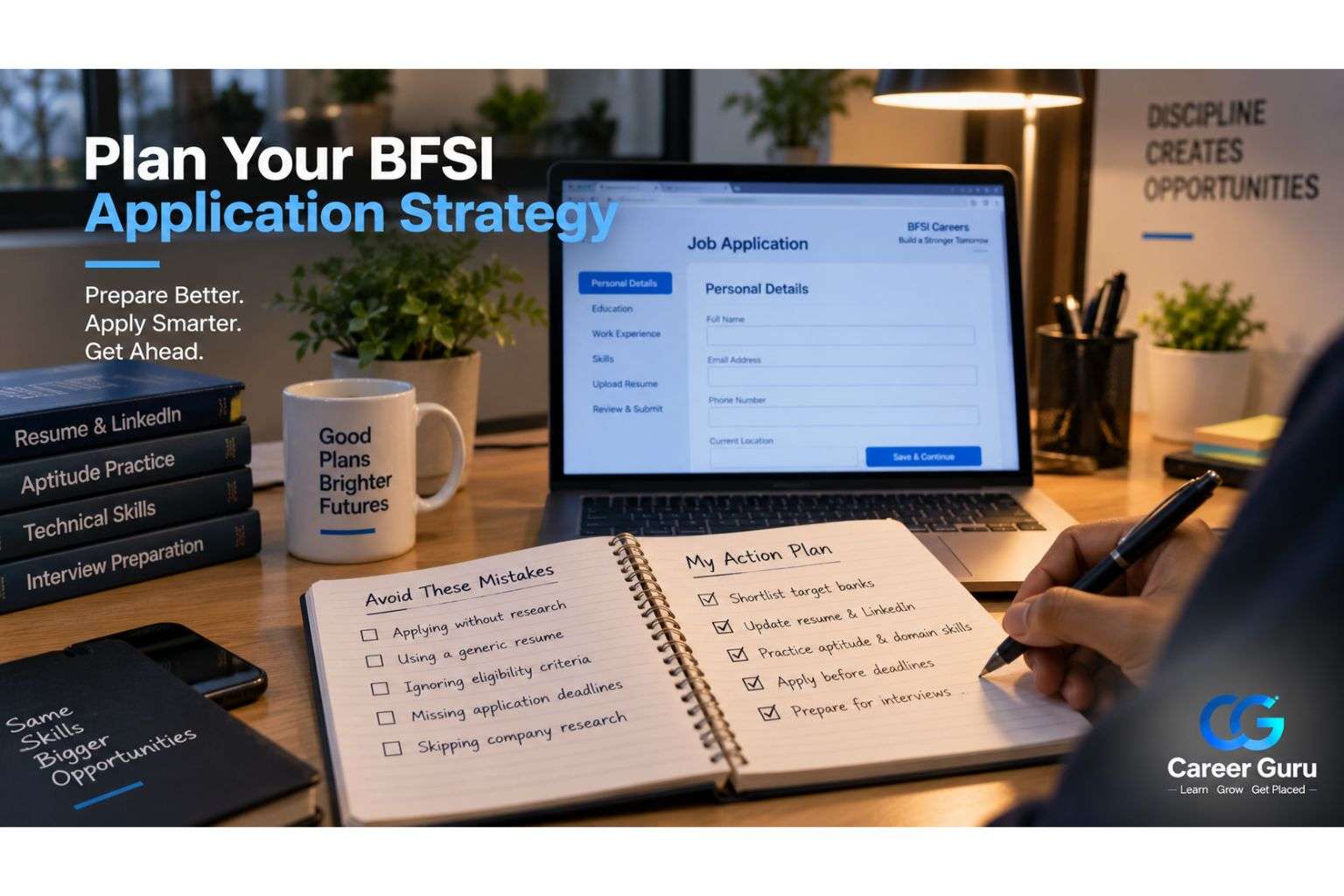
Common Mistakes Freshers Make When Targeting BFSI IT Jobs
The biggest one is treating “BFSI” and “bank job” as the same thing, and applying only through bank recruitment portals meant for clerks and probationary officers. That is a completely different hiring pipeline from BFSI IT jobs for freshers.
The second mistake is ignoring domain knowledge entirely. A fresher who understands what an NPA is, or how a UPI transaction actually settles, will out-interview a fresher with slightly better coding scores but zero domain context, because banking interviewers specifically probe for this.
The third mistake is dismissing service companies’ BFSI verticals as “not real tech.” Two to three years inside a bank’s core banking or testing team, done well, is a strong stepping stone into a GCC or fintech role later. I have seen this path work repeatedly for students who started in modest BFSI IT jobs for freshers and moved up steadily.
Action Steps by College Year for BFSI IT Jobs for Freshers
First year: Build your SQL and one programming language foundation properly. Do not rush into banking-specific learning yet — general coding fundamentals matter more right now.
Second year: Start reading about how Indian banking actually works — RBI’s role, how UPI and NEFT differ, what a core banking system does. Follow Odisha’s GCC and IT policy announcements so you understand where local opportunities are heading.
Third year: Build one small banking or payments-related project. Take a free or low-cost introduction to a core banking platform like Finacle if your college or a Rooman Technologies-style training partner offers one. Start following BFSI GCC and fintech company career pages directly, not just campus placement notices.
Final year: Apply in parallel across three lanes for BFSI IT jobs for freshers — service company BFSI verticals, fintech infrastructure companies, and GCC off-campus drives. Do not wait for one channel to close before trying another. Tailor your resume separately for each lane; a GCC recruiter and a service company recruiter are looking for different signals from the same resume.
SUGGESTIONS TO READ..
- ODISHA GCC POLICY
- SERVICE BASED VS PRODUCT BASED COMPANY FOR FRESHERS
- AI TOOLS FOR FRESHERS
- CAMPUS PLACEMENT 2026 IS BACK
- AI SKILLS SALARY PREMIUM FOR FRESHERS
External Links Used
- JPMorgan to hire 1,000 tech professionals for India GCC expansion
- Fintech Careers in India 2026: The ₹25-60 LPA Boom and How to Enter
Frequently Asked Questions
FAQ 1-Are BFSI IT jobs for freshers different from regular bank jobs?
Yes, and this confusion costs students real opportunities. A regular bank job – clerk, probationary officer, relationship manager – is hired through the bank’s HR and operations pipeline, usually via exams like IBPS or direct bank recruitment. BFSI IT jobs for freshers sit inside the bank’s or financial company’s technology function, building and maintaining the software the bank runs on. The eligibility, the interview process, and the skills tested are completely different.
If you are an engineering graduate aiming for BFSI IT jobs for freshers, do not apply through generic bank recruitment portals meant for non-technical roles; look at the bank’s dedicated IT recruitment notifications or its GCC and technology centre careers page instead.
Consultant’s Note: I have counselled more than one confused student who cleared a bank’s clerical exam by accident while trying to get into the IT side. It is a respectable job, but it is not the tech career they were aiming for, and switching later is hard. Ask which door you are walking through before you apply.
FAQ 2. Do I need a finance or commerce background for BFSI IT jobs for freshers?
No. Nearly every technical BFSI role I have seen filled has gone to a BTech or MCA graduate, not a commerce graduate. What helps is picking up basic banking vocabulary -terms like NPA, CASA, KYC, and settlement cycles – because interviewers use this to check whether you understand the business you are building software for. You can learn this in a few weeks through free RBI publications and industry primers; you do not need a separate finance degree.
Consultant’s Note: I tell my engineering students the same thing every time — you do not need to become a banker, you need to understand banking well enough to ask an intelligent question in an interview.
3. Which core banking platform should I learn – Finacle, Flexcube, or TCS BaNCS?
Finacle, built by Infosys, has the widest footprint in Indian banks, so it is usually the safest starting point if you want breadth. Oracle Flexcube and TCS BaNCS are also widely used, particularly by private and foreign banks. Rather than trying to master one platform deeply as a fresher, focus on understanding the concepts common to all of them — account management, transaction processing, batch jobs, and reporting — since most companies will train you on their specific platform after hiring.
Consultant’s Note: I have seen students spend months on a paid Finacle course before even applying anywhere. Learn the concepts first; let the employer teach you their specific tool.
4. Is a service company’s BFSI vertical a bad career move compared to a product company?
Not at all, and I actively push back on students who dismiss it. A service company’s banking vertical – working on a real bank’s core system, even as a support or testing engineer – teaches you domain knowledge that a generic product company role never will.
Many engineers I have mentored used two to three years in a bank-focused service role as the exact stepping stone into a GCC or fintech company later, because they walked into those interviews already fluent in banking terminology that other candidates had to learn from scratch.
Consultant’s Note: The pay difference is real, and I will not pretend otherwise. But domain depth compounds over a career in a way that an extra two lakhs in year one does not.
5. What salary can a fresher realistically expect in BFSI IT jobs?
It depends entirely on the employer type, and I would rather give you an honest range than a false headline number. Standard IT services company packages for banking projects run roughly ₹3.36 to ₹6.5 LPA. GCCs and product or fintech companies doing similar banking technology work typically pay ₹6 to ₹20+ LPA for comparable fresher roles, with fintech infrastructure companies and pure-play fintechs often at the higher end of that range for strong technical candidates.
Consultant’s Note: Whenever a student quotes me a BFSI salary figure they saw on Instagram, I ask them which type of company it was for. The number is almost always true for one specific employer category and misleading for every other one.
6. Are GCC banking tech jobs realistic for a tier-2 college student?
They are more realistic than they were even two years ago, but they remain selective. GCCs increasingly hire on demonstrated skill rather than college pedigree alone, which genuinely helps tier-2 students who build strong project work and clear technical assessments. JPMorgan’s recent hiring drive, for instance, relies on HackerRank-based coding and system design assessments rather than pure resume screening.
Build your DSA fundamentals seriously and you have a real shot, regardless of which college name is on your degree.
Consultant’s Note: I have placed students from BPUT-affiliated colleges into GCC interview rounds purely on the strength of their coding practice. The door is open; you still have to walk through it prepared.
7. How is AI affecting BFSI IT jobs for freshers?
Unevenly, and I will not sugarcoat this. Some banks, including JPMorgan, have publicly said AI has already reduced staffing needs by 30 to 40 percent in certain functions, mostly repetitive operations and lower-level support work. At the same time, the same banks are hiring more tech freshers for cloud, cybersecurity, and AI-adjacent roles.
The honest reading is that routine, rule-based BFSI IT tasks are shrinking, while roles requiring judgement, AI-tool fluency, and system-level understanding are growing. Position yourself for the second category.
Consultant’s Note: I tell students the same thing I say about every AI-disrupted sector — do not aim for the job AI is about to automate; aim for the job that will exist to manage and improve the AI system doing it.
8. Do fintech companies count as BFSI IT jobs for freshers
Yes, and increasingly they are the more attractive door. Fintech companies like Razorpay, PhonePe, Paytm, and payments infrastructure firms like NPCI and Cashfree sit squarely inside the financial services sector, and their engineering, data, and product roles are genuine BFSI IT jobs for freshers, often paying better than traditional bank technology roles. The trade-off is that hiring bars are typically higher, with strong DSA and system design expectations even at the fresher level.
Consultant’s Note: If your coding is strong, aim for fintech first. If you are still building fundamentals, a bank or service company’s BFSI vertical is the more forgiving entry point.
9. What is the biggest mistake freshers make when targeting BFSI IT jobs for freshers?
Treating it as a single, uniform job market. I see students apply the same generic resume to a public sector bank’s IT recruitment, a GCC’s off-campus drive, and a fintech startup’s SDE opening, without adjusting for the very different things each one is testing. A bank’s IT recruitment values stability, domain learning ability, and process discipline.
A GCC values coding rigour and system design. A fintech values speed, ownership, and product thinking. Tailor accordingly.
Consultant’s Note: I ask every student the same question before they submit a resume — who is reading this, and what do they actually care about? Most students have never thought about it.
10. Should a final-year student apply to BFSI IT jobs alongside regular campus placements?
Yes, in parallel, not instead of. BFSI and GCC hiring for freshers is heavily off-campus and rolling through the year, unlike the fixed-window campus placement drives most students are used to. Apply through your college placement cell where BFSI or GCC recruiters visit, but do not stop there — actively track NPCI, Cashfree, Juspay, GCC career pages, and bank IT recruitment notifications directly, since many of these never come through campus at all.
Consultant’s Note: The students I have seen land the best BFSI IT offers were the ones checking company career pages weekly, not the ones waiting passively for the placement cell to bring the opportunity to them.
Final Word
BFSI IT jobs for freshers are not a passing trend dressed up in AI headlines. They are a structural shift in where India’s banks, insurers, and payment companies are choosing to build their technology teams — increasingly in-house, increasingly in India, and increasingly open to freshers who show up with the right fundamentals.
If you are an engineering student in Odisha wondering where the next real hiring wave is coming from, this sector deserves your serious attention, not just your curiosity.
For more honest, no-hype career guidance for engineering students, explore more posts on Career Guru’s blog, or reach out directly at 9777278853.