

UI UX Design Internships in India 2026 — Skills, Portfolio, Tools and How to Get Your First Role Without a Design Degree
Everything you need to know about UI UX design internships in India 2026 — real skills, essential tools, portfolio tips and honest advice from a 27-year IT career consultant.
UI UX Design Internships in India 2026 — The Career Path Nobody Told Your Engineering College About
UI UX design internships in India 2026 are among the most searched and least understood career opportunities available to Indian students right now.
Every week I speak to engineering students who are quietly miserable about the idea of spending their careers writing backend code or debugging software systems. They are technically capable. They pass their exams. But something about pure software development does not excite them.
And then they discover UI UX design.
Suddenly everything changes. They find a field that combines technology with psychology, creativity with problem-solving, and visual thinking with genuine business impact. They get excited about a career for the first time in years.
And then the doubt arrives.
“I do not have a design degree.” “I cannot draw.” “I have never studied graphic design.” “Is this field even real in India?”
After 27 years as an IT career consultant — placing students across India’s IT sector including design and product roles — I can answer every one of those doubts directly.
You do not need a design degree for UI UX design internships in India 2026. You do not need to be an artist. You do not need to have studied graphic design. What you need is a specific set of learnable skills, a genuine portfolio of real work, and an understanding of what Indian companies hiring UI UX interns are actually looking for.
This blog gives you all three.
What UI UX Design Actually Means — And Why It Is Different From What Most Students Think
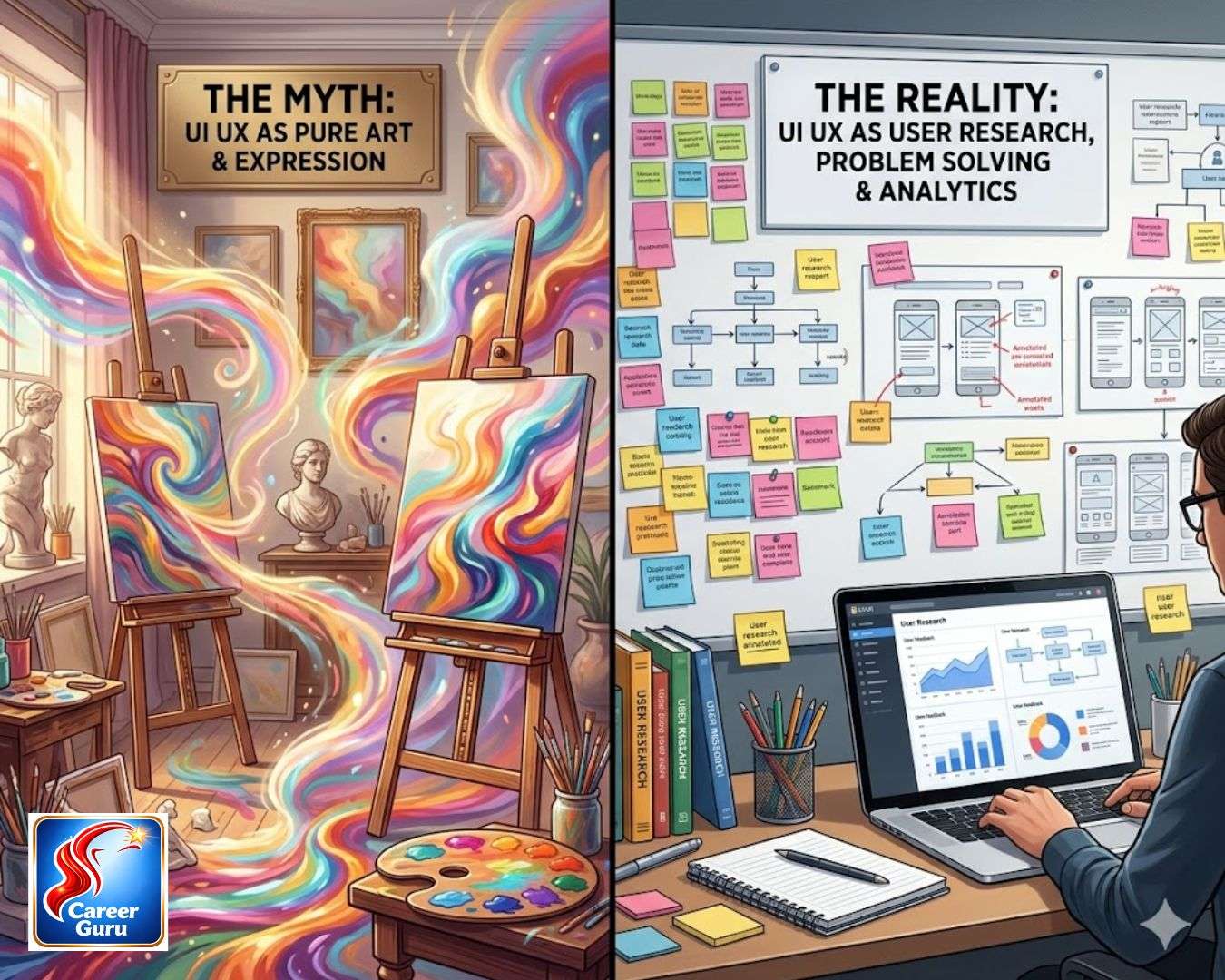
UI UX design internships India 2026 — myth vs reality of what UI UX work actually involves
Before we talk about UI UX design internships in India 2026 specifically, let me clear up the most damaging misconception about this field.
UI UX design is not primarily an artistic discipline. It is a problem-solving discipline.
UI stands for User Interface — the visual layer of a digital product. The buttons, the screens, the typography, the colour system, the layout. How something looks and feels.
UX stands for User Experience — the research and thinking layer beneath the visual design. Understanding who the user is. What they are trying to accomplish. Where they get confused or frustrated. How to design a flow that helps them achieve their goal with the least friction possible.
The best UI UX designers in India are not the ones who can draw the most beautifully. They are the ones who understand people deeply, think logically about problems, and can translate that understanding into interfaces that work intuitively.
That combination — empathy, logical thinking, and visual communication — is something engineering students are often exceptionally well-suited for. The structured problem-solving that B.Tech education develops translates directly into good UX thinking.
The art is learnable. The thinking is what matters. And the thinking is something you may already have.
Why UI UX Design Internships in India 2026 Are a Genuine Opportunity Right Now
The timing of this blog is not accidental. UI UX design internships in India 2026 represent one of the most accessible and fastest-growing entry points into India’s product and technology sector right now for three specific reasons.
India’s product company ecosystem is growing rapidly. Companies like Zoho, Freshworks, Razorpay, Swiggy, Zomato, CRED, and hundreds of funded startups are building products used by millions of people. Every one of those products needs UI UX designers. And most of them are actively hiring freshers and interns because experienced UI UX talent in India is genuinely scarce.
The tools have democratised entry into the field. Three years ago the UI UX tools landscape in India was fragmented and expensive. Today Figma — the industry standard tool globally — offers a completely free version that gives students access to the same design software used by senior designers at top companies. The barrier to entry has dropped dramatically.
Portfolio matters more than degrees here. UI UX is one of the few IT career paths in India where a strong portfolio of real work genuinely outweighs formal qualifications in the hiring process. A B.Tech student with three well-executed Figma projects and a clear understanding of design thinking can get an interview at a product company that would not shortlist them for a software developer role based on their CGPA alone.
That combination — growing demand, accessible tools, and portfolio-first hiring — makes UI UX design internships in India 2026 one of the most compelling career opportunities available to Indian students right now.
Skills You Need for UI UX Design Internships in India 2026
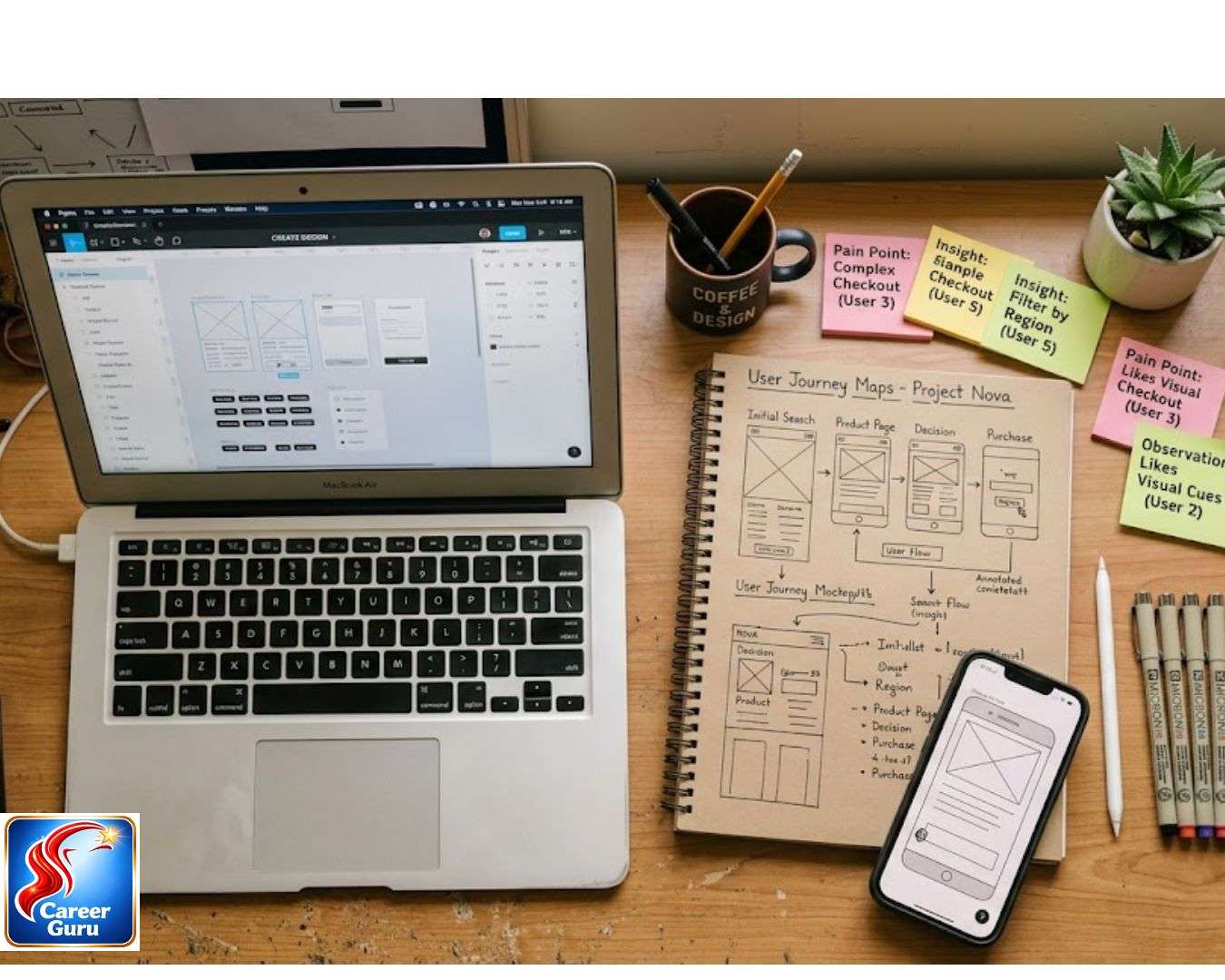
Skills needed for UI UX design internships India 2026 — student workspace with Figma and user research materials
Let me be specific about the skills that actually determine whether you get shortlisted for UI UX design internships in India 2026. Not the skills that sound impressive in a course advertisement. The ones that appear consistently in internship job descriptions and come up in every design interview I have helped students prepare for.
User Research and Empathy Mapping
Every UI UX role in India — internship or full-time — requires at least a basic understanding of user research. This means knowing how to conduct a user interview, how to create a user persona, how to map a user journey, and how to identify pain points in an existing product experience.
You do not need advanced research methodology at the internship level. You need to demonstrate that you understand who you are designing for and why certain design decisions serve them better than others.
Practice this by picking any app you use daily — Swiggy, PhonePe, Google Maps — and conducting a basic UX audit. Who is the primary user. What are they trying to accomplish. Where does the current design create friction. What would you change and why. Write it up. That exercise is both a skill-building practice and a portfolio piece.
Wireframing and Prototyping
Wireframing is the process of creating low-fidelity layouts that show the structure of a screen without visual design details. Prototyping is connecting those wireframes into a clickable flow that simulates the actual user experience.
These two skills are tested in almost every UI UX internship interview in India. Companies want to see that you can think through a product flow logically before you start adding colours and fonts.
Figma handles both wireframing and prototyping in a single tool. Learn to create a basic wireframe in Figma. Then learn to connect screens into a prototype that someone can click through. That combination is the practical foundation of UI UX work at the internship level in India in 2026.
Visual Design Fundamentals
You do not need to be a trained graphic designer for UI UX design internships in India 2026. But you do need to understand the basic principles that make visual design work.
Typography — understanding font pairing, hierarchy, and readability. Colour theory — understanding how colours create emotion, how contrast works, and accessibility considerations. Layout and spacing — understanding grid systems, white space, and visual balance. Component design — understanding how to create reusable design elements like buttons, cards, and navigation bars.
None of these require artistic talent. They are principles you can learn and apply. Google’s Material Design guidelines and Apple’s Human Interface Guidelines are free, comprehensive resources that teach visual design fundamentals in the context of real product design.
Figma — The Non-Negotiable Tool for UI UX Design Internships India 2026
Figma is the tool. Not Adobe XD. Not Sketch. Not Canva.
In India’s current UI UX job market Figma proficiency is listed in virtually every internship and junior designer job description. It has become the industry standard globally and Indian product companies have adopted it completely.
The good news is that Figma is free for students. Their free plan gives you access to the full design tool with unlimited personal projects. There is no reason to pay for anything else at the student level.
What Figma proficiency means at the internship level in India in 2026 is being able to create frames, use auto layout, build components, set up a simple design system, create a prototype, and share your work with a link that anyone can view.
All of these can be learned through Figma’s own free tutorial resources — which are genuinely excellent — and through consistent practice on real projects.
🔗 Visit: figma.com/resources/learn-design
Basic Understanding of Design Systems and Accessibility
This is the skill that separates candidates who understand design at a surface level from those who understand it at a professional level — and it is increasingly being tested in UI UX internship interviews at Indian product companies in 2026.
A design system is a collection of reusable components, design tokens, and guidelines that ensure consistency across a product. Understanding what a design system is, why it exists, and how to work within one tells an interviewer that you understand how design works at scale in a real company — not just how to make a single screen look good in isolation.
Accessibility means designing for users with visual, motor, or cognitive differences. Understanding basic accessibility principles — sufficient colour contrast, readable font sizes, clear navigation structures — signals that you think about the full range of users rather than just the ideal case.
Neither of these requires deep expertise at the internship level. A basic understanding demonstrated through your portfolio work is enough to stand out from the majority of applicants.
Building a Portfolio for UI UX Design Internships India 2026 — Without a Single Day of Work Experience

UI UX portfolio for design internships India 2026 — student presenting case study in interview
Your portfolio is your single most important asset when applying for UI UX design internships in India 2026. More important than your degree. More important than your CGPA. More important than any certification.
Here is why. UI UX hiring is fundamentally different from software development hiring. A software developer candidate can be tested with a coding challenge. A UI UX candidate needs to show how they think — how they approach a design problem, how they research users, how they make decisions, and how they communicate their reasoning.
That thinking is only visible through a portfolio.
Three well-executed case studies is the right portfolio size for UI UX design internships in India 2026. Not ten. Not one. Three. Each one should tell the complete story of a design project from problem identification through research, wireframing, visual design, and final prototype.
Here is what each case study should include.
The problem statement. What product or feature were you designing. Who is the user. What problem were you solving for them.
Your research process. What did you do to understand the user before you started designing. Even a simple competitive analysis or a few informal user interviews counts as research at the student level.
Your design decisions. Walk through your wireframes and explain why you made specific layout and flow decisions. This is the most important part of any UI UX case study — showing your reasoning rather than just your output.
The final design. Your high-fidelity Figma screens and prototype. Clean. Consistent. With a functioning click-through prototype that the viewer can interact with.
What would you improve? One short paragraph about what limitations exist in your current design and what you would explore if you had more time. This signals design maturity — the understanding that design is never finished, only iterated.
Three Portfolio Project Ideas That Work for Indian Students With No Work Experience
Project 1 — Redesign an existing Indian app. Pick a popular Indian app that has known UX problems — many payment apps, government portals, and e-commerce apps have genuine usability issues. Conduct a UX audit. Identify three to five specific problems. Redesign the problematic flows in Figma. Document your entire process as a case study. This type of project is immediately relatable to Indian product company interviewers who are familiar with the same apps.
Project 2 — Design a solution to a real Indian problem. Identify a genuine pain point in Indian daily life — booking an auto-rickshaw in a smaller city, navigating a local government service, finding authentic local food options. Design a mobile app that solves that problem from user research through final prototype. Projects that address specifically Indian contexts show recruiters at Indian companies that you understand their users.
Project 3 — Improve the onboarding experience of any product. Onboarding — the first-time user experience — is a universally important and universally discussed topic in Indian product companies. Pick any product and redesign its onboarding flow to reduce friction and increase completion rate. Document your user research, your design decisions, and your prototype. This project type demonstrates understanding of a real business metric — onboarding completion — alongside design skill.
Where to Find UI UX Design Internships in India 2026
Finding the right platforms for UI UX design internships in India 2026 is different from finding software development internships. Here is where to look specifically.
Internshala has a dedicated design category with a consistently strong listing of UI UX internships across India. Filter by UI UX design specifically rather than just “design” — the category includes graphic design and social media roles that are different from what you want.
LinkedIn is where most product companies and funded startups post UI UX internship opportunities. Follow companies like Zoho, Freshworks, Razorpay, Groww, and similar product companies directly and turn on job notifications for their pages.
Behance and Dribbble are design portfolio platforms where Indian companies actively search for design talent directly. Having a well-presented portfolio on Behance specifically is a passive job search tool — companies find you rather than you finding them.
Direct company career pages. Many Indian startups do not advertise UI UX internships on job boards — they post only on their own career pages. Follow your target companies on LinkedIn and check their career pages monthly.
AngelList and Wellfound list startup job openings across India and have a disproportionately high concentration of UI UX design roles relative to their overall listing volume — because startups building products need designers more urgently than large service companies do.
🔗 Related Read: Best Platforms to Find Summer Internships in India 2026
What Indian Companies Actually Look for in UI UX Design Interns in 2026
After placing students in design roles and speaking with hiring managers at Indian product companies, here is what they consistently tell me they look for when evaluating UI UX intern candidates.
A portfolio that shows process, not just output. The biggest mistake Indian UI UX students make in their portfolios is showing only the final polished screens with no explanation of how they got there. Hiring managers at Indian companies want to see your thinking. Show your wireframes. Show your iteration. Show why you made the decisions you made.
Genuine curiosity about users. Even at the internship level Indian product companies want candidates who are genuinely curious about people and how they interact with digital products. This comes through in interviews when a candidate can speak naturally about what they observed during even informal user research.
Figma proficiency that is demonstrated, not claimed. Every UI UX candidate claims to know Figma. The ones who impress share a portfolio link that opens directly in Figma — with components, auto layout, and a working prototype. That demonstration is worth more than any certificate.
The ability to give and receive design feedback professionally. Design is a collaborative, iterative process. Candidates who can explain their design choices clearly and respond to feedback thoughtfully rather than defensively signal that they will function well in a real design team.
Read These Next
- 📌 Best Platforms to Find Summer Internships in India 2026
- 📌 How to Write a Resume for Internship With No Experience in India 2026
- 📌 How to Write a Cover Letter for Internship in India 2026
- 📌 Top 10 High Paying Internships in India 2026
- 📌 LinkedIn Profile Tips for Students India 2026
- 📌 GitHub Profile for Indian Students 2026
- 📌 Top Tech Skills Employers Look for in Freshers in India 2026
- 📌 Best Free Online Courses for IT Students in India 2026
- 📌 Internship vs Training India 2026
- 📌 How to Prepare for an Internship Interview in India 2026
FAQs — UI UX Design Internships India 2026
FAQ 1 — Can Indian engineering students with no design background realistically get UI UX design internships in India 2026 or is it only for students from design colleges?
This is the question I get asked most often by engineering students who are interested in UI UX — and my answer after placing students in design roles across India is an unqualified yes.
Engineering students with no formal design background get UI UX internships at Indian product companies regularly in 2026. The path requires specific preparation but it is absolutely not closed to non-design graduates.
Here is why engineering students are often genuinely well-suited for UI UX work. UX design is fundamentally about structured problem-solving — understanding a problem deeply, breaking it into components, testing solutions, and iterating based on evidence. That is almost exactly the analytical framework that a good engineering education develops.
The visual design skills that engineering students typically lack are real but they are learnable with deliberate practice over weeks — not years.
What Indian product companies are hiring for in UI UX interns is not artistic talent. It is the ability to think clearly about user problems, communicate design decisions logically, and produce work in Figma that demonstrates both research and visual competence. A B.Tech student who has invested three to four months in learning Figma, building a portfolio of three case studies, and developing a basic understanding of user research methodology is genuinely competitive for UI UX internships at Indian startups and product companies.
The students I have seen struggle are not those with engineering backgrounds — they often have an advantage in the logical thinking component of UX. They are the ones who learned Figma superficially without building real case studies, or who focused on making screens look beautiful without being able to explain the design decisions behind them.
Consultant’s note — I have placed engineering students from B.Tech CSE, ECE, and even mechanical engineering backgrounds into UI UX roles at Indian product companies.
The common thread among all of them was not their degree. It was a portfolio that showed genuine design thinking — clear problem statements, documented research however simple, logical wireframing decisions, and the ability to explain their choices in plain language during the interview. Build that portfolio and your degree becomes a non-issue in UI UX hiring conversations.
,
FAQ 2 — How long does it realistically take to become ready for UI UX design internships in India 2026 starting from zero design experience?
I want to give you an honest timeline here rather than the optimistic one that course advertisements tend to offer — because making the right preparation investment requires knowing what the realistic timeline actually is.
For a student starting from zero design experience — no Figma knowledge, no user research exposure, no design portfolio — the realistic timeline to become genuinely competitive for UI UX design internships at Indian companies is four to six months of consistent daily practice. That timeline assumes one to two hours of focused daily practice and a willingness to build real projects rather than just completing tutorial exercises.
Here is what that timeline looks like broken down. The first four to six weeks should be entirely focused on Figma fundamentals — frames, components, auto layout, prototyping. Figma’s own free learning resources cover this comprehensively. The goal by week six is to be able to build a basic screen from scratch in Figma without needing to reference tutorials for basic operations.
Weeks seven through twelve should focus on design principles and the first portfolio project — ideally a UX audit and redesign of an existing Indian app. This project combines the Figma skills from the first phase with user research and design thinking that you are building simultaneously. The output is your first case study.
Months four through six are for building the second and third portfolio projects, refining all three case studies for presentation quality, and beginning to apply for internships while continuing to develop your skills.
Students who compress this timeline by skipping genuine project building in favour of certificate collecting almost always arrive at interviews with polished-looking portfolios that fall apart the moment an interviewer asks them to walk through their design process. The timeline is longer than you want it to be. The outcomes it produces are worth it.
Consultant’s note — The most common mistake I see Indian students make when preparing for UI UX internships is spending the first two months entirely on Figma tutorials and none of it on actual design thinking or user research. Figma is a tool.
It is important. But knowing how to use Figma without understanding how to think about design problems is like knowing how to type without knowing what to write.
Learn the tool and the thinking simultaneously from week one — even imperfectly. Your case studies will be better for it.
FAQ 3 — What is the realistic salary or stipend for UI UX design internships in India 2026 and what does the full-time career path look like after that?
Let me give you honest numbers from actual offer letters and internship listings rather than the figures that appear in design course marketing material.
For UI UX design internships in India in 2026 the stipend range varies significantly by company type. At large IT service companies that have design practices — TCS, Infosys, Wipro — UI UX interns typically receive between ₹10,000 and ₹20,000 per month.
At mid-size Indian product companies and funded startups the range is ₹15,000 to ₹35,000 per month. At well-funded unicorns and global product companies with India offices the range for strong candidates can reach ₹40,000 to ₹60,000 per month.
The full-time career progression after a UI UX internship in India is one of the strongest available in the IT sector right now. A junior UI UX designer with one to two years of experience at a product company earns between ₹5 and ₹10 LPA. A mid-level UI UX designer with three to five years earns between ₹12 and ₹25 LPA.
Senior designers and design leads at top Indian product companies earn ₹25 to ₹50 LPA. These are real figures from actual job listings — not aspirational claims.
What makes the UI UX career trajectory particularly strong in India right now is the genuine scarcity of experienced design talent. Most Indian engineering colleges do not teach UI UX at all. Most design colleges produce graduates with strong visual skills but limited product thinking. The sweet spot — a designer who combines analytical thinking with visual competence and user empathy — is genuinely rare and genuinely well-compensated when found.
Consultant’s note — The students I have placed in UI UX roles consistently tell me that their salary growth in the first three years exceeded what they would have earned in software development roles at service companies.
That comparison is not universal — a strong software developer at a product company will always earn more than a junior designer. But for students who are genuinely better suited to design thinking than to software development, the UI UX career path in India in 2026 offers a combination of accessibility, growth, and financial reward that is hard to match elsewhere in the IT sector.
What to Do This Week — Your UI UX Internship Action Plan
Rather than summarising what you have already read let me leave you with seven specific actions that will move you meaningfully toward your first UI UX design internship in India 2026.
Day one — Create a free Figma account. Go to figma.com. Create a free account. Open a new file. Spend thirty minutes exploring the interface without a tutorial. Click on everything. Break things. Figure out what things do. That unguided exploration builds familiarity faster than any tutorial in the first session.
Day two — Complete Figma’s free beginner tutorial. Figma has its own free learning resources that cover everything you need for basic proficiency. Complete the first tutorial end to end. Then recreate what you built from scratch without following the tutorial. The recreation is where the learning actually happens.
Day three — Pick your first portfolio project. Choose one Indian app that you use regularly and find frustrating. Write one paragraph describing who the primary user is, what they are trying to accomplish, and where the current design fails them. That paragraph is the problem statement for your first case study.
Day four — Conduct informal user research. Ask three people who use that same app to walk you through how they use it while you observe. Note where they hesitate, where they make mistakes, and what they say under their breath in frustration. Those observations are your user research. Write them up.
Day five — Sketch your first wireframes. On paper. Not in Figma yet. Draw the key screens of your redesigned solution. Focus on the flow and the layout — not the visual design. Get the thinking right on paper before you move to the tool.
Day six — Build your wireframes in Figma. Take your paper sketches and recreate them as low-fidelity wireframes in Figma. Connect them into a basic prototype. Share the prototype link with one person and watch them try to use it. What confuses them is your next iteration.
Day seven — Update your LinkedIn profile. Add UI UX Design as a skill. Add Figma as a tool. Write one sentence in your About section about your design interest and what you are currently building. That update makes you findable by recruiters searching for design talent — even before your portfolio is complete.
Four to six months from today — if you follow this path consistently — you will have a portfolio of three genuine case studies, real Figma proficiency, and a strong enough foundation to compete seriously for UI UX design internships in India 2026.
Start today. Not when you feel ready. Today.
Already exploring internship opportunities? Read our complete guide on Best Platforms to Find Summer Internships in India 2026 and make sure you are applying in all the right places for UI UX roles specifically.