

Top Tech Skills Employers Look for in Freshers in India 2026 — What Hiring Managers Actually Want
Discover the top tech skills employers look for in freshers in India 2026. A 27-year IT career consultant reveals what hiring managers actually test for — and what most students are missing.
Focus Keyword: Top tech skills employers look for in freshers in India 2026
Top Tech Skills Employers Look for in Freshers in India 2026 — And Why Most Students Are Building the Wrong Ones
The top tech skills employers look for in freshers in India 2026 have shifted more dramatically in the past three years than in the entire decade before that. And most students have not caught up with that shift yet.
Here is what I mean by that. I regularly speak with hiring managers across India’s IT sector — at service companies, product startups, analytics firms, and consulting organisations. I ask them one specific question every time. “What skill gap do you consistently find in the freshers you interview?” The answers have been remarkably consistent over the past two years.
It is not that freshers lack technical knowledge. Most of them have studied the right subjects. It is that they have studied theory without building practical ability. They know what a JOIN is but cannot write one under pressure. They know what a neural network is but cannot explain why their model is overfitting. They know what Agile is but have never worked in an actual sprint.
That gap — between knowing about something and being able to actually do it — is the gap that determines who gets hired and who goes home with nothing.
After 27 years of working as an IT career consultant and watching this gap play out in thousands of interviews across India, I can tell you exactly which tech skills employers are specifically testing for in 2026 — and more importantly, what genuine proficiency in each one actually looks like versus surface-level familiarity.
Why the Top Tech Skills for Freshers in India 2026 Are Different From Previous Years

Tech skills employers look for freshers India 2026 — theory vs practical skills contrast
Three specific shifts have happened in India’s IT hiring landscape that directly affect which tech skills matter most for freshers in 2026.
Shift 1 — Automation has eliminated the most entry-level tasks. Routine coding tasks, basic testing, and simple data entry work that used to be given to freshers is increasingly handled by automation tools. This means companies now need freshers who can contribute at a slightly higher level from day one. The bar has moved up. Students who were competitive three years ago with basic programming knowledge now need one or two additional practical skills to clear the same filter.
Shift 2 — AI tools have changed what employers test for. The rise of GitHub Copilot, ChatGPT for code, and other AI-assisted development tools has shifted what employers value in freshers. Pure code memorisation matters less. Problem decomposition, code review, understanding why code works or does not work, and the ability to evaluate AI-generated code critically matters significantly more. Employers in 2026 are testing for thinking skills alongside coding skills.
Shift 3 — Data awareness is now expected across all IT roles. Data skills are no longer exclusive to data science roles. Software developers are expected to understand databases deeply. Business analysts are expected to write SQL queries. Product managers are expected to interpret data dashboards. The boundary between data work and other IT work has blurred significantly — and freshers who have only prepared for one narrow role often find themselves underprepared for the actual breadth of what is expected.
Understanding these three shifts explains why the top tech skills employers look for in freshers in India 2026 look the way they do.
The Top Tech Skills Employers Look for in Freshers in India 2026 — The Complete List
Skill 1 — SQL and Database Knowledge

SQL — top tech skill employers look for in freshers India 2026
SQL sits at the top of every honest list of tech skills employers look for in freshers in India 2026. Not because it is the most exciting skill. Because it is the most universally required one.
Every company that stores data — which is every company — needs people who can query it. That means software developers, data analysts, business analysts, quality engineers, and even product managers are all expected to have functional SQL knowledge at the entry level in 2026.
What employers are specifically testing is not whether a fresher has heard of SQL. They are testing whether the fresher can write a working query from scratch under interview pressure. Can they write a multi-table JOIN correctly. Can they use GROUP BY and HAVING appropriately. Can they write a subquery when a problem requires it. Can they explain the difference between INNER JOIN and LEFT JOIN without hesitation.
The students who pass this test are the ones who have practiced writing SQL regularly on real datasets — not the ones who watched a tutorial series and feel vaguely familiar with the syntax.
What genuine proficiency looks like: Being able to sit down in an interview with no reference material and write a correct, efficient SQL query for a multi-step business problem within ten minutes.
🔗 Related Read: Data Science Career Roadmap India 2026
Skill 2 — Python Programming With Practical Application
Python is the most versatile language on this list and appears in more Indian fresher job descriptions than any other programming language in 2026. But there is an important distinction between what employers are testing and what most students have prepared.
Employers testing Python skills for freshers in India are not primarily testing machine learning or deep learning ability. They are testing practical Python — the ability to write clean working scripts, manipulate data structures, work with libraries like Pandas and NumPy, automate repetitive tasks, and debug code that is not working as expected.
The freshers who impress in Python assessments are the ones who have built real things with Python. Not the ones who have watched the most tutorials. A student who built a web scraper, a data cleaning script, and a basic Flask API has demonstrated more practical Python ability than one who completed five Python courses without building anything.
What genuine proficiency looks like: Writing a working Python script from scratch that solves a real problem — parsing a CSV file, cleaning inconsistent data, or automating a file management task — without needing to Google basic syntax.
🔗 Related Read: Python vs Java vs C++ for Indian Students 2026
Skill 3 — Data Analysis and Visualisation
Data analysis has become one of the most consistently demanded top tech skills employers look for in freshers in India 2026 — across IT services, product companies, fintech, e-commerce, and healthcare. Every business function generates data. Every business function needs people who can make sense of it.
What employers are looking for at the fresher level is not advanced statistical modelling. It is the ability to take a dataset, explore it methodically, identify meaningful patterns, and communicate the findings clearly — both in written summaries and in visual dashboards.
The tools that matter most in India’s current market are Excel for basic analysis, Python with Pandas and Matplotlib for more sophisticated work, and Power BI or Tableau for dashboard creation. A fresher who is competent in all three covers the data analysis requirements of the vast majority of Indian IT roles in 2026.
The communication aspect of data analysis is consistently underestimated by students. Indian employers specifically cite the ability to explain data findings to non-technical stakeholders as a skill they rarely find in freshers and actively look for. Build it deliberately.
What genuine proficiency looks like: Taking a raw dataset with missing values and inconsistencies, cleaning it, performing exploratory analysis, building a clear dashboard, and explaining what the data shows in plain language to someone who has never opened a spreadsheet.
Skill 4 — Version Control With Git and GitHub
Git and GitHub are among the most practically important top tech skills employers look for in freshers in India 2026 — and among the most consistently absent from fresher profiles.
Here is the reality of software development in every Indian IT company. Code is managed through version control. Pull requests, branches, commits, merges, and conflict resolution are daily activities. A fresher who joins a development team and does not understand basic Git workflow creates friction for the entire team immediately.
Yet the majority of Indian engineering colleges still do not teach Git practically. Students graduate having written code in isolation — never collaborating through version control, never pushing to a shared repository, never resolving a merge conflict.
The fix is simple and completely free. Create a GitHub account today. Push every project you build to it. Learn basic Git commands — clone, add, commit, push, pull, branch, merge. Contribute to one open source project however small. That combination gives you a visible, verifiable Git history that employers can evaluate — and tells any recruiter who looks at your profile that you understand how real development teams actually work.
What genuine proficiency looks like: Being able to create a branch, make commits, push to GitHub, create a pull request, and resolve a basic merge conflict without assistance.
🔗 Related Read: Best Free Online Courses for IT Students in India 2026
Skill 5 — Cloud Computing Fundamentals
Cloud computing knowledge has moved from a nice-to-have to a genuine expectation for freshers at companies across India’s IT sector in 2026. AWS, Microsoft Azure, and Google Cloud are the three platforms that dominate Indian corporate environments — and basic familiarity with at least one of them is now mentioned in a surprising number of entry-level job descriptions.
What employers are looking for at the fresher level is not cloud architecture design or DevOps engineering. It is conceptual understanding combined with one practical credential. What is a virtual machine. What is object storage. What does serverless mean. What is the difference between IaaS, PaaS, and SaaS. Being able to answer these questions clearly — and having a foundational certification to back up the claim — is the cloud knowledge bar that most entry-level Indian IT roles are setting in 2026.
The good news is that all three major cloud providers offer free foundational learning paths. AWS Cloud Practitioner, Microsoft Azure Fundamentals AZ-900, and Google Cloud Digital Leader are all free to study for and the foundational certifications are relatively affordable to sit. A cloud certification on a fresher resume in India in 2026 is one of the highest-return investments of preparation time available.
What genuine proficiency looks like: Being able to explain core cloud concepts clearly, describe the basic services of one major cloud platform, and hold a confident conversation with an interviewer about cloud use cases in a corporate environment.
Skill 6 — Object Oriented Programming Concepts
Object oriented programming is one of the most consistently tested top tech skills employers look for in freshers in India 2026 across every type of company and every type of technical role. TCS tests it. Infosys tests it. Every startup that interviews freshers for development roles tests it.
Yet it is also one of the areas where freshers consistently underperform — not because they have never studied it but because they have studied it theoretically without ever writing code that genuinely demonstrates it.
Knowing that encapsulation, inheritance, polymorphism, and abstraction are the four pillars of OOP is not what an interviewer is testing. They are testing whether you can implement a class hierarchy correctly, whether you understand when to use inheritance versus composition, and whether you can explain a real-world example of each concept without reverting to textbook definitions.
The students who pass OOP questions comfortably are the ones who have built projects using object oriented design — where classes and objects are not just academic concepts but tools they have used to solve real problems.
What genuine proficiency looks like: Being able to design a simple class hierarchy for a real-world scenario from scratch in an interview — writing it in code, explaining the design choices, and handling follow-up questions about why you structured it the way you did.
Skill 7 — Basic Understanding of APIs and Web Services

API knowledge — top tech skill employers look for freshers India 2026
APIs — Application Programming Interfaces — are how modern software systems talk to each other. Every application you use is built on APIs. Every company you will work for uses APIs extensively. And yet basic API knowledge barely appears in most Indian college syllabuses.
Employers hiring freshers for software development, backend development, and integration roles in India in 2026 consistently list API understanding as a required skill. What that means practically is understanding what a REST API is, how HTTP methods work — GET, POST, PUT, DELETE — what JSON is and how to read it, and how to make basic API calls using tools like Postman or Python’s requests library.
This is not advanced knowledge. A student can build functional API understanding in two to three weeks of focused self-study. But it needs to be hands-on — actually calling real APIs, reading the responses, and building simple integrations — not just reading about what APIs are.
What genuine proficiency looks like: Being able to use Postman to call a public API, understand the JSON response, and write a basic Python script that retrieves and processes data from that API.
Skill 8 — Communication of Technical Concepts
This is the skill on this list that surprises most students. Communication is not a tech skill in the traditional sense. But every single hiring manager I have spoken to in India over the past three years lists it as one of the top tech skills employers look for in freshers — because the absence of it directly limits how useful a technically strong fresher can actually be on a real team.
Here is what employers mean when they say they want freshers who can communicate technical concepts. They want someone who can explain what they built to a non-technical colleague. Who can write a clear commit message. Who can document their code so another developer can understand it without asking questions. Who can present their findings from a data analysis in a way that makes sense to a business manager.
These are practical, learnable skills. Build them deliberately. Write documentation for every project you build. Practice explaining your work to family members who have no technical background. If they understand — you have communicated it well. If they look confused — keep simplifying until they do.
What genuine proficiency looks like: Being asked “explain what this project does” in an interview and giving a clear, jargon-free two-minute explanation that a non-technical person could follow — followed by a technical deep-dive when the interviewer asks for one.
How to Build These Top Tech Skills as a Fresher in India in 2026
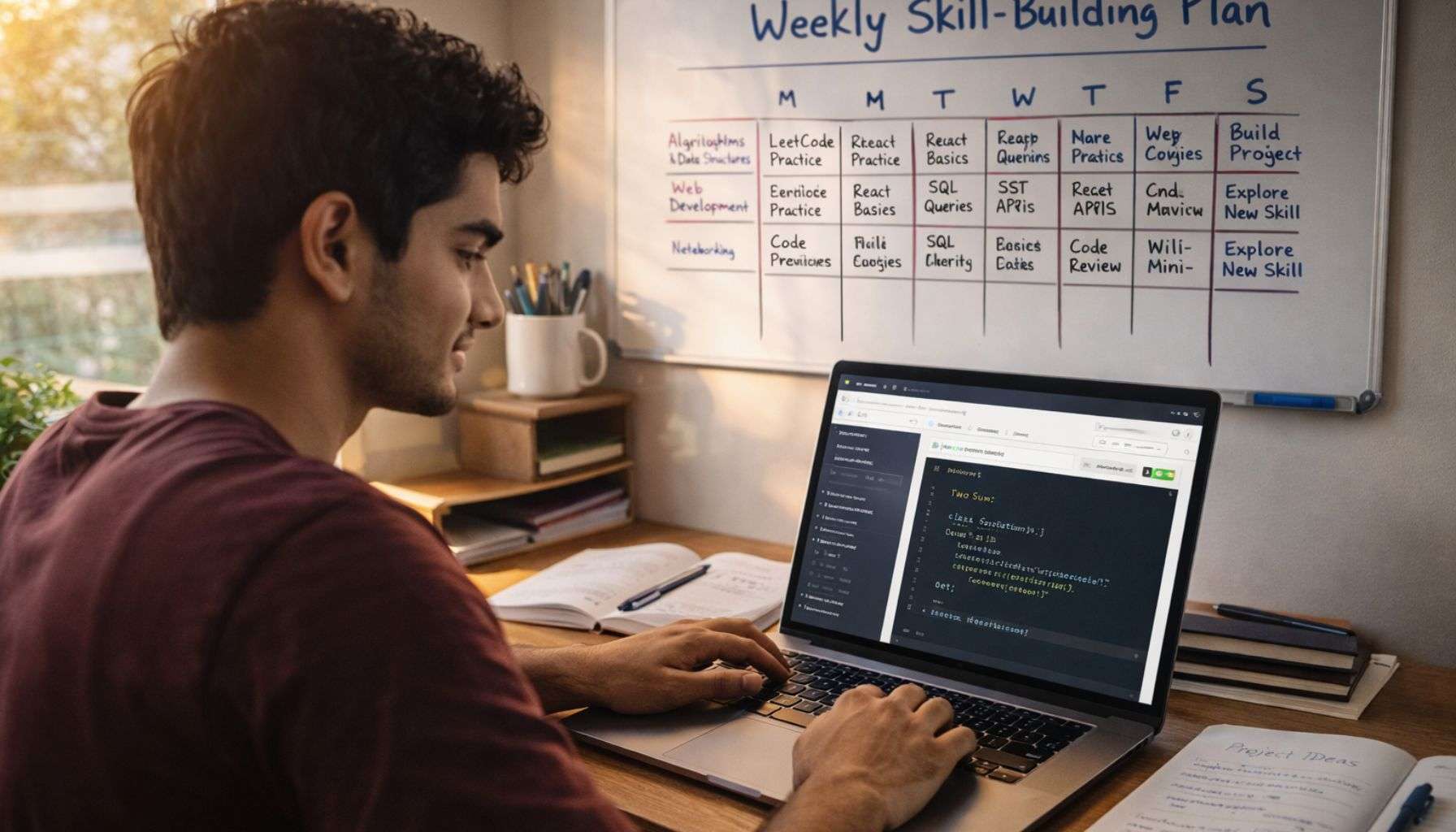
Building top tech skills for freshers India 2026 — structured weekly practice plan
Knowing which skills matter is the first step. Building them practically is the second. Here is the honest approach that works.
Do not try to build all eight skills simultaneously. Pick the two or three most relevant to your target role and go deep on those first. A data analyst role needs SQL, Python for data, and Power BI most urgently. A software developer role needs Python or Java, OOP, Git, and APIs most urgently. Focused depth beats scattered surface-level familiarity every time.
Build something with every skill you learn. For every skill on this list there is a project you can build that demonstrates it concretely. A SQL project means writing queries against a real database. A Python project means building something that solves a real problem. A Git project means pushing real code to a real GitHub repository. The project is the proof. Without it the skill is just a claim.
Practice under timed conditions. Employers test these skills under pressure. You should practice them under pressure. Set a timer when you practice SQL queries. Set a timer when you write Python code. The discomfort of the timer during practice is significantly better than the discomfort of freezing in an actual interview.
Put your work where recruiters can see it. GitHub for your code. LinkedIn for your project updates and learning posts. Kaggle for your data projects. Every piece of work you make visible is an opportunity for a recruiter to find you rather than you having to find them.
What I Tell Every Fresher I Work With About Tech Skills in India in 2026
The students who get hired in India’s IT sector in 2026 are not the ones with the longest list of skills on their resume. They are the ones who can demonstrate two or three skills genuinely and confidently under interview pressure.
I have sat with hiring managers who told me they would rather hire a fresher who knows SQL and Python deeply and can write working code in both without assistance — than one who claims eight skills and cannot demonstrate any of them beyond a surface level when questioned.
Depth beats breadth at the fresher level. Every time. Build fewer skills more completely. Show your work. Practice under pressure. And never put a skill on your resume that you cannot speak to confidently for five minutes in an interview room.
That approach — focused, practical, honest — is what the top tech skills employers look for in freshers in India 2026 actually reward.
Internal Links — Read These Next
- 📌 Data Science Career Roadmap India 2026
- 📌 Python vs Java vs C++ for Indian Students 2026
- 📌 Best Free Online Courses for IT Students in India 2026
- 📌 Cybersecurity Internships in India 2026
- 📌 TCS NQT 2026 — Complete Guide for Freshers
- 📌 How to Write a Resume for Internship With No Experience in India 2026
- 📌 Why Your Resume Is Getting Rejected in India 2026
- 📌 LinkedIn Profile Tips for Students India 2026
- 📌 Top 10 IT Companies in India Hiring Freshers in 2026
- 📌 Fresher Salary in India 2026
FAQs — Top Tech Skills Employers Look for in Freshers in India 2026
Q 1:- Which single tech skill gives a fresher in India the highest return on preparation time in 2026?
If I had to name one skill — and students ask me this exact question regularly — my answer without hesitation is SQL. Here is the full reasoning behind that answer rather than just the conclusion.
SQL appears in more Indian fresher job descriptions than any other technical skill in 2026. It is tested by service companies, product companies, startups, analytics firms, and consulting organisations. It is relevant to software development roles, data roles, business analyst roles, and quality engineering roles simultaneously.
It can be learned to a genuinely job-ready level in four to six weeks of consistent daily practice using completely free resources. And it is consistently the skill that hiring managers tell me they find most commonly absent in otherwise promising fresher candidates.
That combination — high demand, wide applicability, fast skill-building timeline, free learning resources, and consistent absence in fresher profiles — makes SQL the single highest return-on-investment technical skill a fresher can build in India right now.
A student who spends six weeks going genuinely deep on SQL while their peers are watching machine learning tutorials will almost always outperform those peers in the actual filtering stage of Indian IT hiring in 2026.
Consultant’s note — I have been telling students this for three years and the ones who believed me and started with SQL consistently reached job-ready status faster than those who started with more glamorous skills.
The market data backs it up every cycle. SQL first. Everything else after.
Q 2:- How should a fresher demonstrate tech skills to employers in India when they have no work experience to show?
The question of how to demonstrate skills without work experience is the central challenge of every fresher job search in India — and the answer has become both more accessible and more important in 2026 than it was five years ago.
The three demonstration channels that work best for Indian freshers in 2026 are GitHub, Kaggle, and LinkedIn — in that order of technical credibility with Indian IT recruiters. A GitHub profile with real committed code tells a recruiter that you have actually built things with the skills you claim.
A Kaggle profile with completed notebooks and competition entries tells a recruiter that you have applied data skills to real problems.
A LinkedIn profile with project posts and learning updates tells a recruiter that you are actively developing rather than passively waiting.
The critical word in all three channels is real. Real code. Real projects. Real documentation. Not placeholder repositories with one README file and no actual code. Not Kaggle profiles created but never used. Not LinkedIn profiles listing skills with no evidence behind them. Recruiters who evaluate fresher profiles for technical roles in India in 2026 are sophisticated enough to distinguish between genuine skill demonstration and the appearance of it.
One specific piece of advice I give every student I work with. For every skill you want to demonstrate, build one project that uses that skill to solve a problem you can explain clearly in two sentences. What was the problem. What did you build. What was the result. That three-part structure — problem, solution, result — is the story every portfolio project needs to tell to be genuinely useful in a job search.
Consultant’s note — The most common portfolio mistake I see from Indian freshers is building projects for the resume rather than for genuine learning. The difference shows immediately in an interview.
A student who built something because they were genuinely curious about the problem can talk about it naturally for twenty minutes — discussing challenges, alternative approaches, what they would do differently.
A student who built something purely to check a portfolio box runs out of things to say after two minutes. Build things you are actually interested in. The authenticity comes through every time.
Q 3:- Are soft skills as important as tech skills for freshers in India’s IT sector in 2026 and how should students balance preparation between the two?
This question reflects a false choice that I want to address directly. Soft skills and tech skills are not competing priorities for a fresher preparing for India’s IT job market in 2026.
They are complementary requirements that both need to be present — and the absence of either one creates a specific and identifiable problem in the hiring process.
Here is the practical reality I have observed across hundreds of fresher hiring decisions in India. Technical skills determine whether a candidate gets shortlisted. Soft skills — specifically communication clarity and professional maturity — determine whether a shortlisted candidate gets the offer.
A technically strong fresher who cannot explain their work clearly, who gives vague answers to behavioural questions, or who comes across as unprepared for professional communication will lose an offer to a slightly less technical candidate who communicates with confidence and clarity.
The balance I recommend to students is roughly seventy percent of preparation time on technical skills and thirty percent on communication and interview skills. The seventy percent goes toward building genuine proficiency in the tech skills on this list. The thirty percent goes toward practicing clear verbal communication of technical concepts, preparing specific answers to behavioural interview questions, and building the professional vocabulary that allows a fresher to have an adult conversation about technology without sounding like they are reciting definitions from a textbook.
Consultant’s note — In 27 years of IT career consulting in India I have never seen a purely technical fresher who could not communicate get a job at a company that matters. And I have never seen a fresher who could communicate beautifully but had no real technical skills get past the technical interview. Both are non-negotiable.
The students who treat them that way are the ones who walk out of placement season with offers.
Your Action Plan — What to Do With This Information This Week
This blog has covered the top tech skills employers look for in freshers in India 2026 in detail. But information without action is just reading. Here is what I want you to do with it this week — not eventually, this week.
On day one open your resume and honestly audit every tech skill listed against this list. For each skill you have claimed ask yourself — can I demonstrate this in a fifteen minute technical conversation right now. If the answer is no, either remove it from your resume or commit to building it genuinely before your next application.
On day two identify the two or three skills from this list most relevant to your specific target role. Not all eight. Two or three. Write them down. These are your preparation priorities for the next six to eight weeks.
On day three find one free resource for each of your priority skills. SQLZoo for SQL. Kaggle for Python data skills. Microsoft Learn for Power BI. GitHub’s own documentation for Git. Do not buy anything yet. Start with free resources and build genuine proficiency before spending money on certifications.
25 Latest Technology Trends in 2026 for freshers
On day four create or update your GitHub profile. Push at least one project to it today — even something small. An empty GitHub profile helps nobody. One project that actually runs is a start.
On day five update your LinkedIn profile skills section to accurately reflect your actual skill level. Add skills you have genuinely built. Remove skills you cannot demonstrate. Your skills section is working for or against you in recruiter searches every day.
The top tech skills employers look for in freshers in India 2026 are all learnable. None of them require genius. All of them require consistent honest practice over weeks and months. Start this week. Build genuinely. Show your work. The market in India in 2026 rewards exactly that approach.
Want to know which companies are specifically hiring for these skills right now? Read our complete guide on Top 10 IT Companies in India Hiring Freshers in 2026 and identify exactly where to apply once your skills are ready.






18 Comments