Why a Full-Stack Development Career for Freshers Still Wins: The 2026 Blueprint
A full-stack development career for freshers is still one of the most searched phrases in Indian engineering WhatsApp groups. And that tells me something.
Because every few months, someone puts up a reel or a LinkedIn post saying full stack is dead. AI killed it. Or specialisation killed it. Or the market is saturated.
I have been hearing versions of this since 2018.
And every year, the freshers who built strong full-stack skills — the ones who knew both frontend and backend, who had real projects on GitHub, who could explain their code clearly — kept getting placed. In Bhubaneswar. In Bengaluru. In remote roles from Sambalpur.
I am Aslam Rahman. 27 years in IT career consulting and skill development. I have placed hundreds of freshers across Odisha and Eastern India. I run Career Guru and I am the State Business Partner of Rooman Technologies, an NSDC-certified training partner.
And I want to give you a straight answer today.
Full-stack development is not dead. It is not saturated. It is still the single best career path for a fresher who wants to get a good first job in India’s IT industry in 2026.
Let me show you exactly why.
Why Full-Stack Development Career for Freshers Still Wins in 2026
The IT market changed. No question about that.
Mass hiring slowed down between 2023 and 2025. Companies started being more careful. They stopped taking bulk batches of freshers and putting them through six-month training programmes. They wanted people who could contribute faster.
That shift actually helped full-stack developers. Here is why.
A full-stack developer can work on both the frontend and the backend of a web application. They can build the buttons a user clicks on. They can also write the code that processes data on the server. They connect the two.
Companies — especially startups, product companies, and mid-size IT services firms — love this. One person who can do two jobs means faster delivery and lower cost. In a tight hiring market, that person gets called first.
I speak to recruiters from IT companies in Pune, Hyderabad, and Bengaluru regularly. Every single conversation includes full-stack roles. The number of open positions has not dropped. What has changed is the bar. Companies want better proof now. They want to see real projects, not just a list of tools on a resume.
That is good news for any fresher who is willing to build.
What Full-Stack Development Actually Means in 2026
Let me break this down simply.
A website or app has two sides.
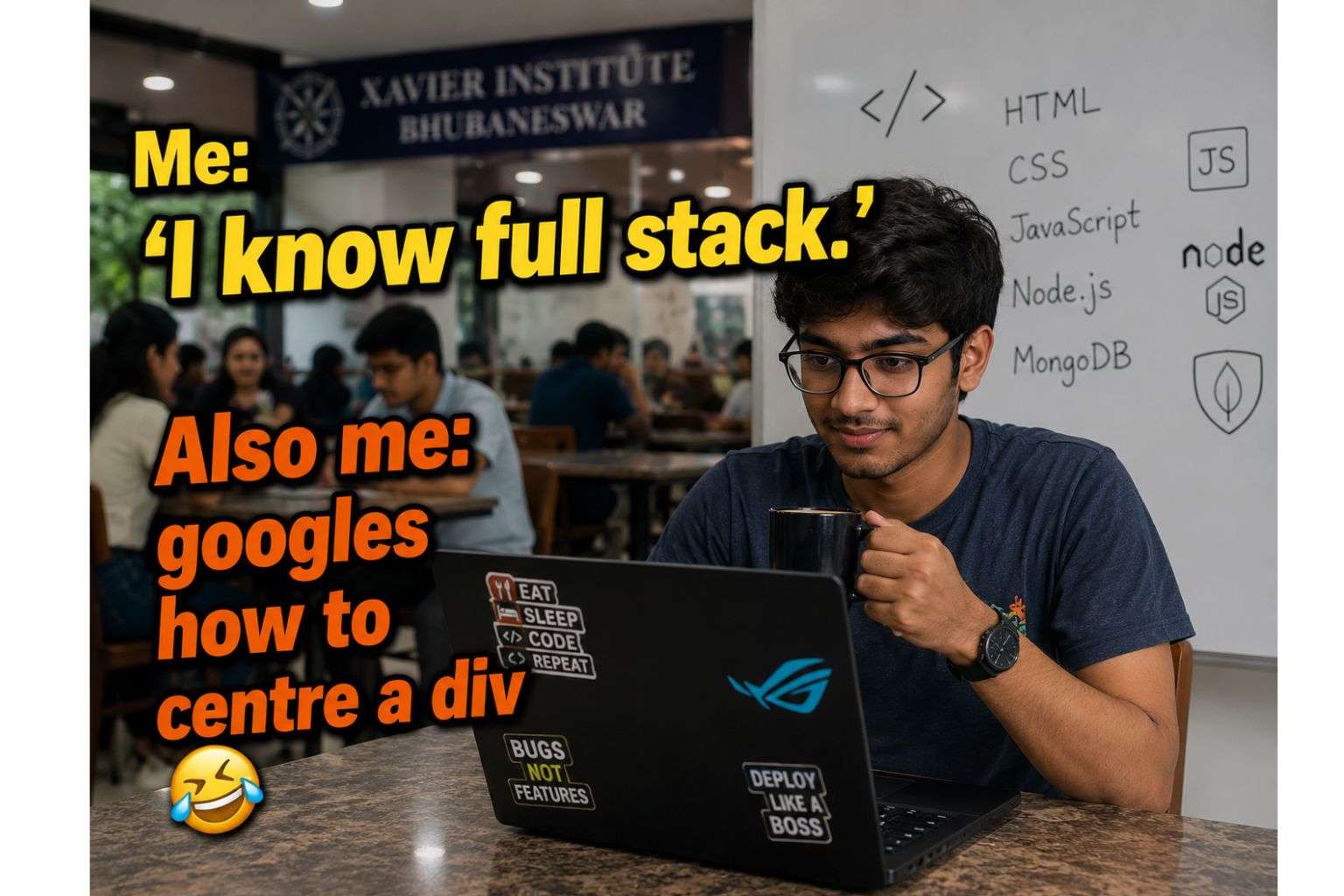
The frontend is what you see. The buttons, the menus, the pages, the design. Built using HTML, CSS, and JavaScript.
The backend is what you do not see. The server, the database, the logic that runs when you click a button. Built using languages like Node.js, Python, or Java — and databases like MongoDB or MySQL.
A full-stack developer builds both.
In 2026, the most in-demand full-stack combination for freshers in India is:
- Frontend: HTML, CSS, JavaScript, and React.js
- Backend: Node.js with Express, or Python with Django/Flask
- Database: MongoDB or MySQL
- Tools: Git, GitHub, REST APIs, and basic cloud deployment (AWS or Azure)
That is it. That is the stack. You do not need to know everything. You need to know this stack well enough to build something real.
The companies hiring freshers are not expecting expert-level mastery. They want someone who understands the flow from frontend to backend, has built at least one or two full working projects, and can explain what they did in an interview.
If you want a deeper look at the technology side of this, read my post on Software Engineering in the AI Era — it explains how the engineering role is evolving and what companies are looking for right now.
The Salary Reality for Full-Stack Freshers in India
Let me give you real numbers.
A fresher with a strong full-stack development portfolio — meaning two or three deployed projects on GitHub, one of which solves a real problem — can expect:
- Service companies (TCS, Infosys, Wipro): ₹3.5 to ₹4.5 lakh per year as a starting package
- Mid-size IT companies: ₹4.5 to ₹6 lakh per year
- Startups and product companies: ₹6 to ₹9 lakh per year, sometimes higher
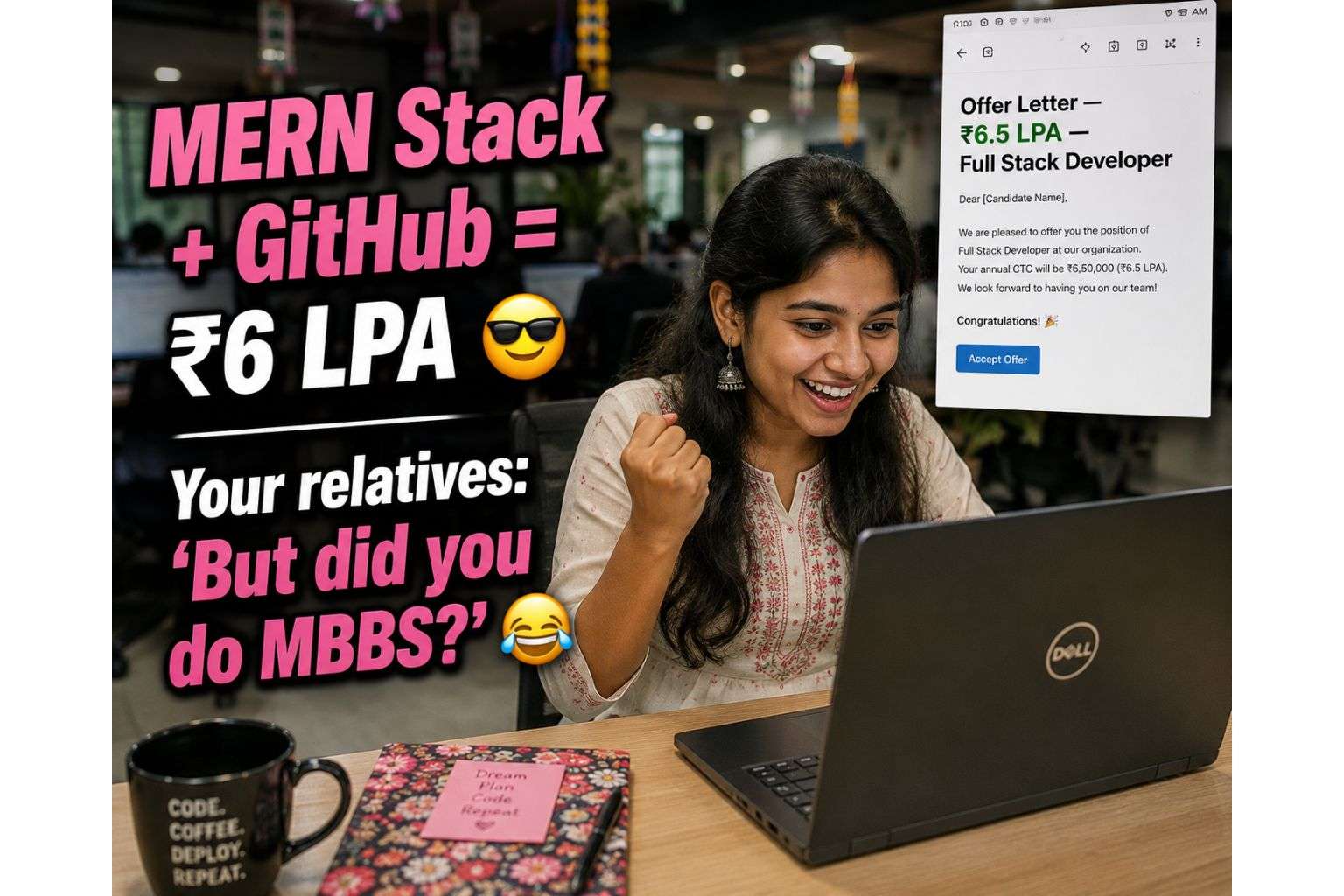
The difference between ₹3.5 lakh and ₹6 lakh is usually one thing: proof.
The student who has two real full-stack projects with a clean GitHub profile gets the higher offer. The student who says “I know MERN stack” but cannot show a working app gets the lower one — or nothing at all.
I wrote a detailed post on how to build a GitHub profile that gets you noticed: GitHub Profile Tips That Actually Get Indian Students Noticed by Recruiters in 2026. Read it before you start building projects.
The MERN Stack: Why This Is Still the Best Starting Point
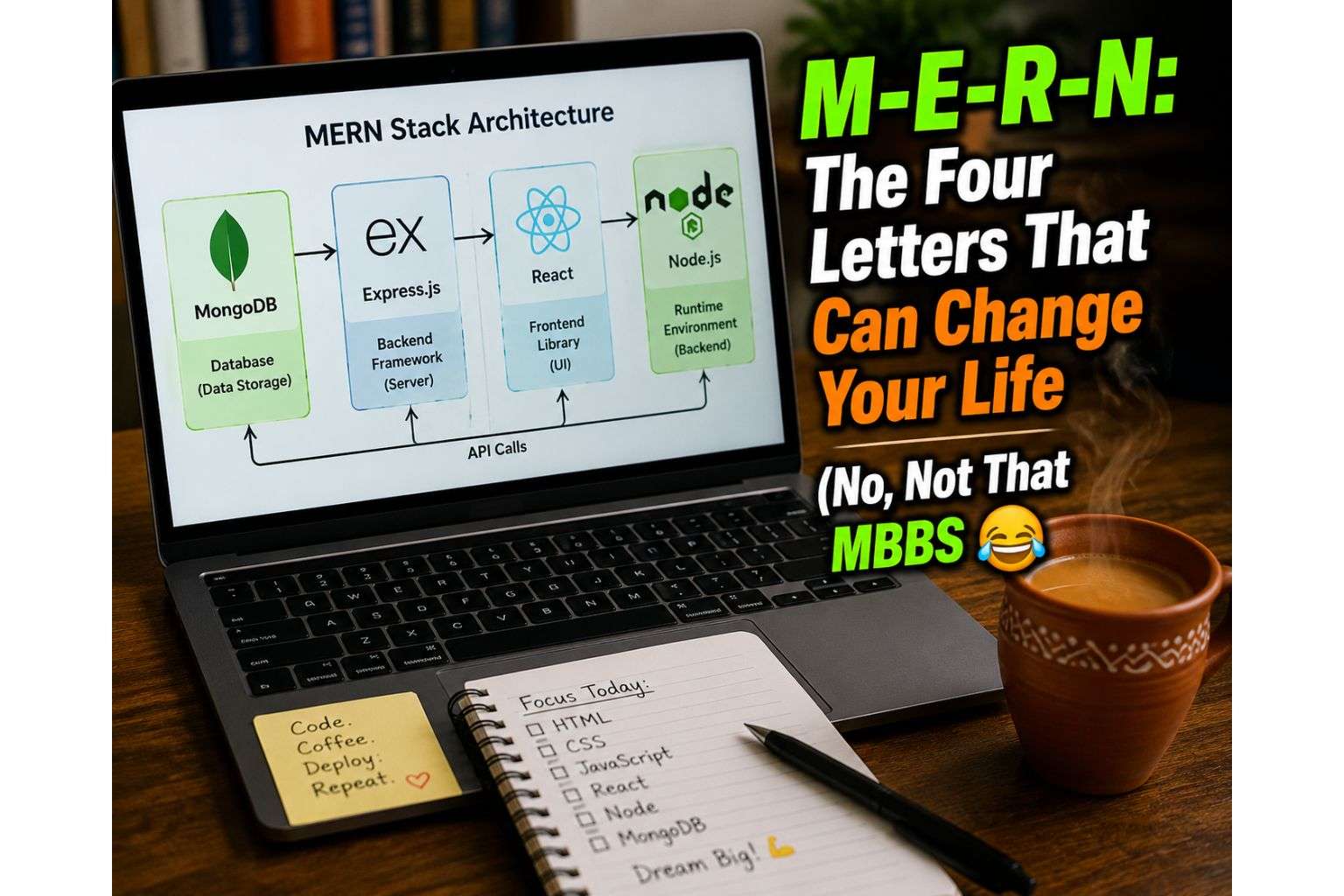
MERN stands for MongoDB, Express.js, React.js, and Node.js.
It is JavaScript all the way. Frontend, backend, and database — one language.
For a fresher, this is a massive advantage. You do not need to switch your brain between Python and JavaScript. You write JavaScript for the browser. You write JavaScript for the server. This makes it faster to learn and faster to build.
I recommend MERN for freshers who want to get hired in the next six to twelve months. Here is the learning path I give my students in Bhubaneswar:
Month 1: HTML, CSS, JavaScript basics. Build a static website. Learn Flexbox, Grid, basic DOM manipulation.
Month 2: React.js. Build a small frontend — a to-do app, a weather app, a movie listing page. Understand components, state, and props.
Month 3: Node.js and Express.js. Build a backend with a few API routes. Connect it to MongoDB. Learn how data flows from the frontend to the database and back.
Month 4: Build one complete full-stack project. Something real. An expense tracker. A job board. A simple e-commerce product listing. Deploy it. Put it on GitHub. Write a clear README.
Month 5: Polish your GitHub, update your resume, and start applying.
That is five months. Consistent effort. No skipping steps.
If you want to know how to write a resume that reflects these skills properly, read: How to Write a Fresher Resume for IT Companies.
Is Full-Stack Development for Non-CS Branches Too?
Yes. Absolutely.
I get this question every week from students in ECE, EEE, and Mechanical. They see full-stack job descriptions and think those are only for CS students.
They are not.
HTML and CSS do not have a branch requirement. JavaScript does not check your degree specialisation before running. MongoDB does not ask whether you studied circuits or code.
What you need is time and consistency. A non-CS student who spends five months building full-stack skills is absolutely competitive for a fresher role. I have placed students from ECE and EEE backgrounds into web development roles in IT companies. It happens regularly.
What you do need to do differently is build your proof earlier. Because your degree does not automatically validate your skills the way a CS degree does, your GitHub projects, your certifications, and your ability to explain your code in an interview must work harder. That is not unfair. It is just the game. Play it well.
If you are from a non-CS branch and wondering how to make the switch, my detailed post on Switching to IT from Non-CS Branches walks through the exact path I recommend.
▶️ Relevant YouTube Videos
Video 1: Full Stack Web Development for Beginners — Full Course by freeCodeCamp A free, comprehensive full-stack development course covering HTML, CSS, JavaScript, Node.js, and more. Over 15 hours of content. This is the best single free resource to start your full-stack journey.
Video 2: MERN Stack Full Tutorial — Build a Full Stack App by Traversy Media One of the most watched MERN stack tutorials on YouTube. Brad Traversy walks you through building a real full-stack app from scratch. A must-watch once you have your basics down.
How Rooman Technologies Helps Freshers Get Full-Stack Ready
Rooman Technologies, an NSDC-certified training partner, offers a structured full-stack web development programme designed specifically for freshers and engineering graduates.
The programme covers HTML, CSS, JavaScript, React, Node.js, databases, and deployment. It includes project work, soft skills training, and placement support. It is recognised by the National Skill Development Corporation, which adds real credibility to your certificate.
As State Business Partner for Rooman Technologies in Odisha, I have seen the placement outcomes of students who go through structured training versus self-study. Both paths work. But structured training cuts the time significantly and gives you accountability.
Explore the Rooman Technologies full-stack and web development courses here.
Action Steps — Based on Where You Are Right Now
If You Are in 1st or 2nd Year
You have the most time. Use it to build depth.
Start with HTML, CSS, and JavaScript. Spend your first two months doing nothing else. Build small websites. A personal portfolio page. A restaurant menu. A simple quiz game. Get comfortable with the browser.
Then move to React. Build at least two frontend projects and put them on GitHub. Do not worry about the backend yet.
Make your GitHub profile clean and active now, so by the time placement season comes, you have two years of consistent commits.
Take a look at what in-demand skills look like beyond full-stack too: Top 5 In-Demand Skills for Freshers in 2026
If You Are in 3rd Year
You need to start building proof, not just knowledge.
Spend this year completing the full MERN stack. By the end of 3rd year, you should have one full-stack project deployed and live — not just on localhost. Deploy it to Netlify or Render (both free). Share the link in your LinkedIn profile.
Start your LinkedIn profile now. Fill it properly. This guide on LinkedIn profiles for freshers will show you exactly what to write.
If budget allows, take a structured full-stack course through Rooman Technologies. The NSDC certification adds weight to your resume.
If You Are in Final Year (Placement Now)
Stop learning new frameworks. Start deepening the ones you know.
Pick your best full-stack project. Clean the code. Write a proper README on GitHub. Make sure it is deployed and accessible. This one project will be the centre of your technical interview.
Practise explaining it out loud: what problem it solves, what technologies you used, what you would improve. Practice this until it is smooth.
Get your resume reviewed. Use this guide: How to Write a Fresher Resume for IT Companies.
Reach out to me directly at 9777278853 if you want a personalised career review before your placement season.
10 Frequently Asked Questions: Full-Stack Development Career for Freshers
1. Is full-stack development still a good career choice for freshers in India in 2026?
Yes — and this is not just my opinion. It is what I see in actual hiring data from companies I interact with across IT hubs in India. Full-stack development is one of the most consistently in-demand skill sets for freshers because it gives companies a versatile hire. One person who can build both the frontend and backend of a web application is genuinely valuable, especially in startups and mid-size product companies where teams are lean.
The noise online about full-stack being “dead” or “saturated” comes from people confusing two different things. The market is not saturated with good full-stack developers. It is saturated with freshers who list MERN stack on their resume without being able to show a single working project. Companies are not tired of full-stack skills. They are tired of freshers who cannot back up their claims. Build real projects, deploy them, put them on GitHub, and you will stand out.
After 27 years of watching freshers get placed and not get placed, I can tell you clearly: the ones who built full-stack skills with real proof kept getting offers even in the tight hiring years of 2023 and 2024.
Consultant’s Note: Full-stack is not the only path, but it is the widest path. It opens doors to frontend roles, backend roles, and full product development roles. That breadth is rare in fresher skill sets — and companies pay for it.
sets – and
2. What is the best tech stack for freshers to learn full-stack development in India?
For freshers in India in 2026, the MERN stack — MongoDB, Express.js, React.js, and Node.js — remains the most practical and most hirable combination. The biggest advantage of MERN is that it is entirely JavaScript-based. You write JavaScript on the frontend with React. You write JavaScript on the backend with Node and Express. You use a JSON-based database with MongoDB. One language, end to end.
This reduces your learning curve significantly compared to stacks that require switching between languages. MEAN (with Angular instead of React) is also valid, but React currently dominates fresher job descriptions. The Python-based alternative — React for frontend with Django or Flask for backend, using PostgreSQL or MySQL — is also highly valued, especially in data-heavy roles and companies that work with machine learning pipelines. Start with MERN. Once you are comfortable, layer in Python as your second skill.
Consultant’s Note: Do not try to learn two stacks at once. Pick MERN, go deep, build proof. You can always add Python skills later. Splitting your attention between two stacks in your first six months will result in being average at both and excellent at neither.
3. How long does it take to become job-ready as a full-stack fresher?
The realistic timeline for a fresher starting from scratch is five to six months of consistent, focused daily practice — roughly two to three hours per day. This is not casual learning. This is building something every week, not just watching tutorials.
Month one covers HTML, CSS, and JavaScript fundamentals. Month two covers React for the frontend. Month three covers Node.js, Express, and MongoDB for the backend. Month four is where you build one complete, deployed full-stack project. Month five is for polishing your GitHub, writing a strong resume, and beginning interview prep.
The biggest mistake I see freshers make is spending four months watching tutorials and one month panicking that they have nothing to show. Flip that ratio. Watch less. Build more. Even a broken project that you fixed three times teaches you more than fifteen hours of clean tutorial content.
Consultant’s Note: Five months is achievable if you treat this like a part-time job, not a hobby. The students I have seen get placed fastest were the ones who set a daily coding alarm and kept it.
4. What salary can a fresher expect with full-stack development skills in India?
The salary range for a fresher with genuine full-stack development skills — meaning deployed projects and a clean GitHub — varies significantly based on the type of company. Service companies like TCS, Infosys, Wipro, and Capgemini typically offer freshers between ₹3.5 lakh and ₹4.5 lakh per year. Mid-size IT companies and IT services firms typically offer ₹4.5 to ₹6 lakh. Product startups and funded tech companies will often start freshers at ₹6 to ₹9 lakh, sometimes more depending on the role and location.
The single biggest variable in which offer you get is proof. A fresher who walks into an interview with two live projects, a clean GitHub, and the ability to explain their code clearly will almost always get a higher offer than someone who lists the same skills but cannot demonstrate them. The salary gap between a “list-based” resume and a “proof-based” resume can easily be ₹1.5 to ₹2 lakh in the first offer itself.
Consultant’s Note: I have seen freshers from small Odisha colleges get ₹6 lakh offers from product companies because their GitHub was strong. I have also seen students from bigger colleges get ₹3.5 lakh offers because they had nothing to show. Build the proof. The salary follows.
5. Can freshers from non-CS branches build a full-stack development career?
Absolutely yes. Full-stack development does not require a CS or IT degree. The skills are teachable to anyone who is motivated, regardless of branch. I regularly mentor and place students from ECE, EEE, Mechanical, and Civil backgrounds into full-stack developer roles. What changes for non-CS students is the starting point and the pace — not the destination.
A non-CS fresher typically needs to spend an extra four to six weeks building comfort with programming basics before starting the proper full-stack roadmap. If you have never written a loop or a function before, start there. Once you have that foundation, the MERN stack learning path is identical regardless of your engineering branch. The key difference is that you need your proof to work harder. Without a CS degree, your GitHub projects and your ability to talk through your code in an interview carry more weight. Build them seriously.
Consultant’s Note: Branch is a door. Skills are the key. I have placed ECE and Mechanical students into development roles at IT companies multiple times. Stop worrying about your branch and start building.
6. What projects should a fresher build to get hired as a full-stack developer?
This question matters more than most freshers realise. The project you build is what gets the interview. The interview is what gets the offer.
The best fresher full-stack projects are ones that solve a real problem — even a small one. An expense tracker that lets you log and view expenses. A job listing board where employers can post and candidates can browse. A simple blog platform with user authentication. A restaurant menu system with cart functionality. These are not complex. But they are complete. They have a working frontend, a working backend, and a connected database.
What makes a project stand out is not complexity — it is cleanliness. Clean code, proper folder structure, a clear README on GitHub, and a deployed link that actually works when a recruiter clicks it. One strong, live, well-documented project is worth more than five half-built projects pushed to GitHub with no README and broken links.
Consultant’s Note: Pick one project. Make it real. Make it live. Make it explainable in three minutes. That project will open more doors than any certificate.
7. What is the difference between a full-stack developer and a software engineer for a fresher?
This is a common source of confusion among students. The terms are often used interchangeably in job descriptions, which makes it harder.
A software engineer is a broader title. It covers someone who can write code, design systems, work on applications, and solve technical problems.
A full-stack developer is a more specific type of software engineer — one who works on both the frontend and backend of web-based applications.
In practice, most fresher IT job descriptions that say “software engineer” are looking for someone who can write code, learn a tech stack on the job, and contribute to a team. A fresher full-stack developer fits this description and adds an extra layer of value because they already understand the end-to-end flow of a web application.
The advice is simple: learn full-stack skills, but apply for both “full-stack developer” and “software engineer” roles. Your profile fits both, and you double your opportunities.
Consultant’s Note: Do not limit yourself to one job title. The skills overlap significantly. Cast a wide net, but make sure your resume reflects what the specific role is asking for.
8. Are full-stack developer jobs available in Odisha or only in metro cities?
Both — and this is changing fast.
Bhubaneswar has a growing IT presence. Infosys, TCS, Wipro, and multiple smaller IT companies operate here. The Odisha government has been actively developing IT infrastructure and inviting companies to set up operations. Cuttack and Rourkela also have growing tech ecosystems. The salaries in Bhubaneswar are lower than Bengaluru, but the cost of living is also significantly lower.
More importantly, full-stack development is one of the skills that opens remote work. And remote work has changed the geography of IT jobs forever. A fresher in Sambalpur or Berhampur who builds strong full-stack skills can apply for remote roles with companies based in Bengaluru, Hyderabad, or even outside India. I have seen this happen with my own students.
Consultant’s Note: Location is no longer the barrier it was five years ago. Build the skill, build the proof, and the market comes to you — whether you are in Bhubaneswar or anywhere else in Odisha.
9. How do I prepare for a full-stack developer interview as a fresher?
Full-stack developer interviews at the fresher level typically have three parts: a coding round, a technical round, and an HR round.
The coding round tests your JavaScript fundamentals — arrays, loops, functions, and basic problem solving. You do not need to be a DSA expert for most fresher full-stack roles, but you need to write clean, readable code under time pressure.
The technical round digs into your projects. Be ready to explain every line. Be ready to answer: what does this code do, why did you choose this database, how would you improve this if you had more time, and what happens when this API fails.
The HR round tests your communication. Practise “Tell me about yourself” and “Tell me about your project” until they sound natural, not rehearsed. Record yourself. Watch it back. Do it again.
For a detailed interview prep plan, visit Career Guru’s IT Interview Preparation Resources.
Consultant’s Note: Most fresher full-stack interviews are won or lost on the project explanation. Know your project cold. That confidence is what separates the offered from the rejected.
10. Should a fresher learn full-stack development or focus on one specialisation like frontend or backend?
My recommendation for most freshers: start with full-stack, then specialise after your first job.
Here is the logic. Full-stack knowledge gives you more interview opportunities. You can apply for frontend roles, backend roles, and full-stack roles. That triples your chances compared to a fresher who has only done frontend. Once you are inside a company for six to twelve months, you will naturally gravitate toward one side — most developers do. That is when you can specialise based on what you enjoy.
There is one exception. If you are passionate about design and UI, and you love making beautiful, responsive interfaces — go deep on frontend with React and CSS. Companies do hire specialist frontend freshers. Similarly, if you love databases and server logic, backend specialisation is valid. But these are narrow paths that require more depth. For the average fresher in India who wants to maximise placement chances, full-stack is the safer, wider bet.
Consultant’s Note: Specialise after you are placed, not before. In the placement game, breadth beats depth at the fresher level. Depth wins after three to five years when you are negotiating a senior role.
One Last Thing
Full-stack development is not a shortcut. It is a skill that takes months to build properly.
But here is what I have seen in 27 years.
The freshers who treated it seriously — who built real projects, who deployed their work, who practised explaining their code — kept getting placed. Regardless of city. Regardless of college. Regardless of whether the market was tight or open.
The full-stack development career for freshers is alive. The demand is real. The salaries are good. The path is clear.
Start today. Build something. Put it on GitHub. Apply.
If you are in Bhubaneswar or anywhere in Odisha and want a personalised career plan, reach out at 9777278853 or visit cguru.co.in.