
Spoken English for IT Interviews – A 27+ Years Career Mentor’s Honest Guide for Odia, Hindi and Other Regional-Medium Students (2027)
(Note: Study advice here comes from my own counselling experience. Survey numbers come from the sources linked below and can change. Please check the original pages before you quote them.)
Spoken English for IT interviews is where I see the most talented small-town students lose. Not in the coding test. Not in the aptitude round. In the first two minutes of the interview.
Last month, a final-year Electronics student from Keonjhar sat in my office. I will call him Sanjib. He studied in an Odia-medium school till class 12. His CGPA was 8.1. He had cleared the online test of an IT company in Bhubaneswar.
Then the HR person smiled and said, “So, tell me about yourself.”
Sanjib said, “Myself Sanjib. I am from Keonjhar. My father is farmer.” Then he stopped. The silence lasted maybe twenty seconds. It felt like twenty minutes.
“Sir, I knew the SQL answer,” he said. “I could not say it.”
Sanjib did not have a knowledge problem. He had a speaking problem. And a speaking problem can be fixed in 60 days, if you follow a plan and do not skip days. Let me show you the plan I gave him.
Quick answer: Good spoken English for IT interviews does not mean fluent or fancy English. It means short, clear, correct sentences that you have practised aloud. Practise one hour a day for 60 days. Rehearse ten standard answers. Record yourself. Fix one mistake at a time.
What Is Spoken English for IT Interviews, Really?
Let me clear one fear first. Nobody expects British or American style English from a fresher. Spoken English for IT interviews is not about accent. Interviewers in Bhubaneswar, Hyderabad or Pune hear Odia, Telugu, Hindi and Tamil accents every day. They do not mind accents.
What they check is simple. Can you explain your thoughts clearly? Can a client, one day, understand you on a call?
So spoken English for IT interviews has three parts.
- Clear: The listener understands you the first time.
- Short: Small sentences. One idea in each.
- Structured: Your answer has a start, a middle and an end.
Do these three and you are ahead of many students with higher marks.
Why Spoken English for IT Interviews Decides So Many Results
Let me give you the reason with numbers, and then my own view.
A report from ETS, the company behind TOEIC, looked at employers across the world. In India, 91 percent of employers said a tougher job market raises the need for English. The global figure was 81 percent. You can read it in the ETS note on English and early-career employability in India. ETS sells English tests, so read it as a signal, not a verdict.
Another signal comes from the India Skills Report 2026. It put national employability at 56.35 percent, as Careers360 reported. Such reports list communication next to technical skill. Employers want both.
Now my own view. Students from tier-2 towns of Odisha rarely fail because of weak basics. They fail when they must speak those basics aloud, in English, to a stranger. That is why spoken English for IT interviews deserves its own plan.

The Real Problem: You Think in Odia and Translate in English
Here is what happens inside your head. The interviewer asks a question in English. You understand it. Your answer forms in Odia or Hindi. Then your brain tries to translate it word by word. By the time the sentence is ready, the moment is gone.
I asked Sanjib to say his father’s work in Odia first. “Mora bapa chasi.” Then I asked for the simplest English. He said, “My father is a farmer.” Perfect. In the interview, he had tried to build a long sentence instead.
This is the first lesson of spoken English for IT interviews. Do not translate long thoughts. Build short ones in English from the start.
Here is a trick that works. Take any long Odia or Hindi thought. Break it into two small ones. Then say each in English. “I am from a small town and I want to do something big” becomes “I am from Keonjhar. I want to build a career in IT.” Short sentences are not weak. They are safe.
The 60-Day Plan for Spoken English for IT Interviews
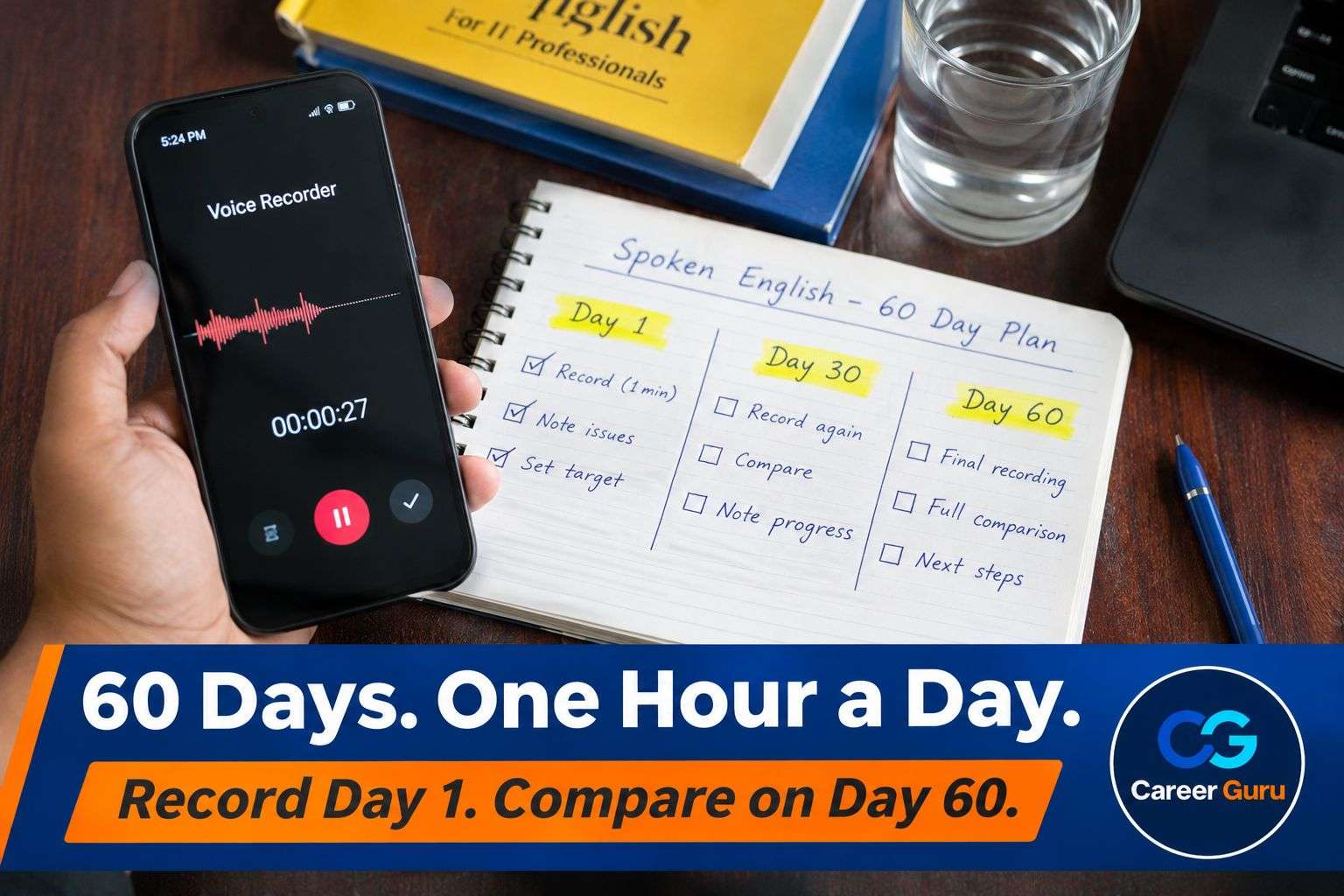
I split the plan into four phases of about fifteen days each. Each day needs one hour. If you can give thirty minutes in the morning and thirty at night, that works too.
The daily one-hour routine
- 15 minutes listening: Listen to English you can follow. Interviews, news or learning podcasts.
- 15 minutes reading aloud: Read any English page out loud. A news story or your own notes.
- 15 minutes speaking: Answer one question aloud. Record it on your phone.
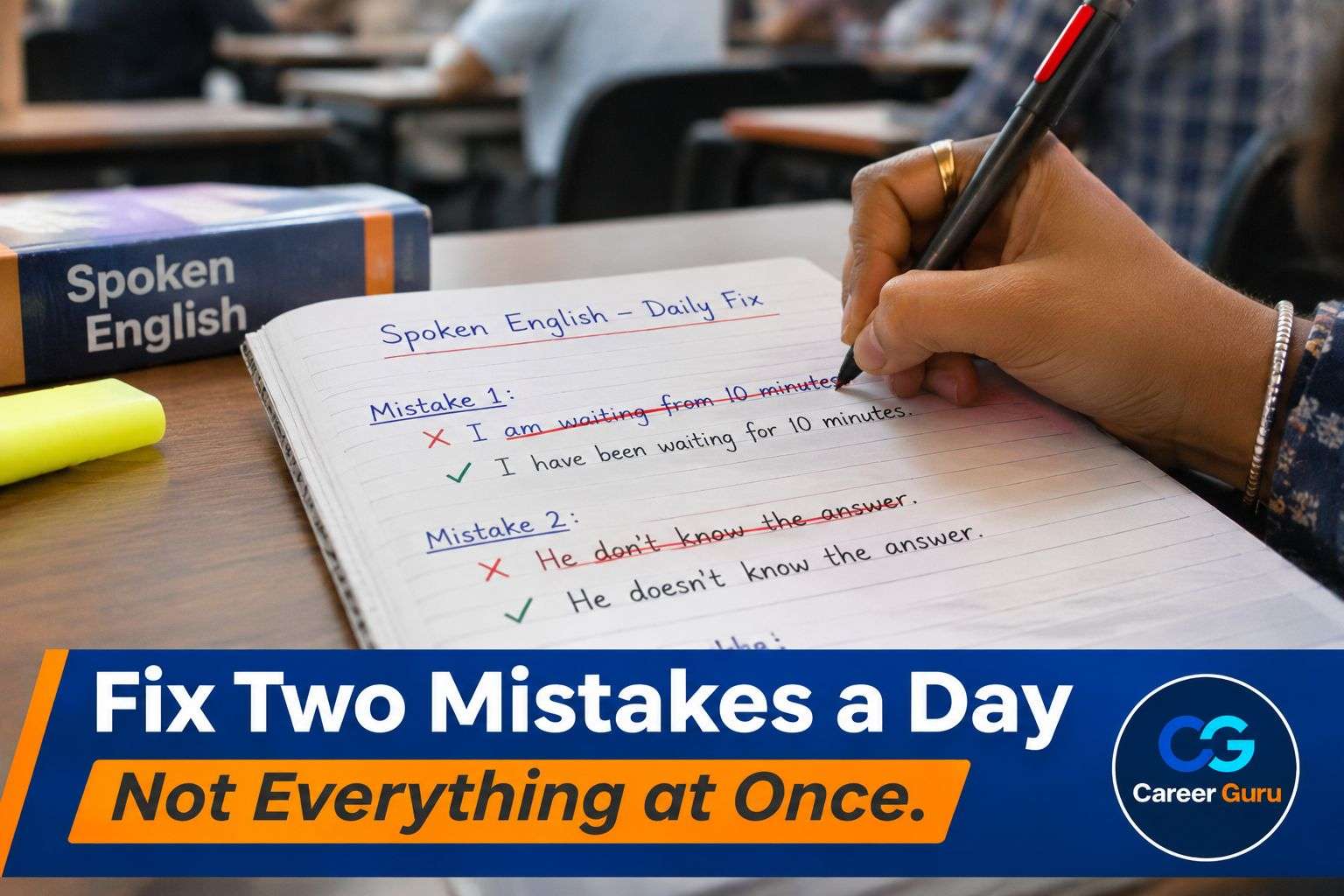
- 15 minutes fixing: Play your recording. Write down two mistakes. Say the corrected line three times.
That routine is the engine of this spoken English for IT interviews plan. The phases below tell you what to put into it.
Phase 1: Days 1 to 15. Get your ears and mouth moving for spoken English for IT interviews
The goal of this phase is comfort, not perfection. Many students are afraid of their own voice.
- Day 1: Record a one-minute introduction in any English. Do not delete it. You will compare it with Day 60.
- Listen to a short English talk and repeat each sentence right after the speaker. This is called shadowing. It trains your mouth to move at English speed.
- Learn twenty new words a week from your own subjects. Words like database, requirement, bug, testing.
- Speak English to yourself during small tasks. “I am making tea. I will study for one hour.”
Sanjib hated his Day 1 recording. “Sir, I sound like a stranger.” I said, “Good. Keep that file.”
Phase 2: Days 16 to 30. Build your ten answers
Now you write and rehearse the ten answers every IT interview asks. You will find them in the next section. Write each in five to seven short, simple sentences. Then say it aloud ten times.
Do not memorise like a poem. Learn the points, not the words. An honest sentence beats a perfect one.
Phase 3: Days 31 to 45. Speak with another human
Practising alone has a limit. Find a partner, such as a friend or a senior. Meet three times a week for twenty minutes. One plays the interviewer, the other answers. Then swap. Explain your project in two minutes. Explain one technical idea, like a SQL join, as if to a new joiner. This phase feels uncomfortable. That is the sign it is working.
Phase 4: Days 46 to 60. Add pressure and polish
Now you practise the way the real day will feel.
- Do a full 20-minute mock interview in formal clothes.
- Do one mock on video call, camera on. Look at the camera, not at your own face.
- Record it. Count your fillers, like “umm” and “actually”.
- On Day 60, record the same one-minute introduction as Day 1. Listen to both.
Sanjib played his two recordings side by side on Day 60. He was quiet for a while. Then he smiled. “Sir, the first one is a different person.”
Ten Answers to Rehearse for Spoken English for IT Interviews
These ten questions come up again and again. Prepare each one once, and your spoken English for IT interviews gets easier every time. The sample lines below are only models. Use your own facts, and keep the English simple.
1. Tell me about yourself. Use this pattern: present, past, future. “I am Sanjib Behera. I am a final-year Electronics student at a college in Odisha. I built a small water tank alert project using a sensor and a phone message. I enjoy solving problems with code. I want to start my career as a software engineer and keep learning.”
2. Why should we hire you? “I learn fast. I finish what I start. In my final-year project I fixed a problem that stopped our team for two days. I am ready to learn your tools.”
3. Explain your project. Use three parts: problem, what you did, result. “We wanted to know when a tank was empty. I used a sensor and wrote the code. It sent a message to the phone. It worked in our hostel for one month.”
4. What are your strengths? Pick two, with one small proof. “I am a patient learner. I practised SQL for thirty days, one hour each day.”
5. What is your weakness? Be honest and show your fix. “I used to be shy while speaking English. I have practised daily for two months. I am much better now.”
6. Why do you want to join this company? Read the company website for ten minutes first. “I read that your company works with banks. I want to learn how real systems work.”
7. Tell me about a problem you solved. Use STAR: situation, task, action, result. Keep it to six sentences.
8. Are you ready to relocate or work in shifts? Be clear. “Yes, I am ready to relocate. I will need a few weeks to settle.”
9. Where do you see yourself in five years? “I see myself as a good developer, trusted by my team. I want to learn cloud skills.”
10. Do you have any questions for us? Never say no. Ask one real question. “What does the first three months of training look like for freshers?”
These answers also work in the HR rounds of big companies. My guide on Infosys DSE vs Cognizant GenC Next vs Wipro Turbo explains where each round fits.
Rescue Lines for Spoken English for IT Interviews
Everyone gets stuck. Good speakers just have rescue lines ready. Learn these by heart.
- “Could you please repeat the question?”
- “Let me think for a moment.”
- “Let me say it in a simpler way.”
- “I do not know this exactly, but I can tell you what I understand.”
- “Could you speak a little slowly, please?” (Good for online calls with a weak network.)
A ten-second pause is fine. What hurts is the panic after it. A rescue line turns panic into calm.
Five Common Mistakes in Spoken English for IT Interviews
1. Saying “Myself” at the start. Say “I am Sanjib” or “My name is Sanjib”. Small fix, big first impression.
2. Saying sorry for your English. Please stop this. It tells the interviewer you expect to fail. Just begin your answer.
3. Memorising a paragraph word by word. One forgotten word and everything falls apart. Learn points, not paragraphs.
4. Speaking too fast. Nervous students race. Slow down and breathe after each sentence.
5. Wrong tenses and “having” words. “I am having two projects” should be “I have two projects”. “I done this project” should be “I did this project”. Fix these two and your English sounds cleaner at once.
My guide on resume projects for freshers shows how one clear project line becomes your two-minute spoken answer too.
Technical Answers Also Need Spoken English for IT Interviews
Many regional-medium students know the subject but freeze when they must say it in English. Use three simple sentences. What is it? Why do we use it? Give a small example.
Example. Question: “What is a primary key?”
“A primary key is a column that identifies each row in a table. It does not repeat and it cannot be empty. For example, a student roll number can be a primary key.”
Three sentences. No big words. The interviewer understands you at once.
Practise ten such answers from your own subject. If you are from a non-CSE branch and aiming for IT, my guide on jobs for non-CSE freshers in Odisha will help you pick a direction first.
Where to Practise Spoken English for IT Interviews for Free
You do not need to spend a lot. Here are free sources I trust students with.
- BBC Learning English. The BBC Learning English site has short listening lessons. Use them in your daily 15 minutes of listening.
- Three videos on “Tell me about yourself”. Watch this video for experienced candidates and freshers, this one made specially for freshers and this simple walk-through for freshers. Watch one, then answer the question aloud in your own words. Do not copy the speaker.
- Your own phone. The voice recorder is your best free teacher.
If you want a trainer to correct you, join a good local class or an NSDC-aligned communication course. Short programs like those from Rooman Technologies can help with spoken English for IT interviews. Choose by how much you actually speak, not by the brochure.
FAQs — Spoken English for IT Interviews
FAQ 1 — Can I crack spoken English for IT interviews if I studied in Odia or Hindi medium?
Yes. Thousands of regional-medium students join IT companies every year. Interviewers care about clear and honest answers, not your school medium. Your technical base is already strong. Start with ten answers and record yourself daily. In two months, the change is clear.
Consultant’s Note — The students who improve fastest are not the smartest. They are the ones who record themselves every day.
FAQ 2 — How many hours a day do I need for spoken English for IT interviews?
One hour a day is enough. Split it into listening, reading aloud, speaking and fixing. Short daily practice beats one long weekend session. With only thirty minutes, stretch the plan to 90 days.
Consultant’s Note — Fix a time for practice. A fixed time becomes a habit in about three weeks.
FAQ 3 — Can I mix Odia or Hindi words in an interview?
Avoid it, unless the interviewer starts it. For practice, think in Odia first, then say it in English. In the interview, keep to English and use your rescue lines when stuck.
Consultant’s Note — Thinking in your mother tongue first is not weakness. It is how most of us learn a new language.
FAQ 4 — Will my accent make me lose the job?
Rarely. IT companies hire people from every state and hear many accents each day. Unclear speech hurts, not accent. Ask a friend, “Did you understand every word?” That is the right test.
Consultant’s Note — A clear Odia-flavoured English is far better than a fake accent.
FAQ 5 — How do I stop being nervous?
Nervousness does not vanish. It becomes smaller with practice. Do mock interviews until the room feels familiar. Keep your first sentence ready, because the first sentence is the hardest. After it, your nerves settle.
Consultant’s Note — Prepare your first two sentences so well that you can say them half asleep.
FAQ 6 — Should I write my answers on paper and read them?
Write them, yes. Read them in the interview, never. Writing shapes your answer. Speaking it aloud ten times fixes the points in your mind.
Consultant’s Note — Paper is for preparing. The interview needs your voice.
FAQ 7 — Do I need a paid course for spoken English for IT interviews?
Not always. A course helps if you lack a partner. Before paying, check whether you will speak in every class and get feedback on your own mistakes. If not, follow the free plan here.
Consultant’s Note — Judge a course by how many minutes you speak in each class, not by how many videos it has.
FAQ 8 — Can AI tools help me practise spoken English for IT interviews?
Yes, as a practice partner. Ask an AI tool to act as the interviewer and give feedback on clarity. Do not let it write your answers. Then test yourself with a real person.
Consultant’s Note — Use AI like a mirror. Do not use it like a mouth.
FAQ 9 — What if I do not understand the question?
Ask politely. Say, “Could you please repeat the question?” This shows confidence, not weakness. A wrong answer to a question you did not understand is worse than a polite request.
Consultant’s Note — I have never seen a student rejected for asking to repeat a question. I have seen many rejected for answering the wrong one.
FAQ 10 — I graduated earlier and have a gap. Does this plan still work?
Yes, at any age. Give your gap one honest line. Say what you did, like a course or a skill, and what you do now. Practise that one answer well, because it will come up.
Consultant’s Note — A gap explained calmly in two sentences is a small matter.
What to Do This Week: Your Action Plan for Spoken English for IT Interviews
If you are in first or second year — Start spoken English for IT interviews practice now, with the daily one-hour routine and no pressure. Join a debate club. You have time on your side.
If you are in third year — Do all four phases of the spoken English for IT interviews plan once, slowly, over 60 days. Write your ten answers. Ask a senior to play interviewer.
If you are in final year — Start today. Record your Day 1 introduction tonight. Finish Phase 1 before the next campus drive. My placement season guide shows what to do week by week between October and December.
If you have already graduated — Follow the spoken English for IT interviews plan fully, and add one mock interview a week with a friend. Use the plan before you start off-campus applications. If you are choosing a city for your first job, see my guide on the best city for freshers from Odisha.
If you want a one-to-one talk about your English and your career direction, you can book a session through my career counselling page.
Back to Sanjib. On Day 60 he sat for another interview, at a different company. The HR person asked the same question. “So, tell me about yourself.”
He took a breath. “I am Sanjib Behera. I am a final-year Electronics student. I built a water tank alert using a sensor and a phone message. I enjoy solving problems with code, and I want to start my career as a software engineer.”
Four sentences. No sorry. No silence.
He called me from the bus stop afterwards. His voice was shaking, but happy. “Sir, I said it. I said all of it.”
That is what spoken English for IT interviews is for. Not to make you someone else. To let the person you already are, finally be heard.
I read all my emails. You can write to me [email protected] or WhatsApp on 9777278853.