

CTC vs In-Hand Salary for Freshers — A 27+ Years Career Mentor’s Honest Guide to Reading Your Offer Letter (2027)
Last updated: 13 November 2026
(Rules and rates here come from news reports and official notices. They can change. Please check your own offer letter and the latest notice before you act.)
CTC vs in-hand salary for freshers is the confusion that lands on my WhatsApp every November, right after the first offer letters arrive. Last month, a final-year Electrical student from Berhampur sent me a photo of his letter. I will call him Subham. The letter said ₹6,00,000 a year. Under the photo, he had typed one line. “Sir, that is ₹50,000 a month, right? I have promised my father ₹15,000, and I am looking for a flat in Bhubaneswar.”
I asked him to read me the second page. The page nobody reads.
He went quiet. Then he said, “Sir, there is a table here. It has PF, gratuity, insurance and something called variable.”
That table is why I wrote this guide. Let me take you through it, so you never plan your life on the wrong number.
Quick answer: In CTC vs in-hand salary for freshers, CTC is what the company spends on you in a year. In-hand salary is what reaches your bank each month. In the example below, the in-hand amount is about 80 percent of CTC divided by twelve. Your own number depends on your letter. The gap is not a trick. It is a list of known items, and you can read every one.
What Is CTC vs In-Hand Salary for Freshers, Really?
CTC means Cost to Company. It is the full amount the company counts as spent on you in one year. Some of that money never comes to you as monthly cash.
In-hand salary is what the bank sends you after the cuts. People also call it take-home pay.
So CTC vs in-hand salary for freshers comes down to one plain question. How much is on paper, and how much do you actually get each month?
Think of a wedding card that says dinner costs ₹1,000 a plate. That price includes the tent and the band. You only eat the food. The card price is the CTC. The food on your plate is your in-hand.
Neither number is a lie. The trouble starts when a fresher plans rent and family support using the first one.

A Walk From CTC to Your Bank Account
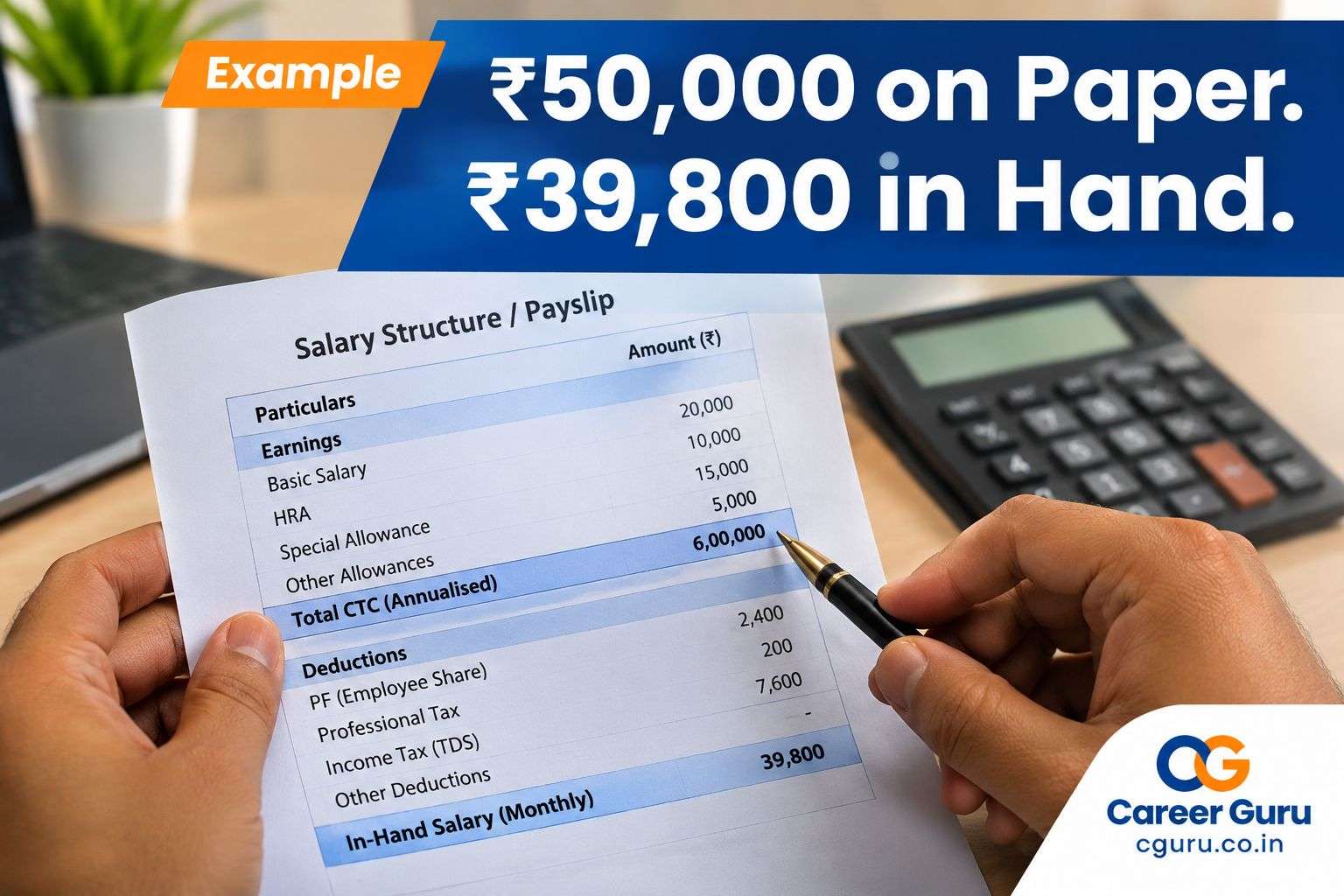
Let me use Subham’s letter to show CTC vs in-hand salary for freshers in real numbers. The figures below are only an example. Your company’s numbers will be different, so use your own letter.
The CTC is ₹6,00,000 a year. Divide by twelve and you get ₹50,000. That is the number everyone repeats at home. Now walk down, one step at a time. All amounts are per month.
- Start: ₹50,000 (CTC divided by twelve).
- Employer’s PF, ₹3,000: The company adds this to your PF account. It is yours later, not now.
- Gratuity, ₹1,200: The company sets this aside. You get it only after enough years of service.
- Insurance, ₹500: The company pays this to an insurer for your cover.
- Variable pay, ₹2,500: This is paid later, and only if the conditions are met.
- Gross salary, ₹42,800: This is your monthly pay on paper.
- Your own PF, ₹3,000: This is cut from your gross and goes into your PF account.
- Income tax, nil: At this pay level, the new tax regime leaves most freshers with no tax.
- Professional tax, nil: Odisha stopped this from April 2026. More on that below.
- In-hand salary: ₹39,800.
The four items in the middle were never going to reach you as monthly cash. Only your own PF is actually cut from your pay.
So ₹50,000 in the letter became ₹39,800 in the bank. That is ₹10,200 less every month, or about 20 percent. Do the same sum with your own letter before you tell anyone your “monthly salary”.
Subham did the sum on the spot. After ₹15,000 for home, he had ₹24,800 left for food, travel, phone and rent. He dropped the flat idea and found a shared room. He still sends money home.
What Changed in 2026 for CTC vs In-Hand Salary for Freshers
Four things moved this year. Each one touches the number in your bank.
1. Odisha ended professional tax. The state repealed the law with effect from 1 April 2026, and Odisha TV reported that deductions from salaries were to stop. In Bhubaneswar, nothing is cut under this head. Karnataka, Telangana and Maharashtra still charge it, usually around ₹200 a month.
2. Income tax is light at fresher pay. Under the new regime, salaried people get a standard deduction of ₹75,000. Salary up to ₹12.75 lakh ends up with no tax, as this Business Today explainer shows. That holds when salary is your only income. Under this regime, HRA also gives no tax savings. It is simply part of your pay.
3. The new labour codes changed the basic pay. The four codes came into force on 21 November 2025. They say basic pay and dearness allowance together must be at least half of your total pay. PF and gratuity are worked out on basic. So a higher basic means a little less cash now and more savings later. Business Standard has a clear report on this. Fixed-term employees can now get gratuity after one year, as Outlook Money explains.
4. PF above ₹1,800 is now voluntary. The new EPF Scheme 2026 keeps the mandatory limit at 12 per cent of ₹15,000, which is ₹1,800 a month. Anything above is voluntary, says Business Standard. Some companies still take 12 per cent of full basic. For Subham, that is ₹3,000. A ₹1,800 cap would raise his cash by ₹1,200 a month, but lower his savings. Ask which way your company does it.
The rules for CTC vs in-hand salary for freshers are clearer now. But the structure still differs from company to company. Your letter is the final word.
How to Read Your Offer Letter, Line by Line
Open the page with the table. For CTC vs in-hand salary for freshers, these are the lines that matter.
- Basic: The base of your pay. PF and gratuity are worked out on it.
- HRA: The housing part. It is cash in your pay, so you can use it for rent.
- Special allowance: The balancing part. Companies use it to make the total match the CTC.
- Employer’s PF: Money the company puts in your PF. Not monthly cash.
- Employee’s PF: Your share. It is cut from your pay each month.
- Gratuity: A reward for staying. It is paid after years of service, not every month.
- Insurance: The company’s premium for your coverage. Useful, but not cash.
- Variable pay: Paid on conditions. Ask how it was paid to the last batch.
- Joining or retention bonus: Look for a line that says you must return it if you leave early.
- Bond or service agreement: Not a pay line, but it can cost you real money if you quit.
Mark each line with one word. Cash, later, or maybe. Only the “cash” lines pay your rent.

Red Flags in CTC vs In-Hand Salary for Freshers
Most offers are honest. A few have small traps. When you study CTC vs in-hand salary for freshers, watch for these.
1. No breakup page. Ask for the full sheet in writing.
2. A big variable part. Your monthly cash will be thin.
3. A joining bonus with a repayment clause. Read what happens if you leave in year one.
4. A bond with a penalty. Know the amount and the period before you sign.

Comparing Two Offers Using CTC vs In-Hand Salary for Freshers
Here is a case I see often. A student has two offers.
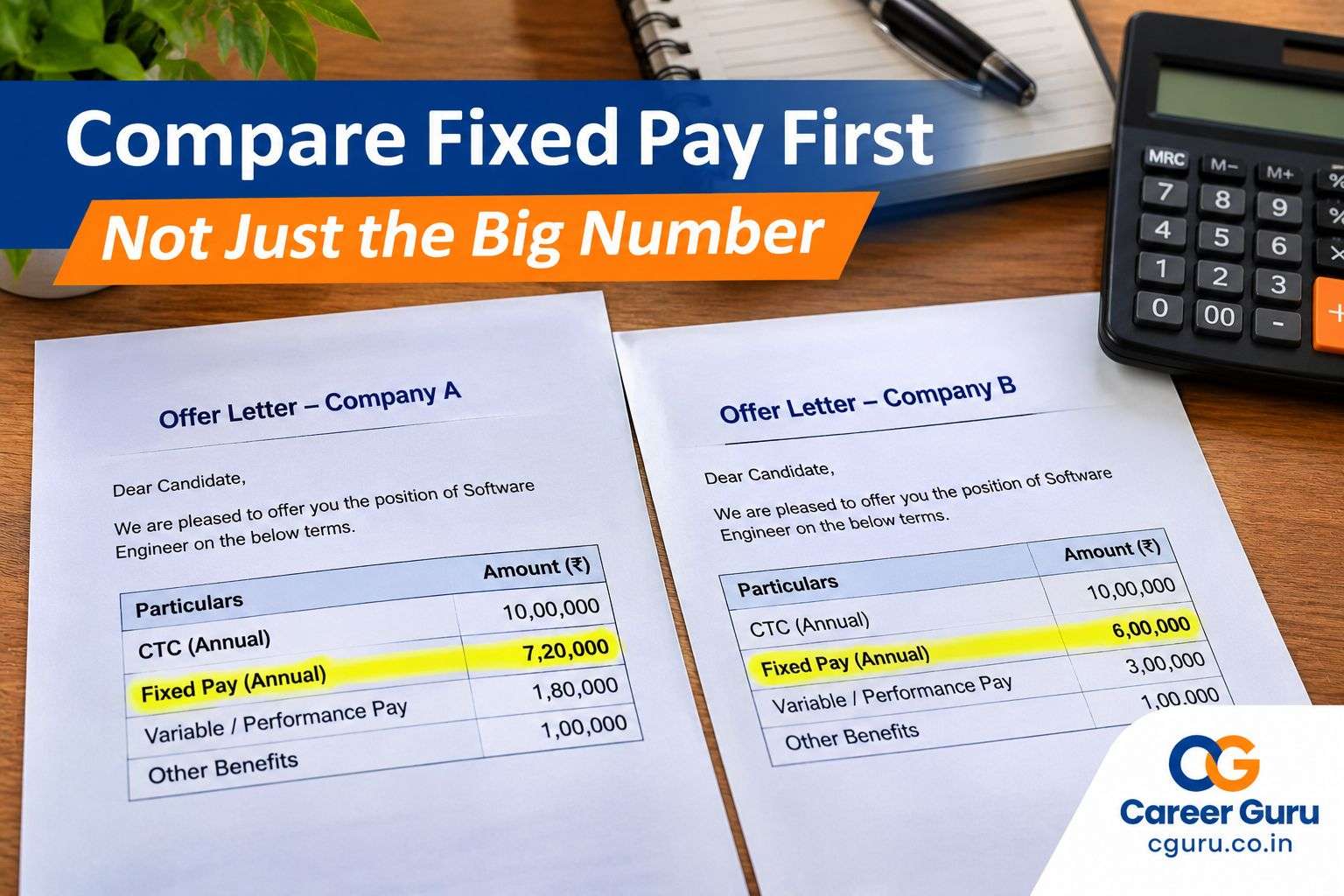
Offer A shows ₹7,00,000. But ₹1,20,000 is variable and ₹40,000 is a joining bonus. Fixed pay is ₹5,40,000.
Offer B shows ₹6,20,000. Only ₹20,000 is variable. Fixed pay is ₹6,00,000.
A looks better on a card. B is very likely to put more in your bank each month. The extra ₹60,000 in fixed pay matters more than the bigger headline.
Three headline numbers can hide three very different breakups. My guide on Infosys DSE vs Cognizant GenC Next vs Wipro Turbo shows this well. Compare fixed pay first, then PF, then variable, then bonds. Think about the city too. My piece on the best city for freshers from Odisha shows how a bigger number in a costly city can leave you poorer.
Three Questions to Ask HR
Many freshers feel shy about asking. Do not be. This is the HR team’s job. Ask by polite email.
- “Could you share the full salary breakdown and the monthly in-hand for this CTC?”
- “Is PF worked out on full basic or capped at ₹1,800?”
- “How much of the CTC is variable, and when is it paid?”
Prefer watching? Try Ankur Warikoo on CTC vs in-hand pay, this video on CTC, PF and gratuity after the new labour code, and this Wipro offer letter explainer.

FAQs — CTC vs In-Hand Salary for Freshers
FAQ 1 — Is CTC the same as in-hand salary in CTC vs in-hand salary for freshers?
No. CTC is the yearly cost to the company. In-hand salary is what reaches your bank each month. CTC includes employer’s PF, gratuity, insurance and variable pay. In my example, ₹50,000 a month in CTC became ₹39,800 in hand.
Consultant’s note — Never tell your family the CTC divided by twelve. Tell them the in-hand number once you have it.
FAQ 2 — How much of my CTC will I get in hand in CTC vs in-hand salary for freshers?
There is no single answer. In CTC vs in-hand salary for freshers, it depends on your letter. In my example, it was about 80 percent of the monthly CTC. It can be lower when variable pay is large or PF is high. It can be higher when PF is capped.
Consultant’s note — Use the walk-down sheet from this guide. Ten minutes of sums beat ten days of worry.
FAQ 3 — Why is my first salary lower than HR said in CTC vs in-hand salary for freshers?
The first month is often a part month. If you join mid-month, you are paid for fewer days. If your first payslip looks off, ask HR to explain each line.
Consultant’s note — Keep a small cushion for the first month. Do not pay a deposit on the strength of one salary credit.
FAQ 4 — Is variable pay guaranteed in CTC vs in-hand salary for freshers?
Not always. Variable pay depends on company rules and performance. Some companies pay it in full, some in parts. Ask how it was paid to the last batch.
Consultant’s note — Treat variable pay as a bonus. Never as a base for your monthly budget.
FAQ 5 — When do I get gratuity in CTC vs in-hand salary for freshers?
For regular employees, gratuity is paid after five years of continuous service. The usual formula is last drawn basic, times 15, divided by 26, times years of service. Fixed-term employees can get it after one year. Do not count this money in your early plans.
Consultant’s note — A good benefit for people who stay. Do not spend it in your head on day one.
FAQ 6 — Do I pay income tax on a ₹6 lakh offer in CTC vs in-hand salary for freshers?
In most cases, no. Under the new regime, salary up to ₹12.75 lakh ends up with no tax. This holds when salary is your only income. If you choose the old regime or have other income, the picture changes. Your payroll team will ask you to pick a regime.
Consultant’s note — Unsure which regime to pick? Ask the payroll team. Do not guess on a form.
FAQ 7 — Is the PF cut a loss in CTC vs in-hand salary for freshers?
No. It is your savings. The money goes into your PF account, and your company adds its share. You can move the account to your next employer using your UAN. Taking it out early can lead to tax.
Consultant’s note — A PF account that grows quietly for years is a gift to your future self.
FAQ 8 — Should I compare offers by CTC or by in-hand salary for freshers?
Compare fixed pay first, then in-hand pay. A smaller CTC with high fixed pay can beat a bigger CTC full of variable pay and bonuses. Add the city and the bond terms to your list.
Consultant’s note — The best offer is not the biggest number. It is the one that lets you save and learn.
FAQ 9 — Can I negotiate after getting an offer in CTC vs in-hand salary for freshers?
In mass hiring, packages are usually fixed. Do not push there. But you can still ask about the structure, such as PF on full basic or capped, and when variable pay is paid. Small and mid-size companies may have more room.
Consultant’s note — Ask to understand, not to fight. A calm email builds a good first impression.
FAQ 10 — Does CTC vs in-hand salary for freshers change in Bengaluru versus Bhubaneswar?
Slightly, through professional tax. Odisha stopped it from April 2026, while Karnataka and some other states still charge it. The bigger difference is rent and daily cost, not tax.
Consultant’s note — Always count what is left at month end, not what comes on the 1st.

What to Do This Week: Your Action Plan for CTC vs In-Hand Salary for Freshers
If you are in first or second year — Learn the words behind CTC vs in-hand salary for freshers. CTC, gross, basic, PF, gratuity and variable.
If you are in third year — Take a sample breakup and do the CTC vs in-hand salary for freshers sum yourself. Do it with two different CTC numbers.
If you are in final year — When an offer arrives, apply CTC vs in-hand salary for freshers to it. Ask for the full breakup in writing. Use the three HR questions. Check the bond. Read the placement notes in my placement season guide and the steps in my TCS NQT 2027 guide. Short skill courses aligned to NSDC, such as those from Rooman Technologies, can help you aim for better roles.
If you have already graduated — Judge every offer on CTC vs in-hand salary for freshers, meaning fixed pay and in-hand pay. If you are looking at jobs in Odisha, my map of Odisha tech opportunities for freshers will show you where roles are growing.
Back to Subham. He joins in a few weeks, and he has already done his CTC vs in-hand salary for freshers sum. He showed it to his father too. He told me, “Sir, now I know what number to say at home.”
That small feeling is what this guide is for. CTC vs in-hand salary for freshers is not a maths problem. It is a trust problem. Read the page nobody reads, and you will never be surprised by your own salary.
I read all my email/messages. You can write to me [email protected] or WhatsApp at 9777278853.