

Why Every Indian Recruiter Checks Your GitHub profile Before Hiring You in 2026 — And What They Are Looking For
Discover why Indian recruiters check your GitHub profile before hiring in 2026 and what they look for. Honest insights from a 27-year IT career consultant who has seen both sides.
Why Indian Recruiters Check Your GitHub Profile Before Hiring You in 2026
Here is something most Indian students do not know is happening.
Right now — while you are reading this — recruiters at Indian IT companies, startups, and product firms are searching GitHub. Not waiting for applications. Not reviewing resumes first. Searching GitHub directly for candidates whose profiles show real technical work.
According to recent hiring surveys over 76 percent of technical recruiters globally check a candidate’s GitHub profile before or during the interview process. In India’s product company and startup ecosystem that number is even higher in 2026. GitHub has quietly become the most honest technical evaluation tool available to any hiring manager — because it shows what you have actually built rather than what you claim to know.
I have been an IT career consultant for 27 years. I have sat with hiring managers at companies ranging from Bengaluru startups to large IT service firms while they evaluated fresher candidates. And over the past three years I have watched a clear shift happen in how technical hiring works in India.
The resume tells a recruiter what you claim. The LinkedIn profile tells them how you present yourself. The GitHub profile tells them the truth.
That shift means your GitHub profile for Indian students 2026 is no longer optional. It is the most important technical portfolio tool available to you. And most Indian students either do not have one or have one that is actively hurting their chances rather than helping them.
This blog is going to show you exactly what Indian recruiters find when they look at a student’s GitHub profile — and exactly what needs to be there for them to keep looking rather than move on.
What Recruiters Actually Do When They Open Your GitHub Profile
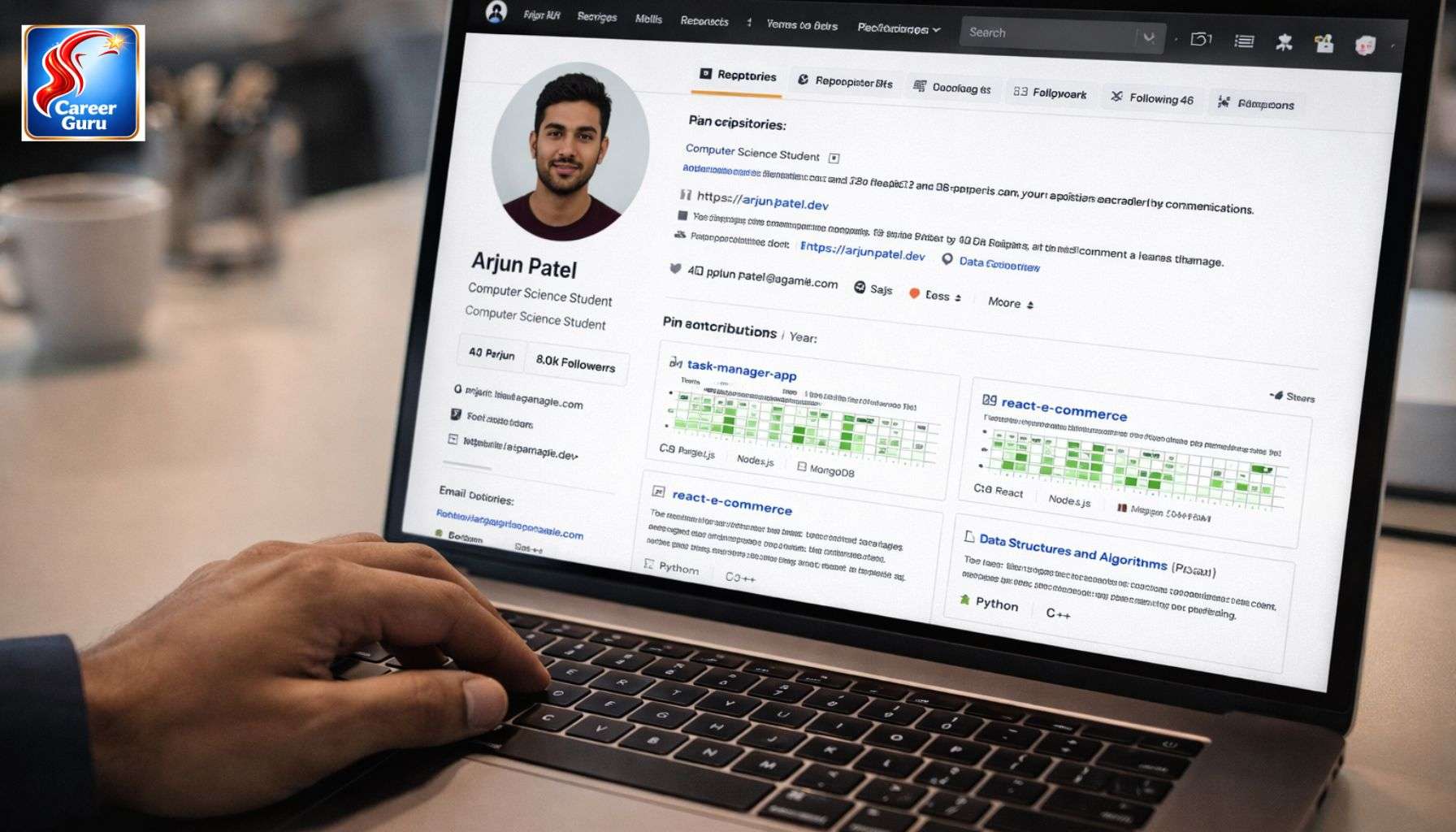
What Indian recruiters look for on GitHub profile 2026 — recruiter navigating student repositories
Before we talk about what to build let me tell you what actually happens when a recruiter opens your GitHub profile. Because understanding their behaviour is what makes the rest of this blog genuinely useful.
A recruiter opening a GitHub profile for the first time spends approximately thirty seconds making an initial assessment. Here is exactly what they look at in those thirty seconds.
First — your contribution graph. That green square grid showing your activity over the past year. A profile with consistent contributions spread across many weeks tells them you code regularly. A profile with a few isolated bursts of activity tells them you coded intensively for one project and then stopped. A completely empty graph tells them you created the account and never used it.
Second — your pinned repositories. You can pin up to six repositories to the top of your profile. These are what a recruiter looks at after the contribution graph. If you have not pinned anything they will look at your most recently updated repositories — which may not be your best work.
Third — your repository names and descriptions. They scan the names and one-line descriptions of your pinned projects. Repositories named “project1” and “assignment3” and “test” tell them nothing. Repositories named “Student-Attendance-System-Python-MySQL” with a clear description tell them immediately what you built and what technologies you used.
Fourth — they click into your most interesting repository. They look at the README. They look at the code quality. They look at the commit history. They look at whether the project actually runs.
That entire sequence takes sixty to ninety seconds. In that time a recruiter has formed a clear opinion about your technical ability, your professional habits, and your initiative. Make sure those sixty seconds work in your favour.
What a Strong GitHub Profile for Indian Students 2026 Actually Looks Like
Let me be specific about what impresses recruiters when they evaluate a GitHub profile for Indian students in 2026. Not general advice. The specific signals that actually change a hiring decision.
A Complete Profile Section
Your GitHub profile has a bio section that most students leave completely empty. Fill it.
Add a one-line professional description. “Final year B.Tech CSE student | Python | SQL | Data Analysis | Open to opportunities.” Add your location — city, India. Add your LinkedIn profile link. Add your email address if you are comfortable with that.
This sounds small. It is not. A recruiter who lands on a GitHub profile with no bio, no location, and no contact information has no easy way to reach you even if your code impresses them. Remove that friction.
A Strong README Profile Page
GitHub allows you to create a special repository with your username as the repository name. Whatever you put in the README of that repository appears on your GitHub profile page as a personal introduction.
Most Indian students do not know this exists. The ones who do and use it well immediately stand out.
Your profile README should include a brief introduction, your current skills, what you are working on or learning right now, and links to your LinkedIn and portfolio. Keep it clean and readable. Do not fill it with dozens of animated badges and emoji. Simple, clear, and professional is what impresses a technical recruiter in India in 2026.
Pinned Repositories That Tell a Story
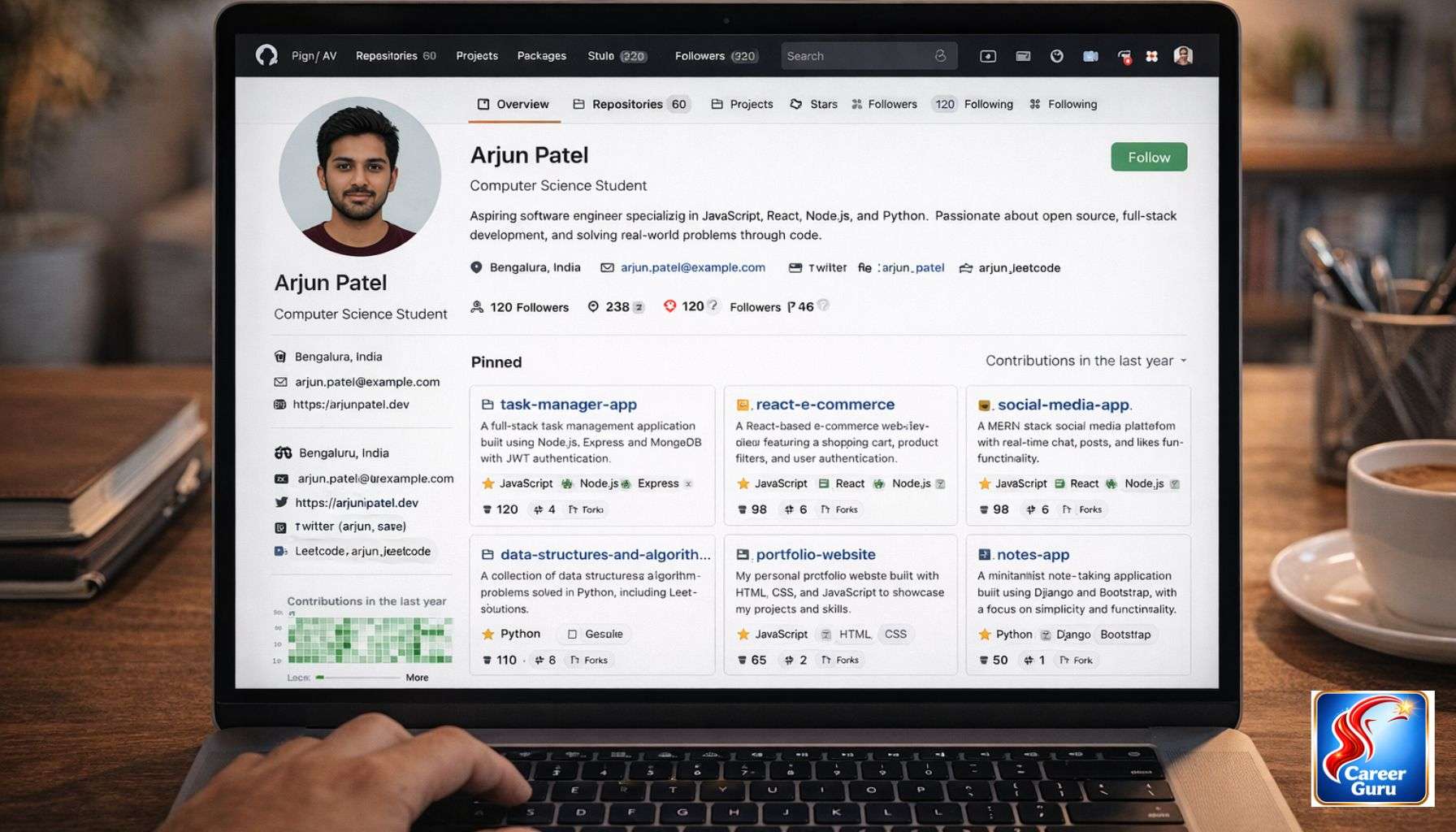
Strong GitHub profile for Indian students 2026 — well organised pinned repositories and contribution graph
Your six pinned repositories are your portfolio. Choose them carefully.
Each pinned repository should represent a different skill or domain. One data analysis project. One web development project. One automation script. One machine learning project if you have built one. One project that solves a real Indian business problem if possible.
The variety shows breadth. The quality of each one shows depth. Together they tell a recruiter that you are a student who builds things across multiple domains — not someone who built one project for a college assignment and called it a portfolio.
For each pinned repository make sure three things are true. The repository name is descriptive — not “project1.” There is a one-line description that explains what it does. And there is a proper README inside.
README Files That Actually Explain the Project
This is the single most neglected element of Indian student GitHub profiles. And it is the one that makes the biggest difference when a recruiter actually clicks into a repository.
A README is not optional. It is the first thing a recruiter reads when they open your repository. A repository with no README is like submitting a report with no title page and no introduction. It immediately signals that the student does not think about how their work is received by others.
A strong README for a student project in India in 2026 has five elements.
Project title and one-line description. What is this and what does it do.
The problem it solves. Why did you build this. What real problem were you trying to address.
Technologies used. Python 3.9, MySQL, Flask, Pandas — whatever you used. Listed clearly.
How to run it. Step by step instructions that someone else could follow to get the project working on their machine.
What you learned. One short paragraph about what building this project taught you. This is the element that turns a code repository into a genuine learning demonstration — and it is something no automated evaluation tool can fake.
Clean Consistent Code
A recruiter who opens your repository and looks at your code is not expecting production-quality enterprise software. They are a student. They know that.
What they are evaluating is whether the code is readable, whether it is organised logically, and whether it suggests someone who cares about their craft rather than someone who wrote the minimum required to make something work.
Three specific things make student code look professional to an Indian technical recruiter in 2026.
Meaningful variable and function names. A variable named student_attendance_count tells a reader what it represents. A variable named x or temp2 does not. This one habit — naming things clearly — is the fastest way to improve how your code looks to someone reading it for the first time.
Comments that explain why, not what. A comment that says # increment counter above a line that increments a counter adds nothing. A comment that says # check for duplicate entries before inserting to prevent data integrity issues tells a reader why that decision was made. That kind of commenting signals thoughtful programming.
Consistent formatting. Consistent indentation, consistent spacing, and a logical file structure. These suggest someone who has internalized professional coding standards rather than someone who only codes when an assignment requires it.
A Consistent Contribution Graph
The green contribution graph on your GitHub profile is a visual representation of your coding consistency over the past year.
A completely empty graph tells a recruiter this account exists but the student does not use it. A graph with three or four large bursts of activity — coinciding suspiciously with college assignment deadlines — tells a recruiter this student only codes when forced to. A graph with consistent activity spread across many weeks and months tells a recruiter this student codes regularly because they genuinely enjoy it.
You do not need to push code every single day. But pushing something — even a small improvement, even a documentation update, even a new practice problem — three to four times per week builds a contribution graph that tells the right story over time.
Start building your contribution graph now. Not next semester. Now. A graph built over six months of consistent activity looks dramatically different from one built in a six-week pre-placement sprint — and recruiters can tell the difference immediately.
At Least One Collaborative or Open Source Contribution

Open source contribution GitHub profile Indian students 2026 — student submitting pull request
This is the element that separates good GitHub profiles from genuinely impressive ones in India in 2026.
Contributing to an open source project — even in a small way — signals something that no personal project portfolio can signal alone. It shows that you can read and understand code written by other people. That you can follow contribution guidelines and coding standards set by others. That you are part of the broader developer community rather than coding in complete isolation.
You do not need to contribute to Linux or React. Small contributions to small projects count. Fixing a typo in documentation. Correcting a bug in a beginner-friendly repository. Adding a feature to a small open source tool you use yourself.
Look for repositories labeled “good first issue” on GitHub — these are specifically marked by project maintainers as appropriate entry points for new contributors. One successful pull request merged into any open source project is a contribution worth mentioning on your resume and worth having visible on your GitHub profile.
What Immediately Turns Indian Recruiters Off When Checking GitHub Profiles in 2026
I want to be direct about the specific things that make a recruiter close your GitHub profile immediately. These are patterns I have seen repeatedly and they are all fixable.
Empty repositories with no README and no code. A repository that exists but contains nothing — or only a single file with three lines of placeholder code — is worse than not having that repository at all. It signals that you started something and abandoned it. Delete empty repositories or complete them before your profile is visible to recruiters.
Copy-pasted tutorial code with no modification. Recruiters who review code regularly can identify tutorial code immediately. A repository that is a direct copy of a YouTube tutorial project with no personalisation, no extension, and no README that acknowledges the source is a red flag rather than a portfolio strength.
Repository names that suggest academic compulsion. Names like “DAA-Assignment-3” and “DBMS-Lab-Practical-7” tell a recruiter that you are uploading college assignments to appear to have GitHub activity rather than building genuine projects. Assignments belong on GitHub only if they represent genuinely strong work — and even then they should be framed as projects rather than assignments.
Forked repositories with no contribution. Forking a repository creates a copy on your profile. Forking hundreds of repositories without contributing to any of them inflates your repository count without adding any real signal to your profile. Recruiters see through this immediately. A profile with five genuine original repositories is far stronger than one with fifty forks and no original work.
No activity for extended periods. A GitHub profile that was last active eight months ago tells a recruiter that you prepared a portfolio at some point and then stopped engaging with code entirely. Consistent recent activity is as important as the quality of what you have built.
How to Build a Strong GitHub Profile for Indian Students 2026 — Starting This Week

Building GitHub profile for Indian students 2026 — student following improvement checklist
You do not need months to meaningfully improve your GitHub profile. You need one focused week and a commitment to maintaining it consistently after that.
Here is exactly what to do.
Day one — Set up your profile properly. Fill in your bio. Add your location, LinkedIn link, and email. Create a profile README repository with a clean introduction. These changes take two hours and immediately make your profile look like it belongs to someone serious about their career.
Day two — Audit your existing repositories. Go through every repository you have. Delete the empty ones. Delete the assignment repositories that add no value. Rename repositories with vague names to descriptive ones. Add one-line descriptions to every repository that remains.
Day three — Write a proper README for your best project. Just one to start. Your strongest project. Title, problem it solves, technologies used, how to run it, what you learned. That single README transforms your best repository from a code dump into a genuine portfolio piece.
Day four — Pin your six best repositories. Choose them based on skill variety and code quality. Arrange them to tell a story about what you can do rather than just what you have done.
Day five — Make one genuine commit to a project. Not a fake commit. A real improvement to an existing project or the start of a new one. This begins your contribution graph activity for the current week.
Day six — Find one open source repository with a good first issue label. Read the contribution guidelines. Identify one small contribution you could make. This is research day — you do not need to submit a pull request today.
Day seven — Update your LinkedIn profile with your GitHub link in the Featured section and in your About section. Every student who reads your LinkedIn profile should be able to reach your GitHub in one click.
Then maintain it. Three to four commits per week minimum. One new project per month. Your GitHub profile for Indian students 2026 is a living document of your technical growth — treat it like one.
Read These Next-
- 📌 Top Tech Skills Employers Look for in Freshers in India 2026
- 📌 LinkedIn Profile Tips for Students India 2026
- 📌 How to Write a Resume for Internship With No Experience in India 2026
- 📌 Why Your Resume Is Getting Rejected in India 2026
- 📌 Data Science Career Roadmap India 2026
- 📌 Python vs Java vs C++ for Indian Students 2026
- 📌 Best Free Online Courses for IT Students in India 2026
- 📌 Top 10 IT Companies in India Hiring Freshers in 2026
- 📌 How to Get an Off Campus Job in India 2026
- 📌 How to Crack Campus Placements in India 2026
Why linkedin & Github profiles now decide IT Job
FAQs — GitHub Profile for Indian Students 2026
Q 1:- Do Indian IT service companies like TCS and Infosys actually check GitHub profiles for freshers or is it only product companies and startups that care?
This is one of the most practically important questions I get from Indian students — because the answer should directly influence how much time you invest in your GitHub profile depending on which companies you are targeting.
The honest answer is that GitHub profile evaluation is significantly more common at product companies and startups than at large IT service companies right now. When TCS evaluates a Ninja candidate through NQT, or when Infosys screens a fresher through InfyTQ, the primary evaluation mechanism is their own standardised assessment — not a GitHub profile review.
At that scale of hiring — tens of thousands of freshers per year — individual GitHub profile evaluation is simply not practical as a primary filter.
However — and this is the part most students miss — the picture changes significantly at the interview stage. Technical interviewers at TCS, Infosys, and Wipro who are evaluating a specific candidate often do look at their GitHub profile if a link is provided on the resume or LinkedIn profile.
A strong GitHub profile at that stage can meaningfully strengthen an interviewer’s impression of a candidate who has performed adequately in the written test but not outstandingly. It provides additional evidence of genuine technical engagement that the standardised test alone cannot capture.
Where GitHub profile evaluation is genuinely widespread and often primary is at product companies — Zoho, Freshworks, Razorpay, smaller funded startups — and at any company that hires through skills-based off campus routes rather than mass campus drives.
If your job search strategy includes any of these companies — and for most Indian students it should — your GitHub profile for Indian students 2026 deserves serious investment.
Consultant’s note — I have personally seen fresher candidates receive interview calls from Bengaluru product startups who found them through GitHub searches rather than through any job portal application.
That inbound recruitment channel — a recruiter finding you rather than you finding them — is available only to students with visible, quality GitHub profiles.
It is a passive job search tool that works for you twenty-four hours a day. The one-time investment of building it properly pays returns every day it exists.
Q 2:- What kind of projects should an Indian student put on GitHub to impress recruiters in 2026 — and how many is enough?
This is the question I get asked most often by students who understand that they need a GitHub profile but are not sure what to actually put on it. And I want to give you a specific, honest answer rather than the generic “build projects that showcase your skills” advice that helps nobody.
Three to five well-executed projects is the sweet spot for an Indian fresher’s GitHub profile in 2026. More than that starts to feel like quantity over quality. Fewer than three gives a recruiter insufficient evidence to form a confident opinion about your abilities.
The specific combination I recommend for maximum impact with Indian technical recruiters covers these bases. One data project — a dataset from Kaggle or a government open data portal, cleaned, analysed, and visualised with clear findings documented in the README.
One web application — a simple full-stack project using Python Flask or Node.js with a basic database backend, focused on completeness and cleanliness rather than complexity. One automation or scripting project — a Python script that solves a genuinely useful problem, however small.
And if you are targeting data science or AI roles specifically, one machine learning project — end-to-end with data preparation, model building, evaluation, and plain-language interpretation of results.
The quality signals that matter most across all of these are consistent — meaningful commit history showing the project was built incrementally rather than dumped all at once, a thorough README, clean readable code, and evidence that the project actually works rather than just exists.
Consultant’s note — The most common mistake I see Indian students make with their GitHub portfolio is building projects specifically designed to look impressive on a profile rather than building things they were genuinely curious about.
That difference comes through immediately when a recruiter asks about the project in an interview. A student who built a project out of genuine curiosity can talk about it naturally for twenty minutes — discussing what surprised them, what they would change, what they want to build next.
A student who built it purely for the portfolio runs out of things to say in three minutes. Build things you are actually interested in. The authenticity is not something you can fake.
Q 3:- How important is open source contribution for an Indian fresher’s GitHub profile in 2026 and how do you actually get started with it?
Open source contribution is genuinely valuable for a GitHub profile for Indian students in 2026 — but I want to calibrate the expectation accurately because the barrier most students imagine is significantly higher than the real one.
The value of having at least one open source contribution on your GitHub profile is disproportionate to the effort it typically requires.
A single merged pull request to any legitimate open source project — even a documentation fix, even a one-line bug correction — tells a recruiter several things that no personal project portfolio can tell them alone. It tells them you can navigate an existing codebase written by other people.
That you can follow external contribution guidelines and standards. That you are connected to the broader developer community rather than coding in complete isolation. And that you have had at least one piece of your code reviewed and accepted by someone other than yourself.
Getting started with open source contribution is simpler than most Indian students believe. Go to GitHub and search for repositories in your area of interest with the label “good first issue” — these are issues that maintainers have specifically marked as appropriate for new contributors.
Read the contribution guidelines carefully before doing anything else. Pick the smallest possible contribution you can make correctly — fixing a typo, improving a README section, correcting a minor bug. Submit your pull request with a clear description of what you changed and why.
That entire process from finding an issue to submitting a pull request can be completed in a single afternoon.
The goal at the fresher stage is not a significant open source contribution. It is one genuine contribution that demonstrates you understand how collaborative development works. That single data point on your GitHub profile carries more weight with technical recruiters at product companies than most students realise.
Consultant’s note — I started recommending open source contribution specifically to Indian students I counsel about two years ago when I noticed that product company recruiters in Bengaluru were beginning to ask about it explicitly during technical interviews.
The question they ask is not “have you contributed to major open source projects” — it is “have you ever worked with code that someone else wrote and submitted changes to it.” That question has a yes or no answer. Make sure yours is yes before you walk into those interviews.
What to Do This Week — Your GitHub Action Plan
Rather than ending with a summary of what you already read, let me leave you with the specific actions that will transform your GitHub profile for Indian students 2026 from wherever it is right now to genuinely recruiter-ready.
This week — not eventually, this week — do these five things.
Open your GitHub profile and look at it the way a recruiter would. Spend sixty seconds scanning it without reading anything carefully. Ask yourself honestly — does this look like someone who builds things regularly or someone who created an account and occasionally uploads assignments. That sixty second test will tell you how much work needs to be done.
Fill your profile bio completely today. Location. LinkedIn link. Email. One professional headline sentence. This takes fifteen minutes and immediately signals that a real professional maintains this profile.
Write a proper README for your single best existing project. Problem it solves. Technologies used. How to run it. What you learned. That one README transforms your best repository from a code dump into a genuine portfolio piece that a recruiter can evaluate meaningfully.
Make three genuine commits this week. To existing projects. To new projects. To anything. Three commits this week begins the contribution graph story that you need to be telling consistently from now until your placements.
Add your GitHub link to your LinkedIn Featured section and your resume today. Every recruiter who looks at either of those will be one click away from seeing your work. Remove every barrier between a recruiter’s curiosity and your actual code.
Your GitHub profile for Indian students 2026 is the most honest technical story you can tell a recruiter. Make sure it is a story worth reading.
LinkedIn profile already strong? Make sure your resume is equally compelling. Read our complete guide on Why Your Resume Is Getting Rejected in India 2026 and ensure every part of your application is working together







4 Comments