
TCS NQT 2026 Complete Guide for Freshers to Crack It in First Attempt
TCS NQT 2026 complete guide for freshers — exam pattern, syllabus, preparation tips and real advice from a 27-year IT career consultant to help you crack it in your first attempt.
Image Alt Text: TCS NQT 2026 complete guide for freshers — student preparing at desk
TCS NQT 2026 — The Exam That Can Change Everything for an Indian Fresher
TCS NQT 2026 guide for freshers is one of the most searched career preparation topics in India right now — and after 27 years of working as an IT career consultant, I completely understand why.
Tata Consultancy Services is not just another IT company. It is the largest private sector employer in India. It hires tens of thousands of freshers every single year. And the TCS National Qualifier Test — the NQT — is the single gateway that every fresher must pass to get their foot in the door.
Here is what makes this exam different from everything else you have prepared for in college.
Your CGPA does not save you here. Your college name does not save you here. Your attendance record and your professor’s opinion of you mean absolutely nothing once you sit down in front of that screen. The NQT is a level playing field.
A student from a tier three college in a small town has exactly the same shot as a student from a tier one college in Bengaluru — if they have prepared the right way.
I have watched students from ordinary colleges crack TCS NQT and walk into six-figure salaries. I have watched students from reputed colleges fail it because they assumed their college name would carry them through. The exam does not care about your background. It cares about how well you have prepared.
This guide is going to walk you through everything — the exam pattern, the syllabus, the preparation strategy, the mistakes to avoid, and the mindset that actually gets students through on their first attempt. Let’s get into it.
What Exactly Is TCS NQT — And Why Does It Matter So Much
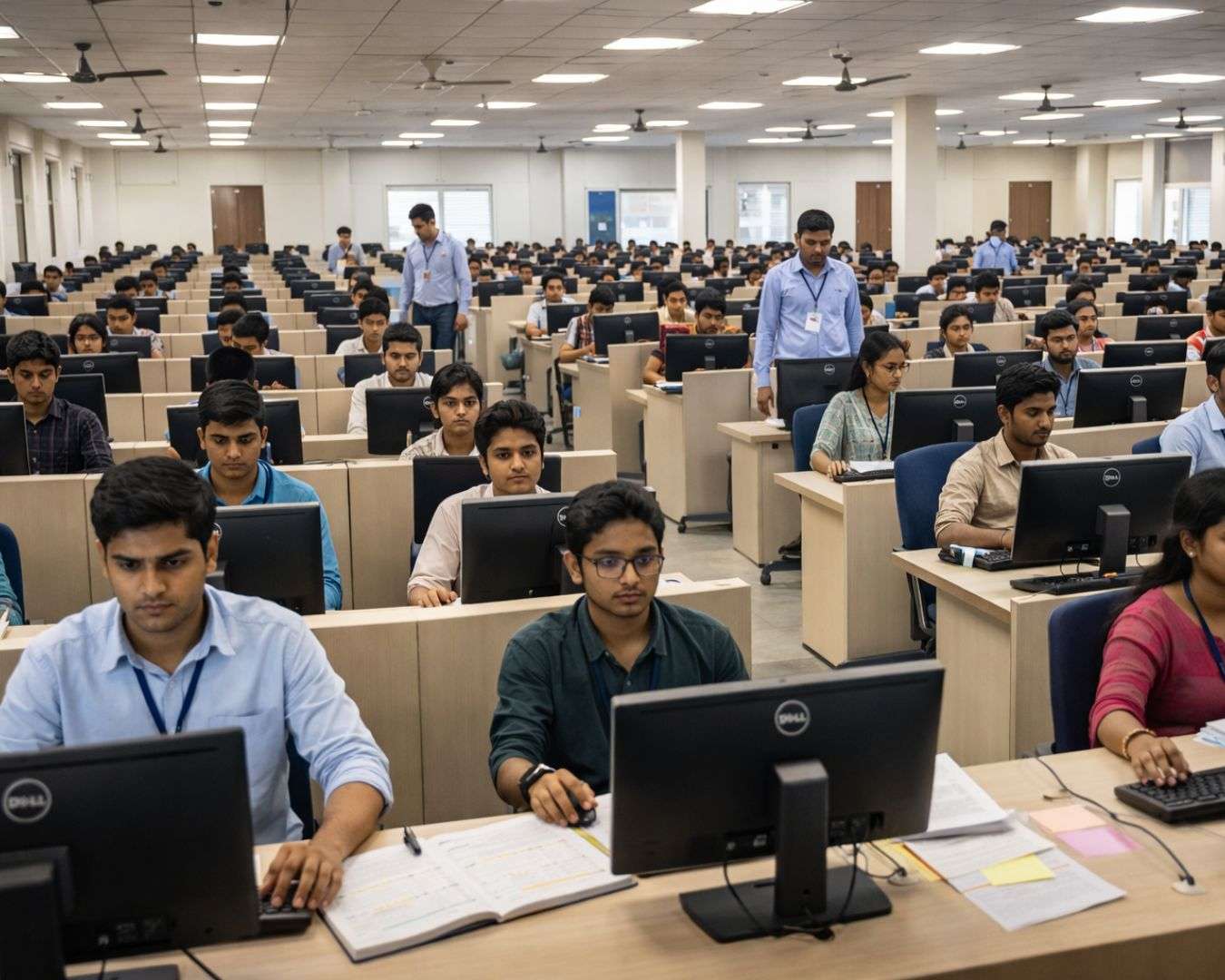
TCS NQT 2026 exam hall — freshers appearing for national qualifier test
TCS NQT stands for National Qualifier Test. It is TCS’s own hiring assessment for freshers across India. It is conducted multiple times a year and is open to students from all streams — engineering, science, commerce, and arts — though the majority of candidates are engineering and computer science graduates.
Passing the NQT qualifies you for TCS’s recruitment process. Depending on your score and the role you are targeting, you could be considered for TCS Ninja — the standard fresher role — or TCS Digital — the higher-paying digital transformation profile that offers significantly better compensation and more interesting work.
Here is why it matters beyond just getting into TCS. The NQT score is valid for two years. It is recognised across TCS’s entire hiring ecosystem. And because TCS is such a large and respected employer, having cleared TCS NQT is a credential that signals something to other companies too — it tells them you cleared a structured, nationally administered assessment. That has value beyond just one job offer.
For students from non-IIT and non-NIT colleges — which is the vast majority of engineering graduates in India — TCS NQT is one of the most accessible and legitimate paths into a well-paying IT career. Treating it seriously is not optional.
TCS NQT 2026 Exam Pattern — What You Are Actually Walking Into
Before you prepare for anything you need to understand exactly what you are preparing for. Let me break this down clearly.
The TCS NQT has two main components. The Foundation section and the Advanced section. Both matter. Here is what each one covers.
Foundation Section — The Section Everyone Must Clear
The Foundation section is common to all candidates regardless of their background or the role they are targeting. It has four parts.
Verbal Ability This section tests your English language skills — reading comprehension, sentence completion, error identification, vocabulary, and grammar. The questions are not extremely difficult but they require accuracy and speed. Many students who are strong in technical areas lose marks here simply because they do not practise English comprehension regularly.
Number of questions — approximately 24 Time — approximately 40 minutes
Reasoning Ability Logical reasoning, number series, arrangements, coding-decoding, blood relations, and similar pattern-recognition problems. This section rewards students who have practised consistently. The questions follow predictable patterns — once you recognise those patterns through practice they become much more manageable.
Number of questions — approximately 30 Time — approximately 50 minutes
Numerical Ability Basic mathematics — percentages, ratios, time and work, time and distance, profit and loss, simple and compound interest, averages, and data interpretation. This is Class 10 and Class 12 level mathematics. The challenge is not difficulty — it is speed. Most students know how to solve these problems. The ones who score well are the ones who can solve them fast.
Number of questions — approximately 26 Time — approximately 40 minutes
Programming Logic Basic programming concepts — flowcharts, pseudo code, output prediction, and fundamental coding logic. You do not need to write code in this section but you need to understand how code works and be able to trace through a simple program to predict its output.
Number of questions — approximately 10 Time — approximately 20 minutes
Advanced Section — This Is Where TCS Digital Candidates Are Separated
The Advanced section is where the real differentiation happens. Strong performance here opens the door to TCS Digital — the higher-paying profile with more interesting work and significantly better long-term career prospects.
Advanced Coding Two coding problems to be solved in a programming language of your choice — Python, Java, C, or C++ are all accepted. The problems test your ability to write clean, working code that handles edge cases. This is the section that separates well-prepared candidates from the rest.
Time — 45 minutes for two problems
Advanced Quantitative Ability Higher difficulty quantitative problems than the Foundation section. Requires stronger mathematical reasoning and problem-solving speed.
Advanced Reasoning More complex logical reasoning problems requiring deeper analytical thinking.
The Advanced section is attempted after clearing the Foundation section. Not everyone needs to attempt all parts of the Advanced section — it depends on which TCS profile you are applying for. But I always advise students to prepare for the Advanced section regardless. Scoring well there gives you options. Scoring poorly limits them.
TCS NQT 2026 Eligibility Criteria
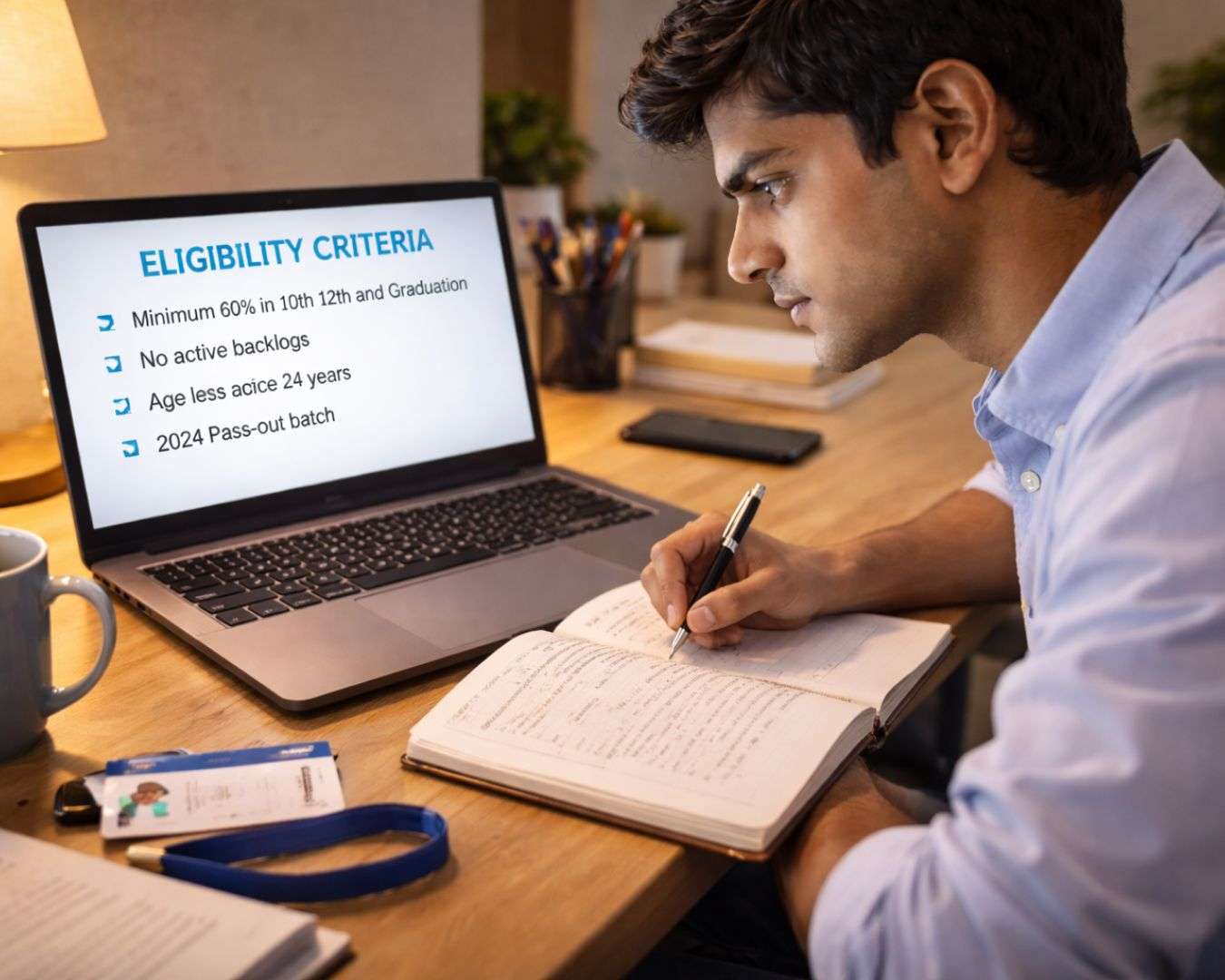
TCS NQT 2026 eligibility criteria — student checking requirements
Let me be very clear about eligibility because this is where many students waste time applying only to be disqualified later.
Academic eligibility: You must have completed your graduation — B.E., B.Tech, M.E., M.Tech, MCA, or M.Sc in relevant disciplines. Some BCA and B.Sc graduates also qualify for specific profiles. Check the current TCS careers page for the most up-to-date eligibility criteria as these can change slightly year to year.
Percentage requirement: TCS typically requires a minimum of 60 percent or 6.0 CGPA across Class 10, Class 12, and your graduation degree. This is a strict filter. If you have a backlog or a gap year, be prepared to explain it clearly during the interview stage if you clear the NQT.
Year of passing: TCS NQT is open to students in their final year as well as recent graduates. The exact passout year eligibility is updated each cycle — check the official TCS careers portal for the current criteria.
Backlog policy: TCS does not accept candidates with active backlogs at the time of joining. Historical backlogs that have been cleared are generally acceptable but this too should be verified on the official portal.
🔗 Official Portal: tcs.com/careers
How to Prepare for TCS NQT 2026 — Section by Section
This is the part that actually matters. Let me give you a preparation strategy that works — not a vague “study hard and practise daily” suggestion but a real, structured approach that I have seen deliver results.
Start at least three months before you plan to appear.
I know that sounds like a lot. It is not. Three months of consistent one to two hours daily is genuinely enough to prepare well for TCS NQT — if those hours are spent the right way. The students who fail are rarely the ones who are not smart enough. They are almost always the ones who started too late or prepared the wrong things.
Verbal Ability Preparation
Read something in English every single day. A news article. A blog post. Anything. The goal is to get comfortable reading and processing English quickly. Reading comprehension is not a skill you build by solving ten comprehension questions the night before the exam. It builds over weeks of regular reading.
For grammar and vocabulary — pick one good resource and stick to it. Word Power Made Easy by Norman Lewis is the most recommended vocabulary book for Indian students and it is genuinely worth the time. For grammar, any standard Class 10 or 12 English grammar book covers everything the NQT tests.
Practice past TCS verbal questions on platforms like IndiaBIX and PrepInsta. The question patterns repeat more often than you would expect.
🔗 Visit: indiabix.com
Reasoning Ability Preparation
Reasoning is the most pattern-driven section in the NQT. Every category of question — series, arrangements, analogies, coding-decoding — follows specific patterns. Once you have seen enough examples of each pattern they become almost mechanical to solve.
Spend the first month of preparation just working through reasoning categories one by one. Do not mix everything together from day one. Master one category. Move to the next. By the time you have gone through all categories your brain will start recognising patterns automatically.
RS Aggarwal’s Verbal and Non-Verbal Reasoning is the standard resource for this section and it covers everything you need. Supplement it with timed practice on IndiaBIX and TCS mock tests.
Numerical Ability Preparation
Go back to basics first. If your Class 10 mathematics is not solid — percentages, ratios, and basic algebra — spend two weeks getting those foundations right before you attempt any timed practice. Speed without accuracy is useless. Accuracy without speed costs you marks. You need both.
After the foundation is solid, focus on speed. Set a timer for every practice session. Work on solving each problem type in under 90 seconds. Quantitative aptitude is a speed game as much as a knowledge game.
RS Aggarwal’s Quantitative Aptitude is the most widely used resource for this section. Arun Sharma’s CAT preparation books are also excellent if you want higher difficulty practice that makes the actual NQT feel easier.
Programming Logic and Coding Preparation
This is the section that most students either over-prepare or completely ignore. Neither extreme is right.
For the Foundation programming logic section — you do not need to be a strong coder. You need to understand basic concepts. What does a loop do. How does a function work. What is the output of this simple program. Practice trace-through questions on platforms like TCS iON practice portal and IndiaBIX.
For the Advanced coding section — this is where you do need real coding skills. Two problems in 45 minutes sounds manageable but under exam pressure with edge cases to handle it is genuinely challenging. Start practising on HackerRank and LeetCode at the easy and medium levels. Do not jump to hard problems initially. Build the habit of writing clean, working code that handles edge cases.
Choose one language and stick to it for the exam. Python is the most beginner-friendly. Java is well-supported. C++ is fastest for competitive-style problems. Pick whichever you are most comfortable in and practise exclusively in that language.
🔗 Visit: hackerrank.com | leetcode.com
The Most Common Mistakes That Cause Students to Fail TCS NQT

Common TCS NQT mistakes to avoid — student learning from failure 2026
I want to talk about these mistakes specifically because I see the same ones repeated year after year. Knowing them in advance is half the battle.
Mistake 1 — Ignoring the Verbal section because you are an engineering student. This is the single most common mistake. Engineering students assume verbal ability is a soft section that does not need serious preparation. Then they lose fifteen to twenty marks there that they needed to clear the cutoff. Verbal ability has the same weight as every other section. Treat it that way.
Mistake 2 — Practising without timing yourself. Doing fifty aptitude questions at your leisure with no time pressure is not the same as doing thirty questions in forty minutes under exam conditions. Always practise with a timer. Always. The only way to build exam speed is to practise at exam speed.
Mistake 3 — Using too many resources. I see students with six different aptitude books, four different YouTube channels, and three different mock test platforms all open simultaneously. That is not preparation — that is confusion. Pick two resources maximum per section and go deep with them. Consistency with fewer resources beats superficiality across many.
Mistake 4 — Not taking full-length mock tests. Practising individual sections is good. But you also need to practise sitting through the full exam duration in one go. Exam fatigue is real. Your concentration drops. Your speed slows. The only way to build stamina for a full-length exam is to simulate full-length exams regularly in the weeks before you appear.
Mistake 5 — Leaving coding preparation for the last two weeks. Coding is not something you can cram. It is a skill that builds through consistent practice over weeks and months. Students who start coding preparation late almost always underperform in the Advanced coding section — and that is precisely the section that opens the TCS Digital profile. Start coding practice from week one of your preparation.
Mistake 6 — Not reading the question properly. Under time pressure students rush and misread questions. They solve for the wrong variable. They miss a condition in the problem. They choose the right method but get the wrong answer because they read the question too fast. Slow down by two seconds per question. Read it fully before you start solving. Those two seconds save you from silly mistakes that cost real marks.
TCS NQT vs TCS Digital — Understanding the Difference
This is something every student should understand clearly before they register.
TCS Ninja is the standard profile. It is what most TCS freshers join as. The starting salary for TCS Ninja is currently around ₹3.36 LPA. The work involves software development, testing, and maintenance across TCS’s large client base. It is a stable, well-structured start to an IT career.
TCS Digital is the premium profile. The starting salary for TCS Digital is currently around ₹7 LPA — more than double the Ninja package. The work involves digital transformation, cloud computing, AI, and newer technology stacks. The projects are more interesting. The growth trajectory is faster.
The difference between who gets Ninja and who gets Digital comes down almost entirely to NQT performance — specifically, performance in the Advanced section and the coding round. Students who prepare only for the Foundation section will qualify for the Ninja profile at best. Students who prepare seriously for the Advanced section and code well give themselves a real shot at Digital.
My advice is always the same. Prepare for Digital. If you get Digital, fantastic. If you end up in Ninja, you have still cleared the exam and got your foot in the door — and you can always work your way across internally. But prepare for the higher bar. Aiming lower and getting lower is not a strategy.
Interview Stage — What Happens After You Clear the NQT
Clearing the NQT gets you to the interview stage. There are typically two rounds after the written test.
Technical Interview This is a one-on-one interview with a TCS technical panel. They will ask you about your final year project, your programming language knowledge, basic data structures and algorithms, and sometimes operating system and database concepts. The questions are not extremely advanced for most freshers but you need to know your project inside out and be able to write basic code on paper or on screen if asked.
Prepare your project explanation in advance. Know what problem it solves. Know the technologies you used. Know what challenges you faced and how you solved them. That combination of knowing your project well and being able to write clean basic code is what the technical interview is really testing.
HR Interview The HR round is conversational. They want to understand who you are, why you want to join TCS, whether you are flexible about location and shift timings, and how you handle pressure. Be honest. Be direct. Prepare answers for the standard HR questions — tell me about yourself, your strengths and weaknesses, where you see yourself in five years, why TCS specifically.
One thing I always tell students about the TCS HR interview. They ask about relocation and night shifts genuinely — not just as a formality. If you have strong objections to either, think carefully about how you answer. Saying you will relocate anywhere and then backing out after joining damages your career more than it helps it.
🔗 Related Read: How to Prepare for an Internship Interview in India 2026
A Realistic Week-by-Week Preparation Plan
Here is a twelve-week plan that works if you follow it consistently.
Weeks 1 and 2 — Foundation Building Revise Class 10 and 12 mathematics basics. Start RS Aggarwal Quantitative Aptitude from the beginning. Read English for thirty minutes daily. Start Word Power Made Easy from page one.
Weeks 3 and 4 — Reasoning and Verbal Deep Dive Work through RS Aggarwal Verbal and Non-Verbal Reasoning chapter by chapter. Continue daily English reading. Start solving verbal practice questions on IndiaBIX.
Weeks 5 and 6 — Quantitative Speed Building Focus on speed. Time every practice session. Target solving quantitative questions in under 90 seconds each. Identify your weak topics and spend extra time there.
Weeks 7 and 8 — Coding Foundations Start HackerRank from the easy level in your chosen language. Complete at least one problem daily. Do not skip days. Consistency here matters more than intensity.
Weeks 9 and 10 — Full Section Practice Start taking sectional mock tests under timed conditions. Review every wrong answer. Understand why you got it wrong — not just what the right answer was.
Weeks 11 and 12 — Full Length Mock Tests and Review Take at least two full-length TCS NQT mock tests per week. Review thoroughly after each one. Focus your remaining preparation time on your weakest areas. Do not try to learn anything new in the final two weeks — consolidate what you already know.
Best Resources for TCS NQT 2026 Preparation
For Aptitude: RS Aggarwal Quantitative Aptitude — the most comprehensive and widely used resource for Indian placement exams.
For Reasoning: RS Aggarwal Verbal and Non-Verbal Reasoning — covers every pattern you will encounter in the NQT.
For Verbal: Word Power Made Easy — Norman Lewis — for vocabulary building over weeks not days.
For Coding: HackerRank — start from easy and build up. LeetCode — for more structured problem sets. TCS iON Practice Portal — for official NQT-style coding questions.
For Mock Tests: PrepInsta TCS NQT mock tests. TCS iON official practice platform. IndiaBIX for individual section practice.
🔗 Visit: prepinsta.com | tcsion.com
Internal Links — Read These Next
- 📌 Summer Internship for Students in India 2026 — Complete Guide
- 📌 Best Platforms to Find Summer Internships in India 2026
- 📌 How to Write a Resume for Internship With No Experience in India 2026
- 📌 How to Convert Your Summer Internship Into a Full-Time Job in India
- 📌 Top 10 High Paying Internships in India 2026 for College Students
- 📌 Internship vs Training — What’s the Difference
- 📌 Best Free Online Courses for IT Students in India 2026
- 📌 Cybersecurity Internships in India 2026
- 📌 10 Real Benefits of an Internship for Students in India 2026
- 📌 How to Prepare for an Internship Interview in India 2026
- 📌 How to Write a Cover Letter for Internship in India 2026
- 📌 Python vs Java vs C++ for Indian Students 2026
FAQs — TCS NQT 2026 Guide for Freshers
Q 1:-How many times can I attempt TCS NQT in 2026?
TCS NQT can be attempted multiple times and your most recent score is the one that counts in TCS’s hiring process. There is a mandatory cooling period between attempts — typically around 30 days — but this can change between cycles so always verify the current policy on the official TCS iON portal before registering for a repeat attempt.
Here is what most students do not think about when it comes to multiple attempts. The question is not just whether you can appear again — it is whether appearing again without meaningful preparation in between will actually improve your score.
The NQT is adaptive in certain sections which means it responds to your knowledge level in real time. A student who appears a second time having done nothing differently between attempts almost always scores within a similar range to their first attempt. The test has not changed. Their preparation has not changed. The outcome will not change either.
The students I have seen improve significantly between NQT attempts are the ones who treated the first attempt as a diagnostic — identifying specifically which sections cost them the most marks — and then spent the cooling period fixing exactly those sections rather than preparing broadly for everything again.
If your first attempt result was disappointing, spend at least four to six weeks in targeted preparation before attempting again. Verbal ability is the section most students underestimate and most consistently underperform in. If that was your weak section, fix it first. It is also worth noting that TCS runs multiple hiring cycles per year and the number of open positions varies between cycles. Earlier cycles in the year typically have more positions available. Appearing in the first available cycle of your final year rather than waiting gives you access to a larger hiring pool.
Consultant’s note — In my experience coaching students through multiple TCS NQT cycles, the students who appeared in the first available cycle of their final year — even if their preparation was not perfect — had significantly better placement outcomes than those who waited for a second or third attempt. Earlier cycles have more positions. Earlier application means earlier joining. That timing advantage compounds in ways most students do not factor into their decision.
Q 2:- Is there negative marking in TCS NQT 2026?
TCS NQT does not have negative marking in the aptitude sections. This means you should attempt every question — never leave anything blank. Even a guess gives you a chance at a correct answer. Zero marks is guaranteed if you leave it blank. In the coding section partial marks are awarded for code that passes some test cases even if it does not pass all of them. Always submit something rather than leaving the coding problems empty.
Q 3:- What is the real difference between TCS Ninja and TCS Digital and is it worth preparing for Digital specifically?
The difference between TCS Ninja and TCS Digital is not just a salary difference — although that difference is significant. TCS Ninja currently starts at approximately ₹3.36 LPA. TCS Digital starts at approximately ₹7 LPA. That is nearly double the starting salary for what is technically the same company, the same joining date, and often the same city of posting.
But the difference goes beyond the number on the offer letter. TCS Digital candidates are typically deployed on newer technology projects — cloud migration, digital transformation, AI-adjacent work, and modern application development. TCS Ninja candidates are more often deployed on maintenance and support work for existing systems. Both are legitimate starting points.
But the learning curve and the career trajectory from Digital are demonstrably steeper and faster in the first two years.
What determines which profile you get is almost entirely your performance in the Advanced section of the NQT — specifically the coding round. Students who perform well in the Foundation section but do not attempt or do poorly in the Advanced section qualify for Ninja consideration. Students who perform strongly in both Foundation and Advanced — and specifically who write clean working code in the coding round — are considered for Digital.
The practical implication is this. If you are going to spend three months preparing for TCS NQT, spend at least one of those months specifically on coding practice. HackerRank easy and medium problems in your chosen language. Not just aptitude. Not just verbal. Code. Because that is the single biggest lever you have to access the Digital profile and everything that comes with it.
Consultant’s note — I have advised hundreds of students on TCS NQT preparation over the years. The ones who specifically targeted the Digital profile by investing in serious coding practice consistently outperformed their own expectations — not just in getting Digital but in how they performed in the technical interview round that follows. Coding practice for NQT is never wasted preparation regardless of which profile you end up in.
Q 4:- What is the minimum score needed to clear TCS NQT in 2026 and how should I set my preparation target?
TCS does not publicly announce a fixed cutoff score for NQT and this is a source of significant anxiety for students who want a clear target to aim for. Let me give you the honest picture based on what I have observed across multiple hiring cycles.
The effective cutoff varies each cycle based on the overall performance distribution of candidates in that cycle and the number of positions TCS is looking to fill. When TCS is hiring aggressively — which they do in cycles where large client projects are ramping up — the effective cutoff tends to be more lenient.
When hiring is more selective the bar rises. You cannot control which cycle you appear in. But you can control how far above the likely cutoff you aim.
My practical guidance on targets is this. For TCS Ninja consideration aim to score above 70 percent in every Foundation section — verbal, reasoning, quantitative, and programming logic. Do not just clear the overall cutoff while being weak in one section. Sectional performance matters and being significantly below average in any one section can disqualify you even if your overall score is acceptable.
For TCS Digital consideration aim above 80 percent in all Foundation sections and produce working code in the Advanced coding round that passes at least the basic test cases. Partial marks are awarded for code that solves part of the problem correctly — submitting something is always better than submitting nothing.
The students I have seen consistently clear NQT on first attempt are the ones who set their target at comfortable above the expected cutoff rather than aiming to just barely pass. Preparation that targets 80 percent gives you a buffer. Preparation that targets 60 percent gives you a margin for error that the exam’s time pressure will eventually eat into.
Consultant’s note — One specific observation from working with students across multiple NQT cycles. The verbal ability section is consistently the one where students lose the most marks relative to their preparation effort. Engineering students habitually under-prepare this section because they assume their technical strength will compensate. It does not. Sectional performance is evaluated independently. Treat verbal as seriously as quantitative.
Q 5:- How should a student with a CGPA below 6.5 approach TCS NQT and the subsequent hiring process?
This is a question I get regularly and the honest answer is more nuanced than most people give it credit for.
TCS’s stated minimum eligibility is 60 percent or 6.0 CGPA across Class 10, Class 12, and your degree. If your CGPA meets that minimum you are eligible to appear for NQT regardless of whether it is 6.1 or 9.1. The NQT is a skill assessment. It does not know your CGPA. A student with a 6.2 CGPA who has prepared thoroughly for the NQT will outperform a student with an 8.5 CGPA who walked in assuming their grades would carry them. I have watched this happen more times than I can count.
Where CGPA does become relevant again is at the HR interview stage. If your CGPA is on the lower end of the eligibility range, an interviewer may ask about it directly. Prepare an honest, brief, forward-looking answer. Something like — “My CGPA does not fully reflect my technical ability and I have been deliberate about demonstrating that through my projects and certifications.
I am aware of the gap and I have used my time outside academics to build practical skills.” Then have specific evidence ready — real projects, real certifications, real skills — that substantiate that claim.
What you should never do is be defensive or dismissive about a lower CGPA. Own it briefly. Pivot to what you have built instead. An interviewer who sees genuine self-awareness and concrete compensating strengths will almost always move past the CGPA question quickly.
If your CGPA is below the 6.0 minimum — which disqualifies you from TCS’s stated eligibility criteria — focus your energy on platforms like Unstop and Zoho’s careers portal where assessment performance matters more than academic filters. Your NQT preparation is still valuable because the skills it builds transfer directly to those assessments.
Consultant’s note — The most memorable placement success story I have been part of in recent years involved a student with a 6.3 CGPA from a tier three college in Odisha who cleared TCS NQT, performed well in the technical interview because he knew his project inside out, and joined TCS Digital. His CGPA came up once in the HR interview. He answered it honestly and confidently. The interviewer moved on in thirty seconds. Your CGPA is one data point. In an interview room your preparation, your projects, and your presence matter infinitely more.
Q 6:- What is the best way to prepare for the TCS NQT coding section if I have very little programming experience?
This is one of the most important questions on this list and one where I want to be completely honest with you about what is realistic and what is not.
If you have very little programming experience and your NQT attempt is four or more weeks away — you have enough time to build functional coding ability for the Foundation programming logic section and a reasonable attempt at the Advanced coding section. If your attempt is one week away, focus your remaining time on the Foundation section and accept that the Advanced coding round will be a stretch.
Here is the preparation path that works for students starting from near zero. Week one — understand basic programming concepts without writing code yet. What is a variable. What is a loop. What is a function. What does this simple program output.
Use IndiaBIX’s programming section and TCS iON practice questions to build pattern recognition for the Foundation programming logic section. This is output prediction and pseudocode reading — not actual coding. You can build this skill in one week of focused practice.
Week two onwards — start writing actual code in Python. Python is the most beginner-friendly language for NQT coding preparation. Start with HackerRank’s thirty days of code challenge which takes you from absolute beginner to someone who can write basic working programs in a structured daily format. Do not skip days. Consistency here matters more than the number of hours per session.
The goal for the Advanced coding section from a near-zero starting point is to be able to write a working solution for at least one of the two problems — even if it only passes the basic test cases. Partial credit is real. Something is always better than nothing.
What will not work is watching coding tutorial videos without actually writing code yourself. You cannot learn to code by watching other people code any more than you can learn to swim by watching swimming videos. Write code every single day. Even ten lines. Even broken code that you fix. The act of writing and debugging is what builds the skill — not the watching.
Consultant’s note — I have seen students with genuinely minimal coding experience build enough Python ability in six weeks of daily practice to attempt the TCS NQT Advanced coding section and pass one of the two problems. That partial performance — combined with strong Foundation scores — has been enough to qualify for Ninja consideration in several cycles I have observed. Do not write off the coding section because you feel behind. Start today. Write something. Then write something slightly harder tomorrow.
Q 7:- What happens in the technical and HR interview after clearing TCS NQT and how should I prepare for both?
Clearing NQT is a genuine achievement and you should feel good about it. But it is the beginning of the selection process not the end. The interview rounds that follow are where many students who cleared the written test lose the opportunity — not because they lack ability but because they walk in underprepared for what these rounds actually involve.
The technical interview at TCS for Ninja candidates is focused and specific. It almost always starts with your final year project. Not a general technical question. Your project. The interviewer will ask what it does, what technologies you used, why you chose those technologies over alternatives, what the hardest part of building it was, and what you would do differently today.
Students who know their project deeply — who can answer follow-up questions naturally without freezing — consistently sail through the technical round. Students who built their project in a group and cannot clearly articulate their specific contribution consistently struggle.
Beyond the project, TCS technical interviewers at the Ninja level typically ask basic OOP concepts, simple SQL queries, fundamental OS or networking questions, and occasionally ask you to write a simple program on paper or on screen. None of these are extremely advanced. All of them reward students who have revised their fundamentals rather than assuming their degree covered them adequately.
The HR round is where students make avoidable mistakes by treating it as a formality. TCS HR interviewers are specifically evaluating flexibility — relocation willingness, shift timing acceptance, domain preference openness. They are also evaluating communication clarity and basic professional maturity. Be honest about your preferences. Be direct about your answers. Never give a yes to relocation or shift flexibility that you intend to reverse at joining time. That creates a professional problem before your career has started.
Always have two or three genuine questions ready for the interviewer at the end of both rounds. Ask about the training program structure. Ask what the first project assignment typically looks like for Ninja joiners. Ask what skills the team finds most valuable in the first six months. These questions show genuine engagement and leave a strong final impression.
Consultant’s note — In every TCS interview debrief I have done with students over the years, the single most consistent differentiator between students who cleared the technical round and those who did not was how well they knew their own project. Not how much they had studied. Not their CGPA. Their project. Students who built something real, understood it deeply, and could speak about it with genuine enthusiasm cleared the technical round at a dramatically higher rate than those who had memorised textbook answers but could not speak authentically about their own work.
Q 8:- Is TCS a good company to start a career at in India in 2026 or should freshers be targeting higher-paying companies instead?
This is a question worth answering honestly because I see a lot of dismissive advice about TCS circulating in student communities online — and most of it misses important context.
TCS is not the highest-paying entry point for a fresher IT career in India in 2026. Companies like Amazon, Microsoft, Freshworks, and well-funded startups all offer significantly higher starting packages. That is a fact. If you have the skills and preparation to access those opportunities, pursuing them alongside TCS makes complete sense.
But here is the context that dismissive advice ignores. TCS is the largest IT company in India. It has structured training programs that give freshers a genuine foundation in professional software development. It has a massive internal mobility system that allows employees to move across domains, technologies, and geographies after their initial period. It has a brand that is recognised by every company in India and most companies globally. And it provides a stable, professional starting point for students who are not yet ready to compete for the highest-tier roles but who want a legitimate entry into the IT industry.
For students from tier two and tier three colleges who missed campus placements and are now in the off campus market, TCS through NQT is one of the most accessible and most reliable paths into a professional IT career available in India. Dismissing it because the starting salary is not as high as a startup offer is a luxury available only to students who have those startup offers in hand.
The honest career consultant’s view is this. TCS as a first job is not a compromise. It is a foundation. What you build on that foundation in your first two to three years — the skills you develop, the certifications you earn, the projects you contribute to — determines where you go next far more than your starting salary does.
Consultant’s note — I have watched students join TCS Ninja at ₹3.36 LPA and be earning ₹12 to ₹15 LPA within three years through a combination of internal growth and one strategic company switch. The starting salary is real. It is also just the starting salary. How you use the first two years inside TCS matters enormously — and the students who use that time to keep learning consistently move faster than those who treat the first job as a destination rather than a launchpad.
Q 9:- What is the minimum score to clear TCS NQT in 2026?
TCS does not publicly announce a fixed cutoff score. The cutoff varies each year based on the overall performance of candidates in that particular cycle. As a general guideline students targeting TCS Ninja should aim to score above 70 percent in all Foundation sections. Students targeting TCS Digital should aim for above 80 percent in Foundation and strong performance in the Advanced coding section. Preparing to score above these benchmarks gives you a reasonable buffer.
Q 10:-. Can students with backlogs appear for TCS NQT 2026?
Students with active backlogs at the time of appearing for NQT can register and take the test. However TCS’s joining criteria typically require no active backlogs at the time of joining. So while a backlog does not prevent you from taking the test, it will likely prevent you from joining if you have not cleared it by the time the offer is made. Clear all backlogs as soon as possible — this applies to every company’s hiring process, not just TCS.
Q 11:- Is TCS NQT 2026 conducted online or offline?
TCS NQT is conducted as a proctored online test through the TCS iON platform. It can be taken from home or from designated test centres depending on the cycle and registration option chosen.
The home-based option requires a stable internet connection, a functioning webcam, and a quiet environment. TCS’s proctoring is strict — any suspicious activity detected during the exam can result in disqualification. Ensure your technical setup is tested and working properly well before your exam date.
Key Takeaways
- TCS NQT 2026 is the single most accessible and legitimate pathway for Indian freshers from any college to enter one of India’s largest and most respected IT companies — and the exam rewards preparation not pedigree.
- The exam has two components — Foundation covering verbal, reasoning, numerical, and programming logic, and Advanced covering higher-level quant, reasoning, and two coding problems.
- TCS Digital offers more than double the starting salary of TCS Ninja — prepare for the Advanced section and coding from day one if you want to give yourself a genuine shot at the Digital profile.
- Start preparation at least three months before your exam date. One to two focused hours daily is enough — but those hours must be consistent and the practice must be timed.
- The most common reasons students fail are ignoring verbal preparation, practising without timing themselves, starting coding too late, and not taking full-length mock tests.
- RS Aggarwal for aptitude and reasoning, Word Power Made Easy for vocabulary, and HackerRank for coding are the three core resources that cover the majority of what you need.
- There is no negative marking in the aptitude sections — attempt every single question. Partial marks are available in coding — always submit something.
Cleared TCS NQT and heading into the interview? Read our complete guide on How to Prepare for an Internship Interview in India 2026 and walk into that room ready for anything.





11 Comments