

How to Prepare for an Internship Interview in India 2026 — Questions and Answers
Learn how to prepare for an internship interview in India 2026 with real questions, answers and expert tips from a 27-year IT career consultant. Walk in ready and walk out confident.
How to Prepare for an Internship Interview in India 2026 — Because Walking in Unprepared Is the One Mistake You Cannot Afford
How to prepare for an internship interview in India 2026 is the question every student asks me the week before their interview. Not the month before. Not after they applied. The week before. And every single time I hear that, I feel the same thing — a mix of concern and hope. Concern because one week is not a lot of time. Hope because one week of the right preparation is still enough to make a real difference.
Here is something I have watched play out hundreds of times over 27 years. Two students. Similar resumes. Similar grades. Similar colleges. One walks into the interview prepared, knows the company, has practised answers, and has thought through their projects. The other walks in, hoping their personality will carry them through.
The prepared student gets the call. Almost every time.
An internship interview is not just a formality. For many companies it is the first serious filter. And the students who treat it seriously — who actually sit down, think it through, and prepare — have a dramatically higher success rate than those who wing it.
This blog is going to walk you through exactly how to prepare. The process, the most common questions, strong answers, and the small details that make a bigger difference than most students realise.
Start Here — Know the Company Before You Know Your Answers

The single most common reason students stumble in internship interviews has nothing to do with their skills or their grades. It is this — they know nothing about the company they are interviewing with.
I have sat in on interviews where a student could not name a single product the company makes. Could not explain what the company does in one sentence. Could not say why they wanted to intern there specifically rather than anywhere else.
That tells an interviewer one thing immediately. This person applied to fifty companies and doesn’t particularly care which one says yes.
Companies notice that. And it puts you at a disadvantage before the interview has even properly begun.
So before you do anything else, spend at least one hour on the company’s website. Read their About Us page. Understand what they do and who their customers are. Look at their recent news or blog. Check their LinkedIn page. Find out if they have won any awards recently or launched any new products.
Then take that information and use it. When the interviewer asks why you want to intern here — and they will ask — you should have a specific, genuine answer that could only apply to that company. Not a generic line that works for every company on earth.
That level of preparation alone puts you ahead of the majority of applicants.
How to Prepare for an Internship Interview in India 2026 — The Structure That Works
Preparation for an internship interview has four parts. Most students only think about one of them — the questions. But all four matter.
Part one — Know yourself. Be clear about your strengths, your projects, your skills, and your story. Be able to talk about your academic background and your interests naturally and specifically.
Part two — Know the company. Covered above. Non-negotiable.
Part three — Know the role. Read the internship description carefully. Understand what they are looking for. Think about how your skills and experience connect to what they need.
Part four — Practice out loud. This is the part most students skip entirely. Reading answers in your head is not the same as saying them out loud. Your brain knows what you mean to say. Your mouth sometimes says something completely different. Practice out loud. In front of a mirror. With a friend. Record yourself on your phone. It feels uncomfortable. Do it anyway.
Most Common Internship Interview Questions in India 2026 — With Real Answers

Student preparing internship interview questions and answers India 2026
Let’s get into the actual questions. I am going to give you the question, tell you what the interviewer is really asking, and then show you what a strong answer looks like versus a weak one.
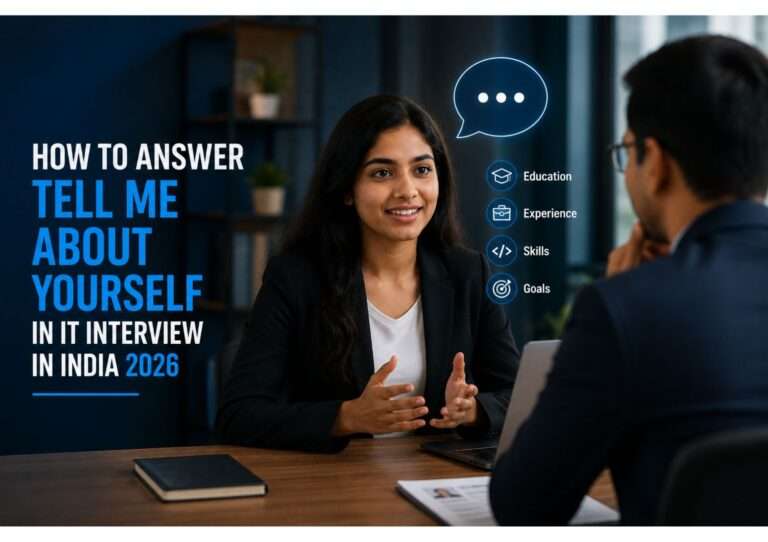
Question 1 — Tell Me About Yourself
What the interviewer really wants: A clear, confident, two minute summary of who you are professionally. Not your life story. Not your hobbies. A focused snapshot of your background, your skills, and why you are sitting in this chair today.
Weak answer: “I am from Bhubaneswar. I am currently pursuing B.Tech in Computer Science from XYZ College. I like coding and playing cricket.”
That answer tells the interviewer almost nothing useful. It sounds like a school introduction.
Strong answer: “I am a third year B.Tech student in Computer Science at XYZ College. Over the past two years I have built two web development projects — one is a student attendance management system and the other is a basic e-commerce site I built to learn React. I have completed Google’s IT Support certificate and an NPTEL course in Python. I am specifically interested in backend development and I applied here because your company works on products that solve real logistics problems — which is the kind of challenge I want to learn from.”
See the difference. The second answer is specific, confident, and ends with a reason that shows genuine interest in this company specifically.
Practice tip: Write your answer out once. Then speak it out loud until it sounds natural — not memorised.
Question 2 — Why Do You Want to Intern With Us?
What the interviewer really wants: Evidence that you chose this company deliberately. That you did some research. That you are genuinely interested in what they do and not just looking for any internship certificate.
Weak answer: “I want to gain practical experience and your company has a good reputation.”
Every student says this. It means nothing.
Strong answer: “I read about your recent work on cloud-based inventory management solutions and it connects directly with what I have been studying and building in my projects. I also noticed that your team has been growing significantly over the past year which tells me there will be real work to contribute to rather than just observing. I want to learn from people who are solving problems at this scale.”
That answer shows research. It shows genuine thinking. And it gives the interviewer something real to respond to.
Question 3 — What Are Your Strengths?
What the interviewer really wants: Self-awareness and relevance. Not a list of adjectives. A real strength that connects to the role with a brief example to back it up.
Weak answer: “I am hardworking, dedicated and a quick learner.”
Every single candidate says this. It has become meaningless through overuse.
Strong answer: “My strongest quality is that I figure things out on my own before asking for help. When I was building my attendance management project I hit a problem with the database query that took me two days to solve. I could have asked someone immediately but I worked through it myself using documentation and Stack Overflow. I eventually fixed it and understood the concept deeply because of that process. I think that persistence is something I will bring into any team I work with.”
A strength backed by a real example is ten times more convincing than an adjective.
Question 4 — What Are Your Weaknesses?
What the interviewer really wants: Honesty and self-awareness. They are not trying to trap you. They want to see if you know yourself and whether you are working on improving.
Weak answer: “I am a perfectionist and I work too hard sometimes.”
This is the most overused fake weakness in interview history. Every recruiter knows it is not a real answer.
Strong answer: “I sometimes spend too long on a problem before asking for help. I think it comes from wanting to solve things independently but I have realised that in a team environment it can slow things down. I have been actively working on this — setting myself a time limit before I reach out to someone. It is a work in progress but I am aware of it.”
That answer is honest, specific, and shows you are already taking steps to improve. That combination builds trust.
Question 5 — Tell Me About a Project You Have Worked On
What the interviewer really wants: Evidence that you can do real work. They want to hear about something specific — what you built, why, what challenges you faced, what you learned.
Weak answer: “I made a website for my college project using HTML and CSS.”
This tells the interviewer almost nothing.
Strong answer: “I built a student attendance management system for my third semester project. It was built using HTML, CSS, PHP and a MySQL backend. The idea came from a real problem — our college still tracked attendance manually and I wanted to digitise it. The biggest challenge was designing the database structure to handle multiple subjects and batches without slowing down queries. I solved it by normalising the tables properly after a lot of trial and error. The system ended up handling data for around 200 students and I presented it at our college tech fest. That project taught me more about databases than an entire semester of theory.”
That answer has a problem, a solution, a result, and a reflection. That is exactly what interviewers want to hear.
Question 6 — Where Do You See Yourself in Five Years?
What the interviewer really wants: To understand if you have thought about your career direction at all. They are not expecting a precise roadmap. They just want to see some ambition and some clarity.
Weak answer: “I want to grow and learn as much as possible.”
That says absolutely nothing.
Strong answer: “In five years I want to be working as a backend developer with solid experience in cloud infrastructure. I am particularly interested in how companies manage data at scale and I want to build expertise in that space. Right now I am focused on getting real hands-on experience through internships like this one — because I know the fastest way to get where I want to go is to work with people who are already there.”
That answer shows direction, shows awareness, and smartly connects the five-year vision back to why this internship matters to them.
Question 7 — Do You Have Any Questions for Us?
What most students do: Say “no, I think everything is covered” and end the interview on a flat note.
What you should do: Always have two or three thoughtful questions ready. This shows genuine interest and leaves the interviewer with a positive final impression.
Good questions to ask:
- “What does a typical day look like for an intern on your team?”
- “What is the most important thing an intern can do in the first two weeks to contribute meaningfully?”
- “What are the qualities you have seen in interns who went on to get full-time offers here?”
That last question is particularly powerful. It tells the interviewer you are already thinking beyond the internship — and it gives you valuable information about what to focus on if you get the role.
The Day Before the Interview — What to Actually Do

Student preparing the night before internship interview in India 2026
Most students spend the day before frantically cramming. That is the wrong approach. Here is what actually helps.
Review your resume one more time. Know every line on it. Be ready to talk about anything you have written. If it is on your resume and you cannot explain it in an interview, take it off.
Prepare two printed copies of your resume. Even if you submitted it online. Bring physical copies. It shows professionalism and interviewers appreciate having something in front of them.
Plan your logistics. Know exactly where the interview is. If it is online, test your camera, microphone and internet connection the night before. Not the morning of. The night before.
Sleep properly. This sounds basic. It is not. A tired brain does not think clearly, does not recall well, and does not project confidence. Eight hours before an interview is not a luxury. It is part of your preparation.
Do not prepare new material on the morning of the interview. Trust what you have already done. Spend the morning of calmly reviewing your notes, eating a proper breakfast, and arriving early.
Small Details That Make a Bigger Difference Than You Think
Dress appropriately. For most IT and corporate internship interviews in India, smart formals or smart casuals work well. When in doubt, dress one level up from what you think is needed. You can always dress down later. You cannot undo a first impression.
Arrive ten minutes early. Not thirty minutes early — that creates awkwardness. Ten minutes gives you time to settle, breathe, and collect your thoughts without rushing.
Put your phone on silent before you enter the building. Not on vibrate. Silent. A phone buzzing during an interview is a distraction that breaks your focus and irritates the interviewer.
Make eye contact. Not staring — natural, comfortable eye contact. It signals confidence even when you do not feel it. If there are two interviewers, distribute your eye contact between both of them when you answer.
It is fine to pause before answering. Students panic when they do not have an immediate answer and start talking before they have thought it through. A two second pause while you collect your thoughts is completely professional. It signals that you think before you speak — which is a quality any good employer values.
End with gratitude and a specific note. Before you leave, thank the interviewer genuinely and mention one specific thing from the conversation. “Thank you for your time — the point you made about how your team approaches security testing was really interesting to me.” That specificity leaves a strong final impression.
For Online Internship Interviews — Extra Points to Cover
Online interviews have become very common in India. They come with their own set of preparation requirements.
Your background matters. A clean, plain wall or a tidy room behind you is fine. A messy bed or a chaotic background is not. If your room is cluttered, sit in front of a plain wall or use a neutral virtual background.
Light your face properly. Sit facing a window or a lamp. If the light source is behind you, your face will be dark and the interviewer will struggle to see your expressions. Expressions matter in an interview — even online.
Wear proper clothes top to bottom. It sounds funny but wear your full interview outfit even in an online interview. It puts you in the right mental state. Getting dressed properly signals to your brain that this is serious.
Log in five minutes early. If the interview is on Zoom, Google Meet, or Teams — join the call five minutes before the scheduled time. Joining late because of a technical glitch is an avoidable bad start.
Internal Links — Read These Next
- 📌 Summer Internship for Students in India 2026 — Complete Guide
- 📌 Best Platforms to Find Summer Internships in India 2026
- 📌 How to Write a Resume for Internship With No Experience in India 2026
- 📌 How to Convert Your Summer Internship Into a Full-Time Job in India
- 📌 Top 10 High Paying Internships in India 2026 for College Students
- 📌 Internship vs Training — What’s the Difference and Which One Should You Choose in India 2026
- 📌 Best Free Online Courses for IT Students in India 2026
- 📌 Cybersecurity Internships in India 2026 — Everything a Student Needs to Know
- 📌 10 Real Benefits of an Internship for Students in India 2026
FAQs — How to Prepare for an Internship Interview in India 2026
Q 1:- How many days before should I start preparing for an internship interview?
Ideally, start at least seven to ten days before. Use the first three days to research the company and review your resume. The next three days to prepare and practice answers out loud. The final days to do mock interviews with a friend or in front of a mirror. One week of focused preparation done consistently is genuinely enough to walk in confidently.
Q 2:- What should I carry to an internship interview in India?
Carry two printed copies of your updated resume, a government-issued photo ID, your college ID card, printed copies of any relevant certificates if asked, and a pen and notepad. Keep everything in a clean folder. Walking in organised signals professionalism before you have said a single word.
Q 3:- Is it okay to say I don’t know the answer to a technical question?
Yes. Saying “I don’t know that yet but here is how I would approach finding the answer” is far better than bluffing or going completely blank. Interviewers for internship roles know you are a student. They are testing your thinking process as much as your knowledge. Honesty combined with a problem-solving mindset is always respected.
Q 4:- How do I handle nervousness during an internship interview?
Nervousness is normal and interviewers expect it from students. The best way to reduce it is preparation — the more you have practised your answers out loud, the less your nerves will interfere on the day. On the day itself, take one slow deep breath before you enter the room. Speak slightly slower than you think you need to. Nervousness makes people speak fast which makes it hard for them to follow. Slowing down helps both you and the interviewer.
Q 5:-Should I follow up after an internship interview in India?
Yes. Send a short thank-you email within 24 hours of the interview. Keep it brief — two to three sentences thanking them for their time, mentioning one specific thing from the conversation, and expressing your continued interest in the role. Most candidates never do this. Those who do are remembered.
Key Takeaways
- Preparation is the single biggest factor that separates students who get internship offers from those who don’t — and one week of the right preparation is enough to make a real difference.
- Research the company thoroughly before the interview. Know what they do, who their customers are, and why you specifically want to be there. Generic answers about wanting to gain experience impress nobody.
- Every answer you give should be specific and backed by a real example. Adjectives without evidence mean nothing in an interview room.
- Practice your answers out loud — not just in your head. Your brain and your mouth are not always on the same page until you have rehearsed enough times.
- The day before is for review and logistics — not for cramming new material. Sleep properly. Arrive early. Bring printed copies of your resume.
- For online interviews — fix your lighting, clean your background, test your tech the night before, and dress properly top to bottom.
- Always ask thoughtful questions at the end of the interview. It shows genuine interest and leaves a strong final impression.
- Follow up with a thank you email within 24 hours. Most candidates skip this step. The ones who don’t are remembered.
Resume ready and interview prepped? Now make sure you are applying to the right places. Read our complete guide on Best Platforms to Find Summer Internships in India 2026 and start sending those applications today.





9 Comments