

Summer Internship for Students in India 2026: Complete Guide to Landing Your Dream Opportunity
According to recent reports, over 70% of employers in India prefer hiring candidates who have prior internship experience over those who don’t. That one stat alone should tell you how important summer internships for students in India 2026 truly are. The good news? There are more opportunities available this year than ever before — you just need to know where to look and how to apply.
Looking for a summer internship in India for 2026? You’re in the right place.
Here’s something most students don’t realise: that 2-3 month summer internship can determine the trajectory of your entire career. Not exaggerating.
Last year, I met Priya—a third-year engineering student who did a summer internship at a startup in Bangalore. Three months later, she had a pre-placement offer worth ₹12 lakhs annually. Her classmates who skipped internships? Still struggling to get interview calls.
Then there’s Rahul, who thought “internships are just for getting certificates.” He spent his summer vacation at home. When campus placements started, he had zero practical experience to talk about in interviews. Companies rejected him repeatedly. He’s now doing a 6-month internship just to build his resume—time he could’ve saved.
I’ve been guiding students for 25 years at Career Guru, and I can tell you with certainty: Summer internships are not optional anymore. They’re essential.
But here’s the problem: Most students don’t know how to find good internships, how to apply effectively, or what to expect. They either:
- Apply randomly to hundreds of positions (spray and pray)
- Only look at “big brand” companies and miss great opportunities
- Get exploited by unpaid, menial-work “internships”
- Don’t know how to convert an internship into a job offer
This comprehensive guide fixes all of that. You’ll learn:
- Why summer internships are crucial for your career
- Types of internships and which suits you
- Where to find genuine opportunities (beyond Internshala)
- How to craft applications that get responses
- Top 50+ companies hiring interns in India
- How to ace internship interviews
- How to convert an internship into a full-time job offer
By the end, you’ll have a clear action plan to secure a valuable summer internship that actually advances your career.
Let’s dive in.
Why Summer Internships Matter More Than You Think
Let me be brutally honest about the current job market.
The reality: Indian colleges produce 15 lakh engineering graduates, 10 lakh commerce graduates, and countless other degree holders every year. Most have similar marks, similar projects, similar resumes.
The differentiator: Practical experience. Real work. Proven ability to perform in professional settings.
That’s what internships give you—and it’s what separates candidates who get offers from those who don’t.
What a Good Summer Internship Actually Does
1. Gives You Real Skills (Not Just Theory)
College teaches you concepts. Internships teach you:
- How actual companies work
- What tools do professionals use daily
- How to solve real problems with real constraints
- How to work in teams with deadlines
Example: You learned data structures in class. In your internship, you’ll actually build features used by real users, debug production issues, and work with messy real-world data.
2. Makes Your Resume Stand Out
Weak resume:
B.Tech Computer Science, 8.5 CGPA
Projects: Library Management System, Student Portal
Skills: Java, Python, HTML, CSS
Strong resume:
B.Tech Computer Science, 8.5 CGPA
Intern at TCS (Summer 2026): Developed REST APIs serving 10,000+ users
Intern at Tech Startup: Built a mobile app feature used by 5,000 customers
Skills: Java, Python, React, AWS (applied in production environments)
See the difference? Specific, real, impressive.
3. Gives You Interview Stories
Every interview has this question: “Tell me about a challenging problem you solved.”
Without internship: “Uh… in my college project, I had a bug…”
With internship: “During my internship at Company X, I was tasked with optimising database queries. Initial load time was 8 seconds, which frustrated users. I analysed the queries, added proper indexing, and reduced it to 1.2 seconds. The product manager said user engagement increased by 15%.”
Real stories from real companies = instant credibility.
4. Opens Doors Through Networking
Your internship mentor might become your reference for future jobs. Your manager might recommend you to their network. Your colleagues might move to other companies and refer you.
I’ve seen countless cases where internship connections led to job offers years later.
5. Often Leads to Pre-Placement Offers (PPO)
Many companies hire 40-60% of their interns as full-time employees. This means:
- You skip campus placement stress
- You already have job security
- You can focus on your final year studies
- Often get better packages than the campus offers
Reality check: At companies like Microsoft, Google, and Goldman Sachs, 50-70% of full-time hires come from their intern pool.
The Cost of NOT Doing an Internship
Let me show you what you lose:
Opportunity cost:
- 2-3 months of learning = 6-12 months of equivalent self-study
- Network connections = potentially worth lakhs in referrals
- Resume boost = the difference between an interview call and rejection
- Skill development = what separates you from 100 other candidates
Time cost: If you don’t intern, you graduate with zero practical experience. You then:
- Struggle in placements (lower packages or no offers)
- Spend 3-6 months searching for a first job
- Start career 6-12 months behind peers who interned
Financial cost:
- Lower starting salary (₹3.5 LPA vs ₹6 LPA for internship holders)
- Over 40-year career, ₹2.5 LPA difference = ₹1+ crore loss
That summer vacation on your couch? Potentially the most expensive vacation of your life.
Types of Summer Internships: Which One Should You Target?
Not all internships are created equal. Let me break down what exists and what you should aim for.
1. Paid Internships (Most Valuable)
What they are: Companies pay you a monthly stipend for your work.
Typical stipends:
- Tech companies: ₹15,000-50,000/month
- Startups: ₹5,000-25,000/month
- Consulting: ₹20,000-40,000/month
- Finance/Banking: ₹15,000-35,000/month
Why they’re better:
- The company values your contribution (actually needs your work)
- Serious work, real projects
- Higher chance of PPO (Pre-Placement Offer)
- Resume impact is strong
Best for: Students who can relocate, want serious experience, aiming for a strong resume
2. Unpaid Internships (Proceed with Caution)
What they are: You work without monetary compensation.
When unpaid is okay:
- Early-stage startups with great learning (founder mentorship)
- NGOs/non-profits where you genuinely want to contribute
- Research positions with renowned professors
- Short-duration (4-6 weeks) to test the waters
Red flags for unpaid internships:
- Large profitable company not paying (they’re exploiting you)
- Menial work (data entry, social media posting only)
- No mentorship or learning
- Duration >2 months with no value addition
Reality: If a company can’t afford to pay interns ₹5,000-10,000/month, question their financial stability and how seriously they take interns.
3. Virtual/Remote Internships (Growing Rapidly)
What they are: Work-from-home internships.
Advantages:
- No relocation costs
- Flexible timing often
- Access to companies in other cities
- Can do alongside other commitments
Disadvantages:
- Less networking (can’t meet people in person)
- Might feel isolated
- Need strong self-discipline
- Some companies take remote interns less seriously
Best for: Students who can’t relocate, want flexibility, and are self-motivated
Reality check: Post-COVID, remote internships are normalised. Don’t discount them—some are excellent.
4. In-Office Internships (Traditional)
What they are: You physically go to the office daily.
Advantages:
- Better mentorship (tap shoulder, ask questions)
- Networking (lunch with team, coffee chats)
- Learn company culture firsthand
- Often leads to stronger relationships → PPO
Disadvantages:
- Relocation costs (₹5,000-15,000/month for accommodation)
- Commute time
- Less flexibility
Best for: Final year students, those wanting deep company experience, targeting PPO

5. Research Internships (For Academia-Bound Students)
What they are: Working with professors on research projects.
Where: IITs, IISc, TIFR, IIMs, international universities
Stipend: ₹5,000-25,000/month (sometimes unpaid)
Best for:
- Students planning a PhD/research career
- Want to publish papers
- Considering higher education abroad
- Genuinely interested in research
Not for: Those targeting corporate jobs (corporate internships better)
6. Startup Internships vs Corporate Internships
Startups:
Pros:
- Wear multiple hats (learn breadth)
- Direct impact visible
- More responsibility early
- Fast-paced learning
Cons:
- Less structure/mentorship
- May shut down (instability)
- Lower stipends often
- Resume brand value is lower
Corporates:
Pros:
- Strong resume brand (Google, Microsoft, TCS)
- Better stipends usually
- Structured program
- Networking with a large cohort
Cons:
- Might do a small part of a large project
- Bureaucracy
- Less individual impact
- Slower pace
My recommendation:
- Second year: Startup (learn fast, explore)
- Third year: Corporate (strong resume, brand, PPO possibility)
Which Type Should YOU Choose?
Match internship to your goals:
| Your Goal | Best Internship Type |
| Want a job offer from a big company | Corporate paid, in-office |
| Exploring interests | Startup, virtual (try multiple) |
| Building a specific skill | Tech companies, paid |
| Planning higher studies | Research internships |
| Need income | Any paid, preferably tech |
| Want broad experience | Startup with multiple roles |
| Targeting a specific company | That company’s internship (duh!) |
Where to Find Summer Internships: Beyond the Obvious
Most students know Internshala and Indeed. But that’s where the competition is fiercest. Let me show you 15 places to find internships—including hidden gems.
Online Internship Portals
1. Internshala (www.internshala.com)
Pros:
- Largest database (100,000+ internships)
- Student-focused interface
- Application tracking
- Internship training courses
Cons:
- High competition (thousands apply per role)
- Quality varies (some exploitative internships listed)
- Many unpaid positions
Strategy: Apply early (first 50 applicants get priority), customise each application
2. LinkedIn (www.linkedin.com)
Underused gem for internships!
How to use:
- Search: “[Company name] internship 2026”
- Set job alerts for “intern” in your field
- Follow companies, watch for intern hiring posts
- Connect with HR recruiters, express interest
Pro tip: Many companies post internships on LinkedIn before other portals
3. AngelList (www.wellfound.com)
Best for: Startup internships
Why it’s great:
- Direct founder/hiring manager contact
- Startup ecosystem focus
- Tech internships primarily
- See company funding, team size
Reality: Startups on AngelList are often hiring-desperate → faster process
4. GitHub Jobs / Stack Overflow Jobs
For: Tech internships specifically
Why use: Companies posting here value technical skills, often tech-forward companies
5. Naukri/Indeed
Pros: Large database, established companies
Cons: Designed for jobs, not internships (fewer intern-specific features)
Use for: Filtering by “internship” + your city + field
Company Career Pages (The Hidden Goldmine)
Most students skip this. Big mistake.
The strategy:
- List 50 companies you’d like to intern at
- Visit each company’s careers page
- Subscribe to their job alerts
- Check monthly for intern openings
Why this works:
- Less competition (not everyone checks company sites)
- Shows initiative (you’re interested specifically in THEM)
- Sometimes positions are not posted elsewhere
Top companies with great intern programs:
Tech:
- Google (google.com/careers)
- Microsoft (careers.microsoft.com)
- Amazon (amazon.jobs)
- Flipkart (flipkart.com/careers)
- Paytm (paytm.com/careers)
- Ola, Uber, Swiggy, Zomato
Consulting:
- McKinsey, BCG, Bain
- Deloitte, PwC, EY, KPMG
Finance:
- Goldman Sachs, Morgan Stanley
- Citibank, HSBC
- Zerodha, Groww
Startups:
- CRED, Razorpay, PhonePe
- Meesho, ShareChat
- BrowserStack, Postman
University Programs & Placement Cells
Your college placement cell knows about internships.
What they have:
- Company tie-ups for intern hiring
- Alumni network (former students now hiring)
- Exclusive intern opportunities
- Application guidance
Pro tip: Make friends with placement cell coordinators. They know everything.
Networking (The Most Powerful Method)
Cold emails work. Here’s how:
Template that works:
Subject: [Your College] Student Seeking Summer 2026 Internship
Dear [Name],
I’m [Your Name], a [Year] year [Degree] student at [College]. I came across [Company]’s work on [specific project/product] and was impressed by [something specific].
I’m seeking a summer internship in [field] and would love to contribute to [team/project]. I’ve worked on [relevant project] and have experience in [skills].
I’ve attached my resume. Would you be open to a brief call to discuss potential opportunities?
Thank you for your time.
Best regards,
[Your Name]
[LinkedIn profile]
[Portfolio/GitHub if relevant]
Send to:
- Alumni working at target companies (check LinkedIn)
- HR managers (find on LinkedIn)
- Hiring managers in your target team
- Founders of startups you admire
Success rate: 5-10% respond (so send 50-100 emails)
Reality: I’ve seen students land internships through cold emails that never would’ve seen their application through portals.
College Fests & Competitions
Many companies recruit interns at:
- Technical fests (Techfest at IIT Bombay, Shaastra at IIT Madras)
- Hackathons (Smart India Hackathon, company-specific hackathons)
- Case competitions (for consulting/finance internships)
- Business school events
Strategy: Participate, do well, network with company representatives present
Social Media (Yes, Really)
Twitter:
- Follow startups, watch for intern hiring tweets
- Tech Twitter often announces openings
Instagram:
- Many startups post openings on stories
- Follow companies you’re interested in
Facebook Groups:
- “Internships in India”
- Field-specific groups (tech internships, marketing internships)
- College alumni groups
Referrals (The Fastest Route)
Statistics: Referred candidates are 5-10x more likely to get interviews.
How to get referrals:
- Ask seniors who interned (they remember being helped)
- Connect with alumni on LinkedIn (mention college connection)
- Attend industry meetups/conferences
- Join online communities (Reddit r/developersIndia, Discord servers)
What to say: “Hi [Name], I noticed you work at [Company]. I’m a [Year] year student at [College] interested in [field] internships. Would you be comfortable referring me if I send my resume?”
Most people say yes if you’re polite and qualified.
Career Guru’s Internship Support
At Career Guru, we help students secure internships through:
- Resume building (ATS-optimised for intern applications)
- Interview preparation (mock interviews for intern roles)
- Company connections (our network across tech companies)
- Skill training (upskill before applying → better offers)
Many of our students secure paid internships at top companies. Check our IT training with placement support.
Top 50+ Companies Hiring Summer Interns in India (2026)
Let me break this down by sector so you can target efficiently.
Technology Companies (Best Stipends, High PPO Rate)
Tier 1 – Dream Companies:
1. Google India
- Internship: Software Engineering Intern (STEP program for second years, standard for third/final years)
- Stipend: ₹80,000-1,00,000/month
- Location: Bangalore, Hyderabad
- Application: careers.google.com (opens Jan-Feb for summer)
- PPO rate: 50-70%
2. Microsoft India
- Internship: Software Engineering Intern, PM Intern
- Stipend: ₹60,000-80,000/month
- Location: Bangalore, Hyderabad, Noida
- Application: careers.microsoft.com (opens Dec-Jan)
- PPO rate: 60%+
3. Amazon
- Internship: SDE Intern, Applied Scientist Intern
- Stipend: ₹50,000-70,000/month
- Location: Bangalore, Hyderabad, Chennai
- Application: amazon.jobs (continuous hiring)
- PPO rate: 40-50%
4. Adobe
- Intern: Software Engineer Intern, UX Design Intern
- Stipend: ₹50,000-60,000/month
- Location: Bangalore, Noida
- Application: adobe.com/careers
- PPO rate: 50-60%
5. Flipkart
- Internship: Tech Intern, Product Intern
- Stipend: ₹40,000-50,000/month
- Location: Bangalore
- Application: flipkartcareers.com
- PPO rate: 30-40%
Tier 2 – Excellent Opportunities:
- Paytm (₹35,000-45,000/month, Noida)
- Ola (₹30,000-40,000/month, Bangalore)
- Swiggy (₹35,000-45,000/month, Bangalore)
- Zomato (₹30,000-40,000/month, Gurugram)
- PhonePe (₹35,000-45,000/month, Bangalore)
- CRED (₹40,000-50,000/month, Bangalore)
- Razorpay (₹35,000-45,000/month, Bangalore)
- Zerodha (₹30,000-40,000/month, Bangalore)
- Freshworks (₹30,000-40,000/month, Chennai)
- Zoho (₹15,000-25,000/month, Chennai
Service-Based IT (High Volume Hiring):
- TCS (₹10,000-15,000/month, Multiple cities)
- Infosys (₹15,000-20,000/month, Multiple cities)
- Wipro (₹12,000-18,000/month, Multiple cities)
- HCL (₹10,000-15,000/month, Multiple cities)
- Tech Mahindra (₹12,000-18,000/month, Multiple cities)
Pros of service-based: Easy to get, good for a resume, structured program
Cons: Lower stipends, less cutting-edge work
Consulting & Finance
- McKinsey & Company (₹40,000-60,000/month, Mumbai/Delhi)
- BCG (₹40,000-55,000/month, Mumbai/Delhi)
- Bain & Company (₹40,000-55,000/month, Mumbai/Delhi)
- Deloitte (₹20,000-35,000/month, Multiple cities)
- PwC (₹18,000-30,000/month, Multiple cities)
- EY (₹18,000-30,000/month, Multiple cities)
- KPMG (₹18,000-30,000/month, Multiple cities)
Finance/Banking:
- Goldman Sachs (₹50,000-70,000/month, Bangalore)
- Morgan Stanley (₹45,000-60,000/month, Mumbai/Bangalore)
- Citibank (₹30,000-40,000/month, Mumbai)
- HSBC (₹25,000-35,000/month, Multiple cities)
- JP Morgan (₹40,000-55,000/month, Mumbai/Bangalore)
Startups (Fast Learning, Diverse Experience)
- Meesho (₹25,000-35,000/month, Bangalore)
- ShareChat (₹30,000-40,000/month, Bangalore)
- Dream11 (₹30,000-40,000/month, Mumbai)
- BrowserStack (₹30,000-40,000/month, Mumbai)
- Postman (₹35,000-45,000/month, Bangalore)
- Hasura (₹30,000-40,000/month, Bangalore)
- Groww (₹30,000-40,000/month, Bangalore)
- Udaan (₹25,000-35,000/month, Bangalore)
E-commerce & Logistics
- Myntra (₹30,000-40,000/month, Bangalore)
- Snapdeal (₹20,000-30,000/month, New Delhi)
- Delhivery (₹20,000-30,000/month, Gurugram)
- Dunzo (₹25,000-35,000/month, Bangalore)
Automobile & Manufacturing
- Tata Motors (₹15,000-25,000/month, Pune/Jamshedpur)
- Mahindra & Mahindra (₹15,000-25,000/month, Mumbai)
- Maruti Suzuki (₹18,000-28,000/month, Gurugram)
- Ola Electric (₹25,000-35,000/month, Bangalore)
NGOs & Social Impact
- Teach For India (Unpaid but impactful)
- Pratham (₹8,000-12,000/month)
- Akshaya Patra (₹10,000-15,000/month)
Media & Content
- Times Internet (₹20,000-30,000/month, Multiple cities)
- Network18 (₹15,000-25,000/month, Mumbai)
Application Timeline (IMPORTANT!)
December-January: Big tech companies open applications
February-March: Startups, consulting
March-April: Rolling basis for most companies
April-May: Last-minute openings
Pro tip: Apply early. First 100-200 applicants get reviewed more carefully.
How to Apply for Summer Internships: Standing Out from Thousands
You’ve found great opportunities. Now comes the hard part: getting selected.
Let me show you how to craft applications that actually get responses.
Your Resume: The 6-Second Test
Reality: Recruiters spend 6 seconds scanning your resume initially. If nothing catches their eye → rejected.
What they look for (in order):
- College name (sadly, tier matters)
- Relevant experience/projects
- Skills matching job description
- CGPA (if above 7.5, prominently display; if below, bury it)
Winning resume structure for interns:
[NAME]
[Email] | [Phone] | [LinkedIn] | [GitHub/Portfolio if relevant]
EDUCATION
College Name | Degree | CGPA | Expected Graduation
– Relevant coursework: [courses matching job]
EXPERIENCE (or PROJECTS if no experience)
Previous Internship/Project Name | Duration
– Bullet 1: What you built/did (action verb)
– Bullet 2: Impact/result (with numbers)
– Bullet 3: Technologies used
SKILLS
Languages: Python, Java, etc.
Tools: Git, AWS, etc.
Other: [relevant to job]
ACHIEVEMENTS
– Competition wins, hackathons, certifications
How to get your first tech jobs in india
Common mistakes that kill intern resumes:
❌ Generic objective (“Seeking challenging position to utilise my skills”)
❌ Paragraphs of text (use bullets!)
❌ Irrelevant information (10th marks, hobbies like “reading”)
❌ No quantification (“Worked on website” vs “Built website serving 500+ users”)
❌ Spelling/grammar errors (instant rejection)
❌ More than 1 page for undergrad (nobody will read it)
Pro tips:
✅ Tailor resume to each application (change skills/projects section)
✅ Use action verbs (Built, Developed, Increased, Reduced, Implemented)
✅ Quantify everything possible (numbers catch eyes)
✅ ATS-friendly formatting (no tables, graphics, or columns – text only)
✅ Save as “YourName_Internship_CompanyName.pdf”
At Career Guru, we offer resume-building services specifically optimized for intern applications.
Cover Letters: Do They Matter?
Short answer: Only if asked for.
If required, here’s the formula:
Paragraph 1: Who you are, what position, where you found it. Paragraph 2: Why you’re interested in THIS company specifically (research!) Paragraph 3: What relevant experience/skills you bring Paragraph 4: Call to action (request for interview)
Length: 250-300 words MAX
Template:
Dear Hiring Manager,
I am [Name], a [Year] year [Degree] student at [College], writing to apply for the [Position] internship at [Company] for Summer 2026.
I’ve been following [Company]’s work on [specific product/project] and am particularly impressed by [something specific]. As someone passionate about [field], I’m excited about the opportunity to contribute to [team/project].
Through my coursework and personal projects, I’ve developed skills in [relevant skills]. In my project on [project name], I [specific achievement with numbers]. I believe this experience, combined with my knowledge of [technology/domain], would enable me to add value to your team.
I would welcome the opportunity to discuss how I can contribute to [Company]’s [goal/mission]. Thank you for considering my application.
Sincerely,
[Name]
Pro tip: Most students send generic cover letters. Mentioning something specific about the company (recent product launch, company blog post, founder interview) shows genuine interest.
LinkedIn: Your Silent Resume
Reality: Many recruiters check your LinkedIn before calling for interviews.
Optimise your profile:
Headline: “Computer Science Student at [College] | Seeking Summer 2026 Internship | Python, Machine Learning”
Not: “Student at XYZ College” (boring!)
About section: 3-4 lines about what you’re passionate about, what you’re learning, what kind of internship you seek
Experience: Add projects as “experience” entries with descriptions
Skills: Endorsements matter – ask friends to endorse your key skills
Activity: Share interesting articles, comment on posts (shows you’re engaged in your field)
Pro tip: Set your profile to “Open to work” with “Internship” selected. Recruiters search for this.
Portfolio/GitHub: For Tech Interns
If you’re applying to tech roles, GitHub is NON-NEGOTIABLE.
What recruiters look for:
- Active commits (not just 1 project uploaded once)
- Clean README files (explain what the project does)
- Well-commented code
- Live demos/deployed projects
Minimum GitHub setup:
- 3-5 projects showcasing different skills
- At least one complex project (not tutorial follow-along)
- Contributions to open source (even documentation)
- Regular commits (shows consistency)
Portfolio websites: Basic HTML portfolio with:
- Your projects with descriptions
- Skills section
- Contact information
- Blog posts (if you write technical articles)
Free hosting: GitHub Pages, Netlify, Vercel
Application Strategy: Playing the Numbers Game
Reality: Even with a perfect resume, rejection is normal.
Expected success rates:
- Applications sent: 100
- Responses received: 10-20
- Interviews: 5-10
- Offers: 1-3
This means: Apply to 50-100 internships.
How to manage volume:
- Tier your targets:
- Dream (10 companies): Put maximum effort
- Target (30 companies): Good effort
- Safety (20 companies): Standard application
- Time management:
- Set aside 2-3 hours daily for applications
- Create templates (resume, cover letter base)
- Customise for each specific role
- Track everything: Create a spreadsheet:
- Company name
- Position
- Date applied
- Status
- Follow-up date
- Follow-up:
- After 1 week: “I applied for X position, wanted to express continued interest”
- After 2 weeks: “Checking on application status”
- Shows persistence (recruiters notice)
Acing the Internship Interview: What Actually Works
You got the interview call—congratulations! Now, let’s make sure you convert it.
Types of Intern Interviews
For tech roles:
- Coding round (DSA problems, live coding)
- Technical round (concepts, past projects)
- HR round (behavioural, culture fit)
For non-tech roles:
- Resume discussion
- Case study/assignment
- Behavioral questions
- HR round
Coding Interviews (For Tech Interns)
What they test: Data structures, algorithms, problem-solving
Common topics:
- Arrays, strings
- Linked lists
- Trees and graphs
- Dynamic programming (for harder roles)
- Time complexity analysis
How to prepare:
Month 1-2:
- Learn one language well (Python or Java preferred)
- Study basic DSA (arrays, strings, searching, sorting)
- Solve 50-100 easy problems on LeetCode
Month 3:
- Medium problems (100+)
- Topic-wise practice (trees, graphs, DP)
- Mock interviews (use Pramp, interviewing.io)
During the interview:
✅ DO:
- Think out loud (they want to see your process)
- Ask clarifying questions
- Start with brute force, then optimise
- Test your code with examples
- Mention time/space complexity
❌ DON’T:
- Jump to coding without planning
- Stay silent while thinking
- Give up immediately if stuck
- Ignore edge cases
Resources:
- LeetCode (must)
- HackerRank, CodeChef
- Cracking the Coding Interview (book)
- NeetCode (YouTube explanations)
Project Discussion (For All Interns)
They will grill you on your resume projects.
Expect questions:
- “Walk me through this project”
- “What challenges did you face?”
- “How did you solve X problem?”
- “What would you do differently?”
- “What technologies did you use and why?”
How to prepare:
For each project on the resume:
- Be able to explain it to a 5-year-old
- Know every technical decision (why this library? why this approach?)
- Have numbers ready (users, performance metrics)
- Identify the hardest problem and how you solved it
Pro tip: If you can’t explain a project confidently, don’t put it on your resume.
Behavioural Questions (For All Interviews)
Common questions:
- “Tell me about yourself”
- “Why do you want to intern here?”
- “Describe a challenge you overcame”
- “Tell me about a time you worked in a team”
- “What are your strengths and weaknesses?”
STAR method for answering:
Situation: Set context
Task: What needed to be done
Action: What YOU did specifically
Result: Outcome with numbers if possible
Example:
Question: “Tell me about a time you faced a difficult problem.”
Bad answer: “In my project, I had a bug. It was hard. I fixed it.”
Good answer: “In my college project (Situation), our web app was crashing when 50+ users accessed simultaneously (Task). I analysed the code and found our database queries were inefficient (Action). I implemented connection pooling and optimized queries, which reduced response time by 60% and eliminated crashes (Result). I learned the importance of considering scalability from day one.”
Prepare 5-7 STAR stories covering:
- Technical challenge
- Teamwork
- Leadership
- Failure/learning
- Initiative/proactive behaviour
The “Do You Have Any Questions?” Trap
This is NOT optional small talk. Interviewers judge you by your questions.
Bad questions:
- “What does your company do?” (you should know!)
- “What’s the salary?” (HR round question)
- “How many leaves do I get?” (looks lazy)
Good questions:
- “What would a typical day look like for this intern?”
- “What project would I be working on?”
- “How does the team collaborate?”
- “What makes someone successful in this role?”
- “What technologies/tools would I be learning?”
- “Is there potential for PPO based on performance?”
Always ask 2-3 questions. Shows genuine interest.
Virtual Interview Tips (Most Common Now)
Technical setup:
- Test camera, mic, internet 30 mins before
- Good lighting (face clearly visible)
- Professional background (plain wall, clean room)
- Have backup (phone data if wifi fails)
Professional presence:
- Dress formally (at least top half)
- Sit upright (no slouching)
- Look at the camera (not your screen)
- Smile, nod (show engagement)
Pro tip: Keep a glass of water handy. If you need thinking time, take a sip.
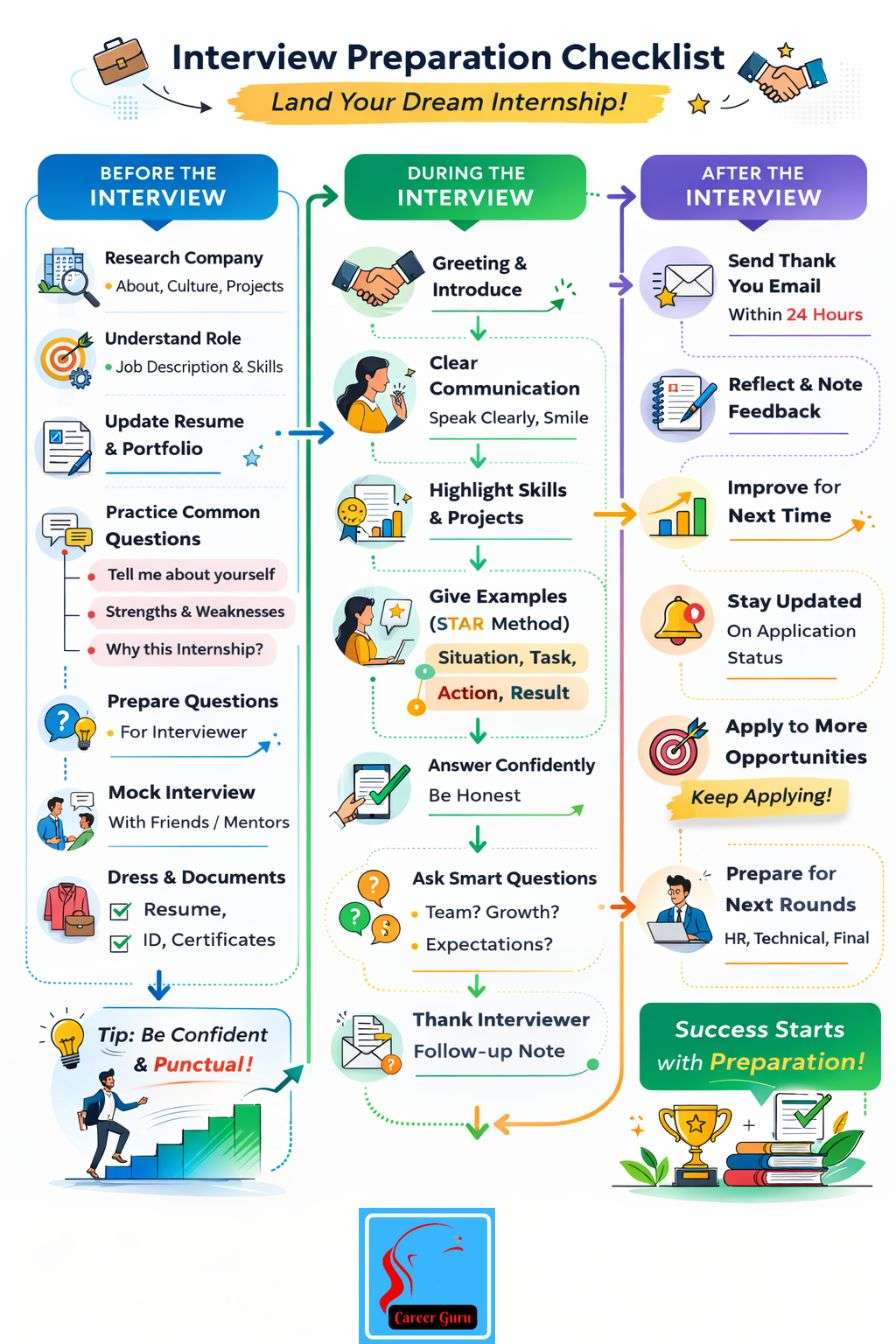
Interview preparation checklist infographic – before, during, and after interview tips.
Making the Most of Your Summer Internship
You got the internship! Now let’s make sure you excel and convert it to full-time offer if possible.
Week 1: Setting the Right Foundation
Day 1-2: Absorb Everything
- Meet everyone on the team
- Understand company culture
- Learn tools/systems
- Ask about expectations
- DON’T: Pretend you know things you don’t
Day 3-5: Start Contributing
- Pick up the first task (even if small)
- Ask questions (better to clarify than assume)
- Document what you learn
- Goal: Show eagerness and reliability
End of Week 1:
- Know your project scope
- Understand success metrics
- Have a list of deliverables
Weeks 2-8: Adding Value
Do this daily:
- Update progress (brief email/message)
- Ask for feedback regularly
- Help teammates when possible
- Attend meetings actively
Weekly goals:
- Complete assigned tasks on time
- Show incremental progress
- Ask for additional responsibilities
- Network with other teams
Mid-internship evaluation: Most companies have this. Ask:
- “How am I performing?”
- “What should I improve?”
- “Am I meeting expectations?”
- DON’T: Wait for them to tell you problems
Week 9-10: Finishing Strong
Deliverables:
- Complete all assigned work
- Document your code/work thoroughly
- Create a handover document
- Present final project (if applicable)
Networking:
- Connect with everyone on LinkedIn
- Thank people individually
- Ask for recommendations
- Especially: Build relationship with your manager (your reference!)
Converting Internship to Full-Time Offer
Statistics: 40-60% of interns who want PPO get it.
What increases your chances:
✅ Exceeding expectations (deliver more than asked)
✅ Being proactive (suggest improvements, take initiative)
✅ Cultural fit (get along with team, match company values)
✅ Asking directly (Week 8: “What’s the process for PPO consideration?”)
✅ Staying in touch (after internship, update on final year, show continued interest)
What kills PPO chances:
❌ Missing deadlines
❌ Lack of communication
❌ Showing disinterest
❌ Poor code quality/work output
❌ Not taking feedback well
If you DON’T get PPO:
- Ask for detailed feedback
- Request to stay connected
- Get a strong recommendation letter
- Use experience for campus placements
Even without PPO, a good internship is a valuable resume boost.
Common Summer Internship Mistakes to Avoid
Let me save you from pitfalls I’ve seen repeatedly.
Mistake #1: Applying Too Late
Reality: Best companies fill intern spots by February-March.
Solution: Start looking in December-January, apply by February
Mistake #2: Not Customising Applications
Copying the same resume/cover letter to 100 companies → 0 responses
Solution: Spend 10-15 mins customising each application (change skills section, mention the company specifically)
Mistake #3: Ignoring People around you.
Don’t just focus on your tasks and go home. Talk to your colleagues, attend team meetings with curiosity, and genuinely connect with your mentor or manager. The network you build during an internship can open more doors than the internship certificate itself.
Mistake #4: Not Following Up After Applying
You applied. Great. Now what? Most students just wait and hope for the best. A simple follow-up email a week later shows initiative and keeps you on the recruiter’s radar. It doesn’t have to be fancy — just a short, polite message checking in on your application status.
Mistake #5: Being Too Shy to Ask Questions at Work
This is one of the biggest ones. A lot of interns sit quietly, pretend they understand everything, and then mess up the task completely. Nobody expects you to know it all — you’re an intern. Ask questions early, ask for clarity, and ask for feedback. That’s literally what the internship is for.
Mistake #6: Treating It Like It Doesn’t Really Matter
Some students think “it’s just an internship” and show up late, miss deadlines, or put in minimal effort. But the people around you are watching. A good impression can turn into a full-time offer, a strong LinkedIn recommendation, or a referral down the line. Treat it like a real job — because in many ways, it is.
Mistake #7: Not Keeping Track of What You’re Learning
Weeks go by fast. If you don’t note down what you’re doing, what tools you used, and what results you achieved, you’ll forget it all by the time you’re updating your resume. Maintain a simple daily or weekly log — it helps during interviews when you’re asked “what did you do in your internship?
Mistake #8: Waiting to Be Told What to Do All the Time
Good interns don’t just complete assigned tasks — they look for ways to contribute beyond that. If you finish early, ask if there’s anything else you can help with. Show that you’re genuinely interested in the work. Initiative is one of the things that separates a memorable intern from a forgettable one.
Mistake #9: Focusing Only on the Stipend
It’s okay to care about money, but if you’re choosing internships purely based on how much they pay, you might end up in a role where you learn absolutely nothing. Prioritise learning, mentorship, and exposure — especially early in your college years. The experience will pay off more in the long run.
Mistake #10: Not Asking for a Letter of Recommendation or LinkedIn Endorsement
You worked hard for weeks. Don’t leave without asking your manager for a recommendation letter or a LinkedIn endorsement. Most managers are happy to do it — they just won’t offer unless you ask. This small step can seriously strengthen your profile for future opportunities.
Frequently Asked Questions (FAQs)
Q 1:- When should I start applying for summer internships in India 2026?
You should ideally start applying between January and March 2026. Top companies and startups open their internship applications early, and popular platforms like Internshala and LinkedIn get flooded with applicants closer to summer. The earlier you apply, the better your chances of landing a good opportunity. Students targeting big corporates like TCS, Infosys, or Deloitte should keep an eye on their official career portals from December 2025 onwards.
2. Are summer internships in India paid or unpaid?
It depends on the company and industry. Most reputed companies, MNCs, and funded startups offer a monthly stipend ranging from ₹5,000 to ₹30,000 or more, depending on your profile and role. Government internships and NGO placements may be unpaid or offer a small allowance. Always check the internship details before applying, and don’t hesitate to ask about compensation during the interview process.
3. Can first-year college students apply for summer internships?
Yes, absolutely! Many companies and startups welcome first-year students, especially for roles in content writing, social media, graphic design, data entry, and basic coding. While some internships require specific technical skills, there are plenty of beginner-friendly opportunities available on platforms like Internshala, Unstop, and LinkedIn. First-year students can use this experience to build their resume early and gain a competitive edge.
4. How long do summer internships in India typically last?
Most summer internships in India last between 4 to 8 weeks, usually running from May to July. However, some companies offer extended internships of 3 to 6 months, especially in the IT and finance sectors. The duration is usually mentioned in the internship listing, so make sure it aligns with your college schedule and availability before applying.
5. What documents do I need to apply for a summer internship in India?
Most internship applications require an updated resume or CV, a cover letter or statement of purpose, your college ID or enrollment certificate, and sometimes academic transcripts or marksheets. For government internships, you may also need a No Objection Certificate (NOC) from your college. It’s a good idea to keep all these documents ready in PDF format before you start applying to save time.
Key Takeaways
- Start your internship hunt early — ideally by December 2025 or January 2026 — to get ahead of the competition.
- Paid internships are common in the corporate and tech sectors, while NGO and government roles may offer little to no stipend.
- First-year students should not wait — there are beginner-friendly internships available across multiple domains.
- Most summer internships last 4 to 8 weeks, so plan your schedule around your college calendar.
- Always keep your documents ready in advance — resume, cover letter, college ID, and transcripts — to apply quickly when opportunities open up.
- Use platforms like Internshala, LinkedIn, Unstop, and Naukri to discover and apply for internships that match your skills and interests.