
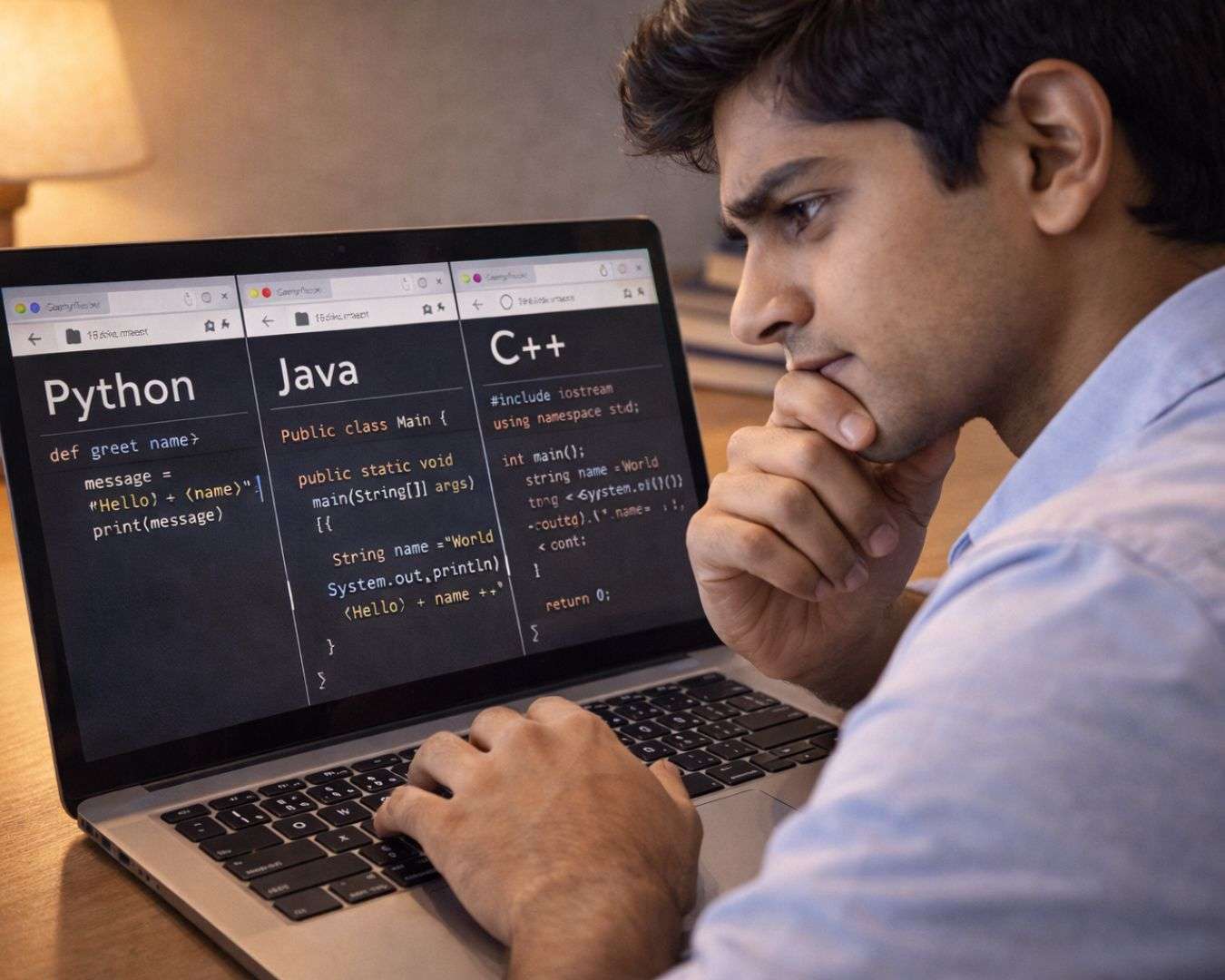
Python vs Java vs C++ for Indian Students — Which Should Learn First for a Job in 2026
Python vs Java vs C++ — which should Indian students learn first for a job in 2026? A 27-year IT career consultant gives you the honest answer no one else will.
Python vs Java vs C++ — The Question Every Indian CS Student Is Asking in 2026
Python vs Java vs C++ for Indian students 2026 is the debate I get pulled into more than almost any other career question right now. And I completely understand why. You are sitting in your first or second year of engineering. Three languages are being thrown at you simultaneously — sometimes by the same college that cannot decide which one to focus on either. Your seniors are giving you conflicting advice. Every YouTube video tells you something different. Every LinkedIn post has a different opinion.
So let me do something that most people giving advice on this topic do not do. Let me give you a straight answer based on 27 years of watching what actually happens to students in the Indian job market — not based on which language is theoretically superior or which one has the most GitHub repositories.
Because here is the truth nobody says clearly enough. The best language to learn first is the one that gets you your first job or your first internship the fastest. That is it. That is the only criterion that matters right now. Everything else is noise.
Let me break down all three languages honestly and then give you my clear recommendation at the end.
First — Why This Decision Feels So Confusing

Indian student confused about Python Java C++ choice for first programming language 2026
The confusion is not your fault. It is the system’s fault.
Most Indian engineering colleges teach C++ in the first year because it has been in the syllabus for decades. Then they introduce Java in the second year because enterprise companies used to demand it. Then Python sneaks in through data science electives or add-on courses because the market shifted. By the time you are in your third year you have touched all three and genuinely mastered none of them.
That spread-thin approach is one of the biggest reasons Indian students struggle in technical interviews. They know a little of everything and a lot of nothing. And interviewers at good companies — whether it is a product startup or a service giant like TCS — can spot that in about five minutes.
The solution is not to learn all three simultaneously. The solution is to pick one, go deep, build real things with it, and then layer the others on top later. But which one do you pick first? Let me walk you through each one honestly.
Python — The Language That Opens the Most Doors the Fastest in India 2026
Let me be direct. If you are a student in India in 2026 and you have not started with Python yet — start today.
Python is not just a language anymore. It is the entry point to almost every high-growth field in technology right now. Data science, machine learning, artificial intelligence, automation, web development, cybersecurity scripting — all of them either use Python as their primary language or have Python as a core tool in their workflow.
Here is what that means practically for your job search. When you open Internshala, LinkedIn, or Naukri and search for internships and entry-level roles for freshers in India — Python appears in more job descriptions than any other programming language. By a significant margin.
What Python is genuinely good for: Data analysis and data science roles are almost entirely Python-driven in India right now. If you want to work with data — and an enormous number of well-paying roles in India involve data in some form — Python is non-negotiable.
Machine learning and AI roles use Python as their primary working language. Web development with Django and Flask gives you a path into backend development. Automation and scripting roles at IT companies use Python constantly. Even cybersecurity professionals use Python to write basic scripts and tools.
What Python is not ideal for: Python is not the best choice if you specifically want to build Android apps. It is not the language you use for systems programming or embedded systems. It is slower than C++ for performance-critical applications. And in traditional service-based IT companies that have been running Java-based enterprise systems for twenty years — Python is still not always the primary language internally, even if they ask for it in new roles.
How hard is Python to learn? This is where Python has a genuine advantage over both Java and C++ for beginners. The syntax is clean and readable. It reads almost like English. A student with no programming background can write a working Python script in their first week. That low barrier to entry means you start building real things faster — and building real things is how you actually learn.
What the Indian job market says about Python in 2026:
Entry-level data analyst roles — Python is almost always listed.
Machine learning internships — Python is mandatory.
Automation testing roles — Python is increasingly preferred over older tools.
Backend development at startups — Python with Django or Flask is very common.
Government and PSU roles — Python is growing but slower here.
🔗 Related Read: Best Free Online Courses for IT Students in India 2026
Java — The Language That Still Runs Half of Corporate India

Java programming for Indian IT jobs 2026 — corporate developer at work
Do not let anyone tell you Java is dead. It is not. It is not even close to dead. Java is the language that runs the backend of a significant portion of India’s banking, insurance, e-commerce, and enterprise software systems.
TCS, Infosys, Wipro, HCL — companies that collectively employ hundreds of thousands of Indian developers — still have enormous Java codebases that need to be maintained, updated, and expanded.
What has changed is not Java’s relevance. What has changed is the type of role Java leads to.
Java is not the entry point into the exciting new-age startup world or the AI and data science space. It is the entry point into large-scale enterprise software development. Banking applications. Payment gateways. ERP systems. Insurance platforms.
These are not glamorous in the way that machine learning projects are glamorous. But they are stable, well-paying, and in consistently high demand across India.
What Java is genuinely good for: Android app development still runs primarily on Java and Kotlin — and Kotlin is built to work alongside Java, so Java knowledge helps. Enterprise software development at large IT companies. Backend development for large-scale applications that need to handle massive concurrent users.
Spring Boot — one of the most widely used frameworks in Indian IT — is Java-based and knowing it well opens a lot of doors at mid to large companies.
What Java is not ideal for: Quick scripting and automation. Data science and machine learning. Small startup environments that move fast and prefer lighter frameworks. Java has significantly more boilerplate code than Python which means more writing for the same output — something that slows down beginners and frustrates people who want to see results quickly.
How hard is Java to learn? Harder than Python for a beginner. Java is strongly typed, more verbose, and requires a clearer understanding of object-oriented programming concepts before you can write anything meaningful. The learning curve is steeper.
But once you get through that curve the discipline it instils — around structure, typing, and object-oriented thinking — makes you a better programmer overall.
What the Indian job market says about Java in 2026: Mass campus hiring at TCS, Infosys, and Wipro — Java is still one of the primary languages tested. Android development roles — Java and Kotlin together. Banking and fintech backend roles — Java with Spring Boot is extremely common.
Large enterprise projects — Java remains dominant. Startup roles — less common but not absent.
C++ — The Language That Makes You a Better Programmer But Is the Hardest Starting Point
Here is my honest take on C++ after 27 years of watching students struggle with it and succeed with it.
C++ is a powerful, fast, and deeply educational language. Learning C++ properly — really properly — will make you understand how computers work at a level that Python and Java simply do not force you to confront.
Memory management, pointers, data structures at the hardware level — C++ teaches you things that make you a fundamentally better programmer regardless of what language you eventually work in.
The problem is the word “properly.” Most students in India do not learn C++ properly. They learn just enough to pass their first year exams and then move on. That shallow C++ knowledge gives them all the pain of a difficult language with none of the benefits of having genuinely mastered it.
What C++ is genuinely good for: Competitive programming — if you want to do well in coding contests like Codeforces, CodeChef, or LeetCode, C++ is the most popular language among top competitive programmers because of its speed.
Core engineering roles in embedded systems, robotics, and hardware-adjacent software. Game development at a serious level. FAANG-level software engineering interviews where performance-critical coding is tested. ISRO, DRDO, and defence research internships.
What C++ is not ideal for: Web development. Data science. Most startup roles. Most campus placement roles at service companies. The vast majority of entry-level IT jobs in India in 2026 do not require C++.
How hard is C++ to learn? The hardest of the three. Memory management alone trips up thousands of students every year. The syntax is unforgiving. Debugging is painful for beginners. If you are learning to program for the first time, starting with C++ is like learning to drive in a Formula One car. The skills transfer but the starting experience is unnecessarily brutal.
What the Indian job market says about C++ in 2026: Competitive programming preparation — C++ is the first choice. Core CS and systems programming roles — C++ is required. Game development studios in India — C++ is used heavily. Embedded systems and IoT roles — C++ and C are standard. General IT service company roles — C++ is rarely the primary requirement anymore.
Python vs Java vs C++ — The Direct Comparison

Python vs Java vs C++ comparison for Indian students 2026
Let me put this as simply as possible.
Choose Python first if you want to get into data science, AI, machine learning, automation, or startup tech roles. If you want to get your first internship as quickly as possible. If you are a complete beginner and want to start building real things fast. If you are not sure exactly which direction you want to go, and want the widest range of options.
Choose Java first if you specifically want to work at large IT service companies like TCS, Infosys, or Wipro for your first job. If you want to build Android apps. If you are interested in enterprise software and large-scale backend systems. If your college placement cell has strong ties to companies that specifically test Java.
Choose C++ first if you are passionate about competitive programming and want to build a strong foundation in computer science fundamentals. If you want to target core engineering or systems programming roles. If you are aiming for research internships at ISRO or DRDO. If you are already comfortable with basic programming and want the discipline that C++ forces on you.
My Honest Recommendation After 27 Years
I want to be completely straight with you here. No hedging.
If you are a first or second year student in India in 2026 with no clear specialisation yet — start with Python.
Here is why. Python gives you the fastest path from zero to something working. It opens the most doors in the current Indian job market. It is the entry point to the highest growth fields — AI, data science, and automation. It is beginner-friendly enough that you will actually enjoy learning it instead of suffering through it. And it will not close any doors to you later. Learning Python first does not prevent you from learning Java or C++ afterwards. In fact it makes those languages easier to pick up because you will already understand programming concepts clearly.
Start with Python. Build two or three real projects. Get comfortable enough to talk about your code in an interview. Then add Java if your target companies require it. And if you want to do competitive programming or systems work — layer C++ on top of that foundation.
That sequence — Python first, then Java, then C++ — is the one I recommend to the majority of students I counsel. And the students who follow it consistently have better internship outcomes and better placement results than those who try to learn all three simultaneously or who start with C++ simply because their college told them to.
Quick Practical Tips Before You Start
Pick one resource and finish it. The biggest mistake students make is starting three different Python courses simultaneously and finishing none of them. Pick one — whether it is NPTEL, Coursera’s Python for Everybody, or any other credible resource — and complete it entirely before moving on.
Build something after every topic. Do not just watch tutorials and feel like you are learning. Every time you finish a new concept, build a tiny project using it. It does not have to be impressive. It just has to be real.
Put your code on GitHub from day one. Create a GitHub profile the day you write your first program. Push every project there no matter how small. By the time you apply for internships you will have a visible history of work that most of your competition will not have.
Join an active community. Whether it is a Python Discord server, a Reddit community, or a local college coding club, being around other people learning the same thing keeps you accountable and moving forward.
🔗 Related Read: Best Platforms to Find Summer Internships in India 2026 🔗 Related Read: Cybersecurity Internships in India 2026 — Everything a Student Needs to Know
Internal Links — Read These Next
- 📌 Summer Internship for Students in India 2026 — Complete Guide
- 📌 Best Platforms to Find Summer Internships in India 2026
- 📌 How to Write a Resume for Internship With No Experience in India 2026
- 📌 How to Convert Your Summer Internship Into a Full-Time Job in India
- 📌 Top 10 High Paying Internships in India 2026 for College Students
- 📌 Internship vs Training — What’s the Difference
- 📌 Best Free Online Courses for IT Students in India 2026
- 📌 Cybersecurity Internships in India 2026
- 📌 10 Real Benefits of an Internship for Students in India 2026
- 📌 Which programming language to choose Python, Java , C++ ?
FAQs — Python vs Java vs C++ for Indian Students 2026
1. Is Python enough to get a job in India in 2026?
Yes — for the right roles. Python alone is enough to get an entry-level data analyst role, a machine learning internship, an automation testing position, or a backend developer role at many startups. For large IT service companies like TCS or Infosys, Java knowledge alongside Python strengthens your profile significantly. But Python as your primary language is a completely viable foundation for a strong IT career in India in 2026.
2. Do I need to know all three languages before applying for internships?
Absolutely not. One language known well is far more valuable than three languages known poorly. Interviewers at good companies will ask you to write code, explain your thinking, and solve problems in your chosen language. If you have spread yourself across three languages without going deep in any of them you will struggle in those moments. Go deep in one first.
3. Which language do TCS, Infosys and Wipro test in campus placements?
All three companies have their own assessment platforms. TCS National Qualifier Test and Infosys InfyTQ both allow you to choose your language for coding rounds — which means Python, Java, and C++ are all acceptable. The aptitude and logical reasoning sections are language-independent. Focus on your coding fundamentals and problem-solving ability in whichever language you are strongest in rather than trying to switch languages just for placement preparation.
4. Is C++ still relevant for Indian students in 2026?
Yes but in specific contexts. Competitive programming, systems programming, embedded systems, game development, and core engineering roles still use C++ extensively. For the majority of IT service roles, startup roles, and data-related roles in India however, C++ is not a primary requirement. It is a valuable skill to have but not the best starting point for most students.
5. How long does it take to learn Python well enough to apply for internships?
With consistent daily practice of one to two hours, most students can build enough Python proficiency to apply for beginner-friendly internships in three to four months. That means being comfortable with data types, loops, functions, basic object-oriented concepts, and one small project you can talk about confidently in an interview. You do not need to know everything. You need to know enough to contribute and learn on the job.
Key Takeaways
- The best programming language to learn first is the one that gets you your first internship or job the fastest — everything else is secondary.
- For most Indian students in 2026, Python is the strongest first choice — it opens the most doors, is the easiest to start with, and is in the highest demand across the fastest-growing fields.
- Java remains highly relevant for large IT service companies and enterprise software roles — if TCS, Infosys, or Wipro are your target companies, Java knowledge is important.
- C++ is the hardest starting point but the most educationally valuable — best suited for competitive programming, systems programming, and core engineering roles rather than general IT careers.
- One language mastered deeply is always more valuable than three languages known superficially — go deep before you go broad.
- The recommended sequence for most students is Python first, then Java, then C++ — each one builds on and complements the previous.
- Put your code on GitHub from day one, build real projects after every topic, and join a community that keeps you accountable and moving forward.
Now that you know which language to start with, make sure you know where to apply once your skills are ready. Read our guide on Best Platforms to Find Summer Internships in India 2026 and start building toward your first real opportunity today.