
How to Write a Cover Letter for Internship in India 2026 — With Real Examples
Learn how to write a cover letter for internship in India 2026 with real examples. Honest advice from a 27-year IT career consultant that actually helps you get noticed.
Focus Keyword: How to write a cover letter for internship in India 2026
How to Write a Cover Letter for Internship in India 2026 — And Why Most Students Get This Completely Wrong
How to write a cover letter for internship in India 2026 is something I get asked about almost as often as resume writing — and yet it remains one of the most poorly done parts of any internship application. Here is a number that puts it in perspective. In my experience reviewing student applications over 27 years, nearly 80 percent of cover letters I have seen are either completely generic, blindly copied from a template, or so formal and stiff that they read like a legal document rather than a human being trying to introduce themselves.
And that is exactly the problem. A cover letter is not a legal document. It is not a summary of your resume. It is not a formal declaration of your intentions. It is a conversation starter. It is the first time a recruiter hears your voice before they have even met you. And if that voice sounds like every other applicant who applied that day — you have already lost half the battle.
The good news is this. Because most students write terrible cover letters, writing a genuinely good one puts you ahead of the crowd immediately. You do not need to be a great writer. You do not need fancy vocabulary. You just need to be clear, specific, and human. This blog will show you exactly how to do that.
First — Do You Even Need a Cover Letter for an Internship in India?
This question comes up a lot. And the honest answer is — it depends. But lean towards yes.
Many internship applications on platforms like Internshala have a section for a cover letter or a short message to the employer. Some companies make it mandatory. Others leave it optional.
Here is my advice. If it is optional — write one anyway. Always.
A recruiter who receives two applications with similar resumes will almost always spend more time on the one that includes a thoughtful cover letter. It signals effort. It signals genuine interest. And it gives you one extra opportunity to say something that your resume cannot say on its own.
The only exception is when the application platform has a character limit so short that a proper cover letter is not possible — in that case a two to three line personalised message works just as well.
What a Cover Letter Is — And What It Is Not
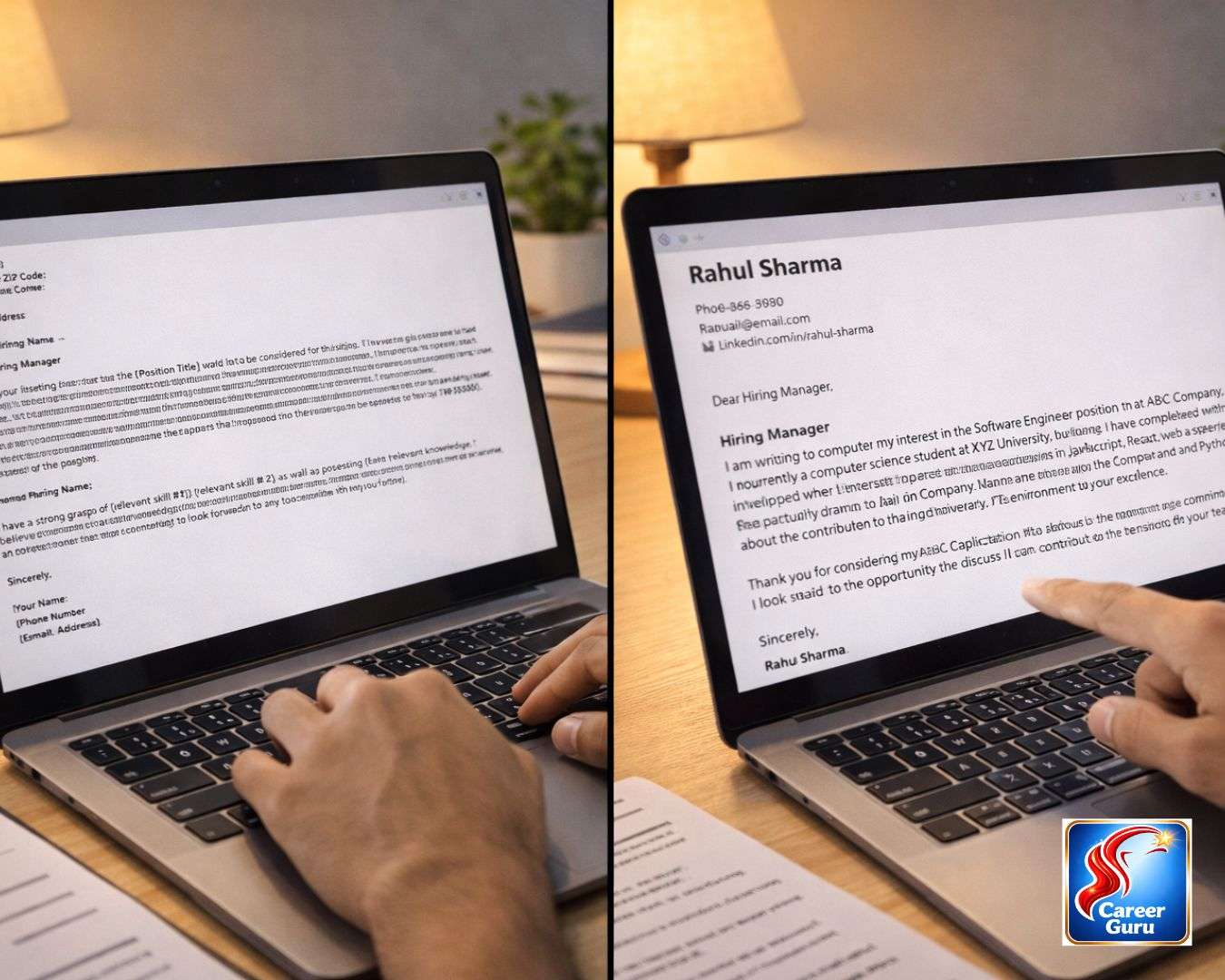
Before we get into how to write one, let me be very clear about what a cover letter is not.
It is not a repeat of your resume. If your cover letter is just your resume written in paragraph form — delete it and start again. The recruiter has already seen your resume. Your cover letter should add something new. It should tell the story behind the resume.
It is not a list of achievements. Lists belong in resumes. A cover letter is prose. It flows like a conversation.
It is not a formal letter to a government department. I have seen cover letters that start with “Respected Sir or Madam, I humbly beg to submit my application for the aforementioned position.” That language belongs in 1995. In 2026 it makes you sound like you copied it from an old textbook — because you probably did.
It is not long. One page maximum. Three to four short paragraphs. That is all. A recruiter reading fifty applications in one afternoon does not have the time or patience for anything longer.
What a cover letter is — is a short, specific, human message that answers three questions. Who are you? Why this company? Why should they give you a chance?
Three questions. Three paragraphs. Done well, that is all you need.
The Structure That Works Every Time
Here is the structure I recommend to every student I mentor. Simple. Clean. Effective.
Paragraph 1 — Who you are and why you are writing. One to two sentences. Tell them your name, your course, your year of study, and which internship you are applying for. Straight to the point. No preamble.
Paragraph 2 — Why this company specifically. This is the most important paragraph and the one most students skip or fake. Tell them something specific about the company that genuinely interests you. Something you found when you researched them. This paragraph is what separates your application from every generic one in the pile.
Paragraph 3 — What you bring to the table Two to three sentences about your most relevant skills, projects, or experiences. Not everything — just the most relevant thing or two that connect directly to what the role needs. This is where your resume and your cover letter work together rather than repeat each other.
Paragraph 4 — The closing One sentence expressing genuine enthusiasm and a polite call to action. Thank them for their time. Say you would welcome the opportunity to discuss further. Keep it confident but not arrogant.
That is the whole structure. Let me now show you exactly what this looks like in practice.
Real Cover Letter Examples — Weak vs Strong
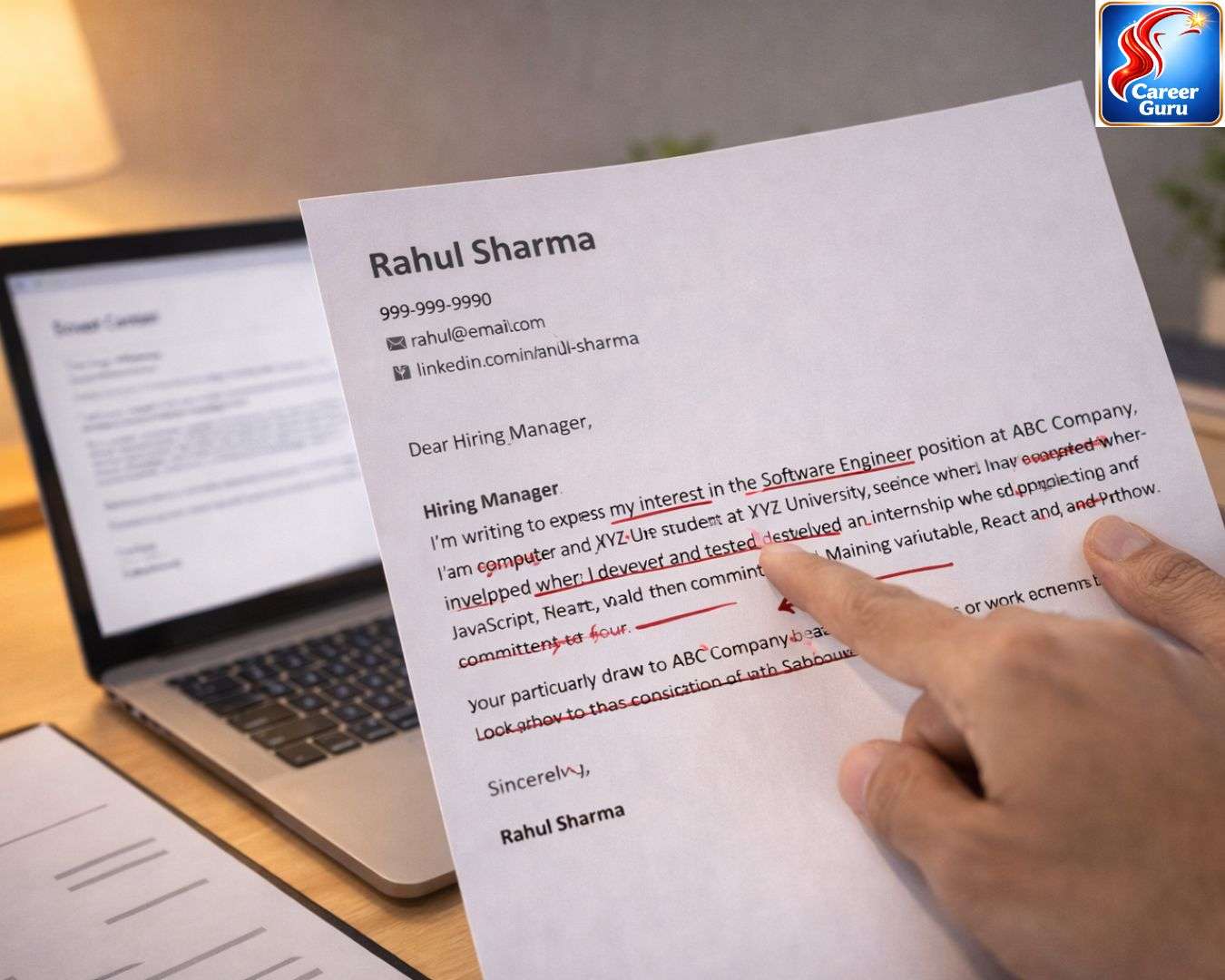
Cover letter with corrections for internship application India 2026
Example 1 — Software Development Internship
Weak Version:
Dear Sir/Madam,
I am writing to apply for the internship position at your esteemed organisation. I am a B.Tech student in Computer Science with a keen interest in software development. I am hardworking, dedicated and eager to learn. I believe this internship will help me grow professionally and contribute to your organisation. I look forward to hearing from you.
Yours faithfully, Rahul Sharma
What is wrong with this? Everything. It has no company name. No specific role. No real skills mentioned. No projects. No reason why this company. It could have been written for any company in any industry in any year. The recruiter reads this and feels nothing — because there is nothing to feel.
Strong Version:
Hi,
I am Rahul Sharma, a third-year B.Tech student in Computer Science at XYZ College, Bhubaneswar. I am applying for the Software Development Intern position listed on your careers page.
I came across your company while researching startups working on supply chain technology in India. The problem you are solving — making real-time inventory tracking accessible to small businesses — is exactly the kind of challenge I want to work on. I have spent the last year building projects around database management and web development and your work sits right at the intersection of what I have been learning.
My most recent project was a warehouse management system built using Python and MySQL that handled inventory records for a simulated business of 500 products. I also completed Google’s IT Support Certificate last year and an NPTEL course in database systems. I am comfortable with Python, SQL and basic REST API concepts.
I would genuinely welcome the chance to contribute to your team this summer and learn from people working on a problem this relevant. Thank you for taking the time to read this.
Rahul Sharma [Phone] | [Email] | [LinkedIn]
Same student. Completely different application. The second version tells a specific story, shows research, connects skills to the company’s actual work, and sounds like a real human being wrote it. That is the version that gets a callback.
Example 2 — Digital Marketing Internship
Weak Version:
Respected Sir/Madam,
I am a BBA student seeking an internship in digital marketing. I have good communication skills and am proficient in Microsoft Office. I am a fast learner and can adapt to any environment. Please consider my application.
Thanking you, Priya Nair
Again — no specifics. No company research. “Proficient in Microsoft Office” is not a digital marketing skill. “Fast learner” and “good communication skills” are phrases that appear on approximately ninety percent of all applications. This cover letter adds nothing to a resume and subtracts credibility.
Strong Version:
Hi,
I am Priya Nair, a second-year BBA student at ABC College, Pune. I am writing to apply for the Digital Marketing Intern position I found on Internshala.
I have been following your brand on Instagram for the past few months and noticed how consistently your content drives engagement — especially your short video series on sustainable living. That kind of content strategy that connects product values to audience identity is something I have been actively studying and trying to replicate in my own work.
Over the past year I have managed the Instagram page for my college’s cultural committee — growing it from 400 to 2,200 followers in eight months through a mix of reels, carousel posts and consistent posting schedules. I completed Google’s Digital Marketing Fundamentals certificate last semester and I am currently learning SEO basics through an online course. I am comfortable with Canva, basic Meta Ads, and content calendar planning.
I would love the opportunity to bring that energy and those skills to your team this summer. Thank you for considering my application.
Priya Nair [Phone] | [Email] | [LinkedIn]
The difference is night and day. Priya’s strong version shows she actually follows the brand. She mentions specific content she noticed. She has real numbers from real work. She sounds genuinely enthusiastic rather than formally desperate. That cover letter gets read twice.
Example 3 — Finance Internship
Weak Version:
To Whom It May Concern,
I am interested in the finance internship at your company. I have studied financial accounting and am good with numbers. I am seeking an opportunity to apply my knowledge in a real world setting.
Regards, Arjun Mehta
Strong Version:
Hi,
I am Arjun Mehta, a third-year B.Com student at PQR College, Mumbai. I am applying for the Finance and Accounts Intern position advertised on LinkedIn.
Your company caught my attention specifically because of your work with MSME lending — a space I find genuinely important given how many small businesses in India struggle to access affordable credit. I wrote a research paper last semester on working capital challenges faced by small manufacturers in Maharashtra and it gave me a real appreciation for how financial analysis can directly impact business decisions at ground level.
I have a strong foundation in financial accounting, Tally ERP, and basic Excel-based financial modelling. I completed an NPTEL course on financial management last year and scored in the top fifteen percent of participants. I am comfortable reading balance sheets, building basic P and L statements, and working with data in Excel.
I am eager to bring that academic foundation into a real working environment and I believe your team would give me exactly the kind of hands-on exposure I am looking for. Thank you for your time.
Arjun Mehta [Phone] | [Email] | [LinkedIn]
Three examples. Three different fields. But the same principle running through all the strong versions — specific, human, researched, and connected to the company’s actual work. That formula works every time regardless of your domain.
The One Line That Most Students Miss

Student writing internship cover letter at college library India 2026
There is one line that separates a good cover letter from a great one. It is the line where you show you actually know something about the company.
Not “your company has a good reputation.” Not “your organisation is a leader in its field.” Those lines mean nothing and every recruiter has read them ten thousand times.
I mean something specific. Something you found when you actually spent fifteen minutes on their website or their LinkedIn page.
“I noticed your team recently launched a product for tier two city logistics.” “I read your founder’s post about building a remote-first culture from day one.” “Your recent campaign around financial literacy for rural women caught my attention.”
One line like that — one line that proves you looked — changes the entire tone of your application. It tells the recruiter this person actually wants to work here. Not just anywhere.
That line takes fifteen minutes of research to find. Most students cannot be bothered. Which is exactly why the ones who do it stand out so immediately.
Common Cover Letter Mistakes to Avoid
Starting with “I am writing to apply.” Everyone starts with this. It is the most predictable opening in every application pile. Start with something slightly more direct instead. “I am [Name], a [year] [course] student at [college], and I am applying for [role].” Clean. Immediate. Specific.
Using words like “esteemed,” “humbly,” and “aforementioned.” This language is outdated and makes your cover letter sound like it was written in 1998. Write the way an educated, professional young person would speak in 2026. Natural, respectful, and direct.
Copying a template word-for-word. Recruiters have seen every template on the internet. If your cover letter sounds like a template, it will be treated like one — skimmed in three seconds and moved past. Even if you start from a template, rewrite every sentence in your own words.
Making it too long. Three to four paragraphs. One page maximum. If you are going beyond that you are either repeating your resume or padding with things that do not need to be there. Cut it down. Tight writing is always stronger than long writing.
Focusing only on what you want to gain. “I want to learn,” “I want to gain experience,” “I want to develop my skills.” These phrases put all the focus on what you want from the company. Flip the perspective. Show what you bring. Show what you can contribute. That shift in tone makes an immediate difference.
Not proofreading. A spelling mistake or a grammatical error in a cover letter tells the recruiter you do not care enough to read your own work before sending it. Read it once yourself. Then read it out loud. Then ask someone else to read it. Three reads minimum before it goes anywhere.
A Simple Checklist Before You Send
Before you hit submit on any internship application with a cover letter — run through this list.
✅ Does it mention the specific company name and role?
✅ Does it have one specific detail that shows you researched the company?
✅ Is it three to four paragraphs and no longer than one page?
✅ Does it sound like a human being wrote it — not a template?
✅ Does it mention your most relevant skill or project?
✅ Have you proofread it at least three times?
✅ Does the closing include your name, phone number, email, and LinkedIn?
✅ Is the tone confident but not arrogant?
If all eight are yes — send it. If any are no — fix it first.
Internal Links — Read These Next
- 📌 Summer Internship for Students in India 2026 — Complete Guide
- 📌 Best Platforms to Find Summer Internships in India 2026
- 📌 How to Write a Resume for Internship With No Experience in India 2026
- 📌 How to Convert Your Summer Internship Into a Full-Time Job in India
- 📌 Top 10 High Paying Internships in India 2026 for College Students
- 📌 Internship vs Training — What’s the Difference
- 📌 Best Free Online Courses for IT Students in India 2026
- 📌 Cybersecurity Internships in India 2026
- 📌 10 Real Benefits of an Internship for Students in India 2026
- 📌 How to Prepare for an Internship Interview in India 2026
- 📌📌How to write your FIRST COVER LETTER
FAQs — How to Write a Cover Letter for Internship in India 2026
1. How long should a cover letter be for an internship application in India?
Three to four short paragraphs is the ideal length. It should fit comfortably on one page — or even less. Recruiters reading dozens of applications in a day appreciate brevity. If you cannot say what you need to say in four paragraphs, you are either including things that do not need to be there or repeating what is already in your resume. Cut it down and keep only what genuinely adds value.
2. Should I address the cover letter to a specific person?
Yes, whenever possible. If the job listing includes a contact name — use it. “Hi Neha” or “Dear Mr Sharma” is always better than “To Whom It May Concern.” If no name is mentioned, check the company’s LinkedIn page for the HR manager or recruiter’s name. If you genuinely cannot find a name, “Hi” or “Dear Hiring Manager” is perfectly acceptable. What to avoid completely is “Respected Sir or Madam” — it sounds outdated and impersonal.
3. Is a cover letter necessary if the internship application says it is optional?
In almost all cases — yes, write one anyway. Optional does not mean unwanted. It means the company will not reject your application for not including one. But including a thoughtful, specific cover letter when others haven’t bothered to is exactly the kind of small advantage that can tip a decision in your favour. The effort it takes is thirty minutes. The potential upside is a callback that might not have come otherwise.
4. Can I use the same cover letter for multiple internship applications?
You can use the same structure and the same general paragraphs about your skills and background. But the company-specific paragraph — the one that shows you researched them — must be different for every application. That paragraph is what makes a cover letter work. If it is the same for every company, it is no longer doing its job. Fifteen minutes of research and five minutes of rewriting per application is a reasonable investment for each opportunity you care about.
5. What if I have no projects or experience to mention in my cover letter?
Focus on what you do have. Your relevant coursework. A certification you completed. A skill you have been building. Something you have observed or read about in the industry that genuinely interests you. A strong cover letter from a student with no experience is always better than a weak one — because the cover letter itself becomes evidence of your communication skills, your research ability, and your genuine interest. Those are real qualities. Lead with them honestly.
Key Takeaways
- A cover letter is a conversation starter — not a resume summary, not a formal declaration, and not a template copied from the internet. It is your voice before the recruiter has met you.
- The single most important thing your cover letter must do is show that you specifically want this company — not just any company. One line of genuine research does more than three paragraphs of generic enthusiasm.
- The structure that works every time is four paragraphs — who you are, why this company, what you bring, and a confident close. Simple, clear, and human.
- Weak cover letters are full of phrases like “hardworking,” “quick learner,” “esteemed organisation,” and “humbly submit.” Strong cover letters are full of specifics — real projects, real numbers, real reasons.
- Always proofread at least three times. A spelling mistake in a cover letter tells the recruiter you did not care enough to check your own work.
- Write one even when it is optional. The students who do it when others don’t are always the ones who get noticed first.
- Keep it to one page. Tight, specific writing is always stronger than long, padded writing. If it takes more than four paragraphs — you are saying too much.
Cover letter ready? Make sure your resume is just as strong. Read our complete guide on How to Write a Resume for Internship With No Experience in India 2026 and make sure both documents are working together to tell your best story.