
Fresher Salary in India 2026 — How Much Can You Really Expect From Your First IT Job
Wondering about fresher salary in India 2026? Get real salary figures, honest expectations and expert advice from a 27-year IT career consultant before you sign that offer letter.
Fresher Salary in India 2026 — The Number Everyone Wants to Know and Nobody Talks About Honestly
Fresher salary in India 2026 is the most emotionally charged career topic I deal with every single year. And I completely understand why. You have spent four years in college. Your family has invested money, time, and hope into your education. And now you are about to step into the job market wondering whether all of that was worth it — and what number is going to appear on your first offer letter.
I want to talk about this honestly. Not with the kind of vague optimism that career blogs usually offer. Not with the doom and gloom that social media sometimes pushes either. Just straight facts from someone who has been watching this market for 27 years and has seen thousands of students navigate their first salary negotiation, their first offer letter, and their first realisation that the number on paper and the number in your bank account are sometimes very different things.
Here is the truth. Fresher salaries in India’s IT sector in 2026 range from ₹2.5 LPA at the lower end to ₹25 LPA and above at the very top end. That is a massive range. And where you land on that spectrum has almost nothing to do with luck and almost everything to do with three things — which company you join, what skills you bring, and how well you prepared for the selection process.
Let me break all of this down for you clearly.
Why Fresher Salaries in India 2026 Vary So Dramatically
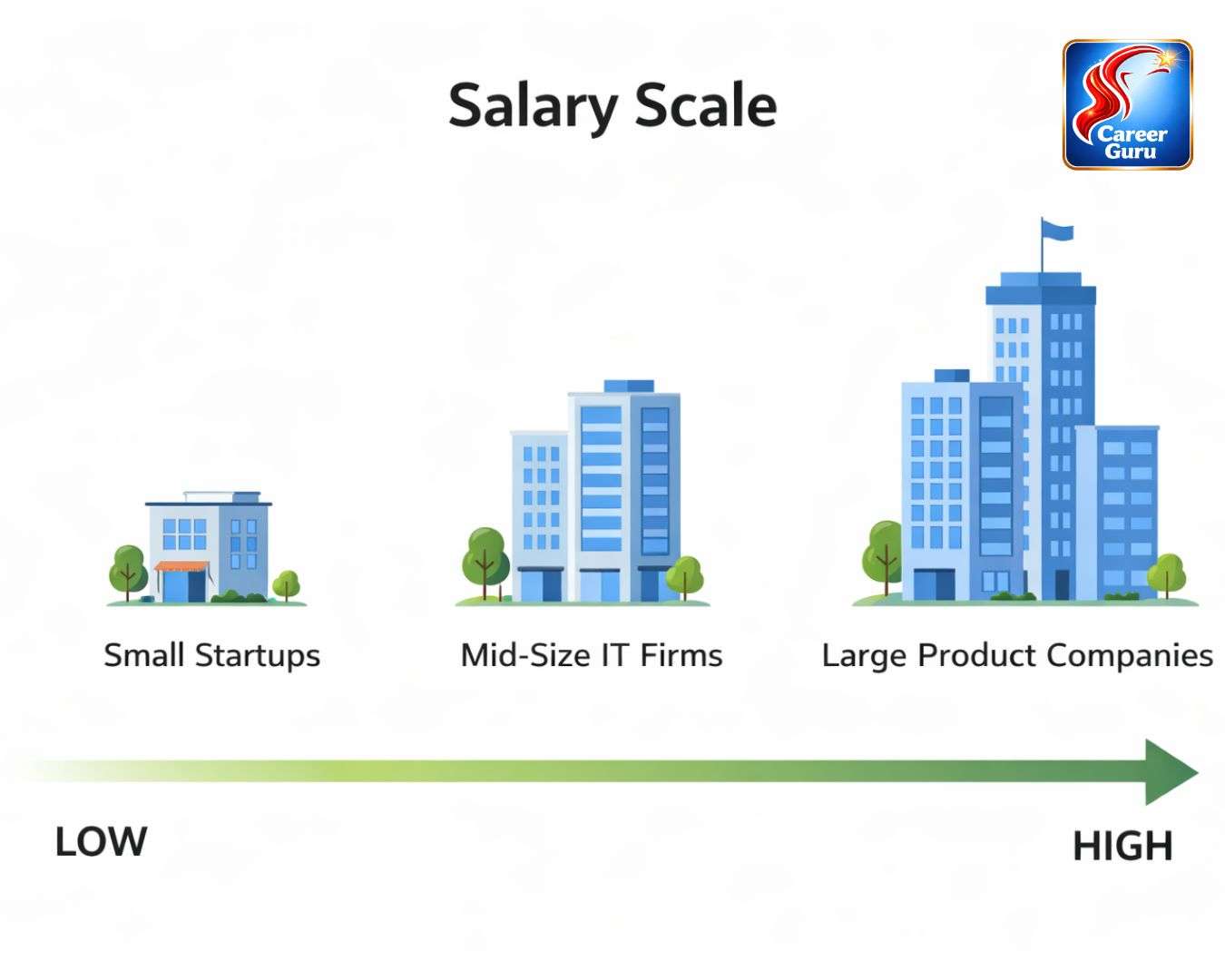
Fresher salary range in India 2026 — from service companies to product companies
Before we get into specific numbers, you need to understand why two engineering graduates from the same college, with similar grades, can receive offer letters that differ by ₹10 LPA or more. This is not random. It follows a very clear pattern.
Type of company matters most. IT companies in India fall into roughly three categories when it comes to fresher compensation. Service companies — the TCS, Infosys, Wipro tier — pay in the ₹3 to ₹5 LPA range for most freshers. Mid-size and product-oriented Indian companies — Zoho, Freshworks, Mphasis — pay in the ₹5 to ₹12 LPA range. Global product companies and unicorn startups — Amazon, Google, Microsoft, Razorpay, Zepto — pay anywhere from ₹12 LPA to ₹25 LPA and beyond.
The role within the company matters. Even within the same company, different fresher profiles attract very different salaries. TCS Ninja and TCS Digital are both entry-level TCS roles but the salary difference between them is nearly ₹4 LPA. Infosys Systems Engineer and Infosys Digital Specialist Engineer are both fresher roles but one pays more than twice the other. The higher-paying profile almost always requires better performance in the company’s own assessment.
Your skills and preparation determine which door opens. This is the part students have the most control over. A fresher who has strong data structures knowledge, has solved 150 problems on LeetCode, and can write clean code in Python has access to a different set of opportunities than one who cannot. Both might have the same CGPA. Only one gets the higher offer.
Fresher Salary in India 2026 — Company by Company Reality Check
Let me give you the actual numbers. Not ranges from three years ago. The current picture as I understand it from working in this space and tracking the market closely.
Large IT Service Companies
TCS TCS Ninja — ₹3.36 LPA TCS Digital — ₹7 LPA TCS Prime — ₹9 to ₹11 LPA for specialist roles
Infosys Systems Engineer — ₹3.6 LPA Digital Specialist Engineer — ₹9.5 LPA
Wipro Project Engineer — ₹3.5 LPA Turbo Program — ₹6.5 LPA
HCL Technologies Graduate Engineer Trainee — ₹3.5 to ₹4 LPA
Tech Mahindra Associate Software Engineer — ₹3.25 to ₹3.75 LPA
Cognizant Programmer Analyst Trainee — ₹4 LPA GenC Elevate — ₹6.5 LPA GenC Next — ₹9 LPA
Capgemini Analyst — ₹4.5 to ₹5 LPA
Accenture Application Development Associate — ₹4.5 LPA
Mid-Size and Indian Product Companies
Zoho Software Developer — ₹5 to ₹8 LPA
Freshworks Software Engineer — ₹10 to ₹14 LPA
Mphasis Software Engineer — ₹4 to ₹6 LPA
NIIT Technologies Software Engineer — ₹3.5 to ₹5 LPA
Persistent Systems Software Engineer — ₹5 to ₹7 LPA
Global Product Companies and High-Growth Startups
Amazon India SDE1 — ₹18 to ₹25 LPA
Microsoft India SDE — ₹20 to ₹30 LPA
Google India SDE — ₹25 to ₹40 LPA
Razorpay SDE — ₹15 to ₹20 LPA
Zepto SDE — ₹15 to ₹22 LPA
Swiggy SDE — ₹14 to ₹20 LPA
These numbers are approximate and vary based on role, location, and individual negotiation. But they give you a realistic picture of what the market actually looks like in 2026.
The CTC vs In-Hand Salary Reality — This Is the Conversation Nobody Has With You Before You Sign

Understanding CTC vs in-hand salary for freshers in India 2026
This is perhaps the most important section of this entire blog. And it is the one most students wish someone had explained to them before they signed their first offer letter.
CTC stands for Cost to Company. It is the total amount the company spends on you in a year — including your salary, your health insurance, your provident fund contribution, your variable pay, and sometimes even things like your training costs. It sounds great on paper. But it is not what lands in your bank account every month.
Let me show you what this looks like in practice.
A fresher offered a CTC of ₹4 LPA at a large IT service company might take home approximately ₹25,000 to ₹28,000 per month after deductions. Here is where that gap comes from.
Provident Fund deduction — Both you and the company contribute to your PF account. Your contribution comes out of your monthly salary. This is good for your long-term savings but reduces your immediate take-home.
Professional Tax — A small monthly deduction that varies by state. Typically between ₹150 and ₹200 per month. Small but part of the picture.
Income Tax — Depending on your salary slab and tax regime choice, you may have TDS deducted from your salary monthly. At ₹4 LPA most freshers fall below the taxable threshold but this changes as salary increases.
Variable Pay — Many companies include a variable or performance-linked component in the CTC. This is money you only receive if you meet certain performance targets — which as a fresher in your first year you may or may not fully achieve. Do not count on variable pay being paid in full when calculating your monthly budget.
One-time components — Some companies include joining bonuses, relocation allowances, or annual bonuses in the CTC. These are real money but they are not monthly income.
The practical rule I give every student. Take the CTC offered, subtract 25 to 30 percent, and divide by 12. That gives you a realistic estimate of your monthly in-hand salary. Plan your life around that number — not the annual CTC figure that looks impressive in WhatsApp forward messages.
Fresher Salary in India 2026 — What Different Cities Actually Mean for Your Money
A salary of ₹4 LPA means something very different depending on where you are working. This is something students from smaller cities often underestimate when they get excited about moving to Bengaluru, Mumbai, or Gurgaon for their first job.
Bengaluru India’s IT capital. Most IT companies have a presence here. A monthly in-hand salary of ₹25,000 to ₹28,000 in Bengaluru will cover a shared accommodation, basic food, transport, and not much else. Rent alone for a decent PG or shared flat in areas near IT parks can run ₹8,000 to ₹15,000 per month.
Hyderabad Slightly more affordable than Bengaluru. Strong IT presence and growing fast. A fresher salary stretches further here than in Mumbai or Bengaluru. A good city to start your career financially.
Pune Similar cost of living to Hyderabad. Strong IT ecosystem. Good quality of life for freshers on entry-level salaries. A comfortable city to start in.
Chennai Reasonable cost of living. Strong IT and manufacturing sector. Public transport is better than most IT cities which helps manage monthly costs.
Mumbai The most expensive city on this list. A ₹4 LPA salary in Mumbai is genuinely difficult to live on comfortably without family support or a very frugal lifestyle. Target higher-paying roles if Mumbai is your goal.
Bhubaneswar and Tier Two Cities Growing IT hubs with significantly lower cost of living. Companies like Infosys, TCS, and Wipro have delivery centres here. A ₹3.5 LPA salary in Bhubaneswar goes much further than the same salary in Bengaluru. For freshers who want to build savings early in their career — starting in a tier two city is a financially smarter decision than many students realise.
What Actually Moves Your Fresher Salary Higher in 2026

Skills that increase fresher salary in India 2026 — certified professional at work
This is the section I want every student to read carefully. Because the difference between a ₹3.5 LPA offer and a ₹9 LPA offer for the same fresher — same college, same CGPA — comes down to specific, learnable things.
Assessment performance at the company level. As I described in the TCS and Infosys sections above — every major IT company has a higher-paying track for freshers who perform better in their own assessment. TCS Digital pays nearly double TCS Ninja. InfyTQ’s higher track pays more than double the standard Infosys package. Preparing specifically and seriously for these assessments is the single highest-return investment of a fresher’s time.
Coding ability above the average bar. Freshers who can write clean, working code — who have solved real problems on platforms like LeetCode and HackerRank — consistently access higher-paying opportunities. This is true at service companies and dramatically more true at product companies and startups. Every hour spent on genuine coding practice is an hour invested in your salary.
Relevant certifications. A foundational cloud certification — AWS Cloud Practitioner, Google Cloud Digital Leader, or Microsoft Azure Fundamentals — is increasingly mentioned in fresher job descriptions at companies like Capgemini, HCL, and Accenture. It does not guarantee a higher salary but it signals current awareness that differentiates your application.
Communication skills. I know this sounds soft. It is not. Companies that pay freshers above ₹6 LPA almost universally cite communication ability as a deciding factor in their selection process. Being able to express yourself clearly in English — in writing and in conversation — opens doors that technical skills alone cannot.
A real project portfolio. Students who can walk into an interview and demonstrate two or three real projects they have built — not college assignments, but actual things they built out of genuine interest — are treated differently by interviewers. It shows initiative. It shows that you learn beyond the syllabus. And it gives the interviewer something concrete to evaluate you on beyond aptitude test scores.
🔗 Related Read: How to Write a Resume for Internship With No Experience in India 2026
🔗 Related Read: Python vs Java vs C++ — Which Should Indian Students Learn First for a Job in 2026
Should You Negotiate Your First Salary as a Fresher in India 2026
This question comes up a lot. And the honest answer is — it depends on the company.
At large IT service companies like TCS, Infosys, and Wipro, the fresher salary is almost always fixed. There is very little room to negotiate because thousands of people are hired at the same level under the same structure. Trying to negotiate here often just delays your joining rather than getting you more money.
At mid-size companies, startups, and product companies the situation is different. Here there is more flexibility. If you have received a competing offer from another company, mentioning it professionally and respectfully is a legitimate way to open a salary conversation. Companies that genuinely want you will sometimes match or improve an offer rather than lose a candidate they have already selected.
A few rules I always give students on negotiation.
Never negotiate before you have a written offer in hand. Verbal offers are not the time for salary conversations.
Always be respectful and specific. “I have received an offer from another company for ₹X — I would love to join here and wanted to check if there is any flexibility” is a professional way to open the conversation. Demands and ultimatums are not.
Know your walk-away number before you enter any negotiation. What is the minimum you will accept. Having that number clear in your mind keeps you from making an emotional decision in the moment.
And finally — do not negotiate over a difference of ₹10,000 to ₹20,000 per year at your first job. The learning, the culture, the team, and the career trajectory matter far more in the long run than a small salary difference at the starting line.
The Salary You Want in Three Years — How to Think About This Now

Fresher salary growth in India IT sector 2026 — performance review meeting
Your first salary is not your forever salary. This is something I tell every student who feels disappointed by their initial offer.
In India’s IT sector, salary growth in the first three to five years of a career can be dramatic — especially for those who keep learning and who perform well. Here is a realistic picture of what that trajectory looks like.
A fresher who joins at ₹3.5 LPA and performs consistently well, picks up relevant certifications, and demonstrates clear value to their team can realistically expect to be earning ₹6 to ₹8 LPA by year three. Those who switch companies strategically — which is common and accepted in Indian IT — often see salary jumps of 30 to 50 percent with each move.
The freshers who stagnate at low salaries for years are almost always those who stop learning after they join. They do the minimum required. They do not pick up new skills. They do not build anything beyond what their job description requires. Their salary reflects that.
The freshers who grow fast are the ones who treat their first job as the beginning of their education — not the end of it. They continue taking courses. They continue building things. They take on responsibilities beyond their role. And their salary growth reflects that too.
Your first offer letter is not a verdict on your potential. It is a starting point.
🔗 Related Read: How to Convert Your Summer Internship Into a Full-Time Job in India 🔗 Related Read: Top 10 IT Companies in India Hiring Freshers in 2026
Internal Links — Read These Next
- 📌 Summer Internship for Students in India 2026 — Complete Guide
- 📌 Best Platforms to Find Summer Internships in India 2026
- 📌 How to Write a Resume for Internship With No Experience in India 2026
- 📌 How to Convert Your Summer Internship Into a Full-Time Job in India
- 📌 Top 10 High Paying Internships in India 2026
- 📌 Best Free Online Courses for IT Students in India 2026
- 📌 How to Prepare for an Internship Interview in India 2026
- 📌 TCS NQT 2026 — Complete Guide for Freshers
- 📌 Top 10 IT Companies in India Hiring Freshers in 2026
FAQs — Fresher Salary in India 2026
Q 1:- What is the average fresher salary in India’s IT sector in 2026?
The average fresher salary across large IT service companies in India in 2026 sits between ₹3.25 and ₹4.5 LPA for standard entry-level roles. Mid-size and product-oriented companies pay between ₹5 and ₹12 LPA. Global product companies and funded startups pay ₹15 LPA and above for strong candidates. The average across all these categories combined is approximately ₹4 to ₹5 LPA for a well-prepared fresher with a relevant engineering degree.
Q 2:- 2. Is ₹3.5 LPA a good salary for a fresher in India in 2026?
It depends on where you are working and what you are comparing it to. In a tier two city like Bhubaneswar, Coimbatore, or Indore — ₹3.5 LPA is a comfortable starting salary. In Bengaluru or Mumbai it is tight. It is not a salary to be embarrassed by — it is a starting point. The more important question is what you do with the first two years to grow beyond it.
3. Do IT companies in India offer salary hikes to freshers in their first year?
Most large IT service companies have a structured appraisal cycle — typically annual — where freshers receive their first salary review after twelve months. The average increment at service companies for a good performer in the first year is between 8 and 15 percent. Product companies and startups can offer higher increments for exceptional performers. Switching companies after two years of experience is one of the fastest ways to see a significant salary jump.
4. What is the highest salary a fresher can realistically get in India in 2026?
At global product companies like Google, Microsoft, and Amazon — freshers with exceptional coding skills and strong interview preparation can receive offers between ₹20 and ₹40 LPA. These are not typical and require significantly more preparation than standard placement preparation. For most freshers the realistic top end through rigorous preparation and strong performance is ₹9 to ₹15 LPA at companies like Cognizant GenC Next, Freshworks, or well-funded startups.
5. Should I join a lower-paying company for better learning or a higher-paying one for better money?
This is one of the most common dilemmas freshers face. My honest advice after 27 years is this — in your first job, learning and mentorship matter more than salary if the salary difference is small. A ₹1 to ₹2 LPA difference is worth tolerating for a genuinely better learning environment in the early years. But a significant salary difference — ₹4 LPA or more — at companies that both offer good learning is worth taking seriously. Never chase money at the complete cost of learning in your first two years. But also do not romanticise the idea of learning so much that you accept compensation that genuinely makes your daily life difficult.
Key Takeaways
- Fresher salaries in India’s IT sector in 2026 range from ₹2.5 LPA to ₹25 LPA and above — where you land depends on which company you target, which profile you qualify for, and how well you prepare.
- CTC and in-hand salary are very different things. Always calculate your monthly take-home — not your annual CTC — before making any financial plans around a job offer.
- The cost of living in your city matters as much as the number on your offer letter. ₹3.5 LPA in Bhubaneswar and ₹3.5 LPA in Mumbai are completely different financial realities.
- The single highest-return action a fresher can take to improve their starting salary is to prepare seriously for the higher-paying assessment tracks at companies like TCS, Infosys, and Cognizant — the salary difference between standard and premium fresher profiles at these companies is significant.
- Coding skills, cloud certifications, communication ability, and a real project portfolio consistently separate higher-paid freshers from their peers — these are all learnable with the right preparation.
- Your first salary is a starting point not a verdict. In India’s IT sector, consistent learners who stay curious and keep building skills see dramatic salary growth in their first three to five years.
- Salary negotiation is possible at mid-size companies and startups — but only after a written offer is in hand, always done respectfully, and never over small differences that are not worth the relationship cost.
- TOP 10 HIGHEST PAYING JOBS IN INDIA 2026
Now that you know what to expect — make sure you are targeting the right companies. Read our complete guide on Top 10 IT Companies in India Hiring Freshers in 2026 and start building your application strategy today.