
Career Counselling After 12th in India: Your Complete Stream-Wise Roadmap to Success
Need career counselling after 12th in India? You’re making a ₹50 lakh decision right now.
That’s not an exaggeration. The career path you choose today will determine your earnings for the next 40 years. Choose engineering when you should’ve chosen design? That’s ₹20 lakhs in wasted education fees plus decades in the wrong field. Pick CA because “it’s safe” when you’re actually creative? That’s a lifetime of unfulfilled potential.
I’ve been doing this for 25 years—counselling students just like you, sitting exactly where you are right now. I’ve guided over 2,000 families through this exact crossroads. And I’ve seen it all: brilliant artists forced into engineering who struggle for years, natural entrepreneurs pushed into medicine who eventually quit, creative minds boxed into accounting who never find joy in their work.
But I’ve also seen the flip side. Students who took the time to understand themselves, got proper career counselling after 12th, and chose paths that matched their aptitude and interests. Today, they wake up excited about their work. They excel because they’re doing what they’re naturally good at. They earn well because they’re passionate and skilled.
The difference between these two groups? One decision made at 17.
Here’s the uncomfortable truth: Every year, 1.5 crore students appear for 12th board exams in India. Of these, 60% make career choices based on what their parents want, what their friends are doing, or which stream “sounds prestigious”—not what actually fits their unique combination of talents, interests, and goals.
This guide is going to change that for you.
We’re going to walk through every major career path available after 12th—Science, Commerce, and Arts. Not with vague descriptions, but with real numbers: actual course costs, realistic salary expectations, honest pros and cons, and brutally honest assessments of who each career truly suits.
By the end, you’ll know exactly what career counselling after 12th in India can do for you, and more importantly, you’ll have a clear roadmap for your next steps.
Let’s begin.
Why Professional Career Counselling After 12th Can Save You Years of Regret
Let me start with a story.
Last year, Priya came to me. Smart girl, 85% in 12th boards, engineering student at a decent college. Problem? She was in her third year and absolutely miserable. “Everyone in my class was doing engineering,” she told me. “My parents said it’s the safest option. I never even considered anything else.”
Turns out, Priya’s psychometric test showed strong artistic and social traits—she was a natural designer and communicator. Engineering, with its heavy focus on math and isolated problem-solving, was the worst possible fit. She’s now completing her B.Tech (can’t waste three years and ₹6 lakhs), but planning to pivot to UX design immediately after. That’s three years she’ll never get back.
Then there’s Rahul. Parents wanted him to be a doctor—family tradition, you know. He cleared NEET, joined MBBS at a private college. Six years and ₹60 lakhs later, he realized he couldn’t handle the emotional toll of patient care. He’s now in marketing. Successful, actually. But those six years and ₹60 lakhs? Gone.
These aren’t exceptions. They’re common. And they’re preventable.
The Stakes Are Higher Than You Think
Let me break down what’s actually at risk:
Financial Investment:
- Engineering (private): ₹8-15 lakhs
- MBBS (private): ₹50 lakhs to ₹1 crore
- Even “affordable” options like B.Com: ₹1-3 lakhs
Time Investment:
- Bachelor’s degree: 3-4 years
- Professional courses: Add 3-5 years (CA, MBBS specialization)
- Total: Often 6-8 years of your life
Opportunity Cost:
- Wrong choice at 18 = Career switch at 25
- That’s 7 years behind peers in right field
- Compounding loss of experience, networking, growth
Emotional Cost:
- Daily frustration doing work you hate
- Constant “what if” thoughts
- Parental conflicts
- Identity crisis in twenties
Add it up: A wrong career choice costs ₹50+ lakhs in direct expenses and lost earnings, plus 5-7 years, plus emotional wellbeing. That’s what’s on the line.
What Happens Without Proper Career Counselling
I see five mistakes repeatedly:
Mistake #1: Following the Herd
“My whole class is doing engineering, so I should too.” This is possibly the worst decision-making framework ever. Your classmates don’t know your strengths. They don’t pay your tuition. They won’t live your life.
Mistake #2: Parental Pressure Compliance
Your parents love you. They want the best for you. But here’s the thing: they chose their careers 25-30 years ago. The job market has transformed completely. What worked for them might be obsolete now. Plus, their unfulfilled dreams aren’t your responsibility to fulfill.
Mistake #3: Chasing Money Over Fit
“CA pays well, so I’ll do CA.” Sounds logical until you realize that high-paying careers require excellence, and excellence requires passion and aptitude. You can’t sustain 5 years of CA preparation if you hate accounts. The 5% who complete CA? They’re the ones who actually love it.
Mistake #4: Not Understanding Course Reality
B.Com is mostly accounting and taxation—if you thought it’s about entrepreneurship, surprise! Law is 70% reading and writing—if you hate reading, you’ll struggle. Engineering is heavily mathematical—if you barely passed 12th math, four years will be torture.
Mistake #5: Ignoring Aptitude Tests
“I’m good at physics, so engineering.” But do you actually enjoy it? Are you spatially intelligent? Can you think in 3D? Do you like building things? Good marks ≠ Right career. That’s like saying “I can run fast, so I should be a marathon runner” while hating running.
What Professional Career Counselling Actually Provides
Real career counselling after 12th in India isn’t someone asking “So, what do you want to do?” and nodding along. That’s a friendly conversation, not counselling.
Professional counselling is scientific. Here’s what you actually get:
1. Psychometric Assessment
- Multiple Intelligence Test (you’re not just “smart” or “average”—you have specific intelligence types)
- Interest profiling (what genuinely fascinates you, not what should)
- Personality assessment (introvert/extrovert is just the start—there are dozens of relevant traits)
- Values clarification (what matters to you: money, impact, creativity, stability?)
- Work style preferences (team vs solo, structured vs flexible, etc.)
2. Data-Driven Analysis Not “I think you’d be good at…” but “Based on your high logical-mathematical intelligence combined with low patience for repetitive tasks, here are careers that statistically work for this profile…”
3. Reality Check “You want to be a wildlife photographer? Great. Let’s talk about what that actually means: months away from family, unpredictable income, physical demands, equipment investment of ₹5+ lakhs. Still interested? Okay, here’s the roadmap.”
4. Financial Planning Complete ROI calculations showing: if you invest ₹X lakhs over Y years, expected starting salary is ₹Z, breakeven time is A years, lifetime earnings are B crores vs alternative path C.
5. Family Mediation When you want design and parents want engineering, a counselor mediates with data. “Here’s what current design professionals earn. Here’s the job market. Here’s how admission works. Here’s a middle ground: Engineering with design minor.”
6. Long-Term Roadmap Not just “do B.Tech” but: Year 1—focus on fundamentals and coding competitions. Year 2—start internship hunting. Year 3—build portfolio. Year 4—campus placements + backup options. Year 5—job vs higher studies decision.
At Career Guru, this is exactly what we do. We’ve refined this process over 25 years and 2,000+ students. And honestly? The ₹5,000-25,000 you invest in proper career counselling can prevent ₹50 lakh mistakes. That’s a 1,000x ROI on just avoiding one wrong choice.
Understanding Yourself First: The Foundation Nobody Teaches
Before we dive into career options, let’s do something most students skip: actually understanding who you are.
I know, I know. You’re thinking “I know myself.” But let me ask:
- What’s your primary intelligence type?
- Are you convergent or divergent thinker?
- What’s your risk tolerance level?
- Do you recharge through social interaction or solitude?
- What frustrates you more: ambiguity or rigidity?
Can’t answer confidently? That’s fine. Most people can’t. That’s why assessment exists.
The Self-Discovery Framework
Interest Mapping (What Do You Actually Enjoy?)
Not what you’re good at. Not what impresses people. What do YOU enjoy?
Think about this:
- When you have free time with no obligations, what do you naturally drift toward?
- Which YouTube videos do you binge without it feeling like work?
- What topics make you lose track of time?
- When do you feel most energized and alive?
Write these down. They’re clues.
Aptitude Assessment (What Are You Naturally Good At?)
I’ve seen students with 95% in physics who hate it. And students with 65% who love it. Marks indicate performance, not aptitude or interest.
Real aptitude shows up as:
- Tasks that feel easier for you than others
- Things people compliment you on naturally
- Skills you picked up quickly without formal training
- Areas where you see patterns others miss
The RIASEC Personality Framework
Based on psychologist John Holland’s research, there are six primary personality types. Most people are a combination of 2-3. Understanding yours helps immensely.
Realistic (The Doers): You like working with your hands, physical activity, building tangible things. You prefer concrete problems over abstract theories.
Careers: Engineering (especially mechanical, civil), Architecture, Agriculture, Aviation, Sports
Investigative (The Thinkers): You love solving problems, researching, analyzing. You enjoy intellectual challenges and understanding how things work.
Careers: Science Research, Medicine, Data Science, Engineering (CSE), Analytics, Psychology
Artistic (The Creators): You value creativity, originality, self-expression. You prefer unstructured environments where you can innovate.
Careers: Design (all types), Arts, Media, Content Creation, Advertising, Music, Writing
Social (The Helpers): You’re drawn to helping others, teaching, counseling. You’re good with people and find fulfillment in service.
Careers: Teaching, Social Work, HR, Counseling, Healthcare (nursing, therapy), NGO work
Enterprising (The Persuaders): You enjoy leading, persuading, taking charge. You’re comfortable with risk and motivated by achievement.
Careers: Business, Sales, Marketing, Entrepreneurship, Law, Politics, Management
Conventional (The Organizers): You like structure, order, clear procedures. You’re detail-oriented and prefer working with data and systems.
Careers: Accounting, Banking, Administration, Finance, Operations, Government services
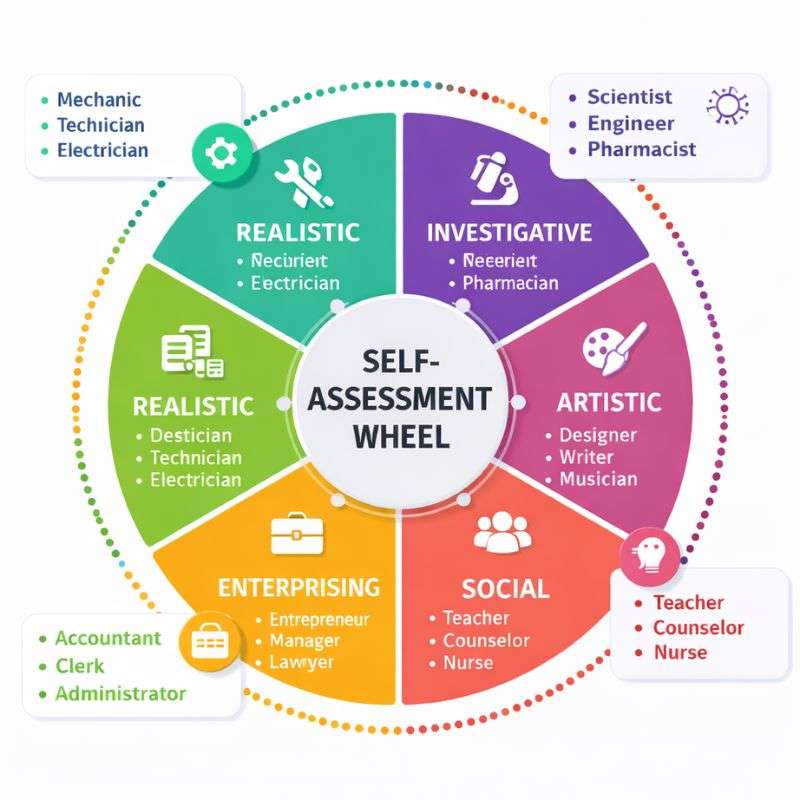
RIASEC wheel infographic showing 6 personality types with icons and matching career clusters.
Here’s the key insight: There are no “better” or “worse” types. A Conventional person will be miserable in an Artistic career, even if it pays more. An Artistic person will suffocate in a Conventional role, even if it’s “prestigious.”
Success = Doing work that matches your type.
The Critical Triangle: Aptitude + Interest + Ability
Let me show you why all three matter:
Scenario 1: Aptitude + Interest, but no Ability (Yet)
- You’re naturally good at music (aptitude)
- You love it (interest)
- But haven’t trained formally (low ability currently)
- Result: Perfect career choice IF you’re willing to build ability through training
Scenario 2: Aptitude + Ability, but no Interest
- You’re good at math (aptitude)
- You’ve developed strong skills (ability)
- But you hate it (no interest)
- Result: Wrong career choice—you’ll burn out even if initially successful
Scenario 3: Interest + Ability, but no Aptitude
- You love dance (interest)
- You’ve practiced for years (ability)
- But honestly, you’re average talent (limited aptitude)
- Result: Great hobby, probably not viable career (unless teaching)
The Sweet Spot: All three aligned = Career goldmine. Even two out of three can work, but missing interest is fatal long-term.
Financial Reality Check (The Conversation Nobody Has)
Let’s talk money. Not just “How much will I earn?” but “How much can my family actually invest in my education?”
Sit with your parents and honestly assess:
Available Education Budget: ₹_________ lakhs
Loan Comfort Level: ₹_________ lakhs (what you’re willing to borrow)
Total Available: ₹_________ lakhs
Now, let’s see what this means:
Budget ₹2-4 lakhs:
- Government engineering colleges
- B.Com/B.Sc/B.A from decent colleges
- CA/CS (mostly self-study based)
- Most vocational courses
Budget ₹5-10 lakhs:
- Private engineering (tier 2)
- Government medical (MBBS)
- Top B.Com/BBA colleges
- Design schools (some)
- 5-year law programs (some)
Budget ₹10-20 lakhs:
- Top private engineering (BITS, VIT, Manipal)
- Design schools (NIFT, NID)
- Top law schools
- Premium management programs
Budget ₹20+ lakhs:
- Private MBBS (in India)
- International education
- Premium private universities
Budget ₹50+ lakhs:
- Private MBBS (top colleges)
- International medicine
Here’s the hard truth: If your budget is ₹5 lakhs and you’re eyeing private MBBS at ₹60 lakhs, something needs to change. Either:
- Target government medical seat through NEET
- Consider alternative healthcare careers
- Take education loan (but understand EMI burden)
- Recalibrate career choice
This isn’t pessimism. It’s planning. Career counselling after 12th in India must include financial reality, not just dreams.
Science Stream Career Options: The Complete, Honest Breakdown
Okay, let’s get into specifics. If you’re reading this, you’ve probably chosen Science in 11th. Smart move—it keeps maximum doors open. But now comes the real question: which door?
Engineering: Beyond the Hype
Let me start with some uncomfortable facts:
- India produces 15 lakh engineers every year
- Only about 20% get core engineering jobs
- Another 50% move into IT/software (regardless of branch)
- 30% end up in unrelated fields, MBA, or UPSC preparation
Still interested? Good. Because if you choose the right specialization and approach it strategically, engineering can be fantastic. If you choose blindly, it’s four years of struggle followed by career confusion.
Computer Science & Engineering (AI/ML Focus)
This is where the money is. Let’s be real.
What it actually involves:
- Coding (a LOT of coding)
- Algorithms and data structures
- Mathematics (discrete math, probability, linear algebra)
- Problem-solving using logic
- Building software systems
Best for:
- People who genuinely enjoy programming (not just “I’m okay with computers”)
- Logical thinkers who like puzzles
- Those comfortable with sitting and thinking for hours
- Self-learners (tech changes fast—you need to keep learning)
Absolutely NOT for:
- People who hate math
- Those who need variety and human interaction daily
- Anyone who forces themselves to code
Top colleges:
- IITs (through JEE Advanced—2.5 lakh students compete for 16,000 seats)
- NITs (through JEE Main)
- IIIT Hyderabad, BITS Pilani, VIT, Manipal
Entrance strategy:
- JEE Main: 12 lakh+ students appear
- JEE Advanced: Only top 2.5 lakh from Main can attempt
- State CETs: Backup option
- Private universities: BITSAT, VITEEE, etc.
Investment:
- IIT/NIT: ₹8-10 lakhs (4 years)
- Top private: ₹12-18 lakhs
- Tier 2 private: ₹6-12 lakhs
Package reality:
- Top IIT/NIT CSE: ₹15-45 LPA (international offers even higher)
- Good colleges: ₹6-12 LPA
- Average colleges: ₹3.5-6 LPA
- Poor colleges: Struggle to get placed
Career options:
- Software developer (most common)
- Data scientist/analyst
- AI/ML engineer
- Cloud architect
- Cybersecurity specialist
- Product manager
- Startup founder
The real picture: First two years are theory-heavy and often boring. Third-fourth years get interesting with projects. Your actual learning happens through internships, online courses, and personal projects—not just college curriculum.
For those serious about tech careers, check our IT training programs that go beyond college theory.
Electronics & Communication Engineering
The honest assessment: This field is shifting. Traditional electronics is shrinking, but emerging tech (IoT, 5G, embedded systems) is growing.
What it involves:
- Circuits and signals
- Communication systems
- Microprocessors and microcontrollers
- Signal processing
Best for:
- Interest in how electronic devices work
- Good with both hardware and software
- Enjoys hands-on lab work
Reality check:
- Core ECE jobs fewer than CSE
- Many ECE graduates also end up in software
- But specialized skills (VLSI, embedded) pay very well
Package: ₹5-15 LPA (varies significantly by specialization)
Mechanical Engineering
The traditional giant, now evolving:
The days of mass mechanical engineering jobs in manufacturing are partially gone. But specialized areas are booming:
- Robotics and automation
- Electric vehicles (massive growth in India)
- Aerospace (ISRO, private space companies)
- Manufacturing 4.0
What it involves:
- Thermodynamics, mechanics, materials science
- CAD/CAM software
- Manufacturing processes
- Machine design
Best for:
- Those who love understanding physical systems
- Interest in how machines work
- Hands-on engineering preference
Package: ₹4-12 LPA (specialization matters hugely)
Career reality: More fieldwork than other branches. Site visits, factory floors. If you want pure desk jobs, this might not be it.
Civil Engineering
Infrastructure boom = Opportunities
India is building: metro in every major city, highways, smart cities, airports. This means civil engineering jobs, but ground reality:
What it involves:
- Structural design
- Construction management
- Environmental engineering
- Transportation systems
Best for:
- Interest in building structures
- Comfortable with site work (sun, rain, travel)
- Patient personality (projects take years)
Package: ₹3.5-10 LPA
Reality: Entry-level means site work. Yes, you’ll get dirty. Yes, you’ll work in heat. But 5-10 years in, you move to planning and management.
Medical & Healthcare: The Road Less Understood
Let’s talk MBBS.
Everyone knows it’s tough to get in (18 lakh+ students for 90,000 seats in NEET). But fewer people understand what comes after.
The MBBS Journey (Brutally Honest Version):
5.5 years of intensity:
- 4.5 years academic
- 1 year compulsory internship
- Enormous syllabus (you’ll study more than any other course)
- Rote memorization + conceptual understanding both needed
The lifestyle reality:
- 36-hour shifts during internship (yes, really)
- Missing family functions, festivals
- Emotionally draining (dealing with suffering, death)
- Extremely high pressure
After MBBS:
- Starting salary (general duty doctor): ₹6-10 LPA
- To specialize (MD/MS): 3 more years + another entrance (NEET PG—even more competitive)
- Post-specialization: ₹20-50+ LPA depending on field
Financial reality:
- Government MBBS: ₹5-10 lakhs total (excellent ROI)
- Deemed universities: ₹25-40 lakhs (manageable)
- Private colleges: ₹50 lakhs to ₹1 crore (ROI questionable unless you’re absolutely sure)
Ask yourself honestly:
- Can I handle seeing blood, injuries, death regularly?
- Am I okay with 80-hour work weeks for years?
- Can I make life-and-death decisions under pressure?
- Is helping people through medicine my calling, not just career?
- Am I prepared for 8.5+ years of intense study?
If you answered yes to all: MBBS might be right.
If you hesitated on any: Consider healthcare alternatives.
Non-Doctor Healthcare Careers (Often Better Choices)
Here’s what most students don’t know: You can have a fulfilling, well-paid healthcare career without MBBS.
Bachelor of Dental Surgery (BDS)
- Duration: 5 years
- Investment: Government ₹4-8 lakhs, Private ₹15-30 lakhs
- Starting salary: ₹4-8 LPA (private practice can reach ₹50L+)
- Lifestyle: MUCH better work-life balance than MBBS
- Best for: Precision-oriented, enjoy working with hands, like patient interaction but want predictable hours
Real talk: Dentistry gets unfairly dismissed as “couldn’t get MBBS.” Reality? Many dentists earn more than MBBS doctors and have better quality of life. Your own clinic at 30 is very achievable.
Nursing (B.Sc Nursing)
- Duration: 4 years
- Investment: ₹2-8 lakhs
- Starting salary India: ₹2.5-5 LPA
- Starting salary abroad: ₹25-40 LPA (US, UK, Australia, Canada desperate for nurses)
The international opportunity: This is huge. Nursing is on skilled worker visa lists globally. Four years of B.Sc Nursing in India, then:
- Clear licensing exam (NCLEX for US, IELTS + CBT for UK)
- Get job offers
- Emigrate with family
- Earn 5-6x Indian salaries
Best for: Patient care focus, okay with shift work, international aspirations
Many of our successful candidates have used this route. Check our abroad services for guidance on international nursing careers.
Pharmacy (B.Pharm)
- Duration: 4 years
- Investment: ₹3-10 lakhs
- Package: ₹3-8 LPA
- Career paths: Pharma companies, hospital pharmacy, drug research, clinical trials, retail chains
Best for: Chemistry lovers, interest in drugs and medicines, research inclination
Emerging healthcare tech careers:
- Medical coding (work for US hospitals remotely, earn in dollars)
- Healthcare IT
- Telemedicine platform roles
- Hospital administration
For more detailed healthcare options, read our complete guide: Career in Healthcare After 12th
Pure Sciences (The Research Path)
B.Sc in Physics/Chemistry/Math/Biology:
Let me be direct: B.Sc alone doesn’t lead to high-paying jobs immediately. But it’s a foundation for:
Path 1: Research & Academia
- B.Sc → M.Sc → Ph.D → Research Scientist/Professor
- 8-10 years total
- Starting as professor: ₹6-10 LPA, grows to ₹15-25 LPA
- Best for: Genuine research passion, love for subject, patient personality
Path 2: Competitive Exams
- B.Sc makes you eligible for UPSC, State PSC, SSC
- Government job security
- Salary: ₹5-15 LPA with benefits
Path 3: Industry Applications
- Quality control in pharma/food/chemical companies
- Forensic science
- Environmental science
- Salary: ₹3-8 LPA
Reality check: If you’re doing B.Sc, plan for M.Sc or professional add-on courses from Day 1. B.Sc + Data Science certifications can land you ₹6-12 LPA analyst roles.

Science stream career flowchart showing pathways from PCM/PCB to various careers with decision points.
Commerce Stream: Breaking Free from “CA or Nothing”
If I had a rupee for every time someone said “I’m in commerce, so CA or B.Com” I’d be rich. Commerce students have 15+ excellent paths. Let’s explore all of them honestly.
Chartered Accountancy: The Prestigious Marathon
The raw truth about CA:
CA is not a course. It’s a test of endurance. It’s possibly the toughest professional qualification in India. If you’re considering it, understand what you’re signing up for:
The Journey:
- Foundation (3 months preparation + exam)
- Intermediate (8-10 months preparation + exam)
- Articleship (3 years practical training—you get paid ₹2,000-5,000/month)
- Final (10-12 months + exam)
Total realistic time: 5-6 years (if you clear in first attempt—most don’t)
Pass rates (this is important):
- Foundation: 30-40%
- Intermediate: 5-10% (90-95% fail each attempt)
- Final: 5-10%
- Only 5% who start CA actually complete it
What it takes:
- 8-12 hours daily self-study
- Extreme self-discipline
- Multiple attempt resilience (most take 2-3 attempts per level)
- Living on pocket money during articleship
- Social life? What’s that?
Investment: ₹1.5-2.5 lakhs (surprisingly affordable)
Post-qualification package: ₹8-25+ LPA (excellent for those who finish)
Best for:
- Obsessive attention to detail
- Love for accounts and taxation
- Self-motivated learners
- Can handle failure and keep going
- Family can support you financially for 5 years
Absolutely NOT for:
- Need regular income urgently
- Can’t handle self-study
- Want work-life balance during study
- Hate accounts/taxation
Can you do CA + B.Com together? Yes, and it’s smart. Gives you a degree backup.
Company Secretary (CS): The Overlooked Alternative
The corporate law specialist:
Path: Foundation → Executive → Professional
Duration: 3-4 years
Investment: ₹1-1.5 lakhs
Package: ₹5-12 LPA
What CS actually does:
- Ensure the company follows laws
- Board meeting management
- Corporate governance
- Mergers & acquisitions support
- Regulatory compliance
Comparison to CA:
| Aspect | CA | CS |
| Difficulty | Extremely hard | Hard |
| Pass rate | 5% overall | 10-15% |
| Scope | Very wide | Focused/niche |
| Salary | Higher average | Moderate |
| Work environment | Varied | Corporate |
Best for: Interest in corporate law + compliance, prefer corporate jobs over practice
B.Com: The Flexible Foundation
B.Com gets dismissed as a “backup option.” Wrong. B.Com is the most flexible commerce degree if you use it strategically.
Types of B.Com:
1. B.Com (Honours): More rigorous, better colleges, focused depth 2. B.Com (Regular): Broader, easier to manage alongside professional courses 3. B.Com with specialisation: Accounting, Banking, Finance, E-commerce
Investment: ₹1-5 lakhs (varies by college)
Direct placement after B.Com: ₹2.5-5 LPA (honestly, not great)
But here’s the strategy:
B.Com is not the destination. It’s the launch pad for:
Option 1: MBA (Most popular, most lucrative)
- 2 years post-B.Com
- Top B-schools (IIMs): ₹20-25 lakhs fees, ₹20-40 LPA packages
- Tier 2 B-schools: ₹8-15 lakhs fees, ₹8-15 LPA packages
Option 2: Specialized Master’s
- M.Com (teaching/research path)
- MSc Finance
- Master’s in specific area
Option 3: Banking exams
- IBPS PO: ₹7-10 LPA
- SBI PO: ₹8-12 LPA
- RBI Grade B: ₹14-18 LPA
Option 4: Professional certifications
- CFA (Chartered Financial Analyst—US-based, globally recognized)
- ACCA (UK-based accounting)
- FRM (Financial Risk Manager)
The smart B.Com student: Joins a decent college, does CA/CS alongside, or prepares for MBA/banking exams, gains internship experience, graduates with degree + marketable skills + clear next step.
The struggling B.Com student: Just attends college, no additional prep, expects placement after degree, disappointed with ₹2.5 LPA offer.
BBA: The Management Entry Point
What is BBA? Three-year management foundation program. Think of it as mini-MBA.
Investment: ₹3-12 lakhs (varies widely)
Direct package: ₹3-6 LPA
Real value: Strong pathway to top MBAs
What you learn:
- Business fundamentals
- Marketing, finance, HR basics
- Management principles
- Entrepreneurship concepts
Best colleges:
- Symbiosis (Pune)
- Christ University (Bangalore)
- NMIMS (Mumbai)
- IP University (Delhi)
Best for:
- Entrepreneurial mindset
- Leadership qualities
- Want business career
- Planning for MBA anyway
Career reality: BBA + 2 years work experience + top MBA = Fast track to corporate leadership
Don’t do BBA if: You’re considering CA/CS (B.Com is better foundation)
New-Age Commerce Careers (The Exciting Ones)
Digital Marketing
- Duration: 3-6 month certifications
- Investment: ₹30,000-1 lakh
- Package: ₹3-8 LPA (freelancing adds more)
- Skills: SEO, SEM, social media, content marketing, analytics
Why it’s hot: Every business needs digital presence. Demand is massive.
Actuarial Science
- What it is: Using math and statistics to assess risk (mainly for insurance)
- Difficulty: Extremely high (like CA level)
- Package: ₹8-20+ LPA
- Best for: Math wizards
FinTech Roles
- What it is: Finance + Technology intersection
- Path: B.Com + tech certifications (Python, blockchain, etc.)
- Package: ₹6-15 LPA
- Growing fast: Payment apps, crypto, digital banking
Financial Planning & Wealth Management
- Certification: CFP (Certified Financial Planner)
- Investment: ₹1-2 lakhs
- Earnings: ₹4-8 LPA salary + commission (can reach ₹15-25L with client base)
For those interested in tech transitions from commerce background: Career Change Guide

Commerce career map showing traditional (CA, CS, B.Com) vs new-age careers (digital marketing, fintech) with salary ranges.
Arts/Humanities Stream: Destroying the “No Future” Myth
Let’s address the elephant in the room.
“Arts has no scope.” “You’ll end up jobless.” “Why did you waste your potential?”
I’ve heard these statements so many times, and honestly, they make me angry. Because they’re categorically, demonstrably false.
Some of the highest earners I know are arts graduates:
- Lawyers charging ₹5 lakhs per case
- Designers with international clients paying in dollars
- Content creators earning ₹10-50 lakhs annually
- Journalists shaping national discourse
- Psychologists with waiting lists of clients
The problem isn’t arts. The problem is lack of awareness about what’s possible.
Law: The Intellectual Power Career
Let me be very clear: Law is prestigious and very lucrative—if you do it right.
Two entry routes:
Route 1: 5-year Integrated Program (Recommended)
- BA LLB / BBA LLB / B.Com LLB
- Direct entry after 12th via CLAT
- Age limit: Usually 20 years or under
Route 2: 3-year LLB
- After any graduation
- For those who discovered law interest later
Entrance Exams:
- CLAT: Common Law Admission Test (for National Law Universities)
- AILET: Only for NLU Delhi
- LSAT India
- Various state-level exams
Top colleges (make or break your career):
- NLSIU Bangalore (dream college, ₹3-4 lakh fees, ₹25 LPA+ packages)
- NALSAR Hyderabad
- NLU Delhi
- Other 20 NLUs (quality varies)
Investment: ₹10-20 lakhs (5-year program)
Package reality:
- Top NLU + Corporate law: ₹15-40 LPA starting
- Good NLU + Corporate law: ₹8-18 LPA
- Average colleges + Corporate: ₹5-10 LPA
- Litigation (starting your practice): ₹2-5 LPA initially, unlimited growth potential
Specializations:
1. Corporate Law (Highest Paying)
- Working for big firms or companies
- M&A, contracts, compliance
- Package: ₹15-50 LPA
- Lifestyle: 60-80 hour weeks, high pressure, excellent money
2. Litigation (Court Practice)
- Criminal law, civil law, constitutional
- Package: Starts low, unlimited ceiling
- Lifestyle: Unpredictable hours, high stakes, can be very lucrative
- Takes 5-7 years to build practice
3. Intellectual Property Rights
- Patents, trademarks, copyrights
- Tech boom = high demand
- Package: ₹8-25 LPA
4. Cyber Law
- Digital crimes, data protection
- Emerging, growing fast
- Package: ₹6-18 LPA
What law actually involves:
- MASSIVE reading (hundreds of pages daily)
- Legal writing (precise, structured)
- Arguments (written and oral)
- Case law research
- Statutory interpretation
Best for:
- Love reading and writing
- Enjoy debates and arguments
- Can think logically and find loopholes
- Comfortable with pressure
- Good memory for details
NOT for:
- Hate reading
- Can’t articulate thoughts clearly
- Want predictable 9-5
- Uncomfortable with confrontation
Work-life balance reality:
- Corporate law: Poor (initially)
- Litigation: Unpredictable
- In-house (company legal team): Moderate
My honest take: If you get into a top NLU (rank under 500 in CLAT) and you like law, it’s an excellent choice. If you’re going to a tier-3 law college, think carefully—legal market is saturated at the bottom.
Mass Communication & Journalism: The Storyteller’s Path
The media landscape has transformed. Let’s talk about reality.
What Mass Comm covers:
1. Journalism (Traditional + Digital)
- News reporting
- Investigative journalism
- Video journalism
- Podcasting
2. Public Relations & Corporate Communication
- Brand management
- Crisis communication
- Media relations
3. Advertising & Creative Communication
- Copywriting
- Campaign planning
- Creative direction
Duration: 3 years (BA/B.Sc)
Investment: ₹3-12 lakhs
Package range: ₹3-8 LPA (varies enormously)
Top colleges:
- IIMC Delhi (Indian Institute of Mass Communication—top tier)
- Symbiosis Pune
- Xavier’s Institute (various)
- Jamia Millia Islamia
Career reality check:
Traditional media (Print, TV):
- Shrinking opportunities
- Lower pays (₹3-6 LPA)
- Job security questionable
- But if you’re passionate, still valuable
Digital media (Online news, platforms):
- Exploding opportunities
- Better pay (₹4-10 LPA)
- Startup culture
- Fast-paced, demanding
Content creation (YouTube, Instagram, etc.):
- No degree needed, actually
- Income: ₹0 to ₹50+ lakhs (extreme variance)
- Takes 2-3 years to monetize typically
- High risk, high reward
Best for:
- Natural curiosity about world
- Good communication skills
- Comfortable on camera
- Quick thinker
- Okay with uncertain income initially
Real earnings trajectory:
- Start: ₹3-5 LPA
- 5 years: ₹6-12 LPA
- 10 years (successful): ₹15-30 LPA
- Freelance/content creation: Can exceed ₹50L+
The big advantage: Portfolio matters more than degree. Start creating content NOW (blog, YouTube, Instagram). By graduation, you’ll have proof of skills + potential income streams.
Design: Where Creativity Meets Commerce
This is where arts students can really shine financially.
Types of Design Careers:
1. Fashion Design
- College: NIFT (National Institute of Fashion Technology)—top tier, tough to get in
- Duration: 4 years
- Investment: ₹8-15 lakhs (NIFT), more for private
- Package: ₹4-12 LPA (own brand can be ₹50L+)
What it involves:
- Sketching and illustration
- Fabric knowledge
- Pattern making
- Collection creation
- Business of fashion
Best for: Strong aesthetic sense, fashion interest, business mindset helps
2. Graphic Design
- Duration: 3-4 years or short courses
- Investment: ₹3-10 lakhs
- Package: ₹3-10 LPA (freelancing adds significantly)
Tools: Adobe Suite (Photoshop, Illustrator, InDesign)
Work options:
- Design agencies
- In-house (companies)
- Freelancing (global clients pay in dollars)
3. UI/UX Design (Hottest right now)
- What it is: Designing digital products (apps, websites)
- Can learn: Bootcamps (6-9 months), online courses
- Investment: ₹1-4 lakhs
- Package: ₹6-20 LPA (tech companies desperate for good designers)
Best for: Understanding user psychology + visual design + tech interest
Why it’s hot: Every app, website, software needs designers. Demand far exceeds supply.
At Career Guru, we’ve started including UI/UX in our IT training programs because the opportunities are massive.
4. Interior Design
- Duration: 3-4 years
- Investment: ₹4-12 lakhs
- Package: ₹3-8 LPA (own practice can reach ₹20L+)
What it involves:
- Space planning
- 3D visualization
- Client management
- Material knowledge
5. Product Design
- What it is: Designing physical products (furniture, gadgets, etc.)
- Top college: NID (National Institute of Design)
- Package: ₹5-15 LPA
6. Animation & VFX
- Booming: OTT content explosion needs animators
- Software: Maya, Blender, After Effects
- Package: ₹3-12 LPA (film industry can pay more)
The design advantage: Portfolio is everything. Your degree matters less than your work. This means:
- Start building portfolio from Day 1
- Take live projects during college
- Freelancing can start even before graduation
- International clients accessible online
Reality check: Initial years (1-3) might be tough financially. But good designers at 5-7 years are making ₹15-25 lakhs easily.
Psychology: The Mind Science
Psychology is booming in India. Mental health awareness is finally growing.
The path:
- BA Psychology (3 years)
- MA Psychology (2 years)
- M.Phil Clinical Psychology (2 years)—required to practice therapy
- Or PhD for research/teaching
Total timeline to practice therapy: 7 years
Investment: ₹3-12 lakhs total
Starting salary: ₹3-6 LPA
Established practice: ₹10-30+ LPA
Specializations:
1. Clinical Psychology
- Treating mental health disorders
- Therapy and counseling
- Hospital settings or private practice
- Demand: Very high, growing
2. Counseling Psychology
- Career counseling (what I do!)
- Relationship counseling
- Student counseling
- Setting: Schools, colleges, private practice
3. Organizational/Industrial Psychology
- HR functions
- Employee well-being
- Talent assessment
- Package: ₹5-12 LPA in corporate
4. Child Psychology
- Working with children
- Schools, clinics, NGOs
- Very fulfilling work
Best for:
- Empathy and patience
- Good listening skills
- Can maintain boundaries (important!)
- Genuinely interested in human behavior
Reality:
- Long education needed (7 years)
- Initial years financially moderate
- Extremely emotionally demanding
- But very fulfilling
- Growing market in India
Income from private practice: ₹1,000-3,000 per session × 15-20 sessions per week = ₹60,000-2,40,000 per month
That’s ₹7-30 lakhs annually from private practice alone, once established.
Liberal Arts: The Renaissance Education
The new trend: Multidisciplinary learning
What is Liberal Arts? Unlike traditional degrees (B.A. English or B.A. History), liberal arts lets you study multiple subjects across disciplines.
Example combinations:
- Economics + Psychology + Data Science
- Literature + Business + Media Studies
- Philosophy + Technology + Design Thinking
Top colleges:
- Ashoka University (Sonepat)
- Flame University (Pune)
- Krea University (Andhra Pradesh)
- Christ University (Bangalore)
Investment: ₹15-25 lakhs (expensive!)
Package: ₹5-12 LPA
Why it’s valuable:
- Develops critical thinking
- Broad knowledge base
- Adaptability
- Problem-solving across domains
Best for:
- Can’t choose one subject
- Intellectually curious
- Want to think, not just learn job skills
- Can afford it (important consideration)
Career paths:
- Consulting firms love liberal arts grads
- Policy research and think tanks
- Startups and entrepreneurship
- Social sector
- Further specialization (MBA, etc.)
Real talk: Liberal arts is excellent education but expensive. If finances are tight, consider public universities with similar multidisciplinary options.
Content Creation & Digital Media (The New Career)
This deserves special mention because it’s not taught in colleges but employs millions.
Platforms:
- YouTube
- Blogging
- Podcasting
How people actually make money:
Income Stream 1: Ad Revenue
- YouTube Partner Program
- Blog ads
- Requires traffic/views
Income Stream 2: Brand Collaborations
- Companies pay for promotion
- ₹10,000 to ₹10 lakhs per collaboration (based on following)
Income Stream 3: Affiliate Marketing
- Earn commission on sales
- Passive income potential
Income Stream 4: Courses/Coaching
- Create and sell courses
- ₹5,000-50,000 per course × students
Income Stream 5: Consulting
- Use content to attract clients
- ₹10,000-1 lakh per project
Realistic timeline:
Year 1: Learning, building, ₹0-20,000/month
Year 2: Growing audience, ₹20,000-80,000/month
Year 3+: Established, ₹1-10+ lakh/month (top creators make crores)
Skills needed:
- Content creation
- Video editing/writing
- Marketing
- Consistency (most important)
- Thick skin (public criticism)
Best for:
- Camera comfortable OR excellent writer
- Niche expertise or unique personality
- Entrepreneurial mindset
- Don’t need immediate stability
My advice: Do it alongside traditional education, not instead of. Build your channel during college. If it takes off, great. If not, you have a degree as backup.
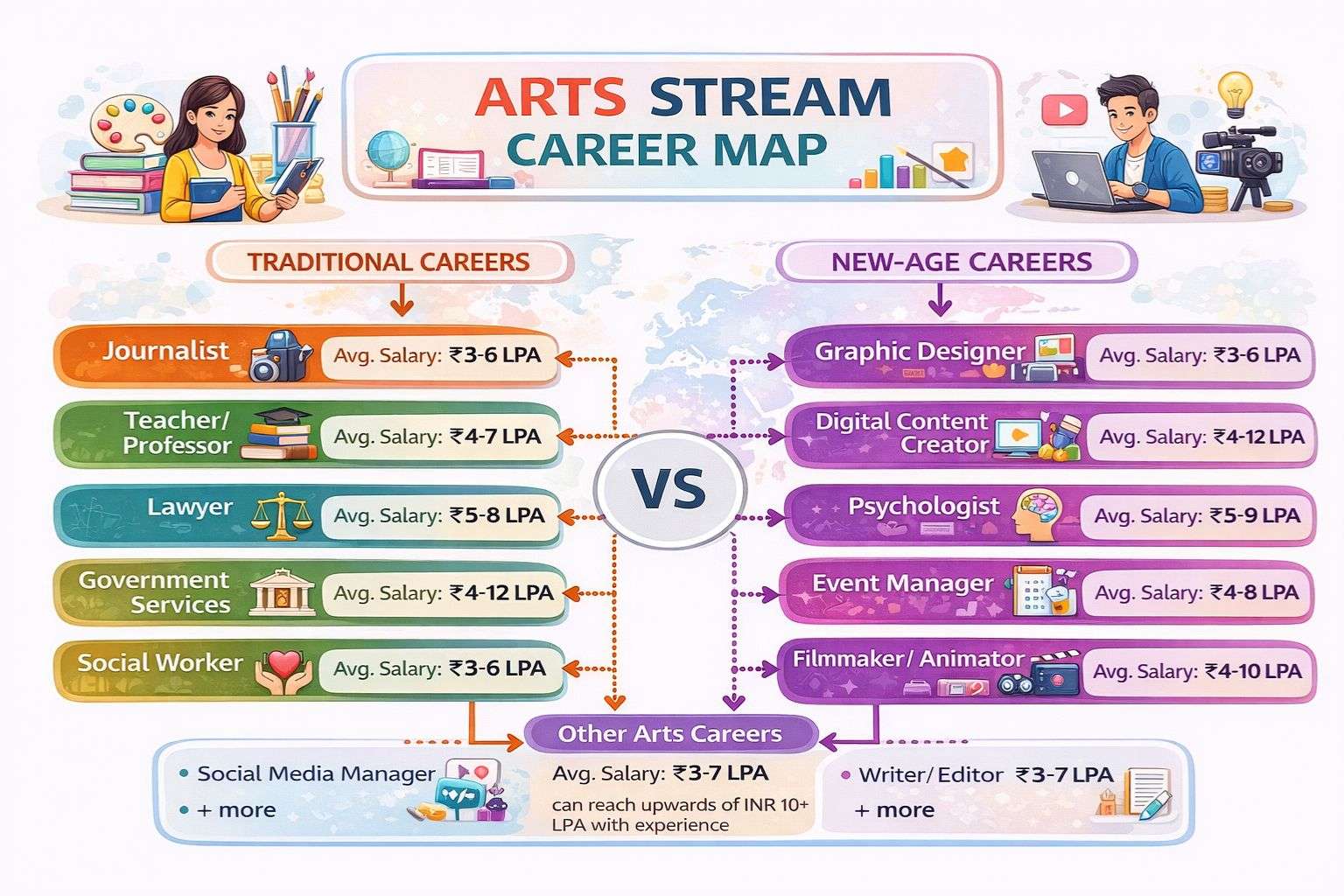
Arts stream career universe showing law, design, media, psychology, content creation radiating from center with salary potentials.
Skill-Based Careers: The Degree-Optional Path
Here’s something revolutionary: Some of the highest-paying careers don’t require traditional degrees.
The world is changing. Skills increasingly matter more than degrees. Let me show you what’s possible.
Digital Skills (Learnable in 6-12 Months)
Web Development
What it is: Building websites and web applications
Skills needed:
- Frontend: HTML, CSS, JavaScript, React
- Backend: Node.js, Python, databases
- Full-stack: Both
How to learn:
- Bootcamps: ₹50,000-2 lakhs (3-6 months intensive)
- Self-taught: Free resources online (requires discipline)
- Career Guru’s program: Structured + placement support
Package: ₹4-15 LPA (experienced freelancers make ₹20L+)
Best part: Start working at 19-20 years old, while degree students are still studying
App Development
Platforms: iOS (Swift), Android (Kotlin), Cross-platform (React Native, Flutter)
Learning time: 6-9 months intensive
Package: ₹5-18 LPA
Freelance potential: Very high
Data Analytics
What it involves: Extracting insights from data using Excel, SQL, Python, Tableau, Power BI
Learning time: 6-9 months
Package: ₹5-14 LPA
Demand: Extremely high across all industries
Digital Marketing
Components: SEO, SEM, Social Media Marketing, Content Marketing, Email Marketing
Learning time: 3-6 months
Investment: ₹30,000-1 lakh for a good course
Package: ₹3-10 LPA (freelancing unlimited)
Why it’s accessible: No coding needed, creative + analytical mix
Video Editing
Software: Premiere Pro, Final Cut Pro,
**Video Editing** **Software:** Premiere Pro, Final Cut Pro, DaVinci Resolve **Learning time:** 4-8 months **Package:** ₹3-12 LPA **Freelance:** YouTubers, companies, agencies all need editors constantly **Market reality:** Good video editors
Career Counselling
Q1: When is the best time to take career counselling after 12th?
The ideal time for career counselling is during Class 11, giving you two full years to plan, prepare for entrance exams, and build relevant skills. However, it’s never too late—even if you’re in Class 12 or have already started college, career counselling can help prevent costly mistakes or guide course corrections.
Optimal timeline:
Best: Class 10 end (for stream selection) or Class 11 beginning
Good: Class 12 beginning (still have a full year to execute)
Still valuable: Class 12 end (helps make informed college choices)
Never too late: Even after graduation for career pivots
At Career Guru, we’ve successfully counselled students at all these stages, with 92% reporting satisfaction with their career choices two years later.
Q2: How much does professional career counselling cost in India, and is it worth it?
Professional career counselling in India typically costs between ₹2,000 and ₹25,000, depending on the depth and duration of service.
Breakdown:
Basic psychometric test + report: ₹2,000-5,000
Test + single counseling session: ₹5,000-10,000
Comprehensive package (multiple sessions + ongoing support): ₹12,000-20,000
Premium with application guidance: ₹20,000-25,000
Is it worth it? Absolutely. Consider this: A wrong career choice can cost ₹5-50 lakhs in wasted education fees plus 5-7 years of your life. If career counselling prevents even one wrong turn, the ROI is 200-10,000%. Think of it as insurance against a ₹50 lakh mistake.
At Career Guru, we offer packages starting at ₹5,000 with flexible options based on your needs.
Q3: What are the best career options after 12th Science apart from engineering and medical?
Science students have numerous excellent options beyond the traditional engineering and MBBS paths:
High-demand alternatives:
Data Science & Analytics: ₹6-20 LPA, growing field, any science background + certifications
Biotechnology: ₹4-15 LPA, research and industry applications
Pharmacy (B.Pharm): ₹3-8 LPA, pharma industry boom
Nursing (B.Sc): ₹2.5-6 LPA in India, ₹25-40 LPA abroad
Psychology: ₹3-10 LPA, mental health awareness growing
Aviation: ₹3-8 LPA (pilot training separate track)
Forensic Science: ₹3-8 LPA, CSI effect creating jobs
Environmental Science: ₹4-10 LPA, sustainability focus
Food Technology: ₹3-8 LPA, food industry applications
Sports Science & Physiotherapy: ₹3-10 LPA, growing wellness sector
Emerging tech options:
AI/ML specialisations: ₹8-30 LPA
Cybersecurity: ₹6-20 LPA
Renewable Energy Engineering: ₹4-14 LPA
Each of these offers good career prospects without the extreme competition of engineering/medical. The key is matching them to your specific interests and aptitude through proper assessment.
Q4: My parents want me to do engineering, but I want to pursue design. How do I convince them?
This is one of the most common conflicts we handle in family counseling sessions. Here’s a strategic approach:
Step 1: Research and present data Don’t just say “I want design.” Show them:
Top NIFT/NID graduates earn ₹8-25 LPA
Experienced designers (5-7 years) make ₹15-30 LPA
International design jobs pay in dollars
Design is a growing industry (₹200+ billion market in India)
Step 2: Address their specific concerns Usually parents worry about:
Job security: Show them hiring data from design firms
Financial stability: Present actual salary progressions
Social prestige: Mention successful Indian designers
Step 3: Propose a middle ground
Engineering with a design minor
Product design (combines both)
UI/UX design (tech + creativity)
Complete B.Tech + pursue design post-graduation
Step 4: Get professional mediation. Book a family counselling session at Career Guru, where we:
Present your psychometric test results objectively
Show why design matches your aptitude profile
Address parents’ concerns with data
Find solutions that satisfy everyone
Remember: Parents usually just need reassurance that you’ve thought this through and have a solid plan. Data and professional guidance often bridge the gap better than emotional arguments.
Q5: Are psychometric tests for career selection really accurate, or are they just a gimmick?
Professional psychometric tests are 80-85% accurate when administered and interpreted correctly—they’re based on decades of psychological research, not gimmicks.
What makes them scientifically valid:
Based on established psychological frameworks (Holland’s RIASEC, Big Five personality traits, Multiple Intelligence theory)
Tested on millions of people globally
Validated through follow-up studies
Used by top universities and corporations worldwide
However, accuracy depends on:
Quality of test: Professional assessments (like Career Guru uses) vs free online quizzes
Honest responses: If you answer what “sounds good” instead of truthfully, the results are useless
Professional interpretation: Tests need expert analysis, not just automated reports
Comprehensive approach: Combining test results with counsellor discussion and real-world factors.
What tests CAN do:
Identify your strongest aptitudes (logical, spatial, linguistic, etc.)
Reveal genuine interests (not what you think you should like)
Show personality traits affecting work satisfaction
Suggest careers with high probability of fit
What tests CANNOT do:
Guarantee success in any field
Predict exact future earnings
Replace your own judgment and research
Account for changing interests over time
Think of psychometric tests like a GPS: They show you the most efficient route based on data, but you still choose the destination and drive the car. They’re guides, not absolute predictors.
At Career Guru, we combine scientific assessment with personalised counselling because context matters as much as data.
Q6: Can I pursue a successful career in Arts/Humanities, or should I switch to Science/Commerce?
Absolutely yes—some of the highest earners and most fulfilled professionals I know are arts graduates. The “arts has no scope” myth needs to die.
Reality check on arts careers:
High-earning arts paths:
Corporate Law: ₹15-50 LPA (top NLU graduates)
UI/UX Design: ₹8-25 LPA (tech boom creating demand)
Content Creation: ₹10-50+ LPA (successful YouTubers, writers)
Psychology (established practice): ₹15-40 LPA
Journalism (senior level): ₹15-30 LPA
Design (fashion, product, graphic): ₹10-30 LPA
Mass Communication (corporate roles): ₹8-20 LPA
Why arts gets bad reputation:
Outdated mindset (world has changed drastically)
People confuse BA from random college vs professional arts programs
Success requires skill development (same as any field)
No fixed path (requires self-direction, which is actually an advantage)
When to stay in the arts:
Your psychometric test shows an artistic/social personality type
You have genuine creative or communication strengths
You’re self-motivated (arts require more self-direction)
Your interests genuinely lie in humanities subjects
When to consider switching:.
You’re only in the arts because you didn’t get science.
You have a strong logical-mathematical aptitude
Parents forced arts but you prefer analytical work
No genuine interest in arts subjects.
The key: Arts is excellent IF:
1. It matches your natural abilities
2. You choose the right specialisation
3. You build marketable skills
4. You’re strategic about career planning
Don’t switch just because of societal pressure. Switch only if science/commerce genuinely suits you better. Get psychometric testing to know for sure.
Q7: What if I choose the wrong career after 12th? Can I change later, or am I stuck forever?
You can absolutely change careers later—I’ve helped hundreds do it successfully. But it does cost time and money, which is why getting it right the first time through career counselling is so valuable.
Realistic career change scenario:
Timeline:
Years 1-2: Realise current path is a wrong fit
Years 3-4: Complete degree anyway (can’t waste 2 years already invested)
Year 5: Retrain/upskill in the correct field (courses, certifications)
Years 6-7: Start from entry-level in a new career
Years 8-10: Finally reach mid-level in the correct field
Total: 8-10 years to get where you could have been if you’d chosen right initially.
Financial impact:
Wasted education: ₹5-20 lakhs (first degree you won’t use)
Retraining costs: ₹1-5 lakhs (new certifications/courses)
Opportunity cost: ₹10-30 lakhs (lower salaries while restarting)
Total impact: ₹16-55 lakhs
Emotional cost:
Watching peers 5-7 years ahead in their careers
Explaining career gaps in interviews
Starting from scratch in my late twenties
Family and social pressure.
BUT—and this is important—it’s still better than spending 40 years miserable in wrong career.
Common successful switches: the
Engineering → Design/UX (very common, relatively smooth)
MBBS → Management/Business (happens more than you’d think)
Commerce → Tech/IT (doable with bootcamps)
Any field → Content creation/Digital marketing (accessible)
How to minimise damage if switching:
Switch as early as possible (Year 1-2 of college is better than after graduation)
Build skills in a new field while completing a current degree
Use current degree as backup
Network in a new field before switching
At Career Guru, we help both prevent wrong choices and navigate career switches when needed.
Bottom line: Change is possible but expensive. Better to invest ₹5,000-25,000 in career counselling now than ₹50 lakhs in career switching later
Q8: How do I know if I should go for CA, or is it too difficult for me?
CA is objectively one of the toughest professional qualifications in India. Here’s the honest assessment:
The brutal statistics:
Only 5% of people who start CA actually complete it
Intermediate pass rate: 5-10% per attempt (90-95% fail)
Average completion time: 5-6 years (many take longer)
Most candidates attempt each level 2-3 times.
You should seriously consider CA if:
✅ You have a genuine passion for accounts, taxation, and auditing (not just “it pays well”)
✅ You’re extremely self-disciplined (8-12 hours daily self-study for years)
✅ You can handle multiple failures without losing motivation
✅ You’re okay with 3 years of articleship earning ₹2,000-5,000/month
✅ Your family can support you financially for 5+ years
✅ You have obsessive attention to detail
✅ You’re academically strong (though marks alone don’t guarantee success)
Seriously reconsider CA if:
❌ You just want “good earning career” but hate accounts
❌ You need regular income soon (family financial pressure)
❌ You get demotivated easily by failure
❌ You prefer practical learning over theoretical self-study
❌ You want a work-life balance during the study phase
❌ You’re choosing it because “parents said so” or “a friend is doing it”
Alternative assessment: Take CA Foundation exam (entry level) while doing B.Com. If you clear it and still feel motivated, continue. If you fail or realize you hate it, you have B.Com as a backup and can pursue other options.
realise.
Alternatives to consider:
CS (Company Secretary): Slightly easier, good career, similar but less brutal
CMA (Cost Accounting): Management accounting focus, more corporate-oriented
MBA after B.Com: Better for those who want corporate careers without extreme exam difficulty
Banking exams: IBPS, SBI PO—good packages (₹7-12 LPA), government security
The honest truth: I’ve seen brilliant students quit CA after 3-4 years because they couldn’t handle the sustained pressure.
I’ve also seen average students complete it through sheer determination. It’s not about intelligence—it’s about endurance, discipline, and genuine interest.
Get psychometric testing to see if your personality type and aptitude actually align with CA requirements before committing 5 years of your life.
Q9: Is online career counselling as effective as in-person counselling?
Yes, online career counselling can be equally effective as in-person—if done properly with professional tools and qualified counsellors.
What makes online counselling effective:
✅ Professional psychometric tests: Same scientific assessments, digital format
✅ Video counseling sessions: Face-to-face interaction via Zoom/Google Meet
✅ Detailed digital reports: Can be reviewed multiple times, shared with family
✅ Convenient scheduling: No travel time, easier for busy families
✅ Recorded sessions: Can revisit discussion points
✅ Digital resources: Easy to share documents, career guides, college lists
✅ Follow-up support: Email, WhatsApp, calls more accessible
What makes online counselling ineffective:,
❌ Free automated quizzes (not scientific)
❌ No actual counsellor discussion (just report)
❌ AI chatbots claiming to guide careers
❌ Uncertified counselors
❌ No follow-up support
Career Guru offers both formats:
In-person: At our Bhubaneswar office for local students/families
Online: For students anywhere in India—same quality, same certified counselors, same comprehensive process
Our online process: counsellors
Professional psychometric assessment (taken online)
Detailed 30-40 page report generated
Scheduled video counselling session (60-90 minutes)
Both the student and the parents join the call
Screen sharing to review results together
Q&A and personalised roadmap discussion
Ongoing email/WhatsApp support
Digital delivery of all documents
Student testimonials: 87% of our online counseling clients report it was as valuable as they expected in-person would be.
The key advantage: Online counselling makes expert guidance accessible regardless of location. A student in a small town can access the same quality counselling as someone in a metro city.
Book online session: Career Guru Counselling or call 9777278853
Q10: What are the most in-demand and future-proof careers after 12th for the next 10-20 years?
Based on industry trends, technological advancement, and economic shifts, here are careers with a strong 10-20 year outlook:
Technology & Data (Highest Growth):
Artificial Intelligence & Machine Learning Engineer. Why: AI is transforming every industry
Current package: ₹8-35 LPA
Entry: B.Tech CSE/AI specialisation or any engineering + certifications
Demand trajectory: Exponential
Data Science & Analytics Why: Data-driven decision making is becoming standard
Current package: ₹6-22 LPA
Entry: Any degree + specialised courses
Demand: Growing across all sectors
Cybersecurity Specialist: Why: Digital threats are increasing, and there is a massive talent shortage
Current package: ₹6-20 LPA
Entry: B.Tech/B.Sc Computer Science + certifications
Job security: Extremely high
Cloud Computing Architect Why? Everything is moving to the cloud
Current package: ₹8-25 LPA
Entry: Engineering + AWS/Azure certifications
Healthcare (Aging Population = Growing Need):
Healthcare Technology Roles: Telemedicine specialists
Health informatics
Medical device engineering
Package: ₹5-18 LPA
Mental Health Professionals, Clinical psychologists
Counselors
Therapists
Package: ₹3-30 LPA (practice-dependent)
Why: Mental health awareness is exploding
Sustainability & Environment:
Renewable Energy Engineers Solar, wind, hydro specialists
Package: ₹4-14 LPA
Why: Climate change forcing transition
Sustainability Consultants ESG compliance experts
Package: ₹5-18 LPA
Why: Corporate sustainability mandates
Creative & Digital:
UI/UX Designers Package: ₹6-20 LPA
Why: Every app/website needs design, and a shortage of talent
Content Creators & Digital Marketers Package: ₹3-50+ LPA (huge variance)
Why: Marketing permanently shifted to digital
Traditional but Evolving:
Healthcare Professionals (Doctors, Nurses) are always in demand
Package: ₹6-50+ LPA
Why: Ageing population, healthcare access expanding
Specialised Lawyers Cyber law, IP law, corporate law
Package: ₹8-50 LPA
Why: Legal complexity is increasing
Careers to be cautious about (automation risk):
Pure data entry
Basic accounting (automation replacing)
Traditional factory work
Routine administrative roles
Future-proofing strategy:
Choose careers requiring human creativity, empathy, or complex problem-solving
Develop adaptability—the ability to learn new skills
Stay updated with industry trends
Combine technical + soft skills
The safest bet: STEM + human skills (technology + communication/creativity/empathy). Pure technical OR pure creative, both have risks. A combination is powerful.
Still have questions? Book a free 15-minute career guidance call:
📞 Call/WhatsApp: 9777278853
📧 Email: [email protected]
🌐 Website: www.cguru.co.in
Our certified career counselors are here to help you make the right choice for your unique situation.