
Artificial Intelligence Career in India 2026 — Is It Really Worth It for Students
Is an artificial intelligence career in India 2026 really worth it for students? A 27-year IT career consultant gives you the honest, unfiltered answer based on real hiring experience.
Artificial Intelligence Career in India 2026 — The Question Every Student Is Asking and the Answer Most Are Not Getting
Every week in India right now a student somewhere is making a decision that will shape the next three years of their life based on incomplete and often misleading information.
They are watching a YouTube video that tells them AI is the future. They are seeing LinkedIn posts about freshers getting ₹40 LPA AI engineer offers. They are sitting in a college seminar where a speaker tells them that every other career will be automated away and AI is the only safe path. And they are making course purchases, career pivots, and preparation decisions based on that information.
Here is a number that should immediately complicate that picture. According to recent industry reports India currently has fewer than 200,000 professionals working in dedicated AI and machine learning roles. The country graduates over 1.5 million engineering students every year.
The math alone should tell you something important — not every student can have an AI career, not every student needs one, and not every student who wants one is going to find it waiting for them at the end of a six-month online course.
I have been working as an IT career consultant for 27 years. I have watched technology waves arrive with enormous fanfare — the internet boom, the mobile revolution, cloud computing, big data. Each one created genuine opportunities for students who understood what the wave actually required. Each one also created enormous noise that sent thousands of students down preparation paths that did not match what the market actually needed.
Artificial intelligence in India in 2026 is the biggest wave I have seen in my career. The opportunity is real. The hype surrounding it is also real — and it is doing genuine damage to students who cannot separate one from the other.
This blog is my attempt to give you the honest answer. Not the answer that sells a course. Not the answer that generates excitement. The answer that helps you make a good decision about your career.
What an Artificial Intelligence Career in India 2026 Actually Looks Like

Artificial intelligence career in India 2026 — the hype version versus the real day-to-day work
Before we answer whether an artificial intelligence career in India 2026 is worth it, we need to establish what that career actually looks like in practice. Because the gap between what students imagine and what the work involves is larger than almost any other field I have observed in my career.
The popular imagination of an AI career involves building robots, creating sentient systems, designing algorithms that change entire industries, and working in futuristic labs on problems that have never been solved before. Some of that work exists.
It exists at a handful of research institutions, at global technology companies like Google DeepMind and Microsoft Research, and at a small number of genuinely cutting-edge Indian AI startups. The people doing that work are typically PhD researchers and senior engineers with five to ten years of specialised experience.
That is not what an entry-level artificial intelligence career in India 2026 looks like for a fresher or a student who has just completed an online course.
Here is what most junior AI and machine learning roles in India actually involve on a day-to-day basis. Cleaning and preprocessing large datasets so they are usable for model training. Building and evaluating standard machine learning models — logistic regression, random forests, gradient boosting — using established libraries.
Writing Python scripts to automate data pipelines. Testing whether existing AI models are performing as expected and diagnosing when they are not. Building dashboards that track model performance metrics over time. And writing clear documentation of what a model does and what its limitations are.
Is that work interesting? Genuinely yes. Is it valuable? Absolutely. Does it require the student to be a mathematics genius or a research prodigy? No. Does it require solid Python, strong data handling skills, genuine statistical understanding, and the ability to think analytically about problems? Yes — every single day.
The students who build successful artificial intelligence careers in India start by being excellent at the fundamentals. The ones who jump to the exciting parts without that foundation almost always stall.
The Honest State of the AI Job Market in India in 2026
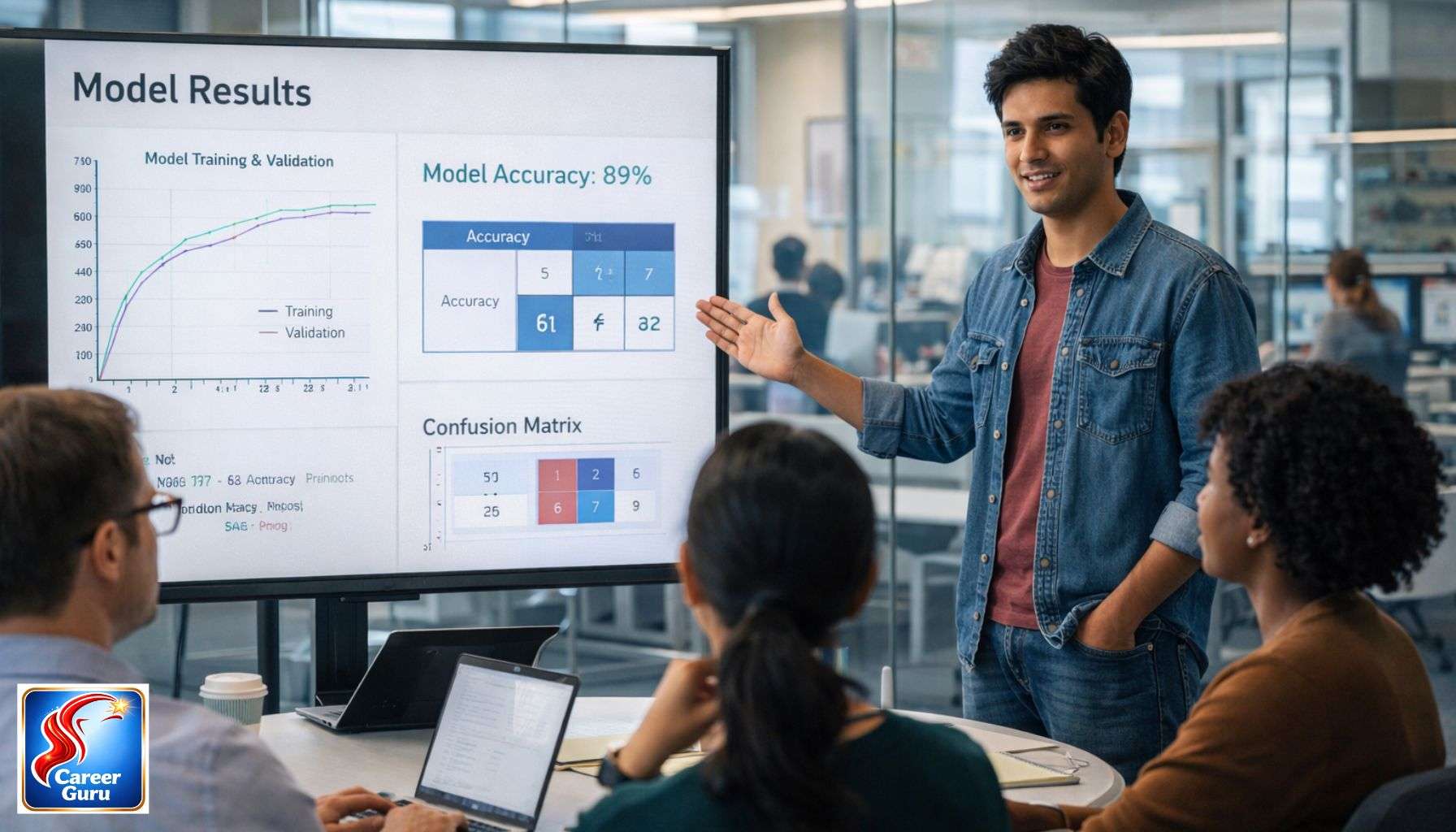
Artificial intelligence career in India 2026 — AI professional presenting model results to team
Let me tell you what the artificial intelligence job market in India actually looks like in 2026 — not what course marketing materials say it looks like.
The AI and machine learning job market in India is growing strongly. That part of the story is true. Indian companies across sectors — banking, e-commerce, healthcare, manufacturing, logistics — are investing in AI capabilities and they need people who can build and maintain those systems. The government’s push toward digital infrastructure and the growth of India’s startup ecosystem are creating genuine new roles that did not exist three years ago.
But here is the part that gets left out of most AI career conversations. The entry-level AI job market in India in 2026 is not the same as the senior AI job market. And the skills that get freshers hired in AI roles are significantly different from the skills that most AI courses spend the most time teaching.
Here is what Indian companies are specifically looking for when they hire freshers for AI and machine learning adjacent roles right now.
Strong Python with data focus. Pandas, NumPy, scikit-learn, and basic data visualisation. This is the practical foundation that comes up in every junior AI role interview. Not TensorFlow. Not PyTorch. Not transformer architectures. Pandas and scikit-learn first.
SQL for data extraction and manipulation. Most real-world AI work starts with getting data from databases. A fresher who cannot write a JOIN query is not ready for a production AI environment regardless of how many neural network architectures they have studied.
Statistics that you can explain to a non-technical person. Distributions, correlation, hypothesis testing, model evaluation metrics like precision, recall, and F1 score. The ability to explain what these mean in plain language to a business stakeholder is a skill Indian AI teams genuinely value and consistently find missing in freshers.
Machine learning fundamentals. Supervised and unsupervised learning, model training and evaluation, overfitting and underfitting, cross-validation. These form the core of what every junior ML role in India tests for.
Communication and documentation skills. This one surprises most students. AI work in Indian companies involves significant communication with non-technical stakeholders — business teams, product managers, senior leadership.
A fresher who can explain what a model does and what its limitations are in clear plain language is significantly more valuable than one who can build a slightly more sophisticated model but cannot explain it to anyone.
Where the Real Artificial Intelligence Career Opportunities Are in India in 2026
Not all AI career opportunities in India in 2026 are equal. Let me be specific about where the genuine opportunities are and where the hype outpaces the reality.
E-commerce and retail analytics. Companies like Flipkart, Amazon India, Meesho, and hundreds of smaller e-commerce players are using machine learning extensively for recommendation systems, demand forecasting, dynamic pricing, and fraud detection. This is one of the most active areas of practical AI hiring for freshers in India right now. The work is applied, well-compensated, and directly connects to business outcomes that companies care about deeply.
Banking and financial services AI. Banks and fintech companies — HDFC, ICICI, Paytm, Razorpay, PhonePe — are investing heavily in AI for credit scoring, fraud detection, customer segmentation, and risk management. This is a strong area for students with a combination of data skills and some understanding of financial concepts. The roles are serious, the problems are genuinely complex, and the compensation at good companies is competitive.
Healthcare and diagnostics. AI applications in medical imaging, disease prediction, and drug discovery are growing in India. This is a more specialised space that typically favours students with relevant domain knowledge alongside technical skills — bioinformatics, medical imaging, or biotechnology backgrounds combined with ML skills. Pure CS students can enter this space but it requires additional domain learning.
IT services companies building AI practices. TCS, Infosys, Wipro, HCL, and Cognizant all have growing AI and analytics practice areas. They hire freshers into these practices — though the work is less cutting-edge than at product companies. For students who want a stable structured entry into AI work, these companies provide a reasonable starting point with the understanding that the learning curve will be less steep than at a startup.
AI startups and research labs. This is where the most exciting work happens and where the highest compensation for genuinely strong candidates exists. Indian AI startups — Sarvam AI, Krutrim, and dozens of smaller applied AI companies — are building genuinely interesting products and need strong technical talent.
The bar is higher. The learning is faster. And for students who are genuinely passionate about AI as a field rather than AI as a salary bracket — this is where the most rewarding work is.
The Skills That Actually Build an Artificial Intelligence Career in India 2026

Skills roadmap for artificial intelligence career in India 2026 — student planning learning path
Let me give you the honest skill roadmap for building a genuine artificial intelligence career in India in 2026. In the order that actually works — not the order that makes a course syllabus look exciting.
Stage 1 — Python and data handling first. If you cannot clean a messy dataset, perform exploratory analysis, and visualise findings clearly in Python — you are not ready for AI work. This is the foundation. Build it before you touch anything else. Pandas, NumPy, Matplotlib, and Seaborn. Real datasets from Kaggle. Consistent daily practice.
Stage 2 — Statistics that you genuinely understand. Mean, median, standard deviation, probability distributions, correlation, hypothesis testing, and model evaluation metrics. Not memorised definitions — actual understanding of what these mean and when each one matters. Khan Academy and StatQuest on YouTube cover this better than most paid courses.
Stage 3 — Machine learning fundamentals with scikit-learn. Linear regression, logistic regression, decision trees, random forests, k-means clustering, and model evaluation. Understand how each algorithm works conceptually. Know when to use each one. Know how to evaluate whether a model is performing genuinely well or just appearing to.
Stage 4 — Deep learning foundations — only after Stage 3 is solid. Neural network architecture basics, backpropagation conceptually, convolutional neural networks for image tasks, basic NLP concepts. TensorFlow or PyTorch — choose one and go reasonably deep rather than touching both superficially.
Stage 5 — Build a portfolio that shows the whole pipeline. Three projects that each demonstrate the complete workflow — data collection, cleaning, analysis, model building, evaluation, and plain-language interpretation of results. On GitHub. With clear README documentation. One tabular data project. One computer vision or NLP project. One project that connects AI to a real Indian business problem.
Stage 6 — Learn to communicate your work. Build the habit of writing clear summaries of every project you complete — what problem it solved, what approach you took, what the results showed, and what the limitations are. This communication skill is what separates hirable AI freshers from technically competent ones who cannot explain their work to anyone outside their immediate technical team.
The Honest Salary Picture for an Artificial Intelligence Career in India 2026
Let me give you real numbers. Not the ₹40 LPA figures that AI course advertisements use — which represent exceptional outliers at global product companies after significant experience — but the numbers that appear in actual offer letters for freshers and early-career professionals in Indian AI roles right now.
Junior Data Scientist or ML Engineer — Entry Level At large IT service companies — ₹5 to ₹8 LPA At Indian product companies and mid-size tech firms — ₹8 to ₹15 LPA At well-funded startups and unicorns — ₹12 to ₹20 LPA At global product companies like Google and Microsoft — ₹20 to ₹35 LPA for exceptional candidates
AI Research Engineer — Requires Strong Academic Background At Indian research labs and AI startups — ₹12 to ₹25 LPA depending on publication record and technical depth At global companies with India research presence — ₹25 to ₹50 LPA for PhD level candidates
Applied ML Engineer — Two to Three Years Experience At Indian product companies — ₹15 to ₹25 LPA At global companies and top startups — ₹25 to ₹50 LPA
The honest context behind these numbers. Most freshers entering AI roles in India in 2026 start at the ₹5 to ₹15 LPA range depending on company type and their skill level. The ₹40 LPA figures exist — but they represent the top one to two percent of candidates at the most selective companies after the most rigorous selection processes. Using them as a benchmark for career planning is like using the Indian cricket team’s salary as a benchmark for planning a sports career.
What is genuinely exciting about AI salaries in India is the growth trajectory. A fresher who joins at ₹8 LPA in a genuinely AI-focused role at a good company and continues building real skills can realistically be earning ₹20 to ₹25 LPA within three to four years. That trajectory is steeper than almost any other track in Indian IT right now.
🔗 Related Read: Fresher Salary in India 2026
🔗 Related Read: Data Science Career Roadmap India 2026
So Is an Artificial Intelligence Career in India 2026 Actually Worth It
Here is my honest answer after 27 years of watching technology careers in India.
Yes — if you are genuinely interested in the work and willing to build the right foundation in the right order.
No — if you are chasing the salary figures in course advertisements without genuine interest in how data, mathematics, and algorithms actually work.
Maybe — if you are currently in a related field like data analytics, software development, or statistics and want to add AI skills to an existing strong foundation. In that case the additional investment is modest and the career uplift is real.
The students I have seen build genuinely successful artificial intelligence careers in India are almost never the ones who enrolled in every AI course they could find and collected certificates aggressively. They are the ones who got genuinely curious about a specific problem — fraud detection, medical imaging, recommendation systems — and went deep on the skills needed to actually solve that problem. That depth, built on top of strong fundamentals, is what Indian companies hiring for AI roles in 2026 are specifically looking for.
The students who have struggled are almost always the ones who learned the vocabulary of AI without building the underlying skills. They can name every algorithm. They cannot explain why one is more appropriate than another in a given context. They can run a neural network training script. They cannot interpret whether the results mean anything. That surface-level knowledge fools nobody in a serious interview room.
Internal Links — Read These Next
- 📌 Data Science Career Roadmap India 2026
- 📌 Best Free Online Courses for IT Students in India 2026
- 📌 Python vs Java vs C++ for Indian Students 2026
- 📌 Fresher Salary in India 2026
- 📌 Top 10 IT Companies in India Hiring Freshers in 2026
- 📌 How to Write a Resume for Internship With No Experience in India 2026
- 📌 Cybersecurity Internships in India 2026
- 📌 How to Crack Campus Placements in India 2026
- 📌 Summer Internship for Students in India 2026 — Complete Guide
- 📌 Why Your Resume Is Getting Rejected in India 2026
FAQs — Artificial Intelligence Career in India 2026
Q 1:- Do I need a mathematics or computer science degree to build an artificial intelligence career in India in 2026 or can students from other backgrounds enter this field?
This is one of the most common questions I receive from students who are interested in AI but worried their background disqualifies them — and the honest answer is more open than most people expect.
A strong mathematics and computer science background genuinely helps in AI — particularly for research-oriented roles, deep learning specialisation, and positions at global product companies that have very high technical bars. If you have that background and are willing to go deep on both the theory and the application of AI, the ceiling on your career in this field is very high.
But dedicated CS or mathematics degrees are not the only viable entry points into an artificial intelligence career in India in 2026.
I have personally worked with students from economics, statistics, physics, and even commerce backgrounds who built successful data science and applied ML careers by compensating for any gaps in their formal education through targeted self-learning. What matters most at the entry level is whether you can demonstrate practical competence — can you clean data, build a working model, evaluate it honestly, and explain what it does clearly.
Those skills are learnable regardless of your degree if you are willing to put in the work.
The roles where background matters most are research positions and highly specialised deep learning engineering roles. The roles where demonstrated practical skill matters most are applied ML, data science, and AI product roles — which represent the majority of AI-adjacent hiring in India right now.
Consultant’s note — In my 27 years of career consulting I have placed students from non-traditional backgrounds into data science and AI-adjacent roles by helping them build a portfolio that demonstrated practical competence clearly enough to overcome the background question.
A GitHub profile with three well-executed, clearly documented machine learning projects often does more heavy lifting in an interview than a degree name. Build the skills. Show the work. The background question becomes less relevant the more convincing your portfolio is.
Q 2:- What is the realistic timeline to become job-ready for an artificial intelligence career in India in 2026 starting from a basic programming background?
I want to answer this question with complete honesty because the gap between what course advertisements promise and what genuine job-readiness requires is one of the most damaging pieces of misinformation circulating in India’s AI career space right now.
Course advertisements routinely promise AI job-readiness in sixty to ninety days. That claim is not true for the vast majority of students. It is not true for students starting from a basic programming background.
And believing it leads to students who have spent three months on a course, collected a certificate, applied for AI roles, and then been confused and discouraged when they cannot answer basic interview questions about their own work.
The honest timeline for building genuine job-readiness for entry-level AI roles in India — starting from a functional Python and basic programming background — is eight to twelve months of consistent daily practice. That timeline covers Python for data analysis properly, statistics foundations, machine learning fundamentals with scikit-learn, basic deep learning concepts, and the building of two to three portfolio projects that demonstrate the complete ML workflow.
Each of these stages requires real time and real practice — not video watching and certificate collecting.
Students who already have strong Python, SQL, and statistics from a data science or engineering background can compress this timeline to five to six months by focusing specifically on the ML and deep learning stages. Students starting from near zero on programming should add two to three months for Python and statistics fundamentals before beginning the ML curriculum.
The students I have seen get their first AI roles fastest are not the ones who tried to compress the timeline most aggressively. They are the ones who went genuinely deep at each stage before moving to the next — arriving at interviews with real understanding rather than surface-level familiarity.
Consultant’s note — I have had this specific conversation with hundreds of students over the past three years as AI career interest has exploded in India. The ones who followed an honest eight to twelve month roadmap and built real projects at each stage had dramatically better interview outcomes than the ones who rushed through a ninety-day course and applied immediately.
The market in 2026 is sophisticated enough to tell the difference in about fifteen minutes of technical questioning. Prepare properly. The timeline is longer than the advertisements say. The outcomes are also better than the advertisements can promise.
Q 3:- Is an artificial intelligence career in India 2026 safe from automation — or is AI itself going to replace AI jobs?
This is the question with the most genuine philosophical complexity on this list — and also one where I think students deserve a straight answer rather than reassuring platitudes.
The honest answer is that AI tools are already changing what some AI work looks like. Tasks that junior data scientists used to spend significant time on — writing boilerplate data preprocessing code, building standard model pipelines, generating basic reports — are being partially automated by AI coding assistants and AutoML tools. That is real and it is happening now.
But here is the important context. The automation of routine tasks in AI work is not eliminating AI jobs in India. It is shifting what those jobs require. The demand for people who can define the right problem, evaluate whether a model’s output is actually trustworthy, communicate findings to non-technical stakeholders, and make judgment calls about when an AI system should and should not be used — that demand is growing, not shrinking.
These are fundamentally human skills that AI tools cannot replicate.
The AI roles most vulnerable to automation displacement in India over the next five years are the most mechanical ones — running standard pipelines on well-defined problems with clear evaluation criteria. The roles least vulnerable are the ones requiring domain expertise, stakeholder communication, problem definition, and ethical judgment about AI system deployment. Building a career that leans toward the second category rather than the first is the smartest long-term positioning available to a student entering this field in 2026.
The students I advise to pursue AI careers are specifically the ones who are curious about the judgment and communication aspects of the work — not just the technical execution. Those students are building careers that AI tools will augment rather than replace.
Consultant’s note — I have been asked some version of “will this career be automated” in almost every technology career counselling session I have conducted in the past three years. My consistent observation is that the students who ask this question are almost always the ones who are thinking about career longevity rather than just immediate salary — which is exactly the right way to think about any technology career.
The AI field in India in 2026 is not static. The students who will thrive in it long-term are those who keep learning continuously rather than treating any qualification as a permanent credential.
Q 4:- What is the difference between a data science career and an artificial intelligence career in India in 2026 and which one should a student choose?
This question comes up constantly and the confusion is understandable because the terms are used interchangeably in many job listings, course advertisements, and career guidance articles. Let me give you the clearest distinction I can draw from actual hiring experience.
Data science as a career in India in 2026 is primarily focused on extracting insights from data to support business decisions. The core tools are SQL, Python for data analysis, statistical methods, and visualisation platforms like Power BI and Tableau. The output is typically reports, dashboards, and analytical findings that help business teams make better decisions.
The work is applied and business-oriented. Most entry-level data science roles in India sit closer to this end of the spectrum than to the cutting-edge AI end.
Artificial intelligence as a career is more specifically focused on building systems that learn from data and make predictions or decisions autonomously. The core tools include machine learning frameworks, deep learning libraries, and increasingly large language model APIs. The output is typically a model, a system, or a product feature that automates or augments a decision-making process.
This work requires deeper technical knowledge and typically a stronger mathematics foundation than pure data science analysis work.
In practice the boundary between these two careers in Indian companies is blurry at the entry level.
Many job titles use data scientist and machine learning engineer interchangeably for roles that involve a mix of both. What matters more than the title is the specific skills the role requires — which you can identify by reading the job description carefully rather than just the headline.
My practical advice on which to choose is this. If you are stronger in communication, business thinking, and applied problem-solving — lean toward data science. If you are stronger in mathematics, programming, and genuinely enjoy understanding how algorithms work at a deeper level — lean toward AI and machine learning.
Both are excellent career choices in India in 2026. The worst choice is picking one based purely on which advertised salary looks higher.
Consultant’s note — The students I have seen make the most successful career starts are almost always the ones who chose based on genuine interest and honest self-assessment of their strengths rather than based on salary comparisons or peer pressure.
A student who genuinely loves working with data and communicating findings will build a more successful data science career than a technically stronger student who chose data science because someone told them it pays more. Genuine interest is not a soft factor. It is a career advantage that compounds every single year.
Q 5:- What are the best free resources specifically for building an artificial intelligence career in India in 2026 without spending money on expensive courses?
This is one of the most practically useful questions on this list and I want to give you specific, honest recommendations rather than a generic list of well-known platforms.
For Python and data foundations — Kaggle’s free learning tracks for Python, Pandas, and data visualisation are the best structured free resource available specifically for data-oriented Python rather than general programming. They are practical, project-based, and directly relevant to AI work.
For statistics foundations — Khan Academy’s statistics and probability course is genuinely excellent and completely free. StatQuest with Josh Starmer on YouTube explains machine learning and statistics concepts in the clearest most human way I have encountered anywhere — and it is free. These two resources together cover everything you need statistically for most entry-level AI roles in India.
For machine learning fundamentals — Andrew Ng’s Machine Learning Specialisation on Coursera can be audited free or accessed through Coursera’s financial aid program which is approved easily for Indian students. This remains the most respected free introduction to machine learning fundamentals available anywhere in the world.
For deep learning — fast.ai’s Practical Deep Learning for Coders course is free, genuinely practical, and specifically designed to get students building real projects quickly rather than getting lost in theory. Google’s Machine Learning Crash Course is also free and covers TensorFlow basics in a structured way.
For building and sharing projects — GitHub is free. Kaggle competitions are free to participate in. Google Colab provides free GPU access for training models. A student who uses these free tools to build and document three real projects has a more compelling AI portfolio than one who has paid for five courses and built nothing.
Consultant’s note — I have watched students build genuine AI competence and land their first AI roles in India using only free resources combined with consistent daily practice. The resources are not the limiting factor in building an AI career in India in 2026. Consistent focused effort is the limiting factor.
A student who spends one hour daily on free resources and builds one real project per month will outperform a student who pays ₹50,000 for a course and watches videos without building anything. Every time.
AI JOBS
What I Want You to Do With Everything You Just Read
This is not a summary of what we covered. You have already read the blog. You do not need me to repeat it back to you in bullet points.
What I want to do instead is leave you with something more useful than a list. I want to leave you with the specific perspective that 27 years of watching students navigate technology career decisions in India has given me — and the concrete actions that will tell you within the next thirty days whether an artificial intelligence career is genuinely right for you or not.
The One Question That Changes Everything
After every career counselling session I have ever conducted on AI careers in India, I ask the student one final question before they leave.
Not “what salary do you want.” Not “which company do you want to work for.” Not “how quickly do you want to get there.”
I ask — “What specific problem do you want AI to help you solve?”
The students who have a real answer to that question — even a rough, unpolished, half-formed answer — almost always go on to build successful AI careers. The ones who look at me blankly and say “I just want to work in AI” almost always struggle.
Here is why that question matters so much. Artificial intelligence is not a job. It is a set of tools applied to specific problems in specific domains. The students who think of it as a job chase certifications and salary figures. The students who think of it as a set of tools applied to problems they genuinely care about build real expertise — because genuine curiosity is the only sustainable fuel for the depth of learning that AI careers actually require.
So before you do anything else — answer that question honestly. Write it down. What problem do you want AI to help solve? Healthcare diagnosis. Financial fraud detection. Agricultural yield prediction. Recommendation systems that actually understand what people want. Supply chain optimisation for small Indian manufacturers.
Any answer is a good answer. No answer is a warning signal worth paying attention to.
What to Do in the Next Seven Days If Your Answer Is Genuine
If you have a real answer to that question — here is exactly what I want you to do in the next seven days. Not eventually. This week.
Day one. Open Kaggle. Find one public dataset related to the problem domain you identified. Download it. Open it in a Jupyter notebook. Spend thirty minutes just looking at it — what columns are there, what do they represent, what questions could this data answer. Do not run any code yet. Just look. Understanding what data represents before you touch it is a skill most AI courses never teach and most AI professionals never develop properly.
Day two and three. Write Python code to clean that dataset. Handle missing values. Fix inconsistent formatting. Remove duplicates. This is unglamorous work. It is also the work that takes up thirty to forty percent of a real AI professional’s time in India. If you find this work interesting rather than tedious — that is a genuine signal that AI work will suit you. If you find it deeply frustrating after two days — that is also useful information about whether this path is right for you.
Day four and five. Perform basic exploratory analysis on the cleaned dataset. What are the distributions of key variables. Are there correlations worth noting. What does the data suggest about the problem you identified on day one. Write your findings in plain language as if you were explaining them to a business manager who has never heard of a data frame.
Day six. Read Andrew Ng’s introduction to machine learning on Coursera — just the first week, which you can audit for free. See how much of it makes sense given what you have been doing with real data for the past five days. The gap between what makes sense and what does not is your personal learning roadmap.
Day seven. Write one paragraph — just one — describing what you learned this week, what surprised you, and what you want to understand more deeply. Put it on LinkedIn or in a personal journal. The act of articulating your learning cements it in a way that passive studying never does.
If you complete those seven days and want to keep going — you have your answer about whether an AI career is right for you. No course purchase required. No certificate needed. Just seven days of honest engagement with real work.
My Honest Closing Thought After 27 Years
I have watched every major technology wave arrive in India since the early days of IT services. Each one brought genuine opportunity. Each one also brought noise — courses, certifications, and career pivots based on salary figures rather than genuine interest.
The students who rode those waves successfully were almost never the ones who moved fastest or spent the most on preparation. They were the ones who were genuinely curious about the technology, honest about what they did and did not know, and willing to go deep rather than wide on the skills that mattered most.
Artificial intelligence in India in 2026 is the biggest wave I have seen. The opportunity is real. Bigger than anything I have observed in my career. But big waves also create the most noise — and the students who get pulled under are almost always the ones chasing the noise rather than building the foundation.
Build the foundation. Go deep on the fundamentals. Find the problem domain that genuinely interests you. And measure your progress by what you can actually do — not by the certificates you have collected or the course hours you have logged.
That approach has worked for every technology wave I have observed in 27 years. It will work for this one too.