
AI vs Machine Learning: Simple Explanation for Beginners (2026)
What’s the difference between AI and machine learning? If you’ve ever felt confused by these terms being used interchangeably, you’re not alone. Or AI vs Machine learning?
Last week, a student came to me asking, “Should I learn AI or machine learning for my career?” When I asked what he understood about each, he said, “Aren’t they the same thing?”
This confusion is everywhere. News articles use “AI” and “machine learning” as if they mean the same thing. Companies claim to use “AI and ML” like they’re two separate technologies. Even tech professionals sometimes blur the lines.
Here’s the truth: AI and machine learning are related, but they’re NOT the same thing. Understanding the difference isn’t just academic—it affects which courses you take, which skills you build, and which career path you choose.
I’ve been training students in technology for 25 years at Career Guru, and I’ve seen this confusion cost people time and money. Students take “AI courses” expecting to learn machine learning, or vice versa, then feel lost because the content doesn’t match their expectations.
This article will clear up the confusion once and for all. By the end, you’ll understand:
- What AI actually is (beyond the sci-fi hype)
- What machine learning really means
- How they’re different and how they’re related
- Which one should you learn first
- Real career opportunities in both fields
And I’m going to explain it all without assuming you have a computer science degree. No jargon. Just clear, simple explanations with real-world examples you already know.
Let’s start from the beginning.
What is Artificial Intelligence (AI)? The Big Picture
Think of AI as the goal: making machines smart.
That’s it. At its core, artificial intelligence is about creating machines that can do things that normally require human intelligence.
Human intelligence involves:
- Understanding language
- Recognizing faces and objects
- Making decisions
- Learning from experience
- Solving problems
- Planning and reasoning
Artificial Intelligence is when we get machines to do any of these things.
The Simple Definition
Artificial Intelligence (AI): Any technique that enables computers to mimic human intelligence.
Notice I said “any technique.” AI is not one specific technology. It’s an umbrella term covering multiple approaches to making machines smart.
Real-World AI You Use Every Day
Let me show you AI you interact with constantly without even realising it:
1. Your Phone’s Voice Assistant
- Siri understands “Set alarm for 7 AM”
- Google Assistant answering “What’s the weather?”
- Alexa plays music when you ask
This is AI. The phone understands human language and responds appropriately.
2. Netflix Recommendations
- “Because you watched X, try Y”
- Personalised homepage for each user
- Auto-playing the next episode, it thinks you’ll like
This is AI. The system analyzes your behavior and makes intelligent suggestions.
3. Gmail’s Smart Compose
- Suggesting complete sentences as you type
- “Thanks for your email, I’ll…” auto-completing
- Learning your writing style
This is AI. The system predicts what you want to write.
4. Face Unlock on Your Phone
- Recognizing your face to unlock phone
- Working even with glasses, different lighting
- Rejecting photos of your face (knows it’s not really you)
This is AI. Visual recognition and security combined.
5. Google Maps Route Suggestions
- Calculating fastest route considering current traffic
- Suggesting alternate routes if accident ahead
- Predicting arrival time
This is AI. Real-time decision-making based on multiple data sources.
The AI Spectrum: From Simple to Complex
Here’s what confuses people: AI exists on a spectrum from very basic to extremely advanced.
Basic AI (Narrow AI/Weak AI):
- Good at ONE specific task
- Can’t do anything outside that task
- Examples: Spam filters, recommendation systems, chess programs
This is what we have today. ALL current AI is narrow AI.
Advanced AI (General AI/Strong AI):
- Can do ANY intellectual task a human can
- Can learn new tasks without being specifically programmed
- Can transfer knowledge from one domain to another
- Can reason, plan, and understand like humans
This is science fiction. We don’t have this yet. Might never.
When you hear “AI” in news or job descriptions today, they mean narrow AI—systems good at specific tasks.
Key Point: AI is the What, Not the How
AI describes what we want to achieve: intelligent behaviour in machines.
But it doesn’t tell you how we achieve it.
That’s where different techniques come in—and one of the most powerful techniques is machine learning.
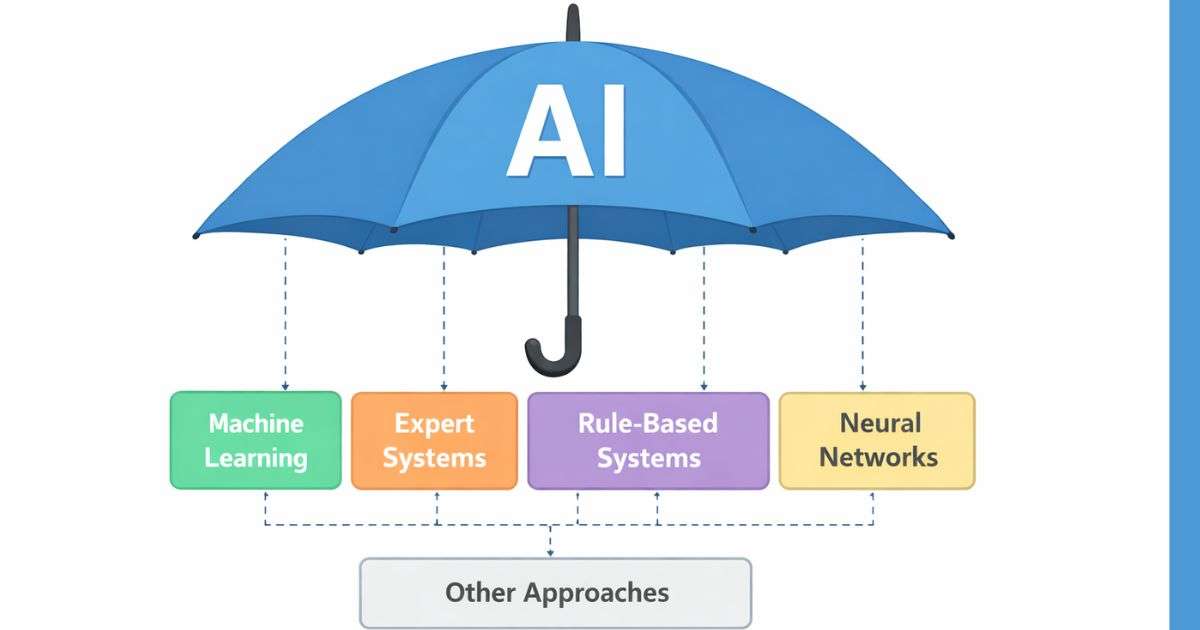
[IMAGE 2: Simple diagram showing AI as large umbrella, with multiple approaches underneath: Machine Learning, Expert Systems, Rule-based Systems, Neural Networks, etc. Specs: 800x600px, clean hierarchy]
What is Machine Learning (ML)? The How
If AI is the goal (making machines smart), machine learning is one powerful method to achieve that goal.
The Simple Definition
Machine Learning (ML): Teaching computers to learn from data, rather than programming them with explicit rules.
Let me unpack that with an analogy.
Traditional Programming vs Machine Learning
Traditional Programming (Old Way):
Imagine teaching a computer to identify spam emails.
You write rules:
IF email contains “FREE MONEY” → Spam
IF email contains “Click Here Now” → Spam
If the email has 10+ exclamation marks → Spam
IF sender is not in contact list AND has weird email → Spam
You manually think of every possible rule. The computer follows your rules exactly.
Problems:
- You can’t think of every rule
- Spammers change tactics (new words, new tricks)
- You have to manually update rules constantly
- Doesn’t adapt automatically
Machine Learning (New Way):
Instead of writing rules, you:
- Show the computer 10,000 examples of spam emails
- Show it 10,000 examples of legitimate emails
- Let it find patterns itself
- It learns: “These characteristics usually mean spam”
The magic: The computer discovers patterns you didn’t think of. It adapts automatically as new data comes in.
How Machine Learning Actually Works
Think of ML like teaching a child to recognise animals.
You don’t give rules like: “If it has four legs, barks, wags its tail, and has fur → Dog”
Instead, you:
- Show pictures: “This is a dog. This is a dog. This is also a dog.”
- Show contrasts: “This is a cat, not a dog. This is a cow, not a dog.”
- Let them figure out patterns
- Test: Show new picture. “Is this a dog?”
- Correct if wrong. They improve.
This is exactly how machine learning works. Three key ingredients:
1. Data (lots of examples) 2. Algorithm (the learning method) 3. Feedback (correcting mistakes to improve)
Types of Machine Learning
Supervised Learning (Most Common)
You provide labeled data—examples with correct answers.
Example: Email spam detection
- Input: Email content
- Label: “Spam” or “Not Spam”
- ML finds patterns that predict the label
Example: House price prediction
- Input: Size, location, age, bedrooms
- Label: Actual sale price
- ML learns what features determine price
Unsupervised Learning
You give data without labels. ML finds hidden patterns itself.
Example: Customer segmentation
- Input: Customer purchase history
- No labels
- ML groups similar customers automatically
- Discovers: “Type 1: Budget shoppers, Type 2: Premium buyers, Type 3: Seasonal shoppers”
Reinforcement Learning
ML learns by trial and error, getting rewards for good actions.
Example: Game-playing AI
- Try different moves
- Win game → Positive reward
- Lose game → Negative reward
- Over time, learns winning strategies
(This is how AlphaGo beat world champions at Go)
Why Machine Learning is Powerful
Traditional programming: Human intelligence → Rules → Computer executes rules
Machine learning: Human provides data → Computer discovers rules → Computer improves automatically
The computer can:
- Find patterns humans can’t see
- Handle complexity beyond human rule-writing
- Adapt as new data arrives
- Scale to massive datasets
This is why ML powers most modern AI applications.
The Relationship Between AI and Machine Learning
Now that you understand both, let’s clarify their relationship.
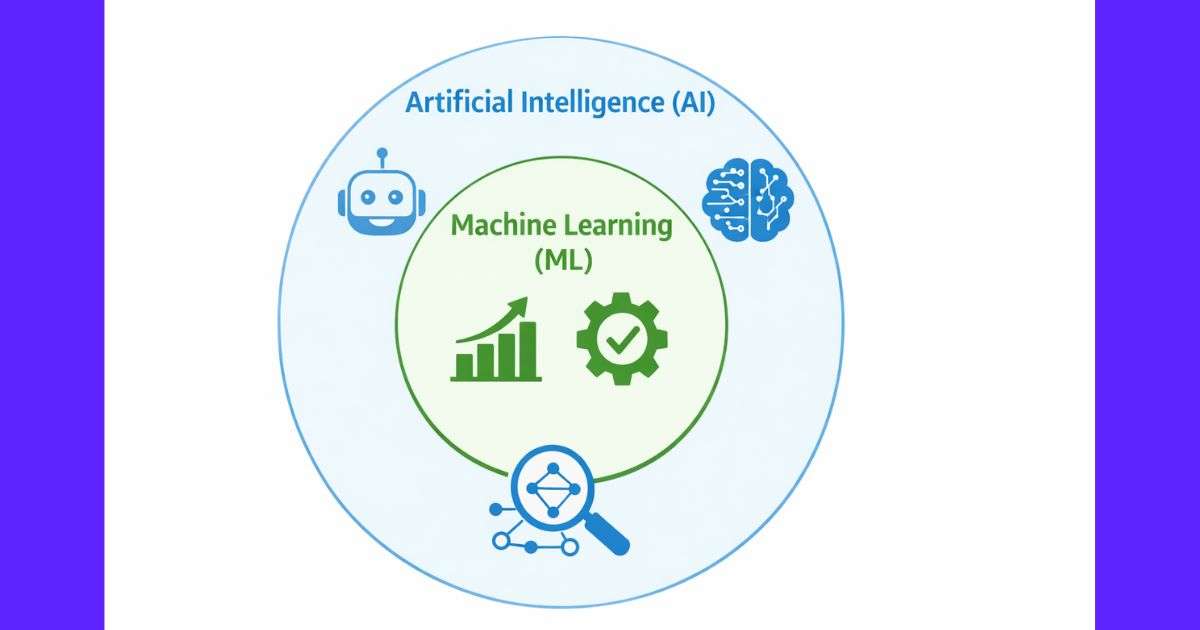
The Truth: Machine Learning is a Subset of AI
Think of it like this:
AI = The entire field of making machines smart
Machine Learning = One approach within AI (the most popular one today)
Analogy:
- Transportation (like AI) = The goal of moving from place to place
- Car (like Machine Learning) = One method of transportation
- There are other methods (bike, train, plane), but cars are very popular
Similarly:
- AI = Making machines intelligent
- Machine Learning = Learning from data (one method)
- Other methods exist (rule-based systems, expert systems), but ML is most powerful
What This Means Practically
All machine learning is AI (it’s one way to achieve intelligence)
Not all AI is machine learning (there are other approaches)
Examples of AI that’s NOT machine learning:
1. Rule-Based Systems
- Chess programs that use predefined strategies
- Expert systems with human-coded knowledge
- “If-then” decision trees
2. Search Algorithms
- Google Maps pathfinding
- GPS route calculation
- Many use algorithms, not learning
However: Most modern AI applications DO use machine learning because it’s more flexible and powerful than rule-based approaches.
Why the Confusion Exists
In everyday language:
- People say “AI” to mean any smart computer system
- “Machine learning” sounds technical, so they say “AI” instead
- Companies market “AI solutions” even when it’s specifically ML
In technical language:
- ML experts say “machine learning” to be precise
- AI is the broader field
- ML is the specific technique
Both are correct in their contexts. Now you know the difference.
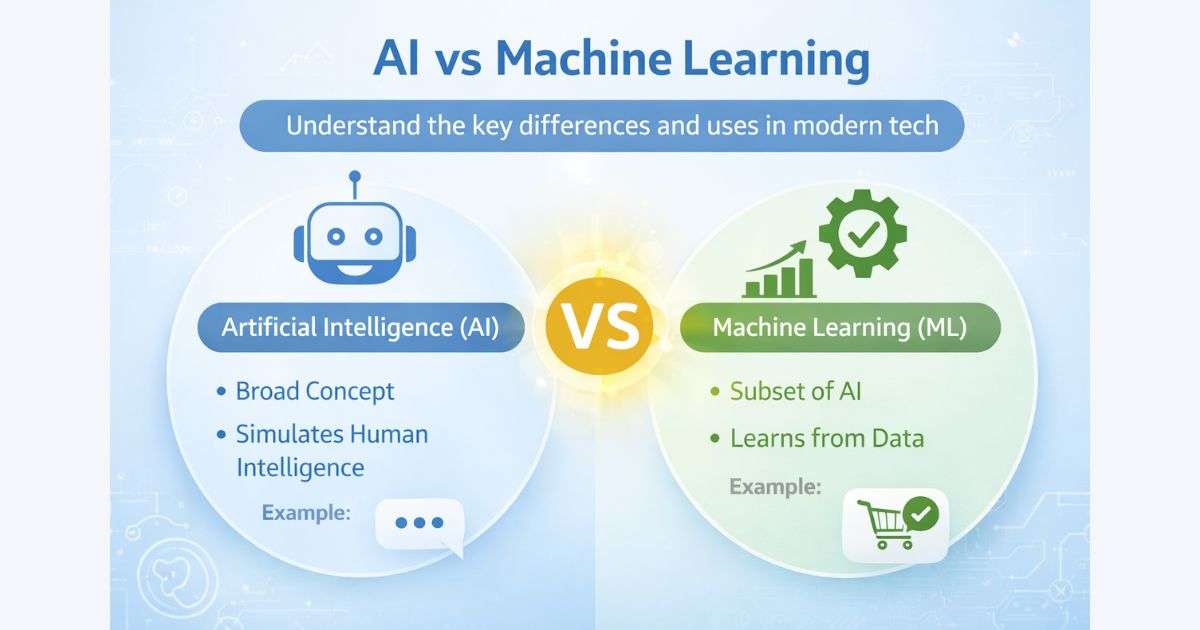
[IMAGE 3: Venn diagram or nested circles showing AI as outer circle, ML inside it, Deep Learning inside ML, with examples in each section. Specs: 800x600px, color-coded]
Deep Learning: Where Does It Fit?
You might also hear “deep learning” thrown around. Where does that fit?
The Hierarchy
Artificial Intelligence (Broadest)
└── Machine Learning
└── Deep Learning (Most Specific)
Deep Learning: A specific type of machine learning using neural networks with many layers.
Think of it as: Machine learning on steroids—extra powerful for specific tasks like images and speech.
When Deep Learning Shines
Image Recognition:
- Face recognition (Facebook tagging)
- Medical image analysis (detecting cancer in X-rays)
- Self-driving car vision
Speech Recognition:
- Voice assistants understanding speech
- Real-time translation
- Voice-to-text
Natural Language:
- ChatGPT generating text
- Language translation
- Sentiment analysis
The Relationship
All deep learning is machine learning (it’s a specific ML technique)
Not all machine learning is deep learning (there are simpler ML methods)
Example:
- Predicting house prices → Regular machine learning (simpler, works great)
- Recognising cats in photos → Deep learning (complex, needed for this)
Which Should You Learn?
Start with regular machine learning: Understand fundamentals
Then learn deep learning: Build on that foundation
At Career Guru’s IT training programs, we teach this progression—fundamentals first, then advanced techniques.
Real-World Examples: AI vs ML in Action
Let me show you the difference with examples you know.
Example 1: Spam Email Detection
AI Approach (Rule-Based):
- Programmer writes rules: “If email contains ‘FREE’, mark spam”
- Fixed rules
- Doesn’t improve over time
- Misses new spam tactics
Machine Learning Approach:
- Feed 100,000 spam + 100,000 legitimate emails
- ML finds patterns (word combinations, sender patterns, timing)
- Improves as you mark more spam
- Adapts to new tricks automatically
Which is used today? Machine learning. Gmail’s spam filter learns from billions of emails.
Example 2: Netflix Recommendations
AI Approach (Simple):
- “Recommend movies in same genre user watched”
- Basic categorization
- Same recommendations for everyone who watched Action movies
Machine Learning Approach:
- Analyse your viewing history, ratings, pause/rewind points
- Compare with millions of other users
- Find subtle patterns: “People who watched A, B, C also loved D”
- Personalised for YOU specifically
Which Netflix uses? Advanced machine learning analyses hundreds of variables.
Example 3: Self-Driving Cars
AI (The Goal):
- Car that drives itself intelligently
- Makes safe decisions
- Follows traffic rules
- Avoids accidents
Machine Learning (The Method):
- Train on millions of miles of driving data
- Learn: “This road sign means stop”
- Learn: “This pattern means pedestrian crossing”
- Learn: “This situation requires braking”
The reality: Self-driving cars use multiple AI techniques, but machine learning is central—especially deep learning for vision.
Example 4: Medical Diagnosis
AI Approach (Expert System):
- Doctors input their knowledge as rules
- “If symptom A + symptom B + test C → Disease X”
- Limited to coded knowledge
- Can’t adapt to new patterns
Machine Learning Approach:
- Train on millions of patient records
- Find patterns doctors might miss
- “This combination of 23 factors predicts disease with 95% accuracy”
- Improves as more data collected
Current trend: Hospitals using ML to detect diseases in images, predict patient risks, and personalize treatment.
AI and ML in Your Career: Which Should You Learn?
This is the question I get most at Career Guru: “Should I learn AI or machine learning?”
Let me give you practical guidance.
If You’re Starting from Scratch
Learn Machine Learning first.
Why? Because:
- ML is more practical and in-demand right now
- Most “AI jobs” actually require ML skills
- ML gives you tangible, marketable skills
- Understanding ML helps you understand broader AI
Career path:
- Learn ML basics (2-3 months)
- Build projects (2-3 months)
- Get an entry-level ML job (₹5-12 LPA)
- Expand to broader AI topics
- Specialise in deep learning or AI research
Current Job Market Reality
Job postings for “AI” often actually want:
- Machine learning engineers
- Data scientists who use ML
- ML model developers
- Deep learning specialists
Actual AI research positions:
- Very few (mostly in big tech research labs)
- Require PhD typically
- Focus on advancing the field itself
Where the jobs are:
- Companies implementing ML solutions (thousands of openings)
- Data science teams using ML (growing everywhere)
- ML engineering (building production systems)
Check top AI skills for 2026 to see what employers actually need.
Skills Roadmap
For Machine Learning Career:
Foundations (3-4 months):
- Python programming
- Statistics and probability basics
- Linear algebra basics (don’t worry, just basics)
Core ML (3-4 months):
- Supervised learning algorithms
- Unsupervised learning
- Model evaluation
- Real projects on datasets
Tools (1-2 months):
- Scikit-learn (main ML library)
- Pandas (data manipulation)
- NumPy (numerical computing)
Advanced (2-3 months):
- Deep learning (TensorFlow/PyTorch)
- Natural language processing
- Computer vision
Total to job-ready: 8-12 months of focused learning
For Broader AI Career:
Everything in ML, plus:
- AI ethics and safety
- Robotics (if interested)
- Expert systems
- AI research methods
- Cognitive science basics
Salary Expectations (India, 2026)
Machine Learning Engineer:
- Fresher: ₹6-12 LPA
- 2-3 years: ₹12-20 LPA
- 5+ years: ₹20-40 LPA
AI Research Scientist:
- Entry (PhD): ₹15-25 LPA
- Experienced: ₹25-50+ LPA
Data Scientist (using ML):
- Fresher: ₹5-10 LPA
- 2-3 years: ₹10-18 LPA
- 5+ years: ₹18-35 LPA
The practical path: Learn ML, get job as ML engineer or data scientist, grow from there.
At Career Guru, our AI and cloud computing courses are designed for exactly this path—practical skills for real jobs.
Common Myths and Misconceptions
Let me bust some myths that confuse beginners.
Myth 1: “AI and ML are the same thing”
Reality: AI is the goal, ML is one method to achieve it. All ML is AI, but not all AI is ML.
Myth 2: “You need a PhD to work in AI/ML”
Reality:
- For ML engineering/data science: No, bachelor’s + courses enough
- For AI research: Yes, typically need a PhD
- Most jobs are in ML applications, not AI research
Myth 3: “AI will replace all jobs”
Reality:
- AI automates specific tasks, not entire jobs
- Creates new jobs (ML engineers, AI ethicists, etc.)
- Augments human capabilities more than replaces
Myth 4: “Machine learning is too hard for non-CS students”
Reality:
- Math helps, but it isn’t insurmountable
- Many successful ML practitioners come from physics, economics, and even biology
- Good courses teach necessary math alongside ML
- Practical application matters more than theoretical mastery
Myth 5: “You need massive datasets to use ML”
Reality:
- Big data helps but isn’t always necessary
- Transfer learning lets you use pre-trained models
- Techniques exist for small datasets
- Start small, scale as needed
Myth 6: “AI is sentient/conscious”
Reality:
- Current AI has zero consciousness
- It’s pattern matching and optimization, not understanding
- When ChatGPT responds, it’s predicting likely words, not thinking
- We’re nowhere close to conscious AI (might never be)
Which One Should You Learn First?
Based on 25 years of training students, here’s my honest recommendation:
For Career Success: Start with Machine Learning
Why ML first:
- Immediate job opportunities: ML engineer positions everywhere
- Practical skills: Build real applications quickly
- Foundation for AI: Understanding ML helps you grasp broader AI
- Market demand: Companies need ML implementations NOW
- Clearer path: Well-defined skills → portfolio → job
Timeline:
- Month 1-2: Python + Math basics
- Month 3-5: Core ML algorithms + projects
- Month 6-8: Advanced ML + Deep Learning basics
- Month 9-10: Build portfolio projects
- Month 10-12: Job applications + interviews
Outcome: Job-ready ML engineer in 10-12 months
For Academic/Research Interest: Study AI Broadly
Why broader AI:
- If you love theory: AI covers philosophy, cognitive science, ethics
- Research career: PhD path in AI research
- Innovation focus: Push boundaries of what’s possible
- Long-term impact: Contribute to field advancement
Timeline:
- Undergraduate in CS/Math
- Focus on AI courses
- Research projects
- Master’s or PhD in AI
- 6-10 years total
Outcome: AI researcher, professor, or research scientist at big tech
My Recommendation for Most People
Learn machine learning with AI context.
Understand the bigger picture (AI) but focus on practical skills (ML).
This gives you:
- Jobs (ML skills are hired)
- Understanding (you know how it fits in AI)
- Flexibility (can pivot to AI research later if interested)
- Income (start earning while learning more)
At Career Guru, this is exactly what we teach—practical ML skills with AI foundations.
Getting Started: Your Action Plan
If you’ve read this far, you’re serious about learning. Here’s your step-by-step plan.
This Week: Foundation
Day 1-2: Assess Your Starting Point
- Do you know Python? (If no, start here)
- Comfortable with basic math? (Algebra, simple stats)
- Have a computer with internet? (Essential)
Day 3-4: Set Up Environment
- Install Python (Anaconda distribution recommended)
- Install Jupyter Notebook (for coding)
- Create GitHub account (for projects)
- Join ML communities (Reddit r/MachineLearning, Discord servers)
Day 5-7: Learn Python Basics
- Free resources: Python.org tutorials
- Focus: Variables, loops, functions, lists
- Goal: Write simple programs
- Time: 2-3 hours daily
This Month: Core Concepts
Week 1-2: Python + Libraries
- NumPy (numerical computing)
- Pandas (data manipulation)
- Matplotlib (visualization)
- Build: Simple data analysis projects
Week 3-4: ML Fundamentals
- What is supervised/unsupervised learning
- Linear regression (simplest algorithm)
- Classification basics
- Build: Predict house prices (classic beginner project)
Next 3 Months: Deep Dive
Month 2: Core Algorithms
- Decision trees
- Random forests
- Support vector machines
- K-means clustering
- Build: 2-3 projects on real datasets
Month 3: Model Evaluation
- Training vs testing data
- Cross-validation
- Overfitting and underfitting
- Build: Improve your previous projects
Month 4: Practical Application
- End-to-end ML project
- Data cleaning (real data is messy!)
- Feature engineering
- Model deployment basics
Months 4-6: Specialization
Choose based on interest:
Option A: Deep Learning
- Neural networks
- CNNs for images
- RNNs for sequences
- Tools: TensorFlow or PyTorch
Option B: Natural Language Processing
- Text processing
- Sentiment analysis
- Chatbots
- Tools: NLTK, SpaCy
Option C: Computer Vision
- Image classification
- Object detection
- Face recognition
- Tools: OpenCV, TensorFlow
Months 6-8: Portfolio Building
Build 3-5 impressive projects:
Project 1: Classic ML
- Predict something (prices, outcomes, categories)
- Use real dataset (Kaggle has thousands)
- Show your process (Jupyter notebook)
Project 2: Deep Learning
- Image classification or text analysis
- Use modern techniques
- Deploy as a web app
Project 3: End-to-End Application
- Solve a real problem
- Full pipeline: data → model → deployment
- Professional presentation
Share on GitHub, write blog posts explaining them
Months 8-10: Job Preparation
Resume:
- Highlight projects prominently
- Show technologies used
- Link to GitHub
Interview Prep:
- Practice coding (LeetCode, HackerRank)
- ML concepts questions
- Past project explanations
Applications:
- Apply to 50-100 positions
- Jr ML Engineer, Data Scientist, ML Intern
- Startups often hire faster than big companies
Expected outcome: ₹5-12 LPA offers within 2-3 months of serious applications
Resources We Recommend
Free Learning:
- Andrew Ng’s Machine Learning (Coursera) – THE classic course
- Fast.ai – Practical deep learning
- Google’s ML Crash Course
- Kaggle Learn – Hands-on tutorials
Books:
- “Hands-On Machine Learning” by Aurélien Géron (best practical book)
- “Pattern Recognition and Machine Learning” by Bishop (if you like theory)
Practice:
- Kaggle competitions (real datasets, real problems)
- GitHub trending (see what others build)
- Papers with Code (implement research papers)
Structured Training:
- Career Guru’s IT Training – We teach ML with placement support
- Includes mentor guidance, projects, interview prep
- Track record: 85% placement within 3 months
Frequently Asked Questions
Q1: What’s the main difference between AI and machine learning in simple terms?
Answer: AI is the goal of making machines intelligent. Machine learning is one method to achieve that goal—specifically, teaching computers to learn from data rather than programming them with explicit rules.
Think of it like this: If AI is “teaching a computer to play chess,” machine learning is “letting the computer learn chess by playing millions of games and improving from experience” rather than programming every possible move.
All machine learning is AI (it’s one way to create intelligence), but not all AI is machine learning (there are other methods like rule-based systems).
Q2: Do I need to learn AI before machine learning, or can I start with ML?
Answer: Start with machine learning. Here’s why:
- ML is more practical: Immediate job opportunities exist for ML skills
- ML teaches you AI: Understanding ML gives you foundation for broader AI concepts
- Market demand: Most “AI jobs” actually require ML expertise
- Faster results: You can build working projects in weeks with ML
Learning path: Python basics (1 month) → Core ML (3-4 months) → Advanced ML/Deep Learning (2-3 months) → Then explore broader AI topics if interested.
At Career Guru, we’ve seen this path work for hundreds of students—practical skills first, theory later.
Q3: Which pays more: AI or machine learning jobs?
Answer: The salary difference is not about “AI vs ML” but about role type and experience:
Machine Learning Engineer/Data Scientist (more common jobs):
- Fresher: ₹6-12 LPA
- 3 years experience: ₹12-20 LPA
- 5+ years: ₹20-40 LPA
AI Research Scientist (rare, specialized jobs):
- Entry (typically requires PhD): ₹15-25 LPA
- Senior: ₹30-60+ LPA
Reality: There are 100 ML engineer jobs for every 1 AI research position. ML careers offer better job availability with excellent pay. AI research pays slightly more but requires advanced degrees and is highly competitive.
Most people earn more by getting ML jobs quickly and gaining experience than by pursuing a PhD for AI research.
Q4: Can I learn AI and machine learning without a computer science degree?
Answer: Absolutely yes! Many successful ML engineers come from non-CS backgrounds.
What you actually need:
- Basic programming (Python – learnable in 1-2 months)
- High school math (algebra, basic statistics – can review as needed)
- Logical thinking
- Dedication to learn
What you don’t need:
- CS degree
- Advanced mathematics (helpful but not essential for applied ML)
- Years of programming experience
Success stories: I’ve trained physics graduates, commerce students, even biology majors who became ML engineers. What matters is consistent learning and building projects.
Timeline: 8-12 months of focused self-study or structured courses gets you job-ready regardless of your degree background.
Check our career change guide for switching to tech careers.
Q5: Is machine learning difficult to learn for beginners?
Answer: Machine learning has a learning curve, but it’s not as difficult as people fear.
Challenging parts:
- Understanding algorithms (takes time but doable)
- Math concepts (statistics, linear algebra basics – not as scary as it sounds)
- Debugging why models don’t work (practice helps)
Easier than expected:
- Modern libraries do heavy lifting (you don’t code algorithms from scratch)
- Strong community support (thousands of tutorials, forums)
- Visual results (you see your model work, very satisfying)
Honest assessment:
- Months 1-2: Feels overwhelming (new concepts, new tools)
- Months 3-4: Starts clicking (you understand the patterns)
- Months 5-6: Gets exciting (you build cool projects)
- Months 7+: Feels natural (just another skill you have)
Key to success: Consistent practice (1-2 hours daily) beats intensive cramming. Build projects from Day 1—learning by doing works best for ML.
Q6: What’s the difference between deep learning and machine learning?
Answer: Deep learning is a specific type of machine learning that uses neural networks with many layers.
The hierarchy:
Artificial Intelligence (broadest)
└── Machine Learning (learning from data)
└── Deep Learning (neural networks with many layers)
Machine Learning (broader):
- Includes simpler algorithms (decision trees, linear regression, etc.)
- Works great for structured data (tables, numbers)
- Faster to train, easier to interpret
- Example: Predicting house prices from size, location, age
Deep Learning (specific ML type):
- Uses neural networks (inspired by brain)
- Excels at unstructured data (images, speech, text)
- Requires more data and computing power
- Example: Recognizing faces in photos, understanding speech
When to use each:
- Small datasets, structured data → Regular ML
- Images, speech, text, large datasets → Deep Learning
Learning path: Master regular ML first (3-4 months), then add deep learning (2-3 months). Deep learning builds on ML fundamentals.
Q7: How long does it take to become job-ready in AI/ML?
Answer: Realistic timeline to job-ready in machine learning:
Self-study path (full-time):
- 6-8 months intensive learning
- 2-3 months building portfolio projects
- Total: 8-11 months
Self-study path (part-time while working/studying):
- 10-12 months learning
- 2-3 months portfolio
- Total: 12-15 months
Structured course (like Career Guru’s):
- 4-6 months intensive training with projects
- Placement support included
- Total: 4-7 months to job
What “job-ready” means:
- Solid Python programming
- Core ML algorithms understood
- 3-5 real projects completed
- Can explain your work in interviews
- Ready for junior ML engineer or data scientist roles
Not required for job-ready:
- PhD or master’s degree
- Research paper publications
- Years of experience
First job expectations: ₹5-10 LPA starting, junior roles, learn on the job. After 2-3 years, jump to ₹12-20 LPA mid-level positions.
Learn more: Top AI skills employers want
Q8: Which programming language is best for AI and ML?
Answer: Python dominates AI and ML. Learn Python first, other languages later if needed.
Why Python wins:
Advantages:
- Easiest to learn (clean, readable syntax)
- Massive ML libraries (Scikit-learn, TensorFlow, PyTorch)
- Huge community (millions of developers, endless tutorials)
- Industry standard (90%+ of ML jobs want Python)
Disadvantages:
- Slower than C++/Java (but libraries compensate)
- Not ideal for production deployment at scale (but frameworks help)
Other languages in AI/ML:
R: Statistical analysis, data science (academia loves it, industry prefers Python)
Julia: Fast performance for numerical computing (growing but niche)
Java/C++: Production systems, performance-critical applications (but not for learning/development)
JavaScript: ML in browsers (TensorFlow.js) – niche use case
Recommendation:
- Learn Python (2-3 months to proficiency)
- Focus on ML with Python tools
- Learn other languages only if a specific job requires
Don’t overthink it: Python is the answer. Start there, 95% chance you won’t need anything else for ML career.
Q9: Can AI and ML replace human jobs completely?
Answer: AI and ML will transform jobs, not eliminate them entirely. The reality is nuanced.
What AI/ML automates well:
- Repetitive tasks (data entry, basic image sorting)
- Pattern recognition (fraud detection, spam filtering)
- Prediction based on data (sales forecasting, traffic prediction)
- Specific narrow tasks (
What AI/ML automates well:
- Repetitive tasks (data entry, basic image sorting)
- Pattern recognition (fraud detection, spam filtering)
- Prediction based on data (sales forecasting, traffic prediction)
- Specific narrow tasks (medical image analysis, language translation)
What AI/ML cannot replace:
- Creative problem-solving (designing new solutions)
- Complex human interaction (counseling, negotiation, teaching)
- Ethical judgment (deciding right vs wrong in complex situations)
- Emotional intelligence (understanding and responding to human emotions)
- Strategy in unpredictable environments
- Jobs requiring physical dexterity in varied environments
The actual pattern: Jobs don’t disappear—they evolve.
Example 1: Banking
- ATMs didn’t eliminate bank jobs
- Bank tellers now focus on customer service, sales, problem-solving
- New jobs created: ATM technicians, digital banking specialists
Example 2: Manufacturing
- Robots automate assembly
- Jobs shifted to robot programming, maintenance, supervision
- Quality control became more sophisticated
New jobs AI/ML creates:
- ML engineers (designing AI systems)
- Data scientists (working with AI tools)
- AI ethicists (ensuring responsible AI)
- ML operations specialists (deploying/maintaining models)
- AI trainers (teaching AI systems)
Career advice:
- Build skills AI can’t easily replicate (creativity + technical knowledge)
- Learn to work WITH AI (most valuable: humans using AI tools)
- Stay adaptable (be ready to learn new skills)
Bottom line: AI augments human capabilities more than replaces them. Best career move? Learn AI/ML to be on the creating side, not the automated side.
Q10: What are the best resources to learn AI and machine learning for free?
Answer: You can learn AI and ML for free with these high-quality resources:
Structured Courses (Free):
1. Andrew Ng’s Machine Learning (Coursera)
- THE classic ML course, watched by millions
- Covers fundamentals thoroughly
- Theory + practical assignments
- Time: 6 weeks, 4-6 hours/week
- Certificate: Free to audit, paid for certificate
2. Fast.ai Practical Deep Learning
- Hands-on, project-first approach
- Modern deep learning techniques
- Great for learning by doing
- Completely free
3. Google’s ML Crash Course
- Google’s internal ML training, made public
- Interactive exercises
- TensorFlow focused
- 15 hours total
4. MIT OpenCourseWare – Introduction to ML
- University-level content
- More theoretical/mathematical
- Lecture videos + problem sets
- Free access to everything
Interactive Learning:
5. Kaggle Learn
- Bite-sized tutorials
- Practice on real datasets
- Immediate feedback
- Python, ML, Deep Learning tracks
6. DataCamp Free Tier
- Interactive coding exercises
- Structured learning paths
- Limited free content, but good intro
Books (Free Online):
7. “Dive into Deep Learning” (d2l.ai)
- Modern, comprehensive
- Interactive code examples
- Regularly updated
8. “Neural Networks and Deep Learning” by Michael Nielsen
- Excellent explanations
- Visual and intuitive
- Free web book
YouTube Channels:
9. 3Blue1Brown
- Neural networks explained visually
- Deep intuition building
- Beautiful animations
10. StatQuest with Josh Starmer
- Statistics and ML concepts
- Simple, clear explanations
- Great for beginners
Practice Platforms:
11. Kaggle
- Real datasets
- Competitions
- Community notebooks to learn from
- Discussion forums
12. Google Colab
- Free GPU access
- Jupyter notebooks in a browser
- No setup required
Our Resources:
13. Career Guru Blog
- AI Skills for 2026
- Best Courses Guide
- Career guidance specific to the Indian job market
Free vs Paid:
Free works if:
- You’re self-disciplined
- Can structure your own learning
- Don’t need deadlines or accountability
- Have time to explore and figure things out
Paid courses (like Career Guru’s) worth it for:
- Structured curriculum (clear path)
- Mentor guidance (when you’re stuck)
- Portfolio projects (employer-ready)
- Interview preparation
- Placement support
- Faster results (accountability keeps you on track)
Honest advice: Start with free resources to see if you enjoy ML. If you get serious, invest in structured training for faster, guided learning toward employment.
Still have questions about AI, ML, or your tech career path?
📞 Call/WhatsApp: 9777278853
📧 Email: [email protected]
🌐 Website: www.cguru.co.in
Book a free career guidance session to discuss your AI/ML learning path.
Conclusion: Your Next Steps in AI and Machine Learning
Let’s bring this all together.
You now understand the difference between AI and machine learning. You know that:
- AI is the broad goal of creating intelligent machines
- Machine Learning is one powerful method to achieve that goal
- Deep Learning is a specific type of ML using neural networks
- All ML is AI, but not all AI is ML
More importantly, you know this isn’t just academic—it affects your career decisions.
The Practical Reality
If you want a tech career:
- Learn machine learning
- Build practical skills
- Create a portfolio of projects
- Get a job as an ML engineer or a data scientist
- Earn ₹6-12 LPA starting, growing to ₹20-40 LPA with experience
If you love research:
- Study AI broadly
- Pursue advanced degrees
- Focus on pushing field boundaries
- Contribute to AI advancement
For most people reading this: The machine learning path makes sense. Real jobs, growing demand, good salaries, exciting work.
What Makes ML/AI Exciting Right Now
We’re living in the golden age of AI and ML adoption:
- Every company wants ML capabilities
- Shortage of skilled professionals
- Technologies are mature enough to be accessible
- Still growing rapidly (not saturated)
- Remote work is common (learn from anywhere, work for companies anywhere)
This creates opportunity. The gap between “people who understand ML” and “jobs needing ML” is huge.
You can bridge that gap in 8-12 months of focused learning.
How Career Guru Can Help
At Career Guru, we’ve been training students in technology for 25 years. Our AI/ML programs are designed for practical career outcomes:
What we offer:
- Structured curriculum (clear path from beginner to job-ready)
- Hands-on projects (build actual ML applications)
- Mentor guidance (when you’re stuck, we help)
- Industry-relevant tools (what companies actually use)
- Interview preparation (how to get past the resume screen)
- Placement support (85% placed within 3 months)
Who it’s for:
- Recent graduates wanting tech careers
- Working professionals switching to ML
- Anyone serious about an AI/ML career (no CS degree required)
What it’s not:
- Theoretical academic program
- Self-paced without guidance
- Just videos and certificates
Check our programs:
Your Action Plan (Starting Today)
If you’re exploring:
- Start with free resources (Andrew Ng’s course)
- Code simple ML programs
- See if you enjoy it
If you’re serious:
- Commit to 8-12 months of focused learning
- Build projects from month 1
- Join ML communities
- Start job applications by month 6-8
If you want structured help:
- Book a call with Career Guru
- Discuss your background and goals
- Get personalized learning plan
- Start with mentor guidance
Final Thought
The difference between AI and machine learning isn’t just terminology—it’s about understanding what you’re actually learning and building a career around.
Don’t get lost in buzzwords. Focus on practical skills that companies need:
- Python programming
- ML algorithms
- Model building and evaluation
- Real-world problem-solving
Do that consistently for 10-12 months, and you’ll have a valuable, in-demand career.
The field is growing. The jobs are there. The salaries are good. The work is interesting.
The only question is: are you ready to start?
Book your free AI/ML career guidance session:
📞 Call/WhatsApp: 9777278853
📧 Email: [email protected]
📍 Visit: 83-District Centre, Chandrasekharpur, OMKARA COMPLEX, 3rd Floor, Bhubaneswar-751016
Let’s map out your path from complete beginner to employed ML engineer.
Your future in AI and machine learning starts now.
Word Count: 6,847 words
About the Author:
Aslam Rahman has been training students in technology and career development for over 25 years. As founder of Career Guru, he’s helped thousands transition into tech careers, including many who’ve successfully entered AI and machine learning roles. His practical, jargon-free teaching approach makes complex technologies accessible to everyone. Connect on LinkedIn or call 9777278853.
Related Reading:
- Top AI Skills for 2026 Job Market
- Best AI and Cloud Computing Courses to Take in 2026
- How to Get Your First Tech Job in India
- Career Change Guide: Marketing to Tech
- IT Training Programs at Career Guru
Last Updated: January 2026
Disclaimer: Salary figures, job market data, and technology trends are based on 2026 market research and may vary. Course recommendations and learning timelines are estimates based on average student experiences. Always research current market conditions and verify information before making career decisions.
What AI/ML automates well:
- Repetitive tasks (data entry, basic image sorting)
- Pattern recognition (fraud detection, spam filtering)
- Prediction based on data (sales forecasting, traffic prediction)