
Background Verification for Freshers (BGV) – A 27+ Years Career Mentor’s Honest Guide to Clearing It Without Panic (2027)
(Company steps and agency rules change from drive to drive. News and law details come from the sources linked below. Please follow the list in your own BGV email and check official pages before you act.)
Background verification for freshers is the step nobody explains until the email lands in your inbox.
You cleared the test. You cleared the interview. The offer letter came. Then a mail arrives from an agency you have never heard of. It wants your 10th marksheet, your Aadhaar and a signed consent form. Your stomach drops.
Take a breath. In 27 years, I have guided many students through this stage. Most clear it without any drama. The ones who struggle usually started late or guessed their way through.
This guide shows you how to handle background verification for freshers with a clean folder, a simple self-check and a few honest emails.
What background verification for freshers really means
BGV is short for background verification. The company checks that what you told them is true. Your resume, your form and your interview answers are matched with official records.
It is not a second interview. Nobody is judging your character here. An agency is comparing names, dates and marks. That is all.
Most big employers do not run this check themselves. They hire a screening agency. AuthBridge, HireRight and IDfy are some names you may see. Your BGV email will tell you which one handles your file.
Background verification for freshers usually starts after you accept the offer. Joining is often tied to it. Many offer letters carry one line saying joining is subject to satisfactory verification. Students skip that line. Please read it today.
What the 2026 news says about background verification for freshers
Let me give you facts, not WhatsApp rumours.
A July 2026 news report, carried by HFS Research, described emails sent to some Cognizant GenC recruits. The mails said joining dates depended on business needs, on successful BGV and on delays at the EPFO’s UAN portal. One mail blamed downtime on the UAN website. Cognizant told the reporter it remains committed to honouring its offers. You can read the full report here.
What does this mean for you? Two things.
First, background verification for freshers is now part of your joining timeline. A pending BGV can sit next to business delays. Second, a delay is not always your fault. Sometimes a portal is down or a queue is long.
If your date is slipping, my guide on offer letter but no joining date shows what to do while you wait. My look at IT hiring for the 2027 batch explains the wider picture.
What gets checked in background verification for freshers
Entry-level checks are usually short. Each employer picks its own list. Banks and client-facing projects may go deeper. Here is the common set.
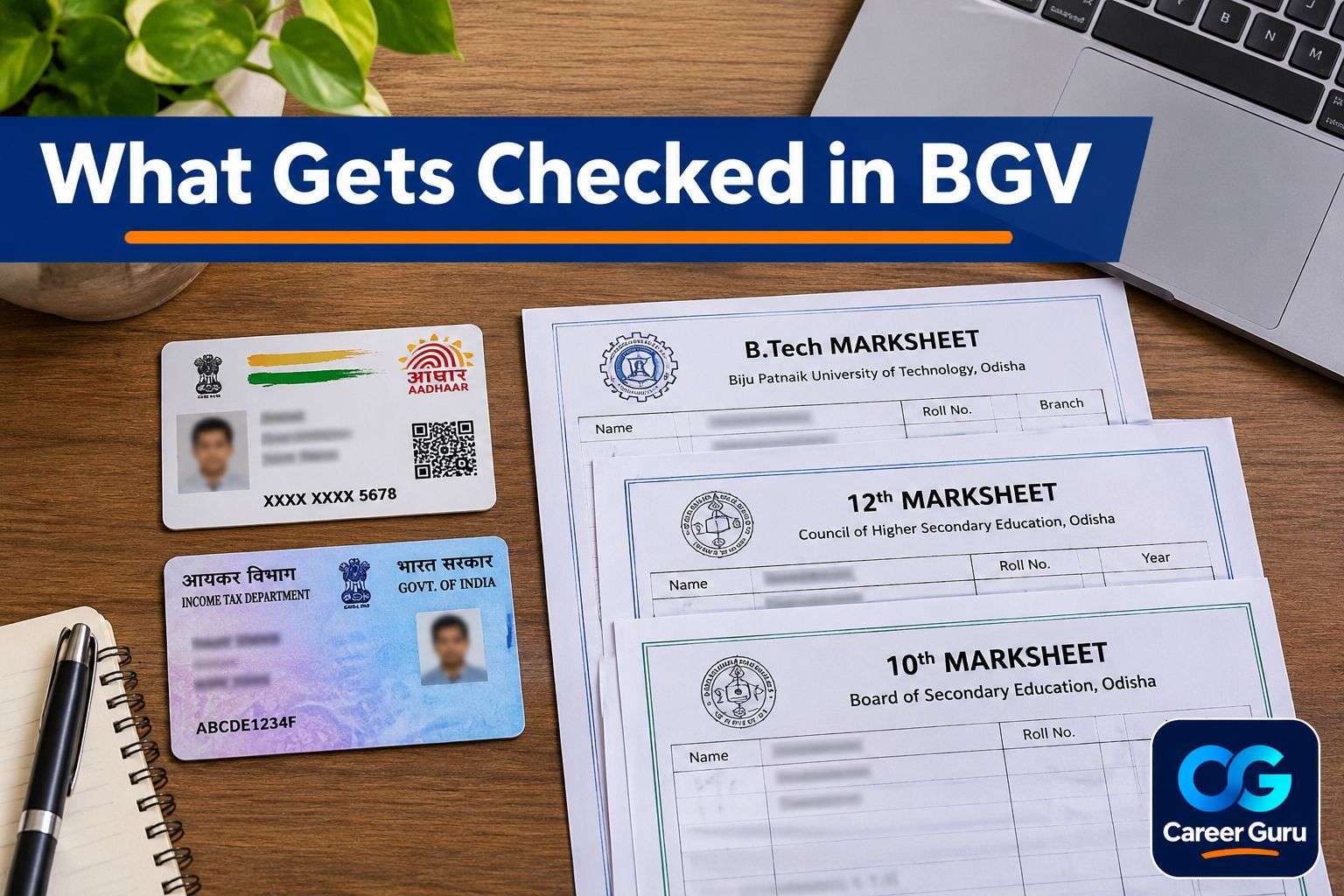
- Identity. Your name, date of birth, Aadhaar and PAN.
- Education. 10th, 12th or diploma, semester marksheets and your degree or provisional certificate.
- Address. Whether you live where you say you do.
- Internship. Company, role and dates, if you listed one.
- Court or police record. Only for some employers and roles.
- Reference. Sometimes a professor or your placement officer.
Work experience checks are usually skipped when you have none. If your email is not clear, ask HR politely which checks apply to you.
How background verification for freshers flows, step by step
The path is almost the same everywhere.
- Initiation mail. HR or the agency sends a portal link, a document list and a deadline.
- Consent and form. You sign an authorisation. You enter your name, date of birth, education, internships and addresses.
- Upload. You upload scans. They must be clear and must match your form.
- Verification. The agency checks records. Some checks are instant. Others need a university reply or a field visit.
- Report. Each check comes back clear, pending or with a query.
- HR decision. A clean report leads to your joining date. A small query leads to a clarification mail.
Check your spam folder every day. Agency mails often land there. Tell your parents and your college that a call or a visit may come.
One more thing. A genuine agency never asks you for money. If anyone wants a fee to “clear” your BGV, stop. Read my guide on fake job offers for freshers first.
Your document checklist for background verification for freshers
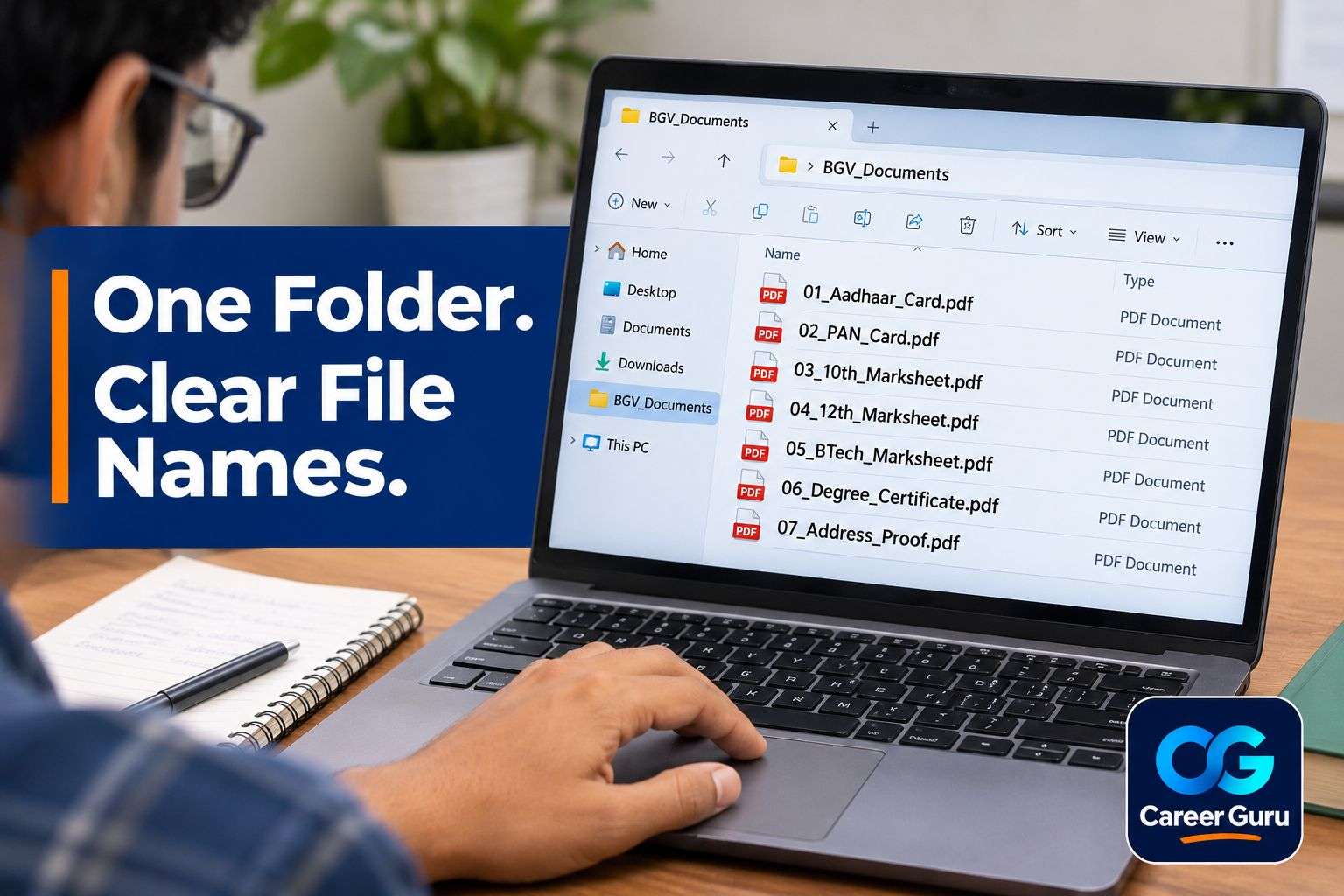
Start on the day you accept the offer. Keep clear PDF scans in one folder. Name them well, like Btech_Sem5_Marksheet.pdf.
Identity: Aadhaar, PAN, a passport if you have one and a recent photo.
Education: 10th and 12th (or diploma) marksheets and certificates. All semester marksheets or one consolidated marksheet. Your provisional or degree certificate. Backlog clearance marksheets, if any. Any course certificate you listed on your resume.
Address: Aadhaar with your current address, a recent electricity bill or a rent agreement. Keep proof for your permanent address too, if it is different.
Internship: Offer letter, completion certificate and the name and email of the person who can confirm it.
If needed: A name-variation affidavit. A short note for any gap in your studies.
My top tip is DigiLocker. If your university or board has lodged your records there, verification gets faster. The National Academic Depository says it notifies you by email or SMS when an employer asks to verify your certificate. Your consent comes first. If you get such a request after accepting an offer, check that it is real and approve it quickly. You can read the official NAD FAQ here.
Is your final certificate not ready? Ask your college for a bonafide or course-completion letter. Many employers accept it for a while. Tell HR when the certificate will arrive.
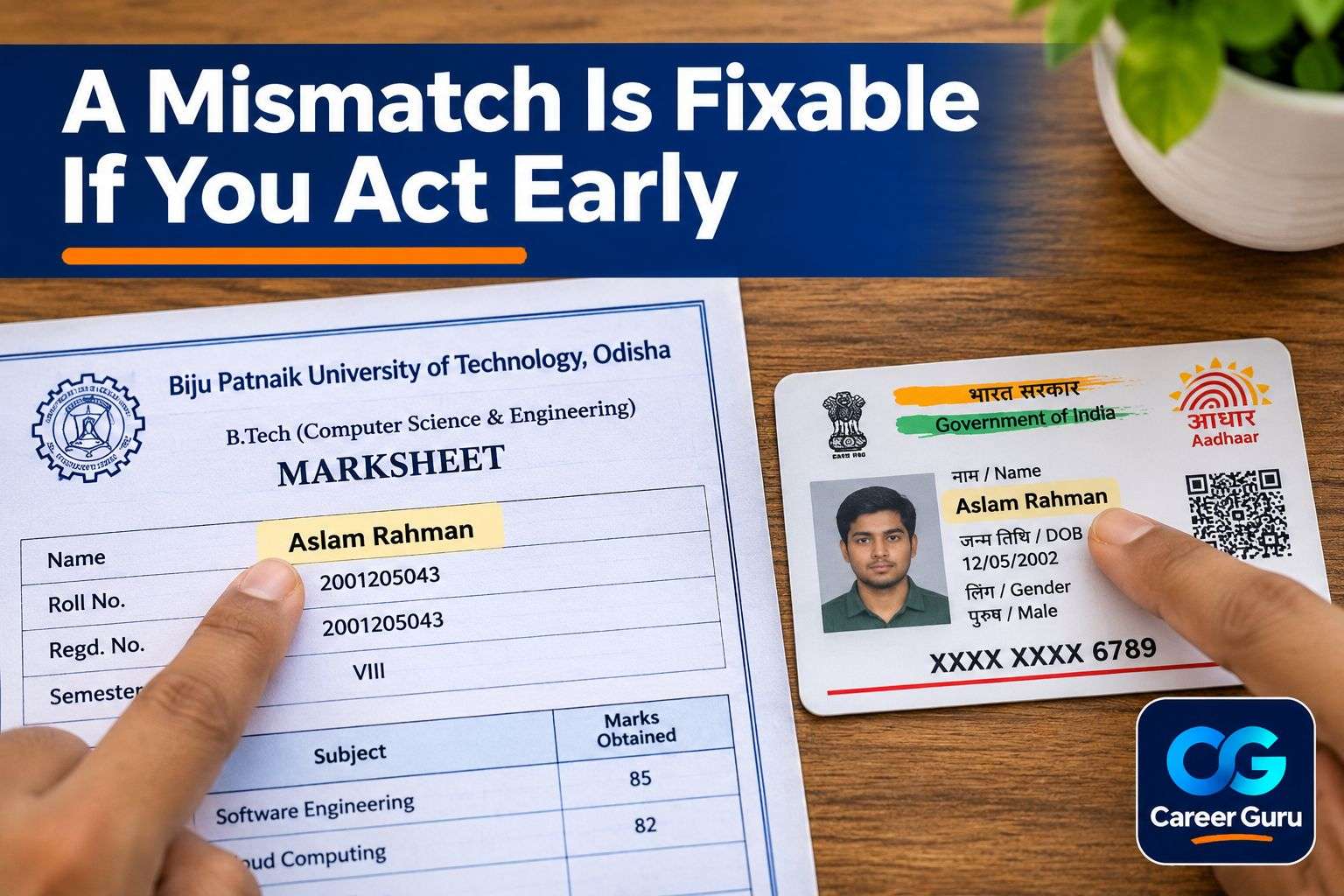
Name, date of birth and marks mismatch in background verification for freshers
Now the part that scares students most. A mismatch.
A mismatch simply means your form says one thing and the record says another. Most mismatches in background verification for freshers are honest slips. They are fixable. Here are the common ones.
- Name spelling. Your surname may read Mohapatra on one paper and Mahapatra on another. Or one document has your full name and another has only initials. I see this every year.
- Date of birth. Your 10th certificate and Aadhaar show different dates.
- Address. Your Aadhaar shows your village. You live in a hostel.
- CGPA. Your resume shows the average of your best semesters. The marksheet shows the overall figure.
- Dates and names. The year or college name on your resume is not the same as on your certificate.
One university notice to students about a Cognizant campus drive warned that BGV can fail when the last name is not updated or the PAN name does not match the registered name. You can see that notice here. It is one college’s letter. But the lesson is simple. Make your names agree before the agency checks them.
Here is how to fix each one early.
- For spelling, get a name-variation affidavit and attach it with your first upload.
- For date of birth, start the correction at once. It takes time.
- For address, add a bill or a rent agreement.
- For CGPA, fix your resume today and use the marksheet figure.
Here is the line I want you to remember. A mistake is fixable. An altered or invented fact is not.
Never edit a scan. Never cover a detail with a sticker or a pen. Never buy an experience letter or an internship certificate from a “consultancy”. Some employment checks can be matched against your PF record. A paper that cannot be confirmed creates a bigger problem than the one you tried to hide.
What about backlogs and gaps? They do not fail BGV by themselves. The check is whether you declared them truthfully. If your marksheet shows a backlog, show it on your form too. My post on jobs for freshers with backlogs tells you how to talk about it.
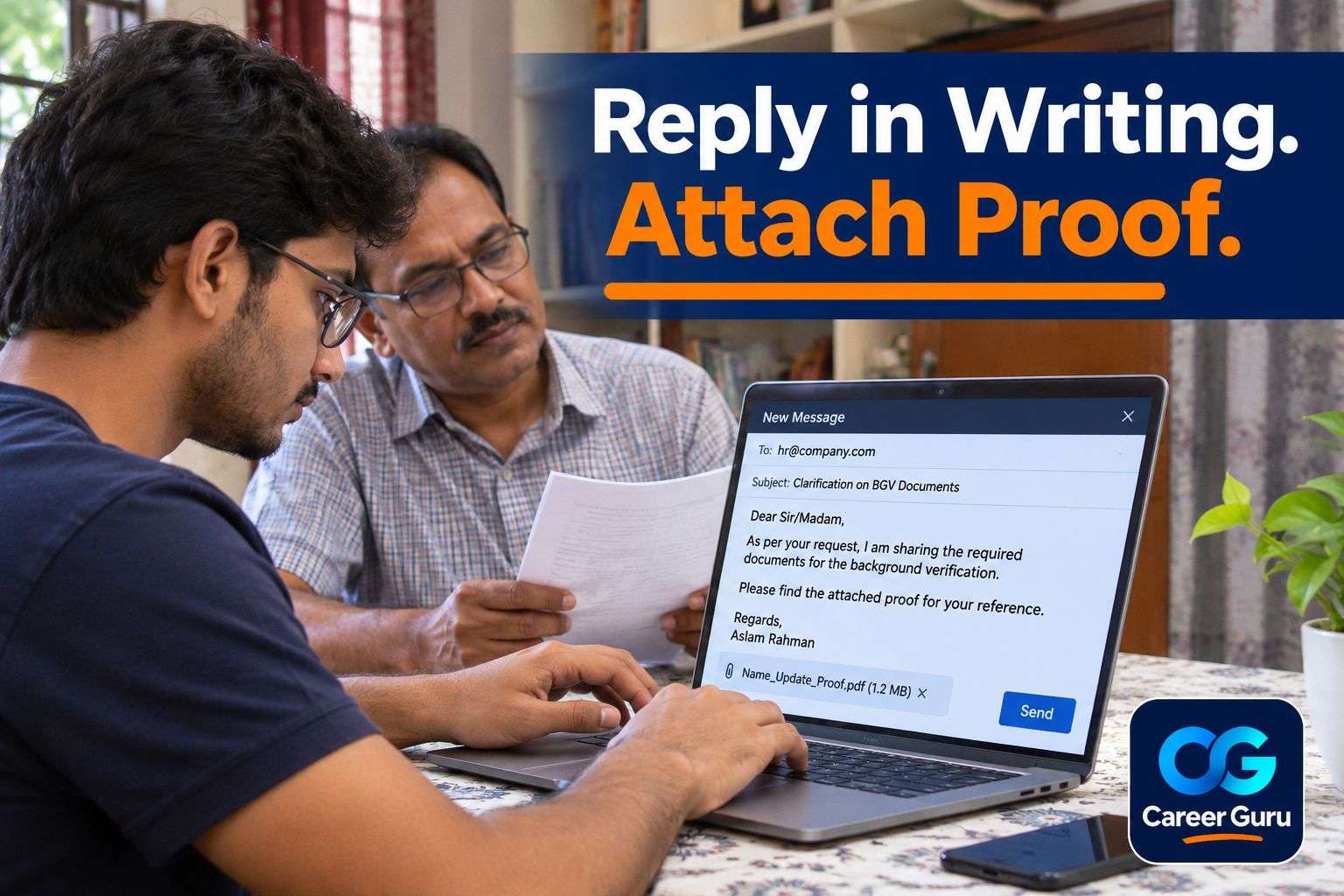
How to reply to a query in background verification for freshers
If the agency or HR flags something, do not panic. Do not go silent either. HR usually asks you to explain before deciding.
Follow this order.
- Read the exact query. Ask HR to name the field if it is unclear.
- Open your original papers. Find out where the error came from.
- Reply in writing within one or two days.
- Attach proof.
- Offer a fix, like an affidavit or a corrected certificate.
- Never make up a story. If you do not know, say so and offer to find out.
A short reply works best. Here is a model for a CGPA mismatch.
Subject: Clarification on BGV query – [Your Name]
Dear [HR Name],
Thank you for flagging the CGPA difference. I entered 8.2 on my resume. That was the average of my last four semesters. My consolidated marksheet shows 7.9 overall and it is attached. I am sorry for the confusion. I am happy to submit a corrected declaration.
Regards, [Name, phone number, offer reference]
See how it is honest, specific and easy to approve.
How long does background verification for freshers take?
Guides I read give a range from a few days to about three weeks. Freshers are often faster because there is little work history to check. But your own email is the final word.
What slows things down is rarely the agency. It is usually one of these.
- A missing or blurry upload.
- A university that replies slowly.
- An internship company that never answers.
- An address in a remote place that needs a field visit.
You can influence all four. Upload clean files on day one. Warn your college. Tell your internship supervisor to expect a mail. Keep someone at home who can confirm your address.
If three weeks pass with no update, send one polite status mail. Keep it short. Give your name, offer reference and the date you uploaded. Ask whether anything is pending from your side. Do not write every day.
Your data rights in background verification for freshers
Your documents carry sensitive data. You have a say in how it is used.
India notified the Digital Personal Data Protection Rules on 14 November 2025. The government’s own backgrounder says organisations must give a separate, clear consent notice that states the purpose. The rules roll out in phases over 18 months, so practice still differs between companies. You can read the PIB backgrounder here.
So use common sense.
- Read the consent form before you sign.
- Share only what the BGV email asks for.
- Ask if a masked Aadhaar copy is accepted.
- If a record about you is wrong, ask HR for a correction in writing.
I am not a lawyer. This is general information. If you face a serious dispute, take advice from a qualified person.
Five mistakes that hurt background verification for freshers
These are the slips I see most in background verification for freshers.
- Ignoring the agency email because it landed in spam.
- Giving a wrong phone number or an old address.
- Uploading a dark, cropped or half-cut scan.
- Quoting a CGPA from memory instead of the marksheet.
- Hiding a backlog or a gap that the marksheet already shows.
Add one more. Do not stop applying elsewhere just because BGV is running. A pending check can sit next to a slow joining date. Keep your Plan B alive.
Action steps by college year for background verification for freshers
First year: Keep your 10th and 12th certificates safe. Make clear scans today. Check your name spelling on each paper.
Second year: Compare your name and date of birth on Aadhaar, PAN and school papers. If anything differs, start the fix now. Corrections can take months.
Third year: Open DigiLocker and see which of your records are there. If you do an internship, ask for a proper letter with dates. Keep your supervisor’s contact.
Final year: Build the folder in one place. Write your resume from the marksheet, not from memory. Read the verification clause before you accept an offer. Answer every agency mail within a day.
Already graduated and waiting: Do a full self-check this week. Ask your college for any missing certificate. Reply to every mail in writing. While BGV runs, build skills. Short programs, including those from Rooman Technologies, are one option if the syllabus fits your branch. Check the syllabus before you pay.
When your joining date is confirmed, read my guides on CTC vs in-hand salary and the first day at an IT company.
Videos worth watching
If you prefer to listen, these three videos explain the BGV process:
- What HR really checks in background verification
- Cognizant offer letter and background verification process explained
- Background verification process explained: BGV checks in MNC
My closing note on background verification for freshers
Background verification for freshers feels big because nobody explains it. Once you see it, it is small. It is your own record matched against your own resume.
Clearing background verification for freshers comes down to simple things. Collect your papers. Match the names. Be honest about backlogs and gaps. Reply on time.

If you do these, you walk through background verification for freshers like any other form. If something does not match, you already know what to do. You fix it early, in writing, with proof. Do not wait for the email. Start your folder tonight.
FAQs: background verification for freshers
1. What is background verification for freshers, and why do companies do it?
Background verification for freshers is a check of your records. The company matches your resume and form with official papers. It confirms your identity, your education and your address. Sometimes it covers internships and court records. Companies do it to avoid hiring on wrong information. It also protects them when they place you on a client project. It is a routine step, not an accusation. Most freshers clear it when their papers match their resume.
Consultant’s Note: I tell students that BGV is a mirror. If your papers and your resume agree, there is nothing to fear.
2. Which documents do I need for background verification for freshers?
Start with identity papers. These are Aadhaar and PAN. Add your 10th and 12th or diploma marksheets. Keep all semester marksheets and your provisional or degree certificate. Keep one address proof, like Aadhaar or a recent electricity bill. If you did an internship, keep the letter and your supervisor’s contact. Some employers also ask for a recent photo and a signed consent form. Your own BGV email has the final list. Follow that list and not a forum post.
Consultant’s Note: When a student shows me a messy phone gallery, I know the stress is coming. A neat folder removes half of it.
3. How long does background verification for freshers take?
It depends. Guides I read mention anything from a few days to about three weeks. Freshers are often quicker because there is no job history to check. Slow replies from a university or an internship company cause most delays. A blurry upload also costs days. Upload clean files on the first day. A portal problem at the company’s end can add days too, as the 2026 news showed. If three weeks pass with no update, send one polite status mail. Do not write every day.
Consultant’s Note: Speed is mostly in your hands. Clean uploads and a reachable phone number save more time than any follow-up mail.
4. Can a name or date of birth mismatch fail background verification for freshers?
A small spelling difference rarely ends an offer. It usually leads to a query. You then show proof, like an affidavit or a corrected paper. A date of birth difference is more serious, so start the fix early. It takes time to correct. Reply to any query in writing and attach proof. The real danger is silence or an altered document. Do not edit scans.
An honest mismatch can be explained. A changed paper creates a new problem. If you are unsure, ask your college office or an elder before you reply.
Consultant’s Note: Names are the most common trouble I see. Match them on every paper before the agency does it for you.
5. Will backlogs or a gap year fail background verification for freshers?
Not by themselves. BGV checks whether your declared details match the record. If you showed the backlog or the gap honestly, there is nothing to flag. The trouble starts when your form hides what the marksheet shows. Some employers have their own rules on backlogs, so read the company’s notice for your drive.
If you have a gap, write one clear line to explain it. Keep proof if you have any, like a course certificate. My guide on jobs for freshers with backlogs covers this in more depth.
Consultant’s Note: Honesty costs one uncomfortable minute. Hiding can cost an offer.
6. What if my degree certificate is not ready for background verification for freshers?
Many freshers face this. Submit your consolidated marksheet. Ask your college for a bonafide or course-completion letter. Many employers accept it for a while. Tell HR when your final certificate will arrive. Then upload it as soon as you get it. Do not leave it for the last day. Also check whether your university has lodged your records on DigiLocker.
Ask your placement officer, who hears this query from many students. Keep every reply in writing.
Consultant’s Note: Certificates always arrive late. Plan for that from the final semester.
7. Can I join before background verification for freshers is complete?
It depends on the company. Some want BGV cleared before the joining date. Others let you join while checks continue. Your offer letter or BGV email should say which applies. If it does not, ask HR in writing.
Do not assume. Until you have a clear answer, keep your other options open. For freshers, this mainly means do not stop applying elsewhere. Keep every mail in one folder.
Consultant’s Note: A verbal assurance is not a plan. A written confirmation is.
8. Can my offer be withdrawn after background verification for freshers?
Yes. Offer letters usually make joining subject to satisfactory verification. In practice, honest mismatches lead to a request for clarification. Fake documents or invented experience are the cases that end offers. That is why I keep telling students to check their own papers first. If a query comes, reply quickly and with proof. If an offer is withdrawn despite honest answers, ask HR in writing for the reason. Then talk to your placement officer. Then move to Plan B without delay.
Consultant’s Note: An honest student can recover from a query. A faked paper is very hard to recover from.
9. Is it safe to share Aadhaar and documents for background verification for freshers?
Share only what the official BGV email asks for. Check that the sender is the company or the named agency. Read the consent form first. Ask if a masked Aadhaar copy is accepted. A genuine agency never asks for money. Never share your OTP or bank details. Do not post your documents in public groups. India’s data protection rules expect a clear consent notice, though the rollout is phased. If something feels wrong, call the official number on the company’s own website.
Consultant’s Note: If a mail rushes you or asks for money, that itself is the warning.
10. Do I need police verification for background verification for freshers?
Not always. Many private IT employers check identity, education and address for freshers. Court or police checks apply to some employers and roles. Banks, government jobs and some client projects are more likely to ask. If your employer wants it, the BGV email will say so. You usually get it from the local police station or your state’s online police portal.
The process differs by state, so ask HR what format they accept. Start early because it can take weeks. Keep your address history ready.
Consultant’s Note: Do not worry about this before you are asked. Prepare once the email says so.
I read all my emails. You can write to me at [email protected]. You can WhatsApp me at 9777278853 with your queries.