

LinkedIn Profile Tips for Students and Freshers in India 2026 — How to Get Noticed by Recruiters
Discover the best LinkedIn profile tips for students and freshers in India 2026. A 27-year IT career consultant shares exactly what recruiters look for — and what makes them scroll past.
LinkedIn Profile Tips for Students India 2026 — What Recruiters Actually See When They Land on Your Page
Here is a number that should immediately change how seriously you take your LinkedIn profile.
Over 87 percent of recruiters in India use LinkedIn as their primary tool for finding and evaluating candidates before they even look at a formal application. Not after you apply. Before. That means before your resume reaches anyone, before you appear for any test, before you send a single cover letter — a recruiter has already formed an opinion about you based on what your LinkedIn profile says. Or does not say.
I have been working as an IT career consultant for 27 years. I have sat with hiring managers at Indian IT companies, startups, and MNCs while they scrolled through LinkedIn profiles making split-second decisions about who was worth a second look and who was not. I have watched genuinely talented students get overlooked because their LinkedIn profile was incomplete, generic, or simply invisible to the search algorithms that determine who appears in a recruiter’s results.
And I have watched students from ordinary colleges with modest CGPAs get interview calls from companies their batchmates could only dream of — because their LinkedIn profile was specific, complete, and told a story that made a recruiter want to know more.
The difference between those two outcomes is almost never talent. It is almost always how well the student understood what LinkedIn is actually for and how to use it correctly.
This blog is going to give you the complete picture — section by section, detail by detail — of what your LinkedIn profile needs to look like in 2026 to be noticed by Indian recruiters. Not the generic advice you find in every LinkedIn tips article. The specific, experience-backed guidance that comes from watching this platform work in real hiring situations for nearly three decades.
Why Most Indian Student LinkedIn Profiles Are Invisible to Recruiters in 2026
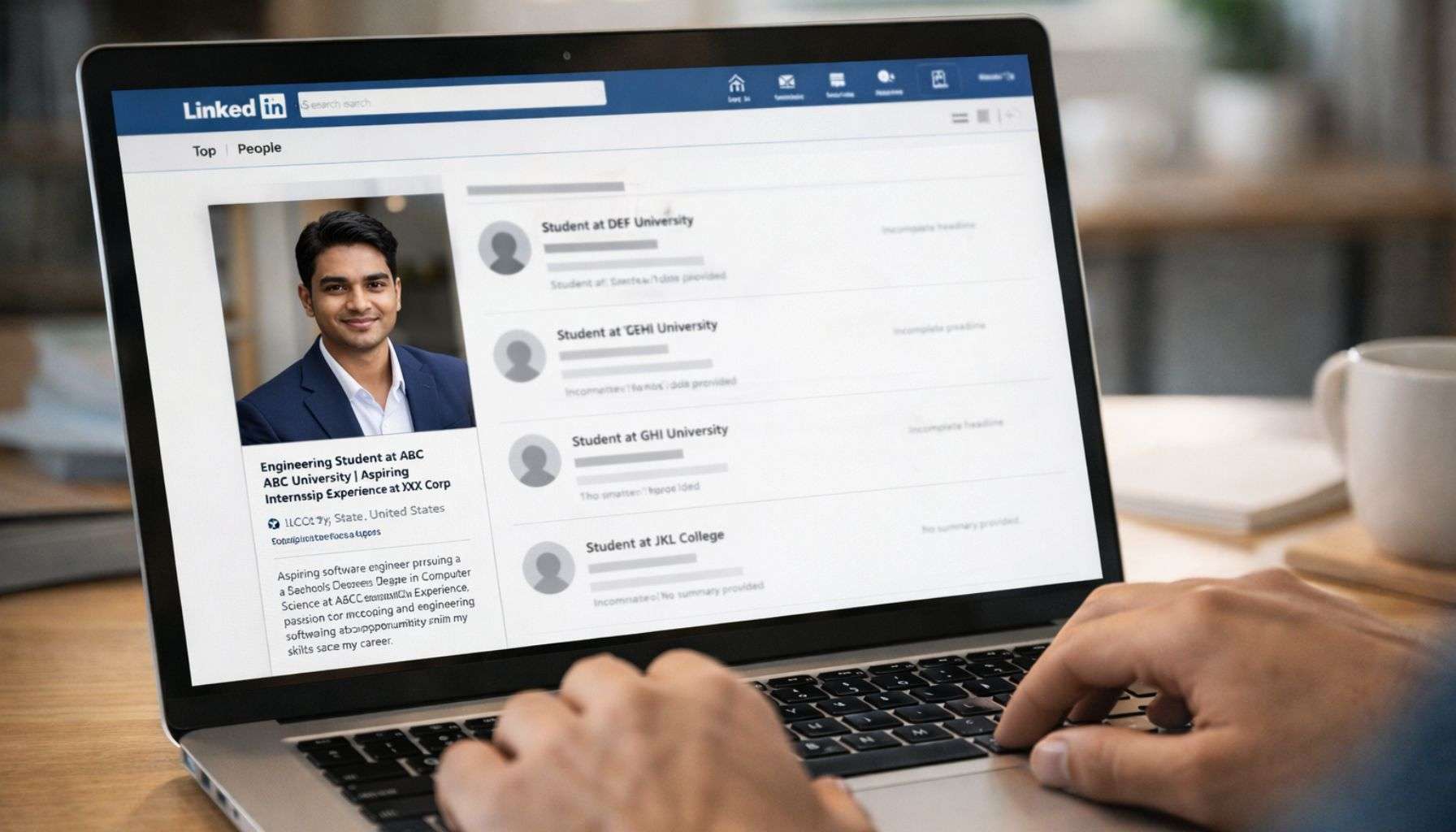
LinkedIn profile tips students India 2026 — recruiters searching for candidates on LinkedIn
Before we talk about what to do let me tell you what most Indian student LinkedIn profiles look like right now — because understanding the problem is the fastest path to fixing it.
Most Indian student LinkedIn profiles have five things in common. A missing or inappropriate profile photo. A headline that just says “Student at XYZ College.” An empty About section. An education section with nothing else below it. And a connection count below fifty.
That profile is not just weak. It is invisible. LinkedIn’s search algorithm — which determines who appears when a recruiter searches for candidates with specific skills and backgrounds — actively deprioritises incomplete profiles. A profile with no photo, no headline keywords, no skills listed, and minimal connections will simply not appear in most recruiter searches regardless of how qualified the student actually is.
The students whose profiles appear in recruiter searches are the ones who have taken the time to fill every section completely, use the right keywords in the right places, and build enough connections to signal to LinkedIn’s algorithm that they are an active, engaged professional — not a dormant account created for a college assignment.
Every section of your LinkedIn profile has a specific job to do. Let me walk you through each one.
Section 1 — Your Profile Photo — The First Thing Every Recruiter Sees
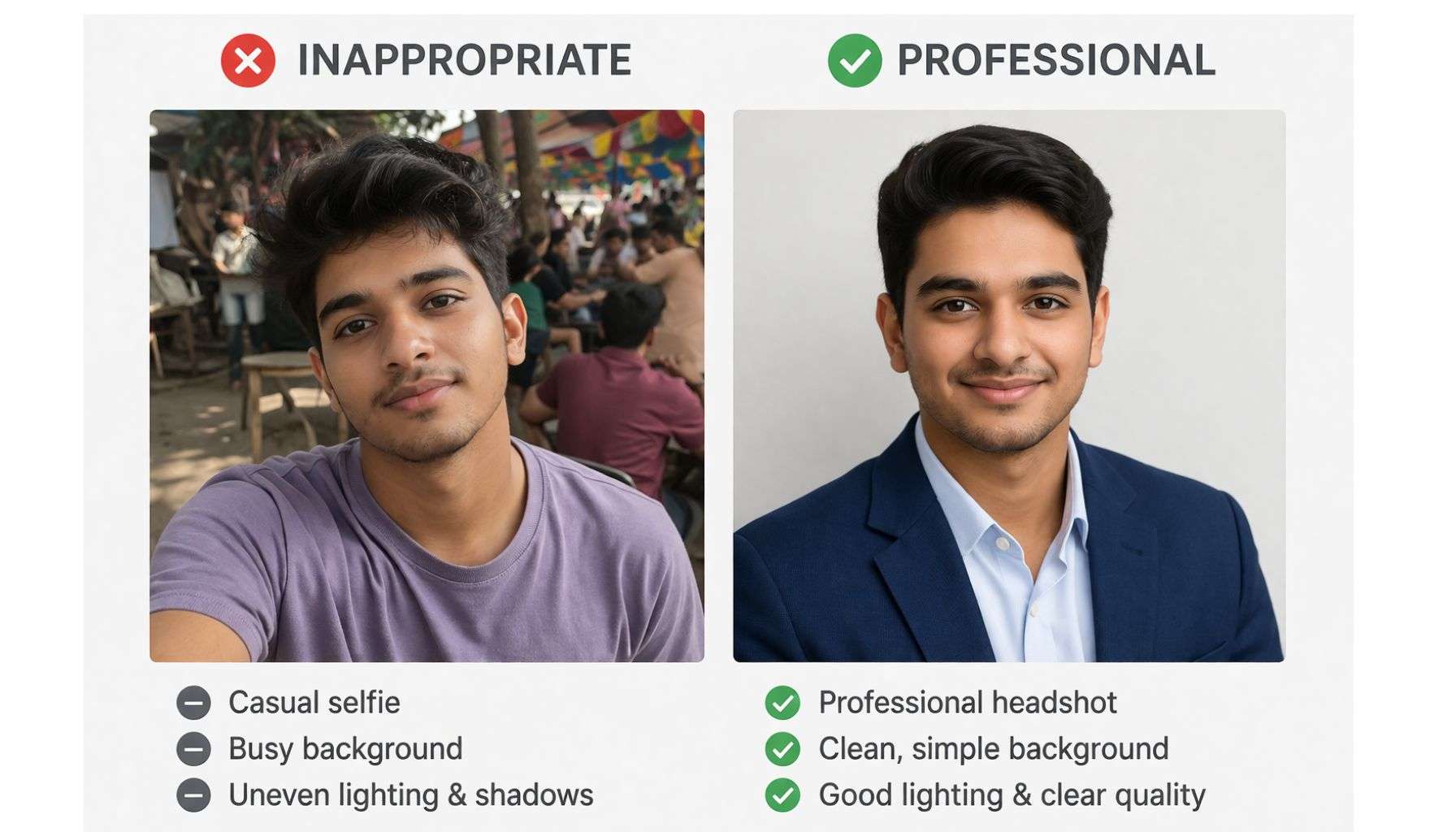
LinkedIn profile photo tips for students India 2026 — professional vs unprofessional photo comparison
Your profile photo is not a formality. It is the first data point every recruiter processes when they land on your profile. And it forms an impression in less than a second — before they have read a single word of your headline or your summary.
Profiles with professional photos receive significantly more profile views than those without. That is not a LinkedIn marketing claim. That is a consistent pattern I have observed across hundreds of student profiles I have reviewed and helped improve over the years.
Here is what a strong LinkedIn profile photo looks like for an Indian student in 2026.
A clear, well-lit headshot where your face occupies at least sixty percent of the frame. Smart professional or smart casual attire — not a wedding outfit, not a festival photo, not a gym selfie. A plain or simple background — a light wall works perfectly. A natural, genuine smile rather than a forced one or a completely expressionless face. Good lighting — natural window light or a simple ring light if you have one.
Here is what it should not look like. A group photo where the recruiter has to guess which person you are. A photo taken at a party or a social event. A photo with filters applied. A photo so small or dark that your face is unclear. A photo of you in sunglasses.
You do not need a professional photographer. You need a decent phone camera, a clean background, good natural light, and someone to take the photo for you rather than a selfie. That is genuinely all it takes.
Section 2 — Your Headline — The Most Important Line on Your Entire Profile
Most Indian students use their LinkedIn headline to state one thing — “Student at XYZ College” or “B.Tech CSE Final Year.” That headline does nothing. It tells a recruiter what you are. It does not tell them what you can do, what you are looking for, or why they should click to read more.
Your LinkedIn headline is the second most important text on your profile after your name. It appears in search results. It appears when you comment on posts. It appears when you send connection requests. It is working for you — or against you — every single time your name appears anywhere on LinkedIn.
Here is the formula that works for Indian student LinkedIn headlines in 2026.
Your current status + Your strongest skills + What you are seeking
Here is what that looks like in practice.
Instead of — “Student at ABC College Bhubaneswar”
Write — “Final Year B.Tech CSE Student | Python | SQL | Data Analysis | Seeking Data Analyst Roles 2026”
Instead of — “MBA Student”
Write — “MBA Marketing Student | Digital Marketing | Content Strategy | SEO | Open to Summer Internships”
Instead of — “Engineering Graduate”
Write — “B.Tech Computer Science Graduate | Java | Spring Boot | Looking for Software Developer Roles | TCS NQT Cleared”
See what those headlines do. They immediately tell a recruiter your qualification level, your specific skills, and what you are looking for. They also contain keywords — Python, SQL, Data Analysis, Java, Spring Boot — that LinkedIn’s search algorithm uses to surface your profile when recruiters search for candidates with those skills.
Your headline has 220 characters. Use every single one of them purposefully.
Section 3 — Your About Section — Where Your Story Lives
The About section — also called the Summary — is the most neglected and most important section of an Indian student’s LinkedIn profile. Most students either leave it completely blank or fill it with three generic sentences that tell a recruiter nothing memorable.
This is a significant missed opportunity. The About section is the one place on your LinkedIn profile where the algorithm steps back and lets your voice come through. It is where a recruiter who has been intrigued by your headline goes to understand who you are beyond a list of skills and qualifications.
Here is the structure that works for an Indian student or fresher in 2026.
Opening line — one specific, confident statement about who you are and what you do. Not “I am a passionate and hardworking student.” Not “I am seeking opportunities to grow.” Something specific. “I am a final year Computer Science student from Bhubaneswar who builds data projects in Python and has been working with SQL databases for the past eighteen months.”
Second paragraph — what you have actually built or done. Your strongest project. Your most relevant internship. A competition you won or a certification you completed. Something concrete that gives the recruiter evidence rather than claims.
Third paragraph — what you are looking for and what you bring. “I am currently looking for data analyst or junior data scientist roles in India where I can contribute to real analytics problems from day one. I bring strong SQL query writing, Python data cleaning and visualisation skills, and the ability to explain technical findings clearly to non-technical stakeholders.”
Closing line — how to reach you. “Feel free to connect or message me directly — I respond to every genuine outreach.”
That four-part structure — who you are, what you have done, what you are looking for, how to reach you — gives a recruiter everything they need to decide whether you are worth a conversation. Keep it between 200 and 400 words. Use short paragraphs with line breaks so it is easy to read on a phone screen where most LinkedIn browsing in India happens.
One thing to avoid in your About section. Do not use the third person. Do not write “Aslam is a passionate student who…” Write in first person. It sounds more human and less like a press release.
Section 4 — Your Experience Section — How to Show Work When You Have None
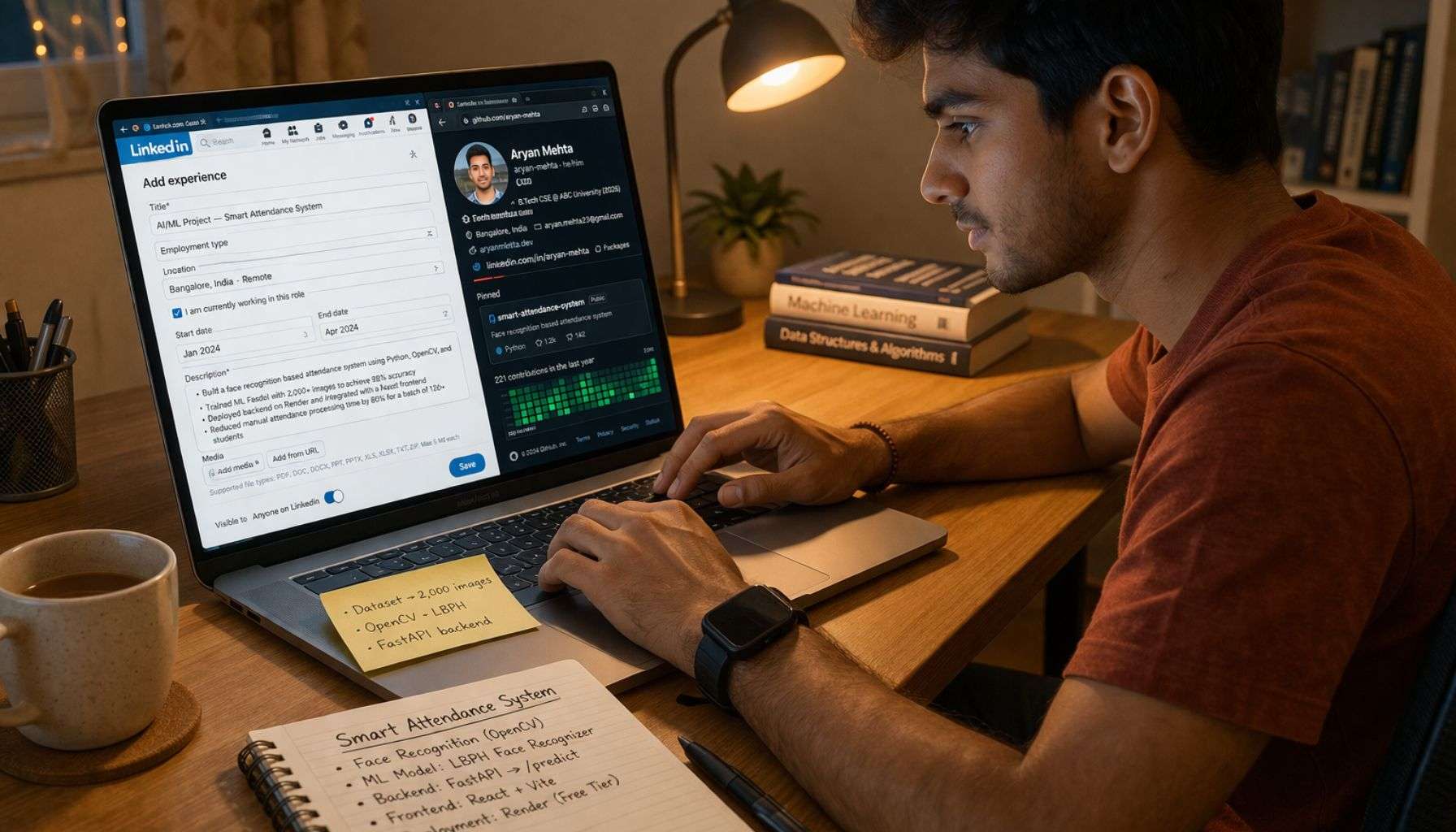
LinkedIn experience section tips for freshers India 2026 — student adding projects to profile
This is where most Indian freshers feel stuck. The experience section seems designed for people who have had jobs. You have not had a job. So you leave it empty. And an empty experience section sends a clear signal to LinkedIn’s algorithm — this person has nothing to show.
Here is what I tell every student I work with. The experience section is not reserved for paid employment. It is for any role where you contributed to something real. And you almost certainly have more to put here than you think.
Internships — even unpaid ones. If you did any internship — even a short one at a local company, even unpaid — it belongs in your experience section. List the company, your role title, the duration, and two to three bullet points describing what you actually did. Be specific. “Developed a sales reporting dashboard using Power BI that was used by the marketing team for weekly performance reviews” is a genuine experience entry. “Did internship at company” is not.
Academic projects — listed as project experience. Your final year project, your third semester project, any significant academic project belongs here. Create an entry with a descriptive title — not just “Final Year Project” but “Student Attendance Management System — Python and MySQL” — and describe what you built, what technologies you used, and what the result was.
Freelance or volunteer work. Designed a poster for a local business. Managed social media for a college event. Built a simple website for a relative’s shop. These belong in your experience section. Frame them professionally. “Social Media Manager — ABC Cultural Committee, June 2024 to March 2025. Grew Instagram following from 400 to 2,800 through consistent content strategy and weekly posting schedule.”
College clubs and positions of responsibility. Were you the events head of your college tech fest. The editor of your college newsletter. The coordinator of your NSS unit. These are experience entries — not just extracurricular checkboxes. They show leadership, initiative, and the ability to manage real responsibilities beyond academic work.
The goal is to ensure that when a recruiter scrolls through your experience section they see a pattern of real contribution — not a blank page that says “this person has done nothing except attend class.”
Section 5 — Your Skills Section — The Keywords That Make You Findable
LinkedIn’s search algorithm uses your skills section as one of its primary filters when recruiters search for candidates. If “SQL” is not in your skills section and a recruiter searches for “SQL data analyst fresher India” — your profile may not appear in their results even if SQL is mentioned in your About section or your project descriptions.
This makes your skills section one of the most technically important parts of your profile for visibility — even though it takes the least time to fill out.
Here is what to do. List every relevant technical skill you genuinely have. Python. SQL. Power BI. Excel. Java. HTML. CSS. Figma. AutoCAD. Tally. Whatever is true for your domain. Then list your tools — VS Code, MySQL Workbench, Jupyter Notebook, Canva, Google Analytics. Then list relevant soft skills — Data Analysis, Team Leadership, Technical Writing, Public Speaking — but keep this section focused on skills rather than personality traits.
LinkedIn allows up to fifty skills. Use as many as are genuinely relevant and honest. The more relevant skills you list the more searches your profile can appear in.
Get your skills endorsed. Ask batchmates, professors, and anyone who has seen your work to endorse specific skills on your profile. Endorsements are a social proof signal that makes your claimed skills more credible to both recruiters and to LinkedIn’s algorithm.
Section 6 — Your Education Section — More Than Just Your Degree
Most Indian students fill the education section with one entry — their college name, their degree, and their graduation year. That is the minimum. Here is what makes it stronger.
Add relevant coursework. If you studied data structures, database management, machine learning, or any other course relevant to your target role — list it. Recruiters who are specifically looking for candidates with certain academic backgrounds can search for these.
Add achievements. If you topped your class in a relevant subject, received a scholarship, won an academic award, or represented your college in a competition — add it to your education entry. These details take thirty seconds to add and make your education section noticeably more substantial than the average.
Add your CGPA if it is above 7.0. Below that, leave it out of the education section and let your skills and projects carry the weight.
Section 7 — Certifications — Your Credibility Signals
Every certification you have completed from a credible platform belongs on your LinkedIn profile. Google certifications. Microsoft certifications. NPTEL courses. Coursera specialisations. IBM certificates.
Add each one with the issuing organisation, the date, and the credential ID or verification link if available. LinkedIn has a dedicated certifications section that displays these cleanly and allows viewers to verify them with one click.
That verifiability is important. A certification with a linked verification page tells a recruiter this is real — not a certificate the student created themselves. In an environment where credential inflation is a genuine problem in India’s fresher job market, verifiable certifications stand out significantly.
🔗 Related Read: Best Free Online Courses for IT Students in India 2026
Section 8 — Your Featured Section — Your Portfolio in Plain Sight
The Featured section sits near the top of your LinkedIn profile — just below your About section — and is one of the most powerful and most underused sections available to Indian students.
Here is what to put there.
Your GitHub profile link. Any recruiter in a technical role who sees a GitHub link in your Featured section will click it. A GitHub profile with real projects and commit history is one of the strongest portfolio signals available to a fresher.
A screenshot or PDF of your best project dashboard. If you built a Power BI dashboard or a data visualisation project — screenshot it, save it as a PDF, and upload it to Featured. Recruiters can see it without leaving your profile.
A link to your best blog post or technical article if you have written one. Demonstrating that you can communicate technical ideas in writing is a significant differentiator.
A link to any published work — a college research paper, a contribution to a GitHub repository, a Kaggle notebook you are proud of.
The Featured section is prime LinkedIn real estate. Use it to show — not just tell — what you can do.
Section 9 — Building Your Connection Network — The Number That Signals Credibility
LinkedIn displays connection counts in three ways — under 500 connections shows the exact number, above 500 shows “500+” which is considered a credibility threshold in professional circles.
For students and freshers in India the immediate goal is to reach 200 to 300 genuine connections before you start actively applying for roles. Here is why that number matters. LinkedIn’s algorithm gives more visibility in search results to profiles with larger networks because a larger network signals that the person is genuinely active on the platform. A profile with 47 connections is treated differently by the algorithm than one with 300.
Here is how to build your network genuinely and quickly.
Connect with every batchmate from college — not just your close friends. Every professor and faculty member who knows your work. Every senior from college who is already working in your target industry. Everyone you met at college fests, hackathons, and competitions. Every person you interact with during any internship.
When you send connection requests, always add a personalised note. Not the default LinkedIn message. One sentence that reminds the person how you know them or why you want to connect. “Hi Professor Sharma — I was in your DBMS class in the third semester and found your approach to normalisation genuinely clarifying. Would love to stay connected.” That one sentence gets a yes far more often than a blank connection request.
After you have connected with people you know, start connecting with professionals in your target industry. Data analysts. Software developers. HR managers at companies you want to join. Keep the personalised note approach. Keep it genuine. Keep it short.
Section 10 — Posting and Engaging — How to Be Visible Beyond Your Profile
Your profile being complete and keyword-rich is essential. But it is not sufficient on its own. LinkedIn’s algorithm also rewards activity — posting, commenting, and engaging with content in your field.
You do not need to post every day. But posting two to three times per week on topics relevant to your career goals keeps your profile active and visible in your connections’ feeds.
Here is what Indian students can genuinely post about without feeling like they are faking expertise they do not have.
What you are learning. “Spent this week working through SQL window functions on HackerRank. Here is what surprised me about how RANK and DENSE_RANK differ in practice.” That kind of learning-in-public post is genuine, useful to others, and signals active professional development to anyone who sees it.
Project updates. “Just finished building my first Power BI dashboard from a public dataset on Indian retail sales trends. Three things I learned that I did not expect.” Then share a screenshot.
Reflections on things you have read or watched. “Read this article about how Flipkart uses ML for demand forecasting. Here is what connected with something I covered in my machine learning course.” That shows you are connecting learning to real industry applications.
Questions for your network. “Currently deciding between focusing on Power BI or Tableau for my data visualisation skills. For those working in Indian data roles — which one are you using more day to day?” Questions generate comments. Comments generate algorithm visibility. Algorithm visibility generates profile views. Profile views generate recruiter interest.
What I Tell Every Student I Work With About LinkedIn
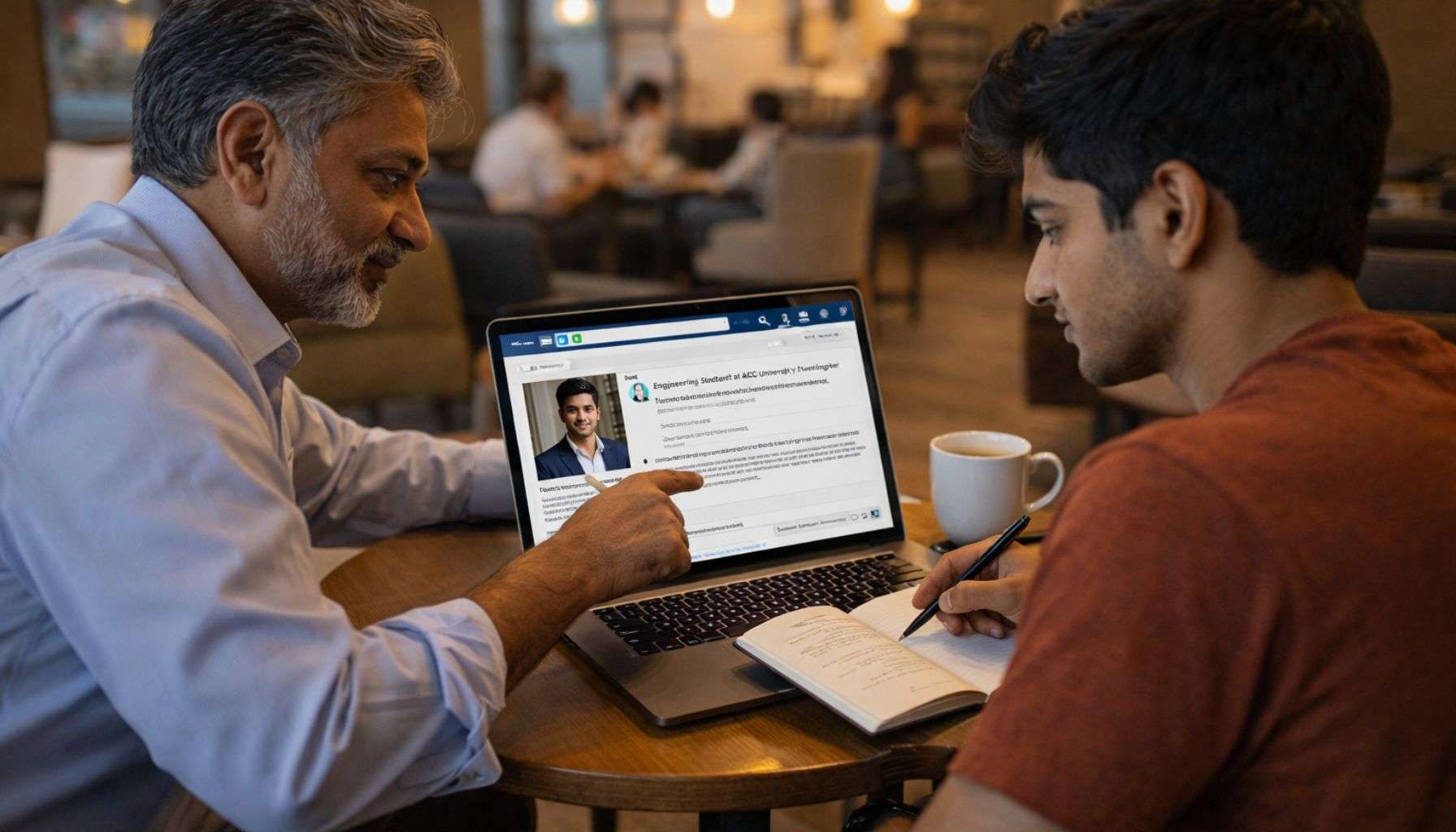
LinkedIn profile mentoring session India 2026 — career consultant reviewing student profile
After 27 years of watching LinkedIn transform from a professional novelty into the primary hiring infrastructure of India’s IT sector, I have one core observation that I share with every student I work with.
LinkedIn is not a resume hosting site. It is a professional identity platform. The students who treat it like a resume — filling it in once and forgetting about it — consistently underperform on the platform compared to those who treat it as an ongoing professional presence that they invest in regularly.
Your LinkedIn profile in 2026 is often the first impression you make on a recruiter. Not your resume. Not your cover letter. Your LinkedIn profile. Because recruiters search LinkedIn before job applications come to them. They find candidates. They evaluate profiles. They reach out to the ones that impress them.
Being on LinkedIn is no longer enough. Being findable on LinkedIn — through a complete profile, relevant keywords, consistent activity, and a genuine network — is what actually opens doors.
Start today. Complete every section. Update it every time something new happens in your academic or professional life. Post something genuine once or twice a week. Connect with people you know and people you want to know.
Your profile is working for you or against you every single hour of every day — whether you are actively using the platform or not. Make sure it is working for you.
How to improve your linkedin if you are college student.
Internal Links — Read These Next
- 📌 How to Write a Resume for Internship With No Experience in India 2026
- 📌 How to Write a Cover Letter for Internship in India 2026
- 📌 Why Your Resume Is Getting Rejected in India 2026
- 📌 Best Platforms to Find Summer Internships in India 2026
- 📌 How to Get an Off Campus Job in India 2026
- 📌 Best Free Online Courses for IT Students in India 2026
- 📌 How to Crack Campus Placements in India 2026
- 📌 Top 10 IT Companies in India Hiring Freshers in 2026
- 📌 TCS NQT 2026 — Complete Guide for Freshers
- 📌 Data Science Career Roadmap India 2026
FAQs — LinkedIn Profile Tips for Students India 2026
Q 1:- Does LinkedIn actually matter for getting a job in India in 2026 or is it only useful for experienced professionals?
This is the question I hear most often from Indian students who have created a LinkedIn account out of obligation and then largely ignored it. And my answer after watching this platform transform India’s hiring landscape over the past decade is — LinkedIn matters more for students and freshers in India right now than it does for most experienced professionals. Here is why that is true and not just encouragement.
Experienced professionals in India often get their next role through internal referrals, headhunter calls, or industry networks built over years. They have existing professional relationships that do the heavy lifting. Students and freshers have none of those things yet. LinkedIn is the platform that gives you access to professional networks, recruiter visibility, and direct company engagement that you simply cannot access any other way at this stage of your career.
The specific shift I have observed in India’s hiring market over the past three to four years is that more and more companies — particularly startups, mid-size IT firms, and product companies — are actively sourcing candidates through LinkedIn rather than waiting for applications to come through job boards.
They search. They find. They reach out. A student who is not findable on LinkedIn is invisible to this entire sourcing channel regardless of how strong their resume is on Naukri or Internshala.
I have personally seen students from tier three colleges in Bhubaneswar and Cuttack receive direct LinkedIn messages from Bengaluru startup recruiters because their profile appeared in a skills-based search.
That direct sourcing channel does not exist anywhere else for a student with no existing industry network. Treat LinkedIn seriously and it treats you seriously back.
Consultant’s note — In my counselling sessions over the past three years I have started asking every student I work with a simple question — “When did you last update your LinkedIn profile?” The answer is almost always “when I created it in first year.” That one-time creation approach leaves months and sometimes years of academic work, projects, certifications, and skills completely invisible to every recruiter who might have found them.
Update your profile every time something significant happens in your academic or professional life. That habit alone will put you ahead of ninety percent of Indian students on the platform.
Q 2:- What should an Indian student write in the LinkedIn About section when they have very little experience to talk about?
This is the question that causes the most paralysis among Indian students approaching LinkedIn seriously for the first time. The blank About section stares back at them and they genuinely do not know what to say because they have been taught — implicitly or explicitly — that only people with impressive experience have something worth writing.
That belief is wrong and it is costing students visibility at exactly the stage of their career when visibility matters most.
Here is the reframe I give every student in this situation. Your About section does not need to demonstrate years of experience. It needs to demonstrate three things — who you are, what you have built or contributed to, and what you are looking for. Every student has something genuine to say on all three counts if they think about it honestly.
“Who you are” does not require a job title. It requires specificity about your academic background and your genuine professional interest. “I am a final year B.Tech student in Computer Science from XYZ College in Bhubaneswar with a specific interest in data analytics and business intelligence” is a perfectly strong opening. It is specific. It is honest. It tells a recruiter exactly what kind of candidate they are dealing with.
“What you have built” does not require professional work experience. It requires any real project, any internship however short, any freelance work however informal, any competition entry however small. One specific project described in two sentences is worth more than three paragraphs of personality adjectives.
“What you are looking for” does not require confidence you do not feel. It just requires honesty about your career goal. “I am currently looking for data analyst internships or entry-level roles in India where I can apply my SQL and Python skills to real business problems.” Clear. Direct. Actionable for any recruiter reading it.
Consultant’s note — The About sections I have seen perform best for Indian students are the ones that sound like a human being wrote them rather than a template.
Read yours out loud after you write it. If it sounds like something a robot would say — rewrite it until it sounds like something you would actually say to a recruiter who asked you to introduce yourself in two minutes.
That test catches ninety percent of the problems with student About sections before they go live.
Q 3:- How important is it to reach 500 connections on LinkedIn and how should an Indian student build their network without it feeling fake?
The 500 connection milestone is real in the sense that LinkedIn displays “500+” rather than the exact number above that threshold — which creates a social proof signal that experienced recruiters notice. But I want to give you the nuanced version of this answer rather than just “get to 500 as fast as possible.”
The quality and relevance of your connections matters significantly alongside the quantity. A profile with 600 connections who are all college batchmates with no industry presence will get less recruiter traction than a profile with 300 connections that include 50 industry professionals, 20 alumni working in your target companies, and a handful of HR managers and recruiters in your field. The algorithm reads connection quality — not just connection count.
The way to build a genuine network without it feeling fake is to connect with context. Every connection request should have a reason — even a small one. You attended the same college. You were in the same class. You heard them speak at an event.
You read something they wrote. You both work in the same field. That context — expressed briefly in a personalised note — transforms a cold connection request into the beginning of a genuine professional relationship.
The fastest legitimate way for an Indian student to reach 300 to 400 relevant connections is a three-week focused effort. Week one — connect with every batchmate, senior, and faculty member from college. Week two — connect with alumni from your college who are working in your target industry. Week three — connect with ten to fifteen professionals per day in your target field, always with a personalised note.
Consultant’s note — The single best LinkedIn network-building advice I have ever given a student is this. After every meaningful interaction in your academic or professional life — a hackathon, a seminar, an internship, a campus placement drive, even a particularly good class — connect with the people you interacted with on LinkedIn that same day.
The recency of the interaction makes the connection feel natural and genuine. Waiting a week or a month makes it feel awkward. Connect in the moment and your network will grow organically from every real experience you have.
Q 4:- Should Indian students be posting content on LinkedIn and what should they post when they are not yet working professionals?
Yes — and the fear that you have nothing worth posting because you are not yet a working professional is one of the most limiting beliefs I see holding Indian students back on LinkedIn right now.
LinkedIn’s algorithm treats posting activity as a strong signal of platform engagement, which directly affects how often your profile appears in recruiter searches and how widely your connection requests and messages are distributed.
A student who posts genuine, relevant content two to three times per week is algorithmically more visible than one with an identical profile who never posts.
The key word is genuine. You do not need to post thought leadership articles about industry trends. You do not need to have opinions about enterprise technology strategy. You need to post things that are honest and relevant to where you actually are in your journey.
Learning updates work extremely well. “Completed week three of the Google Data Analytics certificate today. The section on data cleaning in SQL was the most practically useful thing I have studied in the past month — here is why.”
That post is genuine, specific, and signals active professional development to everyone who sees it.
Project posts work even better. A screenshot of a dashboard you built with two sentences about what you learned. A GitHub link to a project you just pushed with a brief description of the problem it solves. These posts put your work in front of your entire network — including the recruiters and industry professionals you have connected with — without you having to reach out to each one individually.
Consultant’s note — I have watched students in India go from zero recruiter visibility to multiple inbound messages within four to six weeks of starting a consistent posting habit on LinkedIn. Not because their qualifications changed. Because their visibility changed.
The platform rewards consistency over perfection. A genuine post that goes up every week is worth ten perfectly written posts that never get written because the student was waiting until they had something impressive enough to share.
Start posting. Start now. Imperfect and genuine beats perfect and absent every single time.
What to Do This Week — Your Seven-Day LinkedIn Action Plan
Rather than leaving you with a summary of what we covered, I want to leave you with something more useful. Seven specific actions. One per day. That will transform your LinkedIn profile from invisible to genuinely competitive in India’s 2026 job market.
Day one — Profile photo and headline. Get a professional photo taken today. Update your headline using the formula — current status, strongest skills, what you are seeking. These two changes alone will immediately improve how your profile appears in search results.
Day two — Write your About section. Use the four-part structure. Who you are. What you have built. What you are looking for. How to reach you. Keep it between 200 and 400 words. Read it out loud before you publish it. Fix anything that sounds like a template.
Day three — Fill your experience section. Add every internship, every significant project, every freelance work, every position of responsibility from college. Use specific, results-oriented descriptions for each entry. Include technologies used and outcomes achieved.
Day four — Skills, certifications, and education. Add every relevant skill you genuinely have. Add every credible certification with verification links. Strengthen your education entry with relevant coursework and achievements.
Day five — Set up your Featured section. Add your GitHub profile link. Add a screenshot or PDF of your best project. Add any other portfolio evidence that shows your work rather than just describing it.
Day six — Connect with fifty people you know. Batchmates, seniors, professors, family contacts in industry, anyone from any internship or project collaboration. Personalised note with every request.
Day seven — Write and publish your first post. Something genuine about what you are learning or building right now. Two to three short paragraphs. A relevant image or screenshot if you have one. Publish it. Then reply to every comment it receives within the first hour.
Seven days. Seven actions. A LinkedIn profile that works for you rather than against you — every hour of every day that a recruiter somewhere in India is searching for a candidate with your skills.
Profile updated and ready to apply? Make sure your resume tells the same strong story. Read our complete guide on How to Write a Resume for Internship With No Experience in India 2026 and make sure every part of your application is working together.





5 Comments