

Why Your Resume Is Getting Rejected in India 2026 — Honest Feedback From a 27-Year IT Career Consultant
Find out exactly why your resume is getting rejected in India 2026. Honest, experience-backed feedback from a 27-year IT career consultant who has reviewed thousands of fresher resumes.
Focus Keyword: Why your resume is getting rejected in India 2026
Why Your Resume Is Getting Rejected in India 2026 — And It Is Probably Not What You Think
Why your resume is getting rejected in India 2026 is the question I get asked more than almost any other. And every time I hear it I feel two things simultaneously. Genuine empathy — because I know how demoralising it is to send application after application and hear nothing back. And a quiet frustration — because in most cases the reasons are entirely fixable and nobody has taken the time to tell the student what they actually are.
Here is something I want you to hear clearly before we go any further. A rejected resume is almost never a rejection of you as a person or as a potential employee. It is a rejection of a document. And documents can be fixed.
In 27 years of reviewing resumes, sitting with hiring managers, and coaching students through the application process, I have seen the same mistakes appear on thousands of resumes from students across India. Different colleges. Different cities. Different streams. Same mistakes. Over and over again.
The students who fixed these mistakes got callbacks. The ones who did not kept sending the same broken resume to fifty more companies and wondering why nothing was working.
This blog is going to tell you exactly what those mistakes are. Not in vague, generic terms. Specifically. Honestly. The way I would tell a student sitting across from me in my office.
The Hard Truth About How Recruiters Actually Read Your Resume

How Indian recruiters read fresher resumes in 2026 — recruiter scanning applications
Before we talk about what is wrong with your resume, you need to understand the context in which it is being read. Because that context changes everything.
A recruiter at a mid-size IT company in India might receive two hundred to five hundred applications for a single fresher role. They do not have two hours to read them. They have one afternoon. That means each resume gets approximately six to ten seconds of attention before the recruiter decides to read further or move on.
Six to ten seconds. That is not a lot. And in those seconds the recruiter is not reading your resume. They are scanning it. They are looking for specific signals that tell them whether this person is worth a closer look.
What signals are they looking for? Relevant skills. A clear structure. Evidence of real work. Something that connects this person to the role they are trying to fill.
What signals make them move on immediately? Clutter. Generic phrases they have read a hundred times today. Missing information. Poor formatting. A resume that looks exactly like every other one in the pile.
Keep that six to ten second reality in mind as I walk you through every mistake that is costing you those precious seconds.
Mistake 1 — Your Resume Objective Says Absolutely Nothing
This is the first thing a recruiter reads after your name. And for the vast majority of Indian fresher resumes it is the biggest wasted opportunity on the entire page.
Here is what a typical Indian fresher resume objective looks like in 2026.
“Seeking a challenging position in a reputed organisation where I can utilise my skills and knowledge to contribute to organisational growth while enhancing my personal and professional development.”
I have read some version of that sentence on thousands of resumes. It says nothing. It could apply to any person applying for any job at any company in any industry anywhere in the world. A recruiter reads it and learns exactly nothing about you.
Here is what a strong objective looks like.
“Final year B.Tech student in Computer Science at XYZ College, Bhubaneswar, with hands-on experience in Python and MySQL through two academic projects. Looking for a software development internship or entry-level role where I can contribute to backend development and continue building on my data engineering skills.”
See the difference. The second one tells me your qualification, your college, your specific skills, what you have built, and what you are looking for. I know exactly who this person is in two sentences. That is what an objective should do.
The fix: Rewrite your objective completely. Be specific about your stream, your strongest skills, your best project, and the type of role you are targeting. Make it so specific that it could only have been written by you — not copied from a template.
Mistake 2 — You Listed Skills You Cannot Actually Demonstrate
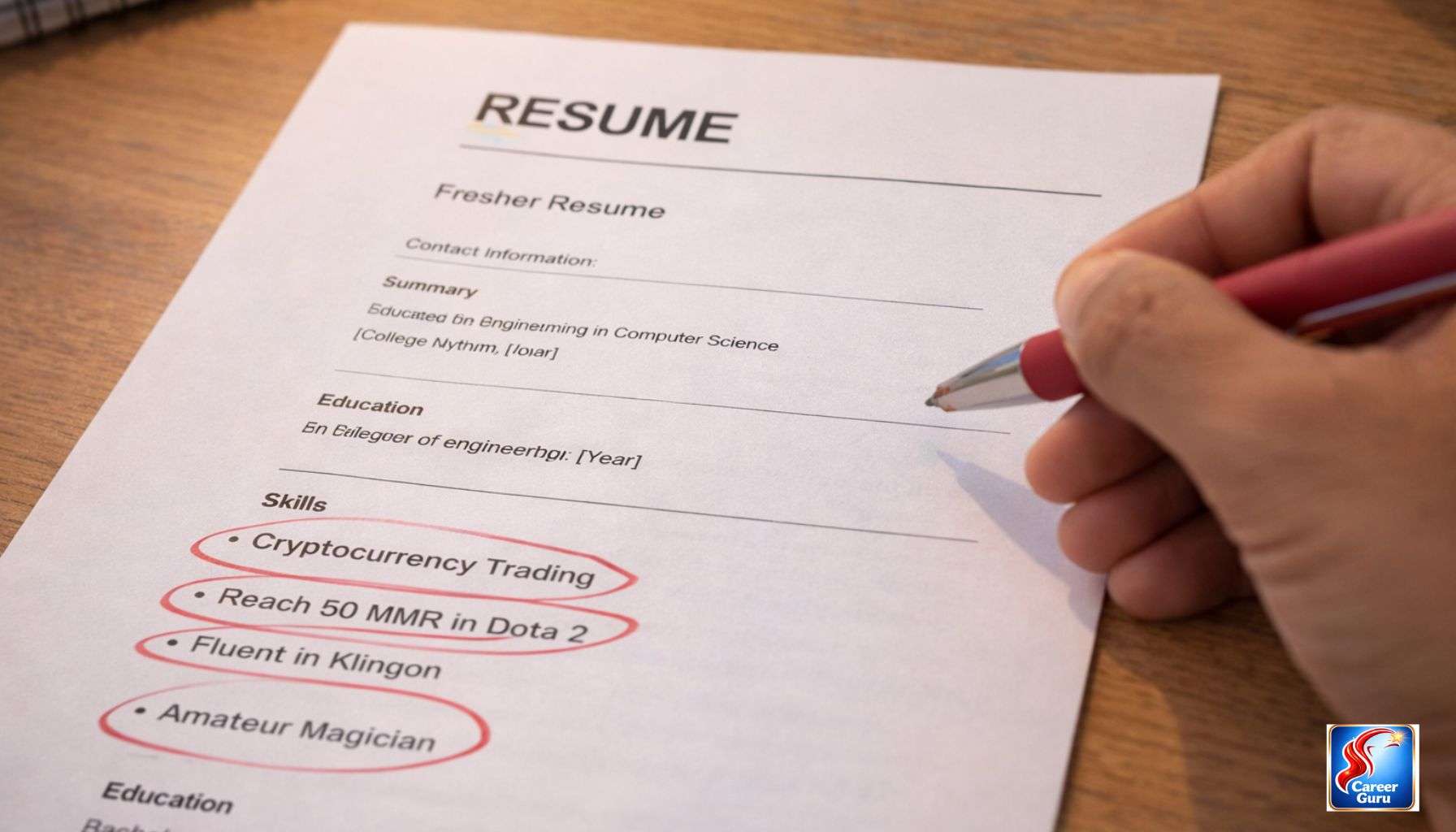
Resume skills mistakes Indian freshers make in 2026 — skills section marked with corrections
This one comes up in almost every resume I review. Students list skills that are either completely outdated, embarrassingly basic, or frankly not true.
I have seen resumes in 2026 that list MS Word and internet browsing as technical skills. I have seen resumes that list machine learning as a skill from a student who watched three YouTube videos on the topic. I have seen resumes that list communication skills, leadership, and teamwork under technical skills — which tells me the student does not understand the difference between technical and soft skills.
Every single skill on your resume is an invitation for an interviewer to ask you about it. If you cannot speak to a skill confidently in an interview — it should not be on your resume. Full stop.
This works in both directions. Do not overstate. Do not understate. List the skills you genuinely have and be specific about your level.
Instead of just writing Python — write Python with experience in data analysis and basic web development using Flask. Instead of just writing SQL — write MySQL with experience building and querying relational databases for academic projects. That specificity tells a much more credible story than a generic list of language names.
The fix: Go through your skills section right now. Remove anything you cannot speak to confidently in a five-minute interview conversation. Add specific context to the skills that remain. Be honest about your level. Honesty in a skills section is always more impressive than exaggeration that falls apart the moment someone asks a follow-up question.
Mistake 3 — Your Project Descriptions Are Vague and Unconvincing
If you have no work experience — and most freshers applying for their first job do not — your projects section is the most important part of your entire resume. It is where a recruiter looks to understand whether you can actually do something beyond passing exams.
And yet most project descriptions I see on Indian fresher resumes look like this.
“Developed a student management system using Java.”
That is one sentence. It tells me what you built and what language you used. That is it. It tells me nothing about the scale, the complexity, the challenges, or what you actually learned from building it.
Here is what a strong project description looks like.
“Built a student attendance management system using Java, JSP, and MySQL that managed records for 300 students across 8 departments. Designed the database schema from scratch, handled concurrent user sessions, and implemented role-based access for students, faculty, and administrators. The project was presented at the college technical fest and selected among the top 5 projects in the department.”
Same project. Completely different impact. The second description tells me the scale, the technologies, the specific problem you solved, and a real-world validation of the work. A recruiter reading that has a clear picture of what you are capable of.
The fix: For every project on your resume answer these four questions and write the answers in two to three sentences. What problem did it solve. What technologies did you use and why. What was the most challenging part. What was the outcome or result. Those four answers transform a vague project description into a convincing demonstration of real skill.
Mistake 4 — Your Resume Is More Than One Page
I know you have been told that a longer resume shows more experience. That is true — for someone with fifteen years of experience. For a fresher it is completely wrong.
A two-page resume from a student with no work experience tells a recruiter one of two things. Either this person does not know how to prioritise information. Or they are padding their resume with content that does not need to be there.
Both of those impressions are bad. Neither is the impression you want to create in the first six to ten seconds of a recruiter’s attention.
Everything relevant about a fresher — education, skills, projects, certifications, extracurriculars — should fit comfortably on one well-designed page. If yours is going beyond one page go through it section by section and ask yourself about every single line — does this add genuine value or am I including it because it fills space.
Cut everything that fills space. Keep everything that adds value.
The fix: Open your resume right now. If it is more than one page identify what is causing the overflow. Remove outdated information — school-level achievements from five or six years ago rarely need to be on a final year college student’s resume. Tighten your descriptions. Reduce font size slightly if needed — but never below 10pt. One clean page is always stronger than two padded ones.
Mistake 5 — The Formatting Makes It Hard to Read Quickly

Good vs bad resume formatting for Indian freshers 2026 — clean resume vs cluttered resume
Remember the six to ten second rule. In those seconds a recruiter is scanning not reading. If your resume is visually difficult to scan — too many fonts, inconsistent spacing, walls of text with no clear sections, colours that distract rather than clarify — it gets moved past regardless of how strong the content is.
Here is what bad formatting looks like on Indian fresher resumes.
Three different font sizes used randomly throughout. Section headings that look the same as body text. Dense paragraphs where bullet points would communicate more clearly. Borders, shading, and design elements that look impressive in Canva but distort badly when printed or opened in a different Word version. A photo placed awkwardly in the corner eating into the space where useful content should be.
Here is what good formatting looks like.
One font throughout — Calibri, Arial, or Georgia work well. Section headings that are clearly bold and slightly larger than body text. Consistent spacing between sections. Bullet points for project descriptions and work experience. Generous but not excessive margins. Saved as a PDF so it looks identical on every device.
The fix: Open your resume in a new window and look at it the way a recruiter would — spend ten seconds scanning it without reading it. Ask yourself whether the structure is immediately obvious. Whether the most important information is easy to find. Whether anything is visually distracting. Then fix what catches your attention negatively.
Mistake 6 — You Are Sending the Same Resume to Every Company
This is one of the most common and most costly mistakes in the entire application process. And it is one that most students do not even realise they are making.
Every company you apply to has a slightly different need. A startup hiring a Python developer cares about different things than a large IT service company hiring a systems engineer. A data analytics role requires different skills to be prominent than a software testing role.
When you send the same generic resume to both — neither recruiter feels like you specifically want to work with them. And recruiters notice that. A resume that feels tailored to their role stands out immediately against a pile of identical generic ones.
You do not need to rewrite your entire resume for every application. That is not realistic. But you should adjust three things for each application.
Your objective — make it specific to the role and company you are applying to. Your skills section — bring the most relevant skills to the top. Your project descriptions — lead with the project most relevant to what the company does.
Those three adjustments take ten to fifteen minutes. And the difference they make in response rates is significant.
The fix: Create a master resume with all your information. Then for each application spend fifteen minutes creating a tailored version that adjusts the objective, skills ordering, and project emphasis to match what that specific company is looking for.
Mistake 7 — No Quantification Anywhere on the Resume
Numbers make things real. They make claims believable. And they help a recruiter visualise the scale of your work in a way that words alone cannot.
Compare these two descriptions.
“Managed the college social media page and grew the follower count.”
versus
“Managed the college cultural committee’s Instagram page and grew followers from 600 to 3,200 in seven months through a combination of reels, carousel posts, and a consistent weekly posting schedule.”
The second one is the same achievement described with numbers. But it is dramatically more convincing. The recruiter can now picture the scale of the work. They can evaluate whether the growth is impressive. They have something concrete to ask about in an interview.
Go through every line of your resume. Every project. Every achievement. Every extracurricular contribution. Ask yourself — is there a number here I am not mentioning. How many users. How many records. What percentage improvement. What ranking. What time period.
The fix: Add at least one number to every project description and every significant achievement on your resume. If you genuinely cannot quantify something — describe the outcome specifically rather than vaguely. Specific always beats vague.
Mistake 8 — Your Contact Information Has Errors or Looks Unprofessional
Resume contact information mistakes Indian freshers 2026 — checking details carefully
This one sounds too basic to mention. And yet I see it on resumes regularly.
Wrong phone numbers. Inactive email addresses. Email addresses that read like gaming usernames from Class 9. LinkedIn profile links that lead to incomplete profiles with no photo. Missing city information that leaves the recruiter unsure whether you are even in the same region as the role.
Your contact information is the section that tells a recruiter how to reach you. If it is wrong — nothing else on your resume matters because they cannot follow up even if they want to.
Here is what professional contact information looks like.
Your full name in a slightly larger font at the top. A phone number that is active and that you will answer. A professional email address — firstname.lastname at gmail or similar. Your city and state. Your LinkedIn profile URL — shortened and pointing to a complete, updated profile.
The fix: Right now — open your resume and check every contact detail. Call the number listed. Send a test email to the address. Click the LinkedIn link. Verify that every single detail is current, active, and professional. This takes five minutes and eliminates one of the most avoidable rejection reasons on this entire list.
Mistake 9 — You Have Not Proofread It Even Once
A spelling mistake in a resume tells a recruiter something specific about you. It tells them that you did not care enough about this application to read your own document before sending it.
That impression — formed in the first ten seconds — is very difficult to undo.
I have seen resumes with the applicant’s own name spelled incorrectly. I have seen “Batchelor of Technology” where “Bachelor” should be. I have seen company names misspelled in cover letters sent to those same companies. These errors are not just embarrassing. They are disqualifying at companies that specifically test written communication as part of their selection process.
The fix: Read your resume out loud from beginning to end. Reading out loud forces your brain to process every word individually rather than skipping over familiar text. Then ask someone else — a friend, a family member, anyone — to read it fresh. A second pair of eyes catches things you have become blind to through familiarity. Then read it one more time. Three reads minimum before your resume goes anywhere.
Mistake 10 — Your Resume Has No Proof of Initiative
This is the subtlest mistake on this list. But it is one that separates good resumes from genuinely impressive ones.
A resume that lists only what you were required to do — college courses, mandatory projects, compulsory exams — tells a recruiter that you do exactly what is expected of you and nothing more. That is not a bad thing exactly. But it is not a differentiating thing either.
A resume that shows things you did beyond what was required — a certification you completed on your own time, a project you built because you were curious about something, a competition you entered, a college club you contributed to — tells a recruiter that you are someone who takes initiative. That you learn independently. That you are driven by genuine interest rather than just fulfilling requirements.
In a pile of two hundred resumes where most candidates have done only what their college required of them, that evidence of initiative stands out immediately.
The fix: Look at your resume and ask yourself honestly — is there anything here that I did because I genuinely wanted to, not because I had to? If not — build something. Complete one free certification. Enter one competition. Start one small project. Then add it. The time investment is small. The resume impact is significant.
🔗 Related Read: Best Free Online Courses for IT Students in India 2026 🔗 Related Read: How to Write a Resume for an Internship With No Experience in India 2026
The Resume Checklist — Go Through This Before Every Application
Before you send your resume anywhere, run through this list. Every single time.
✅ Is your objective specific to this role and company — not generic
✅ Does every skill listed represent something you can speak to confidently in an interview
✅ Does every project description answer what, how, and what result
✅ Is the resume one page and one page only
✅ Is the formatting clean, consistent, and easy to scan in ten seconds
✅ Have you tailored the resume slightly for this specific application
✅ Does at least one number appear in every project or achievement description
✅ Is all contact information current, active, and professional
✅ Have you proofread it at least three times including once out loud
✅ Is there at least one thing on the resume that shows initiative beyond what was required
Ten questions. If all ten are yes — send it. If any are no — fix it first.
Internal Links — Read These Next
- 📌 How to Write a Resume for Internship With No Experience in India 2026
- 📌 How to Write a Cover Letter for Internship in India 2026
- 📌 How to Prepare for an Internship Interview in India 2026
- 📌 How to Prepare for TCS Infosys Wipro Interview in 2026
- 📌 Best Free Online Courses for IT Students in India 2026
- 📌 Best Platforms to Find Summer Internships in India 2026
- 📌 Top 10 IT Companies in India Hiring Freshers in 2026
- 📌 How to Crack Campus Placements in India 2026
- 📌 Fresher Salary in India 2026
- 📌 Python vs Java vs C++ for Indian Students 2026
FAQs — Why Your Resume Is Getting Rejected in India 2026
1. How do I know if my resume is actually the reason I am not getting callbacks?
If you have applied to ten or more relevant positions and received fewer than two or three responses, your resume is almost certainly contributing to the problem. The most reliable way to check is to have someone with genuine hiring experience review it — not just a friend or family member who may be too encouraging. If that is not accessible, run your resume through the checklist in this blog honestly and fix every item that does not pass. A significant improvement in callback rate usually follows within two to three weeks of applying with a corrected resume.
2. Should I use a resume template from Canva or similar platforms?
Canva templates can look visually impressive but they come with significant risks for job applications in India. Many templates use text boxes and design elements that do not parse correctly when companies use Applicant Tracking Systems — the software that screens resumes before a human ever sees them. A clean, simple Word or Google Docs resume saved as a PDF is almost always safer and more effective than a design-heavy Canva template. If you use Canva, choose the simplest, most minimal template available and avoid anything with columns, graphics, or icons replacing text.
3. Is it true that companies use software to screen resumes before a human reads them?
Yes — and this is increasingly common in India, especially at large IT companies and companies that receive high application volumes. Applicant Tracking Systems scan resumes for specific keywords, formatting elements, and information structure before passing them to a human recruiter. This means a resume that looks beautiful but uses complex formatting, text boxes, or images for key information may be invisible to the ATS even if it looks impressive to human eyes. Keep your formatting simple, use standard section headings, and make sure your key information is in plain text.
4. How often should I update my resume?
Update your resume every time something significant changes — you complete a new certification, build a new project, gain new experience, or develop a new skill worth mentioning. Do not wait until you are actively job hunting to update it. Students who maintain their resume as a living document rather than something they dust off every few months always have a stronger, more accurate resume when they need it. At minimum review and update your resume every three months during your final year.
5. My CGPA is low. Should I leave it off my resume entirely?
If your CGPA is below 6.0 or your percentage is below 60 — and the role you are applying for has a minimum CGPA requirement above that — there is little point in including it as it will trigger an automatic filter. If your CGPA is low but above the minimum requirement, include it but let your projects, certifications, and skills do the heavy lifting. The key is to make sure that the rest of your resume is strong enough that your CGPA becomes a minor detail rather than the headline. A resume full of genuine skills, real projects, and evidence of initiative can absolutely overcome a modest CGPA in the eyes of a recruiter who reads past the first filter.
Key Takeaways
- Your resume gets six to ten seconds of initial attention from a recruiter — everything on it must be scannable, specific, and immediately relevant to make those seconds count.
- A generic objective statement is the single most wasted opportunity on most Indian fresher resumes — rewrite it to be specific to your skills, your projects, and the role you are targeting.
- Every skill on your resume is an invitation to be asked about it in an interview — if you cannot speak to it confidently, remove it immediately.
- Project descriptions are your most powerful section when you have no work experience — describe what you built, what technologies you used, what the challenge was, and what the result was.
- One clean well-formatted page is always stronger than two pages of padded content — cut everything that fills space rather than adding genuine value.
- Tailoring your resume for each application — even slightly — dramatically improves your callback rate compared to sending the same document to every company.
- Numbers make achievements real and believable — add at least one quantified detail to every project and significant accomplishment on your resume.
- Three proofreads minimum before your resume goes anywhere — read it out loud at least once and have a second person check it too.
Resume fixed but not sure where to send it? Read our complete guide on Best Platforms to Find Summer Internships in India 2026 and make sure your improved resume is reaching the right people.





6 Comments